Journal of Criminal Law and Criminology
Volume 31
Issue 2
July-August
Article 8
Summer 1940
Current Notes
Follow this and additional works at:
https://scholarlycommons.law.northwestern.edu/jclc
Part of the
Criminal Law Commons,
Criminology Commons, and the
Criminology and Criminal
Justice Commons
This Note is brought to you for free and open access by Northwestern University School of Law Scholarly Commons. It has been accepted for inclusion in Journal of Criminal Law and Criminology by an authorized editor of Northwestern University School of Law Scholarly Commons.
Recommended Citation
CURRENT NOTES
Newman F. Baker [Ed.]
Northwestern University Law School Chicago, Illinois
Traffic Committee Meets-On June 17 and 18 the National Committee on Traffic Law Enforcement met at Northwestern University Law School upon the call of the Committee Chairman, Arthur T. Van-derbilt The Committee was divided into
two groups to consider the preliminary re-ports of the Secretaries of the Subcommit-tee on Courts and the SubcommitSubcommit-tee on Police, George Warren, Esq., and A. R. Forster, Director of Training, Northwest-ern University Traffic Institute. These re-ports were prepared after a year and a half of field study and the use of extensive ques-tionnaires and were truly "National" in scope. Two days were spent in considering the recommendations of each secretary, item by item. Many of them were debated by judges, lawyers, traffic engineers, safety officials and others. All were carefully considered and, although much of each re-port was adopted as prepared, many changes were recommended. These changes are being made by the Secretaries and will be completed and printed by August 1. The future plans for the Traffic Court study include a presentation to a joint meeting at the American Bar Asso-ciation convention in Philadelphia on Sep-tember 10th, of the Criminal Law Section, the Section on Judicial Administration, and the National Conference of Judicial Councils.
Sheriff's School-An interesting move-ment in the education of those engaged in combatting crime was the school for sheriffs reported in the June issue of "Cor-rection."
Sheriffs and their deputies from more than forty counties went to school in Syracuse, N. Y., May 16th, 17th and 18th. It was the first training school for sheriffs held in that State and was sponsored by the New York State Sheriffs' Association in cooperation with the Bureau of Public Service Training of the State Education Department. Sessions were held in the Syracuse Law School auditorium and it was announced at the opening by Albert H. Hall, chief of the Bureau of Public Service Training, that sheriffs completing the course of instruction satisfactorily would receive Public Service Training Certificates issued by the State Education Department.
The course included fundamentals of the criminal and civil phases of the work of sheriff. The staff of instructors was made up of State and local officials, rep-resentatives of the Federal Bureau of In-vestigation, Washington, D. C., and pro-fessors of law from Syracuse University, Columbia University, Cornell University and the Albany Law School.
Special Agents John B. Hogan and Vir-gil J. Wolfe of the Federal Bureau of In-vestigation lectured on "Crime Scene Searches," "Technique and Mechanics of Arrest and Search of Person," "Detection of Deception," "Taking Statements, Re-port Writing, Interviews," "Laboratory Aids to Investigators," and "Testifying in Court, Conduct of Police Officers."
Commissioner Carroll E. Mealey of the Bureau of Motor Vehicles, State Depart-ment of Taxation and Finance, gave the sheriffs valuable information on "Vehicle
and Traffic Laws," and John F. Tremain,
Secretary of the State Commission of
Cor-rection, discussed "Jails and the Care of
Prisoners." Lieutenant Bryan E. Ford,
Director of Training, Police Department,
Rochester, was unable to be present but
his paper was read on "The Relationship
of the Sheriff with Municipal Police."
District Attorney Donald M. Mawhinney
of Onondaga County gave instruction on
the "Preparation of a Criminal Case," and
Professor Victor Levine of Syracuse
Uni-versity Law School pointed out the
'Dis-tinction between Levies; Liability of
Sheriff; Priority and Other Rights."
Professor W. Harvey Reeves of
Colum-bia University Law School discussed
"At-tachments, Generally," and "Replevins,
Generally"; Professor Samuel M. Hesson
of Albany Law School, "Body
Execu-tions, Execution Sales and Alimony
Con-tempt"; and Professor John W.
MacDon-ald, Professor of Law, Cornell
Univer-sity, "Service of Summons and Subpoena,"
"Juries, Writs of Habeas Corpus."
The Officers of the Association are:
George A. Casey, Westchester County,
president; Edwin R. Auer, Onondaga
County, first vice-president; D. Sayre
Beam, Livingston County, second
vice-president; Lewis N. Spring, Wyoming
County, secretary; Milton V. Saulpaugh,
Columbia county, treasurer.
Louis R. Yaguda, Albany, is Counsel
and Executive Director.
The Editor of this Section is pleased to
observe this school in action. While the
sheriff usually has little to do with law
enforcement when his county contains a
large city, in rural areas he still is the
chief police officer. While the office is a
hangover from the local government
set-up of a bygone generation and needs
re-form, this is virtually impossible because
of Constitutional provisions. So, we must
have sheriffs; why not improve them?
Why not train them during their terms of
office? The New York School may furnish
the answer to the sheriffs problem. Other
States may well follow New York's
ex-ample.
Civil Rights and the Police--The Fourth Annual Report of the Washington Crim-inal Justice Association was recently
is-sued as "Crime In The Nation's Capital,
1939" and it shows an increase of 10.4 per
cent in serious offenses. An interesting
comment was made on the topic "Civil
Rights and the Police." It reads:
"As a result of criticism directed against
the police department in its use of
'in-vestigation' and 'dragnet' arrest, a study
of these practices was undertaken by the
Association during 1939.
"The task of apprehending criminals in
Washington, as in other large cities, is
complicated by the ease of transportation,
the.heterogeneity, mobility, and density of
Washington's population. The task is
es-pecially difficult in light of the increased
duties of the police with no proportionate
increase in their numbers.
"From the standpoint of legal
proced-ure, the practice of holding persons for
in-vestigation is not sound, although very
practical from a police standpoint. In
order to solve crimes, it is often necessary
to detain suspects for questioning, without
actually charging them with crime. The
police contend that the law of arrest is not
sufficiently broad to permit efficiency in
the detection and solution of crimes. The
District of Columbia Bar Association now
has under consideration legislation which
may seek to remedy this situation.
"The study made by the Association
in-dicated that the term 'investigation'
cov-ered a variety of police services. Not only
did it indicate that the person so booked
was held for questioning, but it might
indicate that a stray child was being held
for its parents, that a person picked up
on the street ill was being held for
trans-fer to a hospital, that out of town
fugi-tives were being held for other authorities,
and many other services which the police
are called upon to render.
"Undoubtedly the police are using the
charge of investigation to cover many
types of police services. An analysis of the
cases reviewed by the Association,
how-ever, would seem to indicate that the evil
lies not only in taking into custody too
many innocent people and violating their
civil rights, but also in not charging some
of them with misdemeanors, or other
proper charges.
other authorities and 2 were taken into
custody for release to parents. These
per-sons should not have been booked for
'in-vestigation'. In 10 cases juveniles were
apprehended, some on disorderly charges
and others on petty larceny charges, but
at the time of the arrest there was no
intent to charge them or turn them over
to the Juvenile Court. These cases
per-haps should have been booked 'held for
Boys Service Division,' and turned over to
that Division or not have been booked at
all. In 4 cases, disorderly conduct charges
probably should have been placed. Again
in 2 cases hospital treatment was given,
and these should not have been listed
under 'investigation'.
"Careful study of the other cases
re-vealed that the term 'for investigation' is
a misnomer, and that the practice and
procedure of the police in this regard
should be clarified.
"A succinct statement of reason for
registering or holding persons would
as-sist in decreasing the number of persons
'held for investigation', would give a better
indication of the actual service being
rendered to the community by the police,
and would allay the fears of our citizens
that police are systematically lawless in
arresting people in violation of their civil
rights."
Bill of Rights Review-A new quarterly,
"The Bill of Rights Review" has been
launched by the Bill of Rights
Commit-tee of the American Bar Association. The
summer, 1940, issue was -edited by the
Chairman and Secretary of the
Commit-tee, Grenville Clark and Joseph Harrison.
The subsequent issues will be edited by
Professor John E. Mulder of the Law
School of the University of Pennsylvania.
The plan of the publication is indicated
by the first editorial wherein the Editors
say: "One of our prime purposes,
there-fore, is to apply through this Review what
may be called the 'case system' to the
study of this great subject. We shall hope
to do this in several ways: first, through
detailed studies of particular subjects by
acknowledged authorities, such as are
rep-resented in this issue by the articles of
Professor Warner and Professor Chafee
on 'The Third Degree' and 'Censorship of
Plays and Books'; second, through 'Notes and Cases,' in which will be reviewed many of the more important current situ-ations and decisions in the field of civil liberties; and third, through the presenta-tion in our editorial columns of concrete questions on which opinions may reason-ably differ.
Youth Correction Authority Act-At the meeting of the American Law Institute, May, 1940, the Youth Correction Author-ity Act was approved by the body of the Institute. The Act was framed by the Committee on Criminal Justice- Youth with Professor John Barker Waite serving as reporter. In the June, 1940, American Bar Association Journal appears a sum-mary of the Act:
"The new state agency provided in the model act submitted by the Committee calls for an appointive board of three per-sons of special qualification to govern the correction and rehabilitation of young per-sons after conviction. The board would be known as the Youth Correction Authority, have terms of nine years, and would be responsible for the organization, adminis-tration and determination of policies for integrating the handling of young offend-ers on a state-wide basis.
"The Committee asserts that the purely punitive system of criminal justice has failed in two major objectives-the pro-tection of society and the reformation of the individual. The Committee's inquiry shows an unchecked rise in recidivism (repetition of crime) and in offenses com-mitted by the gang-age youth group under the retributive penal system. The Committee believes that substituting a system of individualized training and treatment for retributive punishment would more effectively fulfill the objectives of our criminal justice.
"The trial judge would have the usual
discretion in acquittals and assessment of
fines; but in all convictions excepting those
involving the death sentence or life
im-prisonment, the judge would commit the
youth to the Authority. The judge thus
would exercise the established judicial
function of determining guilt, rather than
emphasizing the leigth of sentence.
"Following out its philosophy that
pub-lic safety can best be protected by
seg-regation and corrective treatment, the
Committee then recommends that the
Au-thority have all control over the youth as
to his detention, imprisonment, training
and treatment. To the extent that
neces-sary funds are available, the Authority
may establish and operate a treatment and
training service, create the necessary
ad-ministrative districts and employ
person-nel needed to conduct its functions. In
any case, it would have power to make use
of law enforcement, detention, probation,
parole, medical, educational, correctional,
segregative and other facilities of public
and private institutions and agencies
within the state. The model act specifies
that this provision would give the
Author-ity no control, however, over the
facili-ties of these institutions-but that its
dealings with them should be on a
co-operative basis.
"When a person is committed to the
Authority, it would immediately
investi-gate him as an individual, psychologically,
physically and as to his social background.
It would make periodic re-examinations
of all persons within its control and keep
written records on each case.
"The Authority would have the
power-with specific limitations protecting the
constitutional rights of the individual,
such as court reviews at age 25-to keep
any youth under supervision and control
so long as 'in its judgment such control is
necessary for the protection of the public.'
It also could discharge such persons as
soon as 'in its opinion there is a
reason-able probability that they can be given
full liberty without danger to the public.'
"The individual treatment procedures
are the main objective of the plan. The
treatment and training service would seek
to integrate the handling of the young
offender and to eliminate the haphazard
and contradictory processes often found under the present system, where varying sets of officials handle the individual as he
goes through the mill."
Prison World-With its May-June% 1940, issue the Jail Association Journal be-came '"he Prison World"-a "publication devoted to the progressive administration of jails, reformatories, prisons, and other penal and correctional institutions." The Prison World is jointly sponsored by the American Prison Association and the Na-tional Jail Association as the official organ of both Associations. No exteisive changes
are contemplated in the new magazine
but added departments and features are
planned. Richard A. McGee is Editor and
Roberts J. Wright is Managing Editor.
California Police Training-The Fourth Annual California Technical Institute of Peace Officers' Training was announced for July 8-20 at University of California, at Los Angeles and July 29-August 10 at University of California at Berkeley. The cooperating agencies were San Francisco Police Department, Oakland Police De-partment, Oakland Fire DeDe-partment, Los Angeles Police Department, Los Angeles Sheriff's Department, Los Angeles District Attorney's Office, Berkeley Police Depart-ment, University of California at Berkeley, University of California at Los Angeles, Attorney General, California Highway Patrol, League of California
Municipali-ties, United States Secret Service, United
States Post Office Department, State Nar-cotic Division, American Red Cross,
Ala-meda County District Attorney's Office,
National Auto Theft Bureau, Greater Los
Angeles Safety Council, and J. C. Beswick
and George H. Brereton directed the
In-stitute. The course of instruction, set
forth below, should prove to be interesting
to persons who have been concerned with
police training:
Civil Process and Procedure, Six hour
Crime Prevention, Six hour course
out-lining problems and correct procedures in
developing a modern crime prevention
program-with special emphasis upon the problem of juvenile delinquency;
Description of Persons, Six hour course
outlining methods which should be used in identifying and describing individuals -the use of "portrait parle"; standard methods of classifying eye and hair colors, various parts of the human anatomy, marks and scars, etc.;
Description of Property, Six hour course
outlining the proper procedure which should be followed in describing lost or stolen property and methods which may be used to supervise pawnshops and sec-ond-hand stores in the control of such property;
Examination of Physical Evidence, A
course outlining the procedure and tech-nique of search for physical evidence at the scene of crime, morgue, home of sus-pect, etc.; an elementary microscopic and macroscopic examination of evidence; ele-mentary ballistics; chemical and physical examination of evidence; and the presen-tation of such evidence in court;
Firearms and Gas Equipment, A ten
hour course on the care and use of re-volvers, Thompson sub-machine gun, gas gun, gas bombs, and gas masks. The first half of the course will be devoted to class-room instruction, and the last half will be used for demonstration and practice on the range;
Fingerprint Identification and Classifi-cation, A twelve hour elementary course
on the identification and classification of fingerprints. The officer will be taught to "roll" prints properly, discover and de-velop "latent" prints at a crime scene, identify and classify the common types of fingerprint patterns, and "search" the
fingerprint files for a suspect's record;
First Aid, A twenty-two hour course in
First Aid, covering the Standard Ameri-can Red Cross Course qualifying all stu-dents, who pass the course examination, for the Standard American Red Cross Card;
Interrogation, A six hour course
cover-ing the proper methods and techniques of interrogating or questioning witnesses and/or suspects;
Investigation at Scene of Crime, A six
hour course on the proper methods and techniques which should be used in in-vestigating any crime, with particular Pm-phasis upon the duties of the investigator at the scene, the collection of evidence, etc.;
Law of Arrest, A six hour course
out-lining the law applying to arrest-how and when arrests can be made; justifica-tion for arrests; use of force; warrants; bail; escapes and resisting arrest;
Law of Evidence, A six hour course
out-lining the law of evidence and including the more important rules of evidence, kinds of evidence, degrees of evidence, "best" evidence, declarations, admissions, confessions, and accusatory statements;
Photography, A forty-four hour course
for the beginner. The student will be taught how to operate several types of cameras; will receive a simplified expla-nation of the various types of shutters and lenses; will learn how to "focus" and "time" properly; how to photograph in-teriors and exin-teriors-using daylight or artificial lighting; how to develop, print and enlarge photographs and receive some instruction in "legal photography";
Police Organization and Administration,
A six hour course covering the general principles and practices which should be followed in the organization and adminis-tration of a modern police department;
Police Problems and Tactics, A
twenty-two hour course outlining the preferred methods, procedures, techniques, and/or attitudes which should be used in the solving of some of the more common prob-lems which face police and other law en-forcement officers in their daily work;
Police Records, A six hour course on
the value and use of police records. Mod-ern practices in filing, record-keeping; use and value of record forms, statistics and modern office euipment for the law en-forcement office;
Police Tactics, A six hour course
Public Relations, A six hour course
outlining methods which may be used, attitudes and contacts which should be developed, and suggested ways and means of developing a good public relations program in police departments and other law enforcement agencies;
Public Speaking, A twelve hour course
covering the fundamental principles and practices which should be used in public speaking. This is a practical course for peace officers in which each student will receive actual practice in speaking before the class;
Report Writing and Modus Operandi, A
twelve hour course covering the standard forms that should be used and practices that should be followed in report writing, including kinds of reports--crime reports, arrest reports, identification reports; "The modus operandi system"-its use and value-subdivisions of the Modus Operandi classification, etc.;
Self-Defense and Police Disarmament,
An eleven hour course covering some of the more important "holds"; defensive and disarmament methods which may be used by police officers, such as: gun disarming -front, rear, and side of head; knife or club disarming, "come-along," "choke hold breaks," etc.;
Special Details, A twelve hour course
outlining methods and techniques which have been found successful in the
investi-gation of homicides, sex crimes, robberies, "buncos" (fraud and embezzlement), and
burglaries;
Special Details, A twelve hour course
outlining methods and techniques which have been found successful in the investi-gation of burglaries, homicides, auto thefts, safe burglaries, violations of the narcotic
law, and functions and facilities of the California State Division of Criminal Identification and Investigation;
Special Details, A ten hour course
out-lining methods and techniques which have been found successful in the investigation of safe burglaries, auto theft, forgery,
"counterfeiting, and the procedure which
must be followed in extradition;
Special Details, A twelve hour course
outlining methods and techniques which have been found successful in the investi-gation of sex crimes, forgery and checks,
robberies, counterfeiting, mail frauds, and
location of stolen property and supervision
of pawnshops;
Special Details, A ten hour course
out-lining methods and techniques which have
been successful in the investigation of
"bunco" (fraud and embezzlement), and
arson cases, the preparing of the
investi-gator's report, and the preparation of a
case for presentation in court;
Surveillance, An eleven hour course
outlining methods and techniques of
sur-veillance and "shadowing" such as: Types
of surveillance-mobile and stationary;
qualifications of the officer; description
and information "formula"; terminologies;
"log book"; disguises and blinds; practice
and field work;
Traffic Accident Investigation, A six
hour course outlining the proper method
and procedure to be employed in
investi-gating traffic accidents, such as: Use and
care of departmental equipment,
question-ing witnesses, observation of drivers,
checking vehicles involved in accidents,
checking roadway, signs and signals,
photography and measurements,
hit-and-run procedure, etc.;
Traffic Accident Records, A six hour
course outlining the value and use of
traffic accident reports and records, such
as, development and use of "location" file,
"spot" maps, analyzing the traffic problem,
etc.;
Traffic Enforcement, A six hour course
outlining suggested practices and
proced-ures that should be followed in developing
a good enforcement program, such as,
determining the problem of enforcement
(from records), "selective" enforcement,
education
through arrests,
summons,
warning, etc. Secure convictions-appear
in court, prepare cases carefully;
Traffic-Physical Laws Pertaining to, A
six hour course covering methods of
ascertaining minimum speed of cars
in-volved in accidents by determination of
stopping distances, measurement of skid
marks, and use of physical laws and
mathematical formulas;
Use and value of publicity, public rela-tions, proper legislation, use of signs, sig-nals and markings, traffic safety instructor in schools--driver training, driver and pedestrian education through newspaper, posters, contests, meetings, proper organi-zation and personnel.
Some of the courses are given only at Berkeley and some only at Los Angeles; other courses are given at both sessions. However, an officer attending either ses-sion is bound to receive an excellent training in policing, if the course is as thorough as indicated.
Police Chiefs and Salaries-One of every six of the present police chiefs of cities over 10,000 was appointed since January, 1939, according to a study of turnover of city officials in the 1940 Municipal Year
Book, published June, 1940. This was the highest turnover since 1935, and the sixth highest rate of turnover among the 12 municipal officials studied. Changes from 1939 to 1940 include replacements result-ing from resignations, promotions, and deaths, as well as from removal.
The average salary of police chiefs re-mained substantially at the 1938 level, which, in turn, was well above the 1934 figures. The average salary of chiefs today varies from $8,265 in cities over 500,000 to $2,348 in cities between 10,000 and 30,000. Salaries of patrolmen, like salaries of the chiefs, tend to increase with the size of the city. In cities from 10,000 to 30,000 half the cities pay a starting wage of $1,500 or higher, but in cities over 500,000 one-half pay $1,860 or more. A similar relation--hip is indicated in the study of maximum salaries included in the Year Book.
Radio Crime Programs-At the annual meeting of the Federal Bar Association, May 4, 1940, the report of the Committee on Criminal Law and Procedure was made by the Chairman, H. Milton Colvin. Part of it dealt with radio programs and is reprinted below because of its general interest.
"The radio is a powerful means of inter-state communication and influence on public opinion throughout the nation. National broadcasts are listened to not
only by grown-ups but by children and growing youth. Children and growing youth are particularly intrigued with the more thrilling and adventurous radio grams and plays. Radio plays and pro-grams concerning the exploits of criminals are especially fascinating to young people. These radio productions appear to be well intended and the announcers are careful to say that these programs are for the purpose of showing that crime does not pay. Some of the programs purport to dramatize actual crimes that have been committed whose perpetrators have been finally run down by the long arm of the law. These plays are acted out with noth-ing left to the imagination. One hears the thud of the lead pipe against the head of the victim as well as the resulting crash-ing of the skull and his blood-curdlcrash-ing shrieks for help and mercy. It is ques-tionable whether this does not harden the young listeners to brutality and make it commonplace and expected. In order to show the cleverness of the law enforce-ment officers these radio plays portray equal or almost equal cleverness on the part of the criminals. Frequently the criminal outdoes the law enforcement officer and gets the best of him until, of course, the final roundup. The result is it is pretty hard for the young person to decide who gets the most thrills out of life -the criminal or the law enforcement officer. Mr. Frank Reller, Chief Probation Officer of the St. Louis Juvenile Court, has prepared a report for the Central States Probation and Parole Association which covers numerous cases of young men and women who have been appre-hended in criminal activities and have
confessed that they have obtained inspira-tion as well as suggesinspira-tions and cues on methods of operation from these radio plays. Under the heading 'Listen Flat Foot' the April 8th number of Time gives a revealing picture of the findings of Mr. Reller and the effect of these radio
slang of the underworld. The chairman
believes that a study of the situation and
of desirable Federal legislation and
regu-lations to remedy this growing evil is a
proper function of the Committee on
Criminal Law and Procedure of the
Federal Bar Association and recommends
that such a study be begun as a part of
the program for the forthcoming year of
the Association."
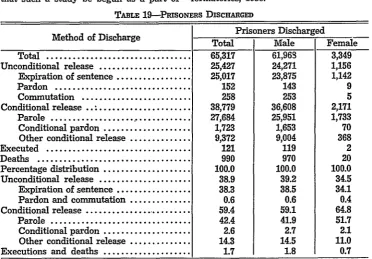
Prisoners Discharged-May 24, 1940, the
Bureau of the Census released for
pub-lication the data of discharged prisoners
from state and Federal prisons and
re-formatories, 1938.
TABLE 19-PRISONERS DiscH4RnsE
Method of Discharge
Prisoners Discharged
Total
Male
Female
Total ...
65,317
61,963
3,349
Unconditional release ...
25,427
24,271
1,156
Expiration of sentence ...
25,017
23,875
1,142
Pardon ...
152
143
9
Commutation ...
258
253
5
Conditional release ...
38,779
36,608
2,171
Parole ...
27,684
25,951
1,733
Conditional pardon ...
1,723
1,653
70
Other conditional release ...
9,372
9,004
368
Executed
...
121
119
2
Deaths
...
990
970
20
Percentage distribution ...
100.0
100.0
100.0
Unconditional release ...
38.9
39.2
34.5
Expiration of sentence ...
38.3
38.5
34.1
Pardon and commutation ...
0.6
0.6
0.4
Conditional release ...
59.4
59.1
64.8
Parole ...
42.4
41.9
51.7
Conditional pardon ...
2.6
2.7
2.1
Other conditional release ...
14.3
14.5
11.0
Executions and deaths ...
1.7
1.8
0.7
The fact that nearly all prisoners who serve time in prisons and reformatories are at some time returned to free society is clearly shown by table 19. Of the 65,317 prisoners discharged, 121 were executed, 990 died in prison, and the remainder, or 98.3 percent, were released and returned to free society.
Death to Children--Children may still be legally executed in most of the states of the American Union, according to Gilbert Cosulich, legal research assistant of the National Probation Association. Cosulich
made this statement in a paper delivered May 22 at the opening session of the third annual meeting of the Association of Ju-venile Court Judges of America, held at Grand Rapids, Michigan. Judge Victor B. Wylegala, judge of the Children's Court of Erie County at Buffalo, New York, presided.
Referring to the case of a sixteen-year-old school boy who is awaiting execution in Idaho, Cosulich said:
[image:9.454.50.423.127.386.2]