Vacancy Overview 2014
May 201
5
Expert Group on Future Skills Needs c/o Skills and Labour Market Research Unit (SLMRU)
SOLAS
Block 1, Castleforbes House Castleforbes Road
Dublin 1, Ireland
Tel: +353 1 5332464
Email: [email protected] Website: www.skillsireland.ie
Vacancy Overview 2014
A report produced by the Skills and Labour Market Research Unit (SLMRU) in SOLAS
for the Expert Group on Future Skills Needs
May 2015
Authors
Foreword
The Vacancy Overview 2014 report is the fifth in a series of annual reports produced by the Skills and Labour Market Research Unit (SLMRU) in SOLAS on behalf of the Expert Group on Future Skills Needs. The report provides an overview of the demand for labour and skills in Ireland through identifying trends in advertised job vacancies. These findings should provide important information for those involved in education and training provision, career guidance and policy makers.
The analysis in this report is based primarily on newly advertised vacancies from two sources, namely vacancies advertised through the Public Employment Service (DSP Jobs Ireland) and a private recruitment agency (IrishJobs.ie). In 2014, DSP Jobs Ireland vacancies were most prevalent for elementary (e.g. cleaning, security and catering), personal services (e.g. care workers) and skilled trades (e.g. chefs, electricians, metal and construction trades) occupations. IrishJobs.ie vacancies occurred most frequently for IT professionals, business and sales associate professionals and administrative roles.
Positioning the vacancy analysis within the labour market context indicated that vacancies were occurring due to a combination of expansion demand (recent employment growth was particularly noticeable for occupations in skilled trades, associate professionals and personal services
occupations) and replacement/turnover demand (across all occupational groups but particularly for personal services, sales and elementary occupations).
Foreign languages, especially German, continued to be in demand for a number of roles (primarily sales positions at associate professional levels) and a third level qualification was a prerequisite for many advertised jobs, particularly for professional positions. A high level of experience was key for managerial positions whereas for sales and customer services occupations (particularly door-to-door salespersons and sales assistants) half of the vacancies had no minimum level of experience
required.
The volume of vacancies advertised through the two sources increased on the previous year (particularly for professionals, skilled trades and operatives). This, in combination with an increasing number of mentions of difficult to fill vacancies and job creation announcements in the media, points to a continued strengthening of demand in the jobs market.
Una Halligan
Table of Contents
Key Findings ... 7
1. Introduction ... 9
2. Data ... 11
3. Overview of Vacancies ... 14
4. Managerial Occupations ... 25
5. Professional Occupations ... 29
6. Associate Professional & Technical Occupations ... 35
7. Administrative and Secretarial Occupations ... 40
8. Skilled Trades Occupations... 43
9. Caring, Leisure and Other Services Occupations ... 46
10. Sales and Customer Services Occupations ... 48
11. Process, Plant and Machine Operative Occupations ... 51
12. Elementary Occupations ... 53
13. Policy Implications ... 55
14. An Exercise in Data Mining ... 57
Appendix A. Job Search Analysis ... 62
Appendix B. Vacancy Trends by Occupation ... 65
Appendix C. Members of the Expert Group on Future Skills Needs ... 70
Key Findings
Overall
In 2014, on average 5,700 vacancies were advertised each month through the Department of Social Protection (DSP) Jobs Ireland and 2,500 vacancies through the IrishJobs.ie; this represents an increase in notifications for both sources since 2013.
DSP Jobs Ireland vacancies
In 2014, DSP Jobs Ireland vacancies were primarily for elementary, personal services and skilled trades occupations (combined accounting for over a half of all notified vacancies). The occupations which appeared most frequently were:
Care workers and home carers (accounting for 12% of all DSP Jobs Ireland vacancies) Sales assistants (5%), primarily for part-time positions
Chefs (4%)
Other administrative occupations (4%), mainly mystery shoppers Kitchen and catering assistants (4%)
Collector salespersons and credit agents (4%), e.g. field/door to door sales agents Business sales executives (3%), e.g. sales representatives/agents
Nurses (3%), mainly notified through recruitment agencies.
IrishJobs.ie vacancies
In 2014, vacancies notified to IrishJobs.ie were primarily for professional and associate professional occupations (these combined accounted for almost two thirds of IrishJobs.ie vacancies), with the following appearing most frequently:
IT professionals (accounting for 11% of all IrishJobs.ie vacancies in 2014; primarily programmers and software developers)
Sales, marketing and related associate professionals (10%), e.g. inside sales representatives, sales accounts and business development managers, marketing executives
Business, finance and related associate professionals (8%), e.g. financial advisor/analysts, financial accounts managers, audit managers
Business, research and administrative professionals (7%), in areas such as project management, risk analysts, management consultants and business analysts, accountants
Administrative occupations (finance) (6%), in fund accounting, multilingual accounts payable/receivable clerks and payroll coordinators
Engineering professionals (4%), e.g. process engineers, design and development engineers).
Job Vacancy Index
Labour market context
Employment growth (expansion demand): professionals and skilled trades accounted for the largest share of employment in quarter 3 2014; the 1.5% growth in employment since quarter 3 2013 relates primarily to growth in employment in skilled trades, associate professionals and personal services occupations.
Transitions (expansion, replacement demand and turnover): most of the movement in professional occupations was associated with persons changing employer whereas for skilled trades, movement into the occupation was primarily related to persons previously unemployed.
Job search analysis
Approximately one quarter of all transitions into employment was for those previously unemployed. An analysis of the methods used by unemployed persons in searching for a job reveals that on average two thirds of unemployed persons stated they utilised the services of public/private employment agencies when searching for a job. Between the first quarters of 2013 and 2014, with the fall in the numbers unemployed, the share and numbers contacting public employment agencies declined, whereas the numbers contacting only private employment agencies increased marginally.
Language skills
Demand for language skills was particularly for associate professional positions (e.g. business sales executives) followed by sales, professionals and administrative roles. German was the most frequently mentioned language required, followed by French, Spanish and Dutch.
Education/ experience required
Vacancies for professional occupations were by far the most likely to require a third level degree qualification while administrative positions had the highest share of vacancies requiring a part or full professional qualification (financial and accounting roles). Sales/customer service positions had the highest share of vacancies with no minimum level of either education or experience required; managerial vacancies were most likely to request a minimum of two to six years’ experience.
Employment permits
Professionals accounted for 69% of all new employment permits issued in 2014, compared to 36% in 2010. There was an increase in the number of new permits issued between 2013 and 2014, relating primarily to the reintroduction of medical employment permits and further increases in the number of permits issued to IT professionals.
Difficult to fill vacancies
The number of difficult to fill vacancies mentioned in the Recruitment Agency Survey conducted by the SLMRU in October 2014 showed increases compared to the situation one year previously. Professional occupations (in IT, engineering, science, health, business and limited openings in construction) accounted for two thirds of all difficult to fill mentions, with a further 15% for associate professional occupations (including technicians and sales related).
Job announcements
Job creation announcements in the media were mostly for IT professionals and sales related occupations, followed by operative and associate professional positions (primarily in
1. Introduction
Aim of the report
This report is produced annually by the Skills and Labour Market Research Unit (SLMRU) in SOLAS on behalf of the Expert Group on Future Skills Needs (EGFSN) in order to provide an overview of the demand for labour through identifying trends in advertised job vacancies.
What data is examined?
Vacancy data: newly advertised vacancies through DSP Jobs Ireland (Public Employment Services) and IrishJobs.ie (a private recruitment agency)
The Recruitment Agency Survey, conducted by the SLMRU in October 2014, which seeks to identify difficult to fill vacancies
Employment permit data, provided by the Department of Jobs, Enterprise and Innovation (DJEI), which indicates where employers were unable to find suitable candidates within the Irish labour market and the broader European Economic Area (EEA)
Job announcements in the media and confirmed by IDA client companies, which indicates future demand in the short-medium term.
Are there limitations to the data?
Yes, these are detailed in Section 2. Despite these limitations, when the data is interpreted with caution, it can provide a useful insight into the developments in Ireland's labour market.
What conclusions can be drawn from the findings?
An examination of vacancy data provides an insight into which occupations have vacancies occurring most frequently in the labour market. These findings should not be treated in isolation, but instead examined alongside other labour market data sources in order to assess if these vacancies are occurring due to expansion demand, replacement demand or turnover and to what extent they indicate shortages of labour and skills. If interpreted in this way, the trends highlighted from this analysis can provide significant insights for stakeholders in areas where education and training should be focused, where sourcing from abroad through work permits is required, or where an examination of working conditions should be monitored.
What is the structure of the report?
Section 2 details the vacancy data utilised, along with the limitations of these data sources Section 3 provides an overview of both employment trends in 2013/2014 and vacancy trends Sections 4 to 12 provide vacancy trends at an occupational level; this analysis is set out for each
occupation according to occupation and job title, education and experience; the occurrence of these occupations in the Recruitment Agency Survey, employment permit data and job
announcements is also profiled
2. Data
Vacancy Data
The vacancy data presented in this report is drawn from the newly advertised job vacancies in the following sources:
DSP Jobs Ireland: the Public Employment Service (PES) collects all vacancies advertised by employers through the National Contact Centre in the Department of Social Protection (DSP); the vacancy data presented here excludes vacancies advertised as part of Work Placement and JobBridge schemes, but does not exclude vacancies advertised by recruitment agencies
IrishJobs.ie vacancy data: gathered from the IrishJobs.ie online vacancy advertising service; the analysis includes only IrishJobs.ie vacancies advertised by an employer and excludes vacancies advertised by recruitment agencies.
Trend
The focus of this report is on vacancies that occurred in 2014. In order to deliver an overview of trends, a five year analysis is provided where possible.
Level of experience and education
The level of experience sought for positions advertised is available from both IrishJobs.ie and DSP Jobs Ireland, although in slightly different formats. For each occupational group, the source which has the most vacancies for each occupational group is utilised to report on this variable. The level of education required is only available for positions advertised through IrishJobs.ie and is therefore not reported on for occupations where most vacancies are advertised through DSP Jobs Ireland.
General vacancy data limitations
Vacancies may be advertised through channels not captured in the analysis (e.g. social media, recruitment agencies, employer websites), leading to an underestimation of the true demand; this may be particularly true in the case of certain foreign languages (e.g. Mandarin) where employers may prefer to advertise the vacancy in the language being sought or in countries where fluency in that language is commonplace
Vacancies may be advertised simultaneously through several channels, leading to multiple counting and an overestimation of the true demand
The extent to which vacancies are arising due to expansion demand (the creation of a new position by an employer), replacement (a person leaving an already existing position), turnover (the rate at which an employer gains and loses employees), or other reasons cannot be inferred from the available data
job vacancies advertised through IrishJobs.ie are skewed towards managerial, professional and associate professional occupations
While it was possible to identify and exclude Work Placement and JobBridge vacancies from the DSP Jobs Ireland data, it was not possible to do so from the IrishJobs.ie vacancy data; however, as the Work Placement and JobBridge schemes are administered and advertised through DSP Jobs Ireland, their occurrence in other data sets is likely to be low and therefore unlikely to skew the data unduly.
Source specific data limitations
The vacancy refreshing facility available to employers on the IrishJobs.ie website makes it possible for a previously advertised vacancy to occur as a new vacancy in the same or following month, which may lead to an overestimation of the true number of new vacancies
DSP Jobs Ireland vacancy data relates to the number of posts advertised, whereas IrishJob.ie data reports on the number of vacancies only with no indication of the number of posts involved While not an issue with DSP Jobs Ireland vacancies (given the vacancy validation procedures in
place), difficulties in distinguishing between true vacancies and non-substantiated advertisements in the IrishJobs.ie data can lead to an overestimation of the true demand Despite having unique reference codes in the IrishJobs.ie data set, the same job can appear in
the data more than once, thus inflating the perceived demand
IrishJobs.ie vacancies have been assigned an occupational code using Cascot software which automatically assigns a code based on key words or word segments found in the job description; in some cases the match may be erroneous (e.g. anti-money laundering may be mistaken for laundering services), and as such this has the potential to reduce the accuracy of the data The DSP Jobs Ireland vacancies are assigned codes manually (using a MANCO occupational coding
system) which are then mapped by the SLMRU to Standard Occupational Classification (SOC) codes; this re-coding process has the potential to diminish the accuracy of the data.
Given the above data limitations, the analysis focuses on the qualitative aspects of newly advertised vacancies. The objective is not to quantify the number of vacancies but rather to examine the types of jobs and skills most frequently appearing in the data sources captured. When vacancy trends are presented, they are included merely as an indication of movement in the vacancies from the two sources rather than the overall vacancy market.
Vacancy Index
SLMRU Recruitment Agency Survey
The Skills and Labour Market Research Unit (SLMRU) in SOLAS has conducted a recruitment agency survey every six months since January 2008. It is designed to gather the views of recruitment agencies in respect of the occupations for which vacancies, in their experience, are proving difficult to fill. Almost 120 recruitment agencies were contacted and asked to participate in a telephone interview. The findings of the most recent survey1, which took place in October 2014, are
presented for each occupational group.
Employment permit data
Employers, where necessary, employ workers from non-EEA countries through employment permit schemes. While the data on newly issued employment permits, provided by the DJEI, may be used to highlight occupations for which employers experience difficulty in sourcing staff from within the EEA countries, it should be interpreted with caution:
new employment permits may be issued to persons already residing in Ireland but who have changed employer
new employment permits may be issued to spouses/partners/dependants of certain categories of existing employment permit holders although the incidences of this occurring have declined in recent years2.
Job announcements
Announcements in the media (national newspapers) indicating the creation or loss of jobs have been documented by the SLMRU since 2010. Job announcements over the period January to December 2014 are summarised and presented for each occupational group, thereby highlighting areas in which job opportunities are arising as well as those where expansion activities may occur in the short-medium term. Job creation expected to arise from foreign direct investment (FDI) in Ireland, supported by the IDA, is also included.
1 Only those recruitment agencies who reported having difficult to fill vacancies (38 of the respondents) participated in the
survey. As such, it is considered that the 38 responses represent the majority of the recruitment agency market.
2 Only spouses/dependants of persons who attained their employment permit before 1 June 2009 were eligible for an
employment permit under the spousal/dependant scheme up to the enactment of the Employment Permits Amendment Act 2014 in October 2014.
3. Overview of Vacancies
This section provides:
1) A profile of the labour market in terms of employment levels, where job openings are occurring and the methods used by unemployed persons when seeking work; this is done through an examination of overall employment trends by occupational group; transitions into employment (from unemployment, inactivity, other occupations (inter-occupational) and within occupations (intra-occupational)); methods used by unemployed persons when seeking work is examined through an analysis of the CSO’s QNHS Job Search questions
2) An overall examination of the vacancy data specifically looking at trends, regional distribution, and occupations where vacancies are occurring most frequently; in addition, an examination of employment permit trends is provided to ascertain where the skills in the labour market were not sufficient to meet demand.
Labour Market Context
[image:15.729.63.531.464.711.2]Vacancies occur when new positions are created or when a vacated position requires replacement. By examining the level of employment growth and transitions into employment, it is possible to attain an indication of the level of movement occurring for each occupational group. Table 3.1 provides details of employment levels, transitions into employment and the share of vacancies for each vacancy source.
Table 3.1 Occupational distributions of employment, employment growth, transitions3 and vacancies, 2014
Employment Transitions into employment, 2014 IrishJobs.ie Vacancies 2014 DSP Jobs Ireland Vacancies 2014 To ta l Em pl oy m en t Q 3 2014 * % Sh ar e of Em pl oy me nt % C han ge Q 3 2013 -Q 3 2014 U ne mp lo yme nt t o emp lo ym ent In ac ti vi ty t o emp lo ym ent In ter in Int ra To ta l t ra nsi tio ns Sh ar e o f T ot al Em pl oy me nt Sh ar e o f T ot al Vacan ci es Sh ar e o f T ot al Em pl oy me nt Sh ar e o f T ot al Vacan ci es
Managers 152,800 8% 3.2% 4,900 5,900 6,000 6,800 23,600 1% 6% 1% 2%
Professionals 341,900 18% -3.6% 14,600 14,500 8,900 30,400 68,400 3% 31% 1% 7% Associate Professionals 225,900 12% 4.7% 14,900 10,900 9,100 16,600 51,500 4% 31% 3% 11% Admin/Secretarial 212,900 11% 0.4% 13,600 13,300 11,400 17,400 55,700 2% 13% 2% 7% Skilled Trades 311,000 16% 6.6% 24,800 16,100 6,800 19,400 67,100 0% 5% 3% 16% Personal Services 152,400 8% 6.4% 9,700 13,400 5,000 16,300 44,400 0% 2% 8% 17%
Sales 161,600 8% 1.3% 14,700 24,200 8,300 18,600 65,800 1% 6% 5% 11%
Operatives 140,700 7% -5.0% 12,300 7,000 11,000 12,200 42,500 1% 4% 5% 10% Elementary 217,700 11% -1.0% 24,300 37,600 12,200 28,600 102,700 0% 2% 7% 20%
Total 1,926,900 100% 1.5% 133,900 142,900 78,800 166,300 521,900 2% 100% 4% 100%
*Excludes Other/Not Stated category and therefore the employment numbers do not tally
Source: CSO QNHS, IrishJobs.ie, DSP Jobs Ireland
3 Persons with no previous occupation (e.g. new entrants to the labour market) are included for the first time.
Employment and employment growth
The CSO’s Quarterly National Household Survey (QNHS) was utilised to provide the level of employment in each occupational group in the most recent quarter and the level of employment growth that occurred since the previous year. Table 3.1 shows that at 18% (or over 340,000), professionals accounted for the largest share of persons employed in the third quarter of 2014, followed by those employed in skilled trades (at 16%).
Between quarter 3 2013 and quarter 3 2014 there was an overall growth in the numbers employed of 28,000, or 1.5%. The level of growth varied across occupational groups with skilled trades
experiencing the largest gains at 6.6% (including for farmers, carpenters and chefs), with declines occurring for professionals (primarily related to falls in the number of doctors and teachers) and operatives (related to assemblers and routine operatives).
Transitions into employment
Employment growth indicates job opportunities associated with expansion demand. However, transitions analysis suggests that for almost all occupational groups, vacancies occur for reasons other than expansion demand; for instance, while employment for elementary occupations contracted, over 40,000 vacancies occurred due to churn. An examination of transitions4 into
employment in 2014 reveals the following key findings (see Table 3.1):
Almost half of all transitions were for persons already in employment, reaching 57% for professional occupations
For those already in employment, activity was recorded both for those moving between
occupations (inter, 15% of all transitions into employment) and within occupations (intra, 32% of transitions); for all occupations excluding skilled trades, sales and elementary,
intra-occupational movements accounted for the largest number of transitions
Of all the transitions into employment recorded in 2014, over 130,000 (or 26%) were for those who were previously unemployed with skilled trades and elementary occupations accounting for the largest numbers in this group; elementary occupations accounted for the largest number of persons who transitioned from inactivity to employment.
The Job Churn analysis conducted by the CSO5 estimated that in 2013, approximately 570,000 job
hirings occurred; this is higher than the numbers estimated by the transitions analysis as different data sources were used and the transitions data excludes persons with no previous occupation (e.g. new entrants to the labour market). If an estimate of 500,000 openings a year are assumed, the vacancies examined in the two sources here (combined totalling more than 100,000) would represent 20% of the vacancy market.
4 A more detailed analysis of labour market transitions is available in the annual National Skills Bulletin produced by the
Expert Group on Future Skills Needs.
5http://www.cso.ie/px/pxeirestat/Statire/SelectVarVal/Define.asp?maintable=JCA01&PLanguage=0
Are the vacancies sources representative?
This leads to the question of whether the vacancy sources utilised here are representative of activity in the labour market at occupational level. Table 3.1 shows that the distribution of vacancies in both DSP Jobs Ireland and IrishJobs.ie differs from the employment distribution across occupations and moreover differs from each other; while professional vacancies are
overrepresented in IrishJobs.ie, there is an underrepresentation of these occupations in DSP Jobs Ireland; conversely there is a greater share of DSP Jobs Ireland vacancies in lower skilled
occupations. However, these two sources combined are broadly in line with the transitions analysis with a high level of transitions in professional occupations reflected in the IrishJobs.ie data and those occurring for skilled trades, sales and elementary occupations were reflected in the DSP Jobs Ireland vacancy data.
Vacancy index
Figure 3.1 provides a vacancy index for DSP Jobs Ireland6and IrishJobs.ie. The vacancy index shows
that DSP Jobs Ireland has, for the most part, been above the base level (set in January 2009) for most of the period from 2009 to 2014, reaching a peak of 171.4 in June 2011. IrishJobs.ie have seen a more significant growth in vacancy notifications occurring since January 2009, with the index peaking at 342.2 in May 2012; the gap between the two sources has been widening since the start of 2011 with a gap of over 180 points in December 2014. A further examination by occupation is provided in Appendix B which shows the gap between the two sources was widest for associate professional, administrative and operative vacancies.
It should be borne in mind that the number of DSP Jobs Ireland vacancies are more than twice that of IrishJobs.ie in absolute terms (on average 5,700 PES vacancies per month compared to 2,500 for IrishJobs.ie in 2014) and the level of DSP Jobs Ireland vacancies did not fall to as low a base during the recession as did vacancies for IrishJobs.ie.
6 Notified vacancies for 1,300 film extras in 2013 through DSP Jobs Ireland were excluded from the analysis in this report.
Figure 3.1 New notified job vacancies index, (Base: January 2009=100), 2009-2014
Source: IrishJobs.ie and DSP Jobs Ireland (3 month moving average)
Vacancy by county
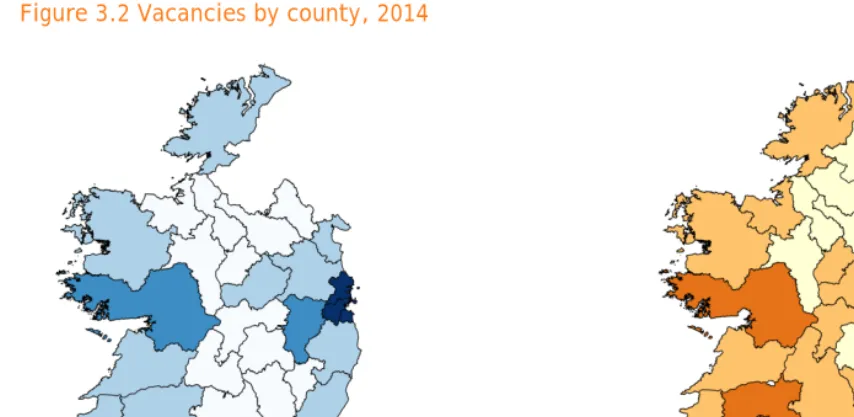
Figure 3.2 provides a breakdown of vacancies by county for both DSP Jobs Ireland and IrishJobs.ie. For the IrishJobs.ie vacancy data, 15% of vacancies were excluded as multiple locations were provided or positions were for outside of Ireland. DSP Jobs Ireland vacancies were only for counties in the Republic of Ireland whereas IrishJobs.ie vacancy data took account of all counties in Ireland. For both sources, Dublin had the highest volume of vacancies, followed by Galway and Cork. For DSP Jobs Ireland there was also a high volume of vacancies in Kildare, with the lowest numbers occurring in counties such as Leitrim, Waterford and Roscommon. For IrishJobs.ie vacancies, the lowest volume occurred for Cavan, Laois, Leitrim and Roscommon.
50.0 100.0 150.0 200.0 250.0 300.0 350.0 Jan -0 9 M ay -0 9 Se p-0 9 Jan -1 0 M ay -1 0 Se p-1 0 Jan -1 1 M ay -1 1 Se p-1 1 Jan -1 2 M ay -1 2 Se p-1 2 Jan -1 3 M ay -1 3 Se p-1 3 Jan -1 4 M ay -1 4 Se p-1 4
Figure 3.2 Vacancies by county, 2014
Source: IrishJobs.ie and DSP Jobs Ireland
Occupational Trends
This section examines the distribution of vacancies across both DSP Jobs Ireland and IrishJobs.ie and how this distribution has changed over time. An analysis of changes in employment permit data also provides an insight into the broad occupations where employers are seeking skills from outside of the EEA.
Vacancies by Occupation
The breakdown of vacancies notified through IrishJobs.ie for each occupational group is detailed in Figure 3.3. Over the five-year period, professionals and associate professionals accounted for the largest share of vacancies, each accounting for almost a third of all vacancies advertised with IrishJobs.ie. While increases in the number of vacancy notifications occurred across all occupations since 2013, professionals and associate professionals experienced the largest gains.
Figure 3.3 IrishJobs.ie vacancies by broad occupation, 2010-2014
Source: IrishJobs.ie
- 5,000 10,000 15,000 20,000 25,000 30,000 35,000 2010
2011 2012 2013
2014 Managers
Professionals
Associate Professionals Admin/Secretarial Skilled Trades Personal Services Sales
DSP Jobs Ireland vacancies are skewed towards the lower skilled occupations with managers, professionals and associate professionals combined accounting for on average a quarter of all notified vacancies (Figure 3.4). While agency vacancies are excluded from the IrishJobs.ie data, it has not been possible to exclude recruitment agency vacancies from the DSP Jobs Ireland data, which has the potential to inflate vacancy notifications in some areas and the extent to which they represent employment opportunities is not clear.
There was a decline in the number and share of vacancies for associate professionals in recent years (the decline since 2013 relates primarily to a reclassification of mystery shoppers from associate professionals to administrative occupations), while there was an increase in the number of professional vacancy notifications (relating to an increase in notifications for nurses, primarily through recruitment agencies). There was a noticeable increase in both the number and share of vacancies for skilled trades in recent years with a 34% increase since 2013. Elementary occupations continue to account for 20% of all vacancy notifications to this source.
Figure 3.4 DSP Jobs Ireland vacancies by broad occupation, 2010-2014
Source: DSP Jobs Ireland
Employment permits by occupation
Due to the change in the employment permit scheme in October 20147, only those new permits
issued between January and September 2014 are reported (Figure 3.5). Even accounting for this, the number of new permits issued in 2014 was a third higher than in 2013. The number of permits issued for professional occupations accounted for 69% of all new permits issued in 2014; new permits for this occupational group have grown each year since 2010, related primarily to IT vacancies and in relation to the growth since 2013, to the reintroduction of medical employment permits8 . Elementary occupations accounted for 17% of all new permits issued in 2010, declining to
1% in 2014.
7The Employment Permits (Amendment) Act 2014 came into effect in October 2014 with the introduction of nine classes of
employment permits. The effect of the new legislation is to increase the focus of economic migration to Ireland on skills, rather than labour shortages.
8 In January 2014, new arrangements came into effect where all non-EEA doctors working in the State required an
employment permit; in previous years, channels other than the employment permit scheme were used for medical doctors.
- 20,000 40,000 60,000 80,000
2010 2011 2012 2013
2014 Managers
Professionals
Associate Professionals Admin/Secretarial Skilled Trades Personal Services Sales
Operatives Elementary Occ
Figure 3.5 Employment permits by broad occupation, 2010-2014
*2014 refers to January to September only
Source: DJEI
Language skills
An analysis was carried out of the languages most often cited in vacancy notifications in 2014 for both IrishJobs.ie and DSP Jobs Ireland (Figure 3.6). The key findings were as follows:
For both vacancy sources, associate professionals (mostly sales positions) accounted for the largest number of vacancies where a specific foreign language was stated; this was followed by sales and customer service, administrative roles and professional occupations
German was the most prominent language mentioned, followed by French
The relatively high number of vacancies with language requirements in skilled trades (primarily related to the DSP Jobs Ireland dataset) was due to vacancies for ethnic chefs
In terms of sectors (in the IrishJobs.ie vacancy data), languages appeared most frequently in customer services, sales and IT.
Figure 3.6 IrishJobs.ie/DSP Jobs Ireland vacancies where specific languages were stated, 2014
* Other includes Italian, Portuguese, Russian, Arabic, Chinese and Japanese
Source: IrishJobs.ie/DSP Jobs Ireland
- 500 1,000 1,500 2,000 2,500 3,000 3,500 4,000 4,500 2010
2011 2012 2013
2014* Managers
Professionals
Associate Professionals Admin/Secretarial Skilled Trades Personal Services Sales
Operatives Elementary Occ
0 200 400 600 800 1,000 1,200 1,400 Managers
Professionals Associate Professional Admin Skilled Trades Personal services Sales & customer service Operatives Elementary
Occupations and job titles
Figures 3.7 and 3.8 summarises the vacancies which occurred most frequently in 2014 for both IrishJobs.ie and DSP Jobs Ireland vacancies by occupational group. Figure 3.7 shows that IT professional vacancies were the most frequently cited through IrishJobs.ie followed by business professionals (e.g. accountants, actuaries) whereas Figure 3.8 shows that care workers and sales and marketing associate professionals were the most cited vacancies through DSP Jobs Ireland.
Figure 3.7 IrishJobs.ie vacancies by occupation and level of frequency, 2014
IT professionals (e.g. PL/SQL developer; applications
developer (.NET, C#, Java))
Sales and marketing associate professionals
Production functional
managers Other managers
Financial administrators
Other administrators
Business professionals (e.g. accountants,
actuaries)
Health professionals
Business, finance and related
associate professionals
Electronic trades and fitting trades Metal machining
Customer service
occupations Sales occupations
Engineering professionals
Science, engineering
associate professionals
Carers Plant, machine, assemblers, process operatives
IT technicians services labourers Security, storage,
Managers Admin Sales/customer service
Professionals Skilled trades Operatives
Associate professionals Personal services Elementary
Figure 3.8 DSP Jobs Ireland vacancies by occupation and level of frequency, 2014
Nursing
Sales and marketing
Receptionists
Mystery shoppers
IT tech
Trainers Graphic design
Hosp.
Other Interpreters
Other admin
HR Media Finance
IT
Chefs
Building Health Youth work Secretarial
Other Dental Tech Retail Finance
Metal trades
Eng Science HR Office manager
Engineering
Care workers
Motor trades
Electricals/electronic Teaching
Accounting
Quantity surveying
Architects
Customer service Construction trades
Leisure
Hairdressing Childcare Housekeeping
Door to door sales
Process operatives
Catering, waiters, bar
Artic/rigid drivers
Process plant
Other services
Sales assistants
Road transport drivers
Cleaning
Mobile
machine Construction
Security
Sales related production General
operatives Agriculture Storage
Managers Admin Sales/customer service
Professionals Skilled trades Operatives
Job Search Analysis
The transitions analysis indicates that over a quarter of all transitions into employment occur for those previously unemployed. For this reason, it is useful to examine the methods used by unemployed persons in seeking work and in particular to assess the usage of public and private employment agencies in the job search process. As such, an examination of the CSO’s Quarterly National Household Survey (QNHS) was undertaken, as the survey asks persons classified as unemployed the methods utilised in the previous four weeks to find work. The survey includes thirteen questions relating to methods used, including whether they have been in contact with public employment offices and/or private employment agencies and if they contacted employers directly. Each question is stand alone and it is therefore possible to get a positive response to any number of job search questions. DSP Jobs Ireland is the only public employment agency in Ireland, while IrishJobs.ie is one of many private employment agencies.
On average, approximately one quarter of unemployed persons contact both a public and private employment agency when searching for a job; a further third contact only a public employment office and a tenth contact a private employment agency only; approximately a third did not answer or stated that they contacted neither.
[image:24.729.76.491.558.752.2]Figure 3.9 shows that there was a significant increase in the numbers unemployed following the onset of the recession in 2009; at the same time, there was an increased number of unemployed persons using the services of both public and private employment agencies when seeking work, peaking in quarter 1 2012. Since then, the overall number of unemployed persons who were actively seeking employment declined, while a fall in those contacting a combination of public and private employment agencies and public employment offices only occurred. In contrast, those contacting only private employment agencies saw small increases over this time period. It is also of note that the numbers who contacted neither type of employment agency only declined marginally, indicating that a significant share of unemployed persons used other methods not captured in the QNHS, such as social media, when searching for work.
Figure 3.9 Job search for unemployed persons, 2005-2014
Source: SLMRU Analysis of CSO QNHS data
- 50,000 100,000 150,000 200,000 250,000 300,000 350,000 Q1 2005
Q1 2006 Q1 2007 Q1 2008 Q1 2009 Q1 2010 Q1 2011 Q1 2012 Q1 2013 Q1 2014
The methods used by unemployed persons to search for a job varied across occupations, sectors, age and duration unemployed. Appendix A provides an analysis of these factors with the key
findings for those who contacted a public/private employment agency in quarter 1 2014 as follows: Occupation: those previously employed as professionals were most likely to contact only a
private employment agency; those previously employed in caring and sales occupations were more likely to contact only a public employment office; associate professionals most likely to contact both
Sector: those previously employed in financial, insurance & real estate activities were most likely to contact only a private employment agency; those previously employed in the
transportation and storage sector were most likely to contact only a public employment office; those previously employed in the IT sector were most likely to engage with both agencies Duration unemployed: the likelihood of contacting either a public or private employment
agency was at its highest for those unemployed for less than six months and between 18 and 47 months unemployed
4. Managerial Occupations
Managerial occupations accounted for 2% of all notified vacancies to DSP Jobs Ireland and 7% of vacancies notified to IrishJobs.ie in 2014
The number of notifications for managerial occupations for DSP Jobs Ireland and IrishJobs.ie combined increased by 6% on the previous year relating to increases in hospitality and financial managers
Vacancies were most common in hospitality, retail and financial services sectors
[image:26.729.69.282.129.473.2] The Job Search analysis of the CSO’s QNHS data indicates that despite a 34% fall in the number of unemployed managers in the year since quarter 1 2013, the number of unemployed managers contacting a public or private employment office when searching for a job declined only marginally in absolute terms.
Figure 4.1 Managerial vacancies as a share of total vacancies, 2014
Source: DSP Jobs Ireland/IrishJobs.ie
Job Titles
Vacancies for managerial positions were most frequent for the following job titles: Hospitality managers in restaurants, bars, hotels and catering
Functional managers:
Financial managers
HR managers across all sectors
Logistics managers (procurement, supply chain, purchasing, warehouse)
Sales and marketing managers
IT managers in areas such as infrastructure and development
Production managers in manufacturing and construction (including site managers)
Operations managers across all sectors
Services managers in retail, banking and facilities.
7% 2%
IrishJobs.ie Managers IrishJobs.ie Others
Education
Of those who stated an education requirement9, managerial occupations had a higher share of
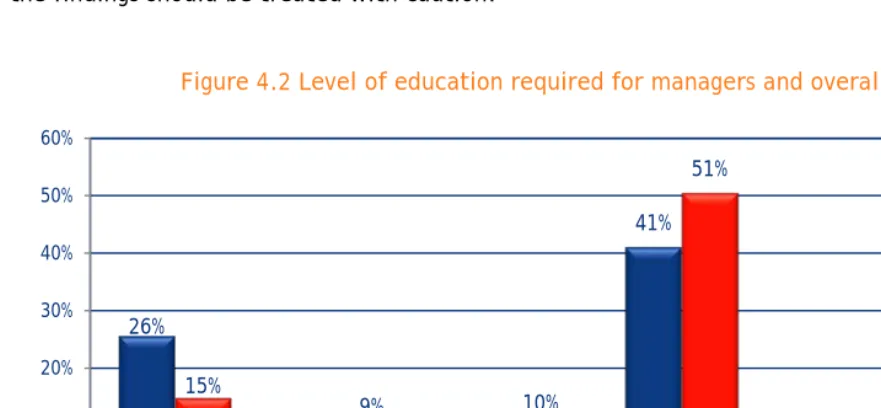
[image:27.729.81.522.283.487.2]vacancies which required no minimum level of education than the overall vacancies, 26% compared to 15% (Figure 4.2). Vacancies that had no minimum experience required were primarily for roles in transport and retail. While this occupation had a lower requirement for third level qualifications (41% of posts required degrees compared to 51% overall), there was a higher share requiring part-professional or part-professional qualifications when compared to overall vacancies. As the number of vacancies which stated a level of education required was small, however, any assumptions based on the findings should be treated with caution.
Figure 4.2 Level of education required for managers and overall, 2014
Source: IrishJobs.ie
Experience
Figure 4.3 shows that, of those who stated a level of experience required10, a high level of
experience was expected for managerial posts with a much lower share of posts requiring two years or less (9% compared to 22%) and a much higher share requiring six or more years (28% compared to 12%) when compared with overall vacancy numbers.
9 48% of managerial vacancies stated a level of education required. 10 50% of managerial vacancies stated a level of experience required.
26%
7% 7%
41%
5%
14% 15%
9% 10%
51%
4%
11%
0% 10% 20% 30% 40% 50% 60%
No minimum
required Junior/Leavingcert/trade Third levelcert/dip Third level degree Postgraduate Part/professional
Managers All occupations
Figure 4.3 Level of experience required for managers and overall, 2014
Source: IrishJobs.ie
Difficult to Fill Vacancies
Of all difficult to fill vacancies reported in the Recruitment Agency Survey conducted in October 2014, 4% were for managers in the following areas:
Sales and marketing managers (digital marketing aimed at customer acquisition and engagement; sales managers with industry specific knowledge including supply chain management, as well as B2B sales)
A small number of mentions in areas including project, production and technical managers, directors of quality and senior ICT managers
Social care managers limited to niche areas (e.g. residential, day and domiciliary care mangers).
Vacancies filled with non-EEA workers (January-September 2014 only)
Overall: new employment permits for managerial positions accounted for 5% of all permits issued in 2014.
Type: these were made up primarily of green cards (45%) and intra-company transfers (41%) (Figure 4.4); indeed, new employment permits for managerial vacancies accounted for 19% of all intra-company transfers for 2014 (Figure 4.5).
Sector: managerial employment permits were primarily issued for positions in services, manufacturing, financial services and IT.
Nationality: over half (55%) of all permits issued for managers were for those originating from the USA.
Occupations: new employment permits were most frequently issued for:
Operations managers Vice presidents CEOs/CFOs
Directors of supply chain
General managers in manufacturing.
5% 9%
58%
28% 6%
22%
60%
12%
0% 10% 20% 30% 40% 50% 60% 70%
No minimum required 0-2 years 2-6 years 6+ years
Figure 4.4 Employment permits by type for managers, Jan-Sept 2014
Source: DJEI
Figure 4.5 New managerial employment permits issued as a share of total permits, Jan-Sept 2014
Job announcements
While there were few job creation announcements in the media for managerial occupations in 2014, managerial roles are implicit in several of the larger scale announcements, such as those specific to construction work (albeit temporary) or the establishment of European headquarters in Ireland by several companies. It is probable that such job creation announcements may be expected to have roles for construction and site managers, marketing and sales directors, purchasing managers, and human resource directors. Nonetheless, such positions are likely to be comparatively small in number, and in the case of construction, temporary. Job creation for managerial roles is confirmed in the jobs announced by IDA client companies in 2014; the posts are relatively small in number and mostly for senior positions in the high-tech manufacturing and ICT sectors.
45% 41%
10% 3%
Green cards
Intra-company transfers Employment Permits Other
7%
1%
19%
2%
15%
93%
99%
81%
98%
85%
0% 20% 40% 60% 80% 100%
Green Card
Employment Permit
Intra-company transfer
Spousal/Dependant
Training
5. Professional Occupations
Professional occupations accounted for 7% of all notified vacancies to DSP Jobs Ireland and 31% of vacancies notified to IrishJobs.ie in 2014
There was an increase in the number of notifications for professional occupations for both DSP Jobs Ireland (relating to an increase in nursing vacancies) and IrishJobs.ie between 2013 and 2014 IrishJobs.ie vacancies were primarily in
the IT sector, with a 33% share, followed by engineering, science, health and business and financial services
Unemployed persons previously employed in professional occupations were
significantly more likely to contact a private employment agency than a public employment office (based on the analysis of the CSO’s QNHS job search questions).
Figure 5.1 Professional vacancies as a share of total vacancies, 2014
Source: DSP Jobs Ireland/IrishJobs.ie
Job Titles
IT professionals
(almost a third of all professional vacancies)
Programmers and software developers in application development (C#, .NET, C++, Java, PHP, iOS), database/enterprise development (Oracle, SQL Server, SAP) and operating systems IT business analysts, architects and systems designers in areas such as platform and user
operations
Web designers/developers (UI/UX, HTML, CSS, jQuery, Javascript, ASP.NET)
Network engineers and test engineers with some testing jobs in localisation requiring language skills
IT project managers (e.g. for desktop/helpdesk support, business systems, service delivery)
Business and finance professionals
Chartered accountants (primarily financial accountants but also in business banking, both qualified and part-qualified)
Management consultants and business analysts (e.g. funds industry, banking, with expertise in SAP)
Other business professionals (risk analysts, project managers, actuaries and quantity surveyors)
31% 7%
IrishJobs.ie Professionals IrishJobs.ie Others
Engineers and scientists
Process engineers in scientific, medical and manufacturing sectors
Product development and design engineers (electrical, mechanical, R&D)
Project managers (in construction, pharmaceuticals, manufacturing); civil/structural engineers
Technologists (food, process, product development, R&D, technical solutions)
Scientists: chemical scientists (e.g. analytical, organic); biological scientists (e.g. microbiology); R&D scientists
Health professionals: (accounted for 6% of all professional vacancies advertised on IrishJobs.ie and 46% of DSP Jobs Ireland professional vacancies due to a high number of recruitment agency
notifications for nurses)
Nurses (e.g. general and staff nurses along with clinical nurse managers in oncology, anaesthetics and orthopaedics)
Doctors, clinical psychologists, pharmacists (mainly retail), radiographers
Therapists (occupational, speech and language, physiotherapist)
Other healthcare professionals (e.g. dietician).
Education
Of those vacancies that stated an education requirement11, almost two thirds stated a minimum of a
[image:31.729.79.521.517.748.2]third level degree qualification, the highest share for any of the occupational groups and above the overall share (Figure 5.2). At 7%, this occupation had the highest share of vacancies requiring postgraduate qualifications and the lowest share of vacancies which had no minimum level of education required (also at 7%).
Figure 5.2 Level of education required for professionals and overall, 2014
Source: IrishJobs.ie
11 53% of vacancies for professional occupations stated a level of education required.
7%
2%
8%
65%
7% 11%
15%
9% 10%
50%
4%
11%
0% 10% 20% 30% 40% 50% 60% 70%
No minimum
required Junior/Leavingcert/trade Third levelcert/dip Third level degree Postgraduate Part/professional
Professionals All occupations
Experience
A high level of experience was required for the majority of vacancies for professional occupations (Figure 5.3); of those which stated an experience requirement12, 67% required two to six years’
experience with a further 17% requiring six or more years’ experience (primarily in engineering and IT-related roles) with both above the overall share.
Figure 5.3 Level of experience required for professionals and overall, 2014
Source: IrishJobs.ie
Difficult to Fill Vacancies
Professional occupations accounted for over two thirds of all difficult to fill (DTF) mentions in the October 2014 Recruitment Agency Survey. Within this occupational grouping, the following occupations were identified as difficult to source:
IT professionals: accounted for a third of all DTF mentions; demand was particularly strong for designers and developers with specific skill sets, namely:
Programmers/developers: primarily with skills in Java, J2EE, C++, Summit, .net, C#, JSP, JQuery, AJAX & JavaScript; in web development (PHP,CSS, HTML, Python) and mobile applications development (for iOS and Android)
IT business analysts, architects and systems designers: (with expertise in Oracle, SQL, MySQL, Hadoop and noSQL) in occupations including software engineers, big data analysts, data warehousing and business intelligence specialists, and SEO (Search Engine
Optimisation) specialists
Cloud computing: with skills in Software as a Service (SaaS) and virtualisation technologies
Web designers: particularly in web related applications which focus on enhancing users’ online experience (UX) and supporting user interaction (UI)
Network engineers: confined to IP networking and specialist roles such as software quality assurance engineers
12 56% of vacancies for professional occupations stated a level of experience required.
4%
12%
67%
17% 6%
22%
60%
12%
0% 10% 20% 30% 40% 50% 60% 70% 80%
No minimum required 0-2 years 2-6 years 6+ years
Professionals All occupations
Engineers and scientists:
Production and process engineers - process automation and system control, product design, production planning, supply chain integration engineers (e.g. medical devices, biotech and pharmaceutical industry); commissioning engineers (overseeing the installation of systems, plant and/or equipment)
Quality assurance and validation engineers, including standards and regulatory compliance, process safety engineers
Electronic engineers (in niche areas)
Chemical engineers (e.g. specialised roles in the biotech/pharmaceutical industry)
Scientists: chemists (e.g. product formulation, analytical development), biological scientists, biochemists and in R&D and pharmacovigilance
Business and financial professionals
Accountants (e.g. chartered and certified accountants with expertise in taxation,
regulation and compliance); management and financial accountant with relevant industry expertise
Analysts: financial and risk analysts with knowledge of IT systems (e.g. Oracle, SAP); supply chain analysts; statisticians/data analysts with SAS, STATA, SPSS; business analysts (e.g. enterprise resource planners (ERP) and customer relationship management (CRM)) Healthcare professionals:
Medical practitioners: doctors/registrars (in areas including emergency medicine, anaesthetists, paediatrics, general medicine, and psychiatry), GPs
Nurses: advanced nursing practitioners (ANP), clinical nurse managers and specific nursing roles (e.g. in intensive care units, operating theatre, cardiac care, oncology, and
psychiatric); difficult to fill mentions also included general nurses and nursing managers for roles in elderly people care settings
Radiographers
Construction professionals: limited to positions in niche areas (experienced quantity surveyors and project managers).
Vacancies filled with non-EEA workers (January-September 2014 only)
Overall: new employment permits for professionals accounted for 69% of total permits issued in 2014
Type: permits were primarily green cards (44%) and employment permits (48%) (Figure 5.4); indeed, permits for professionals accounted for the majority of green cards and employment permits issued at 82% and 70% respectively (Figure 5.5)
Sector: permits were mainly issued for positions in IT (48%) and healthcare (34%)
Nationality: persons from India, Pakistan and the US accounted for 60% of all new permits issued for professionals
IT: multilingual account strategists/managers; analysts (systems, test, data), software developers (with Oracle, Javascript, PHP, etc), systems architects/engineers
Healthcare: medical doctors (registrars (primarily general but also in specialities including anaesthetics, cardiology, oncology, psychiatric, paediatric, ophthalmology and emergency medicine), senior house officers), nurses
Manufacturing: engineers (project, process, electronics, field service) Business: business analysts, auditors
Figure 5.4 Employment permits for professionals, Jan-Sept 2014
[image:34.729.78.523.181.435.2]Source: DJEI
Figure 5.5 New employment permits for professionals and all others, Jan-Sept 2014
Job Announcements
Professional occupations accounted for the most frequently mentioned titles in job creation media announcements in 2014. A significant share of the jobs was in the ICT sector, with financial/business services and high-tech manufacturing also featuring prominently. In addition, a number of roles were cross-disciplinary, requiring skills that span two or more sectors (e.g. IT software development skills for the financial sector, financial skills for positions in high-tech manufacturing, or a financial background for the ICT sector). Job creation for professionals was also confirmed in jobs announced by IDA client companies, particularly for roles in high-tech sectors (e.g. pharmaceuticals, ICT).
As illustrated in Figure 5.6, the demand for professionals, was particularly strong for
Finance professionals, including audit and tax experts, senior accountants, financial control professionals, compliance experts (including AIFMD13), and risk professionals; while most
positions were in the financial services sector (e.g. insurance), financial professionals were also sought for the ICT sector and, to a lesser extent, high-tech manufacturing (medical devices, pharmaceuticals)
13 The Alternative Investment Fund Managers Directive (AIFMD) is a European Union directive which came into force in
July 2013.
44%
7% 48%
2%
Green cards
Intra-company transfers Employment Permits Other
82%
70%
43%
21%
45%
18%
30%
57%
79%
55%
0% 20% 40% 60% 80% 100% Green Card
Employment Permit
Intra-company transfer
Spousal/Dependant
Training
Professionals Other occupations
IT professionals, including software developers and engineers, IT project managers, software testers, and data analysts/data scientists; most of the positions were specific to segments of the ICT sector (e.g. games development, telecoms, cloud-based services, information security, and online sales); however, a number of roles were also announced for IT occupations in sectors such as financial services, energy, transport, and manufacturing
Chemical and pharmaceutical engineers (pharma sector)
Process engineers (high-tech manufacturing)
Design and product development engineers (IT and food manufacturing sectors)
Mechanical engineers
Quality assurance and quality control engineers and professionals, predominantly for high-tech manufacturing (e.g. bio-pharmaceuticals, pharmaceuticals, medical devices) and, to a lesser degree, the IT software sector
Research and development (R&D) engineers, scientists and computer scientists (including positions in IT), high-tech manufacturing, and medical research (e.g. clinical diagnostics, life sciences)
Business and legal professionals, including management consultants, business analysts, and legal experts.
[image:35.729.70.530.478.718.2]While some roles specified a need for experienced candidates, a number of announcements sought to recruit third level graduates.
6. Associate Professional & Technical Occupations
Associate professional/technical occupations accounted for 11% of all notified vacancies to DSP Jobs Ireland and 31% of vacancies notified to IrishJobs.ie in 2014
There was a drop in the number of associate professional/technical
vacancies notified to DSP Jobs Ireland in 2014, mainly due to a reclassification of some occupations, although notifications increased for IrishJobs.ie
Vacancies were primarily in IT, sales, financial services, and accounting The Job Search analysis of the CSO’s
[image:36.729.367.527.182.343.2]QNHS data indicates that in the first quarter of 2014, unemployed associate professionals were more likely to contact a private than a public employment agency when searching for a job.
Figure 6.1 Associate professional vacancies as a share of total vacancies, 2014
Source: DSP Jobs Ireland/IrishJobs.ie
Job Titles
Vacancies for associate professionals were most frequent for
Business associate professionals (accounted for the largest number of vacancies)
Sales and marketing (inside sales specialists with languages, sales representatives, field sales executives, account executives with languages, marketing executives, business developers, fundraisers, mystery shoppers, procurement agents/buyers)
Financial: financial advisers/analysts, audit managers, account managers, multilingual claims officers
Compliance officers
Science, engineering and technology technicians:
IT technicians: technical support agents (with languages including German, French, Dutch and Nordic), customer services executives with languages, data analytics managers, helpdesk technicians, systems administrators
laboratory technicians (medical, quality control, food, microbiology, chemistry) engineering technicians (manufacturing, commissioning/qualification, mechanical,
electrical/electronic, process) CAD technicians
31% 11%
IrishJobs.ie Associate Professionals
IrishJobs.ie Others
DSP Jobs Ireland Associate Professionals
Other associate professionals:
Interpreters
Vocational trainers/instructors (e.g. in the areas of retail sales, childcare, customer service), recruitment consultants
Designers (UI/UX, graphic, fashion, visual), technical writers.
There were also a number of vacancies for performing artists (extras) associated with activity in the domestic and foreign film industry in Ireland, which were excluded from the data as they were once off short-term engagements.
Language Skills
Language skill requirements were predominant in vacancies for associate professionals. Foreign language skills, particularly German, French, Dutch, Spanish and Italian, were required for roles in IT technical support, fraud analysis, risk management, claims and collections.
Education
Of those who stated an education requirement14, 50% stated a minimum of a third level degree
[image:37.729.79.512.496.723.2]qualification with a further 3% requiring a postgraduate qualification (Figure 6.2). Requirements for professional or part-professional qualifications were primarily for finance and accounting roles. The level of education required for associate professional positions was broadly in line with the overall level of education required for all IrishJobs.ie vacancies.
Figure 6.2 Level of education required for associate professionals and overall, 2014
Source: IrishJobs.ie
14 54% of associate professional vacancies stated a level of education required.
16%
8%
12%
50%
3%
11% 15%
9% 10%
50%
4%
11%
0% 10% 20% 30% 40% 50% 60%
No minimum
required Junior/Leavingcert/trade Third levelcert/dip Third level degree Postgraduate Part/professional
Associate Professionals All occupations
Experience
Over a half (52%) of all associate professional occupations stated a level of experience required. Almost two thirds of these vacancies stipulated a requirement of two to six years’ experience (Figure 6.3). In terms of sectors, sales related positions had the lowest level of experience
required. Experience requirements for associate professional positions were broadly in line with the overall level of experience required for all IrishJobs.ie vacancies.
Figure 6.3 Level of experience required for associate professionals and overall, 2014
Source: IrishJobs.ie
Difficult to Fill Vacancies
Approximately 15% of all difficult to fill mentions noted in the October 2014 Recruitment Agency Survey were at associate professional level, primarily in the areas of:
Technicians
IT technicians (QA testers and troubleshooters); IT user support with foreign language skills Electronic technicians in generic roles and Surface Mount Technology (SMT)/PTH Rework
operators (electronic printed circuit board assembly (PCBA)) Cardiac technicians (healthcare)
Sales and marketing and related
Technical sales/sales representatives particularly in medical devices, healthcare and pharmaceuticals
Sales/telesales often with German, Dutch and Nordic languages Supply chain analysts (in demand planning and forecasting).
Vacancies filled with non-EEA workers (January-September 2014 only)
Overall: new employment permits for associate professionals accounted for 15% of total permits issued in 2014
8%
23%
60%
9% 6%
22%
60%
12%
0% 10% 20% 30% 40% 50% 60% 70%
No minimum required 0-2 years 2-6 years 6+ years
Type: over half (51%) of all associate professional permits issued were for employment permits with most of the remainder equally divided between intra-company transfers and employment permits (Figure 6.4); in fact, intra-company transfers for this occupational group account for almost a third (29%) of all intra-company transfers issued (Figure 6.5)
Sector: permits were primarily issued for the IT sector (51%), services (18%), financial services (10%) and manufacturing (9%)
Nationality: those from the US, India and Israel combined accounted for a half of all permits issued for this group
Occupations:
Business and financial: account strategists/managers (with languages) including online sales, business development, inside sales representatives, marketing executives, analysts
(financial and risk)
IT: systems analysts, testers, IT support, localisation, database administrators Science/engineering: manufacturing technicians, customer/commissioning engineers,
mechanical, quality assurance.
Figure 6.4 Associate professional employment permits by type, Jan-Sept 2014
Source: DJEI
Figure 6.5 New employment permits for associate professionals and all others, Jan-Sept 2014
Job Announcements
After professional and sales occupations, associate professional occupations were amongst the most frequently mentioned titles in the job creation media announcements in 2014. Several of the created jobs were announced as part of companies’ establishment of EMEA headquarters in Ireland, with many of the roles being based in contact centres. Job creation for associate professionals is also confirmed in the jobs announced by IDA client companies in 2014, although the majority were in ICT and, to a lesser extent, in high-tech manufacturing.
As illustrated in Figure 6.6, the demand for associate professionals, was particularly strong for 22%
22% 51%
5% Green cards
Intra-company transfers Employment Permits Other
9%
16%
29%
11%
33%
91%
84%
71%
89%
67%
0% 20% 40% 60% 80% 100% Green Card
Employment Permit
Intra-company transfer
Spousal/Dependant
Training
Business associate professionals, in marketing and HR, and for sales and account managers, (in particular for online businesses), business and product developers, risk, fund and asset managers Engineering and science technicians, particularly for the medical devices (e.g. moulding,
extrusion, maintenance and quality) and IT sectors (test automation, data centre operations); there was a smaller number of mentions for lab technicians and analysts for the pharma sector Technical support technicians, often with foreign language skills
Protective service occupations, for Gardaí and army personnel.
Demand was for both entry level (including third level graduates) and experienced candidates. While the majority of announcements were for fewer than 100 jobs, there were several companies that announced the creation of between 200 and 400 jobs. More than half of the positions were for the Dublin area.