2018 3rd International Conference on Computational Modeling, Simulation and Applied Mathematics (CMSAM 2018) ISBN: 978-1-60595-035-8
A Model and Algorithm for Passenger-oriented Train Timetabling on
Urban Rail Transit Network
Tong-tong DANG
1,2and Jian-rui MIAO
1,*1
State Key Laboratory of Rail Traffic Control and Safety, Beijng Jiaotong University, Beijng 100044, China
2
School of Traffic and Transportation, Beijing Jiaotong University, Beijing 100044, China
*Corresponding author
Keywords: Transit network, Train timetabling, Lagrange relaxation, Double objective.
Abstract. This paper focuses on optimizing passenger train timetable on an urban transit network with given predetermined long and short routing operation mode. A double objective integer programming model is established in order to reduce the difficulty of solving train timetabling problem of large transit network. A Lagrangian relaxation algorithm was designed to decrease the complexity of solving the problem by transforming the complicated coupling problem into two independent sub-problems of trains and agents respectively. In response to two sub-problems of Lagrangian relaxation, a time-space network was constructed to solve the shortest path problem of passengers and trains by dynamic programming. Finally, the model and algorithm are verified and analyzed by a simple example.
Introduction
As a key component of public transit operations and management, the passenger train timetabling problem aims to schedule the movements of trains in space and time dimensions and deliver passengers from their origin stations towards their destination stations in a more efficient mode. A lot of researches have been done on the compilation and optimization of urban rail transit diagram under the influence of passenger demand. Niu and Zhou [1] constructs a binary integer programming model considering passenger's time varying demand in order to solve the optimization problem of train operation under single line congestion. Sun and Jun [2] formulate three optimization models to design demand-sensitive timetables by demonstrating train operation using equivalent time. Zhu and Mao [3] proposed a bi-level model to solve the timetable design problem for an urban rail line and designed a two-stage genetic algorithm. In general, existing studies mainly focus on train timetable on a single line or single routing, and a limited number of studies have been devoted to the train timetabling for the urban transit network considering both dynamic passenger demand and routing mode.
In this paper, we first focus on passenger train timetabling for the large-scale urban rail network. In the process of model conformation, the passenger flow OD and passenger departure time and intermediate reentry are fully considered. Then a double objective integer programming model is constructed and the Lagrange relaxation algorithm is designed by decomposing the original problem duality into two sub problems about the shortest path of the passenger and train in order to reduce the computational complexity. A feasible solution can be obtained by constantly adjusting the Lagrange multiplier until the passenger path and the train path match each other. Finally, the model and algorithm is verified by a simple case.
Train Timetabling Model Based on Space-time Network
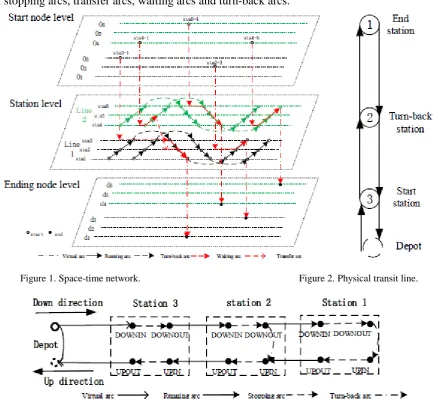
formulate the train timetable according to the passenger demand to minimize the total cost of the network. While the passengers adjust the departure time according to the train timetable to reduce their waiting time.While the travel process of the passenger and the train not only have spatial attributes, but also have time attributes. In order to more clearly describe the travel of passenger and the operation of the train, this paper makes a time discretion for the passenger's starting point and the nodes of each station to construct the space-time network of passenger.The space-time network is defined on the basis of the physical network which is described asG'(V',E)and V'is node set,
' ) , ( ), ,
(i t j s V wherein the node set includes the node of the station layer as shown in Figure.1 and the
virtual node. In the process of dealing with the nodes of the station, in order to describe the turn-back operation and the uplink and downlink of the train, each station is divided into four nodes in this paper, which represent Up-In, Up-Out, Down-In, Down-Out respectively. For example, a simple transit line is as Figure 2 shown, there are three stations and the second station is a turn-back station, which are abstracted to obtain the network of the train as shown in Figure 3. The connections of two
nodes form an arc, such that the arc (i,j,t,s)E wherein the arc set includes virtual arcs, running
arcs, stopping arcs, transfer arcs, waiting arcs and turn-back arcs.
[image:2.595.78.515.285.684.2]
Figure 1. Space-time network. Figure 2. Physical transit line.
Figure 3. Abstract network of the train.
Therefore, this paper proposes a double objective model considering the minimum cost of both sides of supply and demand. The objection is to minimize the total cost of the trains and passengers, which is as follows:
ijts E
ijts k k ijts ijts
E ijts a
a
ijts c y
x
z
( )
) (
Subject to:
Flow balance constraint of passengers
0, otherwise
, ), ( , 1 , ), ( , 1 ) ( : , ) ( : , a T s a d j a DT s a o j x x a E ijts t i a jist E ijts t i a
ijts (2)
Arc capacity constraint
E s t j i Cap y x ijts k k ijts a a
ijts
, ( , , , ) (3)Flow balance constraint of trains
otherwise , 0 , , depot to belongs , 1 , , depot to belongs , 1 ) ( : , ) ( : , k T t i k T t i yy ek
k s E ijts s j k jist E ijts s j k
ijts (4)
Traffic resource constraint
E s t j i Lcap y s t j i C ijts ijts k k
ijts
'''' , (' ' ' ')
)
( (5)
Passenger maximum travel time constraint:
A a T
c
x ijts a E
ijts a
ijts
, ) max( ) ( (6) Binary variables otherwise 0, arc the chooses a passenger when the , 1 a ijtsx (7)
otherwise 0 arc the chooses k train when the , 1 , k ijts
y (8)
Where: a
ijts
x , k ijts
y are both decision variables, identifying if passenger a choose the service of the
arc(i,j,t,s) and if train k runs on the arc (i,j,t,s) respectively, which are also zero-one variables.
Among of them, i、j represent station index, t、s represent time index, Erepresents the set of arcs
of space-time network, cijtsrepresents the general cost that passenger chooses arc(i,j,t,s), only
considering travel time here; ijtsrepresents the general cost that train chooses arc(i,j,t,s), only
considering travel time here,、represent the weight of passengers and trains in the objection,
which depends on the priority of train planning. o(a) represents the origin station of passenger a,d(a)
represents the destination of passenger a, DTa represents the start time and T is the end
time.Capijtsrepresents the maximum passenger number of the arc (i,j,t,s), that is arc capacity; when
the arc satisfies the condition ( , , , )i j t s Er, Capijts is train carrying capacity while when the arc
satisfies the condition ( , , , )i j t s Ew, Capijts is station carrying capacity. k s
T represents train k
departure time from depot, k
d
T represents train k return time to the depot. Ci'j't's'is the set of other arcs
that conflict with this arc (i,j,t,s).A represents the set of all passengers, Tmax(a) represents maximum
Lagrange Relaxation Algorithm
The train timetable problem has been proved to be a NP-hard problem by a lot of literature, the lower bounds of which can be solved by the Lagrange relaxation algorithm. Therefore, this paper chooses this algorithm to relax couple constraint (2) and capacity constraint(4) to original objection to by two Lagrange multiplier ijtsandijts.
E
ijts ijts
k ijts a
a ijts ijts
k ijts E
ijts k ijts a ijts E ijts
a
ijts c y x y Cap
x Z
) ( )
( )
(
)] (
[
min (9)
After relaxing the couple constraint, we can decompose original problem to two independent sub problem about train and passenger as follows:
) (
) (
1 ijts ijts a ijts E
a
ijts c x
Z
(10)
) ) (
( min
'
) (
2 ijts ijts ijts ijts ijts k ijts E
k
ijts Cap
y
Z
(11)
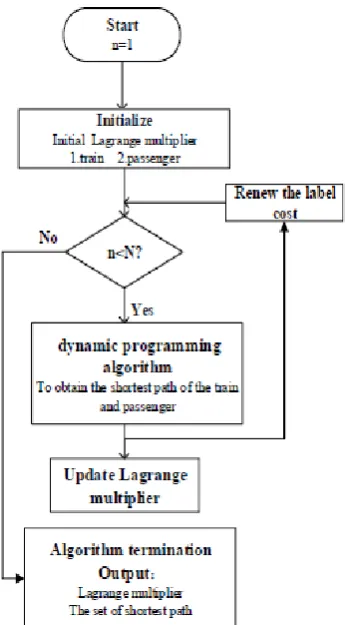
The sub problem of train or passenger can both be solved by shortest path algorithm in space-time network, then constantly update Lagrange multiplier to get feasible solution. The update method is as follows:
1
max{0, ( }, ( , , , )
n n n
k ijts ijts ijts ijts
k
y Lcap i j t s E (12)
1
ijts max 0, ( , , , )
n n n a k
ijts ijts ijts ijts
a k
x y Cap i j t s E (13)
where: n represents the number of iterations, is the step value, and
1 1
n n
T
Tabel 1. Parameters.
Station Station 1 Station2 Station3
Dwell time 0.5min 0.5min 0.5min
Figure 4. Flow chart of Lagrangian relaxation. Figure 5.Comparison between lower bound and the optimal.
Example
The model and algorithm in this paper are verified by a simple transit network in Figure 2 with three stations. The time horizon is one hours, from 8:00 am to 9:00 am and the time interval is 5 seconds. The interval of return is 3min and the minimum departure interval is 2 min. The train carrying
capacity is 10 and station carrying capacity is 20. The weight coefficient is 1/6 and is 5/6. The
[image:5.595.256.527.203.388.2]running time and dwell time are as shown in Table 1. The passenger OD and departure time are as shown in Table 2. All Lagrangian multipliers are initially assumed to be 1 and passenger maximum endurance travel time is two times of their free traveling time.
Table 2. Passengers OD. number Departure
time
O D number Departure time
O D number Departure time
O D
4 8:01 3 2 2 8:13 2 1 9 8:29 1 3
6 8:02 3 1 10 8:14 1 3 8 8:29 2 3
4 8:03 2 1 8 8:15 3 2 8 8:30 2 3
7 8:05 3 2 6 8:17 3 2 10 8:31 2 3
8 8:06 3 1 3 8:18 3 1 6 8:32 3 1
2 8:08 2 1 9 8:18 2 3 9 8:35 3 2
5 8:09 1 2 9 8:19 1 3 8 8:37 2 1
3 8:10 3 2 6 8:20 2 1 10 8:40 1 2
6 8:10 2 3 10 8:21 3 1 10 8:42 1 3
7 8:11 3 1 7 8:25 3 2 9 8:43 2 3
4 8:11 1 3 7 8:26 1 2 6 8:48 1 2
5 8:13 2 3 9 8:27 3 2 9 8:51 2 3
and the lower bound is 301.8 minutes. Figure 5 demonstrates a comparison between the lower bound and optimal value with a final solution gap of 1.3%.
Conclusions
This paper constructed a passenger-oriented timetabling model, and designed a Lagrange relaxation algorithm to decompose original problem to two sub problem in order to reduce the complexity of solving. Finally, through a simple transit network, we can obtain the lower bound of Lagrange relaxation problem. The difference between lower bound and optimal value is only 1.3% as shown in Figure.5, which can verify the correctness of the model and algorithm.
References
[1] Niu H M, Zhou X S. Optimizing urban rail timetable under time-dependent demand and oversaturated conditions[J].Transportation Research Part C 36 (2013) 212–230.
[2] Sun L J, Jin J G, Der-Horng Lee. Demand-driven timetable design for metro services[J]. Transportation Research Part C, 46 (2014) 284-299.
[3] Zhu Y T, Mao B H, Yun B. A bi-level model for single-line rail timetable design with consideration of demand and capacity[J].Transportation Research Part C: Emerging Technologies, Volume 85, December 2017, Pages 211-233.
[4] Pan S, Li R M. Optimization of Urban Single-Line Metro Timetable for Total Passenger Travel Time under Dynamic Passenger Demand [J].Procedia Engineering 137 (2016)151-160.
[5] Fisher ML. An Applications Oriented Guide to Lagrangian Relaxation [J]. Interfaces, 1995, 15(2): 49-58.
[6] Caprara A, Monaci M, Toth P.A Lagrangian Heuristic Algorithm for A Real-world Train Timetabling Problem[J].Discrete Applied Mathematics, 2006, 154(5): 738-753.
[7] Meng L Y, Zhou X S. Simultaneous Train Rerouting and Rescheduling on An N-track Network: A Model Reformulation with Network-based Cumulative Flow Variables [J].Transportation Research Part B: Methodological, 2014, 67: 208-234.