DUAL DATABASE STRATEGY AND I M P L E M E N T A T I O N
Chia-hao Chang
Dept. of Industrial & Systems Eng. U n i v e r i s i t y of M i c h i g a n
Dearborn, M i c h i g a n
Thomas G. Steiner
C o m p r e h e n s i v e Computer Consulting Northville, Michigan
ABSTRACT
In e x p a n d i n g from an a p p l i c a t i o n - o r i e n t e d h i e r a r c h i c a l database m o d e l information system to a system integrated with i n f o r m a t i o n - o r i e n t e d relational database model, IBM offers its IMS/DB2 dual database strategy. There are also other non-IBM database technologies c h a l l e n g i n g DB2 as the only alternative for IMS installation. A u t o m o b i l e industries t h e m s e l v e s are going through such a transition in d e v e l o p i n g their fourth-generation information systems. A couple major a u t o m o b i l e corporations with IMS-based information systems are brought up as examples. These corporations have d e v e l o p e d their design strategies and system architectures. Such an integration has influence upon the operating environment and the decision support for the e n d - u s e r - d r i v e n information retrieval applications.
INTRODUCTION
Ever since database had been brought to this world, d i s a g r e e m e n t s on the kinds of database model used and developed seemed never ending. CODASYL committee w a n t e d to set a standard, and had given t h e i r recommendations to use the network model, but IBM insisted on d e v e l o p i n g their IMS/DL/I using hierarchical models. In the 70s, Codd, based on the relational theory, founded his relational model, and constantly stressed on its sound theoretical foundation and simplicity to use, while Bachman, a p i o n e e r in developing CODASYL model, debated on the p r a c t i c a l i t y of using the traditional model (for both h i e r a r c h i c a l and network models). The dispute led to no conclusion. As far as most industry p r a c t i t i o n e r s were concerned, they only looked at the practicality. The hierarchical model reflected the structures of the assembled products(bill of material), and IBM's IMS/DL/I was the most c o m p l e t e d database system ever d e v e l o p e d adopting the hierarchical models. So IMS/DL/I became the most p o p u l a r l y used database system in the p r o d u c t i o n lines among the major corporations. Yet time had changed, user groups began to involve more non- technical m a n a g e m e n t personnel, whose needs and b a c k g r o u n d s were very different from the traditional information systems users. The typical application interests nowadays are answering ad hoc questions, a c c e s s i n g dynamic information, and p r o c e s s i n g low volume transactions. Compared to the traditional p r o d u c t i o n line processing which is c h a r a c t e r i z e d by high volume transactions, static applications and p r e s p e c i f i e d access paths, the current trend obviously demands for a different kind of database service.
TWO DIFFERENT KINDS OF SYSTEM
The traditonal a p p l i c a t i o n - o r i e n t e d h i e r a r c h i c a l database model information system successfully satisfies the needs of the p r o d u c t i o n lines where e f f i c i e n c y is emphasized. The model structure allows fast processing with the p r e s p e c i f i e d access paths. To high t r a n s a c t i o n volume applications, the saving in fast p r o c e s s i n g will be significant. The model provides satisfactory p e r f o r m a n c e to answer most queries, w h i c h are b a s i c a l l y primary- key queries. Most of the reports and a p p l i c a t i o n s are with little or no dynamic changes. Once they are developed using third g e n e r a t i o n languages such as COBOL, they can be used repeatedly.
When non-technical m a n a g e m e n t personnel becomes the user of computer technologies, their needs demand a more flexible system which will be able to respond to their changing requirements. It is quite a d i f f e r e n t situation. The t r a n s a c t i o n volume from those users is g e n e r a l l y low, and many accesses are not prespecified. The emphasis shifts from process e f f i c i e n c y to effectiveness in supporting the decision making. Relational database model is found to be
Chang and Steiner: Dual database strategy 209
very effective in searching and joining the data. Such p r o c e s s i n g is used
extensively to support the end-user's demands. To enable those end-users to
get information quickly and to modify the results dynamically, the system
implements u s e r - f r i e n d l y languages and methods, so the users can use the system
without extensive training. The direct end-users' involvement in the
application d e v e l o p m e n t resulted in better information for decision making and greater system's responsiveness to users.
IBM'S DATABASE STRATEGY
As one can see that there are two different kinds of fundamentally
incompatible needs w h i c h demand different kinds of information systems using
different database models. The information system using the traditional
hierarchical or n e t w o r k models can support high volume prespecified
applications, while the information system using the relational database models
can be designed to deal with more flexible and dynamic inquiries. To satisfy
both objectives, IBM has a cohesive and aggressive strategy.
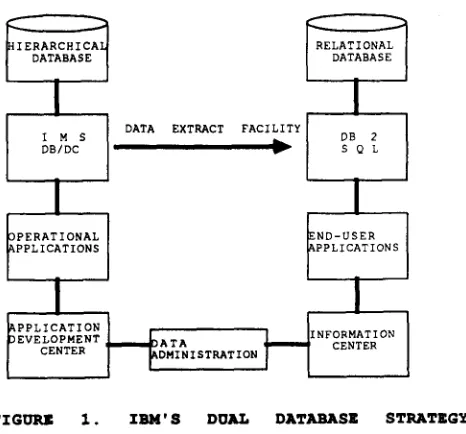
IBM has no intention to abandon its popularly used IMS, at least not yet.
IBM wants to keep IMS as the main product and complements it with an additional
i n f o r m a t i o n - o r i e n t e d relational database system, DB2. Such migration will
allow IMS c o n t i n u a l l y being used to support the heavy volume operational
applications, where the efficiency is very much concerned, while the end-users
can also obtain their information support from the relational database system,
that can p r o v i d e them w i t h more flexible and dynamic information. At the m e a n
time, DB2 is found quite slow in p r o c e s s i n g transactions, and the overhead is
higher than IMS, but since the transaction volume requesting to use DB2 is much
lower than IMS, those limitions can easily be overlooked. In the long run,
however, IBM's key strategic product will be DB2. The release v e r s i o n 2 of DB2
has a l r e a d y impressed many practitioners on its p r o c e s s i n g efficiency
improvement of about i0 to 25%. IBM expects every new release to increase
p r o d u c t i v i t y byl0 to 20%, and in i0 years DB2 will be able to cover full
function of IMS in performance. By then, all d e v e l o p m e n t s can be done under
DB2.
SO far d u r i n g this transition period IMS remains to be the main database
system, and the operational database still is the main database. To help
improve the p r o d u c t i v i t y of application development, IBM introduced various
application d e v e l o p m e n t aids such as the A p p l i c a t i o n D e v e l o p m e n t Facility (now
ADF II). Every new release of IMS improves its p e r f o r m a n c e and capabilities
consistent w i t h the new requirements for operating large transactions. While
DB2 is expected to take over the m a j o r i t y of developments in the future, IMS is
expected to b e c o m e a special fast transaction p r o c e s s s i n g database system. The
goal is to process over 4,000 transactions per second within i0 years. The
I
I M S DB/DCi
IPERATIONAL PPL ICATIONS
DATA EXTRACT
R•ELAT
I ONAL~I
FACILITY ~,~ DB S Q L 2 Ii
"~ND-USER .... ] %PPLICATIONS I
I
I
P LIcATIO
,
1INFORMATION
vE opM NT
[image:2.526.146.379.475.692.2]c o n t i n u i n g s u p p o r t of IMS is important. T h e r e are a r o u n d t h o u s a n d c o r p o r a t i o n s w h o s e p r o c e s s i n g m o d e is large s c a l e and h i g h volume. T h o s e c o r p o r a t i o n s are the m a i n t a r g e t s of IBM's dual d a t a b a s e strategy. The " g i v e - a w a y " p r o g r a m of l e t t i n g t h e m try DB2 for six m o n t h s w i t h no o b l i g a t i o n i n d u c e s o v e r 80% of the e x i s t i n g U.S. IMS u s e r s to l i c e n s e DB2.
At this s t a g e the m a i n f u n c t i o n of DB2 is to p r o v i d e i n f o r m a t i o n for d e c i s i o n support, and the m a i n g r o u p of u s e r s of DB2 is n o n - t e c h n i c a l m a n a g e m e n t p e r s o n n e l . To h e l p d e v e l o p e n d - u s e r a p p l i c a t i o n s , the c o n c e p t of i n f o r m a t i o n c e n t e r is s u g g e s t e d to implement. T h e u s e r i n t e r f a c e s of DB2 p r o v i d e n o n p r o c e d u r a l l a n g u a g e i n t e r f a c e and e m p h a s i z e on the r e l a t i o n a l view of d a t a b a s e . A c c e s s m e t h o d s i n c l u d e Q u e r y by E x a m p l e (QBE), A D R S - I I and S t r u c t u r e d Q u e r y L a n g u a g e / D a t a S y s t e m (SQL/DS), the key c o m p o n e n t of DB2. SQL is a set of b a s i c c o m m a n d s . T h e y act as the e x t e r n a l i n t e r f a c e to DB2 for data d e f i n i t i o n (such as CREATE, DROP, ALTER), d a t a m a n i p u l a t i o n (such as SELECT, INSERT, UPDATE, DELETE) and d a t a c o n t r o l (such as GRANT, R E V O K E ) . The data d e f i n i t i o n l a n g u a g e is i n i t i a l l y u s e d to c r e a t e the d a t a b a s e , and t h r o u g h the data m a n i p u l a t i o n l a n g u a g e , S Q L a c c e s s e s the d a t a u s i n g set o p e r a t i o n s , and the data c o n t r o l l a n g u a g e g r a n t s the a u t h o r i t y to a c c e s s d a t a b a s e . To p r o v i d e an e f f e c t i v e e n d - u s e r interface, the Q u e r y M a n a g e m e n t F a c i l i t y (QMF) is d e v e l o p e d to a c c e s s DB2 d a t a t h r o u g h S Q L and QBE. W i t h the c o n c e p t of i n f o r m a t i o n c e n t e r b e i n g i m p l e m e n t e d , e n d - u s e r s can d e v e l o p t h e i r own ad hoc q u e r y and reports w i t h the h e l p from the Q M F and the a s s i s t a n c e from the p r o f e s s i o n a l personnels. The i n t e g r a t i o n b e t w e e n IMS and DB2, a l o n g w i t h t h e i r d a t a b a s e s , user interfaces, a p p l i c a t i o n d e v e l o p m e n t t o o l s and i n f o r m a t i o n c e n t e r concept, forms the b l u e p r i n t of IBM's f o u r t h - g e n e r a t i o n a r c h i t e c t u r e , a d u a l - d a t a b a s e strategy.
S T R A T E G I E S A D O P T E D BY A U T O M O B I L E C O R P O R A T I O N S
W h i l e IBM o f f e r s its I M S / D B 2 dual d a t a b a s e s t r a t e g y and c o n s i d e r s DB2 as the e m e r g e n c e of I B M ' s f o u r t h g e n e r a t i o n d a t a b a s e b l u e print, t h e r e are also o t h e r n o n - I B M d a t a b a s e t e c h n o l o g i e s , s u c h as C u l l i n e t ' s I D M S / R and some fourth g e n e r a t i o n l a n g u a g e s , c h a l l e n g i n g DB2 as the o n l y a l t e r n a t i v e for IMS i n s t a l l a t i o n . A u t o m o b i l e c o r p o r a t i o n s , the m a j o r i n d u s t r i e s of this nation, are g o i n g t h r o u g h s u c h a t r a n s i t i o n in d e v e l o p i n g t h e i r own f o u r t h - g e n e r a t i o n i n f o r m a t i o n systems. M o s t of t h e i r i n f o r m a t i o n s y s t e m s are I M S - b a s e d . Their d a i l y o p e r a t i o n s are u s u a l l y d e a l e d w i t h h i g h v o l u m e of t r a n s a c t i o n s t h a t need fast p r o c e s s i n g . In o r d e r to s u p p o r t the n o n - t e c h n i c a l m a n a g e m e n t users, the s y s t e m s are u n d e r e x p a n s i o n to i n c l u d e e f f e c t i v e d e c i s i o n s u p p o r t function. T h e i r a p p l i c a t i o n - o r i e n t e d h i e r a r c h i c a l d a t a b a s e s y s t e m is to i n t e g r a t e the i n f o r m a t i o n - o r i e n t e d r e l a t i o n a l d a t a b a s e s y s t e m w i t h e n d - u s e r - o r i e n t e d interfaces. The f o l l o w i n g is the dual d a t a b a s e s t r a t e g i e s a d o p t e d by two m a j o r a u t o m o b i l e c o r p o r a t i o n s .
C o r p o r a t i o n One
C o r p o r a t i o n one has d e v e l o p e d m o s t of its p r o d u c t i o n a p p l i c a t i o n systems u n d e r the I M S / D L / I e n v i r o n m e n t . The l a n g u a g e i n t e r f a c e is COBOL. M a j o r p r o d u c t i o n a c t i v i t i e s such as the s h i p p i n g and r e c e i v i n g of s p e c i f i c parts, i n v e n t o r y control, and the p a c k a g i n g of p a r t s h a v e i m p l e m e n t e d on-line p r o c e s s i n g . T h e r e are h i e r a r c h i c a l d a t a b a s e , r e l a t i o n a l d a t a b a s e and i n d i v i d u a l files u s i n g at the c o r p o r a t e , d i v i s i o n and p l a n t levels. B e c a u s e of the high t r a n s a c t i o n v o l u m e of the p r o d u c t i o n a p p l i c a t i o n systems, IMS will c o n t i n u e to be the p r i n c i p a l d a t a b a s e m a n a g e m e n t s y s t e m in the n e a r future.
D e c i s i o n s u p p o r t has r e c e n t l y b e c o m e a v a i l a b l e to the e n d - u s e r s u n d e r the " i n f o r m a t i o n c e n t e r " concept, w h i c h d e v e l o p s a p p l i c a t i o n s u s i n g fourth g e n e r a t i o n l a n g u a g e s and r e l a t i o n a l d a t a b a s e support. T h e l a n u g a g e of choice is I n f o r m a t i o n B u i l d e r ' s FOCUS. The r e l a t i o n a l d a t a b a s e u s e d by FOCUS is e x t r a c t e d from the o n l i n e o p e r a t i o n a l IMS d a t a b a s e on the d a i l y base. T h e r e f o r e to a point, the i n f o r m a t i o n o b t a i n e d from the r e l a t i o n a l d a t a b a s e may not r e f l e c t up to the m i n u t e s i t u a t i o n , but t h a t u s u a l l y is not i m p o r t a n t to the e n d - u s e r s . T h e i r i n t e r e s t s are m o r e f o c u s e d on the m a n a g e r i a l i n f o r m a t i o n such as the o v e r a l l t r e n d of the t r a n s a c t i o n s i n s t e a d of the p e r f o r m a n c e of a s i n g l e t r a n s a c t i o n . T h e d e c i s i o n s u p p o r t i n f o r m a t i o n c o n c e r n s m u c h w i d e r time zone, from p a s t to future. T h a t is d i f f e r e n t from the p r o d u c t i o n line where the c u r r e n t i n f o r m a t i o n is m o s t important.
Chang and Steiner: Dual database strategy 211
C o r p o r a t i o n T w o
C o r p o r a t i o n t w o has a l s o d e v e l o p e d m a n y of its p r o d u c t i o n a p p l i c a t i o n systems, i n c l u d i n g its p a y r o l l system, b i l l i n g system, d e a l e r financial a c c o u n t i n g s y s t e m and e x e c u t i v e b o n u s e s system, u n d e r the IMS d a t a b a s e m a n a g e m e n t system, w h i c h is the p r i n c i p a l d a t a b a s e m a n a g e m e n t system r e s p o n s i b l e for the h i g h v o l u m e t r a n s a c t i o n p r o c e s s i n g .
The c u r r e n t s y s t e m has b e e n e n h a n c e d to p r o v i d e a d d i t i o n a l r e p o r t i n g c a p a b i l i t i e s u s i n g F O C U S as the r e p o r t g e n e r a t o r . In the past, the c o r p o r a t i o n a l l o w e d its a p p l i c a t i o n d e v e l o p e r s try d i f f e r e n t s o f t w a r e p r o d u c t s , and that r e s u l t e d in s e v e r a l " s t a n d a r d " systems. In the future, IMS and DB2 will be used as this c o r p o r a t i o n ' s m a i n d a t a b a s e m a n a g e m e n t systems. All n e w a p p l i c a t i o n s will f i r s t be r e v i e w e d to see if t h e y c o u l d be i m p l e m e n t e d in an IMS, DB2 or IMS/DB2 e n v i r o n m e n t .
Some O b s e r v a t i o n and C o m m e n t s
B o t h c o r p o r a t i o n s seem to h a v e the same long r a n g e plan. T h e y are g o i n g to use I M S / D B 2 dual d a t a b a s e s t r a t e g y for t h e i r f u t u r e a p p l i c a t i o n s . IBM's p l a n is to i m p r o v e D B 2 ' s p r o d u c t i v i t y so t h a t e v e n t u a l l y DB2 will be the main d a t a b a s e s y s t e m c o m p l e m e n t e d by the s p e c i a l fast p r o c e s s i n g IMS. It seems both c o r p o r a t i o n s will do j u s t that. U n l e s s t h e r e is an i n d i c a t i o n t h a t an a p p l i c a t i o n n e e d s IMS Fast Path, or r e q u i r e s a s u b s t a n t i a l a p p l i c a t i o n base in IMS, the n e w a p p l i c a t i o n will be d e v e l o p e d u n d e r DB2.
Both c o r p o r a t i o n s are c u r r e n t l y i n v o l v e d the u s i n g of f o u r t h g e n e r a t i o n languages, e s p e c i a l l y FOCUS, in t h e i r a p p l i c a t i o n d e v e l o p m e n t s . W h e n DB2 is to be u s e d as the m a i n d a t a b a s e m a n a g e m e n t system, one has to c o n c e r n the future p o s i t i o n of t h o s e l a n g u a g e s . A good i n d i c a t i o n is t h a t the list of fourth g e n e r a t i o n l a n g u a g e s , i n c l u d i n g b o t h IBM and n o n - I B M p r o d u c t s , that have i n t e r f a c e s w i t h s t r u c t u r e d q u e r y l a n g u a g e (SQL) is growing. Both c o r p o r a t i o n s have p e r s o n n e l s w h o are e x p e r i e n c e d in FOCUS will n a t u r a l l y c h o o s e FOCUS as the f o u r t h g e n e r a t i o n l a n g u a g e i n t e r f a c i n g w i t h DB2 d a t a b a s e . S i n c e S Q L can also be e m b e d d e d in COBOL, t h a t p e r m i t s b a t c h a p p l i c a t i o n p r o g r a m s w r i t t e n in C O B O L
(as well as in PL/I, F O R T R A N and o t h e r languages) to a c c e s s DB2 d a t a b a s e .
The dual d a t a b a s e s t r a t e g y seems e f f e c t i v e l y p r o v i d e u s e r s b o t h the d e c i s i o n s u p p o r t and fast t r a n s a c t i o n p r o c e s s i n g c a p a b i l i t i e s . The n o n p r o c e d u r a l e n d - u s e r i n t e r f a c e not o n l y e n c o u r a g e s m o r e n o n - t e c h n i c a l users u t i l i z i n g the c o m p u t i n g t e c h n o l o g y , it a l s o a l l o w s e n d - u s e r s to d e s i g n and d e v e l o p t h e i r own a p p l i c a t i o n s and g e n e r a t e i n f o r m a t i o n to s a t i s f y t h e i r own needs. At the same time, this a d d i t i o n a l c o m p o n e n t a l l e v i a t e s some w o r k from the h e a v y - l o a d e d IMS system. H e n c e IMS can be u t i l i z e d m a i n l y for o p e r a t i o n a l t r a n s a c t i o n p r o c e s s i n g , w h i l e the r e l a t i o n a l d a t a b a s e s y s t e m or the fourth g e n e r a t i o n l a n g u a g e h a n d l e s the d e c i s i o n s u p p o r t a p p l i c a t i o n s .
C O N C L U S I O N
The d a t a b a s e s t r a t e g y has e v o l v e d from the t r a d i t i o n a l h i e r a r c h i c a l m o d e l s to dual d a t a b a s e models. S u c h a m i g r a t i o n has r e s u l t e d s u c c e s s f u l l y in s u p p o r t i n g the h i g h v o l u m e t r a n s a c t i o n p r o c e s s i n g at the o p e r a t i o n a l level and e n d - u s e r - d r i v e n i n f o r m a t i o n r e t r i e v a l at the m a n a g e m e n t level. The c o u p l e m a j o r a u t o m o b i l e c o r p o r a t i o n s m e n t i o n e d in the p a p e r are the examples.
REFERENCE
[i] IBM Database 2 S Q L Usage Guide, IBM International Systems Centers - Santa
Teresa, San Jose, 1983
[2] "IBM Powers Up," Business Software Review, February 1987
[3] "Making the Decision: Which 4GL?", Computerworld, June 6, 1986
[4] Babcock, C. "Answering Skeptics, DB2 Thrives in Production Systems,"
Computerworld, N o v e m b e r 24, 1986
[5] Codd, E. "Inside [BM's Relational 'Strategy'," Computerworld-Extra,
December 3, 1986
[6] Dash, J. and R. Ojala "IBM Database 2 in An information M a n a g e m e n t System
Environment," IBM Systems Journal, Vol. 23, No. 2, 1984
[7] Hessinger, P. "DB2 and IMS, The Options Doubled, and So Did The Confusion,"
Computerworld-Extra, December 4, 1985
[8] Hessinger, P. "Good for What Ails You?" Computerworld, October 8, 1986
[9] Hessinger, P. "IBM's Database Strategy for Tomorrow," Computerworld, April 9, 1984
[10] Kaiser, M. "SQL Speaks to Databases," Computerworld, December 3, 1986
[11] Martin, J., M a n a g i n g the Database Environment, Prentice-Hall, Englewood