2018 International Conference on Communication, Network and Artificial Intelligence (CNAI 2018) ISBN: 978-1-60595-065-5
System Approach to Digital Mining
Andrey Ostroukh
*and Nataliya Surkova
Moscow Automobile and Road State Technical University (MADI), Russian Federation *Corresponding author
Keywords: Digital mining, Internet of Things (IoT), Mnemonic scheme, Human Machine Interface (HMI), Autonomus haulage vehicle.
Abstract. The article proposes the system approach to digital mining that integrates the processes of interaction control systems for mining industry. On the system tasked motion control special machinery and spatial position and its working bodies, dispatching transport operations in real time. Search optimal algorithms and technologies appropriate to the level of economic justification of the main criterion of promotion of automation in the roads construction. This is intended to show the process and benefits to mining model embedded with intelligent data. Such a model can serve as the basis for how contractors plan. With intelligent modeling, users can add and remove information in real time while simultaneously looking at multiple ways to perform construction work instead of making manual modifications.
Introduction
The mining industry is as vital to today’s global economy as ever before, yet it is at a crossroad. It is an industry that is currently combating multiple adverse global trends such as falling commodity prices, a slowing global economy and skilled labor shortages.
Divergent industry views and experience with respect to information and communication technology (ICT) deployment and innovation are clear to see [1, 2]. On the one hand, enough data exists to suggest that mining companies are beginning to take ICT seriously. Total ICT spending in the global mining sector is projected to increase from US$16.3 billion in 2010 to US$26 billion in 2018, growing at a compounded annual rate of 5.4%. The main drivers cited for such “rapidly” increasing ICT spending are similar to those for the modern trends and challenges.
In this research will explore how the mining sector could adopt the most tried-and-true and up-and-coming Digital Mining and Internet of Things (IoT) technologies, especially once the exploration and planning cycles recommence.
Internet of Things Technologies in Mining
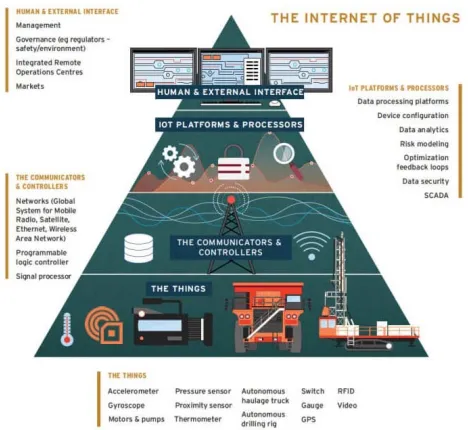
Some skeptics, especially those with a background in industrial equipment, have wondered aloud if anything is new, especially when much of the IoT discussion is coupled with automation. The industry has been deploying programmable logic controller (PLC) and supervisory control and data acquisition (SCADA) systems for industrial processes and automation for years, including at mine sites [3]. However, despite the complexity of these systems, they were never quite designed to communicate with each other or within a larger system.
Figure 1. Internet of things technologies in mining.
Many of these machines do not have recognizable computing parts such as a touchscreen or a monitor, leading some to call the machines “headless” IoT devices. Indeed, the likelihood of “headless” may well be a way to differentiate the consumer side of the IoT with the industrial side.
The IoT can be manifested in vehicle collision avoidance systems, which include personnel and vehicle tags that can communicate wirelessly, and in trucks equipped with infrared, radar and video systems, all for the purpose of notifying operators of the presence of obstacles. In addition, Schneider Electric suggests that miner safety could improve with using the IoT to integrate “people tracking, communications, video surveillance and analytics, and real-time personal health management.” That said, perhaps another way to address health and safety concerns is to simply remove people from the front-line operations.
Digital Mining Productivity Solutions
Digital Mining is a suite of technologies that can improve performance, reliability, safety, and operations by providing intelligent, real-time monitoring that makes it possible for mine operators to make data-driven decisions that improve equipment reliability and optimize mine operations (Figure 2).
[image:2.612.201.414.522.714.2]Digital Mining is powered by Predix, GE’s cloud-based operating platform built exclusively for industry, and delivers interconnected technology needed to achieve breakthrough levels of efficiency and maximum performance by combining machine sensors, connectivity, data capture, visualization, and analytics. It collects information such as vibration data, temperature, and pressure to inform mine operators of machine health, and also detects impending failures before they occur. The data collected enables the linking of insights across machines and processes.
Mining, as an industry, faces strong headwinds and must drive productivity and improve operational savings. Digital Mine, through advanced sensor technology and analytics, seizes the industry’s untapped data to help make a difference. Using Industrial Internet mindset to actively monitor and diagnose equipment and operations to improve assets, maximize efforts, boost fuel efficiency, and lower costs.
[image:3.612.190.426.262.410.2]In addition to software, Digital Mining provides customized solutions. For example, Komatsu is using GE’s 400 Ton Wheel Motor on its new 980E-4 mining haul truck (Figure 3). It is the industry’s most powerful and efficient electric wheel motor and has created a new class in haul truck performance.
Figure 3. Komatsu 980E-4 Autonomus haulage vehicle.
Its drive system delivers the lowest operating cost per ton in the 400-T haul truck class market. Digital solutions can help customers reduce equipment failures, deliver up to 5 percent improvement in mineral recovery, and increase optimization.
Mining Fleet Management System
Advanced Mining Fleet Management System (FMS) to meet the needs of the mining sector and delivers increased productivity and higher production (Figure 4). FMS is a state-of-the-art, feature rich, system that can be customized to customer requirements.
This system has a critical advantage of being able to act as the site FMS or conversely, integrate with most common FMS to receive dispatch information and communicate information with an autonomous fleet.
Software platform is the leader in OEM agnostic command and control of autonomous mining vehicles. Mobius operates at the system level on a dedicated server housed in a site control room. Mobius is connected to each vehicle via an RF Network such as wireless mesh, LTE, or others [4 – 7].
FMS are designed for modular, yet scalable deployment and recognizes the daunting task of automating all aspects of a surface or underground mines in one step. Yet, a piecemeal approach often introduces risk of deploying independent systems which are unable to integrate later into an overall mine system.
FMS easily scales from small mines to a very large mines with multiple pits and dumping areas. FMS is rugeed, built specifically to operate in the harsh mining environments. Designed to be user friendly is highly configurable on the fly.
Figure 4. Mining fleet management system.
With software installed as a foundation, mines can implement individual projects that can then scale into larger integrated solutions with the aim of ultimately realizing a fully autonomous, yet integrated mining operation:
move more coal without having to buy more trucks or excavators;
lower fuel costs: Trucks don’t wait as long for an excavator;
park trucks when they are not needed, saving fuel and maintenance;
more accurate loading: Excavator operators can see the tonnage as they load;
real-Time KPI’s and Management Reporting Current Information: don’t make decision with yesterday’s data;
view real-time production data onsite or from the company HQ office anywhere in the world;
better equipment preventive maintenance using OEM Engine Health real-time data and prestart check functionality;
lowest price for a high quality system;
in country support and maintenance;
locally developed, managed, installed and maintained by experts in the business for over 10 years.
Mining Truck Haulage Onboard System
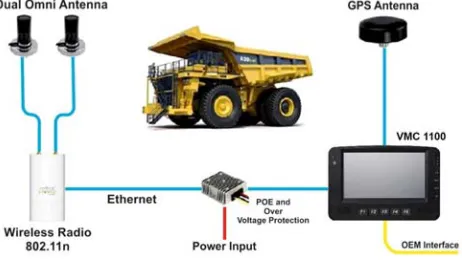
Mining Truck Haulage Onboard System for consists of a rugged LCD touch screen integrated display and processor, with WiFi communications and GPS tracking capabilities (Figure 5).
This is a system of robotic components that installs easily into any vehicle platform, converting it from manual to robotic control [8 – 15]. Depending on the unique characteristics of each vehicle, we may use any one or a combination of by-wire, mechanical, and/or hydraulic modules to complete the automation.
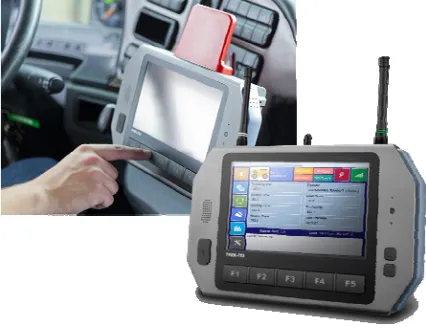
[image:4.612.192.423.576.706.2]Operators receive their assignments and update their status with the system unit (Figure 6).
Figure 6. Human machine interface.
The moving mine map display always shows the operator their current position and guides them to their next assignment (loader, dump, etc.).
The onboard screen also shows the location of the other equipment around the mine that is installed with software.
Conclusion
However, Digital Mining provides embedded technologies to turn a ‘dumb’ machine into an intelligent machine, and allows both centralized and distributed analytics, as well as control and ubiquitous connectivity via the internet.
In the evolving field of the industrial internet, decisions are often made centrally in monolithic data analytics applications sitting over ‘data lakes’, but also in a distributed fashion through edge analytics. Any future autonomous mining platform will need to support both scenarios in order to be successful.
References
[1] Ostroukh, A.V. (2013). Systems of Artificial Intelligence in the Industry, the Robotics and the Transport Complex. Krasnoyarsk, RU: Publishing House Science and Innovation Center, Ltd. [2] Ostroukh, A.V. & Surkova N.E. (2015). Intelligence Information Systems and Technologies. Krasnoyarsk, RU: Publishing House Science and Innovation Center, Ltd.
[3] Salniy, A.G., Kukharenko, V.N., Nikolaev, A.B. & Ostroukh, A.V. (2013). General Principles of SCADA Design. Automation and Control in Technical Systems, 2(2), 8-12.
[4] Nikolaev A.B., Vasuhova S.A., Ostroukh A.V. Automated Systems and Industrial Robots Remote Control // SGEM2014 Conference Proceedings, ISBN 978-619-7105-10-0 / ISSN 1314-2704, June 19-25, 2014, Vol. 1, 51-56 pp. DOI: 10.5593/SGEM2014/B21/S7.007.
[6] Ostroukh A.V., Krasnyanskiy M.N., Obukhov A.D., Karpov S.V., Dedov D.L. Development Of Automated Information Systems for Monitoring of Intellectual Activity Results // SGEM2015 Conference Proceedings, ISBN 978-619-7105-34-6 / ISSN 1314-2704, June 18-24, 2015, Book2 Vol. 1, 101-108 pp. DOI: 10.5593/SGEM2015/B21/S7.014.
[7] Ostroukh A.V., Nikolaev A.B., Surkova N.E., Krasnyanskiy M.N. Development of Laboratory Work for Remote Access Laboratory // SGEM2014 Conference Proceedings, ISBN 978-619-7105-10-0 / ISSN 1314-2704, June 19-25, 2014, Vol. 1, 119-126 pp. DOI:
10.5593/SGEM2014/B21/S7.016.
[8] Maksimychev O.I., Ostroukh A.V., Zbavitel P.Yu., Ivakhnenko A.M., Ephimenko D.B., Karelina M.Y. Technology of Monitoring and Control Algorithm Design for Earth-Moving Machine // International Journal of Applied Engineering Research. 2016. Vol. 11. No 9. pp. 6430-6434.
[9] Maksimychev O.I., Ostroukh A.V., Pastukhov D.A., Karelina M.Y., Zhankaziev S.V., Nuruev Y.E. Automated Control System of Road Construction Works // International Journal of Applied Engineering Research. 2016. Vol. 11. No 9. pp. 6441-6446.
[10] Ostroukh, A.V., Gimadetdinov, M.K. & Popov, V.P. (2015). Selection Process Equipment for Automated Crushing Plant. Automation and Control in Technical Systems, 4(2), 35-45. DOI: 10.12731/2306-1561-2015-2-4.
[11] Gimadetdinov, M.K. & Ostroukh, A.V. (2014). List and Sequence of Solutions for Automated Crushing and Screening Production. Automation and Control in Technical Systems, 3(4), 55-61. DOI: 10.12731/2306-1561-2014-4-6.
[12] Ostroukh, A.V., Gimadetdinov, M.K., Borshch V.V. & Vorobeva, A.V. (2014). Development statistical modeling algorithm optimal control automated crushing and screening process. Industrial Automatic Control Systems and Controllers, (12), 3-10.
[13] Gimadetdinov, M.K., Popov, V.P. & Ostroukh, A.V. (2015). Automation of Crushing and Screening Production with a Full Range of Technological Operations and Related Processes. Industrial Automatic Control Systems and Controllers, (9), 10-18.
[14] Ostroukh, A. V., Nedoseko, I. V., Surkova, N. E., & Bulatov, B. G. (2016). Automated Control System for the Milling Unit of Mineral Powders Plant. International Journal of Applied Engineering Research, 11(4), 2625-2628.