2018 International Conference on Computer Science and Software Engineering (CSSE 2018) ISBN: 978-1-60595-555-1
Adaptive Feature Fusion Object Tracking
with Kernelized Correlation Filters
Baoyi Ge, Xianzhang Zuo and Yongjiang Hu
1
ABSTRACT.
Aiming at the problem of occlusion in object tracking, adaptive feature fusion object tracking with kernelized correlation filters is proposed to advance the robustness of the correlation filter for object tracking. Firstly, feature fusion based on tracking confidence is proposed to improve the robustness of object tracking. Then combined with the detection method of tracking confidence to solve the object occlusion and tracking failure. Finally, template updating strategy based on tracking confidence is proposed to solve the drift problem. The experiment carries on the OTB100 dataset, and compares with other tracking algorithms. The results show that the tracking precision is 4.5% higher than that of the optimal algorithm, and the tracking success rate is improved by 6.1%. Moreover, the object can be well tracked under the occlusion.
INTRODUCTION
Relatively, correlation filter for object tracking has attracted wide attention due to its fast tracking speed and high robustness recently. However, it still facing with many difficulties, mainly due to the deformation, rotation, occlusion, fast motion and background clutters of the object in the tracking process. In view of the above problems, many researches have been carried out.
Henriques et al. [1] proposed kernelized correlation filters (KCF) object tracker. The sampling process of correlation filter training is equivalent to the cyclic shift operation by using the property of cyclic matrix to complete the dense sampling of model training. The kernel function is used to improve the robustness
of object tracking. Bibi et al. [2] proposed the scale adaptive kernel correlation filter (SAMF) tracker. By constructing the object scale pool, the change of the object scale is estimated. The problem of the change of the object size is solved, but the scale pool is limited and is not sensitive to the change of object scale. Danelljan et al. [3] proposed discriminative scale space tracker (DSST), which is simple, efficient and accurate in estimating the change of object scale by extra one-dimensional scale correlation filter. Ma Chao et al. [4] proposed the hierarchical convolutional features tracker (HCFT) to extract more robust features by convolution neural network. Liu Ting et al. [5] proposed adaptive block object tracking Real-time part-based tracker via adaptive correlation filters (RPAC). The object block is tracked by correlation filter, and then the final tracking result is based on all the block information. However, the model is complex, in some cases, the robustness is not high enough.
Although the relevant research has made some progress, the tracking robustness needs to be further improved, tracking failure occurs when the object is occluded, and the model is prone to drift. In view of the above problems, this paper puts forward adaptive feature fusion object tracking with kernelized correlation filters algorithm. Firstly, feature fusion method based on tracking confidence is proposed to improve the robustness of object tracking, and then combined with the detection method of tracking confidence to solve the object occlusion and tracking failure. Finally, template updating strategy based on tracking confidence is proposed to solve the drift problem. The experimental results show that the proposed algorithm can better solve the occlusion problem and improve the robustness of tracking.
KERNELIZED CORRELATION FILTERS FOR OBJECT TRACKING
The kernelized correlation filtering object tracker first trains the correlation filterw according to the object features and searches for the maximum response in the next frame as the object location. Correlation filter model training constructs the loss function to make T
( )
f x =w x and value minimize error:
2
min ( ( ) )
n
i i i
f − +λ
∑
ω x y
ω (1)
Where λ is the tradeoff factor, the closed solution can be obtained:
H 1 H
(
λ
)−= +
ω X X I X y (2)
Where H * T
( )
=
X X , *
X is the complex conjugate matrix of X, then we can
obtain:
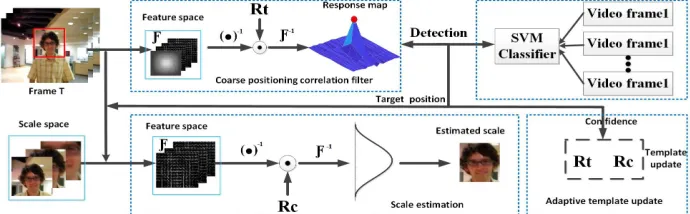
Figure 1. Flow chart of our algorithm.
Where represents the multiplication of the corresponding element, ˆw=Fw
represents the DFT result of w. For nonlinear cases, the kernel function method
is used, so we can express ( )f z as:
1
( ) ( , )
n T
i i i
f
κ
=
= =
∑
z w z α z x (4)
The dual space coefficient α obtained from the upper formula is:
1
(K
λ
)−= +
α I y (5)
In this paper, Gaussian kernel function is used:
(6) The maximum response value is:
(7) The template is solved by the previous frame, in the next frame, the maximum response is output as the object location. In order to reduce the computation and the effect of noise, the following model update strategy is adopted:
1
ˆn =
η
ˆ+(1−η
)ˆn−x x x (8) 1
ˆn =
η
ˆ+(1−η
)ˆn−α α α (9)
Where η represents the model update rate.
ADAPTIVE FEATURE FUSION OBJECT TRACKING WITH KERNELIZED CORRELATION FILTERS
effect of adaptive update template to solve the model drift problem. The details are as follows:
Object Tracking Confidence
Correlation filtering object tracking determines the location of object by the response map, and the maximum response will be the object. By analysing the response map, the tracking effect can be judged. To solve the model drift problem caused by occlusion in object tracking, a model updating method based on response peak value is proposed [6,7], which is based on the confidence degree of object response peak value. When the peak value meets a certain threshold, the strategy solves the model drift problem in object tracking to a certain extent. However, as shown in figure 2, the tracking peak is still large in the following cases, but the object has been occluded, the model has drifted, Therefore, using peak value as an indicator of occlusion confidence has great limitations. The average peak-to correlation energy (APCE) index of average peak correlation energy confidence, is proposed [8]:
(
)
2 max min
2 , min ,
mean ( k )
k APCE
ω ω
− =
−
∑
G G
G G (10)
Where Gmax/Gmin represents the maximum / minimum value of the response map,
respectively. Gω,k represents different response values. APCE is the description of the fluctuation of object tracking.
[image:4.612.100.495.531.637.2]According to the object tracking effect, when the object tracking well, the response fluctuation is small and the APCE value is large. When the tracking is interfered, the APCE value is small. Therefore, APCE can better reflect the effect of object tracking. At the same time, APCE calculates according to the response map and has low computational complexity and less time consuming, which is a better object tracking confidence index.
Adaptive Feature Fusion
The Correlation filtering object tracker MOSSE uses gray feature as object descriptor, but gray feature is easily affected by environmental factors, such as noise and illumination, etc. Therefore, the robustness of tracking is low. Subsequently, HOG (Histograms of oriented gradients) is used as the object tracking feature. The HOG [9] feature is constructed by calculating and counting the oriented gradients of histogram of the local region. The local appearance of the object is constructed by calculating and counting the oriented gradient histogram. The object local appearances and shapes can be well described by the distribution of local gradients and edges, its pair of light and other factors are insensitive.
Local sensitive histogram (LSH) [10] was applied to the object tracking. LSH collects the area around a pixel of the object, calculates the histogram of each point, and then adds the histogram of each pixel's histogram. All the interval values of the histogram of each pixel are weighted as the pixel values of the corresponding position. The local sensitivity histogram feature considers the influence of surrounding pixels on the central pixel and has good adaptability to the variations of illumination and attitude.
The representation of single feature to object feature is incomplete, therefore, the object tracking method based on feature fusion is more robust. In this paper, the HOG feature and the LSH feature fusion is adopted, HOG on the object details and LSH complement each other around the object pixel representation of the object more comprehensive characterization. The APCE object tracking confidence is derived from the adaptive weight, and the higher weight is assigned to the response with better feature representation, so as to obtain better tracking results.
1 1 2 2
p p
A A
= +
res res res (11)
Where Ap represents the confidence value, res represents response value.
The final object tracking response is a weighted result of HOG and LSH features, which is better for object tracking.
Track-by-detection
In the process of object tracking, it is easy to cause the tracking failure due to the occlusion and out of view. Track-by-detection tracking method can better solve the occlusion and loss tracking problem. object tracking based on online SVM [11] is accomplished by initial modelling and online update classifier.
determine the location of the object, to continue tracking, and to update the model when the confidence of object tracking is high, so as to prevent the object model from drift due to environmental interference.
Model Update Strategy
The object tracking process needs to update the model to accommodate the object changes. The standard correlation filtering uses the formula (8-9) to update the template. When the object is occluded, or the migration occurs, the model is contaminated and the error accumulates, resulting in tracking failure.
Based on the confidence degree to judge the object tracking effect, updating the model according to the object tracking situation can avoid model pollution, effectively, but the previous object tracking confidence threshold needs to be set artificially based on experience. It leads to the decrease of adaptability in different scenarios, and the fixed threshold cannot satisfy various tracking conditions. In this paper, an adaptive confidence threshold method is proposed. In different tracking scenarios, the model update threshold can be determined adaptively, and the tracking is more robust. The threshold is set as follows:
(1 )
shd = −
κ
•shd+ •κ
APCE (12)Where shd is the model update threshold,
κ
is the threshold update rate,APCEis the confidence index.
1 if
0 else
APCE shd
update= > •
γ
(13)
Where
γ
is the object confidence factor.The confidence index of the current frame is calculated after the new frame tracking, and the calculation amount is greatly reduced, the information of the current tracking confidence degree and the original tracking confidence degree is combined. At the same time, the threshold updating strategy can reduce the number of model computation and update to a certain extent, and accelerate the object tracking speed.
EXPERIMENT
environment is MATLAB 2017a, the processor is Intel core i5, the main frequency is 2.3GHz, and the memory is 8G.
The contrast experiment method is used, except for the algorithm of this paper. The other methods for tracking object tracking are as follows: KCF [1], DSST [3], MIL [14], TSST [15], STRUCK [16], CT scanning [17], OAB [18]. The experimental parameters are set: the object expands to 1.8, the model update
rate ηis 0.025, the threshold renewal rate
κ
is 0.1, the object confidence factorγ
is0.7, and the rest parameters are the same as [3].
In order to evaluate the performance of the trackers, the object tracking success rate and precision are used. The object tracking success rate is evaluated by the overlap rate of the tracking boundary frame. The number of successful frames whose overlap rate is greater than a given threshold is calculated in the experiment:
t a t a
S=
∩
∪
R R
R R (14)
Where Rt /Ra represents object region and the ground truth region,
respectively, the larger S means the higher accuracy.
The precision of object tracking is measured by calculating the distance between the object frame and the center of the tracking frame, and the smaller distance means the higher precision.
b t
∆ = D −D (15)
Where Db /Dt represents the center position of ground truth and the tracker
center position.
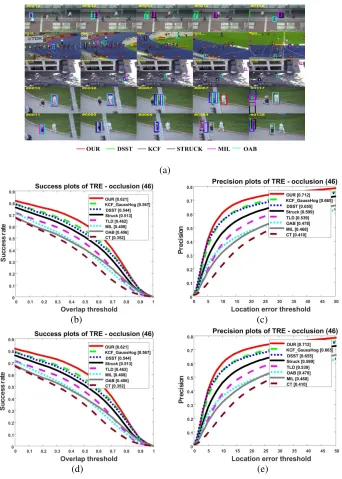
1. As shown in figure 3 (a), the partial tracking results of our method and the contrast tracking method on OTB100 show that our method is better for object tracking, especially in the case of occlusion. Therefore, the tracking strategy based on detection can solve the occlusion and misalignment problems of object tracking effectively.
2. As shown in figure 3 (b-c), the statistical index data of the tracking results of our method and the contrast tracking method in the OTB100 dataset. As shown in the figure, we can see that the success rate of object tracking in our method is improved by 6.1% compared with KCF, which is 9.5% higher than that of DSST. Compared with KCF, the precision of object tracking is improved by 4.5%, which is 5.4% higher than that of DSST, which is more obvious than other object tracking algorithms. Therefore, this method combined with adaptive feature fusion method can better improve the robustness of object tracking.
than other object tracking algorithms. The object detection algorithm based on confidence degree can keep the object tracking in the case of object occlusion and tracking failure.
(a)
(b) (c)
[image:8.612.132.474.147.626.2](d) (e)
CONCLUSION
In this paper, Adaptive Feature Fusion Object tracking with Kernelized Correlation Filters is proposed. The precision and robustness of the object tracking are improved. An adaptive feature fusion method is proposed to improve the robustness and precision of object tracking. By combining the object detection algorithm, the problem of object occlusion caused by object occlusion is effectively solved; in the stage of model updating, the adaptive feature fusion method is proposed to improve the robustness and precision of object tracking. An adaptive model updating strategy based on object tracking confidence index is proposed to avoid model drift.
Since the correlation filtering is model-based tracking algorithm, the tracking effect on the rapid deformation of the object is not good and future research on the object rapid deformation problem can be made. In addition, deep learning features can be used to further improve the precision of object tracking.
ACKNOWLEDGMENTS
This work was financially supported by National Nature Foundation of China (no. 51307183).
REFERENCES
1. Henriques, Joao F., et al. "High-Speed Tracking with Kernelized Correlation Filters."IEEE Transactions on Pattern Analysis & Machine Intelligence 37.3(2014):583-596.
2. Li, Yang, and J. Zhu. "A Scale Adaptive Kernel Correlation Filter Tracker with Feature Integration." European Conference on Computer VisionSpringer, Cham, 2014:254-265. 3. Danelljan, Martin, et al. "Accurate Scale Estimation for Robust Visual Tracking." British
Machine Vision Conference 2014:65.1-65.11.
4. Ma, Chao, et al. "Hierarchical Convolutional Features for Visual Tracking." IEEE International Conference on Computer Vision IEEE, 2015:3074-3082.
5. Liu, Ting, G. Wang, and Q. Yang. "Real-time part-based visual tracking via adaptive correlation filters." IEEE Conference on Computer Vision and Pattern Recognition IEEE Computer Society, 2015:4902-4912.
6. Bolme, David S., et al. "Visual object tracking using adaptive correlation filters."
Computer Vision and Pattern Recognition IEEE, 2010:2544-2550.
7. Ma, Chao, et al. "Long-term correlation tracking." Computer Vision and Pattern Recognition IEEE, 2015:5388-5396.
8. Wang, Mengmeng, Y. Liu, and Z. Huang. "Large Margin Object Tracking with Circulant Feature Maps." (2017):4800-4808.
10. He, Shengfeng, et al. "Visual Tracking via Locality Sensitive Histograms." Computer Vision and Pattern Recognition IEEE, 2013:2427-2434.
11. Zhang, Jianming, S. Ma, and S. Sclaroff. "MEEM: Robust Tracking via Multiple Experts Using Entropy Minimization." European Conference on Computer Vision Springer, Cham, 2014:188-203.
12. Wu, Yi, J. Lim, and M. H. Yang. "Object Tracking Benchmark." IEEE Transactions on Pattern Analysis & Machine Intelligence 37.9(2015):1834.
13. Wu, Yi, J. Lim, and M. H. Yang. "Online Object Tracking: A Benchmark." Computer Vision and Pattern Recognition IEEE, 2013:2411-2418.
14. Babenko, B, M. H. Yang, and S. Belongie. "Visual Tracking with Online Multiple Instance Learning. " Computer Vision and Pattern Recognition, 2009. CVPR 2009. IEEE Conference on IEEE, 2009:983-990.
15. Kalal, Zdenek, J. Matas, and K. Mikolajczyk. "P-N learning: Bootstrapping binary classifiers by structural constraints." Computer Vision and Pattern Recognition IEEE, 2010:49-56.
16. Hare, Sam, A. Saffari, and P. H. S. Torr. "Struck: Structured output tracking with kernels."
International Conference on Computer Vision IEEE Computer Society, 2011:263-270. 17. Zhang, Kaihua, L. Zhang, and M. H. Yang. "Real-Time Compressive Tracking." European
Conference on Computer Vision Springer-Verlag, 2012:864-877.