www.hydrol-earth-syst-sci.net/20/73/2016/ doi:10.5194/hess-20-73-2016
© Author(s) 2016. CC Attribution 3.0 License.
A question driven socio-hydrological modeling process
M. Garcia1, K. Portney2, and S. Islam1,3
1Civil & Environmental Engineering Department, Tufts University, 200 College Avenue, Medford, MA 02155, USA 2Bush School of Government & Public Service, Texas A&M University, 4220 TAMU, College Station, TX 77843, USA 3The Fletcher School of Law and Diplomacy, Tufts University, 160 Packard Avenue, Medford, MA 02155, USA Correspondence to: M. Garcia ([email protected])
Received: 29 July 2015 – Published in Hydrol. Earth Syst. Sci. Discuss.: 24 August 2015 Revised: 1 December 2015 – Accepted: 7 December 2015 – Published: 15 January 2016
Abstract. Human and hydrological systems are coupled: hu-man activity impacts the hydrological cycle and hydrological conditions can, but do not always, trigger changes in human systems. Traditional modeling approaches with no feedback between hydrological and human systems typically cannot offer insight into how different patterns of natural variabil-ity or human-induced changes may propagate through this coupled system. Modeling of coupled human–hydrological systems, also called socio-hydrological systems, recognizes the potential for humans to transform hydrological systems and for hydrological conditions to influence human behavior. However, this coupling introduces new challenges and exist-ing literature does not offer clear guidance regardexist-ing model conceptualization. There are no universally accepted laws of human behavior as there are for the physical systems; further-more, a shared understanding of important processes within the field is often used to develop hydrological models, but there is no such consensus on the relevant processes in socio-hydrological systems. Here we present a question driven pro-cess to address these challenges. Such an approach allows modeling structure, scope and detail to remain contingent on and adaptive to the question context. We demonstrate the utility of this process by revisiting a classic question in wa-ter resources engineering on reservoir operation rules: what is the impact of reservoir operation policy on the reliabil-ity of water supply for a growing creliabil-ity? Our example model couples hydrological and human systems by linking the rate of demand decreases to the past reliability to compare stan-dard operating policy (SOP) with hedging policy (HP). The model shows that reservoir storage acts both as a buffer for variability and as a delay triggering oscillations around a sus-tainable level of demand. HP reduces the threshold for action thereby decreasing the delay and the oscillation effect. As
a result, per capita demand decreases during periods of wa-ter stress are more frequent but less drastic and the additive effect of small adjustments decreases the tendency of the sys-tem to overshoot available supplies. This distinction between the two policies was not apparent using a traditional noncou-pled model.
1 Introduction
Human and hydrological systems are coupled. Many im-pacts of human activity on the hydrological system are now well documented (Tong and Chen, 2002; Wissmar et al., 2004; Vörösmarty et al., 2010; Vahmani and Hogue, 2014) and there is increasing evidence that how and when hu-mans respond individually and collectively to hydrological change has important implications for water resources plan-ning, management and policy (Srinivasan et al., 2010; Di Baldassarre et al., 2013; Elshafei et al., 2014). These obser-vations have prompted a call to treat humans as an endoge-nous component of the water cycle (Wagener et al., 2010; Sivapalan et al., 2012). Representing water systems as cou-pled human–hydrological systems or socio-hydrological sys-tems with two-way feedback allows new research questions and potentially transformative insights to emerge.
Traditional modeling approaches assume that there is no feedback between hydrological and human systems and, therefore, cannot provide insights into how different patterns of natural variability or human-induced change may prop-agate through the coupled system. Over short timescales, such as a year, many human and hydrological variables can be considered constant and their couplings may be ig-nored (Srinivasan, 2015). However, water resources infras-tructure decisions have impacts on longer (decadal to cen-tury) timescales; therefore, there is a need for an approach that can handle not only long-term variability and nonsta-tionarity in the driving variables (e.g., precipitation, temper-ature, population) but also addresses how these changes can propagate through the coupled system, affecting the struc-ture and properties of the coupled system (Sivapalan et al., 2012; Thompson et al., 2013). Dynamic modeling of socio-hydrological systems recognizes the potential for humans to transform hydrological systems and for hydrological condi-tions to influence human behavior. While human behavior is usually incorporated into a model through scenarios, sce-narios cannot include two-way feedback. Building effects of human behavior into a simulation model can enable testing of feedback cycles and can illuminate the impact of feed-back and path dependencies that are not easily identifiable in scenario-based modeling.
Coupled modeling, on the other hand, introduces new challenges. First, it is not possible to exhaustively model complex systems such as the coupled human–hydrological system (Sterman, 2000; Schlüter et al., 2014). Bounds must be set to develop an effective model but researchers are chal-lenged to objectively define the scope of coupled modeling studies. Second, by definition coupled models cross disci-plines and modelers are unable to point to the theoretical framework of any single discipline to defend the relevant scope (Srinivasan, 2015). At the same time researchers must balance the scope and level of detail in order to create a parsimonious and communicable model. Finally, critical as-sessment of models is more challenging when the theories, empirical methods and vocabulary drawn upon to create and communicate a model span disciplinary boundaries (Schlüter
et al., 2014). At the same time, critique is needed to move the field forward as the science is new and lacks established protocols. Transparency of the model aims, the development process, conceptual framework and assumptions are thus par-ticularly important. A structured but flexible modeling pro-cess can address these challenges by encouraging modelers to clearly define model objectives, document reasoning be-hind choices of scale, scope and detail, and take a broad view of potentially influential system processes.
In this paper we present a question driven process for eling socio-hydrological systems that builds on current mod-eling tools from both domains and allows the flexibility for exploration. We demonstrate this process by revisiting a clas-sic question in water resources engineering on reservoir op-eration rules: the tradeoff between standard operating policy (SOP) and hedging policy (HP). Under SOP, demand is ful-filled unless available supply drops below demand; under HP, water releases are reduced in anticipation of a deficit to de-crease the risk a large shortfall (Cancelliere et al., 1998). We add to this classic question a linkage between supply relia-bility and demand. As this question has been asked by nu-merous researchers before, it offers an excellent opportunity to test the utility of our proposed modeling framework using a hypothetical municipality called Sunshine City as a case study.
2 Modeling socio-hydrological systems
Modeling the interactions between human and hydrological systems exacerbates challenges found in modeling purely hy-drological systems including setting the model boundary, de-termining the relevant processes and relationships and clearly communicating model framing and assumptions. Common approaches to hydrological modeling are reviewed to put socio-hydrological modeling in the context of hydrological modeling practice. Next, modeling approaches used in sys-tem dynamics and social-ecological syssys-tems science, both of which address coupled systems, are described. Then, socio-hydrological modeling approaches are reviewed and gaps identified. While no one approach is directly trans-ferrable to socio-hydrological systems, practices from hy-drological modeling, along with those from integrative dis-ciplines, serve as a baseline for comparison and inform our socio-hydrological modeling process. We then present our recommendations for socio-hydrological model conceptual-ization.
2.1 Modeling hydrological systems
of model development are generally accepted, in practice approaches diverge, particularly in conceptual model de-velopment. In hydrology, Wheater et al. (1993) identified four commonly used modeling approaches: physics-based, concept-based (also called conceptual), data driven and hy-brid data–conceptual. Physics-based models represent a sys-tem by linking small-scale hydrological processes (Sivapalan et al., 2003). Concept-based models use prior knowledge to specify the influential processes and determine the structure. Data driven models are derived primarily from observations and do not specify the response mechanism. Hybrid data– conceptual models use data and prior knowledge to infer model structure (Wheater et al., 1993; Sivapalan et al., 2003). Modeling purpose typically determines the modeling ap-proach. Environmental models may be developed to formu-late and test theories or to make predictions (Beven, 2002). Physics-based models can be used to test theories about small-scale processes or to predict catchment response by scaling up these processes. Concept-based models hypoth-esize the important elements and processes and their struc-ture of interaction to answer a question or predict a certain property, although hypotheses are often not explicitly stated and tested (Wheater et al., 1993). A reliance on prior knowl-edge limits the applicability of concept-based modeling in fields lacking consensus on both the presence and relevance of feedback processes. Data driven models are effective in prediction. While they have potential for hypothesis testing, a focus on black box input–output models limits insight into system processes and the ability to extrapolate beyond ob-served data (Sivapalan et al., 2003). Hybrid data–conceptual models use data and other knowledge to generate and test hypotheses about the structure of the system (Wheater et al., 1993; Young, 2003). As socio-hydrology is a new area of re-search, prior knowledge alone is insufficient and the focus is on modeling to enhance understanding through hypothesis generation and testing; hybrid data–conceptual modeling tac-tics aimed at enhancing understanding therefore inform our proposed process.
2.2 Modeling coupled systems
While coupling of natural and human systems is in its in-fancy in hydrology, there is a strong tradition of studying coupled systems in the fields of system dynamics and social-ecological systems. These fields have developed approaches to understand and model complex systems and can inform a socio-hydrological modeling process. First, in both fields the research question or problem drives modeling decisions. Much of the work to date on socio-hydrological systems is exploratory and aims to explain evidence of system coupling seen in case data. Developing a model to answer a question or solve a problem allows a more structured and defensible framework to support the modeling decisions and provides a benchmark for model validation (Sterman, 2000; Hinkel et al., 2015). For example, Jones et al. (2002), in modeling
the sawmill industry in the northeastern United States focus on understanding if the system has the structural potential to overshoot sustainable yield. While the resulting model is a significant simplification of a complex system, the reason for inclusion of tree growth dynamics, mill capacity and lumber prices and the exclusion of other variables is clear. Second, system dynamics and social-ecological systems science use multiple data sources, both quantitative and qualitative, to specify and parameterize model relationships. Omitting in-fluential relationships or decision points due to lack of quan-titative data results in a greater error than their incorrect spec-ification (Forrester, 1992). Third, system dynamics focuses on developing a dynamic hypothesis that explains the system behavior of interest in terms of feedback processes (Sterman, 2000). Finally, social-ecological systems science has found that the use of frameworks as part of a structured model de-velopment process can aid transparency and comparability across models (Schlüter et al., 2014).
2.3 Progress and gaps in socio-hydrological modeling
Several research teams have operationalized the concepts of socio-hydrology using approaches ranging from simple generic models to contextual data-driven models. Di Baldas-sarre et al. (2013) developed a simple generic model to ex-plore the dynamics of human–flood interactions for the pur-pose of showing that human responses to floods can exacer-bate flooding problems. Viglione et al. (2014) extended this work to test the impact of collective memory, risk-taking atti-tude and trust in risk reduction measures on human–flood dy-namics. Kandasamy et al. (2014) analyzed the past 100 years of development in the Murrumbidgee River basin in eastern Australia and built a simple model of the transition from the dominance of agricultural development goals, through a slow realization of adverse environmental impacts, to emergence of serious ecological restoration efforts. Elshafei et al. (2014) proposed a conceptual socio-hydrological model for agricul-tural catchments and applied it to the Murrumbidgee and the Lake Toolibin basins; they then built upon this conceptual model to construct a detailed semi-distributed model of the Lake Toolibin basin (Elshafei et al., 2015). Srinivasan and collaborators analyzed water security in the city of Chennai, India. By modeling the feedback between household level coping mechanisms and regional-scale stressors, the team ex-plained the counterintuitive effects of policy responses such as the observation that reduced groundwater recharge caused by fixing leaky pipelines decreased a household’s ability to use wells to cope with water system interruptions (Srinivasan et al., 2010, 2013).
mod-eling socio-hydrological systems from stating framing as-sumptions to model validation techniques and highlight the specific challenges of scale interactions found in these cou-pled systems. Elshafei et al. (2014) and Liu et al. (2014) de-tailed the development of conceptual models, giving readers insight into the framing of their case study work.
These methodological advances have begun to address the many challenges of translating the concept of feedback be-tween human and hydrological systems into actionable sci-ence. However, obstacles remain: principally, expanding the scope of modeling to include societal systems and human decision-making exacerbates the challenges of setting the model boundary and process detail, and of evaluating those choices. The source of this challenge is twofold. First, there are fundamental differences between natural and social sys-tems. The laws governing physical, chemical and biological systems such as conservation of mass and energy are broadly applicable across contexts; the relevance of rules influenc-ing social systems varies by context. Second, the modelinfluenc-ing of coupled human–hydrological systems is new intellectual territory. At this intersection the norms and unstated assump-tions instilled by disciplinary training must be actively ques-tioned and examined within a transparent model develop-ment, testing and validation process.
There are no universally accepted laws of human behavior as there are for the physical and biological sciences (Loucks, 2015). While institutions (formal and informal rules) influ-ence behavior, the impact of institutions on the state of the system depends on whether people follow the rules (Schlager and Heikkila, 2011). Additionally, these rules are not static. In response to outcomes of past decisions or changing con-ditions, actors change both the rules that shape the options available for practical decisions and the rules governing the collective choice process through which these operation rules are made (McGinnis, 2011). Furthermore, water policy de-cisions are not made in isolation of other policy dede-cisions. Decisions are interlinked as the same actors may interact with and get affected differently depending on the contexts (McGinnis, 2011b). The outcome of a related policy deci-sion may alter the choices available to actors or the resources available to address the current problem. The state of the hy-drological system, particularly during extreme events, can spark institutional changes; yet, other factors such as polit-ical support and financial resources as well as the prepared-ness of policy entrepreneurs also play a role (Crow, 2010; Hughes et al., 2013). Given this complexity, Pahl-Wostl et al. (2007) argue that recognizing the unpredictability of pol-icy making and social learning would greatly improve the conceptualization of water management. Nevertheless, some dynamics persist across time and space; water management regimes persist for decades or centuries and some transitions in different locations share characteristics (Elshafei et al., 2014; Kandasamy et al., 2014; Liu et al., 2014). Furthermore, modeling is a useful tool to gain insight into the impacts of these dynamics (Thompson et al., 2013; Sivapalan and
Blöschl, 2015). However, complex systems such as socio-hydrological systems cannot be modeled exhaustively (Ster-man, 2000; Schlüter et al., 2014). Rather, model conceptu-alization must balance sufficient process representation and parsimony (Young et al., 1996; Ostrom, 2007).
Model conceptualization is based on general assumptions about how a system works. Often these assumptions are im-plicit and not challenged by others within the same research community (Kuhn, 1996). This works well when research stays within the bounds of the existing methods, theories and goals of one’s research community; when working in new intellectual territory, research community norms can-not be relied upon to guide assumptions. Further disciplinary training is highly successful at teaching these community norms, and researchers working on interdisciplinary projects must actively question the framing assumptions they bring to the project (Lélé and Norgaard, 2005; McConnell et al., 2009). By its integrative nature, socio-hydrological model-ing crosses disciplines and modelers are unable to point to the theoretical framework of any single discipline to make simplifying assumptions (Srinivasan, 2015). In absence of research community norms, we must return to modeling fun-damentals. Models are simplifications of real systems that, in a strict sense, cannot be validated but the acceptability of model assumptions for the question at hand can be assessed (Sterman, 2000). Careful articulation of the research ques-tions links the assessment of important variables and mech-anisms to the question context. This allows the critique to focus on the acceptability of these choices relative to model goals and enables critical assessment of the range of appli-cability of identified processes through case and model com-parison.
The recent Water Resources Research Debate Series of-fers an excellent illustration of this point. Di Baldassarre et al. (2015) catalyze the debate by presenting a generic model of human–flood interaction. This model incorporates both the “levee effect”, in which periods of infrequent flood-ing (sometimes caused by flood protection infrastructure) in-crease the tendency for people to settle in the floodplain, and the “adaptation effect”, in which the occurrence of flooding leads to an adaptive response. In the model they link flood frequency and adaptive action through a social memory vari-able which increases with the occurrence of floods and de-cays slowly overtime; flood occurrence directly triggers levee heightening in technological societies and indirectly, through the social memory, decreases floodplain population density (Di Baldassarre et al., 2015).
and institutions process the flood threat, the social capacity for adaptation and the preparedness of policy entrepreneurs, among other factors. Loucks (2015) observes that data on past behavior is not necessarily an indicator of future be-havior and suggests that observing stakeholder responses to simulated water management situations may offer additional insight. Troy et al. (2015) and Di Baldassarre et al. (2015) note that the human–flood interaction model presented rep-resents a hypothesis of system dynamics which allows for exploration, and that simple stylized models enable gener-alization across space and time. In sum, the debate presents different perspectives on the acceptability of the modeling assumptions.
A close look at how the debate authors critique and commend the human–flood interaction model illustrates that the acceptability of modeling assumptions hinges upon the model’s intended use. For example, Gober and Wheater (2015) critique the simplicity of social memory as a proxy for social system dynamics but acknowledge the util-ity of the model in clarifying the tradeoffs of different ap-proaches to meet water management goals. As we can never have comprehensive representation of a complex and cou-pled human–hydrological system, we need transparency of the abstracting assumptions and their motivation. This is not a new insight; however, a question driven modeling process allows the flexibility and transparency needed to examine the acceptability of model assumptions while acknowledging the role of context and the potential for surprise.
2.4 A question driven modeling process
Our proposed process begins with a research question. The research question is then used to identify the key outcome metric(s). A dynamic hypothesis is developed to explain the behavior of the outcome metric over time; a framework can be used to guide and communicate the development of the dynamic hypothesis. Remaining model processes are then specified according to established theory.
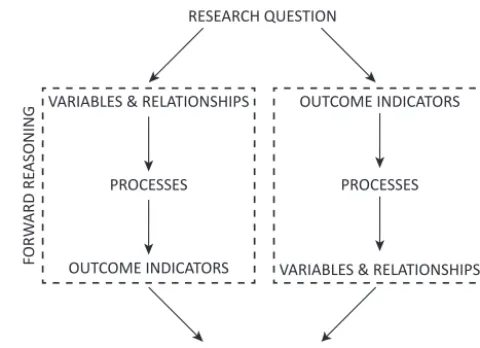
As emphasized by both system dynamics and social-ecological systems researchers, the research question drives the process of system abstraction. One way to think about this process of abstraction is through the lens of forward and backward reasoning. Schlüter et al. (2014) introduced the idea of forward and backward reasoning to develop con-ceptual models of social-ecological systems. In a backward-reasoning approach, the question is first used to identify in-dicators or outcome metrics; next, the analysis proceeds to identify the relevant processes and then the variables and their relationships, as seen in Fig. 1 (Schülter et al., 2014). These three pieces then form the basis for the conceptual model. In contrast, a forward-reasoning approach begins with the identification of variables and relationships and then proceeds toward outcomes. Forward reasoning is most suc-cessful when there is expert knowledge of the system, and backward-reasoning is useful primarily when prior
knowl-RESEARCH QUESTION
CONCEPTUAL MODEL VARIABLES & RELATIONSHIPS
PROCESSES
OUTCOME INDICATORS BA
CK
W
ARD RE
ASONING
PROCESSES
VARIABLES & RELATIONSHIPS OUTCOME INDICATORS
FOR
W
ARD RE
[image:5.612.308.548.64.238.2]ASONING
Figure 1. Backward-reasoning process (adapted from Schlüter et
al., 2014).
edge is insufficient (Arocha et al., 1993). As few researchers have expert knowledge of all domains involved in socio-hydrological modeling and data is often sparse, a backward-reasoning approach is here used to conceptualize a socio-hydrological model. Additionally, this outcome-oriented ap-proach will focus the scope of the model on the question’s relevant variables and processes.
The research question helps to define the outcome met-ric(s) of interest; however, determining the relevant processes and variables requires further analysis. One tool to identify influential processes and variables is the dynamic hypothe-sis. A dynamic hypothesis is a working theory, informed by data, of how the system behavior in question arose (Sterman, 2000). It is dynamic in nature because it explains changes in behavior over time in terms of the structure of the system (Stave, 2003). The dynamic hypothesis could encompass the entire socio-hydrological model, but in practice many pro-cesses within a model will be based on established theory such as rainfall runoff or evaporation processes. The intent is to focus the dynamic hypothesis on a novel theory explaining observed behavior. Stating the dynamic hypothesis clarifies which portion of the model is being tested.
A framework can aid the development of the dynamic hy-potheses and the communication of the reasoning behind it. The use of frameworks enhances the transparency of model development by clearly communicating the modeler’s broad understanding of a system. Socio-hydrological model-ers can develop their own framework (Elshafei et al., 2014) or draw on existing frameworks that address coupled human– hydrological systems such as the social-ecological systems (SES) framework, the management transition framework, or the integrated structure–actor–water framework (Ostrom, 2007; Pahl-Wostl et al., 2010; Hale et al., 2015).
framework is a nested conceptual map that partitions the at-tributes of a social-ecological system into four broad classes: (1) resource system, (2) resource units, (3) actors and (4) the governance system (McGinnis and Ostrom, 2014). Each of the four top tier variables has a series of second tier (and po-tentially higher tier) variables; for example, storage charac-teristics and equilibrium properties are second tier attributes of the resource system (Ostrom, 2009). The SES framework prescribes a set of elements and general relationships to con-sider when studying coupled social and ecological systems (Ostrom, 2011). The variables defined in the SES frame-work were found to impact the interactions and outcomes of social-ecological systems in a wide range of empirical stud-ies (Ostrom, 2007). In addition to specifying candidate vari-ables, the SES framework specifies broad process relation-ships (Schlüter et al., 2014). At the broadest level, SES spec-ifies that the state of the resource system, governance system, resource unit properties and actor characteristics influence interactions and are subsequently influenced by the outcomes of those interactions. To operationalize the SES framework for model conceptualization one must move down a level to assess the relevance of the tier two variables against case data and background knowledge. This review aims to check the dynamic hypothesis against a broader view of coupled system dynamics and to inform determination of remaining model processes.
The following case presents the development of a socio-hydrological (coupled) and a traditional (noncoupled) model to illustrate this process. While this process is developed to study real-world cases a hypothetical case is used here for simplicity, brevity and proof of concept.
3 Sunshine City: a case study of reservoir operations
Sunshine City is located in a growing region in a semi-arid climate. The region is politically stable, technologically de-veloped, with a market economy governed by a representa-tive democracy. Sunshine City draws its water supply from the Blue River, a large river which it shares with downstream neighbors. The water users must maintain a minimum flow in the Blue River for ecological health. Sunshine City can draw up to 25% of the annual flow of the Blue River in any given year. A simple prediction of the year’s flow is made by assuming that the flow will be equal to the previous year’s flow; the resulting errors are corrected by adjusting the next year’s withdrawal.
[image:6.612.313.539.83.241.2]The city’s Water Utility is responsible for diverting, treat-ing and transporttreat-ing water to city residents and businesses. It is also tasked with making infrastructure investment deci-sions, setting water prices. Water users receive plentiful sup-ply at cost and there have been no shortages in recent years. While located in a semi-arid environment, the large size of Sunshine City’s Blue River water availability and allocation created a comfortable buffer. The city’s Water Utility is also
Table 1. Summary of Sunshine City properties.
Sunshine City properties
Variable Value Units
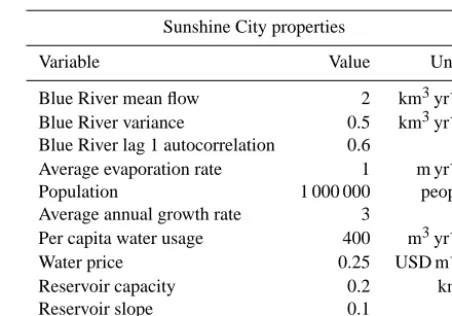
Blue River mean flow 2 km3yr−1 Blue River variance 0.5 km3yr−1 Blue River lag 1 autocorrelation 0.6 – Average evaporation rate 1 m yr−1 Population 1 000 000 people Average annual growth rate 3 % Per capita water usage 400 m3yr−1 Water price 0.25 USD m−3 Reservoir capacity 0.2 km3
Reservoir slope 0.1 –
responsible for setting water efficiency codes and other con-servation rules. The current building code includes only basic efficiencies required by the national government. The Blue River, along with other regional sources, is fully allocated making future augmentation of supplies unlikely. See Table 1 above for a summary of key characteristics of Sunshine City. Along with the rest of the region, Sunshine City’s popula-tion, and its water demand, has grown rapidly over the past few years. Managers at the Water Utility are concerned they will no longer be able to meet its reliability targets as de-mands rise and have added a reservoir to increase future re-liability. They now must decide how to operate the reservoir and are considering two options: standard operating policy (SOP) and hedging policy (HP). The selected operating pol-icy must satisfy downstream user rights and maintain min-imum ecological flows. In addition to meeting the legal re-quirements, the Water Utility managers are concerned with finding a policy that will enable the city to provide the most reliable water supply throughout the lifetime of the reservoir (50–100 years). From experience they have observed that both water price and reliability affect demand. A key puz-zle that emerges for water managers from this experience is: how do operational rules governing use of water storage in-fluence long-term water supply reliability when consumers make water usage decisions based on both price and relia-bility?
RELE
ASE
STORAGE AT THE END OF PREVIOUS PERIOD PLUS PREDICTED INFLOW
DP
DP VMAX + DP
1
1
1
[image:7.612.51.285.67.197.2]1
Figure 2. Standard operating policy, whereDis per capita demand,
P is population andVmaxis reservoir capacity (adapted from Shih and ReVelle, 1994).
3.1 Background
The decision of how much water to release for use each time period is deceptively complex due to the uncertainty of fu-ture streamflows and the nonlinear benefits of released water (Shih and ReVelle, 1994; Draper and Lund, 2004). In mak-ing release decisions, water utilities must fulfill their man-date to maintain a reliable water supply in a fiscally efficient manner. Reliability is the probability that the system is in a satisfactory state (Hashimoto et al., 1982). In this case, a satisfactory system state is one in which all demands on the system can be met. The definition of an unsatisfactory state is more nuanced. Water shortages have a number of charac-teristics that are important to water management including frequency, maximum shortage in a given time period, and length of shortage period (Cancelliere et al., 1998). Long-term reliability here refers to the projected reliability over several decades. The time frame used for long-term projec-tions varies between locaprojec-tions and utilities (i.e., Boston uses a 25-year time frame, Denver uses a 40-year time frame, and Las Vegas uses a 50-year time frame) and a 50-year time frame is used here (MWRA, 2003; SNWA, 2009; Denver Water, 2015).
Two operational policies, SOP and HP, are commonly used to address this decision problem. Under SOP, demand is al-ways fulfilled unless available supply drops below demand; under HP, water releases are limited in anticipation of an ex-pected deficit (Cancelliere et al., 1998). Hedging is used as a way to decrease the risk of a large shortfall by imposing conservation while stored water remains available. Figures 2 and 3 illustrate SOP and HP, respectively. For this simple ex-periment only linear hedging, where KP is the slope of the release function, is tested.
The traditional argument for hedging is that it is economi-cal to allow a small deficit in the current time period in order to decrease the probability of a more severe shortage in a fu-ture time periods (Bower et al., 1962). This argument holds true if the loss function associated with a water shortage is
RELE
ASE
STORAGE AT THE END OF PREVIOUS PERIOD PLUS PREDICTED INFLOW DP
KPDP VMAX + DP
KP
1
1
1
Figure 3. Hedging policy, whereKP is hedging release function slope (adapted from Shih and ReVelle, 1994).
nonlinear and convex; in other words that a severe shortage has a larger impact than the sum of several smaller short-ages (Shih and ReVelle, 1994). Gal (1979) showed that the water shortage loss function is convex, thereby proving the utility of hedging as a drought management strategy. Other researchers have shown that hedging effectively reduces the maximum magnitude of water shortages and increases total utility over time (Shih and ReVelle, 1994; Cancelliere et al., 1998). More recent work by Draper and Lund (2004) and You and Cai (2008) confirms previous findings and demon-strates the continued relevance reservoir operation policy se-lection.
[image:7.612.307.546.72.197.2]Table 2. Household conservation action by shortage experience
(ISTPP, 2013).
Last experienced Percent of households, over the
a water shortage past year, that have
invested in changed taken
efficient fixtures water use no
or landscapes behavior action
Within a year 56 % 88 % 11 %
1–2 years ago 52 % 87 % 11 %
2–5 years ago 51 % 78 % 17 %
6–9 years ago 50 % 79 % 18 %
10 or more years ago 42 % 74 % 24 %
Never experienced 36 % 66 % 31 %
and frequency of running the dishwasher to timing of lawn watering and frequency of car washing. Water use behavior is shaped by knowledge of the water system, awareness of conservation options and their effectiveness, and consumer’s attitudes toward conservation (Frick et al., 2004; Willis et al., 2011). Changes to water use behavior can be prompted by price increases, education campaigns, conservation reg-ulations and weather (Campbell et al., 2004; Kenney et al., 2008; Olsmtead and Stavins, 2009).
As a city begins to experience a water shortage, the wa-ter utility may implement wawa-ter restrictions, price increases, incentive programs or education campaigns to influence con-sumer behavior. While staff within the water utility or city may have planned these measures before, the occurrence of a water shortage event, particularly if it aligns with other driving forces, offers a window of opportunity to implement sustainable water management practices (Jones and Baum-gartner, 2005; Hughes et al., 2013). In addition, water users are more likely to respond to these measures with changes in their water use behavior and/or adoption of conservation technologies during shortages. Baldassare and Katz (1992) examined the relationship between the perception of risk to personal well-being from an environmental threat and adop-tion of environmental practices with a personal cost (finan-cial or otherwise). They found that the perceived level of en-vironmental threat is a better predictor for individual envi-ronmental action, including water conservation, than demo-graphic variables or political factors. Illustrating this effect, Mankad and Tapsuwan (2011) found that adoption of alterna-tive water technologies, such as on-site treatment and reuse, is increased by the perception of risk from water scarcity.
Evidence of individual level behavior change can also be seen in the results of a 2013 national water policy survey con-ducted by the Institute for Science, Technology and Public Policy at Texas A&M University. The survey sampled over 3000 adults from across the United States about their atti-tudes and actions related to a variety of water resources and public policy issues. Included in the survey were questions that asked respondents how recently, if ever, they
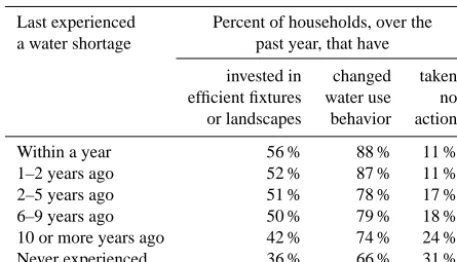
person-ally experienced a water shortage and which, if any, house-hold efficiency upgrade or behavioral change actions their household had taken in the past year. Efficiency upgrade op-tions offered included low-flow shower heads, low-flush toi-lets and changes to landscaping; behavioral options given in-cluded shorter showers, less frequent dishwasher or wash-ing machine use, less frequent car washwash-ing and changes to yard watering (ISTPP, 2013). As seen in Table 2, respon-dents who had recently experienced a water shortage were more likely to have made efficiency investments and to have changed their water use behavior. This finding is corrobo-rated by a recent survey of Colorado residents. Of the 72 % of respondents reporting increased attention to water issues, the most-cited reason for the increase (26 % of respondents) was a recent drought or dry year (BBC Research, 2013). Other reasons cited by an additional 25 % of respondents including news coverage, water quantity issues and population growth may also be related water shortage concerns or experiences.
The increased receptivity of the public to water conserva-tion measures and the increased willingness of water users to go along with these measures during shortage events com-bine to drive changes in per capita demands. The comcom-bined effect of these two drivers was demonstrated in a study of the Arlington, Texas, water supply system (Giacomoni et al., 2013; Kanta and Zechman, 2014). Additional exam-ples of city- and regional-scale drought response leading to long-term demand decreases include the droughts of 1987– 1991 and the mid-2000s in California and of 1982–1983 and 1997–2009 in Australia (Zilberman et al., 1992; Turral, 1998; Sivapalan et al., 2012; Hughes et al., 2013). It is often dif-ficult to separate the relative effects of the multiple price and nonprice approaches applied by water utilities during droughts (Olmstead and Stavins, 2009). The point is, how-ever, that the response generally points to lower per capita water demands.
0 50 100 150 200
1970 1980 1990 2000 2010
Year
P
e
r ca
p
it
a
de
m
a
n
d
(
g
a
llo
n
s
p
e
r d
a
y
[image:9.612.50.285.67.210.2])
Figure 4. Historical city of Los Angeles water use (LADWP, 2010).
time. In sum, the Los Angeles case serves both to illustrate that hydrological change can prompt long-term changes in water demands and as a reminder that multiple factors influ-ence water demands and hydrological events will not always dominate.
3.2 Model development
The Sunshine City water managers want to understand how the operational rules governing use of water storage influence long-term water supply reliability when consumers make wa-ter usage decisions based on price and reliability. A model can help the managers gain insight into system’s behavior by computing the consequences of reservoir operation pol-icy choice over time and under different conditions. As scribed in the background section, many supply side and de-mand side factors affect water system reliability. However, not all variables and processes are relevant for a given ques-tion. A question driven modeling process uses the question to determine model boundary and scope rather than beginning with a prior understanding of the important variables and pro-cesses. A question driven process is here used to determine the appropriate level of system abstraction for the Sunshine City reservoir operations model.
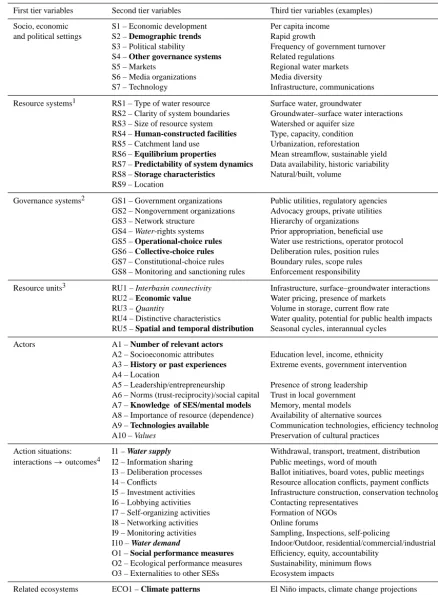
From the research question it is clear that reliability is the outcome metric of interest and that the model must test for the hypothesized link between demand changes and reliabil-ity. Reliability, as defined above, is the percent of time that all demands can be met. The SES framework is used to guide the selection of processes and variables, including the dynamic hypothesis. Given this wide range, the framework was then compared against the variables and processes found to be in-fluential in urban water management and socio-hydrological studies (Brezonik and Stadelmann, 2002; Abrishamchi et al., 2005; Padowski and Jawitz, 2012; Srinivasan et al., 2013; Dawadi and Ahmad, 2013; Elshafei et al., 2014; Gober et al., 2014; Liu et al., 2014; Pande et al., 2013; van Emmerik et al., 2014). Based on this evaluation two second tier variables were added to the framework: land use to the resource system
characteristics and water demand to interactions; other vari-ables were modified to reflect the language typically used in the water sciences (i.e., supply in place of harvesting). See Table 3 for urban water specific modification of the SES framework.
We then assess the relevance of the tier two variables against case data and background knowledge (summarized in Sects. 3 and 3.1, respectively) by beginning with the out-come metric, reliability. Within the framework reliability is an outcome variable, specifically a social performance met-ric, and it is the direct result of water supply and water de-mand interaction processes. Water supply encompasses the set of utility level decisions on reservoir withdrawals and discharges. As detailed in the case description, these deci-sions are shaped by the selected reservoir operating policy, streamflow, the existing environmental flow and downstream allocation requirements, reservoir capacity, water in storage and water demands. Streamflow is a stochastic process that is a function of many climatic, hydraulic and land surface parameters. However, given the driving question and the as-sumption that the city represents only a small portion of the overall watershed, a simple statistical representation is suffi-cient and streamflow is assumed independent of other model variables.
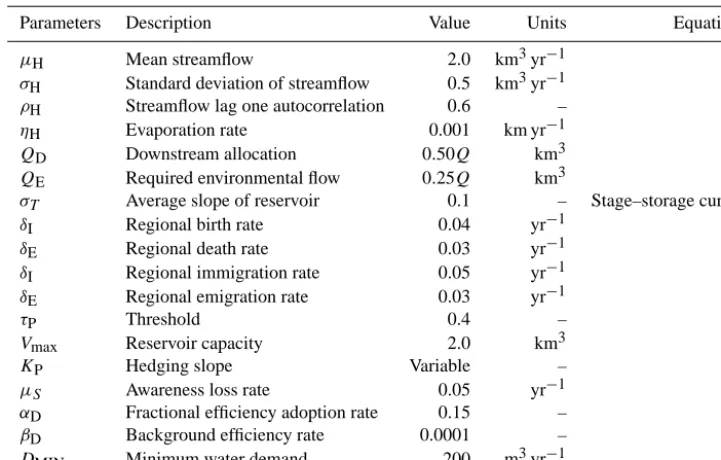
Total water demand is a function of both population and per capita demand. As described in the background section, per capita water demand changes over time in response to household level decisions to adopt more water efficient tech-nologies and water use behavior change made by individuals in each time interval; these decisions may be influenced by conservation policies. As conditions change water users re-assess the situation and, if they choose to act, decide between available options such as investment in efficient technology, changing water use behavior and, in extreme cases, reloca-tion. Therefore, per capita demand is a function of price and historic water reliability as well as available technologies, and water user’s perception of the water system. Since the focus of the question is on system wide reliability individ-ual level decisions can be modeled in the aggregate as to-tal demand, which is also influenced by population. Popu-lation increases in proportion to the current popuPopu-lation, as regional economic growth is the predominant driver of mi-gration trends. However, in extreme cases, perceptions of re-source limitations can also influence growth rates. The SES variables used in the conceptual model are highlighted in Ta-ble 3 and the resulting processes are summarized in Fig. 5.
elas-Table 3. SES framework, modified for urban water systems.
First tier variables Second tier variables Third tier variables (examples)
Socio, economic S1 – Economic development Per capita income
and political settings S2 – Demographic trends Rapid growth
S3 – Political stability Frequency of government turnover
S4 – Other governance systems Related regulations
S5 – Markets Regional water markets
S6 – Media organizations Media diversity
S7 – Technology Infrastructure, communications
Resource systems1 RS1 – Type of water resource Surface water, groundwater
RS2 – Clarity of system boundaries Groundwater–surface water interactions
RS3 – Size of resource system Watershed or aquifer size
RS4 – Human-constructed facilities Type, capacity, condition
RS5 – Catchment land use Urbanization, reforestation
RS6 – Equilibrium properties Mean streamflow, sustainable yield
RS7 – Predictability of system dynamics Data availability, historic variability
RS8 – Storage characteristics Natural/built, volume
RS9 – Location
Governance systems2 GS1 – Government organizations Public utilities, regulatory agencies
GS2 – Nongovernment organizations Advocacy groups, private utilities
GS3 – Network structure Hierarchy of organizations
GS4 – Water-rights systems Prior appropriation, beneficial use
GS5 – Operational-choice rules Water use restrictions, operator protocol
GS6 – Collective-choice rules Deliberation rules, position rules
GS7 – Constitutional-choice rules Boundary rules, scope rules
GS8 – Monitoring and sanctioning rules Enforcement responsibility
Resource units3 RU1 – Interbasin connectivity Infrastructure, surface–groundwater interactions
RU2 – Economic value Water pricing, presence of markets
RU3 – Quantity Volume in storage, current flow rate
RU4 – Distinctive characteristics Water quality, potential for public health impacts
RU5 – Spatial and temporal distribution Seasonal cycles, interannual cycles
Actors A1 – Number of relevant actors
A2 – Socioeconomic attributes Education level, income, ethnicity
A3 – History or past experiences Extreme events, government intervention
A4 – Location
A5 – Leadership/entrepreneurship Presence of strong leadership
A6 – Norms (trust-reciprocity)/social capital Trust in local government
A7 – Knowledge of SES/mental models Memory, mental models
A8 – Importance of resource (dependence) Availability of alternative sources
A9 – Technologies available Communication technologies, efficiency technologies
A10 – Values Preservation of cultural practices
Action situations: I1 – Water supply Withdrawal, transport, treatment, distribution
interactions→outcomes4 I2 – Information sharing Public meetings, word of mouth
I3 – Deliberation processes Ballot initiatives, board votes, public meetings
I4 – Conflicts Resource allocation conflicts, payment conflicts
I5 – Investment activities Infrastructure construction, conservation technology
I6 – Lobbying activities Contacting representatives
I7 – Self-organizing activities Formation of NGOs
I8 – Networking activities Online forums
I9 – Monitoring activities Sampling, Inspections, self-policing
I10 – Water demand Indoor/Outdoor, residential/commercial/industrial
O1 – Social performance measures Efficiency, equity, accountability
O2 – Ecological performance measures Sustainability, minimum flows
O3 – Externalities to other SESs Ecosystem impacts
Related ecosystems ECO1 – Climate patterns El Niño impacts, climate change projections
ECO2 – Pollution patterns Urban runoff, upstream discharges
ECO3 – Flows into and out of focal SES Upstream impacts, downstream rights
[image:10.612.74.513.85.681.2]Reservoir storage
Shortage awareness Water
demand
Water supply
Water shortage +
-+
-Reservoir storage
Shortage awareness
Water demand Water supply
Water shortage +
-+
-Population
-+ Population + Growth Rate
[image:11.612.100.498.68.174.2]+ +
Figure 5. Causal loop diagrams: (a) water demand, shortage and conservation; (b) water demand, shortage and population; (c) population
and growth rate.
Table 4. State and exogenous model variables.
Variable Description Units Equation Variable Type
Q Streamflow km3yr−1 1 Exogenous
V Reservoir storage volume km3 2 State
P Population Persons 3 State
W Withdrawal km3yr−1 4 State
S Shortage magnitude km3yr−1 5 State
M Shortage awareness 6 State
D Per capita demand m3yr−1 7 State
ticity of water can lead to increased water demands if rates do not change proportionally (Dalhuisen et al., 2003); here prices are assumed to keep pace with inflation. Given this assumption, and the focus on a city in a developed region, economic development likely plays a minor role. Similarly, group decision-making and planning processes such as pub-lic forums, voting and elections can shape the responses to reliability changes over time. This model aims to answer a question about the impact of a policy not the ease or like-lihood of its implementation. Once the policy is established through whatever process that is used, the question here fo-cuses on its efficacy. Therefore, group decision-making pro-cesses need not be included.
In addition to determining the appropriate level of detail of the conceptual model, we must determine which variables change in response to forces outside the model scope (exoge-nous variables), which variables must be modeled endoge-nously (state variables) and which can be considered con-stants (parameters). Again the nature of the question along with the temporal and spatial scale informs these distinctions. Variables such as stored water volume, per capita water de-mand and shortage awareness will clearly change over the 50-year study period. The population of the city is also ex-pected to change over the study period. Under average hy-drological conditions the population growth rate is expected to be driven predominately by regional economic forces ex-ogenous to the system; however, under extreme conditions water supply reliability can influence the growth rate. There-fore, population is considered a state variable. Streamflow
characteristics may change over the 50-year timescale in re-sponse to watershed wide land use changes and global-scale climatic changes. Streamflow properties are first considered stationary parameters in order to understand the impact of the selected operating policy in isolation from land use and cli-mate change. Clicli-mate scenarios or feedbacks between popu-lation and land use can be introduced in future applications of the model to test their impact on system performance. Reser-voir operating policy, summarized as the hedging slope,KP, is considered a parameter in the model. Alternate values of parameterKP are tested but held constant during the study period to understand the long-term impacts of selecting a given policy. Reservoir properties such as capacity and slope are also held constant to hone in on the effect of operating policy. See Tables 4 and 5 for a summary of variable types. From these model relationships, general equations are devel-oped by drawing from established theory, empirical findings and working hypotheses.
Streamflow,Q, is modeled using a first-order autoregres-sive model, parameterized by mean (µHkm3yr−1), standard deviation (σHkm3yr−1) and lag one autocorrelation (ρH). The final term,at, is a normally distributed random variable
with a mean zero and a standard deviation of 1. Qt =ρH(Qt−1−µH)+σH
[image:11.612.147.447.239.345.2]
Table 5. Model parameters.
Parameters Description Value Units Equation
µH Mean streamflow 2.0 km3yr−1 1
σH Standard deviation of streamflow 0.5 km3yr−1 1
ρH Streamflow lag one autocorrelation 0.6 – 1
ηH Evaporation rate 0.001 km yr−1 2
QD Downstream allocation 0.50Q km3 2
QE Required environmental flow 0.25Q km3 2
σT Average slope of reservoir 0.1 – Stage–storage curve
δI Regional birth rate 0.04 yr−1 3
δE Regional death rate 0.03 yr−1 3
δI Regional immigration rate 0.05 yr−1 3
δE Regional emigration rate 0.03 yr−1 3
τP Threshold 0.4 – 3
Vmax Reservoir capacity 2.0 km3 4
KP Hedging slope Variable – 5
µS Awareness loss rate 0.05 yr−1 6
αD Fractional efficiency adoption rate 0.15 – 7
βD Background efficiency rate 0.0001 – 7
DMIN Minimum water demand 200 m3yr−1 7
is the required environmental flow.
dV
dt =Qt−Wt−ηHAt−QD−QE (2)
Population is the predominant driver of demand in the model. Population (P) changes according to average birth (δB, yr−1), death (δD, yr−1), emigration (δE, yr−1)and immi-gration (δI, yr−1)rates. However, immigration is dampened and emigration accelerated by high values of perceived short-age risk, as would be expected at extreme levels of resource uncertainty (Sterman, 2000). The logistic growth equation, which simulates the slowing of growth as the resource car-rying capacity of the system is approached, serves as the ba-sis for the population function. While the logistic function is commonly used to model resource-constrained population growth, the direct application of this function would be in-appropriate for two reasons. First, an urban water system is an open system; resources are imported into the system at a cost and people enter and exit the system in response to re-ductions in reliability and other motivating factors. Second, individuals making migration decisions may not be aware of incremental changes in water shortage risk; rather, per-ceptions of water stress drive the damping effect on net mi-gration. Finally, only at high levels does shortage perception influence population dynamics. To capture the effect of the open system, logistic damping is applied only to immigration driven population changes when shortage perception crosses a threshold, τP. To account for the perception impact, the shortage awareness variable,M, is used in place of the ratio of population to carrying capacity typically used; this
modi-fication links the damping effect to perceived shortage risk.
dP
dt =
Pt[δB−δD+δI−δE]
Pt[(δB−δD)+δI(1−Mt)−δE(Mt)] forMt≥τP (3)
Water withdrawals, W, are determined by the reservoir operating policy in use. As there is only one source, water withdrawn is equivalent to the quantity supplied. The pre-dicted streamflow for the coming year is 0.25×Qt−1, ac-counting for both downstream demands and environmental flow requirements. Under SOP,KPis equal to one which sets withdrawals equal to total demand, DP (per capita demand multiplied by population), unless the stored water is insuf-ficient to meet demands. Under HP, withdrawals are slowly decreased once a pre-determined threshold,KPDP, has been passed. For both policies excess water is spilled when stored water exceeds capacity,Vmax.
Wt= (4)
Vt+0.25Qt−1−Vmax for Vt+0.25Qt−1≥ DtPt+Vmax DtPt for DtPt+Vmax>
Vt+0.25Qt−1≥KPDtPt Vt+0.25Qt−1
KP for KPDtPt> Vt+0.25Qt−1 When the water withdrawal is less than the quantity de-manded by the users, a shortage,S, occurs.
St=
DtPt−Wt forDtPt> Wt
0 otherwise (5)
events to the awareness of shortage risk. The first term in the equation is the shortage impact which is a convex func-tion of the shortage volume. The economic utility of hedging hinges on the assumption that the least costly options to man-age demand will be undertaken first. As both water utilities and water users have a variety of demand management and conservation options available and both tend to use options from most to least cost-effective, a convex shortage loss is also applicable to the water users (Draper and Lund, 2004). It is here assumed that the contribution of an event to shortage awareness is proportional to the shortage cost. At high levels of perceived shortage risk only a large shortage will lead to a significant increase in perceived risk. The adaptation cost is multiplied by one minus the current shortage awareness to account for this effect. The second term in the equation in-corporates the decay of shortage,µS(yr−1), awareness and its relevance to decision making that occurs over time (Di Baldassarre et al., 2013).
dM dt =
S
t
DtPt
2
(1−Mt)−µSMt (6)
Historically, in developed regions per capita water de-mands have decreased over time as technology improved and as water use practices have changed. As described above, this decrease is not constant but rather is accelerated by shocks to the system. To capture this effect there are two portions to the demand change equation: shock-stimulated logistic de-cay with a maximum rate ofα(yr−1)and a background de-cay rate,β(yr−1). Per capita water demand decrease acceler-ates in a time interval if water users are motivated by recent personal experience with water shortage (i.e., M>0). As a certain amount of water is required for basic health and hy-giene, there is ultimately a floor to water efficiencies, speci-fied here asDmin(km3yr−1). Reductions in per capita water usage become more challenging as this floor is approached; a logistic decay function is used to capture this effect. When no recent shortages have occurred (i.e.,M=0), there is still a slow decrease in per capita water demands. This background rate,β, of demand decrease is driven by both the replacement of obsolete fixtures with modern water efficient fixtures and the addition of new more efficient building stock. This back-ground rate is similarly slowed as the limit is approached; this effect is incorporated by using a percentage-based back-ground rate. Note that price is not explicitly included in this formulation of demand. As stated above, because price and nonprice measures are often implemented in concert it is dif-ficult to separate the impacts of these two approaches and in this case unnecessary.
dD dt = −Dt
Mtα
1− Dmin
Dt
+β
(7) As a comparison, a noncoupled model was developed. In this model, population and demand changes are no longer modeled endogenously. The shortage awareness variable
is removed as it no longer drives population and demand changes. Instead the model assumes that population growth is constant at 3 % and that per capita demands decrease by 0.5 % annually. While these assumptions may be unrealis-tic they are not uncommon. Utility water management plans typically present one population and one demand projection. Reservoir storage, water withdrawals and shortages are com-puted according to the equations described above. A full list of model variables and parameters can be found in Tables 4 and 5, respectively.
3.3 Results
The model was run for SOP (KP=1) and three levels of HP where level one (KP=1.5) is the least conservative, level two (KP=2) is slightly more conservative and level three (KP=3) is the most conservative hedging rule tested. Three trials were conducted with a constant parameter set to under-stand the system variation driven by the stochastic stream-flow sequence and to test if the relationship hypothesized was influential across hydrological conditions. For each trial streamflow, reservoir storage, shortage awareness, per capita demand, population and total demand were recorded and plotted. As a comparison, each trial was also run in the non-coupled model in which demand and population changes are exogenous.
In the first trial, shown in Fig. 6a, there were two sus-tained droughts in the study period: from years 5 to 11 and then from years 33 to 37. Higher than average flows in the years preceding the first drought allowed the utility to build up stored water as seen in Fig. 6b. The storage acts as a buffer and the impacts are not passed along to the water users until year 18 under SOP. Under HP the impacts, as well as wa-ter users’ shortage awareness, increase in years 15, 13 and 12 based on the level of the hedging rule (slope ofKP) ap-plied, as shown in Fig. 6c. The impact of this rising shortage awareness on per capita water demands is seen in the accel-eration of the decline in demands in Fig. 6d. This demand decrease is driven by city level policy changes such as price increases and voluntary restrictions in combination with in-creased willingness to conserve.
Figure 6. Model results, trial 1: (a) annual streamflow, (b)
reser-voir storage volume, (c) public shortage awareness, (d) per capita demand, (e) annual city population, (f) total demand.
imposed. Several years of above average flow ending in year 29 drive further recovery. The second prolonged drought has the most pronounced effect under the SOP scenario. Short-age impacts are drastic, driving further per capita demand decreases and a temporary decline in population. A slight population decrease is also seen under level one hedging but the results demonstrate that all hedging strategies dampen the effect.
In the second trial there are two brief droughts in the be-ginning of the study period, bebe-ginning in years 4 and 10, as seen in Fig. 7a. Under SOP and the first two hedging policies there is no change in operation for the first drought and the reservoir is drawn down to compensate as seen in Fig. 7a–b. Only under the level three HP are supplies restricted, trig-gering an increase in shortage awareness and a subsequent decrease in per capita demands, as found in Fig. 7c and d. When the prolonged drought begins in year 20, the four sce-narios have very different starting points. Under SOP, there is less than 0.5 km3of water in storage and total annual de-mands are approximately 0.65 km3. In contrast, under the level three HP there is 1.4 km3 of water in storage and to-tal annual demands are just under 0.6 km3. Predictably, the impacts of the drought are both delayed and softened under HP. As the drought is quite severe, all scenarios result in a contraction of population. However, the rate of decrease and total population decrease is lowered by the use of HP.
Figure 7. Model results, trial 2: (a) annual streamflow, (b)
reser-voir storage volume, (c) public shortage awareness, (d) per capita demand, (e) annual city population, (f) total demand.
In the third and final trial there is no significant low flow period until year 36 of the simulation when a moderate drought event occurs, as shown in Fig. 8a. Earlier in the simulation minor fluctuations in streamflow only trigger an acceleration of per capita demand declines under the level three HP, as seen in Fig. 8c and d. A moderate drought begins in year 36. However, the reservoir levels drop and shortage awareness rise starting before year 20, as seen in Fig. 8b and c. Then when the drought occurs the impacts are far greater than in the comparably moderate drought in trial 1 because a prolonged period of steady water supply enabled population growth and placed little pressure on the population to reduce demands. In the SOP scenario, the system was in shortage be-fore the drought occurred and total demands peaked in year 30 at 0.82 km3. The subsequent drought exacerbated an ex-isting problem and accelerated changes already in motion.
[image:14.612.50.285.64.344.2]ex-Figure 8. Model results, trial 3: (a) annual streamflow, (b)
reser-voir storage volume, (c) public shortage awareness, (d) per capita demand, (e) annual city population, (f) total demand.
pected, changes to per capita demands, population, and total demands are gradual and consistent across the operating pol-icy scenarios, found in Fig. 9e and f.
4 Discussion
The proposed question driven modeling process has three aims: to broaden the researcher’s view of the system, to connect modeling assumptions to the model’s purpose and to increase the transparency of these assumptions. A socio-hydrological model was developed to examine the differ-ence in long-term reliability between two reservoir operating policies, SOP and HP. This question focused the conceptual model on processes influencing reliability at the city scale over the 50-year planning period. As part of the conceptual model development, the SES framework was used to check framing assumptions. The wide range of candidate variables included in the SES framework was reviewed against case data and background information. The model’s intended use then informed decisions of which processes to include in the model, which processes were endogenous to the system and which variables could be held constant. The point here is not that the logic presented by the modeler using this process is unfailing but that it is clear and can inform debate. The questions raised about both the functional form of model
re-Figure 9. Noncoupled model results, trial 3: (a) annual
stream-flow, (b) reservoir storage volume, (c) shortage volume (demand– supply), (d) per capita demand, (e) annual city population, (f) total demand.
lationships and the variables excluded during the manuscript review process indicate that some transparency was achieved. However, the reader is in the best position to judge success on this third aim.
[image:15.612.310.547.66.343.2] [image:15.612.49.286.67.343.2]Hedging reduces the threshold for action, thereby decreasing the delay and the oscillation effect. This distinction between the two policies was not apparent when using a traditional noncoupled model. The significance of this observation is that a decrease in oscillation means a decrease in the mag-nitude of the contractions in population and per capita water demands required to maintain sustainability of the system. It is these abrupt changes in water usage and population that water utilities and cities truly want to avoid as they would hamper economic growth and decrease quality of life.
Examining the structure of the system can explain the dif-ferences in system response to SOP and HP. As seen in Fig. 5, there are one positive and two negative feedback loops in the system. Positive feedback loops, such as population in this model, exhibit exponential growth behavior but there are few truly exponential growth systems in nature and through in-teraction with other feedback loops most systems ultimately reach a limit (Sterman, 2000). Negative feedback loops gen-erate goal seeking behavior. In its simplest form a negative feedback loop produces a slow approach to a limit or goal akin to an exponential decay function. In this case, the goal of the system is to match total demand with average sup-ply. The fact that supply is driven by streamflow, a stochastic variable, adds noise to the system. Even if streamflow is cor-rectly characterized with stationary statistics, as is assumed here, the variability challenges the management of the sys-tem. Reservoir storage helps utilities manage this variability by providing a buffer but it also acts as a delay. The delay between a change in the state of the system and action taken in response allows the system to overshoot its goal value be-fore corrective action is taken, leading to oscillation around goal values. While water storage decreases the impact of a drought, changes to water consumption patterns are required to address demand driven shortages. Water storage simulta-neously buffers variability and delays water user response by delaying impact. There are parallels between the feedback identified in this urban water supply system and the feedback identified by Elshafei et al. (2014) and Di Baldassarre (2013) in agricultural water management and human–flood interac-tions, respectively. Broadly, the three systems display the bal-ance between the interaction between opposing forces, in this case articulated as positive and negative feedback loops.
The case of Sunshine City is simplified and perhaps sim-plistic. The limited number of available options for action constrains the system and shapes the observed behavior. In many cases water utilities have a portfolio of supply, stor-age and demand manstor-agement policies to minimize short-ages. Additionally, operating policies often shift in response to changing conditions. However, in this case no supply side projects are considered and the reservoir operating policy is assumed constant throughout the duration of the study pe-riod. As there are physical and legal limits to available sup-plies the first constraint reflects the reality of some systems. Constant operational policy is a less realistic constraint but can offer new insights by illustrating the limitations of
main-taining a given policy and the conditions in which policy change would be beneficial. Despite these drawbacks a sim-ple hypothetical model is justified here to clearly illustrate the proposed modeling process.
There are several limitations to the hypothetical case of Sunshine City. First, the hypothetical nature of the case pre-cludes hypothesis testing. Therefore, an important extension of this work will be to apply the modeling process pre-sented here on a real case to fully test the resulting model against historical observations before generating projections. Second, only one set of parameters and functions was pre-sented. Future extensions to this work on reservoir policy selection will test the impact of parameter and function se-lection through sensitivity analysis. Finally, we gain limited understanding of the potential of the model development pro-cess by addressing only one research question. We can fur-ther test the ability of the modeling process to generate new insights by developing different models in response to dif-ferent questions. In this case, the narrow scope of the driv-ing question leads to a model that just scratches the surface of socio-hydrological modeling as evidenced by the narrow range of societal variables and processes included. For exam-ple, this model does not address the ability of the water utility or city to adopt or implement HP. HP impacts water users in the short term. These impacts would likely generate a mix of reactions from water users and stakeholders making it im-possible to ignore politics when considering the feasibility of HP. However, the question driving this model asks about the impact of a policy choice on the long-term reliability of the system not the feasibility of its implementation. A hypothe-sis addressing the feasibility of implementation would lead to a very different model structure.
While there is significant room for improvement, there are inherent limitations to any approach that models human be-havior. The human capacity to exercise free will, to think creatively and to innovate means that human actions, particu-larly under conditions not previously experienced, are funda-mentally unpredictable. Furthermore, as stated above we can never fully capture the complexity of the socio-hydrological system in a model. Instead we propose a modeling process that focuses socio-hydrological model conceptualization on answering questions and solving problems. By using model purpose to drive our modeling decisions we provide justi-fication for simplifying assumptions and a basis for model evaluation.
5 Conclusions