ScholarWorks @ Georgia State University
ScholarWorks @ Georgia State University
Public Health Theses School of Public Health
8-13-2013
A Systematic Review of Health Literacy Interventions and Policies
A Systematic Review of Health Literacy Interventions and Policies
and the Effect on the Health Outcomes of Limited English
and the Effect on the Health Outcomes of Limited English
Proficient (LEP) Patients
Proficient (LEP) Patients
Melissa T. Duong
GSU School of Public Health
Follow this and additional works at: https://scholarworks.gsu.edu/iph_theses
Recommended Citation Recommended Citation
Duong, Melissa T., "A Systematic Review of Health Literacy Interventions and Policies and the Effect on the Health Outcomes of Limited English Proficient (LEP) Patients." Thesis, Georgia State University, 2013. https://scholarworks.gsu.edu/iph_theses/300
A SYSTEMATIC REVIEW OF HEALTH LITERACY INTERVENTIONS AND POLICIES
AND THE EFFECT ON THE HEALTH OUTCOMES OF LIMITED ENGLISH PROFICIENT (LEP) PATIENTS
BY MELISSA DUONG B.A., EMORY UNIVERSITY
A CAPSTONE SUBMITTED TO THE GRADUATE FACULTY OF THE SCHOOL OF PUBLIC HEALTH AT GEORGIA STATE UNIVERSITY
IN PARTIAL FULFILLMENT OF THE
REQUIREMENTS FOR THE DEGREE
MASTER OF PUBLIC HEALTH
APPROVAL PAGE
A SYSTEMATIC REVIEW OF HEALTH LITERACY INTERVENTIONS AND POLICIES AND THE EFFECT ON THE HEALTH OUTCOMES OF
LIMITED ENGLISH PROFICIENT (LEP) PATIENTS
BY MELISSA DUONG
Approved:
Bruce Perry, MD MPH
Committee Chair
Kim Ramsey-White, PhD
Committee Member
AUTHOR’S STATEMENT
In presenting this capstone as a partial fulfillment of the requirements for an advanced
degree from Georgia State University, I agree that the Library of the University shall make it
available for inspection and circulation in accordance with its regulations governing materials of
this type. I agree that permission to quote from, to copy from, or to publish this capstone may be
granted by the author or, in her absence, by the professor under whose direction it was written, or
in his absence, by the Associate Dean, College of Health and Human Services. Such quoting,
copying, or publishing must be solely for scholarly purposes and will not involve potential
financial gain. It is understood that any copying from or publication of this dissertation which
involves potential financial gain will not be allowed without written permission of the author.
NOTICE TO BORROWERS
All capstones deposited in the Georgia State University Library must be used in accordance with the stipulations prescribed by the author in the preceding statement.
The author of this capstone is: Melissa Duong
2021 Wildcat Lake Court Lawrenceville, Georgia 30043
The Chair of the committee for this capstone is: Bruce Perry, MD MPH
School of Public Health Georgia State University
Georgia State University P.O. Box 3995
Atlanta, Georgia 30302-3995
Users of this capstone who not regularly enrolled as students at Georgia State University are required to attest acceptance of the preceding stipulation by signing below. Libraries borrowing this capstone for the use of their patrons are required to see that each user records here the information requested.
NAME OF USER ADDRESS DATE TYPE OF USE
ABSTRACT
Melissa Duong
A Systematic Review of Health Literacy Interventions and Policies and the Effect on the Health
Outcomes of Limited English Proficient (LEP) Patients
(Under the direction of Bruce Perry, MD MPH)
Limited English Proficient (LEP) patients are subject to low patient health outcomes due to
limited health literacy. Cultural and linguistic barriers prohibit the obtainment and
comprehension of health information and services. This systematic review will present the
complications of healthcare experienced by LEP patients and will provide an analysis of
interventions and policies that will be a gateway to better health outcomes for the LEP patient
population.
INDEX WORDS: systematic review, health literacy, limited English proficiency, LEP, Asian,
TABLE OF CONTENTS
Page
CHAPTER
I. INTRODUCTION ……… 1
II. BACKGROUND ……… 2
Literacy ……… 2
Health Literacy & Its Implications ……… 3
Limited English Proficiency (LEP) & Its Implications ……… 6
III. METHODOLOGY ………11
Conceptual Framework ………11
Search Strategy ………12
Inclusion Criteria ………12
IV. RESULTS ………13
Interventions ………14
Policies ………22
V. DISCUSSION AND CONCLUSION ………25
Interventions ………25
Policies ………28
CHAPTER I
Introduction
With the upcoming reforms that the Patient Protection and Affordable Care Act (ACA)
promises, there is increasing concern for the patient consumer’s awareness and ability to
understand and access the United States (U.S.) healthcare system. Policies are in place to ensure
all Americans access to healthcare by mandating that everyone be enrolled in a health insurance
plan, whether it is by an employer, government, or private insurance. Efforts have been made to
simplify the process of “shopping” for insurance plans, such as the provision of private insurance
exchanges offered by each state, where consumers may choose the healthcare plans that best suit
their medical needs (ASPA, 2013).
Increased access to health services comes with the need for increased access to health
information. The diverse U.S. patient population requires additional mechanisms, such as
interventions and policies, which specifically address the varied needs of each vulnerable patient
population. For example, limited English proficient (LEP) patients experience lower health
literacy rates, due to language barriers and cultural beliefs. In turn, limited health literacy makes
LEP patients more susceptible to lower health outcomes. This paper will present the
complications of healthcare experienced by LEP patients and will provide an analysis of
interventions and policies that will be a gateway to better health outcomes for the LEP patient
CHAPTER II
Background
Literacy
The National Center for Education Statistics (NCES) sponsors the U.S.’s most
comprehensive assessment of adult literacy to date. As defined by NCES, literacy is the ability
of “adults to use printed and written information to adequately function at home, in the
workplace, and in the community” (“National Assessment of Adult Literacy (NAAL), n.d.”). In
2003, NCES conducted its second nationally representative survey, the National Assessment of
Adult Literacy (NAAL), with a sample size of 19,000 adults, ages 16 and older. NAAL
measured a person’s knowledge and skill in performing three types of literacy tasks: prose (use
of continuous texts, such as editorials, instructional materials, etc.); document (use of
noncontinuous texts, such as job applications, maps, etc.); and quantitative (balancing a
checkbook, figuring out a tip, etc.).
From the first assessment in 1992 to 2003, literacy levels of the general American public
have been stable in prose and document literacy, with a significant increase in quantitative
literacy (“National Assessment of Adult Literacy (NAAL),” n.d.). The earlier assessment found
that vulnerable populations, such as the elderly, immigrants, minorities, and low-income
individuals, have “basic” or “below basic” reading levels (Schillinger et al., 2002). NAAL
estimates that out of the 11 million “nonliterate” adults, 4 million could not take the test because
of language barriers (“National Assessment of Adult Literacy (NAAL), n.d.”), indicating that
Health Literacy & Its Implications
The effect of health literacy on patients and their health outcomes is gaining awareness as
a public health issue. In 2004, the Institute of Medicine (IOM) acknowledged the importance of
health literacy in health promotion and protection in its report, Health Literacy: A Prescription
to End Confusion. Thereby, the phrase health literacy was ultimately defined as “the degree to
which individuals have the capacity to obtain, process, and understand basic health information
and services needed to make appropriate health decisions” (“Health Literacy,” n.d.).
Inevitably, Americans do not equally possess the same or even comparable rates of health
literacy. This ability is determined by one’s level of education, culture, and language, and just as
importantly, the characteristics of one’s healthcare environment (Ratzan & Parker, 2000). More
than one-third of American adults have limited health literacy levels. In a study of 103 patients
admitted to the Internal Medicine Hospitalist Service in Vermont, where the population consists
mostly of educated, native English speakers, 60% of inpatients, 33-51% of outpatients, and
15-50% of adults in emergency departments are reported to have limited health literacy (Morris,
Grant, Repp, MacLean, & Littenberg, 2011), emphasizing the need for patients and family
members to fully understand and comply with post-discharge instructions. The 2003 NAAL was
the first national assessment to measure health literacy in the U.S. Only 28% of Whites had
basic or below basic health literacy rates, as compared to 31% of Asians, 37% of Multiracial
Persons, 48% of American Indians, 58% of Blacks, and 66% of Hispanics (Kutner, Greenberg,
Jin & Paulsen, 2006).
Similar to the measurement for literacy rates, health literacy encompasses five different
literacy components: reading, writing, numeracy, oral (speaking), and aural (listening) (Ratzan
showed that one’s level of reading ability is not directly proportionate to ones’ oral and aural
skills (Schonlau et al., 2011). Therefore, health information and communications should be
disseminated and expressed in both written and verbal forms to reflect the variability in
Americans’ literacy skills.
Health literacy further amplifies the health disparities that already plague the U.S.
healthcare system and plays an important role in one’s health status. By being able to read,
understand, and act on health information, such as prescription drug labels, health education
fliers, and physician instructions (Kim & Keefe, 2010; Schonlau, Martin, Haas, Derose, & Rudd,
2011), patients can reduce their risk of hospitalization, prescription medication errors, premature
death (Mullins, Blatt, Gbarayor, Yang, & Baquet, 2005), and unnecessary diagnostic testing
(Gany, Leng, Shapiro, Abramson, Motola, Shield, & Changrani, 2007).
Because of the unfamiliarity of Westernized culture and medical care, LEP patients often
have difficulty navigating and accessing the U.S. healthcare system. Most LEP patients have
low income, and thus, lack health insurance and the ability to pay for costly procedures (Burke et
al., 2004). They are unknowledgeable of which services and healthcare options are available,
and they experience great difficulty scheduling and getting to appointments due to language
discordance and a lack of transportation (Burke et al., 2004; Uba, 1992). The inability to speak
fluent English places some LEP patients in a cultural and social isolation.
LEP Asian patients may also underestimate the risks of associated conditions and
diseases due to prior false misconceptions, and in turn, neglect taking appropriate preventive
measures to maintain good health. For example, Asian women with no symptoms or family
history of breast cancer disregard the need for annual mammograms, deeming it “unnecessary”
Philadelphia, PA, it was found that most Asians could not determine the risk factors of cancer
(Phipps, Cohen, Sorn, & Braitman, 1999). The fallacy that nothing can be done about cancer
also deters Asian patients from seeking care. Likewise, a similar study on cervical screening
among Cambodian women in Seattle, WA showed that women who exhibited no symptoms,
have no history of STDs, or who are abstinent or premenstrual think that they are not at risk for
cervical cancer. This misunderstanding of risk, compounded by sentiments of embarrassment,
pain, or fear of testing and other consequential procedures (such as a hysterectomy), reduces the
likelihood of cervical cancer screening among Cambodian women (Schillinger et al., 2002).
Not only does limited health literacy affect one’s alacrity to seek health services, it also
affects the patient’s willingness to actively obtain health information through recommended and
trusted health-related resources. In a study of 180 asthmatic and diabetic teenagers in Columbus,
OH, 92% of subjects were adequately health literate, and 62% planned to access the
recommended health-related websites to learn more about their condition. Participants with
higher levels of literacy, namely older White females, expressed greater intent to use the
recommended and trusted sites (Chisolm, Hardin, McCoy, Johnson, McAlearney, & Gardner,
2011).
Health literacy also determines the extent to which patients can self-manage their
prescriptions and medical conditions. Not understanding the provider will reduce the patient’s
adherence to medical regimen and therapy guidelines (Mullins et al., 2005). For some patients,
the unfamiliarity of Western medication results in unfilled prescriptions or disrupted course of
treatments. Some LEP Asian patients typically stop taking their medications once the symptoms
Limited English Proficiency (LEP) & Its Implications
Among minority groups, those who cannot speak English fluently, especially those
foreign-born or immigrants, experience an additional barrier to healthcare: language. The U.S.
Census Bureau estimated that 21.4 million people had limited English proficiency (spoke
English less than very well) (Gany et al., 2007). The President’s Advisory Commission on Asian
Americans and Pacific Islanders reported that in 2002, 40% of Asian families have no one over
the age of 14 who can speak English very well (Wang, Miller, Hufstader, & Bian Ying, 2007).
Past and current research have only been able to focus on the well-acculturated minority groups
in the U.S. who speak English fluently, have higher education and income, and have better health
insurance, while excluding the minorities who cannot speak English well enough to answer
survey questions (Kim & Keefe, 2010). Not surprisingly, this unaccounted-for population
suffers from serious health disparities and is more in dire need of adequate healthcare. Language
barriers, compounded by limited health literacy levels, drastically affect the quality of healthcare
among many minority groups, especially LEP patients.
Limited health literacy leads to lower health outcomes, due to the patients’ inability to
comprehend health risks and conditions, uninformed decision-making during office visits, and
inadequate self-management and self-care of chronic conditions and medical regimen.
Particularly among patients who are not English-proficient, limited health literacy also translates
to limited access to healthcare and decreased precaution for preventive care. In a Los Angeles
study for colorectal cancer screenings among Korean Americans ages 40-70, language barrier
was the reason that a quarter of the study population did not get screenings, preceded by lack of
health insurance (41%) and no knowledge of where to go to get screenings (30%) (Jo, Maxwell,
Beyond the implication of language barriers, much of the reason that LEP patients do not
easily obtain, process, and understand basic health information and services can be attributed to
cultural barriers. Strong beliefs instilled by one’s culture, especially those that view Westernized
medicine in a negative light, may drastically affect one’s attitude toward seeking care. For
example, most first generation Asian Americans, especially the elderly, view suffering and
illness as a natural and inevitable part of life (Kim & Keefe, 2010), and attribute etiology of
illnesses to supernatural causes, such as an imbalance of yin and yang, an obstruction of chi, or a
curse or punishment by evil spirits (Uba, 1992). The cultural emphasis on stoicism perpetuates
the belief that one’s life is predetermined and medical care for physical pain or illness is futile
(Uba, 1992), which decreases the likelihood that these patients will seek medical care promptly,
if at all.
A strong cultural distrust of Western medicine may prompt LEP Asians to first use
traditional methods of care, such as herbal medicine, spiritual healers, or rituals, before seeking
Westernized medical care. Due to the temporary physical markings and discoloration of the skin
that may be caused by procedures, such as pinching, cupping, coining, or moxibustion, some
Asians may delay seeking Westernized medical care for fear that the physician might
misinterpret these markings as abuse (Uba, 1992). Thus, by the time they turn to Westernized
medical care, their symptoms are much more severe, and their chances of successful treatment
have decreased—consequences that they negatively attribute to Western healthcare (Uba, 1992),
which only perpetuates their distrust of Westernized medical care.
The distrust of Western medicine is propagated by the unfamiliarity and lack of
understanding of Westernized medical procedures. Asians frequently assume that all procedures
This flawed notion fuels the misconception that preventive or diagnostic measures, such as
screenings and X-rays, are curative (Uba, 1992), and thus, greatly reduces the likelihood of
follow-up care. In Denver, out of the 10% of Vietnamese refugees who sought Westernized
medical care, only 27% returned for a follow-up visit (Uba, 1992). Furthermore, surgeries,
invasive diagnostic techniques, and immunizations are seen as unnatural and pose dangers to
one’s spirit (Uba, 1992), and may sometimes be avoided although much needed.
Other cultural barriers to achieving proficient health literacy include cultural values that
are placed on patient-physician interactions. Effective communication is the responsibility of
both the healthcare professional and the patient. The IOM states that in order for patients to
achieve the health goal of “active participation in encounters with healthcare professionals,” they
must be able to ask questions for clarification (“Health Literacy,” n.d.). The ability to ask
questions differs variably in different cultures. Patients need to feel comfortable with their
healthcare providers in order to build rapport. Some cultures, particularly Asian cultures,
“emphasize politeness, respect for authority, and avoidance of shame” (Uba, 1992). Because
Asian patients regard physicians with a great deal of respect, there is a reluctance to ask
questions or voice concerns about their treatment or prescribed medical regimen. This cultural
value, coupled with the lack of bilingual healthcare providers, create frustration for LEP patients
when they are unable to accurately communicate symptoms to providers and are unable to
understand the explanations and reasoning behind diagnostic testing procedures, prescription
medication, and the need for follow-up visits (Schonlau et al., 2011; Uba, 1992). The loss of
control of one’s illnesses and the inability to make personal healthcare decisions are ethical
The control of illnesses is often correlated with preventive measures and lifestyles. In
regards to screening, Asian LEP patients are less likely to undergo invasive or vulnerable testing
procedures, such as Pap smear testing or clinical breast exams, because of the awkwardness or
discomfort of relying on a translator present in the room. However, they will participate in other
screenings, such as mammograms, which tend to be more private and often do not need the
presence of a translator (Jacobs, Karavolos, Rathouz, Ferris, & Powell, 2005). LEP patients
often do not have a regular source of primary care and do not seek preventive care (Jacobs et al.,
2005). Moreover, women who spoke a native language other than English were less likely than
English-speaking or bilingual women to exercise regularly (Lim, 2010). Thus, language barriers
greatly influence one’s attitude towards preventive healthcare measures.
The Public Health Issue
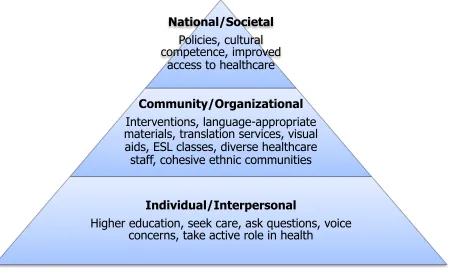
The social ecological model establishes that there are many layers that influence the
health of LEP patients, whether it is at the individual, community, or national level. Although it
has been demonstrated that health disparities of LEP patients are multifaceted, the scope of this
paper will focus on the various interventions and policies that are currently in place to promote
better health outcomes and health literacy in LEP patients. By doing so, the author will ascertain
the need for more attention to the sensitive health issues of the LEP patient population. Figure 1
shows the social ecological model of examples of interventions that help to mitigate health
FIGURE 1: Social ecological model of interventions appropriate to LEP patients
National/Societal
Policies, cultural competence, improved
access to healthcare
Community/Organizational
Interventions, language-appropriate materials, translation services, visual aids, ESL classes, diverse healthcare staff, cohesive ethnic communities
Individual/Interpersonal
CHAPTER III
Methodology
Conceptual Framework
The methodology for this systematic review was developed after consultation with
experts in health policy, health management, health disparities, and linguistic barriers to care.
The databases included were deemed to contain the most relevant studies to the subject matter.
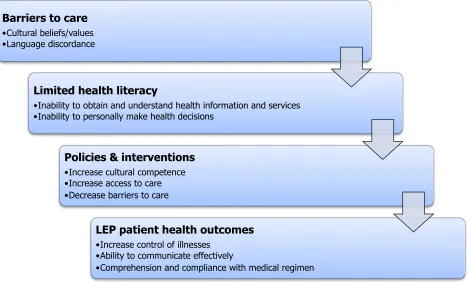
The conceptual framework of this paper is to delineate the types of barriers to care that affect
LEP patients, explain how limited health literacy contributes to the disparities of LEP patients,
present interventions and policies that help mitigate these healthcare disparities, and demonstrate
the subsequent effects on LEP patient health outcomes. Figure 2 shows a visual depiction of the
[image:18.612.83.552.409.692.2]conceptual framework used to guide this systematic review.
FIGURE 2: Conceptual framework for the review
Barriers to care
• Cultural beliefs/values • Language discordance
Limited health literacy
• Inability to obtain and understand health information and services • Inability to personally make health decisions
Policies & interventions
• Increase cultural competence • Increase access to care • Decrease barriers to care
LEP patient health outcomes
• Increase control of illnesses • Ability to communicate effectively
Search Strategy
The search strategy for health literacy interventions targeted peer-reviewed, published
literature found in four online databases, including the Academic Search Complete, Education
Resources Information Center, Medline, and PubMed. Search strategies were developed for
each database to include the phrases “health literacy” and “limited English,” being mindful that
searches in the PubMed database required the use of medical subject headings (MeSH).
The search strategy for health literacy policies is similar to that of the strategy for
interventions. For those papers that referenced policies, the original text of the policy was
researched and analyzed.
Inclusion Criteria
To be included, the studies had to be undertaken in the U.S. and had to include
interventions or policies that were targeted to promote health literacy and improve health
outcomes in LEP patients. For example, some studies assessed rates of health literacy in LEP
populations, but did not examine the effects of any particular intervention. Furthermore, articles
CHAPTER IV
Results
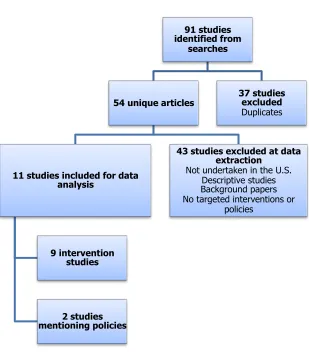
Because the search terms were very specific, only 91 studies were initially identified
from the systematic search of the four databases. Of the original 91 articles, 37 were duplicates
and were excluded, resulting in 54 unique studies. Upon review of the abstracts and full-text
articles, 43 did not include targeted health literacy interventions or policies for LEP patients in
the U.S., and were therefore eliminated. The remaining 11 studies were used for analysis.
[image:20.612.148.457.337.692.2]Figure 3 shows the systematic search process with reasons for inclusion and exclusion of articles.
FIGURE 3: Flowchart of review
91 studies identified from
searches
54 unique articles
11 studies included for data analysis
9 intervention studies
2 studies mentioning policies
43 studies excluded at data extraction
Not undertaken in the U.S. Descriptive studies Background papers No targeted interventions or
policies 37 studies
Interventions
Of the 11 articles that met the inclusion criteria, nine of the articles evaluated an
intervention that targeted improving LEP patient health outcomes and health literacy levels.
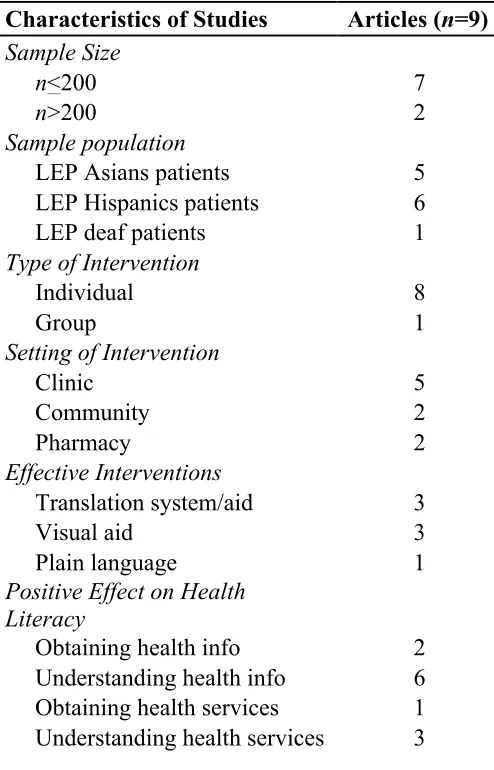
Table 1 shows a summary of the characteristics of the articles that met the inclusion criteria
(n=9). In general, the nine articles included in the analysis had a very small sample size. Only
two of the nine articles had a sample size that consisted of more than 200 people. Most of the
articles focused on LEP Hispanic (n=6) and Asian patients (n=5), but only one article focused on
[image:21.612.74.321.336.721.2]interventions available for LEP deaf patients.
TABLE 1: Summary of characteristics of articles meeting inclusion criteria
Characteristics of Studies Articles (n=9) Sample Size
n<200 7
n>200 2
Sample population
LEP Asians patients 5
LEP Hispanics patients 6
LEP deaf patients 1
Type of Intervention
Individual 8
Group 1
Setting of Intervention
Clinic 5
Community 2
Pharmacy 2
Effective Interventions
Translation system/aid 3
Visual aid 3
Plain language 1
Positive Effect on Health Literacy
Obtaining health info 2
Understanding health info 6
Of the interventions mentioned, only one of the articles included a group intervention; all
of the others (n=8) consisted of an individual-level intervention. More than half of the articles
(n=5) consisted of a clinical intervention approach; the remaining articles mentioned community
(n=2) and pharmaceutical (n=2) interventions. One-third of the articles (n=3) used a translation
method, whether it was a new translation system or a translation aid, such as foreign language or
American Sign Language (ASL) interpreters. Another three articles used some form of visual
aid, including an interactive questionnaire survey. One article used plain language as a method
of effective communication.
In regards to improving health literacy, the majority of the articles (n=8) focused on
health information; two improved the patients’ ability to obtain health information, and six
improved the patients’ understanding of the given health information. Four of the articles
concerned health services, such as an improvement in the patients’ access to health services
(n=1) and comprehension of the importance of the recommended health services (n=3).
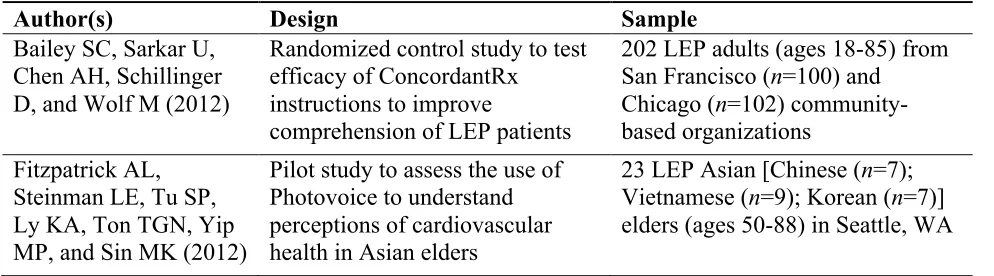
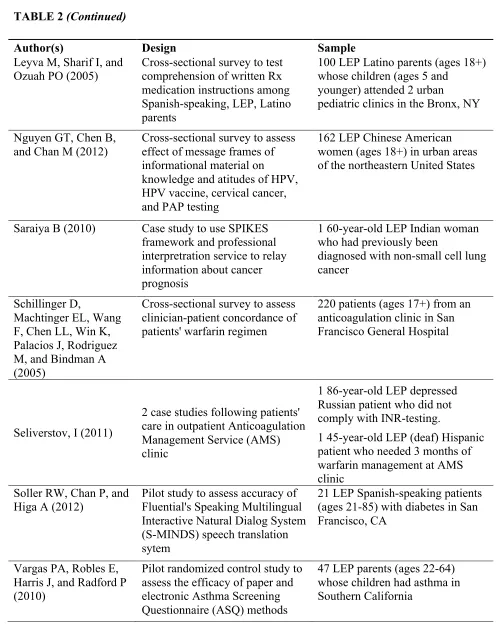
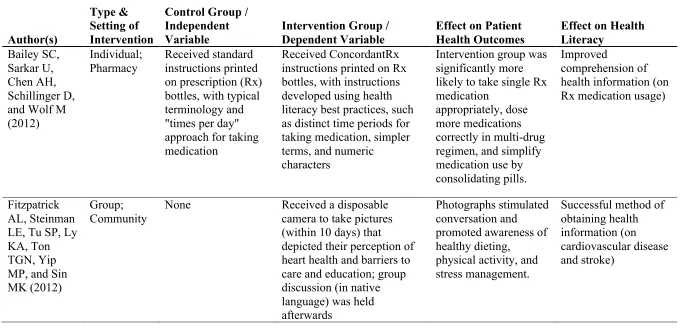
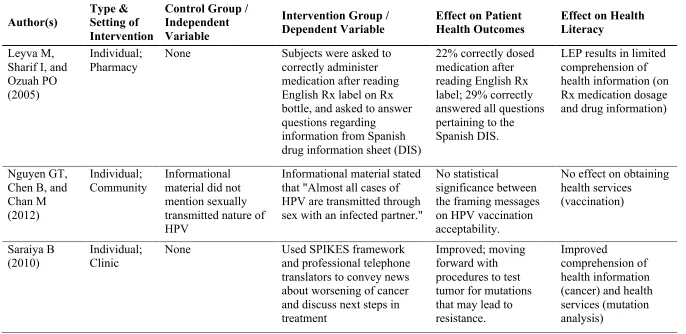
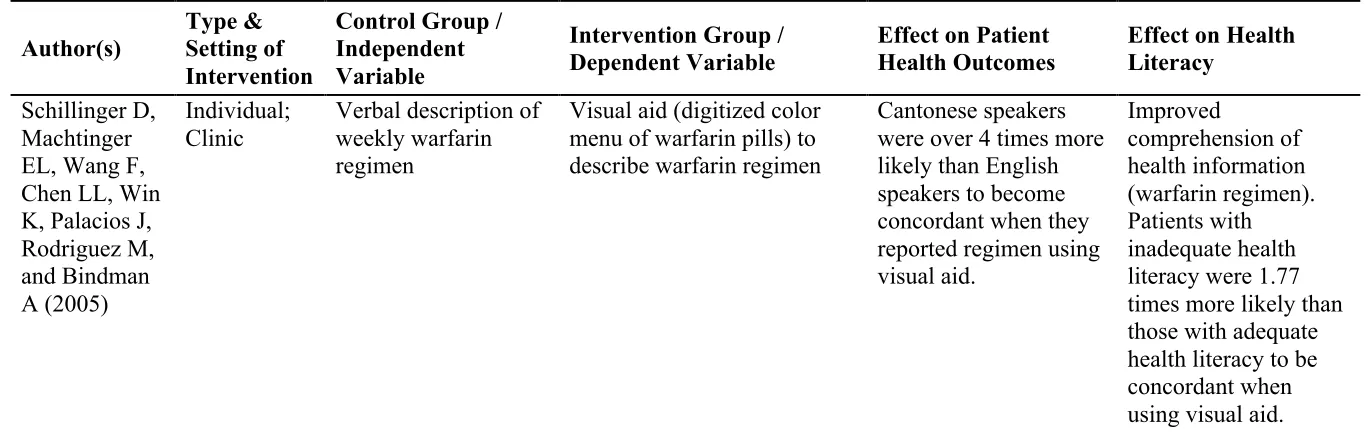
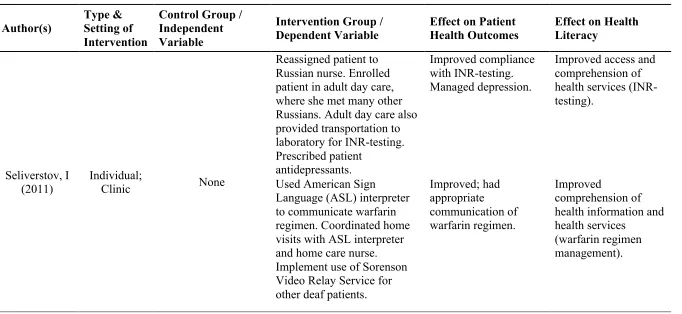
Tables 2 and 3 describe the articles in greater detail. Table 2 shows the study designs and
sample populations of the articles. Table 3 shows a summary of the interventions evaluated in
[image:22.612.70.567.544.682.2]the articles, including the effects on patient health outcomes and health literacy.
TABLE 2: Designs and samples of articles meeting inclusion criteria
Author(s) Design Sample
Bailey SC, Sarkar U, Chen AH, Schillinger D, and Wolf M (2012)
Randomized control study to test efficacy of ConcordantRx
instructions to improve
comprehension of LEP patients
202 LEP adults (ages 18-85) from San Francisco (n=100) and
Chicago (n=102) community-based organizations
Fitzpatrick AL, Steinman LE, Tu SP, Ly KA, Ton TGN, Yip MP, and Sin MK (2012)
Pilot study to assess the use of Photovoice to understand perceptions of cardiovascular health in Asian elders
TABLE 2 (Continued)
Author(s) Design Sample
Leyva M, Sharif I, and Ozuah PO (2005)
Cross-sectional survey to test comprehension of written Rx medication instructions among Spanish-speaking, LEP, Latino parents
100 LEP Latino parents (ages 18+) whose children (ages 5 and
younger) attended 2 urban
pediatric clinics in the Bronx, NY
Nguyen GT, Chen B, and Chan M (2012)
Cross-sectional survey to assess effect of message frames of informational material on
knowledge and atitudes of HPV, HPV vaccine, cervical cancer, and PAP testing
162 LEP Chinese American women (ages 18+) in urban areas of the northeastern United States
Saraiya B (2010) Case study to use SPIKES framework and professional interpretration service to relay information about cancer prognosis
1 60-year-old LEP Indian woman who had previously been
diagnosed with non-small cell lung cancer
Schillinger D,
Machtinger EL, Wang F, Chen LL, Win K, Palacios J, Rodriguez M, and Bindman A (2005)
Cross-sectional survey to assess clinician-patient concordance of patients' warfarin regimen
220 patients (ages 17+) from an anticoagulation clinic in San Francisco General Hospital
Seliverstov, I (2011)
2 case studies following patients' care in outpatient Anticoagulation Management Service (AMS) clinic
1 86-year-old LEP depressed Russian patient who did not comply with INR-testing.
1 45-year-old LEP (deaf) Hispanic patient who needed 3 months of warfarin management at AMS clinic
Soller RW, Chan P, and Higa A (2012)
Pilot study to assess accuracy of Fluential's Speaking Multilingual Interactive Natural Dialog System (S-MINDS) speech translation sytem
21 LEP Spanish-speaking patients (ages 21-85) with diabetes in San Francisco, CA
Vargas PA, Robles E, Harris J, and Radford P (2010)
Pilot randomized control study to assess the efficacy of paper and electronic Asthma Screening Questionnaire (ASQ) methods
TABLE 3: Summary of interventions and the effects on patient health outcomes and health literacy Author(s) Type & Setting of Intervention
Control Group / Independent Variable
Intervention Group / Dependent Variable
Effect on Patient Health Outcomes
Effect on Health Literacy
Bailey SC, Sarkar U, Chen AH, Schillinger D, and Wolf M (2012)
Individual; Pharmacy
Received standard instructions printed on prescription (Rx) bottles, with typical terminology and "times per day" approach for taking medication
Received ConcordantRx instructions printed on Rx bottles, with instructions developed using health literacy best practices, such as distinct time periods for taking medication, simpler terms, and numeric
characters
Intervention group was significantly more likely to take single Rx medication
appropriately, dose more medications correctly in multi-drug regimen, and simplify medication use by consolidating pills.
Improved
comprehension of health information (on Rx medication usage)
Fitzpatrick AL, Steinman LE, Tu SP, Ly KA, Ton TGN, Yip MP, and Sin MK (2012)
Group; Community
None Received a disposable camera to take pictures (within 10 days) that depicted their perception of heart health and barriers to care and education; group discussion (in native language) was held afterwards
Photographs stimulated conversation and promoted awareness of healthy dieting,
physical activity, and stress management.
TABLE 3: (Continued) Author(s) Type & Setting of Intervention
Control Group / Independent Variable
Intervention Group / Dependent Variable
Effect on Patient Health Outcomes
Effect on Health Literacy
Leyva M, Sharif I, and Ozuah PO (2005)
Individual; Pharmacy
None Subjects were asked to
correctly administer medication after reading English Rx label on Rx bottle, and asked to answer questions regarding
information from Spanish drug information sheet (DIS)
22% correctly dosed medication after reading English Rx label; 29% correctly answered all questions pertaining to the Spanish DIS.
LEP results in limited comprehension of health information (on Rx medication dosage and drug information)
Nguyen GT, Chen B, and Chan M (2012)
Individual; Community
Informational material did not mention sexually transmitted nature of HPV
Informational material stated that "Almost all cases of HPV are transmitted through sex with an infected partner."
No statistical
significance between the framing messages on HPV vaccination acceptability.
No effect on obtaining health services (vaccination) Saraiya B (2010) Individual; Clinic
None Used SPIKES framework
and professional telephone translators to convey news about worsening of cancer and discuss next steps in treatment
Improved; moving forward with procedures to test tumor for mutations that may lead to resistance.
Improved
TABLE 3: (Continued) Author(s) Type & Setting of Intervention
Control Group / Independent Variable
Intervention Group / Dependent Variable
Effect on Patient Health Outcomes
Effect on Health Literacy
Schillinger D, Machtinger EL, Wang F, Chen LL, Win K, Palacios J, Rodriguez M, and Bindman A (2005)
Individual; Clinic
Verbal description of weekly warfarin regimen
Visual aid (digitized color menu of warfarin pills) to describe warfarin regimen
TABLE 3: (Continued) Author(s) Type & Setting of Intervention
Control Group / Independent Variable
Intervention Group / Dependent Variable
Effect on Patient Health Outcomes
Effect on Health Literacy
Seliverstov, I (2011)
Individual;
Clinic None
Reassigned patient to Russian nurse. Enrolled patient in adult day care, where she met many other Russians. Adult day care also provided transportation to laboratory for INR-testing. Prescribed patient
antidepressants.
Improved compliance with INR-testing. Managed depression.
Improved access and comprehension of health services (INR-testing).
Used American Sign
Language (ASL) interpreter to communicate warfarin regimen. Coordinated home visits with ASL interpreter and home care nurse. Implement use of Sorenson Video Relay Service for other deaf patients.
Improved; had appropriate communication of warfarin regimen. Improved comprehension of health information and health services
TABLE 3: (Continued) Author(s) Type & Setting of Intervention
Control Group / Independent Variable
Intervention Group / Dependent Variable
Effect on Patient Health Outcomes
Effect on Health Literacy
Soller RW, Chan P, and Higa A (2012)
Individual; Clinic
Dragon, Jibbigo, Google
S-MINDS Improved
patient-physician dialogue. S-MINDS was 97-100% accurate on all
translations. Patients' satisfaction was high (4.7-4.9 out of 5.0). S-MINDS outperformed 3 other translation systems when
translating fast speech, speech disfluencies, and multiple noise conditions.
Improved method of obtaining health information, and improved comprehension of health information (diabetes). Vargas PA, Robles E, Harris J, and Radford P (2010) Individual; Clinic Nurse-guided structured interview Paper-and-pencil ASQ; Electronic ASQ
Parents using the electronic ASQ gave 68% more concordant answers with the nurse interview, compared to the 54% concordance rate of the parents who had paper ASQ.
Improved
Policies
Of the 11 articles that met the inclusion criteria, two described policies that related to
LEP patients and health literacy. A total of four federal policies were extracted and researched
for original text. Of these four, all implied an improvement in comprehension of health
information, and one implied an improvement in access to health services, although none had
any direct text that would signify a deliberate improvement in health literacy levels. Regarding
the effects of the policies on the LEP patient population, one policy had no mention of LEP
patients, one implied improved access to language-appropriate services and written health
information materials (although this policy is not implemented federally), and two have no
TABLE 4: Summary of policies on health literacy and LEP patients
Article Policy (Effective
Date) Summary
Effect on Health
Literacy Effect on LEP Patients
Federal Adherence Bailey SC, Agarwal N, Sleath B, Gumusoglu S, and Wolf MS
(2011) Title VI of the Civil Rights Act of 1964
Prohibits discrimination based on national origin
(Implied) Improve access to health services and improve comprehension of health information
(Implied) Provide access to LEP patients,
including language-appropriate patient counseling and written health information
No Regenstein M,
Andres E, Nelson D, David S, Lopert R, and Katz R (2012) Bailey SC, Agarwal N, Sleath B, Gumusoglu S, and Wolf MS (2011)
PUBLIC LAW 111–274: Plain Writing Act of 2010
Executive orders for federal agencies to distribute
communications and information in "plain writing"
(Implied) Improve comprehension of health information
TABLE 4: (Continued)
Article Policy (Effective
Date) Summary
Effect on Health
Literacy Effect on LEP Patients
Federal Adherence Regenstein M,
Andres E, Nelson D, David S, Lopert R, and Katz R (2012)
U.S. Food and Drug
Administration (FDA) - Medicine Guides (2010)
FDA requires manufacturers of certain drugs and biological products to issue Med Guides
(Implied) Improve comprehension of health information for increased safety
Requirement for non-technical wording; no regulation on language-appropriateness or translations
Yes
Regenstein M, Andres E, Nelson D, David S, Lopert R, and Katz R (2012)
FDA, Title 21, Volume 5, Chapter 1, Subchapter D, Part 310, Subpart E, Section 310.515 (2013)
FDA requires patient package insert for specific new drugs or devices
(Implied) Improve comprehension of health information for increased safety
Requirement for non-technical wording; no regulation on language-appropriateness or translations
CHAPTER V
Discussion
Interventions
- Use of translation system and translation aid
Out of the nine studies examined, the top two interventions consisted of using a
translation system or visual aids. Since language is a barrier for most LEP patients, it would
make sense that using the patients’ native language would ease patient-physician
communication. Three case studies used professional interpreters to communicate health
complications to a Russian, Indian, and deaf patient (Saraiya, 2010; Seliverstov, 2011). When
patients are ethnically matched to their physicians and other healthcare professionals, the
language barrier decreases and services, such as those in the mental health field, are improved
(Wang et al., 2007). Culturally similar patient/physician relationships may also result in a higher
patient satisfaction, adherence to medical regime, and decreased costs, as opposed to using
interpreter services (Mullins et al., 2005). New healthcare information technology are constantly
emerging, and some have proved to be 97-100% accurate when translating conversations in a
clinical setting (Soller, Chan, & Higa, 2012). The use of professional interpreters and translation
systems allow for more fluid conversation between patients and healthcare professionals because
patients have the opportunity to ask further questions about their prognosis, risks, and treatment
options. Translation systems may also provide more patient privacy and confidentiality because
there is little need to rely on family members for translation.
Interpreter services also have several drawbacks due to the ethnic diversity in the Asian
population, and even that within subgroups of many ethnicities. It may be difficult to find
2007). Thus, the problem then becomes the amount of staff and resources allotted to provide
multiple dialects of one language and none of another. Additionally, in the study surveying
cancer knowledge among Asian Americans in Philadelphia, PA, it was found that even with the
use of translators, patients were still reluctant to ask questions about cancer and prevention
(Phipps, Cohen, Sorn, & Braitman, 1999). In her assessment of cultural barriers experienced by
Asian Americans, Uba also points out that untrained translators might overemphasize diagnoses
or minimize symptoms, resulting in erroneous treatment and/or unnecessary frights to the
patients (Uba, 1992). The inability to communicate with and ask questions of healthcare
professionals results in the patients’ decreased satisfaction of healthcare as a result of perceived
decreased involvement in the decision-making process.
- Use of visual aids
The use of visual aids to help facilitate communication was another trend observed
among the interventions examined. Patients better accurately describe their warfarin regimen
when using visual cues, such as a digitized color menu of warfarin pills, than when they were
asked to verbally describe their medical regimen (Schillinger et al., 2005). Visual aids may help
patients gain better control of their health conditions by allowing for visual association between
the pills and the proper prescribed methods. In another study of parents with asthmatic children
in Southern California, parents were better to express their child’s asthma symptoms when using
the electronic Asthma Screening Questionnaire (ASQ) than a paper-and-pencil method (Vargas,
Robles, Harris, & Radford, 2010). The interactive technology may be useful in helping patients
accurately recall symptoms. A novel study, drawing from the ideology of Photovoice, asked
elderly Asian patients to use a disposable camera to take pictures of things in their community
allowed patients to share in small groups (more comfortably in their native language) their
perceptions of cardiovascular disease, and to learn from one another and trained professionals
how to better care for their health. Visual aids, such as photos, colored menus, and interactive
tools, are effective interventions to help healthcare professionals communicate health
information to LEP patients.
- Use of plain language
Several states, including California, Illinois, and Virginia, have begun testing a new
pharmaceutical plain language approach to prescription writing. Bailey et al. conducted an
evaluation of the approach, using a randomized control trial to measure the efficacy of
ConcordantRx instructions compared to standard pharmacy instructions. The standard
instructions had usual terminology with capital letters, using a “‘times per day’ approach to
explain when medicine should be taken (i.e. ‘TAKE TWO TABLETS TWICE DAILY’)”
(Bailey, Sarkar, Chen, Schillinger, & Wolf, 2012). On the other hand, the ConcordantRx
instructions were developed using “health literacy best practices.” Time of day for taking
medication was split into four time periods (morning, noon, evening, bedtime), and used
numerical characters instead of spelling out the quantity. These instructions were also translated
into the patient’s native language, when necessary. The researchers found that the patients with
ConcordantRx instructions were more likely to dose their medications correctly, even when there
were multiple medications involved. This study provides evidence to support the standardization
and revision of current instructions on prescription medication labels. If patients are better able
to understand the prescription instructions, they will be less likely to make errors when taking
One intervention that did not seem to have much correlation with a change in patient
behavior was the message framing approach in the study conducted by Nguyen, Chen, and Chan.
Half of the participants received informational material that mentioned the sexual nature of HPV,
and the other half of the informational material did not. Regardless of the message framing,
acceptability and willingness to be vaccinated against HPV was very low among the study
participants (Nguyen, Chen, & Chan, 2012). Further research may need to be conducted to
determine the cultural barriers that perpetuate the resistance of HPV vaccination and Pap testing
in Asian communities.
Policies
Although there may be states that have implemented their own policies to increase LEP
patient health outcomes, and there have been strong recommendations from national agencies,
such as the U.S. Food and Drug Administration (FDA) or the Office of Minority Health at the
U.S. Department of Health and Human Services, this section will only discuss policies that have
been passed as federal law.
In summary, none of the four policies extracted had any direct wording to signify an
improvement in health literacy, although there were implied improvements to comprehension of
health information (n=4) and access to health services (n=1). One notable finding is that the
general interpretation of the Title VI of the Civil Rights Act of 1964 implies that entities that
receive federal funding must provide language-appropriate services and healthcare information
to LEP patients (Bailey, Agarwal, Sleath, Gumusoglu, & Wolf, 2011; Regenstein et al., 2012;
“Title VI of the Civil Rights Act of 1964,” n.d.). However, this is the only policy out of the four
clearly stated to include implications for the LEP patient populations, LEP patients may notice
remarkable improvements in health literacy levels and patient health outcomes.
While the FDA’s two regulations on providing Medicine Guides (MG) and patient
package insert (PPI) for certain drugs and biological products require non-technical wording for
comprehension in the general U.S. public (“CFR - Code of Federal Regulations Title 21,” n.d.;
Regenstein et al., 2012; U.S. Food and Drug Administration, n.d.), these policies may not be
enough to accommodate the LEP patient population. For example, there are no current
regulations on language-appropriateness and no non-English versions available for MG or PPI.
Since 2010, President Obama has issued four executive orders stating that
communications and information disseminated by federal agencies be written in “plain writing”
and be “clear, concise and well-organized” so that the public can understand and use (“Plain
Writing Act of 2010,” n.d.). These executive orders make a very profound statement about the
direction and commitment of the federal government to health literacy. The executive orders
hold government agencies accountable to transparency and public review, which sets a great
example and precedence for other agencies to take the same approach. However, there is no
mention of how this policy can directly be related to the LEP patient populations.
Policymakers should familiarize themselves with the diversity of LEP patients and create
policies, taking into consideration one’s primary language, ethnicity, health literacy, insurance,
and immigrant status (Kim & Keefe, 2010) to address the various needs between ethnicities and
subgroups of the LEP patient population in the U.S.
Limitations
Because the systematic search strategy had specific keyword searches and specific
that pertain to LEP patients may have been excluded. For example, there were many other
interventions found in the systematic search that were not eligible for inclusion in this analysis
because the studies did not evaluate the interventions or because the full text was no longer
available online because it may have contained personally identifiable information. For
example, Singleton, an expert in cultural and linguistic barriers to health literacy, developed
eight picture story modules to prompt beginner and low-literacy public school students in Fairfax
County, Virginia to think about and discuss difficult topics (Singleton, 2001). This, like the
other visual aids, allows patients to better obtain and understand health information.
Other examples of successful interventions that were found in the literature review but
did not meet the inclusion criteria for the analysis of this systematic search include community
outreach efforts and language-appropriate media. Direct community efforts may educate
immigrants about their rights and help them gain access to available health services (Wang et al.,
2007), dispute misconceptions of health (Phipps et al., 1999), and specifically target and address
the diverse ethnic needs of various Asian cultures (Wu & Ronis, 2009). One such example of a
successful intervention study that may prompt further evaluation includes home visits, small
group presentations, counseling, medical interpretation, and transportation to help Cambodian
women in Seattle take a more active approach to health (Schillinger et al., 2002) and participate
in annual screenings for cervical cancer. Although quite influential, outreach at the community
level may be difficult because it calls for a change in behaviors of culturally sensitive issues
(Mullins et al., 2005).
Similarly, language-appropriate educational material can help to reduce the stigma and
reluctance of various health conditions and medical procedures (Wang et al., 2007) by portraying
sex-appropriate groups (Mullins et al., 2005). One colorectal cancer study showed that 42% of
participants preferred community educational seminars, 30% preferred language-appropriate
media (television), and 20% preferred language-appropriate health promotional print materials
(Jo et al., 2008). Another study in California demonstrated an increase in Asians calling a
language-appropriate hotline to access tobacco cessation information (Zhu, Wong, Stevens,
Nakashima, & Gamst, 2010). Language-appropriate intervention methods have shown a positive
correlation with improved patient outcomes in the Asian community, and should be further
researched in the general LEP patient population.
Future Directions
There is still much work that needs to be done to understand the specific needs of the
LEP patient population. This paper solely establishes the urgent need and call to action to
address the health concerns of LEP patients. With more resources, the author plans to research
and compile a comprehensive resource packet of interventions that may be appropriate to
clinical, community, and pharmaceutical settings. Future studies may also include a
comprehensive policy analysis of all existing state policies that are LEP-sensitive. This project
may be used to inform federal policies to influence awareness of LEP issues in all states.
Conclusion
LEP patients are subject to low patient health outcomes due to limited health literacy.
Cultural and linguistic barriers prohibit the obtainment and comprehension of health information
and services. Culturally competent healthcare professionals and policymakers are needed to
raise awareness and demystify LEP issues in the clinical and political settings. Interventions,
such as translation services, visual aids, and use of plain language, help bridge the
protection of LEP patients, and proposed methods for increasing access and comprehension of
health information and services to LEP patients. Further ethnic-driven, culturally-sensitive
References
ASPA. (2013, June 10). About the Law. Retrieved July 23, 2013, from
http://www.hhs.gov/healthcare/rights/index.html
Bailey, S. C., Agarwal, N., Sleath, B., Gumusoglu, S., & Wolf, M. S. (2011). Improving drug
labeling and counseling for limited English proficient adults. Journal of health care for
the poor and underserved, 22(4), 1131–1143. doi:10.1353/hpu.2011.0145
Bailey, S. C., Sarkar, U., Chen, A. H., Schillinger, D., & Wolf, M. S. (2012). Evaluation of
language concordant, patient-centered drug label instructions. Journal of general internal
medicine, 27(12), 1707–1713. doi:10.1007/s11606-012-2035-3
Betancourt, J. R., Green, A. R., Carrillo, J. E., & Ananeh-Firempong, O. (2003). Defining
cultural competence: a practical framework for addressing racial/ethnic disparities in
health and health care. Public Health Reports, 118(4), 293–302.
Burke, N. J., Jackson, J. C., Thai, H. C., Lam, D. H., Chan, N., Acorda, E., & Taylor, V. M.
(2004). “Good health for new years”: development of a cervical cancer control outreach
program for Vietnamese immigrants. Journal Of Cancer Education: The Official Journal
Of The American Association For Cancer Education, 19(4), 244–250.
CFR - Code of Federal Regulations Title 21. (n.d.). Retrieved July 22, 2013, from
http://www.accessdata.fda.gov/scripts/cdrh/cfdocs/cfCFR/CFRSearch.cfm?fr=310.515
Fitzpatrick, A. L., Steinman, L. E., Tu, S.-P., Ly, K. A., Ton, T. G. N., Yip, M.-P., & Sin, M.-K.
(2012). Using Photovoice to Understand Cardiovascular Health Awareness in Asian
Elders. Health Promotion Practice, 13(1), 48–54. doi:10.1177/1524839910364381
Gany, F., Leng, J., Shapiro, E., Abramson, D., Motola, I., Shield, D. C., & Changrani, J. (2007).
Journal of General Internal Medicine, 22(Suppl 2), 312–318.
doi:10.1007/s11606-007-0360-8
Health Literacy: A Prescription to End Confusion. (n.d.). Retrieved November 29, 2012, from
http://www.nap.edu/openbook.php?record_id=10883&page=R1
Jacobs, E. A., Karavolos, K., Rathouz, P. J., Ferris, T. G., & Powell, L. H. (2005). Limited
english proficiency and breast and cervical cancer screening in a multiethnic population.
American Journal of Public Health, 95(8), 1410–1416.
Jo, A. M., Maxwell, A. E., Wong, W. K., & Bastani, R. (2008). Colorectal Cancer Screening
among Underserved Korean Americans in Los Angeles County. Journal of immigrant
and minority health / Center for Minority Public Health, 10(2), 119–126.
doi:10.1007/s10903-007-9066-6
Kim, W. S., & Keefe, R. H. (2010). Barriers to healthcare among Asian Americans. Social Work
in Public Health, 25(3/4), 286–295.
Kutner, M., Greenberg, E., Jin, Y., & Paulsen, C. National Center for Education Statistics,
(2006). The health literacy of America’s adults: Results from the 2003 National
Assessment of Adult Literacy. Retrieved from U.S. Department of Education website:
http://nces.ed.gov/pubs2006/2006483.pdf
Lim, J. (2010). Linguistic and ethnic disparities in breast and cervical cancer screening and
health risk behaviors among Latina and Asian American women. Journal Of Women’s
Health (2002), 19(6), 1097–1107.
Muecke, M. A. (1983). Caring for Southeast Asian refugee patients in the USA. American
Mullins, C. D., Blatt, L., Gbarayor, C. M., Yang, H.-W. K., & Baquet, C. (2005). Health
disparities: A barrier to high-quality care. American Journal of Health-System Pharmacy,
62(18), 1873–1882. doi:10.2146/ajhp050064
National Assessment of Adult Literacy (NAAL). (n.d.). Retrieved July 17, 2013, from
http://nces.ed.gov/naal/literacytypes.asp
Nguyen, G., Chen, B., & Chan, M. (2012). Pap Testing, Awareness, and Acceptability of a
Human Papillomavirus (HPV) Vaccine Among Chinese American Women. Journal of
Immigrant & Minority Health, 14(5), 803–808. doi:10.1007/s10903-012-9607-5
Phipps, E., Cohen, M. H., Sorn, R., & Braitman, L. E. (1999). A pilot study of cancer knowledge
and screening behaviors of Vietnamese and Cambodian women. Health Care For Women
International, 20(2), 195–207.
Plain Writing Act of 2010. (n.d.). Retrieved 15 June 2013, from
http://www.plainlanguage.gov/plLaw/index.cfm
Ratzan S, Parker R. Introduction. In: Selden C, Zorn M, Ratzan S, Parker R, editors. National
Library of Medicine Current Bibliographies in Medicine: Health Literacy. Bethesda, MD:
National Institutes of Health, U.S. Department of Health and Human Services; 2000.
Regenstein, M., Andres, E., Nelson, D., David, S., Lopert, R., & Katz, R. (2012). Medication
Information for Patients with Limited English Proficiency: Lessons from the European
Union. Journal of Law, Medicine & Ethics, 40(4), 1025–1033.
doi:10.1111/j.1748-720X.2012.00729.x
Saraiya, B. (2010). Communicating with a patient with limited English proficiency. Hem/Onc
Schillinger, D., Grumbach, K., Piette, J., Wang, F., Osmond, D., Daher, C., … Bindman, A. B.
(2002). Association of health literacy with diabetes outcomes. JAMA: the journal of the
American Medical Association, 288(4), 475–482.
Schillinger, D., Machtinger, E. L., Wang, F., Chen, L.-L., Win, K., Palacios, J., … Bindman, A.
(2005). Language, Literacy, and Communication Regarding Medication in an
Anticoagulation Clinic: Are Pictures Better Than Words? Advances in Patient Safety:
From Research to Implementation (Volume 2: Concepts and Methodology).
Schonlau, M., Martin, L., Haas, A., Derose, K. P., & Rudd, R. (2011). Patients’ Literacy Skills:
More than just reading ability. Journal of health communication, 16(10), 1046–1054.
doi:10.1080/10810730.2011.571345
Seliverstov, I. (2011). Practical management approaches to anticoagulation non-compliance,
health literacy, and limited English proficiency in the outpatient clinic setting. Journal Of
Thrombosis And Thrombolysis, 31(3), 321–325. doi:10.1007/s11239-011-0560-2
Singleton, K. (2001). Picture Stories for ESL Health Literacy. Retrieved from
http://www.eric.ed.gov/ERICWebPortal/detail?accno=ED465303
Soller, R. W., Chan, P., & Higa, A. (2012). Performance of a new speech translation device in
translating verbal recommendations of medication action plans for patients with diabetes.
Journal of diabetes science and technology, 6(4), 927–937.
Title VI of the Civil Rights Act of 1964. (n.d.). Retrieved July 22, 2013, from
http://www.justice.gov/crt/about/cor/coord/titlevi.php
U.S. Food and Drug Administration. (n.d.). Drug Safety and Availability - Medication Guides.
WebContent. Retrieved July 22, 2013, from
Uba, L. (1992). Cultural barriers to health care for southeast Asian refugees. Public Health
Reports, 107(5), 544–548.
Vargas, P. A., Robles, E., Harris, J., & Radford, P. (2010). Using information technology to
reduce asthma disparities in underserved populations: a pilot study. The Journal of
asthma: official journal of the Association for the Care of Asthma, 47(8), 889–894.
doi:10.3109/02770903.2010.497887
Wang, J. L., Miller, N. A., Hufstader, M. A., & Bian Ying. (2007). The health status of Asian
Americans and Pacific Islanders and their access to health services. Haworth Press Inc.
Wu, T.-Y., & Ronis, D. (2009). Correlates of recent and regular mammography screening among
Asian-American women. Journal Of Advanced Nursing, 65(11), 2434–2446.
Zhu, S.-H., Wong, S., Stevens, C., Nakashima, D., & Gamst, A. (2010). Use of a smokers’
quitline by Asian language speakers: results from 15 years of operation in California.