Georgia State University
ScholarWorks @ Georgia State University
Public Management and Policy Dissertations Department of Public Management and Policy
Fall 1-8-2010
The Impact of Performance Ratings on Federal
Personnel Decisions
Seong Soo Oh
Follow this and additional works at:https://scholarworks.gsu.edu/pmap_diss
This Dissertation is brought to you for free and open access by the Department of Public Management and Policy at ScholarWorks @ Georgia State University. It has been accepted for inclusion in Public Management and Policy Dissertations by an authorized administrator of ScholarWorks @ Georgia State University. For more information, please [email protected].
Recommended Citation
THE IMPACT OF PERFORMANCE RATINGS ON
FEDERAL PERSONNEL DECISIONS
A Dissertation Presented to The Academic Faculty
by
Seong Soo Oh
In Partial Fulfillment
of the Requirements for the Degree Doctor of Philosophy in Public Policy
Georgia State University and Georgia Institute of Technology December 2009
THE IMPACT OF PERFORMANCE RATINGS ON
FEDERAL PERSONNEL DECISIONS
Approved by:
Dr. Gregory B. Lewis, Advisor
Andrew Young School of Policy Studies Georgia State University
Dr. Gordon Kingsley School of Public Policy
Georgia Institute of Technology
Dr. William L. Waugh Jr.
Andrew Young School of Policy Studies Georgia State University
Dr. Julia E. Melkers School of Public Policy
Georgia Institute of Technology
Dr. Katherine G. Willoughby
Andrew Young School of Policy Studies Georgia State University
TABLE OF CONTENTS
Page
LIST OF TABLES v
LIST OF SYMBOLS AND ABBREVIATIONS vii
SUMMARY viii
CHAPTER
1 INTRODUCTION 1
1.1 Background of the Study 1
1.2 Performance Appraisals and Performance-Based Rewards 4
1.3 History of Federal Performance Appraisals 6
2 THE IMPACT OF RATINGS ON CAREER ADVANCEMENT 9
2.1 Introduction 9
2.2 Literature Review 11
2.3 Other Factors Affecting Career Advancement 15
2.4 Hypotheses 21
2.5 Data and Methods 28
2.6 Findings 34
2.7 Conclusions 50
3 PERFORMANCE RATINGS AND GENDER AND RACIAL
INEQUALITIES IN CAREER SUCCESS 53
3.1 Introduction 53
3.2 Literature Review 54
3.3 Hypotheses 58
3.4 Other Factors Affecting Performance Ratings, Salary Increases, and
3.5 Data and Methods 67
3.6 Findings 75
3.7 Conclusions 91
4 CONCLUSION 94
APPENDIX: TABLES 98
LIST OF TABLES
Page
Table 2.1: Descriptive Statistics of Performance Ratings and Career Advancement 35
Table 2.2: Career Advancement Comparison: T-test 35
Table 2.3: Impact of Performance Ratings on Career Advancement: Panel Model 37
Table 3.1: Differences in Mean Characteristics by Race and gender 76
Table 3.2: Race and gender Differences in Performance Appraisal Ratings by Year:
Ordered Logit Model 80
Table 3.3: Difference in the Impact of Performance Ratings on Percent Change in Salary
Growth: Pooled OLS Model 86
Table 3.4: Difference in the Impact of Performance Ratings on Promotion: Pooled Logit
Model 89
Table A.1: Performance Appraisal Rating Distribution, 1988-2003 98
Table A.2: Career Advancement by Year 99
Table A.3: T-test by Year: Career Advancement Comparison between Fully Successful
and Outstanding 100
Table A.4: Impact of Performance Ratings on Percent Change in Salary Growth
by Year 101
Table A.5: Impact of Performance Ratings on Promotion Probability by Year 105
Table A.6: Career Advancement by PATCO Category 106
Table A.7: T-test by PACTO Category: Career Advancement Comparison
between Fully Successful and Outstanding 107
Table A.8: Impact of Performance Ratings on Percent Change in Salary Growth by
PATCO Category: Panel Model 108
Table A.9: Impact of Performance Ratings on Promotion Probability
by PATCO Category: Panel Model 109
Table A.10: Career Advancement by Grade Level 110
Table A.12: Impact of Performance Ratings on Percent Change in Salary Growth
by Grade: Panel Model 112
Table A.13: Impact of Performance Ratings on Promotion Probability by Grade: Panel
Model 113
Table A.14: Career Advancement by Agency 114
Table A.15: T-test by Agency: Career Advancement Comparison between Fully
Successful and Outstanding 115
Table A.16: Impact of Performance Ratings on Percent Change in Salary Growth by
Agency: Panel Model 116
Table A.17: Impact of Performance Ratings on Promotion Probability by Agency: Panel
Model 118
Table A.18: Race and gender Differences in Performance Appraisal Ratings by Sex-type
of Occupation: Ordered Logit Model 120
Table A.19 Race and gender Differences in Performance Appraisal Ratings by PATCO
Category: Ordered Logit Model 121
Table A.20 Race and gender Differences in Performance Appraisal Ratings by Grade
Level: Ordered Logit Model 124
Table A.21 Race and gender Differences in Performance Appraisal Ratings by Agency:
Ordered Logit Model 126
Table A.22: Difference in the Impact of Performance Ratings on Percent Change in Salary Growth in the Upper and Lower Grade Levels 128
Table A.23: Difference in the Impact of Performance Ratings on Percent Change in Salary Growth in the Male-Dominant and Female-Dominant Occupations 129
Table A.24: Difference in the Impact of Performance Ratings on Promotion in the Upper
and Lower Grade Levels 130
Table A.25: Difference in the Impact of Performance Ratings on Promotion in the
LIST OF ABBREVIATIONS
CPDF Central Personnel Data File
CSRA Civil Service Reform Act
EPA Environmental Protection Agency
GAO Government Accountability Office
GS General Schedule
NASA National Aeronautics and Space Administration
OLS Ordinary Least Square
OPM Office of Personnel Management
PATCO Professional, Administrative, Technical, Clerical, and Other
SUMMARY
Can pay-for-performance increase the motivation of public employees? By
providing a basis for personnel decisions, particularly linking rewards to performance,
performance appraisals aim to increase employees’ work motivation and ultimately to
improve their work performance and organizational productivity. With the emphasis on
results-oriented management, performance appraisals have become a key managerial tool
in the public sector. Critics charge, however, that pay-for-performance is ineffective in
the public sector, largely because the link between performance and rewards is weak.
However, no one has empirically measured the strength of the linkage.
If performance ratings do have an impact on career success in the federal service,
they might contribute to race and gender inequality. Although many studies have
examined factors affecting gender and racial differences in career success, studies that try
to connect gender and racial inequalities to managerial tools are scarce.
Using a one percent sample of federal personnel records, the first essay examines
the impact of performance ratings on salary increases and promotion probabilities, and
the second essay explores whether women and minorities receive lower ratings than
comparable white males, and women and minorities receive lower returns on the same
level of performance ratings than comparable white males. The first essay finds that
performance ratings have only limited impact on salary increases, but that they
significantly affect promotion probability. Thus, the argument that performance-rewards
link is weak could be partially correct, if it considers only pay-performance relationships.
comparable white men, but some minority male groups, particularly black men, tend to
receive lower ratings than comparable white men. On the other hand, the returns on
outstanding ratings do not differ between women and minority male groups and white
men, though women groups seem to have disadvantages in promotion with the same
CHAPTER 1
INTRODUCTION
1.1 Background of the Study
Many observers believe that the link between performance and rewards is weak in
the federal service. Paul Light criticizes the lack of compensation for outstanding
performers in the federal service, arguing that “the very definition of outstanding
demands comparison. If the term is to have merit, it cannot apply to more than a
handful” (Light, 1999). Rynes et al. (2005) also argue that “Given the typically weak link
between performance and pay as well as problems with getting supervisors to provide
credible measures of performance for administrative purposes, perhaps any positive
results at all should be regarded as impressive” (p. 588, my italics). That weak link
between performance and rewards may be a primary reason why critics argue
performance-based compensation is not effective and has failed to achieve desired
outcomes (Ingraham, 1993; Kellough & Nigro, 2002; Pearce & Perry, 1983).
Critics, however, do not provide empirical evidence on how weak the link
between performance and rewards is. Performance appraisal systems stand on the belief
that by providing a basis for personnel decisions, particularly linking pay to performance,
performance appraisals motivate employees to increase their work efforts, and hence
improve individual performance and organizational productivity (Daley, 1992; Milkovich
& Wigdor, 1991). Therefore, for performance-based rewards to be effective, they must
between performance and rewards is weak (Pearce & Perry, 1983; Rynes et al., 2005;
Smith & Rupp, 2003).
However, the arguments that performance-rewards link is weak are mostly based
on surveys or less systematic perceptions. Ingraham (1993), for example, cited two
surveys conducted by the U.S. Merit Systems Protection Board and argued, “[A] majority
of those responding do not perceive a link between performance and reward” (p. 352,
italics in original). In response to the 1989 Merit Principles Survey question “If you
perform better in your present job, how likely is it that you will receive more pay?”, for
instance, only 37.1 percent said it was “likely” or “very likely.” This survey gives us
employee perceptions on the practice of pay-for-performance in the federal civil service,
but it still does not provide quantifiable evidence on the strength of the link between
performance and pay. If there is a meaningful difference in performance pay between top
and average performers but only a few employees are evaluated as top performers, for
instance, then most average performers cannot improve their performance enough to
receive that performance pay and their answers would primary be “unlikely.” On the
contrary, if most employees receive performance pay, though the amount is small, the
employees would choose “very likely.” Does this mean that performance-pay
relationship is very strong, so that performance-based pay is very effective to motivate
employess? Other problems with this kind of survey are that employees may not
recognize the size of difference in performance rewards between high and average
performers or, because most federal employees dislike performance appraisal and
pay-for-performance (Ingraham, 1993), they may recognize pay differences between high and
known about the strength of the linkage between performance and rewards. The
dissertation provides empirical evidence by examining the impact of performance ratings
on salary growth and promotion probabilities.
If agencies use performance appraisals to make pay and promotion decisions,
performance ratings should be associated with an individual’s career success. According
to Sherk (2007), pay inequality among individuals rose in recent years due to increased
use of performance pay. Also, performance appraisals could be associated with gender
and racial disparities in career success. Castilla (2008) presents two possible
explanations of how performance ratings can contribute to the disadvantages of women
and minorities in career success. First, women and minorities can receive lower
performance ratings than comparable men and whites with the same performance level
(“performance-evaluation bias”). Second, women and minorities can receive lower
returns on the same performance ratings (“performance-reward bias”). Although, many
studies have examined factors affecting gender and racial differences in career success,
few try to connect gender and racial inequalities to managerial tools. The dissertation
explores how performance appraisals could be associated with gender and racial
disparities in career success.
The dissertation is composed of two essays. Using a one percent sample of the
Central Personnel Data File, which is maintained by the U.S. Office of Personnel
Management, essay 1 examines how strongly performance ratings affect salary growth
and promotion in the federal civil service, and essay 2 explores how performance ratings
1.2 Performance Appraisals and Performance-Based Rewards
Although many researchers have studied performance appraisal, the practice of
performance evaluation varies among organizations and the term “performance
appraisal” is used a bit differently from researcher to researcher. Some researchers define
performance appraisal broadly and use performance appraisal and performance
management interchangeably. But in general, performance appraisal refers to “the
process in which, for a specified period of time, employees’ work performance,
behaviors, or traits are rated, judged, or described by a person other than the rated
employee and the results are kept by the organization” (Coens & Jenkins, 2000, p. 14).
Typically, employees’ performance is evaluated by their immediate supervisors
(Daley, 1992). Immediate supervisors know their subordinates best and can use
performance appraisal as a managerial tool. However, many kinds of rater errors can
occur, and that reduces the credibility of the evaluation results. Examples of these types
of errors include the halo effect (inappropriate generalization of one aspect of an
employee’ performance to all other aspects of the job), first impression error (influence of
initial positive or negative impression on an employee to subsequent evaluation on the
employee), the similar-to-me effect (giving higher ratings to those who resembled raters),
the comparison or contrast effect (evaluating based on the relative performance of each
other not on the actual performance), and central tendency error (evaluating all
employees in the middle of the scale) (Kellough, 2002; Murphy & Cleveland, 1995). To
reduce rater error, many studies have concentrated on how to improve performance
appraisal or have suggested alternatives (Bretz et al., 1992). Frequently suggested
supervisors, peers, subordinates, and self-evaluation to evaluate employee performance
(Rynes et al., 2005), and rater training to improve accuracy (Daley, 1992).
Ideally, raters should evaluate job outcomes, but because performance
measurement is so difficult, particularly in the public sector (Montoya & Graham, 2007),
most organizations evaluate employees based on their traits, such as dependability and
cooperativeness, and on some behaviors (Kellough, 2002).
The results of performance appraisal are used for numerous purposes. The
common purposes of performance appraisals can be grouped into two broad categories:
developmental and judgmental (Boswell & Boudreau, 2000; Daley, 1992, 2005; Rynes et
al., 2005). Developmental purposes focus on distinguishing within individuals whereas
judgmental purposes are related to distinguishing among individuals (Cleveland et al.,
1989). According to Boswell & Boudreau (2002), development is “any effort concerned
with enriching attitudes, experiences, and skills which improve the effectiveness of
employees” (p. 392). Examples of developmental uses are identifying strengths and
weaknesses and identifying training needs. Thus, developmental purposes focus more on
individuals’ potential than on current levels of skills and abilities.
Judgmental purposes are well known for merit pay or pay-for-performance.
Performance appraisals compare individuals’ performance to other employees or to set
standards in the organization, and therefore help to identify good and bad performers.
Based on the performance appraisal results, organizations make administrative decisions.
According to Daley (1992), “promotion and merit pay are the two most widely known
and used of the judgmental appraisal purposes” (p. 17). Other judgmental purposes
In theory, performance appraisals are supposed to be used for both developmental
and judgmental purposes. In practice, judgmental appraisals that affect pay and
promotion decisions are common than developmental appraisals (Daley, 1992; Murphy &
Cleveland, 1995).
1.3 History of Federal Performance Appraisals
The history of performance appraisal in the federal government begins in the early
1950s with the passage of the Performance Rating Act of 1950, which aimed to identify
the best and worst employees (U.S. Office of Personnel Management, 2008b, 2008c).
However, both supervisors and subordinates were dissatisfied with performance appraisal
and it was not emphasized in the federal government throughout the 1960s and most of
the 1970s (Riccucci & Naff, 2008). The Civil Service Reform Act (CSRA) of 1978
changed the performance appraisal system dramatically. Agencies were required to
develop appraisal systems for all federal employees and were told that “results of the
appraisal must be used as a basis for training, rewarding, reassigning, promoting,
reducing in grade, retaining, and removing employees” (U.S. Office of Personnel
Management, 2008c). The CSRA also created the Merit Pay System which covers
supervisors and managers in General Schedule (GS) 13-15. Under the Merit Pay System,
which became mandatory on October 1, 1981, agencies pooled half of the general
comparability adjustment and within-grade and quality-step increase monies and
distributed the fund to the employees based on their performance ratings (Milkovich &
Wigdor, 1991; Nigro et al., 2007). However, the Merit Pay System did not work well;
increases” (Nigro et al., 2007). Pearce and Perry (1983) found that the Merit Pay System
was not better than the previous seniority-based compensation in motivating employees.
The federal government introduced the Performance Management and
Recognition System (PMRS) in 1985 and replaced the Merit Pay System with a new
pay-for-performance system for GS 13-15 employees. Under this system, middle managers
were assigned one of five summary ratings and received performance awards based on
those ratings. PMRS covered about 8 percent of federal white-collar employees in 1993
(Eisenberg & Ingraham, 1993).
In 1995, the federal government substantially decentralized performance appraisal
and pay-for-performance. Agencies can now select eight permissible summary rating
patterns, allowing from two (pass or fail) to five levels of summary ratings (U.S. Office
of Personnel Management, 2008c). The two largest federal departments (Homeland
Security and Defense) were allowed to develop their own compensation systems, using
pay banding to widen the gap between the pay of high and low performers (Hyde, 2005;
Naff & Newman, 2004).
Federal experience with performance-based pay is not positive, however. Studies
found that federal supervisors did not differentiate enough between high and poor
performers in performance ratings, which made it hard for high performers to receive
enough rewards; they also found that the systems failed to motivate employees (Gaertner
& Gaertner, 1985; Nigro et al., 2007; Pearce & Perry, 1983). Nevertheless,
performance-based pay is always a popular reform. The Obama Administration is going to introduce a
governmentwide pay-for-performance system that “takes employees’ performance into
(OPM) director announced the reform plan for making effective pay-for-performance,
which allows large pay increases for a small number of truly outstanding performers. On
the other hand, Kunreuther (2009) argues that the precondition for effective
pay-for-performance is an unbiased and realistic evaluation system but that decades of federal
experience show the precondition is hard to achieve. He also argues that rewarding only
a few stellar performers with substantial pay-out may demotivate a large number of
mediocre employees, so that the system cannot achieve improved organizational
productivity. However, little is known about whether the federal government has ever
rewarded outstanding performance with “substantial pay-outs,” whether the amount of
merit pay was enough to motivate outstanding performers, and whether rewarding
outstanding performers with “substantial pay out” demotivates average performers.
Indeed, there exists a widespread perception that the link between pay and performance is
weak, and therefore reform efforts have focused on strengthening it. However, in order
to achieve the goal of improving organizational productivity, a reform initiative needs not
CHAPTER 2
THE IMPACT OF RATINGS ON CAREER ADVANCEMENT
2.1 Introduction
With the emphasis on results-oriented public management, performance appraisal
systems have become a key tool for managing public agencies’ performance. By
providing a basis for personnel decisions, particularly by linking rewards to performance,
performance appraisals seek to motivate poor performers to increase their productivity,
and strong performers to maintain or enhance theirs. Because of the theoretical promise
of improving individual performance and ultimately organizational productivity,
organizations have made much effort to improve performance-based compensation as
well as to develop performance appraisal systems (Bretz et al., 1992).
One of the major issues of the federal reform effort was the extent to which
performance appraisal results would be used for personnel decisions. The Civil Service
Reform Act of 1978 states that federal agencies should develop performance appraisals
for all employees and use the results “as a basis for training, rewarding, reassigning,
promoting, reducing in grade, retaining, and removing employees” (U.S. Office of
Personnel Management, 2008c). However, critics argue that performance appraisals in
the public sector are broken, particularly because the linkage between performance and
rewards is so weak that performance appraisals fail to serve their purpose of motivating
employees and improving performance (Light, 1999).
Because of the central role of performance-based rewards in federal human
governmentwide pay-for-performance system that “should include large raises for a small
group of truly outstanding performers” (Rosenberg, 2009). How large do performance
pay differences between the best and worst performers need to be to motivate them?
Although reform efforts to make effective performance appraisal systems should start
from a knowledge of the relationship between performance appraisal results and rewards,
little is known about the strength of the linkage. In addition, results of performance
appraisals are supposed to be used for numerous purposes including promotion decisions,
but most studies have focused primarily on merit pay or pay-for-performance.
This study examines the impact of performance ratings on salary increases and
promotions in the federal civil service. For performance-based compensation to be
effective, according to equity theory, there should be meaningful reward differences
among employees depending on their performance. This study does not judge whether
reward differences are “meaningful” but measures the differences in rewards by
performance rating levels and provides a basis for judging whether the differences are
large enough to motivate employees. Expectancy theory argues that employees are
motivated when they perceive that their work effort leads to higher performance
(expectancy), that higher performance leads to rewards (instrumentality), and that the
rewards are valuable to them (valence). This study does not cover the expectancy and
valence parts of expectancy theory. In other words, the present study does not examine
whether performance ratings reflect employees’ real performance or whether
governments’ rewards are valuable to public employees. This study focuses only on one
part of instrumentality: whether higher performance ratings lead to higher rewards. In
this study examines how strongly performance ratings are tied to pay increases and
promotions.
This paper is organized as follows. Section 2.2 reviews theories that provide a
basis for performance-based rewards and previous studies that are related to
performance-rewards relationship. Section 2.3 reviews factors that affect career
advancement. Section 2.4 develops hypotheses on pay increase and promotion
probabilities. Section 2.5 describes the data, variables, and research design. Section 2.6
presents the findings and discusses what they tell us about the hypotheses. Section 2.7
concludes the paper by summarizing the study and discussing its implications.
2.2 Literature Review
Theoretical Bases of Performance-Based Rewards
According to equity theory, employees’ work motivation depends on a balance
between their perceived inputs to organizations and outcomes from the organizations to
them (Adams, 1965). Employees consider both internal and external equity. Internal
equity means that employees feel inequity if their input is greater or smaller than the
rewards. External equity means that employees compare their outcome/input ratio with
those of their coworkers, and they feel inequity if their outcome/input ratio is lower or
higher than their coworkers’. Equity theory argues that employees try to reach a balance
either by reducing their input (work effort) if they are under-compensated or by raising
their input if they are over-compensated, either in terms of internal or external equity.
Many empirical studies support the theory, finding that undercompensated workers lower
Werner, 2005). Although critics argue that employees’ responses on overcompensation
differ from those on undercompensation (Mowday, 1991) and that perceptions of fairness
are influenced not only by “the ends achieved” (distributive justice) but by “the means
used to achieve those ends” (procedural justice) (Greenberg, 1990), equity theory
provides a useful framework for understanding worker behavior in organizations (Bolino
& Turnley, 2008).
In particular, equity theory gives us some implications for performance-based
rewards (Heneman & Werner, 2005). For performance-based rewards to be effective,
employees must perceive the amount of rewards to be equitable both compared to their
input and compared to other employees (Gabris & Ihrke, 2000). Therefore, in order to
retain high performers and keep their performance level high, there should be meaningful
reward differences between high and average performers. Because employees’ perceived
input/outcome ratio is as important as the actual input/outcome ratio but equity sensitivity
varies among employees (Rainey, 2003), managers need to better communicate with
employees on performance rewards.
Another theory that provides a rationale for performance-contingent rewards is
expectancy theory. Vroom (1964) argues that an employee’s work effort is a function of
the multiplication of expectancy, instrumentality, and valence. The theory indicates that
in order for rewards to motivate employees, individuals should perceive that more effort
leads to higher performance (expectancy), that improved performance leads to higher
rewards (instrumentality), and that the rewards are valuable to them (valence). Many
researchers propose that expectancy theory is a useful framework to understand
including faculty motivation to conduct research (Chen et al., 2006; Tien, 2000), student
motivation to learn (Hancock, 1995), and organizations’ strategic decisions (Chen &
Miller, 1994).
Expectancy theory has some implications for performance-based rewards
(Heneman & Werner, 2005). First, there should be an opportunity for employees to
improve their performance. If not, expectancy cannot be present. Second, the amount of
reward should be contingent upon the level of performance, so that employees can
understand that performance is instrumental in achieving performance-based rewards.
Third, rewards must be a valued outcome to the employees.
Several issues occur when the theory is applied to performance-based rewards. In
many cases, employees work together with their coworkers so that individual effort may
not result in increased performance. Because of resource limitations, organizations often
can not provide high enough rewards for high performance. One of the controversial
issues is how effective the extrinsic rewards are. Organizations largely rely on monetary
rewards to motivate employees. It is clear that monetary rewards are strong motivators
(Bucklin & Dickinson, 2001; Lawler, 1971; Locke et al., 1980; Rynes et al., 2004;
Stajkovic & Luthans, 2003). For example, Locke et al. (1980) argue that “money is the
crucial incentive” and that “no other incentive or motivational technique comes even
close to money with respect to its instrumental value” (p. 379). However, public
employees tend to place great value on the intrinsic rewards (Houston, 2000) and on
helping others and serving society rather than monetary rewards (Perry, 1996). Oh and
Lewis (2009) found that performance appraisal systems, which rely on extrinsic rewards,
circumstances, extrinsic rewards can drive out intrinsic motivation, particularly when a
majority of employees are intrinsically motivated (Canton, 2005; Frey, 1997; James,
2005; Ryan & Deci, 2000).
Linkage between Performance Appraisal Results and Rewards
Agencies introduce performance appraisal as a tool to motivate employees. Some
studies show that merit pay results in positive outcomes, particularly for individual
performance (Heneman & Werner, 2005; Milkovich & Wigdor, 1991). In theory,
performance-based rewards are promising and some positive experience in the private
sector provides good justification of performance-based rewards in the public sector. In
practice, however, many empirical studies show that performance appraisal is ineffective
and that the impact of performance ratings on salary decision is minimal in the public
sector (Pearce & Perry, 1983; Smith & Rupp, 2003).
The ineffectiveness of performance appraisal and performance-based pay comes
from a variety of sources. In order for performance appraisal results to be used for pay
decisions, performance ratings should reflect employee performance accurately so that
everyone can trust the results. However, rater error is unavoidable, particularly in the
public sector where performance is not easily measured. Not only because of
measurement itself, but because of supervisors’ rational behavior, performance ratings do
not reflect real employee performance (Klingner & Nalbandian, 1998; Murphy, 2008;
Nigro et al., 2007; Rynes et al., 2005). For example, Murphy (Murphy, 2008) argues that
“performance appraisal is a complex event that occurs in environments that often push
repercussions of giving ratings their subordinates or superiors will find objectionable” (p.
198). Nigro et al. (2007) also argue that accurate ratings are not rewarded by the
organization, and “negative ratings often yield nothing more than stressful interpersonal
conflict and time-consuming appeals by resentful workers to suspicious civil service
boards” (p. 170). Under these circumstances, it is hard for organizations to rely much on
the performance ratings when they make pay decisions.
Another reason for the weak relationship between performance ratings and
rewards is a shortage of resources. Pay and promotion are limited. In particular, it is hard
for government agencies to have large enough budgets to give meaningful pay
differences between good and poor performers. Rating errors and limited resources result
in inflated performance ratings (Riccucci & Naff, 2008). According to the U.S. Office of
Personnel Management, over two thirds of all federal employees received performance
ratings of 4 or 5, the two top ratings, during the fiscal years of 1991-1996 (U.S. Office of
Personnel Management, 1999).
Whether performance ratings reflect employee performance accurately or not,
performance ratings are used as proxy of employee productivity in many studies (Alonso
& Lewis, 2000; Medoff & Abraham, 1981). Whether performance ratings are inflated or
not, individual performance ratings are supposed to be linked to organizational rewards
under pay-for-performance systems (Heneman & Werner, 2005). This study aims to
determine whether and how strongly performance ratings are related to rewards.
2.3 Other Factors Affecting Career Advancement
Studies have shown that individual characteristics and job-related factors are
ratings on salary increases and promotion probabilities, this study controls for gender,
race, education, federal experience, age, supervisory status, grade, occupation type, and
agencies. This section briefly reviews how these factors are associated with pay and
promotion.
Gender and Racial Minority Status
Gender and race are important factors in predicting career success. Many studies
show that women’s and minorities’ average salaries are lower than men’s and whites’,
though the gender pay gap has been decreasing. Glass ceiling theory argues women and
minorities have fewer opportunities for advancement to upper-level positions than do
men and whites, but studies on gender/racial differences in promotion probabilities
provide mixed results. While some studies have found that promotion probabilities are
lower for women and minorities than for white men (Blau & DeVaro, 2006; Cobb-Clark,
2001; Paulin & Mellor, 1996), others find that women’s promotion probabilities are as
high or higher than men’s (Hersch & Viscusi, 1996; Krull, 2006; Lewis, 1986, 1992).
Hersch and Viscusi (1996) explain that because women tend to be hired at lower level
women have higher promotion rates than men. Gerhart and Milkovich (1989) also found
women received more promotions and larger salary increases than men, and explained
that one reason is that women work at lower positions which have large promotion
opportunities.
Education
less educated employees (Becker 1993; Mincer 1993). Screening theory, on the other
hand, argues that education does not enhance productivity but that higher earnings reflect
innate ability, which leads individuals to obtain more education, and employers use
educational attainment as a proxy for likely productivity (Belman & Heywood, 1991;
Hungerford & Solon, 1987; Spence, 1974). Empirical studies show that education has no
impact on salary increase (Lewis, 1997a) and has only minimal effect on promotion
probabilities in the federal government (Lewis, 1986).
Federal Experience
Work experience is a human capital factor that increases salary level. However,
studies show that work experience is curvilinearly associated with salary increases (e.g.,
Lewis & Oh, 2009), probably because workers invest in skills more early in their careers
than late in their careers (Becker, 1973). Empirical studies have found that salary
increases and promotion probabilities drop with federal experiences (Lewis, 1986, 1997a).
Age
Most labor economics literature that has examined the determinants of salary
show that age has positive impact on salary. However, a positive coefficient on age does
not necessarily (?) mean that older employees are more productive than younger
employees (Hellerstein et al., 1999). Studies have found that the relationship between
age and productivity is negative (Rhodes, 1983; Cox & Nkomo, 1992) or that age is not
related to productivity (McEvoy & Cascio, 1989). On the other hand, Sturman (2003)
age is positively associated with productivity up to a certain age, and then negatively
associated with productivity. Consistent with Sturman (2003), Lewis and Oh (2008)
showed that the relationship between age and salary level is curvilinear, which means
salary rises at a decreasing rate and then decreases at a increasing rate with age. Lewis
(1997a) also found that salary increase and promotion chances drop with age in the
federal agencies.
Supervisory Status
Federal supervisors earn more than nonsupervisors. Taylor (1979) analyzed
15,912 federal employees drawn from the U.S. Civil Service Commission’s data file and
showed supervisors’ salaries were 11.5 to 17.2 percent higher than nonsupervisors in
1977, after controlling for age, years of service, veterans status, years of education, and
PATCO category. Using data from the Central Personnel Data File, Johnson and Libecap
(1989) found supervisors earned 14.2 percent more than nonsupervisors in 1985, holding
constant level of education, occupational group, and PATCO category. Asch (2001)
analyzed data from the Department of Defense civil service personnel and found
supervisors earned 6.0 to 11.4 percentage points more than nonsupervisors, controlling
for a variety of variables including performance rating.
Although supervisors have a salary advantage, they do not differ in promotion
probabilities from comparable federal employees who are not supervisors. Asch (2001)
showed that supervisors’ promotion speed is not faster than nonsupervisors in the
Department of Defense and the three military departments when she controlled for
Grade Level
In the federal civil service, salary level is largely a function of grade level. Job
evaluation determines the value of the job and assigns the grade for the job (U.S. Office
of Personnel Management, 2002b). Advancement to a higher grade leads to about a 10
percent increase in salary (Spyropoulos, 2005). Promotion chances drops with grade. In
his study on middle-level federal managers, Lewis (1992) showed men’s average
promotion rates were 7.6 percent for GS 13, 6.1 percent for GS 14, and 2.4 percent for
GS 15 in 1979-1989. Naff (1994) showed the average promotion rate was about 10
percent or below for GS 13-GS 15 whereas the rate was 33 to 44 percent for GS 9 in
1991-1992. Lewis (1997a) compared promotion probability among grade level groups in
the federal agencies and found promotion probabilities were highest at GS 1-GS 3 and
decreased with the grade, holding gender, age, federal experience, and education constant.
PATCO Category
All federal white-collar occupations are classified into five categories:
Professional, Administrative, Technical, Clerical, and Other (PATCO), based on “the
subject matter of work, the level of difficulty or responsibility involved, and the
educational requirements” (U.S. Office of Personnel Management, 2002a, p. 242).
Because the PATCO system requires a higher level of education (a bachelor’s degree) for
positions in Professional and Administrative than for positions in the three other
categories (U.S. Office of Personnel Management, 2002a), employees in Professional and
Administrative categories have a career advantage over employees in the other three
categories. In general, Professional and Administrative occupations are “two-grade
Schedule 5 through 11, while Technical and Clerical occupations are “one-grade interval”
series, which means employees are promoted one grade at a time (U.S. Office of
Personnel Management, 2002b). Because promotion to a higher grade results in higher
salary increases than normal annual salary increases, employees in Professional and
Administrative also have a salary advantage. Studies show that women’s disadvantages
in pay in federal agencies are associated with their relatively high concentration on
Technical or Clerical occupations (e.g., DiPrete & Soule, 1986; Lewis, 1996).
Agency
Career patterns of employees vary with the agencies in which they work. Borjas
(1980) found that employee salary rate was negatively related to the size of the agency in
the federal government and that in 1977 salaries for comparable employees were highest
in Community Service Administration and lowest in Agriculture. Lewis (1997a) showed
that Defense employees’ salary increases and promotion chances were lower than
comparable employees in domestic agencies.
As discussed above, federal career advancement is not simply a function of some
individual characteristics, but numerous factors come into play to in determining pay
increases and promotion probabilities. In addition, those factors could be positively or
negatively associated with performance ratings that employees receive. For example,
Lewis (1997b) shows that older employees are more likely than younger ones to receive
outstanding ratings in federal agencies. Therefore, it is necessary to separate these
factors for measuring the relationship between performance ratings and career
2.4 Hypotheses
Pay Increase
Performance appraisal systems are designed to evaluate employee performance
and agencies use the results for pay decisions. Based on equity and expectancy theories,
higher performers should receive higher merit increases and poor performers should
receive low or no merit increases. For performance-based pay to be effective, some
portion of the pay increase should be based on employee performance and there should
be meaningful differences in performance pay among employees. Mitra et al. (1995)
argue that if the merit portion of the annual salary increase is too small, merit pay could
decrease employee motivation and morale; therefore, they argue, merit pay should be at
least 6 to 7 percent of base pay if it is to be effective. Fuller and Tinkham (2002) suggest
that, in a firm with an effective reward differentiation program, outstanding performers
(defined as the top 5 to 15 percent) receive performance pay twice that of average
performers and poor performers receive 40 percent less than average performers. Medoff
and Abraham (1981) measured the impact of performance ratings on the log of annual
salary in two major U.S. corporations and found that differences in salary between those
who received the highest and lowest performance rating were 7.8 and 6.2 percent, after
controlling for level of education, years of work experience, region, and grade level.
Under the Performance Management and Recognition System introduced in 1985,
federal employees in GS 13-15 who received level 5 (outstanding) were to receive
performance awards of 2 to 10 percent of their pay in addition to the general pay increase
(a percentage increase to base pay and a locality pay adjustment which is recommended
were to be penalized: level 2 employees were to receive only 50 percent of the general
pay increase and level 1 employees were to receive no pay increase (Riccucci & Naff,
2008).
Hypothesis 1.1: Salary increases will be higher for highly rated employees than
for poorly rated employees.
In general, the amounts of performance pay do not seem to vary much among
employees either in the private or public sector, however (Heneman & Werner, 2005;
Murphy, 1992; Zenger, 1992). According to Teel (1986), “most of the organizations
surveyed awarded 60 percent or more of their employees raises that varied no more than
2 percent from the average” (p. 90). Employees in the Federal Senior Executive Service
do not think pay and bonuses are meaningfully different among executives. Only 26
percent of respondents agreed or strongly agreed that “Pay distinctions are meaningfully
different among executives” (U.S. Office of Personnel Management, 2008e, p. 2). OPM
(2008b) explains that the reason such a low percentage of federal executives believe pay
differs meaningfully may be because the rating pattern used in the agencies does have
enough rating levels to distinguish employee performance or agencies do not have
enough funding to make difference between good and poor performers (U.S. Office of
Personnel Management, 2008b).
Hypothesis 1.2: Differences in salary increases between highly rated and poorly
rated employees will be small.
Murphy & Cleveland, 1995): “Everybody gets a satisfactory rating or above” (Taylor et
al., 1995, p. 506). Ratings inflation jeopardizes the performance appraisal systems (Bretz
et al., 1992; Hyde, 2005), they argue, because inflated ratings make it hard to measure
employees’ work performance accurately, and thus it is difficult for organizations to use
performance ratings for either administrative or developmental purposes (Roch, 2005).
Many studies have tried to uncover the source of rating inflation. Murphy and
Cleveland (1995) argue that, inflated ratings are mostly a result of raters’ rational
behavior, not an inability to evaluate performance accurately. Raters give inflated ratings
because high evaluations may indicate that the raters are effective in employee
development (Greenberg, 1991) and because “they want to be personally popular”
(Gerhart & Rynes, 2003, p. 168). Murphy and Cleveland (1995), focusing on negative
consequences of accurate ratings, add more reasons why raters inflate their ratings.
Because a low rating can result in an unpleasant situation, raters inflate to avoid that
situation. In the worst case, “accuracy in evaluation could make it difficult for
supervisors and subordinates to work together” (p. 266), and therefore accurate rating
could lower organizational productivity in the long run. They argue that if accurate
ratings are an important goal, organizations must reward accurate ratings and punish
inaccuracy; otherwise rational supervisors are likely to give inflated ratings to their
subordinates.
However, little is known about how rating inflation affects rating effectiveness.
There are two opposing arguments. Some researchers argue that ratings used for
personnel decisions are significantly higher than ratings used for feedback or research
On the contrary, Montoya and Graham (2007) argue that it is easy for supervisors to give
higher ratings when the highest rating does not necessarily lead to additional pay.
Although both explanations are possible depending on the organizational context
(Daley, 1992), performance ratings should be less inflated if organizations use
performance ratings to make personnel decisions, because they have limited resources to
reward high performers. The experience of the Government Accountability Office
(GAO) was that performance ratings are not inflated but differentiate among employees
when personnel decisions rely heavily on performance evaluations. In January 2002,
GAO implemented a new competency-based performance management system, which
emphasizes links between performance and merit pay increases. As a result, “for fiscal
year 2002, the GAO-wide average performance appraisal rating was 2.19 (out of 5)
compared with 4.26 (out of 5) for fiscal year 2001. Similarly, under the new system, no
employees received a score of 4.7 or higher, while 19 percent of employees received a
score of 4.7 or higher for fiscal year 2001” (U.S. General Accounting Office, 2003, pp.
9-10). If performance ratings are not inflated, it may imply that performance ratings have a
substantial impact on personnel decisions.
Examples of private companies that employ forced ranking systems, in which
raters must rate employees according to the assigned number of employees for each grade,
also support that performance rating-personnel decision relationship is stronger when
performance rating is less inflated. In the private sector, the use of forced ranking system
has become popular in recent years. For example, the General Electric system limits the
highest performers to 20 percent and classifies 10 percent of employees as the poorest
only to avoid rating inflation but to strongly tie personnel decisions to performance
(Kräkel, 2008; Scullen et al., 2005).
Average performance ratings vary widely among federal agencies. Employees in
the Army were six times as likely as employees in Agriculture to receive outstanding
ratings in 1995 (67 vs. 11 percent), and employees in Defense Department received high
ratings whereas employees in Agriculture, Labor, Treasury, Interior, Transportation, and
Veterans Affairs received low ratings (Lewis, 1997b). Also, the average performance
rating rose between 1991 and 1996 and the rise over time is pretty steady (U.S. Office of
Personnel Management, 1999). The average rating for General Schedule 13-15
supervisors and management officials, increased from 4.16 (in 1991) to 4.45 (in 1996),
and the percentage receiving outstanding ratings increased from 34.7 to 56.0 percent. In
General Schedule 1-12, the average rating rose from 3.95 to 4.16, and the percentage
receiving outstanding ratings was 27.2 percent in 1991 but 39.2 percent in 1996 (U.S.
Office of Personnel Management, 1999).
Hypothesis 1.3: As performance ratings have risen over time, the impact of
performance ratings on salary increase has decreased.
Hypothesis 1.4: The impact of performance ratings on salary increase was
smaller in agencies where mean performance ratings were higher.
Promotion Probabilities
Informing promotion decisions is another important purpose of performance
appraisals (Milkovich & Newman, 1996; Murphy & Cleveland, 1995). Buckley et al.
outcomes, that is, pay and promotion” (p. 105). Some federal agencies also clearly state
that performance appraisals serve as a basis for promotion decisions (National Institute of
Standards and Technology, 2009; U.S. Office of Personnel Management, 2008d). For
example, the National Institute of Standards and Technology (2009) states that the
objectives of its performance management are “To use performance appraisal results as a
basis for paying, rewarding, [and] promoting” (National Institute of Standards and
Technology, 2009).
Compared to pay decisions, promotion decisions have several different
characteristics, however. First, while performance-based pay is contingent on past
performance, promotion decisions not only serve as a reward for past performance but
consider who are the best fit for the advanced job (Banks & Murphy, 1985). Second,
organizations make performance-based pay decisions annually, but make promotion
decisions based on the past several years’ work (London & Stumpf, 1983). Third, unlike
pay decisions, employees in higher grade levels have fewer chances to be promoted,
because position openings are fewer in high grades (Lewis, 1986, 1992).
Some studies found weaker linkages between performance ratings and promotions
than between performance ratings and salary increases (Castilla, 2008). In his analysis of
a large private firm, Mobley (1982) found that the firm’s promotion decisions relied 30
percent on an employee’s performance rating. The GAO (2003) also reported that
performance ratings have only a “modest” impact on promotion chances of federal
workers. Part of the reason is that, as Asch (2005) argues, the promotion system requires
the supervisor to determine who are the best performers but performance ratings do not
rank-ordered, although they are rated as same level of performance, and therefore it is
possible that some outstanding performers are promoted whereas other outstanding
performers are not, even if all other factors are equal.
Although very few studies have empirically tested the relationship between
performance ratings and promotions, it is clear that performance ratings are positively
related to promotion probabilities. Using logit analysis, Powell and Butterfield (1994)
examined whether gender and other job-related factors including performance ratings
affected promotion decisions in a cabinet level department where 39 SES positions were
filled in the periods of 1987-1994, and found that performance ratings had a significant
effect on promotion decisions. Lyness and Heilman (2006) analyzed 448 upper-level
managers in a private company and found that as performance rating1 increased by one
level, the odds of promotion rose 53 percent for female managers and 13 percent for male
managers, holding constant age, organizational tenure, education, and organizational
level.
Hypothesis 1.5: Highly rated employees are more likely than poorly rated
employees to be promoted.
Hypothesis 1.6: Difference in promotion probabilities between highly rated and
poorly rated employees will be small.
Rating inflation may affect not only salary increase but promotion probabilities.
1
Hypothesis 1.7: As mean performance ratings have risen over time, the impact of
performance ratings on promotion probabilities has decreased.
Hypothesis 1.8: The impact of performance ratings on promotion probabilities is
smaller in agencies where mean performance ratings are higher.
2.5 Data and Methods
Data
This study relies on a one percent random sample of the Central Personnel Data
File (CPDF). The U.S. Office of Personnel Management (OPM) collects personnel data
from the federal agencies, except special agencies including U.S. Postal Service, the
Central Intelligence Agency, the Federal Bureau of Investigation, the Defense Imagery
and Mapping Agency, and the White House Office. The CPDF contains demographic
information, job information, the agency of employment and location of employees (U.S.
Office of Personnel Management, 2008a).
Each year OPM draws a one percent random sample from the CPDF for study
purposes based on their social security numbers. Because employees in the sample one
year remain in the sample for all years in which they work for the government in April, it
allows us to track employees over time and to identify promotions. Because of the
privacy concerns, OPM declined to provide updated information on employee
performance ratings, which is the key variable for the study. So the latest available data
on individual performance ratings is 2003 and the earliest is 1988. Thus, this study
analyzes full-time, white-collar employees from 1988 through 2003. Because a
1996 but the pass/fail system is too crude to provide a basis for pay and promotion
decisions (Liff, 2007; Montoya & Graham, 2007), this study restricted the sample to
employees under five-level rating systems.2
Dependent Variables
To measure the impact of performance ratings on personnel decisions, this study
uses the percentage change in salary and promotion as dependent variables. Because
salary level depends largely on employees’ grade, the dollar amount of salary growth is
higher for higher-grade employees than for lower-grade employees. That is, even a small
percentage salary increase for higher-grade employees increases salary by more dollars
than a high percentage increase for lower-grade employees. Thus, instead of using actual
dollar amount for salary growth, this study uses percentage change in salary. Salary
growth is measured by the difference in salary between the next year and this year,
divided by this year’s salary and multiplied by 100. The variable promotion is coded 1 if
his or her next year’s grade is higher than this year’s grade and coded 0 for everyone else.
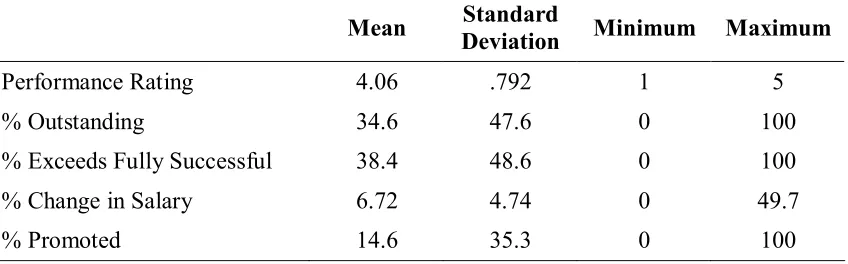
As shown in Table A.1, the mean percent change in salary is 6.72, and 14.6 percent were
promoted employees over the 1988-2003 period.
2
Independent Variables
Critics argue that performance ratings may not accurately reflect employee
performance. However, by definition, pay-for-performance is an incentive plan that
“reward[s] employees based on subjectively rated measures of performance” (Heneman
& Werner, 2005, p. 6). The key independent variable is a set of dummy variables for
performance ratings. The U.S. Office of Personnel Management categorizes summary
ratings into five levels: “1 Unacceptable, 2 Level between Fully Successful and
Unacceptable, 3 Fully Successful or equivalent, 4 Level between Outstanding and Fully
Successful, and 5 Outstanding or equivalent.” Because few employees receive the lowest
two ratings, level 1 or 2, I combined the two into a single category and labeled it less than
fully successful. The variables outstanding, exceeds fully successful, and fully successful
represent level 5, 4, and 3, respectively. The reference group in the regression and logit
models is those who received fully successful ratings. Thus, coefficients on performance
rating dummy variables show whether the named groups are different from those who
received fully successful in salary growth and promotion probabilities.
This study controls for human capital factors. Education, federal experience, and
age are measured in years. To capture the curvilinear impact of experience on salary
growth and promotion probability (e.g., salary growth will be faster and promotion
probability will drop faster early in their careers than later in their careers), I add squared
term for federal service experience and age.
Other individual characteristics also have an impact on career success. Gender
and race are common factors that explain pay and promotion inequalities. The CPDF
American Indians is small, I dropped the group and created 7 dummy variables for seven
race and gender group: black male, Hispanic male, Asian male, white female, black
female, Hispanic female, and Asian female, and use white male as the reference group.
Career patterns vary with job-related factors and the agencies in which employees
work. Salary rises with grade but promotion probabilities drop. I create a set of dummy
variables for each grade level and for the Senior Executive Service, which is labeled as
grade 16 for convenience. But because only a few employees are in grades 1 and 2 in the
sample, I combine grade 1, 2, and 3, and label them as grade 3. The reference group is
grade 8. Following the OPM classification, I create dummy variables for Professional,
Administrative, Clerical, and Technical occupations with the Other category as the
reference group. A dummy variable supervisory status is coded 1 for those whose
position is a supervisor or manager, and 0 for everyone else. Organizational factors are
some of the most important factors affecting performance ratings and personnel decisions
(Condrey & Brudney, 1992). Performance ratings vary dramatically by agency (Lewis,
1997b), so I create agency dummy variables for all cabinet-level departments and the four
largest independent agencies (the Environmental Protection Agency, the General Services
Administration, the National Aeronautics and Space Administration, and the Social
Security Administration). All other agencies are combined and are used as the reference
group, other agency.
Methods
To test the hypotheses, this study first analyzes the full panel data set. To
present the descriptive statistics. As reviewed above, many factors influence career
advancement in the federal service, and those factors could be associated with
performance ratings. Understanding basic patterns of differences of career advancement
between performance groups helps to understand how individual and job-related factors
affect pay increases and promotion probabilities. Therefore, before separating those
factors from the pure rating effect, I run t-tests to test for differences in career
advancement between those receiving outstanding and fully successful ratings and
between those receiving exceeds fully successful and fully successful ratings. Using
panel data analysis, I measure the impact of performance ratings on salary increase.
Since the dependent variable promotion is dichotomous, this study employs panel data
logit analysis.
Two common methods for panel data analysis are fixed effect and random effect
models. The random effect model assumes that the unobserved individual effects are not
correlated with the any of the other regressors, whereas the fixed effect model allows the
unobserved effect to be correlated with the other explanatory variables. Because a
Hausman test for this study rejected the null hypothesis that there is no correlation
between unobserved individual effects and the other regressors, this study uses the fixed
effect model.
The panel data analysis for this study has weaknesses, however. The panel data
set used for this study is unbalanced, because different employees are in the panel for
different lengths of time, depending on when they entered federal employment and how
many years they stayed. In general, unbalanced panel data works with panel data
this sample, the reason that some observations are dropped is not random but related to
the purpose of performance appraisals; that is, analysis on the CPDF shows that linkages
between performance ratings and salary growth are stronger for dropped observations,
which moved from five-level rating system to pass/fail or three-levels, than for existing
observations. The other weakness is that the model includes time invariant variables such
as race and gender, but the fixed effect model drops variables that do not vary within
individuals (e.g., gender and race) so that we cannot estimate parameters (Greene, 2003).
Also, outstanding performers who consistently receive outstanding ratingsare excluded
from the estimation when we use fixed effect model, which may leads to a biased results.
Therefore, the primary analysis will be cross-sectional ordinary least square (OLS) and
logistic regressions.
To understand how performance ratings, salary increases, and promotions have
changed over time, I present the descriptive statistics by year from 1988 to 2003. To
examine whether differences in salary increases and promotion probabilities between
outstanding and fully successful performers are constant over time or rising, falling,
fluctuating, I run a set of t-tests by year comparing those who received outstanding and
fully successful ratings. And then, I conduct ordinary least square regressions
year-by-year during 1988-2002 to examine whether the patterns of salary increases in t-tests hold
up to multivariate analyses, which control for individual and job-related factors.
To estimate the impact of performance ratings on promotion probabilities by each
year, I use logistic regression analysis. Because logit analysis assumes that the log-odds
of promotion are a linear function of the independent variables, the percentage change
of this study’s purposes is to measure the size of the impact of performance ratings on
promotion probabilities, so I use the prchange command in Stata program (Long &
Freese, 2006), which allows us to calculate the impact of the variable into a percentage
change, holding all the other variables at their means.
Analysis of the full panel data and the OLS and logit analyses allow us to
examine the impact of ratings on salary increases and promotion probabilities in the
federal civil service, after controlling for race and gender, education level, federal
experience, age, supervisory status, grade, PATCO category, and agency. However,
because the distribution of performance ratings and the practices regarding salary
increase and promotion decisions vary with individual and job-related factors, we need
further analysis to examine how the impact of ratings differs within each subcategory of
factors. Among the most important factors are occupation type (PATCO), grade level,
and agency. As in the full panel analysis and the cross-sectional analysis by year, I
present first the descriptive statistics, and then run a set of t-tests, and finally conduct the
panel data analysis for each category of occupation type (PATCO), grade level, and
agency.
2.6 Findings
Analysis of the Full Data Set
Table 2.1 presents the descriptive statistics of performance ratings and career
advancement in the period of 1988-2003. Federal employees’ performance rating is
pretty high. The average performance rating was 4.06, and 73 percent of employees
ratings. The average salary increase was 6.72 percent, and on average, 14.6 percent of
[image:45.612.115.539.186.318.2]employees were promoted annually.
Table 2.1: Descriptive Statistics of Performance Ratings and Career Advancement
Mean Standard
Deviation Minimum Maximum
Performance Rating 4.06 .792 1 5
% Outstanding 34.6 47.6 0 100
% Exceeds Fully Successful 38.4 48.6 0 100
% Change in Salary 6.72 4.74 0 49.7
% Promoted 14.6 35.3 0 100
Table 2.2: Career Advancement Comparison: T-test
Mean % Salary Change % Promoted
Fully Successful Outstanding Fully successful Outstanding
7.04** 6.59 15.4** 14.6
Fully Successful Exceeds Fully
Successful Fully Successful
Exceeds Fully Successful
7.04** 6.62 15.4** 14.1
Table 2.2 shows the results of t-tests to compare the differences in career
advancement between outstanding and fully successful performers and between exceeds
fully successful and fully successful performers. Surprisingly, outstanding performers’
mean salary increase rate and the percentage of them promoted were lower than for fully
successful performers. Mean salary increases were 0.45 percentage points lower and the
percentage promoted was 0.8 percentage point lower for outstanding performers than for