Georgia State University
ScholarWorks @ Georgia State University
Public Health Theses School of Public Health
Spring 5-15-2015
Associations of Early Sexual Initiation, Family
Circumstances, and STD Incidence
Emily Ayers
Follow this and additional works at:https://scholarworks.gsu.edu/iph_theses
This Thesis is brought to you for free and open access by the School of Public Health at ScholarWorks @ Georgia State University. It has been accepted for inclusion in Public Health Theses by an authorized administrator of ScholarWorks @ Georgia State University. For more information, please contact [email protected].
Recommended Citation
Ayers, Emily, "Associations of Early Sexual Initiation, Family Circumstances, and STD Incidence." Thesis, Georgia State University, 2015.
i
Associations of Early Sexual Initiation, Family Circumstances, and STD Incidence
By
Emily C. Ayers
B.A. French
Georgia College & State University
A Thesis Submitted to the Graduate Faculty of Georgia State University in Partial Fulfillment
of the
Requirements for the Degree
MASTER OF PUBLIC HEALTH
ii
TABLE OF CONTENTS
ACKNOWLEDGMENTS………..iii
LIST OF TABLES………..iv
LIST OF FIGURES... ……….v
APPROVAL PAGE...……….…vi
ABSTRACT...………...…vii
AUTHOR’S STATEMENT...………...viii
NOTICE TO BORROWERS..………....ix
INTRODUCTION………..1
1.1 Background………...1
1.2 Purpose of Study………...…..2
1.3 Research Questions……….2
REVIEW OF THE LITERATURE………...4
2.1 Early Sexual Debut……….………...4
2.2 Family psychosocial circumstances ………...6
2.3 Concurrent Sexual Risk Behaviors………..9
2.4 Other Concurrent Risk Behaviors………...10
2.5 Peer Pressure……….………..…11
2.6 Race/Ethnicity ………12
METHODS AND PROCEDURES……….. 13
3.1 Data Source………... 13
3.2 Inclusion and Exclusion Criteria……….……..13
3.3 Variables…………...14
3.4 Statistical Procedures...18
RESULTS……… 20
4.1 Descriptive Statistics………...…..20
4.2 Unadjusted Odds Ratios ……….…...23
4.3 Interaction / Effect Modification………28
4.4 Multivariate Logistic Regression………..…………..……28
4.5 Stratification by Gender ………...29
DISCUSSION AND CONCLUSION………..32
5.1 Discussion of Research Questions………32
5.2 Study Strengths and Limitations………...33
5.3 Implications of Findings………34
5.4 Recommendations for Future ………...35
5.5 Conclusions………35
iii
Acknowledgements
I would like to thank my committee members, Dr. Roblin and Dr. Strasser, for their guidance and support throughout this thesis. I would also like to thank Dr. Hayat and Dr.
iv List of Tables
1: Demographic Characteristics of Study Population by Exposure and Outcome…21
2: Family Circumstances of Study Population by Exposure and Outcome………..22
3: Univariate Analysis of Association of Independent Family Variables With
Early Age of Sexual Debut………...27
v List of Figures
1: Family Circumstance Dummy Variables for Logistic Regression………...17
2: Age of Sexual Debut as Possible Effect Modifier in the Relationship Between
vi
APPROVAL PAGE
Associations of Early Sexual Initiation, Family Circumstances, and STD Incidence
By
Emily C. Ayers
Approved:
__________________________________________ Committee Chair
Dr. Douglas Wilmot Roblin Committee Member
Dr. Sheryl Strasser Committee Member
vii
ABSTRACT
BACKGROUND: According to the World Health Organization’s (WHO) 2008 global estimate, approximately 498 million individuals worldwide become infected each year with a sexually transmitted disease (STD) or infection. Although adolescents only make up about a quarter of the sexually active population, approximately half of the newly reported STDs in the U.S each year are among individuals aged 15-24 years (The Henry J. Kaiser Family Foundation, 2014). The CDC reports that approximately 46.8% of U.S. high school students reported already having experienced their sexual debut. When adolescents engage in sexual behaviors earlier, it puts them at greater risk for other risky behaviors and ultimately STD incidence. Family circumstances are also considered to have an impact on an adolescent’s likelihood to engage in earlier sexual behaviors.
METHODS: Data were obtained from the National Longitudinal Survey of Adolescent to Adult Health, Waves I and IV. Logistic regression was used to measure the strength of the relationship between early sexual debut and STD, and was also conducted to
determine which family circumstances have the strongest associations with both early sexual debut and STD incidence. Statistical interaction was included to test for effect modification in the model. Gender was shown to be a significant predictor of STD incidence; therefore the model was tested for differential effects by gender.
RESULTS: Adolescents experiencing an early sexual debut (<15 years of age) were 2.22 times more likely to experience an STD than those with a late debut (≥ 15 years of age) (95% CI 1.88, 2.62). With respect to family circumstances and their relation to STD, the strongest association lay within adolescents’ perception of fathers caring “none to very little” and STD incidence (OR=2.75, 95% CI: 1.60-4.70). The strongest associations of family circumstances with early sexual debut were adolescents whose mothers served jail time (OR=3.38, 95%CI: 2.37-4.82) and adolescents who felt like their mothers approved of their sex lives (OR=3.11, 95%CI: 2.09-4.64). Age of sexual debut was tested for statistical interaction in the model and was only significant among the variable for mother figure. Stratifying for gender, relationship to mother figure for males proved to have a statistically significant interaction with debut for both levels of mother figure (No mother p<.0001, Non-related female p=.0003), rendering age of sexual debut an effect modifier in the association between males relationship to their mother figure and STD incidence.
DISCUSSION:
viii
Author’s Statement Page
In presenting this thesis as a partial fulfillment of the requirements for an
advanced degree from Georgia State University, I agree that the Library of the University shall make it available for inspection and circulation in accordance with its regulations governing materials of this type. I agree that permission to quote from, to copy from, or to publish this thesis may be granted by the author or, in his/her absence, by the professor under whose direction it was written, or in his/her absence, by the Associate Dean, College of Health and Human Sciences. Such quoting, copying, or publishing must be solely for scholarly purposes and will not involve potential financial gain. It is understood that any copying from or publication of this dissertation which involves potential
financial gain will not be allowed without written permission of the author. _________Emily Ayers________________
ix
Notice to Borrowers Page
All theses deposited in the Georgia State University Library must be used in accordance with the stipulations prescribed by the author in the preceding statement.
The author of this thesis is: Student’s Name: Emily C. Ayers
Street Address: 1155 East Confederate Ave SE Unit A City, State, and Zip Code: Atlanta, GA 30316
The Chair of the committee for this thesis is: Dr. Roblin Professor’s Name: Dr. Roblin
Department: Institute of Public Health College: Health and Human Sciences
Georgia State University P.O. Box 3995
Atlanta, Georgia 30302-3995
Users of this thesis who not regularly enrolled as students at Georgia State University are required to attest acceptance of the preceding stipulation by signing below. Libraries borrowing this thesis for the use of their patrons are required to see that each user records here the information requested.
NAME OF USER ADDRESS DATE TYPE OF USE
1 CHAPTER I INTRODUCTION
1.1 Background
According to the World Health Organization’s (WHO) 2008 global estimate,
approximately 498 million individuals worldwide become infected each year with a sexually
transmitted disease (STD) or infection (STI), with Chlamydia trachomatis (chlamydia),
Neisseria gonorrhoeae (gonorrhea), Treponmea pallidum (syphilis), and Trichomonas vaginalis
(Trichomoniasis) being the primary infectious agents (Mesenberg et al., 2014). Sexual health is a
growing concern worldwide, as STDs greatly contribute to acute morbidity, infertility, and
mortality (Mesenberg et al., 2014).
Concerns about the sexual health of adolescents in the United States are due to the
increasingly high rate of teenagers becoming infected with STDs. Although adolescents only
make up about a quarter of the sexually active population, approximately half of the newly
reported STDs in the U.S each year are among individuals aged 15-24 years (The Henry J.
Kaiser Family Foundation, 2014). The United States has seen an almost 50% decrease in teenage
pregnancies since the peak in 1990, however the teenage birth rate in 2013 was still 27 births per
1000 females, falling from 62 births per 1000 females in 1991 (The Henry J. Kaiser Family
Foundation, 2014). In 2013, a CDC survey among U.S. high school students reported that 46.8%
of students had already experienced their sexual debut.
When adolescents experience early sexual initiation (“early debut”), they are more likely
to engage in other risky behaviors, such as multiple sexual partners, lack of condom use, drug or
alcohol use before sex, etc. These risky behaviors typically lead to high levels of STD incidence
or pregnancies among adolescents. Family circumstances may also have a direct effect on this
2
weak social and familial support, and parents who do not provide any sort of emotional support
or discipline can greatly be affected by these factors when it comes to their sexual decisions,
including the age of their sexual initiation. This in turn affects their likelihood for other risky
behaviors, including a higher likelihood to contract an STD and for teenage pregnancy.
1.2 Purpose of Study
The purpose of this study is to examine the relationship between family circumstances
and age of sexual debut, to examine the relationship between family circumstances and STD
incidence, to examine the relationship between age of sexual debut and STD incidence, and to
evaluate if early sexual debut acts as an effect modifier in the relationship between family
psychosocial circumstances and STD incidence. In this proposed research, the National
Longitudinal Study of Adolescent to Adult Health Wave IV Survey Data will be analyzed in
order to look for trends in associations between family circumstances and STD incidence. Other
factors such as gender, race, sexual orientation, and educational attainment will also be
evaluated. This research is important within the field of public health because this type of effect
modification leading to STD incidence has not yet been evaluated.
1.3Research Questions
1. What is the association between age of sexual debut and STD incidence?
2. What is the association between family psychosocial circumstances and STD
incidence?
3. What is the association between family psychosocial circumstances and age of sexual
3
4. Does age of sexual debut act as an effect modifier between the relationship of family
4 CHAPTER II
REVIEW OF THE LITERATURE
Sexually transmitted diseases and infections’ incidence rates are disproportionally high
among adolescents, and the literature suggests this phenomenon is due to their likelihood to
engage in risky behaviors, when they may not be cognitively prepared for the situations they
enter. Though youth only make up 25% of the sexually active population in the U.S., they are
burdened with half of all new STD cases every year (Haydon et al., 2012). In this review of the
literature, different family circumstances, risky sexual behaviors, and STD incidence among
adolescents will be evaluated. For these purposes within the literature, the terms “youth’” and
“adolescent” are used broadly, and often interchangeably. The WHO defines an “adolescent” as
an individual between 10-19 years of age, and “youth” as individuals who are between 15-24
years of age. For the purposes of this review, we will primarily be looking at sexual risk taking
behaviors among adolescents, primarily those who experience their sexual debut before 15 years
of age, the different circumstances leading to their risky decision-making, and the outcomes of
STD incidence as a result. Little research has been conducted to analyze the associations
between adolescent sexuality and adult health (Haydon et al., 2012). Analyzing sexual risk
behaviors among adolescents is important in order to provide interventions for prevention, and
due to the large health, social, and financials costs and implications of STDs (Cheney et al.,
2015).
2.1 Early sexual debut
Defining an “early” sexual debut, or initiation, can sometimes be difficult. It is safe to
5
phenomenon define “early” sexual debut as less than 15 years of age at first coitus. Adolescents
who have earlier sexual debuts are also put at higher risk for other factors that may contribute to
their likelihood for STD incidence (Cheney et al., 2015). Beginning in the 1980’s, the age of
onset of sexual activity began to drastically decline among youth in the U.S., and with this
transition came many other sexual risks and consequences that continue to burden adolescents
today.
The link between early sexual debut and STD incidence is well established, along with
the link between early sexual debut and many other types of adverse outcomes, including
unplanned pregnancies, abortion, and other high-risk sexual behaviors (Boyle, 2003).
Haydon et al. (2012), who used the National Longitudinal Survey of Adolescent to Adult
Health to analyze trends in sexual behaviors and their association with STD prevalence,
employed latent class analysis to determine what types of individuals were most likely to
experience lifetime STD diagnosis. They found that odds were greater for lifetime STD
diagnosis among early sex initiators (22%). They also discovered that concurrent sexual
relationships, another sexual risky behavior, was more likely among early initiators (20%). In
accordance with these findings, sexual “postponers” reported the lowest rates of STD prevalence,
at only 6% (Haydon et al., 2012).
In a study by Epstein et al. (2014), researchers used a test-and-replicate strategy among
two different longitudinal studies, the Seattle Social Development Project (SSDP), and the
Raising Healthy Children (RHC) survey, in order to analyze associations between age of sexual
debut and STIs. Epstein et al. (2014) found that the association between early sexual debut and
STD incidence was mediated by lifetime sex partners in the SSDP survey but only partially
6
use, lifetime number of partners, sex under the influence of drugs or alcohol, but itself had no
effect on STD incidence. The researchers’ conclusion was that early sexual debut is a primary
mediator of STD incidence, and that it is a driving force that influences many other types of risk
behaviors (Epstein et al., 2014)
O’Donnell et al. (2001) analyzed youth from the Reach for Health survey, following
1,287 adolescents from the seventh grade and mapping their sexual behavior until the
participants were in the tenth grade. The participants were considered “urban minorities” and at
baseline (seventh grade), 31% of males and 8% of females reported to have already experienced
their sexual debut. By the end of the study (tenth grade), 66% of males and 52% of females
reported to have made their debut.
Early sexual debut has a proven association with STD incidence, and it is possible that it
also mediates the relationships between other factors and STDs. In addition to age of sexual
debut, sexual concurrency, use of barrier protection and use of health services for STD treatment
are other types of risk behaviors that can elucidate the link between adolescent STD incidence
and social factors (Santelli et al., 2000).
2.2 Family psychosocial circumstances
Many recent studies have discovered links between negative family circumstances and
adolescents participating in risky behaviors. ”Negative” family circumstances can encompass
many different scenarios, such as youth experiencing their parents going through a divorce,
having new step-parents, living in a single-parent home, losing a parent to death, having a parent
going to jail, or having parents who simply don't provide enough emotional support. Having
negative family experiences or circumstances can be very difficult for adolescents, as family
7
their ability to resist poor decision-making. In the U.S. today, half of all adolescents will have
parents who divorce (Donahue et al., 2010). It is important to understand the implications of the
failing family structure on the adolescent, and the resulting increase in their likelihood for sexual
risk behavior (Donahue et al., 2010). Within Donahue et al. (2010)’s research, univariate and
multivariate models were built to analyze the association between parental relationship
instability and sexual partnerships before the age of 16. These models showed that early (before
the age of 5) onset family instability increased the odds of reported sexual partnerships (odds
ratio [OR]=3.5), which then may be associated with other sexual risk behaviors (Donahue et al.,
2010). Another study conducted by Klavs et al. (2006), which examined time trends in sexual
debut, found that the primary risk factor for early sexual debut among young men was not living
with both parents until the age of 15. In addition to these findings, Zimmer-Gembeck et al.
(2007) found that the odds of early sexual debut increased when adolescents were living in single
parent homes or in “blended” families, e.g. with step-parents.
Family socioeconomic status, as measured by a family’s income and in some cases
educational attainment, has been shown to be associated with many different health measures
(Santelli et al., 2000). STD incidence in relation to SES has very rarely been analyzed, however
increased risk of adolescent STD incidence and pregnancies is commonly attributed to poverty,
which is more prevalent among racial and ethnic minority groups (Santelli et al., 2000).
In support of the research that shows associations of negative family circumstances and
risky behaviors among adolescents, studies also show associations of positive family
circumstances and youth abstaining from poor sexual decision-making. Parents’ ability to talk to
their children about sex can have a big influence on their behavior. Santelli et al. (2000) used the
8
to risky sexual behaviors among adolescents, which, as aforementioned, have a proven
association with adolescent STD incidence. This study found that among both genders,
adolescents were less likely to have ever had their sexual debut at the time of the study when
participating individuals were provided with parental sex education, and/or if they were living in
a 2-parent household. These associations were found to all be independently correlated with
never having had sex (Santelli et al., 2000). Epstein et al. (2014) also found that strong familial
structure and management was protective against early sexual debut. This idea of strong familial
management carries over into Donahue et al.’s (2010) research, whom also concluded that
adolescents whose parents had knowledge of their activities were less likely to participate in
sexual activities.
In a meta-analysis by Zimmer-Gembeck et al. (2007), researchers found that in 10 out of
17 studies, an association of late age of first intercourse existed within youth living in “intact”
families, defined as living in a home with 2 parents or married parents. Zimmer-Gembeck et al.
(2007) also noted that educational attainment of parents had a small effect on adolescent risk
behavior, delaying the age of sexual debut in 8 out of the 14 studies in which this variable was
measured. Age of sexual debut also had an association with parental communication about
disapproval of the adolescents’ potential sexual behavior. This parental disapproval was found to
be one of the only processes that were associated with delaying sexual debut among adolescents
in this meta-analysis. (Zimmer-Gembeck et al., 2007)
Klavs et al. (2006) found that higher educational attainment and having sexual education
provided by either their parents or their school was associated with later sexual debut among
9
concluded that adolescents whose parents had knowledge of their activities were less likely to
participate in sexual activities.
2.3 Concurrent Sexual Risk Behaviors
As previously mentioned, adolescents who have earlier sexual debuts are also put at
higher risk for other factors that may contribute to their likelihood for STD incidence, rendering
this public health concern of high importance. Some of these other factors include: “unwanted
intercourse”, lower likelihood to use sexual protection or contraception, and higher numbers of
lifetime sexual partners. (Cheney et al., 2015)
O’ Donnell et al. (2001) also found that individuals who initiated sex earlier than their
peers experienced increased likelihoods of many different types of other sexual risk behaviors.
Some of these other risky behaviors included higher numbers of lifetime partners, teenage
pregnancies, forcing of sexual activity, higher frequency of sexual acts, and higher likelihood to
have had sex while drunk or taking drugs. (O’Donnell et al., 2001) In a survey conducted by the
CDC, researchers investigated other types of risky behaviors, such as lack of condom use, and
found that 40.9% of students reported to have not used a condom in their last sexual encounter
(CDC, 2013). In a study analyzing the National Longitudinal Survey of Adolescent Health,
conducted by Haydon et al. (2012), the researchers found that among early sex initiators (>16
years of age), the most prevalent outcome for these individuals was ever-STD diagnosis (23%),
followed by sexual concurrency within the past year (13%), diagnosis of an STD within the past
year (9%) and transactional sex within the last year (2%). These findings support the claim that
early sexual initiators are more likely to participate in other sexual risk behaviors in their lifetime
than later sex initiators. Klavs et al. (2006) discovered in their research that among both sexes,
10
behaviors such as lack of condom use, were more likely to be infected with bacterial STIs, and
were more likely to experience teenage pregnancy.
Sexual concurrency refers to having more than one sex partner at a given point in time. In
a Russian cross-sectional study conducted by Zhan et al. (2011), researchers concluded that
partner concurrency (sexual concurrency among the individual and their partner) was associated
with increased odds of having an STD.
2.4 Other Risk Behaviors Associated with Early Sexual Debut
Zhan et al. (2011) also found sexual concurrency to be significantly associated with age
of sexual debut. Among individuals who had a sexual debut before 16 years of age, 30.5% of
them had sexually concurrent partners, (p=.003), and high numbers of lifetime partners
(p<.0001) (Zhan et al., 2011). In addition, Zhan et al.’s (2011) study also found significant
associations of sexual partner concurrency among weekly drinkers (p=0.003). These findings are
consistent with other studies, such as a study by Steinberg et al. (2011). Steinberg et al. (2011)
measured different high-risk behaviors among incarcerated, adolescent females who had
previously tested positive for an STD. The study employed 539 females between the ages of
12-18, and found many concomitant risky behaviors. Of the sample, 43.3% reported low condom or
contraceptive use, 25% reported a previous STD, 26% reported a history of pregnancy, 23%
reported a history of arrest for drugs or prostitution, 18% reported having a history of
prostitution, and 50% reported using drugs or alcohol weekly (predominantly marijuana, alcohol,
and methamphetamines). This study concluded that there is a relationship between drug use and
other sexual risk behaviors among incarcerated female adolescents who were STD-positive
11
Staras et al. (2011) used The Relationship of Alcohol, Youth, and Sexually Transmitted
Disease Project to analyze relationships between substance use disorders (SUDs) and STDs.
Their findings showed that STDs were more highly associated with youth who had an SUD
(31.5%) than youth who did not have an SUD (24.4%). Study participants who had an SUD were
also 1.8 times more likely than those without an SUD to have an STD (95% CI 1.2, 2.9) (Staras
et al., 2011).
2.5 Peer pressure
Adolescents obtain a significant amount of the information that they have about sex from
their peers. Many youth experiment sexually due to pressure from their peers, and at the same
time are encouraged to participate in many other adult-like activities as well, such as drug and
alcohol use. Peer pressure can also contribute to many youth having sexual experiences before
they are ready (van de Bongardt, 2014).
In a qualitative study conducted by Li Pong Wong (2012), 34 focus groups were held in
order to obtain adolescents’ views on sexual attitudes and behaviors. Wong found many different
factors that affected the individuals’ sexual behavior, and peer pressure was a heavily influencing
factor among some of the participants. Many of the participants, particularly those under the age
of 16, revealed that most of their sexual decision making was unplanned, or spontaneous, while
university undergraduate students reported peer pressure and social norms being a causal factor
in their sexual decisions (Wong, 2012).
Zimmer-Gembeck et al. (2007) noted in a systematic review that in 6 out of the 8 studies
which measured for friendships with “deviant” peers, the associations of these friendships and
12
with adolescents whose peer relationships had problem behaviors, such as drug use
(Zimmer-Gembeck et al., 2008).
2.6 Race/ethnicity
Race and ethnicity are very important variables in understanding the epidemiologic
relationship of sexual risk behaviors among adolescents and its consequences. Within the U.S.,
researchers have determined that African Americans and Hispanics are disproportionately
associated with higher rates of STD incidence compared to Whites (Mojola et al., 2012). What
causes these racial disparities in STD incidence is enigmatic. Although African American female
youth have been found to be less likely to participate in many types of sexual risk behaviors, a
study by Hipwell et al. (2011) found that African American female youth are more heavily
burdened by STD incidence than their white counterparts. CDC STD surveillance tracked trends
of some racial minority groups experiencing high burdens of STD incidence. In the U.S. in 2009,
71% of gonorrhea cases, 52% of syphilis cases, and 48% of chlamydia cases occurred among
African Americans (CDC Fact Sheet, 2009). African Americans are also more likely to use
condoms than Whites and Hispanics (Mojola et al., 2012). Santelli et al.’s (2000) analysis of the
Youth Risk Behavior Survey found that individuals who claimed to be of white race were more
likely to experience later sexual debut than individuals of other races. Therefore, it is possible
that one explanation for this disparity in the cause of African American youth to be more heavily
burdened by STDs than other races may be an effect of the rates of earlier sexual debut among
individuals of their race (Dariotis et al., 2011). In addition, The 1997 Youth Risk Behavior
Survey conducted by the CDC reports African American Males to be three times as likely as
Hispanics and seven times as likely as whites to have had intercourse before the age of 15 (O’
13 CHAPTER III
METHODS AND PROCEDURES
3.1Data Source
Data were obtained primarily from the National Longitudinal Survey of Adolescent to
Adult Health (hereinafter termed “Add Health”) Wave IV (2008-2009), with additional variables
obtained from the initial wave (Wave I) of the same survey. Family circumstance variables along
with demographic variables were obtained from Wave I, whereas the age of sexual debut and
STD incidence were measured in Wave IV.
ADD Health was conducted longitudinally in four waves in all 50 states of the U.S. The
first wave of the survey was conducted in 1994-95 among adolescents from grades 7-12, and the
same survey population has since been followed and surveyed into adulthood, with the final
wave (Wave IV) taking place in 2008, when the sample was then 24-32 years old (52 survey
respondents being 33-34 years old). Wave IV included 92.5% of the sample from Wave I, and of
that sample 80.3% were interviewed. The data collection was carried out by Research Triangle
Institute (RTI) under a sub-contract to the University of North Carolina at Chapel Hill.
3.2Inclusion and Exclusion Criteria
Waves I and IV of the National Longitudinal Study of Adolescent to Adult Health were
used for this analysis. This analysis was limited to respondents who participated in both Wave I
and Wave IV.
The Add Health study design used a clustered sample in which the clusters were
unequally sampled, and there were sample weights provided for 5,114 of the students. The use of
sample weights generalized the sample to the entire U.S. population. For this analysis, the
14
Wave IV in-home survey was used. The cross-sectional sample weight was used in lieu of the
longitudinal sample weight because for the purposes of this analysis, we wish to investigate
association rather than causation.Cluster2 was the cluster variable employed, while a strata
variable was unavailable in the publicly available data set.
3.3Variables
Sexually Transmitted Disease
Add Health analyzes many different types of STDs. The primary dependent variable was
measured by the survey item, “Have you ever been told by doctor, nurse, or health professional
that you had any of the following sexually transmitted diseases?” Respondents were instructed to
select all the diseases that they have been told by a physician that they have had. Options
included chlamydia, gonorrhea, trichomoniasis, syphilis, genital herpes, genital warts, hepatitis
B, Human Papilloma Virus (HPV), Pelvic Inflammatory Disease (PID), cervicitis or
mucopurulent cervicitis (MPC), urethritis, vaginitis, HIV infection or AIDS (this variable was
excluded from the publicly available data set, and thus, excluded from this analysis), “any other
STD”, or “Have had no STD”. Respondents who selected that they have had no STD were coded
as “0”; and respondents who indicated that they had one of the specific STDs were coded as “1”
for having ever had an STD.
Sexual Behavior / Sexual Debut
Early vs. late sexual debut was defined from responses to the item: “How old were you
the first time you had sexual intercourse?” An age of 15 years of age or younger was coded as
“1” for “Early Debut”, and, and age of 16 years of age or older was coded as “2” for “Late
Debut”. Fifteen years of age was chosen as the cutoff based upon the literature (Epstein et al.,
15
Family Circumstances
A focus of this study was how family circumstances might influence age of sexual debut
and, therefore, STD incidence. Family circumstance variables were available with reference to
both “fathers” and “mothers”. Variables used included “Is your biological (mother/father) still
alive?” “(Has/did) your biological (mother/father) ever (spent/spend) time in jail or prison?”
“How many times (has/did) your biological (mother/father) (spent/spend) time in jail or prison?”
was a continuous variable. “How old were you when your biological mother/father went to jail or
prison (the first time)?” This was also a continuous variable, measured in years.
Relationship to mother/father figure was also measured. Response options included
Biological Mother/Father, Adoptive Mother/Father, Step-mother/Step-father who adopted you,
Step-Mother/Step-Father, Foster Mother/Foster father, other female/male non-relative,
Grandmother/Grandfather, Aunt/Uncle, Sister/Brother, Other female/male relative, or Not raised
by male/female figure. Step-mother/father who adopted you and step-mother/father were recoded
as one variable, “Step-Mother”/“Step-Father”; “Foster Mother”/“Foster Father” and ‘Other
female/male non-relative’ were recoded as one variable for “Non-Related Female/Male”;
“Grandmother/Grandfather”, “Aunt/Uncle”, “Sister/Brother”, and “Other female/male relative”
were recoded as one variable, for “Female Relative”/“Male Relative”, and Was not raised by a
female/male figure was renamed “None”.
“How close are you to your (mom/dad)?” and “How much does your (mother/father)
care?” were both assessed on a Likert scale, with responses “Not at all”, “Very little”,
“Somewhat”, “Quite a bit”, “Very much”. “How does your (mom/dad) feel about your sex life?”
was also assessed on a Likert scale, with respond options “Strongly approve”, “Disapprove”,
16
mothers and fathers was also analyzed. Response options included “8th grade or less”, “>8th
grade/didn’t graduate high school”, “Business/trade/voc. school instead high school”, “ High
school graduate”, “GED”, “Business/trade/voc. school after high school”, “College/didn't
graduate”, “Graduated from college/university”, “Prof training beyond 4-year
college/university”. “Went to school/Respondent doesn’t know level” and “Respondent doesn’t
know if mom went to school” were recoded as one variable, for “Child doesn’t know”.
These categories were used when assessing chi-square associations, however these variables
were later condensed further for the purposes of creating fewer categories in the logistic
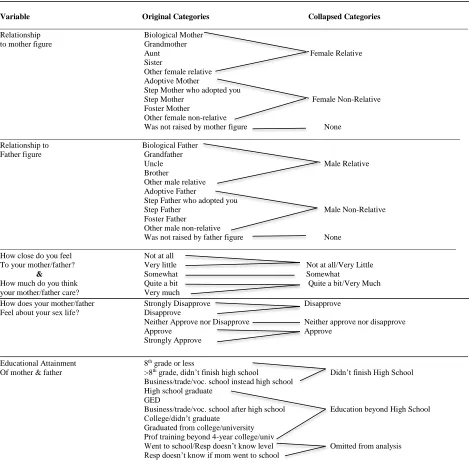
regression analysis. The family circumstance dummy variables that were created are outlined in
17
Figure 1: Family Circumstance Dummy Variables for Logistic Regression
Variable Original Categories Collapsed Categories
_____________________________________________________________________________________________________________________
Relationship Biological Mother
to mother figure Grandmother
Aunt Female Relative
Sister
Other female relative Adoptive Mother
Step Mother who adopted you
Step Mother Female Non-Relative
Foster Mother
Other female non-relative
Was not raised by mother figure None
___________________________________________________________________________________________________________________ Relationship to Biological Father
Father figure Grandfather
Uncle Male Relative
Brother
Other male relative Adoptive Father
Step Father who adopted you
Step Father Male Non-Relative
Foster Father
Other male non-relative
Was not raised by father figure None
__________________________________________________________________________________________________________________ How close do you feel Not at all
To your mother/father? Very little Not at all/Very Little
& Somewhat Somewhat
How much do you think Quite a bit Quite a bit/Very Much
your mother/father care? Very much
How does your mother/father Strongly Disapprove Disapprove Feel about your sex life? Disapprove
Neither Approve nor Disapprove Neither approve nor disapprove
Approve Approve
Strongly Approve
______________________________________________________________________________ Educational Attainment 8th grade or less
Of mother & father >8th grade, didn’t finish high school Didn’t finish High School
Business/trade/voc. school instead high school High school graduate
GED
Business/trade/voc. school after high school Education beyond High School College/didn’t graduate
Graduated from college/university Prof training beyond 4-year college/univ
Went to school/Resp doesn’t know level Omitted from analysis Resp doesn’t know if mom went to school
Respondent Characteristics
For age, respondents entered their birth year, and age was calculated by creating a new
18
respondents filled out the Wave IV survey. However, after examination of the distribution of
age, the variable turned out to have little variation (due to the survey sample design) and,
therefore, was not included in the analysis.
For race, survey respondents had the option to choose more than one answer. For this
reason, the variable for interviewer observed race was used. This race variable was chosen
because there was not more than one selected answer and because it minimized missing data. For
race, the different responses included White, Black/African American, American Indian/Native
American, Asian/Pacific Islander, and other.
Another demographic variable assessed among the adolescents was educational
attainment. Response options included 8th grade or less, some high school, high school graduate,
some vocational/technical training, completed vocational/technical training, some college,
completed college, some graduate school, completed a master’s degree, some graduate training
beyond a master’s degree, completed a doctoral degree, some post baccalaureate professional
education, or completed post baccalaureate professional education.
Sexual orientation was included as well. Responses included 100% Heterosexual, Mostly
Heterosexual, Bisexual, Mostly Homosexual, 100% Homosexual, and Asexual.
3.4Statistical Analysis
Chi-Square tests were initially used to determine associations of respondent
characteristics with STD incidence and sexual debut (Table 1), and to determine associations
between family circumstances and STD incidence and sexual debut (Table 2).
19
1. Early sexual debut will be associated with higher likelihood of STD incidence.
2. Negative family circumstances are likely to affect an adolescent’s likelihood to engage in risky behaviors, and thus their likelihood to contract an STD. 3. Negative family circumstances are also associated with higher likelihood for early sexual debut.
4. Age of sexual debut will act as an effect modifier in the relationship between family psychosocial circumstances and STD incidence.
Bivariate logistic regression was performed to assess the association between age of
sexual debut and STD incidence. Family psychosocial circumstances were more complicated. In
order to answer the second hypothesis as to whether or not family circumstances were associated
with STD incidence, simple logistic regression was done for each family variable separately with
STD incidence as the outcome dependent variable. Next, to test the hypothesis of family
circumstances being associated with early sexual debut, simple logistic regression was conducted
with the family variables with early sexual debut as the outcome. Next, statistical interaction
(effect modification) was tested between the family variables, age of sexual debut, and STD
incidence using logistic regression in order to answer the final hypothesis.
Finally, to evaluate whether the associations of family circumstances with early debut
and STD might differ by respondent gender, analyses were repeated by estimating these same
models stratified by gender.
All data management and statistical analyses were conducted using SAS version 9.3
20
CHAPTER IV
RESULTS 4.1 Descriptive Statistics
The sample size for the study population for which sample weights were provided is
5,114. Due to missing data, not all variable counts equal 5,114.
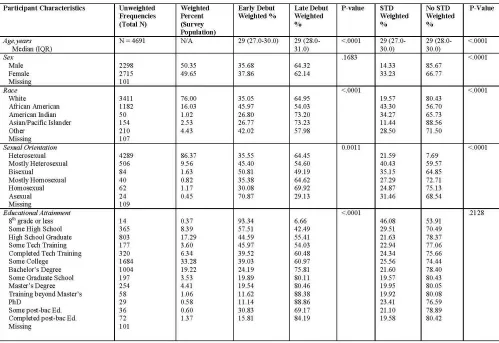
The demographic characteristics of the respondents are displayed in Table 1. The
percentage of the study population with an early sexual debut (defined as 15 years of age or
younger) was 36.8%. The STD incidence rate among the study population was 23.7%.
African-Americans were found to be most likely to have experienced an early sexual debut (46.0%) and
to have experienced an STD (43.3%) compared to other races. Females (37.9%) were slightly
more likely to have experienced an early debut than males (35.7%) and were more likely to have
experienced an STD (33.2%) than males (14.3%). Bisexual individuals (50.8%) were most likely
to have experienced early debut compared to other sexual orientations, however “Mostly
Heterosexual” individuals (40.4%) were more likely to have experienced an STD than other
orientations.
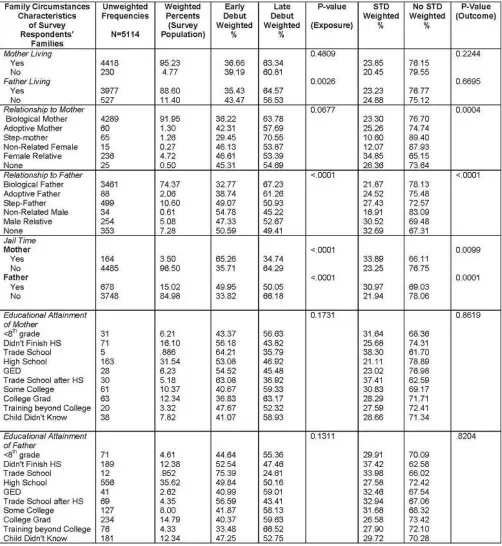
Table 2 displays associations among family circumstances, early sexual debut, and STD
incidence. One of the strongest associations here -is the mother/father jail time variables.
Adolescents whose mothers served jail time were more likely to experience an early sexual debut
(65.3%) than those whose mothers didn’t (35.7%) and to have an STD (33.3%) than adolescents
whose mothers didn’t (23.3%). Adolescents whose fathers served jail time were also more likely
to have an early debut (50.0%) than adolescents whose fathers didn’t (33.8%) and to experience
21
22
23 4.2 Unadjusted Odds Ratios
Age of Sexual Debut / STD Incidence
Once the chi-square associations of sexual debut and STD incidence with respondent
characteristics and family circumstances were assessed, bivariate logistic regression analyses
were performed to estimate the unadjusted odds ratios of early sexual debut and STD incidence.
The results showed that those who experienced an early age of sexual debut were 2.22 times
more likely to experience an STD than those who experienced a later debut (95% CI 1.88, 2.62).
With respect to father figures, adolescents who had no father figure were 59.3% more
likely to have an STD than adolescents who were raised by a male relative (OR=1.59, 95%CI:
1.21-2.09, p <.01). Adolescents who were raised by a non-related male figure were 14.5% more
likely to experience an STD than those who were raised by a male relative (OR=1.15, 95%CI:
0.91-1.44, p =0.43). With respect to mother figures, adolescents who had no mother figure were
3% more likely to have an STD than adolescents who were raised by a female relative (OR=1.03,
95%CI: 0.39-2.67, p = 0.70). Adolescents who were raised by a non-related female figure were
30% less likely to experience an STD than those who were raised by a female relative (OR=0.71,
95%CI: 0.41-1.22, p = 0.34).
With respect to perceived closeness to their fathers, Adolescents who claimed to feel little
to none closeness towards their fathers were 93% more likely to have an STD than adolescents
who felt quite or very close to their fathers (OR=1.93, 95%CI: 1.39-2.70, p = 0.01). Adolescents
who claimed to feel somewhat close to their fathers were 49.5% more likely to experience an
STD than those who felt quite or very close to their fathers (OR=1.50, 95%CI: 1.13-1.98,
p=0.65). With respect to adolescents’ perceived closeness to their mothers, adolescents who
claimed to feel little to none closeness towards their mothers were 59.7% more likely to have an
24
p=0.18). Adolescents who claimed to feel somewhat close to their mothers were 46.8% more
likely to experience an STD than those who felt quite or very close to their mothers (OR=1.47,
95%CI: 1.14-1.89, p =0.33).
With respect to fathers serving jail time on adolescent behavior, adolescents whose
fathers served jail time were 32.0% more likely to experience an STD than adolescents whose
fathers did not serve jail time (OR=1.32,95% CI: 1.05-1.66, p=0.02). When measuring this same
effect of mothers, adolescents whose mothers served jail time were 26.7% more likely to
experience an STD than adolescents whose mothers did not serve jail time (OR=1.27, 95% CI:
0.88-1.83, p= 0.21).
With respect to adolescents’ perceived feelings of their fathers on their sex lives,
adolescents who felt that their fathers approved of their sex life were 34.9% more likely to
experience an STD than those who felt that their fathers disapproved of their sex lives (OR=1.35,
95%CI: 0.90-2.03, p=0.15). Adolescents who felt that their fathers neither approved nor
disapproved of their sex lives were 2.5% less likely to experience an STD than adolescents who
felt that their fathers disapproved of their sex lives (OR=.98, 95% CI: 0.71- 1.34, p=0.34). When
measuring this same association for mothers, adolescents who felt that their mothers approved of
their sex life were 36.2% more likely to experience an STD than those who felt that their mothers
disapproved of their sex lives (OR=1.36, 95%CI: 0.89-2.09, p =0.31). Adolescents who felt that
their mothers neither approved nor disapproved of their sex lives were 18.8% more likely to
experience an STD than adolescents who felt that their mothers disapproved of their sex lives
(OR=1.19, 95% CI: 0.93-1.51, p =0.91).
With respect to educational level of fathers on adolescents likelihood for STDs,
25
those adolescents whose fathers finished high school or had further education (OR=1.32,
95%CI:0.94-1.83, p=0.11). For mothers, adolescents whose mothers didn’t finish high school are
5.7% more likely to have an STD than those adolescents whose mothers finished high school or
had further education (OR=1.06, 95%CI: 0.63-1.77, p=0.83).
With respect to adolescent’s perceptions on their father’s level of caring, adolescents who
felt that their fathers cared about them none or very little were 174.5% more likely to experience
an STD than those adolescents who felt that their fathers cared quite a bit or very much
(OR=2.75, 95%CI: 1.60-4.70, p=0.01). Adolescents who felt that their fathers cared about them
somewhat were 64.3% more likely to experience an STD than those adolescents who felt that
their fathers cared about them quite a bit or very much (OR=1.64, 95% CI: 1.10-2.46, p=0.97).
With mothers, adolescents who felt that their mothers cared about them none or very little were
133% more likely to experience an STD than those adolescents who felt that their mothers cared
quite a bit or very much (OR=2.33, 95%CI: 1.07-5.10, p=0.24). Adolescents who felt that their
mothers cared about them somewhat were 116.4% more likely to experience an STD than those
adolescents who felt that their mothers cared about them quite a bit or very much (OR=2.16,
95% CI: 1.36-3.43, p=0.20).
Many of the associations found here were not statistically significant. The associations
that were found to be statistically significant here are fathers serving jail time and STD incidence
(p=0.02), perception of fathers caring none to very little and STD incidence (p=0.01),
adolescents raised by no father figure and STD incidence (p<.01), and adolescents who felt little
26
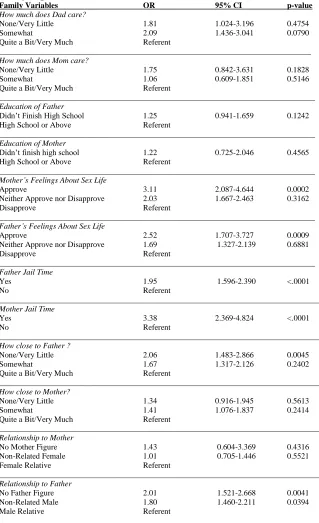
Family Circumstances / Age of Sexual Debut
Bivariate logistic regression was next carried out to measure the association of each
family circumstance with likelihood for early sexual debut among adolescents. Adolescents who
felt that their mothers approved of their sex life were 211% more likely to have an early sexual
debut than adolescents who felt that their parents disapproved of their sex life (OR=3.11, 95%CI:
2.09-4.64, p<.01). Adolescents who felt that their fathers approved of their sex lives were 152%
more likely to have experienced an early sexual debut than adolescents who felt that their fathers
disapproved of their sex life (OR=2.52, 95%CI: 1.71-3.73, p<.01). Adolescents whose fathers
served jail time were 95% more likely to experience early sexual debut than those whose fathers
didn’t (OR= 1.95, 95%CI: 1.60-2.39, p<.0001). Adolescents whose mothers served jail time
were 238% more likely to experience an early sexual debut than those whose mothers didn’t
(OR=3.38, 95%CI: 2.37-4.82, p<.0001) Adolescents who felt none to very little closeness to
their fathers were 106% more likely to experience an early sexual debut than those who felt quite
a bit or very much closeness to their fathers (OR=2.06, 95%CI: 1.48-2.87, p<.01). These results
27
Table 3: Bivariate Analysis of Association of Independent Family Variables With Early Age of Sexual Debut
Family Variables OR 95% CI p-value
How much does Dad care?
None/Very Little 1.81 1.024-3.196 0.4754
Somewhat 2.09 1.436-3.041 0.0790
Quite a Bit/Very Much Referent
______________________________________________________________________________
How much does Mom care?
None/Very Little 1.75 0.842-3.631 0.1828
Somewhat 1.06 0.609-1.851 0.5146
Quite a Bit/Very Much Referent
_______________________________________________________________________________
Education of Father
Didn’t Finish High School 1.25 0.941-1.659 0.1242
High School or Above Referent
_______________________________________________________________________________
Education of Mother
Didn’t finish high school 1.22 0.725-2.046 0.4565
High School or Above Referent
_______________________________________________________________________________
Mother’s Feelings About Sex Life
Approve 3.11 2.087-4.644 0.0002
Neither Approve nor Disapprove 2.03 1.667-2.463 0.3162
Disapprove Referent
_______________________________________________________________________________
Father’s Feelings About Sex Life
Approve 2.52 1.707-3.727 0.0009
Neither Approve nor Disapprove 1.69 1.327-2.139 0.6881
Disapprove Referent
_______________________________________________________________________________
Father Jail Time
Yes 1.95 1.596-2.390 <.0001
No Referent
________________________________________________________________________________
Mother Jail Time
Yes 3.38 2.369-4.824 <.0001
No Referent
________________________________________________________________________________
How close to Father ?
None/Very Little 2.06 1.483-2.866 0.0045
Somewhat 1.67 1.317-2.126 0.2402
Quite a Bit/Very Much Referent
________________________________________________________________________________
How close to Mother?
None/Very Little 1.34 0.916-1.945 0.5613
Somewhat 1.41 1.076-1.837 0.2414
Quite a Bit/Very Much Referent
________________________________________________________________________________
Relationship to Mother
No Mother Figure 1.43 0.604-3.369 0.4316
Non-Related Female 1.01 0.705-1.446 0.5521
Female Relative Referent
________________________________________________________________________________ Relationship to Father
No Father Figure 2.01 1.521-2.668 0.0041
Non-Related Male 1.80 1.460-2.211 0.0394
28 4.3 Interaction / Effect Modification
Next, age of sexual debut was tested for significance as a potential effect modifier on
each of the family variables as a predictor of STD incidence. Over all family circumstances, few
of the family variables had a statistically significant interaction with age of sexual debut in
association to STD incidence. However, one variable was an exception. Age of sexual debut was
a statistically significant effect modifier in the association of relationship to mother figure and
[image:38.612.175.359.307.450.2]STD incidence (2 (2) = 8.15, p = 0.017).
Figure 2: Age of Sexual Debut as Possible Effect Modifier in the Relationship Between
Family Circumstances and STD Incidence
Because of this statistical interaction, relationship to mother figure was the variable used
and tested for significance in the multivariate logistic regression. Further results are discussed in
Section 4.4.
4.4 Multivariate Logistic Regression
Relationship to mother figure was the focus of the multivariate logistic regression
analysis, because it was the only variable which had statistically significant interaction with age
of sexual debut in relation to STD incidence. The results showed that the odds of STD when
comparing respondents who had an early age of sexual debut compared to respondents with a
Age of Sexual Debut
STD Incidence Family
29
late age of sexual debut, adjusted for mother figure effect modification, gender, race, sexual
orientation, and educational attainment was .615. In the total sample, the modifying effect of
relationship to mother on relationship of early debut and STD incidence was not statistically
significant (Non-related female vs. female relative p=0.593, No mother figure vs. Female relative
p =0.066). Because these results were not significant, the model was then stratified by gender,
which showed to have a large effect on the model. Results of the gender stratification are
discussed in section 4.5.
Next, STD and early sexual debut were put into a multivariate logistic regression model,
to obtain an adjusted odds ratio, controlling for gender, race, sexual orientation, and educational
attainment. In this model, the odds of STD given an early sexual debut are 2.15 (95%CI: 1.81,
2.55).
4.5 Stratification by gender
When reviewing the multivariate model, gender was shown to have a very strong
association (χ² 212.3, p<.0001) between early sexual debut and STD incidence, indicating that
gender was a possible confounder in the relationship. Because of this, the model was next
stratified by gender. For males, relationship to mother figure showed to have a statistically
significant interaction with debut for both levels of mother figure (No mother p<.01, Non-related
female p<.01). For females, relationship to mother figure had no statistical interaction with debut
(No mother p=0.20, Non-related female p=0.60). Therefore, among adolescent males, age of
sexual debut acts an effect modifier in the association between relationship to mother figure and
STD incidence. Next, because of the strength of gender in the multivariate model, this analysis
was next stratified by gender to see if the effects of the other strongly associated family variables
30
logistic regression was used to test for only the family variables shown to have a significant
association with STD incidence and sexual debut, and the corresponding variable for the other
parent. Demographic factors were not controlled for in this model. Findings are shown in Table
[image:40.612.98.514.190.535.2]4.
Table 4: Stratification of Family Circumstances and STD incidence by Gender Males Females
Variables Unadjusted OR
95% CI p-value Unadjusted OR
95% CI p-value
Age of Sexual Debut
Early Late 2.398 Referent 1.812, 3.174 < .0001 2.199
Referent
1.795, 2.694
< .0001
Relationship to Mother
Non-Related Female None Female Relative 0.877 0.894 Referent 0.359, 2.139 0.147 5.426 0.9115 0.9618 0.567 1.111 Referent 0.320, 1.005 0.290, 4.255 0.1773 0.5822
Relationship to Father
Non-Related Male None Male Relative 1.069 1.755 Referent 0.741, 1.540 1.036, 2.973 0.2868 0.0436 1.105 1.602 Referent 0.828 1.474 1.113, 2.306 0.4075 0.0278
How much does your mother care?
None/Very Little Somewhat
Quite a bit/Very much
1.337 1.249 Referent 0.351, 5.094 0.417, 3.735 0.8098 0.9082 2.983 2.115 Referent 1.175, 7.573 1.313, 3.407 0.1281 0.5168
How much does your father care?
None/Very Little Somewhat
Quite a bit/Very much
1.032 2.182 Referent 0.266, 4.002 1.013, 4.701 0.5844 0.0760 3.441 1.300 Referent 1.730, 6.846 0.759, 2.227 0.0039 0.2849
Father Serve Jail Time?
Yes No
1.476 Referent
1.078, 2.021 0.0153 1.252 Referent
0.924, 1.697 0.1464
Mother Serve Jail Time?
Yes No
1.954 Referent
1.018, 3.750 0.0440 0.952 Referent
0.607, 1.492 0.8292
Many of the gender specific associations with family variables and STD incidence do
show an association (OR>1.0), however; few associations are found to be statistically significant.
While not statistically significant for males, females who felt that their fathers cared about them
none to very little compared to females who felt that their fathers cared about them very much
were 3.44 times more likely to have an STD (95%CI: 1.73-6.85, p<.01). The association of
31
however males whose fathers served jail time were 47.6% more likely to have an STD
(OR=1.48, 95%CI: 1.08-2.02, p=0.02), and males whose mothers served jail time were 95.4%
more likely to have an STD (OR=1.95, 95%CI: 1.02-3.75, p=0.04). Having no father figure
compared to being raised by a male relative was significant for both males
32 CHAPTER V
DISCUSSION AND CONCLUSION
5.1 Discussion of Research Questions
The first research question asked addressed included whether or not early sexual debut
would be associated with higher likelihood of STD incidence. This association was proven, as
consistent with the literature. The next research question included negative family circumstances
affecting an adolescent’s likelihood for STD incidence. This association was proven, with the
strongest associations lying within fathers serving jail time, perception of fathers caring none to
very little, adolescents raised by no father figure, and adolescents who felt little to none
closeness towards their fathers. These results were also expected, because as the literature
suggests, many family circumstances are associated with poor and risky decision making among
youth. The third research question dealt with family circumstances being related to early age of
sexual debut. This association was also proven. The variables with the strongest associations
were adolescents who felt that their mothers and/or fathers approved of their sex life, adolescents
whose mothers and/or fathers served jail time, and adolescents who felt none to very little
closeness to their fathers. Adolescents being at an increased likelihood for early sexual debut
when they felt their parents approved of their sex life can be considered controversial. This
phenomenon is likely due to the adolescent having fewer inhibitions about sex, and not being
worried about any type of repercussions if their parents openly approve of them having a sex life
at a young age. The term “sex life” however, can have multiple meanings. Some respondents
may have intended that their parents approve of their lack of sexual activity, and some may have
intended that their parents approve of them being sexually active. These results suggest the latter.
The next research question involved age of sexual debut as an effect modifier between the
33
circumstance variables, only one variable (relationship to mother figure) was shown to have
statistical interaction with age of debut and STD incidence. This association was also only true
among adolescent males. This was unexpected, because the literature suggests that many
different types of family psychosocial circumstances are associated with both age of sexual debut
and STD incidence. Many of the family variables were associated with both STDs and age of
debut, however, only one showed a statistically significant interaction.
5.2 Study Strengths and Limitations
There are several strengths and limitations to this research. First of all, the Add Health
survey design was strong. The survey design used sampling weights, which generalized a small
population to the target population. There are many benefits to this type of data collection. For
one, the weights compensate for not collecting data from the entire population. They also
adjust for differential selection probabilities, adjust for differential nonresponse and attrition, and
reduce potential bias associated with nonresponse (West, Sampling Weights and Variance
Estimation).
However, while the nature of the research has many positive attributes, there are still
limitations to be considered. For one, there was not a strata variable available for use within the
public use data set. According to the investigators, not including a strata variable in the analysis
“only minimally affects the standard error” (Chen & Chantala, 2014). This is a serious limitation
to the analysis of the data because not only did the investigator not define his interpretation of
what a “minimal effect” is, we also do not know if this minimal difference in the standard error
renders the results more conservative or more liberal than they should be. Another limitation of
interest is that the researcher is taking for granted that students responded truthfully. When
34
etc., there can be some apprehension to answer truthfully due to fear of disciplinary action.
However, this possibility of response bias only causes an underestimation of the effect of the
associations, because it is highly unlikely that students would report that they did participate in
sexual activity or drug and alcohol use when they actually did not. In addition, the variable
measures of STD incidence were a self-reported lifetime history of STD diagnosis, which is
susceptible to response bias due to the social stigma of sexually transmitted disease. Other
possible types of bias within this data include selection bias, misclassification bias, and survey
non-response bias. In addition, although this data was collected longitudinally, the study design
used for this analysis was cross-sectional in nature. Therefore, the directionality of the
associations between the selected independent variables and the dependent variable cannot be
established.
5.3 Implications of Findings
There are many implications of the findings in this research. African Americans are
shown to have the highest rates of early sexual debut, which has a proven association with STD
incidence. These findings are consistent with the literature. Many different types of family
circumstances have been shown in the literature to be associated with poor decision making in
adolescents. Because of this, some specific subgroups that should be targeted by prevention
efforts include minorities, and also children who have weak familial structures.
In addition, the Theory of Planned Behavior can go to explain some of the associations
found in this study. We can conclude that certain family circumstances lead to an earlier debut,
and subsequently STD, but further explanation of the causal mechanisms behind this
phenomenon is necessary. The Theory of Planned Behavior attempts to explain the behaviors
35
the behavior of individuals. Norms (both social and subjective) can heavily influence an
adolescent and their decision-making process. An individual’s likelihood to engage in certain
behaviors can be affected by their perception of whether or not their peers or people of
importance (in this scenario, likely a parent) approve or disapprove of their behavior. The
question as to whether the adolescent has the ability to exert behavioral control over their actions
due to these norms could certainly be a factor in some of the associations found in this research.
5.4 Recommendations for Future Research
One recommendation for future research would include considering estimation of a
mediation model of relationships among family circumstances, early sexual debut and STD
incidence. Another suggestion for future research would be to include questions relating to other
sexual risk behaviors in the analysis. Other variables that could be of interest include the age of
initiation of other types of sexual behaviors, birth control use/adherence, number of partners, and
sexual concurrency. Sexual concurrency is highly associated with risky decision-making and
with STD incidence (Maughan-Brown, 2012) and could go to explain some of the associations
that were presented in this research.
5.5 Conclusion
The results of this study indicated that not only is sexual debut associated with STD
incidence, but family circumstances are also associated with STD incidence and early sexual
debut. Adolescents’ interactions with the mother figure variable appears to be a particular
important factor in affecting adolescent behaviors associated with early sexual debut. Public
health intervention programs that address adverse health consequences of early sexual debut
36
adolescents, particularly male adolescents, as a factor in modifying an adolescent’s likelihood to
37 References
Boyle, F., Dunne, M., Purdie, D., Najman, J., & Cook, M. (2003). Early patterns of
sexual activity: Age cohort differences in Australia. International Journal of STD &
AIDS,14(11), 745-752.
Cavazos-Rehg, P. A., Krauss, M. J., Spitznagel, E. L., Schootman, M., Bucholtz, K. K., Peipert, J.
F., et al. (2009). Age of sexual debut among U.S. adolescents. Contraception, 80(2),
158–162.
Chen, P., & Chantala, K. Guidelines for Analyzing Add Health Data. Carolina Population
Center, University of North Carolina at Chapel Hill, 2014. Available at
http://www.cpc.unc.edu/projects/addhealth/data/guides/wt-guidelines.pdf.
Cheney, M., Oman, R., Vesely S.K., Aspy, C.B., Tolma, E.L., & John, R. (2015). Prospective
association between negative life events and initiation of sexual intercourse: The
influence of family structure and family income. American Journal of Public Health,
105(3), .
Dariotis, J.K., Sifakis, F., Pleck, J.H., Astone, N.M., & Sonenstein, F.L. (2011). Racial and ethnic
disparities in sexual risk behaviors and STDs during young men’s transition to
adulthood. Perspectives on Sexual and Reproductive Health, 43(1), 51-59.
Donahue, K., D'Onofrio, B., Bates, J., Lansford, J., Dodge, K., & Pettit, G. (2010). Early
exposure to parents' relationship instability: Implications for sexual behavior and
depression in adolescence. Journal of Adolescent Health,47(6), 547-554.