Georgia State University
ScholarWorks @ Georgia State University
Respiratory Therapy Theses Department of Respiratory Therapy
Fall 12-1-2015
Respiratory Therapy Student Perception of Patient
Simulation Education at a Large Urban University
Abdullah Alqarni
Follow this and additional works at:https://scholarworks.gsu.edu/rt_theses
This Thesis is brought to you for free and open access by the Department of Respiratory Therapy at ScholarWorks @ Georgia State University. It has been accepted for inclusion in Respiratory Therapy Theses by an authorized administrator of ScholarWorks @ Georgia State University. For more information, please [email protected].
Recommended Citation
Alqarni, Abdullah, "Respiratory Therapy Student Perception of Patient Simulation Education at a Large Urban University." Thesis, Georgia State University, 2015.
__________________________________________________________________
Respiratory Therapy Theses Department of Respiratory Therapy
__________________________________________________________________
11-30-2015
RESPIRATORY THERAPY STUDENT
PERCEPTION OF PATIENT SIMULATION
EDUCATION AT A LARGE URBAN
UNIVERSITY
Abdullah Alqarni
(
Under the Direction of Prof. Robert Murray)
ACCEPTANCE
This thesis, RESPIRATORY THERAPY STUDENT PERCEPTION OF PATIENT SIMULATION AT A LARGE URBAN UNIVERSITY, by Abdullah Alqarni, was prepared under the direction of the Master’s Thesis Advisory Committee of the Respiratory Therapy department at Georgia State University. It is accepted by the committee in partial fulfillment of requirements for the Master’s of Science degree in Respiratory Therapy at Byrdine F. Lewis School of Nursing and Health Professions, Georgia State University.
The Master’s Thesis Advisory Committee, as representatives of the faculty, certifies that this thesis has met all standards of excellence and scholarship as determined by the faculty.
______________________________Date_________
Robert B. Murray, MS, RRT Committee Chair
______________________________ Date_________
Lynda T. Goodfellow, Ed.D., RRT, FAARC Committee Member
______________________________ Date_________
In presenting this thesis as partial fulfillment of the requirements for the advanced degree from Georgia State University, I agree that the library of Georgia State University shall make it available for inspection and circulation in accordance with its regulations governing materials of this type. I agree that permission to quote, to copy from, or to publish this thesis may be granted by the professor under whose direction it was written, by the Byrdine F. Lewis School of Nursing & Health Professions director of graduate studies and research, or by me. Such quoting, copying, or publishing must be solely for scholarly purposes and will not involve potential financial gain. It is understood that any copying from or publication of this thesis, which involves potential financial gain, will not be allowed without my written permission.
NOTICE TO BORROWERS
All these deposited in the Georgia State University Library must be used in accordance with stipulations prescribed by the author in the preceding statement. The author of this thesis is:
Abdullah Alqarni 1303 Peachtree Creek Circle
Atlanta, GA 30341 The director of this thesis is:
Prof. Robert Murray Clinical Assistant Professor
Byrdine F. Lewis School of Nursing and Health Professions Georgia State University
Atlanta, GA 30303-4019
Users of this thesis not regularly enrolled as students of Georgia State University are required to attest acceptance of the preceding stipulation by signing below. Libraries borrowing this thesis for use of their patrons are required to see that each user records here the information requested:
NAME OF USER ADDRESS DATE TYPE OF USE
URBAN UNIVERSITY
A thesis submitted by Abdullah Alqarni
in partial fulfillment of requirements for the degree of Masters of Science
in Health Sciences
in
The Department of Respiratory Therapy
Under the supervision of Prof. Robert Murray in the
Byrdine F. Lewis School of Nursing and Health Professions Georgia State University,
Respiratory Therapy Student Perception of Patient Simulation at a Large Urban University
By
Abdullah Alqarni
(Under the Direction of Prof. Robert Murray)
ABSTRACT
Background: Patientsimulations have become a basis of training for numerous health care professions. In the field of Respiratory Therapy (RT), it has been proven to influence and motivate the students in proactively participating in learning through the use of clinical demonstrations and technology. However, there remains a limited number of studies that investigate the impact of simulation in RT. PURPOSE:
The aim of this study was to determine the perceptions of RT students at an urban university on what they have learned from their patient simulation sessions. METHODS: A self-reporting descriptive survey was used. It was a modification of the Student Satisfaction and Self-confidence in Learning NLN/Laerdal Research tool. The participants included 34 undergraduate and graduate RT students from the Georgia State University. RESULTS: With a response rate of 88.2%, the majority of the RT students were
satisfied with their present learning and felt supportive of simulation experience, availability and access to various learning materials and activities, simulation as their motivation, and the way instructors taught the simulation. It also revealed that self-confidence and enthusiasm in learning increased with simulation activities. Majority of RT students perceive simulation education as a helpful and effective teaching method (x̅ 3.13 SD ± 0.73). RT students perceive developing the skills and obtaining the required
knowledge from simulation to perform necessary tasks in the clinical setting as the most important clinical benefit they acquire from simulation education (x̅ 3.16, SD ± 0.74). The RT students also believe it is their responsibility to learn what is needed to know from simulation activity and they agree that they know how to get help when they do not understand the concepts covered in the simulation (x̅ 3.53, SD ± .50).
ACKNOWLEDGMENTS
I would like to express my deepest gratitude to my advisor, Prof. Robert Murray, for his excellent guidance, caring, patience, and providing me with an excellent atmosphere for doing research. Besides my thesis chair, I would like to thank the rest of my thesis committee: Prof. Ralph Zimmerman and Dr. Lynda T. Goodfellow, for their insightful comments, expertise and time to facilitate this process. I would like to thank all the people who contributed in some way to the work described in this thesis.
Table of Contents
LIST OF ABBREVIATION ... vi
CHAPTER I ...1
INTRODUCTION ...1
Statement of Problem ... 2
Purpose of the Study ... 3
Significance of the Study ... 3
Summary ... 3
CHAPTER II ...5
REVIEW OF THE LITERATURE ...5
Introduction ... 5
General Information about Health Professional Education ... 6
Effective Clinical Simulation ... 7
Student's perception of clinical simulation in Nursing Education... 9
Student's perception of clinical simulation in Physical Therapy Education ... 11
Student's perception of clinical simulation in Radiography Education ... 13
Student's perception of clinical simulation in Medical School Education... 13
Summary ... 14
CHAPTER III ... 15
METHODOLOGY ... 15
Research Design ... 15
Instrumentation ... 15
Sample ... 16
Protection of Human Subjects ... 17
Data collections and Analysis ... 17
Summary ... 18
CHAPTER IV ... 19
FINDINGS ... 19
Demographic Findings ... 19
Findings Related to Research Question 1 ... 20
Findings Related to Research Question 2 ... 21
Summary ... 22
Discussion of Findings ... 23
Implications for Research ... 27
Recommendations for Future Research ... 27
Limitations of the Study ... 27
Conclusion ... 28
References ... 29
Appendix A: Student Satisfaction and Self-Confidence in Learning NLN/Laerdal Research Tool ... 33
LIST OF ABBREVIATION
HPSMs: Human Patient Simulation Mannequins
IRB: Institutional Review Board
PT: Physical Therapy
RT: Respiratory Therapy
BSRT: Bachelor of Science in Respiratory Therapy
INACSL: International Nursing Association for Clinical Simulation and Learning
SBT: Simulation-Based Training
IOM: Institute of Medicine
CHAPTER I
INTRODUCTION
Patient simulations have become a standard aspect of training in numerous health care professions. It is defined according to its level of fidelity and use of technology. The process involved motivates the students to be pro-active in participating while learning. Simulation experiences are found to be
advantageous as it improves the knowledge acquisition of the students and improves technical and communication skills, as well as decision-making of the students during clinical demonstrations (Ohtake, Lazarus, Schillo, & Rosen, 2013). Clinical simulation is found to be a very effective teaching strategy in comparison with traditional classroom teaching because it develops the assessment skills needed for evaluating a deteriorating patient (Merriman, Stayt, & Ricketts, 2014). The utilization of human patient simulation mannequins (HPSMs) has been proven to improve the acquisition of knowledge and the critical thinking skills of the students, as well as the students’ overall satisfaction with the quality of learning they are receiving (Lapkin, Levett-Jones, Bellchambers, & Fernandez, 2010).
The use of simulation, as an educational tool, helps the students practice different procedures prior to actual performance on a real, live patient. Simulation provides a safe learning environment and helps overcome the difficulties and challenges that plague many allied health courses specifically the shortage of clinical areas for training (Reid-Searl, Eaton & Happell, 2011). The reason behind this lies in the concept of equal opportunity and consistency between what is taught and what is experienced in making sure safe practice takes place (Maginnis & Croxon, 2010).
fidelity and virtual simulators (Aebersold & Tschannen, 2013). Meanwhile, articulation of the use of clinical simulations and their effectiveness improves the learning experiences of the students in both the clinical laboratory and the practice setting. Nevertheless, many studies have addressed the effectiveness of patient simulation for undergraduate nursing students, but there are no studies that address the
effectiveness of patient simulation for Respiratory Therapy (RT) students.
There are limited investigations related to the study of simulation in the in the field of RT. A pilot study by Price et al. (2010) explored and discovered the usefulness of student training with Advance Human Patient Simulator. This study particularly tried to apply simulation in the emergencies that RT students might face in the future. The authors of the study stated that limitations exist for examining the efficacy of stimulation amongst students of RT. These limitations include the small sample size and the inaccurate student coding of written clinical simulation tests and surveys. In addition, they add that they could have re-administered the self-confidence surveys along with the 1-month written clinical simulation tests (Price, Causer, Balon, Helling, & Dumire, 2010).
The current study differs from other studies based on the inclusion of RT students’ opinions about the importance of patient simulation and its impact on their clinical exploration. Likewise, there were specific kinds of patient simulation that first and second year students have had during simulation
sessions. The questions are structured to assess the helpfulness of topic-specific patient simulations for the students to perform the respective procedures in the hospital. Lastly, this study also compares literature from other health care disciplines such as nursing, physical therapy, radiography, and medical school education to RT.
Statement of Problem
addresses RT students’ perception of patient simulations prior to clinical experience. Therefore, undergraduate and graduate RT students’ perceptions of patient simulations will enhance the learning environment so that theyovercome the difficulties and challenges that many students face in actual clinical settings.
Purpose of the Study
The aim of this study was to identify the perceptions of RT students at an urban university on what they have learned from their patient simulation sessions. In addition, the intent of this study was to
determine whether the patient simulations activities increased RT students’ self-confidence and enthusiasm in learning. The following research questions were addressed to help stir the study:
1. What are the perceptions of undergraduate and graduate RT students regarding patient simulation education?
2. How confident are RT students as a result of this patient simulation education?
Significance of the Study
The goal of this study was to assess implementation of patient simulation courses in laboratory settings as a mandatory requirement prior to clinical practice. This is important because the perception and feedback of students in using alternative learning methods are crucial to RT educators in facilitating improvements in RT education.
Summary
CHAPTER II
REVIEW OF THE LITERATURE
Introduction
The following literature review is a compilation of recent research and studies concerning patient simulation education since 2001. Databases used for this review include EBSCOhost, CINAHL, and PubMed. Keywords utilized include clinical simulations, RT students, clinical setting, and patient
simulation education. Search results provided limited available literature related specifically to simulation education in the field of RT. However, there are numerous literature studies citing the significance of patient simulation education in health care education and clinical practice. Moreover, this literature review aims to provide answers to the research questions that attempt to describe the perception of RT students regarding patient simulation education; which are 1) What are the perceptions of undergraduate and graduate RT students regarding patient simulation education? 2) How confident are undergraduate and graduate RT students as a result of this patient simulation education?
General Information about Health Professional Education
The current focus on interdisciplinary education and practice in different health care delivery settings has been growing in the past 15 years. Interdisciplinary education is defined as “a process of teaching health professional students the knowledge, attitudes, and skills needed for the interdisciplinary practice of health care” (Lavin et al., 2001, p. 18). This involves the students and the faculty in at least two specific health professions. Thus, institutions have been encouraged to develop graduate and
undergraduate methods for teaching interdisciplinary primary care practice. Instead of dependence on gathered experiences, experts have surveyed the vast literature and existing interdisciplinary education and practice models to deepen their knowledge (Lavin et al., 2001).
For example, in a workshop held by the Institute of Medicine (2014), this global forum on innovation in health professional education offered an excellent foundation for the creation of new ideas in relation to evaluating the concept of health professional education. Such forums support positive and open collaboration of various types of information sharing from different health care providers in the world. Among the issues tackled was the need to address the gaps within the area of health professional education, such as the lack of uniformity among the educators and the health professionals. The forum found that greater standardization of practices must take place to evaluate both the students and the educators to come up with the best possible methods of caring for patients (Institute of Medicine, 2014).
test the students in varied situations – which sends the message to students that the skills and knowledge – as well as its application, are all vital elements of their education. In the end, assessment serves as a vehicle for learning and has an impact on patients and society (Institute of Medicine, 2014).
Moreover, it has been found that mere assessment of the outcome of a team process is insufficient. A person is required to observe how decisions are made in order to offer feedback to the rest of the team and improve overall processes. Additionally, communication is necessary in order to ensure the safety of patients. Also, there is no single tool for inter-professional education because assessment instruments are required to be suited according to the objectives, goals, and setting of the curriculum where the inter-professional experience is happening (Institute of Medicine, 2014).
Effective Clinical Simulation
In order to determine if a patient simulation education is effective, a brief overview and description of what simulation is in the clinical setting is provided herein. Simulation refers to a technique of
replacing or strengthening real-life experiences with guided ones that either replicate or recall important aspects of real life in a completely interactive way (Fitzgerald, 2003). It is a time-intensive and cost-intensive teaching method that involves hands-on experience, life-like mannequins, and a debriefing session (Shinnick, Woo, Horwich, & Steadman, 2011, p. 105). Likewise, to determine the effectiveness of a clinical simulation, different factors are also evaluated, such as the objectives and purposes of the simulation activity, the participants’ experience professional discipline, and knowledge and skills, as well as the required technology, extent of participation, and the feedback method used (Gaba, 2004). To
encourage simulation. These include professional societies, health care payers, liability insurers, and the public (Gaba, 2004).
Simulation can only be effective in education when the perceptions of the students are initially understood. Unfortunately, published literature discussing the usefulness of pre-clinical simulation-based training (PSBT) remains limited. One study (Madhavanprabhakaran, G., Al-Khasawneh, E., & Wittmann, L., 2015) found that PSBT improves the knowledge, skills, and confidence of the students. The
researchers discovered that pre-clinical exposure to simulation provides a safer, supportive learning environment for the students as they are permitted to enhance their knowledge, critical thinking skills, psychomotor skills, and decision-making skills in attaining clinical learning outcomes. In the end, the use of simulation is deemed an effective educational strategy that is becoming widespread in the training of health professionals all over the world (Madhavanprabhakaran, et al., 2015).
Guidance for effective clinical simulation was developed by the International Nursing Association for Clinical Simulation and Learning (INACSL) called Standards of Best Practice. This document is designed to develop further the science of simulation, provide evidence-based guidelines for training and implementation, and to share the best practices in the field of nursing. These standards include: (1) terminology to offer consistency; (2) professional integrity of participants; (3) clear and measurable participant objectives; (4) facilitation of multiple methods; (5) proficient facilitator; (6) debriefing process to improve practice via reflection; and (7) participant assessment and evaluation (International Nursing Association for Clinical Simulation and Learning, n.d.).
their learning stage. Through repetitive practice, correction of errors and debriefing are done without risking the patients’ safety (Madhavanprabhakaran, et al., 2015).
Student's perception of clinical simulation in Nursing Education
In nursing education, patient care simulations enhance clinical understanding. According to Comer (2005), role-playing strategies is an effective alternative and supplement to simulation technology in teaching clinical nursing skills. It is free of risks and only provides opportunities for nursing students to practice their clinical skills and exercise their clinical judgment. During a patient care simulation,
students are usually given a specific scenario and are expected to cooperate and work by simulating proper rendition of care to the patient while another student takes on the role of the patient. By the end of the simulation, students reported a deeper understanding of the course material while the faculty reveals less failure rates during course examinations (Comer, 2005).
Recently, Jeffries (2012) reported that nursing students were honing their clinical judgment and decision-making in simulated clinical experience with human patient simulators because of the shortage of clinical placement sites and technological advancements. In this way, simulation instructions assist the students to obtain knowledge and skills in decision-making in the clinical environment that closely resembles a hospital setting but is more controlled and reduces risks. Nursing students perceived the entire experience to be effective (Parsh, 2010). Comparing clinical performance and simulations, nursing schools in the country are questioning how much time should be provided for simulation or other related experiences. Time used in simulation improved the students’ clinical performance as evidenced by higher scores in contrast to the absence of simulations (Jeffries, 2012).
high-fidelity technology, simulation becomes an efficient and innovative mode of teaching that addresses issues concerning student enrollment, shortages in faculty members, and lack of clinical sites. Simulation, as an interactive learning strategy, allows the clinical instructor to address the appropriate content and teach numerous objectives. An examination of the students’ perception of simulated clinical experience as a method of instruction found that the educator or the clinical instructor’s role remains a crucial component in encouraging positive outcomes of the students’ performance (Schoening, Sittner, & Todd, 2006). In comparison to low fidelity simulation, whereby materials and the overall environment of the scenario are less similar with the actual job, high fidelity simulators are expected to provide better predictors and performance of the actual job performance by having no direct risk to patients, team training, development of a standardized curriculum, reflective learning, and less errors through crisis resource management. Moreover, high fidelity simulation increases the facilitation of clinical skills acquisition based on competence through repetitive practice according to the learner’s pace (Hicks, Coke, & Li, 2009).
Scholars believe that the clinical instructors’ inability to utilize teaching strategies that foster transfer of learning is to blame for many students’ incapacity to apply what they learned inside the class into the clinical setting (Botma, 2014; Evans et al., 2014; Institute of Medicine, 2014; International Nursing Association for Clinical Simulation and Learning, n.d.; Jeffries, 2012; Merriman, Stayt, & Ricketts, 2014; Parsh, 2010; Reid-Searl, Eaton, Vieth, & Happell, 2011; Shoemaker, et al., 2009;
Schoening, Sittner, & Todd, 2006). With this regard, simulation has been found to help students apply in practice what they have learned inside the classroom. It has been proven that simulation encourages the integration of theory into practice, builds the students’ confidence, and makes the students recognize the aspects of care that need to be improved (Botma, 2014).
similar to the complexities of real critical situations, is the answer to the current problems in clinical training programs (Botma, 2014). This kind of simulation is a strong motivator for many students to learn and, eventually, apply what they know and the skills they learned in the actual clinical setting (Botma, 2014).
In relation, Madhavanprabhakaran et al. (2015) posits that a majority of the participants admit that pre-clinical simulation-based training (PSBT) improves their knowledge, while many of them expressed their patient safety practices got better. Thus, PSBT is proven to be advantageous in improving skill competencies by increasing the students’ confidence. The use of simulation training to facilitate clinical learning outcomes was proven to be effective (Madhavanprabhakaran, et al., 2015).
Student's perception of clinical simulation in Physical Therapy Education
Based on the effectiveness of simulation in educating and training health care professionals, the effect can be assessed based on the following: knowledge, learner satisfaction, skill performance, critical thinking, and self-confidence (Shoemaker, et al., 2009). Similarly, the design principles behind
simulations include clear objectives; fidelity or sense of realism; opportunity to solve problems in real-time; student support; and opportunity for reflection (Shoemaker, et al., 2009). Meanwhile, high-risk clinical environments like those experienced in the intensive care unit of rehabilitation programs
reportedly make physical therapists feel inadequately prepared. Simulation allows the students to be more focused and to execute deliberate practice in a controlled learning environment. By incorporating a simulated critical care experience, physical therapy students feel confident with regards to their technical, behavioral, and cognitive performance, which eventually leads to high student satisfaction. Thus, a simulation experience is a positive one because it reinforces course material and is proven to be a useful educational tool for physical therapy students (Ohtake, Lazarus, Schillo, & Rosen, 2013).
Student's perception of clinical simulation in Radiography Education
Radiographers are healthcare providers responsible for performing diagnostic x-ray examinations. In one study, simulation training was discovered to increase the perceived self-efficacy of radiographers and helped enhance their critical thinking skills in assessing patients and evaluating images (Chiu, 2013). On the other hand, one issue in combining high fidelity simulation in a medical imaging preclinical session is finding a suitable tool or equipment. Another problem is the high cost of equipment and its availability due to the fast-growing medical imaging technology. However, low and medium fidelity simulations are also good teaching tools that engage the students to learn in a cost-effective manner. In fact, Smith (2010) found that students were able to perform tasks better, assess performance, and erase the fear of error.
Additionally, preclinical simulated sessions were discovered to improve the students’ confidence for clinical placement in radiography education. Simulation was shown to improve the application of theory to clinical environment and facilitates learning of complex practical clinical factors that affect the radiography students’ preparedness to graduate. For radiography students, simulation permits them to practice problem-solving, radiation safety, time management, and patient communication skills in a safe environment. Moreover, since simulations make the students more confident, the students will most probably adopt a more involved role in learning (Smith, 2010).
Student's perception of clinical simulation in Medical School Education
problems and positively affects their clinical performance (Evans et al. 2014).
In the study of Evans et al. (2014), a group of researchers evaluated third year medical students’ participation in a mandatory 12-week simulation course and if it improved their skills in decision-making, teamwork, and communication. With high-fidelity mannequin simulation, the researchers found a positive impact contributed by simulation on both the clinical management skills and team leadership skills of the medical students (Aebersold et al., 2012). This is because the simulation mannequin gave the medical students the opportunity to observe, evaluate, and provide feedback that does not normally happen in the clinical setting. Likewise, the students’ perceptions increased as their simulation exposure increases (Evans et al., 2014).
Summary
In summary, patient simulation is proven to be an effective tool in helping allied health students, such as those studying nursing, physical therapy, radiography, and medical school education.
CHAPTER III
METHODOLOGY
In this study, the impressions of undergraduate and graduate RT students of patient simulation education were measured in an attempt to enhance their learning outcomes and assist in overcoming the challenges that can be encountered in many areas. The research questions were: 1) What are the perceptions of undergraduate and graduate RT students regarding patient simulation education? 2) How confident are RT students as a result of this patient simulation education?
Research Design
An exploratory design with a self-reporting survey was utilized in this study. The main element of a survey is its quality of being a procedure of examination that includes noting inquiries and is a typical kind of descriptive research (Brown, 2009). The survey design provided an intention to gather relevant information from the students to determine whether patient simulation provides effective tool in helping majority of allied health students, such as those studying RT (Portney & Watkins, 2008). The reason for a survey was to gather primarily information from a sample in order to report the population in research. Amongst the benefits that can be taken from doing a survey research, an important element is the gathering of data from numerous participants while utilizing a single instrument.
Instrumentation
An adaptation of the Student Satisfaction and Self-Confidence in Learning NLN/Laerdal Research Tool acted as a review instrument that was utilized as a part of this study. Accordingly, consent has been released by the National League for Nursing in order to utilize the particular instrument for the purpose of our study. After this consent was confirmed, the survey instrument was changed in order to distinguish the
graduate RT students. In the original study, the instrument's reliability was tested using Cronbach's alpha, which was found to be 0.94 for student satisfaction (five items) and 0.87 for simulation activity and self-confidence in learning (eight items), suggesting more large valid studies are still needed. Changes to a survey didn’t influence the reliability and/or validity of results.
After inviting students to participate in this study, the survey was distributed by the researcher to them in order to determine whether the patient simulations activities increased their self-confidence and enthusiasm in learning. In order to limit potential recall bias, the target survey was conveyed to students who were enrolled in a credentialing program in order to determine the value of patient simulation sessions for RT students. Apart from this, individuals who were included in the committee met and discussed every element of the instrument without potentially influencing the quality and/or legitimacy of results (See Appendix A). A Cover letter sample was made and sent to thesis chair for review. After suggestions, a final cover letter can be seen in Appendix B.
Sample
The number of participants in this study was a convenience sample of undergraduate and graduate RT students who participated in clinical rotations at Georgia State University. The sample for this study consisted of 34 who were in the third semester of degree programs. Exclusion criteria included students from different levels of RT programs, including first year RT, AS to BS students, and traditional masters. No personal demographics were collected.
Advantages of convenience sampling are very easy to carry out with few rules because it simply provides the researcher with ease of access to a readily accessible population. The researcher basically invites the prospective study subject to participate in the study and guarantees it is their choice.
Protection of Human Subjects
The proposal for this study was submitted to Georgia State University Institutional Review Board (IRB), the privilege of the subjects was secured at all times. Cooperation was entirely voluntary with implied consent accepted with return of the completed survey. No names were used for information gathering. Additionally, there were no dangers that were distinguished of being incorporated in this study. Recognized effective attributes of patient simulation, which may give a beneficial outcome on student learning results in the clinical setting were listed as benefits from this study. Meanwhile, findings of attributes of clinical instructors were essential in formulating a valid and reliable key to be able to evaluate the effectiveness of patient simulations.
Data collections and Analysis
After the time of accepting IRB endorsement, the researcher identified the specific date upon which the survey can be carried out. To decrease bias, the researcher directed and appropriated the survey packets to students without faculty present. These survey packets comprised of a cover letter document with a clarification of the study and the instrument review. No personal information was recorded from the survey instruments to assure confidentiality of the participants.
Summary
In summary, the methodology supports the goals in answering the questions aimed to determine the perception of RT students regarding patient simulation education at a large urban university. The sample consists of undergraduate and graduate RT students from the Georgia State University that have experienced clinical rotations. Their perceptions were measured to identify if it satisfies patient simulation education and how it affects their confidence level. The self-reporting survey and exploratory research design, as well as the Student Satisfaction and Self-Confidence in Learning NLN/Laerdal Research Tool, served as the research instrument that investigated the perception of undergraduate and graduate
CHAPTER IV
FINDINGS
The aim of this study was to identify the perceptions of RT students at an urban university on what they have learned from their patient simulation sessions. In addition, the intent of this study was to
determine whether the patient simulations activities increased RT students’ self-confidence and
enthusiasm in learning. Responses to the simulation evaluation survey are presented through descriptive statistics using SPSS version 22. Students used a Likert-type scale method to respond to the survey statements. The scale ranged from 1 to 4 (1 strongly disagree, 2 disagree, 3 strongly agree, 4 strongly agree). Demographic information of the sample and results of the descriptive statistical analyses are provided. The following research questions were addressed to help stir the study.
1. What are the perceptions of undergraduate and graduate RT students regarding patient simulation education?
2. How confident are RT students as a result of this patient simulation education?
Demographic Findings
The invited participants of this study were a convenience sample of undergraduate and graduate RT students. The sample for this study consisted of 34 RT students who were in the third semester of their undergraduate and graduate RT degree programs. Thirtyresponses were received out of thirty-four
Findings Related to Research Question 1
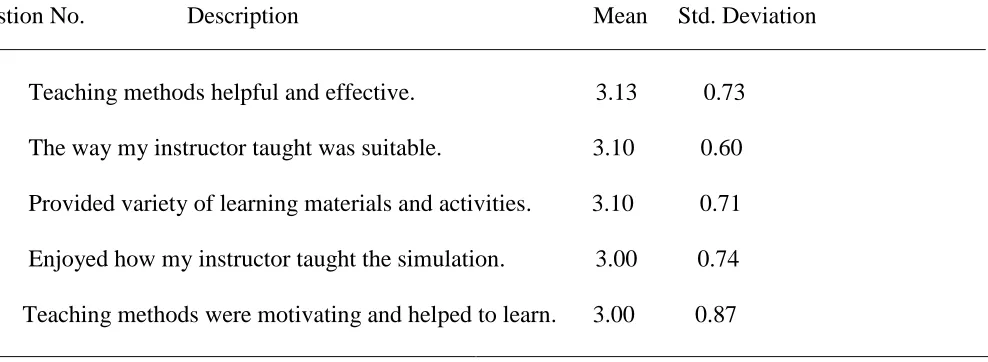
The findings were tabulated and presented in table 1, which includes the question number on the survey and a description of the questions. The table shows mean scores (x̅ ) and standard deviation (SD) of students’ overall perceptions of satisfactions of the RT patient simulation education evaluated by
[image:31.612.71.565.308.489.2]undergraduate and graduate RT students. The results have been ranked from highest mean scores to lowest according to questions on the survey.
Table 1. Students’ overall perceptions of satisfactions of the RT patient simulation education in rank
order. (n = 30)
Question No. Description Mean Std. Deviation
Q1 Teaching methods helpful and effective. 3.13 0.73 Q5 The way my instructor taught was suitable. 3.10 0.60 Q2 Provided variety of learning materials and activities. 3.10 0.71 Q3 Enjoyed how my instructor taught the simulation. 3.00 0.74 Q4 Teaching methods were motivating and helped to learn. 3.00 0.87
The first research question asked, “What are the perceptions of undergraduate and graduate RT students regarding patient simulation education?” The students indicated high agreement with the
Findings Related to Research Question 2
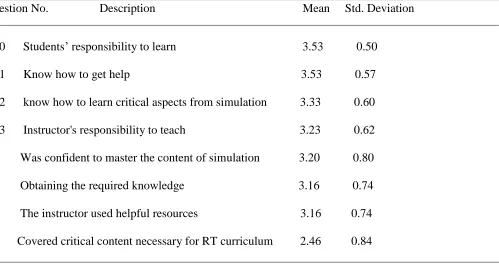
The second research question asked, “How confident are RT students as a result of this patient simulation education?” The majority of the students indicated that they were confident while developing the skills and obtaining the required knowledge from this simulation to perform necessary tasks in a clinical setting. Among the factors that the students perceive to raise their confidence level through patient simulation education, the students’ notion that it is their responsibility to learn increases their
[image:32.612.65.564.428.692.2]self-confidence more. This is followed by their knowledge on how to get help; ability to learn critical aspects from simulation; the instructors’ responsibility; confidence in mastering the contents of simulation; acquisition of required knowledge; instructor’s use of helpful resources; and coverage of critical content deemed necessary to the RT curriculum.
Table 2. Students’ overall perceptions of self-confidence in learning as a result of the RT patient
simulation education in rank order. (n = 30)
Question No. Description Mean Std. Deviation
Summary
The findings of this study assert the perceptions of RT students at an urban university on what they have learned from their patient simulation sessions. It is determined that patient simulation sessions helped improve RT student perception that they developed the necessary knowledge and skills that are applicable in the clinical setting. Likewise, the findings indicate that the students’ self-confidence
CHAPTER V
INTERPRETATION OF FINDINGS
This chapter will interpret the findings related to answering the research questions. This chapter is divided into six sections, including the overview of the study, discussion of the findings, implications for research, recommendations for future research, and the conclusion.
Overview of the Study
The goal of the current study was to identify the perceptions of RT students at an urban university on what they have learned from their patient simulation sessions. In addition, the intent of this study was to determine whether the patient simulations activities increased RT students’ self-confidence and enthusiasm in learning.
Research Questions
1. What are the perceptions of undergraduate and graduate RT students regarding patient simulation education?
2. How confident are RT students as a result of this patient simulation education?
Discussion of Findings
Findings Related to Research Question 1
As a motivating method for teaching, the students agree that the patient simulation sessions helped them learn important RT-related lessons while enjoying the whole experience. Thus, this implies that patient simulation education fosters an effective learning environment.
This is similar to the findings in Katowa-Mukwato et al.’s (2014) study whereby medical students during their clerkship found themselves to be more competent with their clinical skills and clinical
demonstration due to simulations, which improved their overall performance. From the medical students’ perspective, they believe that simulations enabled them to manage small clinical problems and helped them during their clinical duty (Katowa-Mukwato et al., 2014). Moreover, nursing students see the entire simulation experience as effective due to its ability to provide them with comparable clinical experience (Parsh 2010). Similarly, the findings of this study is comparable to Evans et al.’s (2014) research that discovered a 12-week simulation education course was highly effective and helpful for the students, as evidenced by their enhanced decision-making skills, teamwork, and communication, management and leadership skills (Evans et al., 2014).
Findings Related to Research Question 2
selves strengthens their confidence the most. As a result, they become self-assured through constant exposure to simulations. Thus, it becomes clear that patient simulations are able to cover crucial information and application of RT processes that are required in the RT curriculum.
These findings are consistent with the feedback of PT students after simulation activity. According to Shoemaker, Riemersma, and Perkins (2009), PT students expressed their awe at how simulations offered real-life scenarios and provided them a realistic environment that helped prepare them address different events that may take place in the clinical setting (Shoemaker, et al., 2009). In the same way, Jeffries (2012) reveal how the experiences of nursing students with simulation increased their self-confidences and developed their clinical judgment and decision-making skills despite the shortage of clinical placement sites and technological advancements. Likewise, simulation allows the students to witness a scenario that is similar to a hospital setting but is more controlled, and as a result reduces the risks for errors (Jeffries, 2012).
Additionally, the findings of the current study agree with past literatures that commend the self-confidence benefits that patient simulations offer. Among these is how patient simulations not only
Although the findings of this study do not disregard the positive impact of patient simulation in satisfying the requirements of the RT curriculum and its influence on the students’ self-confidence, the findings also remind the students, faculty members, clinical instructors, schools, and preceptors, as well as other
stakeholders that simulations cannot work efficiently on its own. As much as simulations increases the students’ motivation and other relevant skills necessary to succeed in their chosen fields and expertise, simulation is not enough to supply the knowledge and skills required to be well-equipped health care professionals. Nonetheless, simulation remains a strong motivator for numerous students (Botma, 2014). Additional findings showed that simulation education is helpful in the Bachelor of Science in Respiratory Therapy (BSRT) department at the Georgia State University is the support of various organizations and agencies like the Institute of Medicine (IOM) (2014). In during their workshop last year, they revealed the numerous benefits of simulation to health professional education (Institute of Medicine, 2014).
Implications for Research
The result of this study was to determine the perceptions of RT students at an urban university on what they have learned from their patient simulation sessions. In addition, the findings helped determine whether the patient simulations activities increased RT students’ self-confidence and enthusiasm in learning. This study and its findings imply a need for further research in line with patient simulations and its effectiveness. The advancement of simulation education will help RT clinical students develop
necessary skills that are relevant to real-life scenarios in the clinical workplace. Likewise, students should work hard to improve their performance with less risk for actual errors that may affect their confidence through patient simulation education. This study contributes to past investigations by ranking the perceptions of students towards patient simulation education. Lastly, this study implies improvements addressing some areas of concerns in the field of simulation education in relation to the study of RT.
Recommendations for Future Research
Further research about patient simulation education in RT field is recommended due to the limited studies that currently exist. It is suggested that RT faculty members and administrators should also be involved in similar students in the future in order to provide a parallel or comparative view according to clinical preceptors, school administrators, and faculty members, as well as other specialists concerned.
Limitations of the Study
post-simulation education are yet to be explored. Finally, this study has no link to clinical outcomes, which limits it applicability.
Conclusion
In conclusion, a majority of the RT students in this study were satisfied with their current
experiences with simulation education. This is in accordance to the teaching methods, helpful features of simulation, access to different learning materials and activities, an insightful and enjoyable simulation experience, the influence of clinical preceptors, and the motivation of the clinical students. As this study found, simulation education is an effective teaching and training strategy among clinical students,
including RT, nursing, PT, radiography, and medical school. It supports the student’s acquisition of
necessary knowledge and skills relevant to their respective health care field. It helps RT students face their curiosity, fears, and clinical challenges, in addition to increasing their confidence levels that would assist them during actual clinical exposure. Thus, simulation has been proven to be advantageous in cases involving both academic and clinical settings. In the end, simulation not only boosts the confidence of the students but also encourages them to adopt effective learning strategies and coping mechanisms
References
Aebersold, M., & Tschannen, D. (2013). Simulation in Nursing Practice: The Impact on Patient Care.
Online Journal of Issues in Nursing, 18(2), 1.
Botma, Y. (2014). Nursing student’s perceptions on how immersive simulation promotes theory–practice integration. International Journal of Africa Nursing Sciences, 1, 1-5.
Brown, S. J. (2009). Evidence-based nursing: The research-practice connection. Jones & Bartlett Publishers.
Chiu, J. (2013). Radiographer level of simulation training, critical thinking skills, self-efficacy, and clinical competence. Dissertation. Dowling College. (2574116)
Comer, S.K. (2005). Patient care simulations: Role playing to enhance clinical understanding. Nursing Education Perspectives, 26(6), 357-361.
Evans, L.V., Crimmins, A.C., Bonz, J.W., Gusberg, R.J., Tsyrulnik, A., Dziura, J.E., & Dodge, K.L. (2014, December 12). A comprehensive, simulation-based approach to teaching clinical skills: The medical students’ perspective. Yale Journal of Biology and Medicine, 87(4), 575-581.
Gaba, D. (2004). The future vision of simulation in health care. BMJ Quality and Safety Health Care, 13, i2-i10. doi:10.1136/qshc.2004.009878
Gore, T., Leighton, K., Sanderson, B., & Wang, C. (2014). Fidelity’s effect on student perceived preparedness for patient care. Clinical Simulation in Nursing, 10(6), e209-e315.
Hicks, F.D., Coke, L., & Li, S. (2009). Report of findings from the effect of high-fidelity simulation on nursing students’ knowledge and performance: A pilot study. Retrieved, 14 September 2015, from
Institute of Medicine (IOM). (2014, September 19). Assessing health professional education: Workshop summary. Washington, DC: National Academies Press. Retrieved from
http://www.ncbi.nlm.nih.gov/books/NBK248046/?report=reader
International Nursing Association for Clinical Simulation and Learning (IACSL). (n.d.). Standards of best practice: Simulation. Retrieved, March 11, 2015, from
http://www.inacsl.org/i4a/pages/index.cfm?pageid=3407
Jeffries, P.R. (2012, May 25). Clinical versus simulation: Outcomes, the evidence, and current research. Retrieved, March 11, 2015, from
http://www.wiser.pitt.edu/sites/wiser/ns12/pdfs/Clinical%20versus%20simulation_Jeffries.pdf
Katowa-Mukwato, P., Andrews, B., Maimbolwa, M., Lakhi, S., Michelo, C., Mulla, Y., & Banda, S.S. (2014). Medical students' clerkship experiences and self-perceived competence in clinical skills.
African Journal of Health Professions Education, 6(2), 155.
Lapkin, S., Levett-Jones, T., Bellchambers, H., & Fernandez, R. (2010). Effectiveness of patient simulation manikins in teaching clinical reasoning skills to undergraduate nursing students: a systematic review. Clinical Simulation in Nursing, 6(6), e207-22.
Lavin, M.A., Ruebling, I., Banks, R., Block, L., Counte, M., Furman, G., Miller, P., Reese, C., Viehmann, V., & Holt, J. (2001). Interdisciplinary health professional education: A historical review.
Advances in Health Sciences Education6(1), 25-47.
Madhavanprabhakaran, G., Al-Khasawneh, E., & Wittmann, L. (2015, Feb). Perceived benefits of pre-clinical simulation-based training on pre-clinical learning outcomes among Omani undergraduate nursing students. Sultan Qaboos University Medical Journal, 15(1), e105-e111.
Merriman, C. D., Stayt, L. C., & Ricketts, B. (2014). Comparing the Effectiveness of Clinical Simulation versus Didactic Methods to Teach Undergraduate Adult Nursing Students to Recognize and Assess the Deteriorating Patient. Clinical Simulation In Nursing, 10(3), e119-27.
Ohtake, P.J., Lazarus, M., Schillo, R., & Rosen, M. (2013). Simulation experience enhances physical therapist student confidence in managing a parent in the critical care environment. Physical Therapy, 93(2), 216-228.
Parsh, B. (2010, October). Characteristics of effective simulated clinical experience instructors: Interviews with undergraduate nursing students. Journal of Nursing Education,49(1), 569-572.
Portney, L.G. & Watkins, M.P. (2008). Foundations of Clinical Research: Applications to Practice. (3rd ed.). Pearson Prentice Hall, Upper Saddle River, New Jersey.
Price, T., Causer, T.P., Balon, J.A., Helling, T.S., & Dumire, R.D. (2010). Pilot study of respiratory student education using an advanced human patient simulator for critical patient management scenarios. Respiratory Care Education Manual, 19, 63-71.
Reid-Searl, K., Eaton, A., Vieth, L., &Happell, B. (2011). The educator inside the patient: Students' insights into the use of high fidelity silicone patient simulation. Journal of Clinical Nursing,
20(19/20), 2752-2760.
Reese, C.E., Jeffries, P.R., & Engum, S.A. (2010). Learning together: Using simulations to develop nursing and medical student collaboration. Nursing Education Perspectives, 31(1), 33-37.
Shoemaker, M.J., Riemersma, L., & Perkins, R. (2009, March). Use of high fidelity human simulation to teach physical therapist decision-making skills for the intensive care setting. Cardiopulmonary Physical Therapy Journal,20(1), 13-18.
Shinnick, M.A., Woo, M., Horwich, T.B., & Steadman, R. (2011, May). Debriefing: The most important component in simulation? Clinical Simulation in Nursing, 7(3), e105-e111.
Instructions: This questionnaire is a series of statements about your personal attitudes about the instruction you receive during your simulation activity. Each item represents a statement about your attitude toward your satisfaction with learning and self-confidence in obtaining the instruction you need. There are no right or wrong answers. You will probably agree with some of the statements and disagree with others. Please indicate your own personal feelings about each statement below by marking the numbers that best describe your attitude or beliefs. Please be truthful and describe your attitude, as it really is, not what you would like for it to be. This is anonymous with the results being compiled as a group, not individually.
Mark:
1 = STRONGLY DISAGREE with the statement 2 = DISAGREE with the statement 3 = AGREE with the statement 4 = STRONGLY AGREE with the statement
Satisfaction with Current Learning
SD
D
A
SA
1. The teaching methods used in this simulation were helpful and effective.
1 2 3 4
2. The simulation provided me with a variety of learning materials and activities to
promote my learning the respiratory therapy curriculum. 1 2 3 4
3. I enjoyed how my instructor taught the simulation. 1 2 3 4
4. The teaching materials used in this simulation were motivating and helped
me to learn. 1 2 3 4
5. The way my instructor(s) taught the simulation was suitable to the way I learn. 1 2 3 4
Self-confidence in Learning SD D A SA
6. I am confident that I am mastering the content of the simulation
activity that my instructors presented to me. 1 2 3 4
7. I am confident that this simulation covered critical content necessary for
the mastery of the respiratory therapy curriculum. 1 2 3 4
8. I am confident that I am developing the skills and obtaining the required
knowledge from this simulation to perform necessary tasks in a clinical setting 1 2 3 4
9. My instructors used helpful resources to teach the simulation. 1 2 3 4
10. It is my responsibility as the student to learn what I need to know from
this simulation activity. 1 2 3 4
11. I know how to get help when I do not understand the concepts
covered in the simulation. 1 2 3 4
12. I know how to use simulation activities to learn critical aspects of these skills. 1 2 3 4
13. It is the instructor's responsibility to tell me what I need to learn of the
Dear Respiratory Therapy student,
You are invited to participate in a study entitled " Respiratory Therapy Student Perception of Patient Simulation At
A Large Urban University”. The aim of this study is to identify the perceptions of RT students at an urban
university on what they have learned from their patient simulation sessions. The study is being conducted by
Abdullah Alqarni, a master degree student from the Department of Respiratory Therapy at Georgia State University,
under the advisement of Robert B. Murray. The information you provide will be used in a thesis prepared by
Abdullah Alqarni and supervised by Robert B. Murray. It is completely voluntary to take part and participate in the
study. If you decide to participate in the study you will be asked to complete the survey provided with this letter.
The survey should not take more than ten minutes. However, if you decide not to participate, you may simply leave
the classroom. You may stop taking the survey at any time without penalty or loss of benefits to which you are
otherwise entitled; simply submit the survey at any time. Your responses will be kept strictly confidential, as we
will not use names or codes to identify you or your response. To better assure confidentiality, all surveys will be
destroyed after all surveys have been collected. We hope that you will submit a completed survey. When we publish
our findings, we will report our findings based on groups, not on individuals. If you would like an executive
summary, please send your information to [email protected]. If you have any questions about this
research, now or in the future, please contact Abdullah Alqarni at [email protected] or Robert B. Murray
at [email protected]. The department's contact information can be found at the bottom of this page. You may also
contact Ms. Susan Vogtner in Georgia State University's IRB Office at [email protected]
If you are 19 years of age or older and agree to the above please proceed to the survey
Sincerely,
Abdullah Alqarni
Department of Respiratory Therapy Georgia State University