ScholarWorks @ Georgia State University
ScholarWorks @ Georgia State University
Computer Science Theses Department of Computer Science
Summer 8-12-2014
Towards an MPI-like Framework for Azure Cloud Platform
Towards an MPI-like Framework for Azure Cloud Platform
Sara Karamati
Follow this and additional works at: https://scholarworks.gsu.edu/cs_theses
Recommended Citation Recommended Citation
Karamati, Sara, "Towards an MPI-like Framework for Azure Cloud Platform." Thesis, Georgia State University, 2014.
https://scholarworks.gsu.edu/cs_theses/77
This Thesis is brought to you for free and open access by the Department of Computer Science at ScholarWorks @ Georgia State University. It has been accepted for inclusion in Computer Science Theses by an authorized
administrator of ScholarWorks @ Georgia State University. For more information, please contact
by
SARA KARAMATI
Under the Direction of Dr. Sushil K. Prasad
ABSTRACT
Message passing interface (MPI) has been widely used for implementing parallel and distributed
applications. The emergence of cloud computing offers a scalable, fault-tolerant, on-demand
al-ternative to traditional on-premise clusters. In this thesis, we investigate the possibility of
adopt-ing the cloud platform as an alternative to conventional MPI-based solutions. We show that
cloud platform can exhibit competitive performance and benefit the users of this platform with
its fault-tolerant architecture and on-demand access for a robust solution. Extensive research is
done to identify the difficulties of designing and implementing an MPI-like framework for Azure
cloud platform. We present the details of the key components required for implementing such a
framework along with our experimental results for benchmarking multiple basic operations of
MPI standard implemented in the cloud and its practical application in solving well-known
large-scale algorithmic problems.
by
SARA KARAMATI
A Thesis Submitted in Partial Fulfillment of the Requirements for the Degree of
Master of Science
in the College of Arts and Sciences
Georgia State University
Copyright by Sara Karamati
by
Sara Karamati
Committee Chair: Sushil K. Prasad
Committee: Rafal Angryk
Yi Pan
Electronic Version Approved:
Office of Graduate Studies
College of Arts and Sciences
Georgia State University
ACKNOWLEDGEMENTS
I would like to express my deep and sincere gratitude to my advisor, Dr. Sushil Prasad,
for his support and guidance throughout this research. I would like to thank Dinesh Agarwal for
his contribution in the publication of "Towards an MPI-like framework for the Azure cloud
plat-form" in the CCGrid 2014 conference. I would like to thank my colleagues at DiMoS group for
sharing their knowledge and experience with me and their help in my research.
My deepest appreciation goes to my husband, Reza, who supported me in many ways and
made me feel strong. This work could not be done without his support, understanding, and love.
Most of all, I thank my parents, my sister, and my brother for their endless love, support, and
TABLE OF CONTENTS
ACKNOWLEDGEMENTS ... iv
LIST OF TABLES ... vii
LIST OF FIGURES ... viii
1 INTRODUCTION ...1
1.1 Motivation ...1
1.2 Introduction to Windows Azure ...3
1.3 The Components of Windows Azure ...4
1.4 Challenges of Cloud HPC...6
1.5 HPC Frameworks on Azure ...7
1.6 Organization of the Thesis ...8
2 CONSIDERATIONS FOR PORTING THE MPI STANDARD TO CLOUD .... 10
2.1 Design of MPI Primitives ... 10
2.1.1 Point-to-Point Communications ... 10
2.1.2 One-sided Communications ... 14
2.1.3 Collective Communications ... 14
2.2 Interface and Hardware Configuration... 16
2.3 Software Configuration ... 17
3 IMPLEMENTATION ... 18
3.2 Implementing MPI Collective Operations on Azure Cloud Platform ... 21
4 COMMUNICATION BENCHMARKS AND EVALUATION ... 26
4.1 Test Environment ... 26
4.2 Latency... 27
4.3 Performance of Collective Algorithms... 29
4.3.1 Barrier Performance ... 29
4.3.2 Broadcast and Scatter Performance ... 30
5 PERFORMANCE OF APPLICATIONS ON THE CLOUD... 35
5.1 N-Body Particle Simulation ... 35
5.2 Cannon’s Multiplication Algorithm ... 41
6 CONCLUSION AND FUTURE WORK ... 44
6.1 Conclusion ... 44
6.2 Future Work ... 44
REFERENCES ... 46
LIST OF TABLES
Table 1.1 Comparison of Windows Azure queues and Service Bus queues ...5
LIST OF FIGURES
Figure 3.1 Comparison of traditional MPI code with cloudMPI ... 20
Figure 3.2 Send and receive mechanism in cloudMPI via Azure... 21
Figure 3.3 Implementation of broadcast using storage queue (left) and Service Bus
topic (right) ... 22
Figure 3.4 Broadcast naive implementation versus hypercube-based
implementation ... 23
Figure 3.5 Multi-threaded scatter operation ... 24
Figure 3.6 Barrier operation implementation ... 25
Figure 4.1 Benchmarking MPI performance on Azure cloud environment for small
messages ... 28
Figure 4.2 Benchmarking MPI performance on Azure cloud environment for large
messages ... 29
Figure 4.3 . Benchmarking performance of barrier operation on Azure cloud
environment ... 30
Figure 4.4 Benchmarking performance of broadcast operation on Azure cloud
environment ... 31
Figure 4.5 Benchmarking performance of scatter operation on Azure cloud
environment ... 32
Figure 4.6 Comparing the performance of scatter operation for MPI and
cloudMPI ... 33
Figure 4.7 Performance of broadcast naïve operation and its hypercube-based
Figure 4.8 Performance of scatter multi-threaded implementation ... 34
Figure 5.1 Performance of N-Body simulation for 20,000 and 30,000 particles ... 39
Figure 5.2 Performance of N-Body simulation for 40,000 and 50,000 particles ... 40
Figure 5.3 Performance of N-Body simulation on 8 nodes ... 41
Figure 5.4 cloudMPI performance for a 4800×4800 matrix ... 42
1 INTRODUCTION
1.1 Motivation
For several decades, computer industry enjoyed increasing number of transistors on a
chip with a proportional increase in the clock frequency with no drastic limitations on the
electri-cal and thermal power. Last decade marked a shift in computing industry and the clock
frequen-cy could no longer increase because of increasing temperature of the CPUs and limitations in the
cooling systems. The clock frequency barrier along with the advent of mobile computing ushered
us in the era of multi-core low-power architectures aided by accelerator units like
general-purpose GPUs and specialized hardware —including hardware-accelerated codecs, digital signal
processors, etc. In this period, software developers should actively optimize their applications by
taking advantage of the special capabilities of the underlying hardware (e.g., cache-aware
algo-rithms, SIMD operations, off-loading work to GPU, etc.) in order to improve speed and energy
efficiency of their applications. Furthermore, with the increasing bandwidth and reliability of the
Internet, scaling software systems as massive distributed services has become more and more
ubiquitous. These massive systems (networked servers and data-centers distributed all over of
the world also known as the cloud) work hand-in-hand with the consumer devices in order to
de-liver quality services. Quality of these services relies on the software that utilizes the capabilities
of the cloud and consumer hardware efficiently.
While the advent of cloud computing has provided researchers with a computing platform
with unprecedented scale, its adoption for high-performance computing has been limited by the
difficulty in employing cloud-based resources. Although the Infrastructure as a Service (IaaS)
facilities commonly provided by commercial cloud computing companies promise portability of
cluster node, IaaS cannot demonstrate essential requirements for high-performance computing
such as low-latency networks and fault-tolerant computing.
The steep learning curve involved in understanding the very peculiar and non-uniform
ar-chitectures and runtime environments of various cloud platforms discourage HPC community to
adopt it as an alternative platform. In order for a large-scale penetration of cloud computing
plat-forms into the HPC community, cloud vendors will have to offer easier approaches to utilize
these platforms for scientific research.
One of the popular programming environments followed by the HPC community is the
message passing interface (MPI) [1]. Various implementations of MPI standard are available in
the market proving the effectiveness of MPI standard for parallel and distributed application
de-velopment. While MPI has been a popular choice for traditional parallel and distributed
plat-forms, its current implementations are not pragmatic for cloud computing platforms [2]. Creating
an MPI-like framework for cloud platforms thus is a non-trivial problem. Cloud platforms most
often come with their own set of APIs and hence porting legacy parallel and distributed
applica-tions require a great deal of engineering.
In order to help these applications run on cloud platforms with as little effort as it would
be to run on any other platform, it is essential to bring the same frameworks that these
applica-tions use to cloud platforms. Unlike traditional parallel and distributed platforms, cloud
plat-forms have better fault tolerance and recovery due to their relatively stable operation. The
tradi-tional frameworks could exploit this feature to simplify their fail-proofing mechanisms. Other
key strengths of the cloud can be exploited for coarse-grained, long-running applications
includ-ing variable pricinclud-ing, on-demand allocation/deallocation and scalability to tradeoff budget vs.
ex-isting standards on a new platform, but rather, it requires careful adaptation in tune with the
sig-nificantly different computing infrastructure.
1.2 Introduction to Windows Azure
Windows Azure is a Microsoft web service that provides flexible cloud platform for
building, deploying, and managing applications. It allows users to reliably host and scale out
their applications, store and manage data in many different ways, and provides messaging
capa-bilities for distributed applications development.
Unlike traditional clusters, cloud platform can easily scale by increasing/decreasing the
capacity of individual nodes through hardware upgrading/downgrading (i.e., changing memory
capacity or the number of CPU cores, etc.) or by adding/releasing nodes (also known as
horizon-tal scaling) [3]. In order to benefit from vertically scaling the cloud application, in addition to
reasonable hardware, sufficiently capable software is also required that can take advantage of the
available hardware.
Horizontal scaling pattern can minimize cost by releasing some of the allocated
re-sources, when they exceed the demands of application and increase the resources as throughput
falls below default expectations. Efficient utilization of the cloud resources is important since
cloud platform follows pay-as-use model. Scaling activities can be automated programmatically
by monitoring specific performance metrics such as memory usage, CPU utilization, and average
queue length, and so on.For applications with variable or unknown workload, the cloud elastic
feature can be used to adjust the resources according to the demand and consequently leading to
cost savings by releasing unused resources.
In the following section, we discuss key components of Windows Azure that are used in
1.3 The Components of Windows Azure
Virtual Machines (VMs): Windows Azure virtual machines are configurable and
main-tainable servers in the cloud. These scalable computing resources can be set up with
software and services on Windows Server or Linux-based operating systems. Because of
the control on the configuration and recycling existing virtual machine images, Azure
vir-tual machines are suitable options for migrating legacy codes and applications to the
cloud.
Cloud Service: Azure cloud service is designed for developing multi-tier applications on
a platform consisting of one or more compute roles. Convenience of deploying multiple
roles makes this service a good option for applications requiring distributed processing
and flexible scaling. Azure cloud service supports two kinds of roles namely web role
and worker role. Unlike worker role, web role runs IIS so they can be used for front-end
web applications. At the cost of limited control in comparison to virtual machines, Azure
cloud service assures maintaining infrastructure, patching operating system, and restoring
from hardware and service failures.
Cloud Storage: Azure storage service is classified into three categories based on the
characteristics of the stored data. Blob storage is ideal for storing large amount of
un-structured data. It can contain hundreds of gigabytes of data. Table storage stores
struc-tured non-relational data. A single table can hold a collection of entities with different set
of properties. Queue storage is the perfect means to pass messages between Azure roles.
It can contain an unlimited number of messages each with maximum size of 64KB.
Service Bus: Azure Service Bus provides three different communication mechanisms for
and asynchronous messaging components that store messages until they are consumed by
the receiver. The main difference between queue and topic is in the number of receivers
of a message. While a message in a queue can be received by only one possible
subscrib-er, a topic allows the message to be received by multiple subscribers that satisfy specific
criteria. Service Bus relay service provides direct communication between sender and
re-ceiver over a TCP channel. Unlike queue and topic, relay service supports bi-directional
messaging.
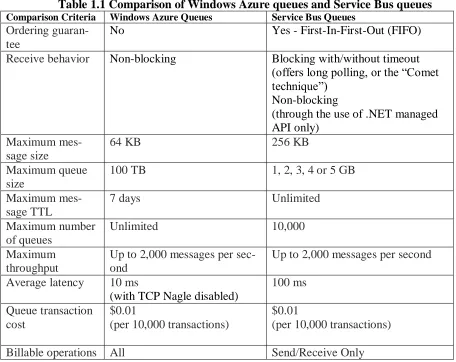
Table 1.1 compares the features of the Windows storage queue and Service Bus queue.
The data in this table are collected from the advertised information about these services by
Mi-crosoft [4].
Table 1.1 Comparison of Windows Azure queues and Service Bus queues
Comparison Criteria Windows Azure Queues Service Bus Queues
Ordering guaran-tee
No Yes - First-In-First-Out (FIFO)
Receive behavior Non-blocking Blocking with/without timeout (offerslongpolling,orthe“Comet technique”)
Non-blocking
(through the use of .NET managed API only)
Maximum mes-sage size
64 KB 256 KB
Maximum queue size
100 TB 1, 2, 3, 4 or 5 GB
Maximum mes-sage TTL
7 days Unlimited
Maximum number of queues
Unlimited 10,000
Maximum throughput
Up to 2,000 messages per sec-ond
Up to 2,000 messages per second
Average latency 10 ms
(with TCP Nagle disabled)
100 ms
Queue transaction cost
$0.01
(per 10,000 transactions)
$0.01
(per 10,000 transactions)
[image:16.612.79.535.351.713.2](no charge for other operations) Idle transactions Billable
(querying an empty queue is counted as a billable transac-tion)
Billable
(a receive against an empty queue is considered a billable message)
Storage cost $0.14
(per GB/month)
$0.00
Outbound data transfer costs
$0.12 - $0.19
(depending on geography)
$0.12 - $0.19
(depending on geography)
1.4 Challenges of Cloud HPC
Several researchers have studied the practicality of running tightly coupled and MPI-style
applications in the cloud environment. These studies evaluate the performance of MPI
applica-tions on different cloud platforms including Amazon EC2 [2, 5-9] and Microsoft Windows
Az-ure [10, 11]. Most studies use classical MPI benchmarks such as NAS, NPB, HPL, and CSFV to
compare the performance of MPI on public cloud platforms. Others evaluate the feasibility of
running large-scale applications on the cloud such as low-order coupled atmosphere-ocean
simu-lation [5] and biomedical applications [11], matrix multiplication, K-means Clustering [8] . All
studies confirm there is a strong correlation between the application communication time and
application overall performance on the cloud platform. These studies show that the lack of
high-bandwidth, low-latency interconnects as well as virtualization overhead has large effect on the
performance of HPC applications on the cloud. Jackson et al. [6] report a significant variability
in performance on Amazon cloud platform due to virtualization in the cloud environment and
consequent resource sharing and contention.
This project is an ongoing work in our research group. cloudMPI first introduced in
dis-sertationtitled“ScientificHighPerformancecomputing(HPC)ApplicationsontheAzureCloud
is considered. The previous version only considered the point to point routines for cloudMPI
using Azure queue storage. The interface of cloudMPI was different from conventional MPI and
it involved some effort to convert legacy MPI applications to cloudMPI.
1.5 HPC Frameworks on Azure
MapReduce is a widely used programming model that provides good performance in the
cloud platform. Several studies have evaluated the performance of MapReduce in the cloud
plat-form. Microsoft Daytona [13] is an iterative MapReduce runtime optimized for data analytics
and machine learning built on Microsoft Windows Azure. In Daytona architecture a single
mas-ter instance is used to perform the scheduling of applications and tasks and handling of failures.
The master assigns each map and reduce task to a slave instance. The instances communicate
directly through a TCP connection. Twister4Azure [14] is another iterative MapReduce runtime
for Windows Azure cloud. This runtime environment uses Azure queues for map and reduce
tasks scheduling, Azure tables for metadata and monitoring data storage, Azure blob storage for
data storage and the Window Azure compute worker roles to perform the computations. A
multi-level data caching mechanism is also used in the Twister4Azure runtime to mitigate the latency
issues inherent in the cloud services.
Pregel.NET [15] is a bulk synchronous parallel (BSP) framework for graph processing
customized for the Microsoft Windows Azure cloud. Pregel.NET uses the Pregel architecture
design [16] for BSP graph processing. In this model, each worker role holds the distributed graph
partitions and performs vertex-centric tasks on their own partition of the graph. The storage
queues are used for message transmission between vertices on different compute nodes as well as
AzureBlast [10] is a parallel implementation of BLAST library on Windows Azure. Blast
is a sequence comparison tool widely used in bioinformatics applications. To run Blast on
multi-ple instances, the query-segmentation data-parallel pattern is adopted. Given an input file, which
contains a number of query sequences, AzureBlast distributes partitioned input sequences
be-tween Azure compute instances to be executed. Once all workers process their assigned partition,
the results are merged and become available on the blob storage.
1.6 Organization of the Thesis
In this thesis, we discuss the key components of implementing a message passing
frame-work on Azure cloud platform and provide design guidelines derived from our experiments. The
goal of this thesis is to theoretically and experimentally investigate the cloud environment for
high-performance computing and to identify the strengths of the Azure cloud platform to
effi-ciently map MPI to this platform. The rest of this thesis is organized as follows:
The design of an MPI-like framework for application development on Azure cloud
plat-form is presented in Chapter 2. An efficient implementation of a proof-of-concept MPI-like
framework, cloudMPI, on the Windows Azure cloud platform is provided in Chapter 3. This
chapter details the implementation of MPI-like communicators and primary communication
primitives for selective point-to-point and collective operations. Detail of experimental results,
their evaluation, and the environment setup are discussed in Chapter 4. A study of the
practicali-ty and efficiency of the cloudMPI framework by porting widely-used applications to this
plat-form is presented, as well as benchmarking results that assess the current communication
effi-ciency and overhead for short and long messages for Azure API and cloudMPI framework. The
1.7 Related Publication
Part of this work was presented in the 14th IEEE/ACM International Symposium on
Cluster, Cloud, and Grid Computing and accepted for publication in the conference proceedings
2 CONSIDERATIONS FOR PORTING THE MPI STANDARD TO CLOUD
In this section, we discuss the requirements of the components of an MPI-like framework
and the challenges that make it an interesting research problem. The framework design is
ex-pected to behave as close to traditional MPI framework as possible, yet it can benefit from the
scale and dynamicity of cloud computing as well as its fault tolerance.
2.1 Design of MPI Primitives
The point-to-point communication is the most commonly used communication pattern in
MPI. There are two categories for MPI point-to-point communications: 1) blocking and 2)
non-blocking. These categories provide a number of communication modes: synchronous (MPI
Ssend, MPI Issend), buffered (MPI Bsend, MPI Ibsend), ready (MPI Rsend, MPI Irsend), and
standard (MPI Send, MPI Isend). Each mode uses different mechanisms to send messages to
tar-get nodes offering trade-offs for synchronization overhead, system overhead, buffer space, and
reliability. In the following, we focus on different options for communications on Azure cloud
environment and consider MPI communication modes of transferring data for them [18].
2.1.1 Point-to-Point Communications
Blocking buffered asynchronous communication using Azure queue storage: In
Az-ure cloud infrastructAz-ure, all queue services are accessible from any compute node. This
capability makes it possible to use the intra-node communication mechanism to
imple-ment MPI methods for messaging among processes that are either on the same compute
node or on remote nodes over the cloud. Nemesis communication subsystem [19] for
MPICH uses shared memory queue for intra-node messaging. This communication
sub-system uses free queues to prevent starvation of senders or receivers and assures efficient
of shared memory, the free queue used in Nemesis implementation can be removed
with-out performance fall-off. Our design goal here is to use Windows Azure queue storage to
communicate messages between Azure compute instances. Each compute instance has a
receive queue that it needs to poll in order to receive messages from other instances. To
send a message to a compute instance, the message is inserted into the queue of the
re-ceiving instance. The size of the message sent to the queue cannot exceed 64KB.
There-fore, large data are sent to blob and its unique id, which identifies the location of the data
in the blob, is sent as a message to the receivers queue. The Azure queue storage does not
guarantee a first-in-first-out (FIFO) ordered delivery. Therefore, a mechanism such as
lo-cal queue is needed to compensate for this deficiency. The receive process would follow
these steps: 1) Check the local queue for desired message; 2) If message is found, use it
as needed; otherwise, 3) Poll the Azure queue; 4) If message is found use it as needed;
otherwise, 5) Put the unexpected message in the local queue and go to step 3.
Communication over queue offers the advantages of asynchronous and buffered
commu-nication modes. In comparison to synchronous mode, it is safe because it is not dependent
on the order of send and receive operations. Furthermore, senders and receivers do not
have to be available at the same time; therefore, if the receiving instance fails, it receives
messages reliably as soon as it is available. A visibility timeout can be assigned to a
mes-sage from the queue and the mesmes-sage will reappear in the queue if it has not been deleted
by the end of the timeout period. This feature provides fault tolerance for the application
by ensuring that no messages will be lost during instance failure. Additionally, queue
service eliminates synchronization overhead by buffering the message in the queue. The
message is larger than the maximum message size that queue service can handle
(typical-ly 64 KB). This effective(typical-ly eliminates the pitfall of using buffer mode for messages larger
than available buffer space which in traditional MPI programs will generate an error and
the program will by default exit.
Another alternative to the local queue is using table storage. The sender of a message will
store the message in a table instead of a queue. Messages can be automatically tagged
with a time-stamp to enforce strict ordering at the time of retrieval. However, table
stor-age does not have the fault tolerance boasted by Azure queue storstor-age service. If a node
fails after taking a message out of the table storage, there is no automated recovery or
re-appearing of the message in the table storage.
Blocking buffered asynchronous or blocking synchronized messaging for short
mes-sages using Service Bus relay: The first design scheme, the message passing via Azure
storage, is slow for short messages. Therefore, an alternative scheme optimized for short
messages can be designed. In this communication scheme, the Service Bus relay service
is used to communicate between two compute instances over the TCP channel. In this
communication mechanism, each cloud node hosts Windows Communication Foundation
(WCF) services for communication operations. Whenever an instance decides to send a
message to another instance, it invokes the send service of the receiver instance and
pass-es the dpass-esired mpass-essage as the argument for the service call. This method has two
varia-tions. The first variation provides buffered and asynchronous communication and the
second variation supports unbuffered and synchronous communication. In the first
varia-tion, whenever an instance decides to send a message to another instance, it invokes the
the service call. The send service puts the message inside a local queue in the receiver
side. As a result, a receiver instance can receive a message by checking its local queue. In
the second variation, the send service call waits until a receiver instance provides a
matching receive. In this variation, the send service call (receive routine) first triggers an
event and then waits for an event from the receiver (send service call).
Blocking buffered FIFO communication using Azure Service Bus queue: The third
design scheme can use Azure Service Bus queue for communication. This design is
simi-lar to one that uses Azure queue except for following finer details. In comparison to
Az-ure storage queue, which only supports messages of type string and binary array, Service
Bus queue can support messages of any type. Therefore, it obviates the need for an
ex-plicit type conversion. While the Service Bus queue supports the maximum message size
of 256KB (in comparison to 64KB for Azure storage queue), the maximum queue size is
only 5GB (which is 100 TB for Azure Storage queue). The disadvantage of this service is
that its latency is ten times greater than that of Azure storage queue. Since Service Bus
queue supports first-in-first-out ordered delivery, it alleviates the out-of-order delivery
for messages sent from the same instance.
Non-blocking communication: Asynchronous operations or multiple threads can be
used to implement non-blocking send and receive calls. In asynchronous send and
re-ceive, which is supported with Service Bus queue, the next statement executes before the
previous send or receive request is completed. The asynchronous send and receive
instan-tiates a delegate that invokes a method when the operation is completed; so, this callback
uses multiple threads in order to send and receive messages. In this variation, a new
thread is launched for every send and receive request.
2.1.2 One-sided Communications
The Service Bus relay service can be utilized to implement one-sided communication
methods. In MPI one-sided communication (introduced in MPI-2 standard [20]), only one of the
processes initiates the data transmission on sender and receiver processes. Since a Service Bus
relay communication supports request-reply communication, where sender makes calls to service
operations and waits for a response from the service without explicit participation of the receiver,
it can be a suitable candidate for implementing MPI one-sided operations. The sender instance
calls a service and waits for a response from the service. For MPI GET the service operation
re-sponse is the requested data; for MPI PUT the request is to put the input data in the requested
location; and for MPI Accumulate the service call combines the service call input with the data
already present in the receiver part.
2.1.3 Collective Communications
MPI collective communication consists of three groups:
Barrier synchronization: The goal of this group is to synchronize all the processes
with-in a communicator. All the with-instances with-in a communicator put a message with-inside the barrier
queue when they reach the synchronization point and then wait for an event. One of the
instances inside the communicator (master) polls the barrier queue until it receives k
mes-sages, where k is the number of instances in the communicator. After that, the master
in-stance calls a service in all of the other inin-stances in the communicator in order to unlock
Another design option is to use Table storage for synchronization between nodes. Each
worker role adds an entity with a message containing worker ID to the table storage, and
then waits for the master node to change its message entity value to the number of
pro-cesses in the communicator. The master node waits until all propro-cesses add an entity to the
table, and then sends a signal to processes by updating their entity values to the number
of processes in the communicator.
Data movement collective operations: Broadcast, gather, and scatter operations are
ex-amples of this type of operations. The operations of this group can be implemented using
the point-to-point send and receive operations. For example, the broadcast operation can
be implemented by sending a message to the queues of all other compute instances in the
communicator. The time of sending to all other instances can be overlapped using
asyn-chronous send operation or multithreading. The other option is to use Service Bus topics
and subscriptions. Service Bus topics and subscriptions offer a one-to-many
communica-tion pattern. In this method, there is a topic for each communicator. All the compute
in-stances in the communicator are subscribed to the topic. When a compute instance sends
a message to a topic, the message is available to each subscribed instance. Also,
sub-scribed instances can define a filter for received messages. For example, they can filter
messages so that they receive only messages from the senders other than themselves (i.e.,
the sender ID differs from that of the subscribed instance).
Global computation: The reduction operation is one of the operations of this group. One
method for reduction operation is to send the data of all compute instances to the receiver
instance. Then, the receiver instance applies the reduction operation on the received data.
type of messaging called session enabled messaging where all the data related to
reduc-tion operareduc-tion are given identical session ID. Therefore, the receiver receives messages
with the same session ID, consecutively.
2.2 Interface and Hardware Configuration
The steep learning curve faced by developers who want to write applications for the
cloud has a lot to do with the interface provided by cloud vendors. We have worked with a
num-ber of cloud vendors and we invariably found the interface to be overwhelming. We firmly
be-lieve that the nomenclature and accessibility must be abstracted out to reduce the complexity and
to allow developers to seamlessly work with the cloud platforms. A terminal-based interactive
shell, which provides easy to use bindings, can provide developers with means to administer the
basic configurations of their project. The terminal shell can connect to developers account on the
cloud by asking their configuration settings at first launch and from there it can behave like the
well-known terminal Putty to execute commands on the cloud setup. Windows Azure currently
allows this but there is no easy way to accomplish this without going through a cumbersome
ex-ercise.
A lightweight terminal could allow somewhat similar yet minimalistic, familiar, and
sim-ple interface. Based on the account information (credentials), the user could be automatically
configured for that machine. This terminal should also provide developers with commands to
install required packages and spin-off the Azure roles (VMs) as necessary. There should also be
a user friendly way to configure the packages based on the MPIapplication’srequirements.
De-velopers only need to port their legacy MPI code and/or develop new cloud-based MPI code. The
code deployment can therefore be friction-less as all the cloud related configurations are already
terminal, developers can specify the number of running instances and change them on the go and
deploy their application to the cloud.
2.3 Software Configuration
The MPI APIs intended for use on the cloud environment should be similar to traditional
MPI in order to reduce the cost of porting. However, C# and PHP, which are the default
imple-mentation languages for the Azure platform, along with the configuration of Azure roles brings
up some implementation challenges. In traditional MPI, pointers to initial address of the
send/receive buffer are passed to MPI functions. However, C# or PHP do not encourage using
pointer arithmetic due to type safety and security concerns. This may cause a problem as pointer
3 IMPLEMENTATION
The cloudMPI framework is based on the object-oriented principles consisting of the
fol-lowing classes: 1) cMPI, 2) cMPIMessage, 3) Datatype, 4) Comm. These classes, collectively,
implement basic MPI routines.
The cMPI class is the core of the implementation. This class offers the methods to
facili-tate the communication among MPI nodes. All members of this class are declared static.
The cMPI Message class packs the data to be transferred in a message as well as the other
attrib-utes of a message that can be used to distinguish messages at the receiver end. A message
in-cludes following fields: data, source, tag, msgId and isSmallMessageField. isSmallMessage field
is used by the program to determine the location of the data (queue or blob). For large messages
this field is set to false. msgId stored in this message is used for large messages and contains the
location of the data in the blob.
The class Datatype contains the type information of the data elements of the array that is
to be sent/received in the MPI communication operations. In order to provide seamless operation
with traditional MPI routines, we use the standard MPI data types, as shown in Fig. 2.1. Current
implementation supports all primitive types provided by the C# language; however, it can easily
be extended to support any user defined data type.
Comm class: If multiple communicators are required, there will be one queue per node
for each communicator. Default COMM WORLD communicator is defined as a static member in
3.1 Implementing MPI Point-to-Point Operations on Azure Cloud Platform
The basic point-to-point communication operations implemented in cMPI class are send
and receive methods. These two methods are declared as follows:
int Send(Object buffer, int offset, int count, Datatype type, int dest, int
tag, cMPI Comm MPI COMM)
int Recv(ref object buffer , int offset, int count, Datatype type, int
source, int tag, cMPI Comm MPI COMM)
The arguments of these methods closely correspond to conventional MPI send and
re-ceive routines except for an additional offset parameter. Unlike the traditional MPI which uses
pointers to specify buffer index, the cloudMPI methods get additional offset argument to indicate
the data position in the buffer. The buffer wraps the data that is to be sent in a generic object
type. The buffer is actually an array of any serializable object. However, the type of the data
wrapped by this object should be consistent with the type argument, which is one of the required
arguments in Send/Recv methods.
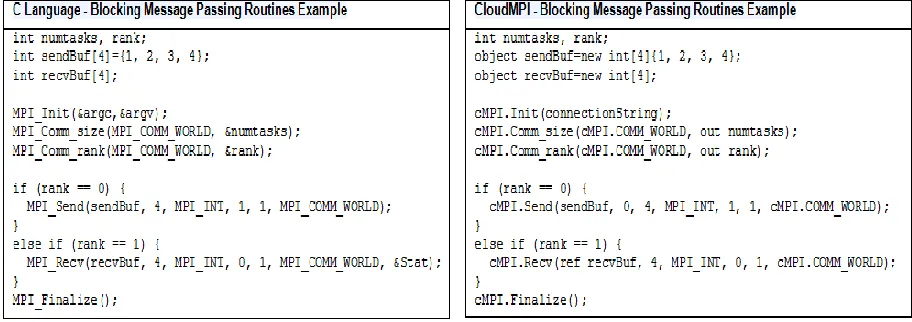
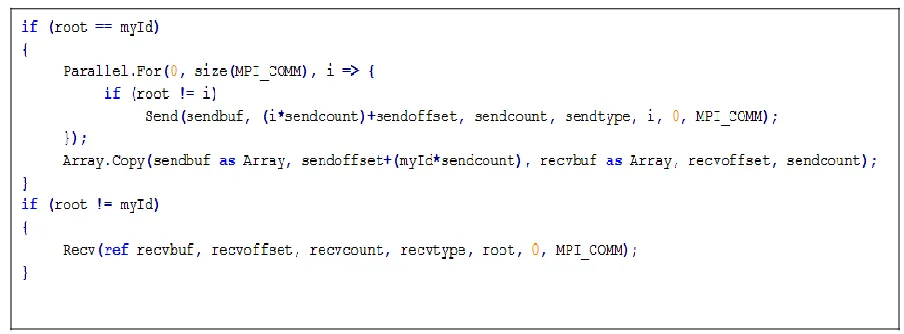
Figure 3.1 shows an MPI sample code in C and its equivalent code for cloudMPI. As
shown in this figure, the cloudMPI API is very similar to the C bindings of the conventional
MPI. cMPI.Init initializes a channel of communication and assigns a list of nodes to this channel.
One queue, dedicated to this channel, is created per node after the initialization. The need to
al-locate nodes to a channel allows users to broadcast a message to all of the nodes in a
communi-cator. This routine gets Azure storage string as input, which contains the necessary parameters
required to access developer storage account in the Windows Azure environment. The receive
buffer should be defined as object data type as shown in Fig. 3.1. cMPI.Finalize is used to
Figure 3.1Comparison of traditional MPI code with cloudMPI
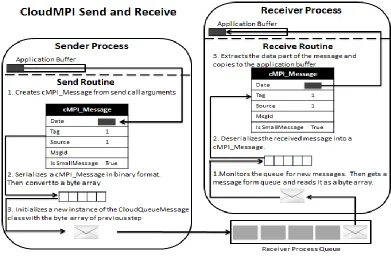
Figure 3.2 shows the send and receive mechanism between sender and receiver instances.
The send routine packs the data to be transferred as well as the other attributes in a message of
type cMPI Message. These attributes can be used to distinguish messages at the receiver
in-stance. Then the message is serialized to binary format and converted to byte array (Azure
queues can store messages of type string or byte array). Finally a CloudQueueMessage is created
from the byte array and sent to the receiver instance queue. On the other side, the receiver
rou-tine monitors its queue for new message. The new message is deserialized to an object of type
cMPI Message. Then the receiver instance can retrieve required information from the received
Figure 3.2 Send and receive mechanism in cloudMPI via Azure
3.2 Implementing MPI Collective Operations on Azure Cloud Platform
Broadcast: In the broadcast operation, a root node sends a message to all other nodes in
the communicator. cloudMPI supports three implementations of data broadcasting methods: 1)
using a combination of Azure queue storage and Azure blob storage; 2) using a combination of
Service Bus topic and Azure blob storage; 3) a hypercube-based broadcasting algorithm using
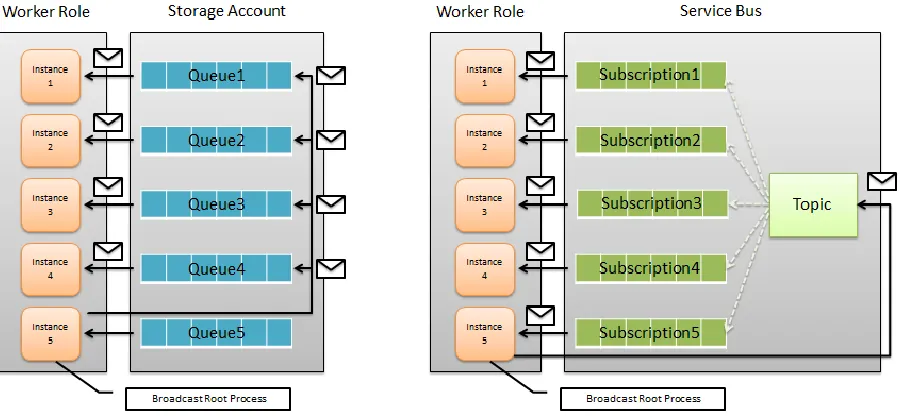
Azure storage services (queue and blob). The first approach uses the point-to-point send and
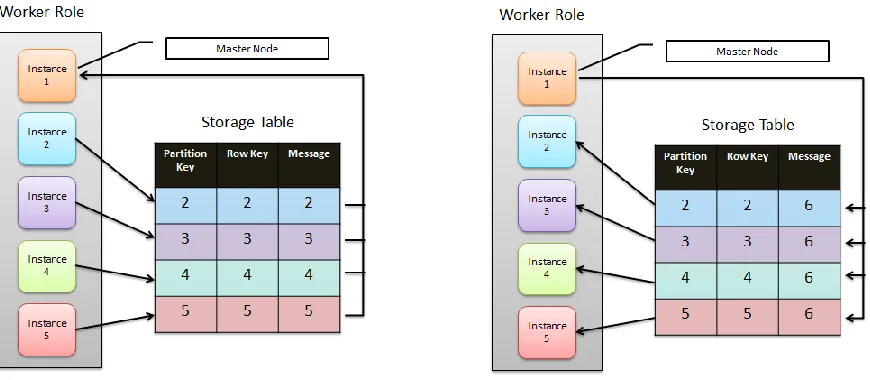
re-ceive operations to implement the broadcast operation following the scheme shown in Fig. 3.3
(left). The root node uses the send routine inside a loop to broadcast a message to all other nodes
in the communicator. Then, other nodes in the communicator get the message using the receive
routine. In the second approach, a Service bus topic is used to broadcast a message between the
communicator instances. All instances get subscribed to this topic inside the init routine. When a
communicator to be received. As the size of the message passes the maximum message size (i.e.
64 KB for storage queue and 256KB for Service Bus topic), the blob storage is used in both
methods to communicate the broadcast data and the queue and topic messages indicate the blob
[image:33.612.81.531.213.422.2]ID of the data stored in the blob storage.
Figure 3.3 Implementation of broadcast using storage queue (left) and Service Bus topic (right)
The third implementation is a hypercube-based broadcast algorithm that uses the storage
queue and blob service for data communication. In this communication scheme, the broadcast
operation is performed in multiple steps. At each step, a number of nodes act as the message
sender; and their neighbor nodes (in an imaginary hyper-cube arrangement) along a single
direc-tion of the hyper-cube act as the receiver nodes. In the beginning of the broadcast sequence, the
root node sends the message to one of its neighbors and the chain process of broadcast gets
initi-ated. As a result, in the nth time step, 2n nodes receive the message. In other words, for a
Figure 3.4 Broadcast naive implementation versus hypercube-based implementation
Scatter and Gather: In the scatter operation, a root node sends the segments of a
mes-sage of size m to different nodes, and in the gather operation, the root node receives the segments
of a message of size m from different nodes and stores them based on the order of the sending
nodes rank. In MPI gather/scatter operations, the length of the message received from or sent to
other nodes is the same for all nodes. The scatter and gather routines are implemented using the
point-to-point send and receive operations. To scatter a message between nodes of a
communica-tor, first, root node extracts N segments of the data from the send buffer and sends each segment
to the receive queue of the corresponding nodes so that node 1 gets the first segment, node 2 gets
the second segment, etc. Then, other nodes in the communicator will wait for the message from
the root processor. To gather a message from other nodes of a communicator, first, each node
except for the root node sends its data to the root node queue. Then, root node receives the data
from the queue and stores them in a local buffer based on the rank order. cloudMPI supports two
versions of the scatter method. The only difference between these two versions is that one uses
Service Bus queue; and the other, queue storage for communication. Similar to the broadcast
For the scatter routine, we also implemented a multi-threaded version of the scatter operation. In
[image:35.612.76.528.158.325.2]thisimplementation,threadsruninparalleltosendthemessagestootherinstances’queues.
Figure 3.5 Multi-threaded scatter operation
Barrier: This operation is used to synchronize operations in MPI nodes. This routine
blocks nodes until all the nodes within the communicator reach the synchronization point. We
use table storage to implement the barrier method in cloudMPI. All the instances in a
communi-cator insert an entity with a property equal to their ID to the barrier table when they reach the
synchronization point and then wait until the master node updates their property. A master node
inside the communicator monitors the barrier queue until it receives k entity messages, where k is
the number of instances in the communicator. After that, the master instance updates the property
of all the entities to the number of instances in the communicator. Therefore, other processors
Figure 3.6 Barrier operation implementation
Reduction (MPI_SUM): The reduction operations collect and reduce the values of the
send buffer of the different nodes to a single value. For the purpose of this thesis, only
MPI_SUM operation of the MPI reduction is implemented. This can be easily extended to other
reduction operations. The reduction routine is implemented using the point-to-point send and
receive operations. This operation is similar to the gather routine, and the only difference is that
the reduction operation computes the reduce operation over elements received from the gather
4 COMMUNICATION BENCHMARKS AND EVALUATION
4.1 Test Environment
In this section, we evaluate the performance of cloudMPI over the Microsoft Azure cloud
environment. In order to evaluate the communication performance of cloudMPI, we employ the
traditional messaging benchmarks for MPI [21]. Not only we convert these benchmarks for cloud
platform using cloudMPI framework, we also create a cluster of virtual machines running a
fla-vor of Linux operating system to run the original MPI benchmarks on barebone machines on the
cloud. Inbothplatforms,computenodesaresettobeAzure“small”virtualmachinewith
1.75GB of memory.
In order to setup our two-processor MPI virtual machine over the barebone cloud
infra-structure, a series of configuration steps are needed beyond installing Linux. These steps are
in-structive for the Azure environment, and hence briefly described below. Master and slave virtual
machines have to be created and configured properly. These configurations include installing
MPI, configuring network for each machine, loading and compiling the program on each node,
etc. We start with creating a master virtual machine with proper installation of the MPI. In our
experiments, we use openMPI, which is a popular implementation of the MPI standard. In order
to provide SSH connectivity with the slaves, a public/private key pair is generated and the SSH
configuration files are modified accordingly. The next step is to create a slave node. MPI
instal-lation steps should be performed on this machine as well. To provide the ability to connect to this
machine via SSH from the master node, the SSH server should be installed. The key pair
gener-ated in the master node is used here to setup the SSH connection. In this step, the program can be
To create the desired number of slave nodes, we first save an image of the currently
cre-ated slave node and then create multiple instances of this image using a shell script and the API
provided by the Azure platform. Since each slave instance that gets created this way has a
ran-dom port number for its SSH connectivity, we use additional shell API commands to query these
instances to get their SSH port numbers. These port numbers are then added to the master node’s
SSH configuration file. Furthermore, the host names supplied in the shell script to create slave
nodes are also used to create the MPI configuration file on the master node. MPI uses random
TCP port numbers. Therefore, it is difficult to establish the TCP/IP connection between master
and slave nodes as this type of communication between virtual machines is not supported by
simple Azure network. In order to overcome this problem a virtual network needs to be created
on the Azure platform and all the nodes needs to be added to this network. In order to load new
code on slave nodes, simple shell scripts can be used to load/compile the code remotely on slave
nodes.
4.2 Latency
A ping-pong latency test is often used to characterize the MPI communication
perfor-mance. The benchmarks measure the network latency between two compute nodes. Node 1 sends
a message to node 2, waits for node 2 to receive the message, and then receives a return message
from node 2.
For the cloudMPI-based implementation, the benchmarks perform the same operations as
for the network benchmarks, but the messages are not sent point to point. Instead, each message
is stored in the storage by the sender and the receiver receives the message by reading it from the
cloud storage. Thus, there is additional latency introduced in the system that could degrade the
Figure 4.1 Benchmarking MPI performance on Azure cloud environment for small messages
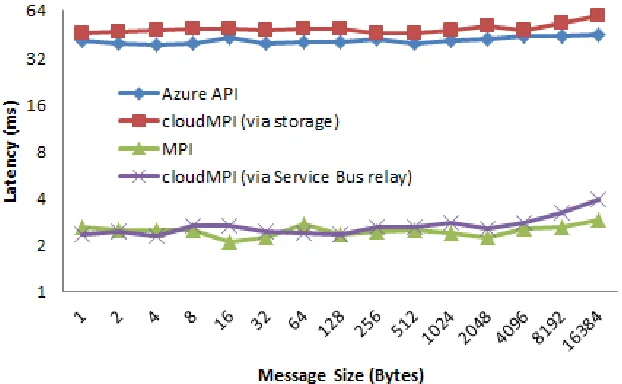
Figure 4.1 shows the benchmark results for short messages. The cloudMPI via Service
Bus relay and traditional MPI displays comparable performance in terms of communication
la-tency. Since these two methods do not have the additional overhead of reading and writing from
the cloud storage, their performance is superior to the other two methods. To improve the
per-formance for short messages (i.e., message size < 1,460 bytes) useNagleAlgorithm property was
turned off.
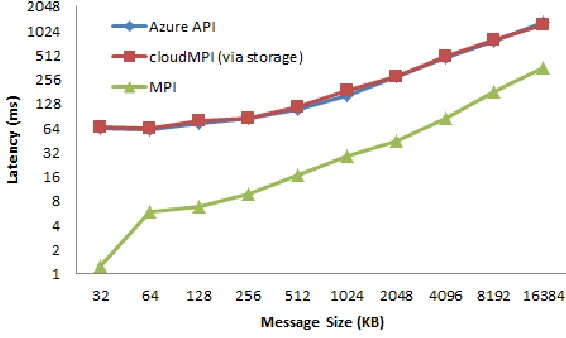
For communication by large messages, Service Bus relay cannot be used; therefore, as
shown in Fig. 4.2, for large messages, we are comparing the benchmark results for the Azure
cloud platform for two communication methods, namely MPI and cloudMPI. It is clear that
tradi-tional MPI benchmarks on the cluster of virtual machines outperform other implementations.
In-terestingly, while MPI performs up to 50× better than cloudMPI via storage for short messages,
the difference keeps reducing as the message size increases, finally reducing to a difference of
of message sizes cloudMPI can be reasonably competitive with traditional MPI while providing
[image:40.612.165.448.160.329.2]the convenience, reliability, and massive scalability of the cloud platform.
Figure 4.2 Benchmarking MPI performance on Azure cloud environment for large messages
4.3 Performance of Collective Algorithms
We executed the performance tests using our benchmark code on the implementation of
barrier, broadcast, and scatter collective operations using cloudMPI and MPI on the cloud
clus-ters. We then analyzed the performance results and the optimal implementation of various
collec-tive operations.
4.3.1 Barrier Performance
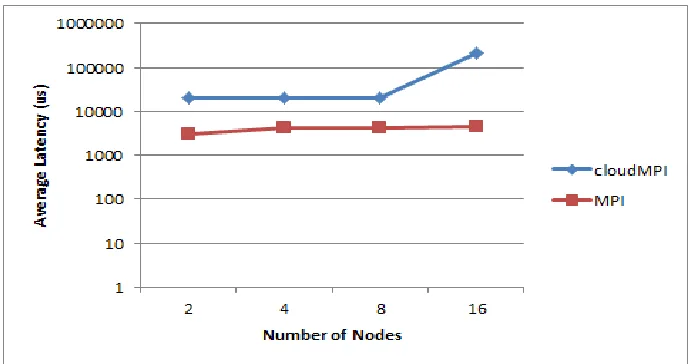
The benchmark measures the average time to complete a barrier routine repeated for
100,000 times. We run this benchmark on a cluster with 16 single-core nodes (i.e., Azure small
nodes). As shown in Fig. 4.3, the benchmark results demonstrate significant performance gap on
increases. The average latency of barrier operation for MPI is almost 49 times as fast as the
cloudMPI for a cluster with 16 nodes. When the number of compute nodes is small, the
[image:41.612.133.480.180.362.2]perfor-mance gap is smaller but still significant.
Figure 4.3 . Benchmarking performance of barrier operation on Azure cloud envi-ronment
4.3.2 Broadcast and Scatter Performance
Broadcast and scatter benchmarks measure the completion time of the routine averaged
over all the compute nodes in the communicator (including both the sender and receivers). We
compare the performance of the cloudMPIwith that of the traditional MPI. For both scatter and
broadcast operations, the result of benchmarks indicates that the traditional MPI outperforms
cloudMPI implementations for messages with small size. As the message size increases, the
per-formance gap between cloudMPI and MPI significantly shrinks. Experimental results for
cloud-MPI scatter operation indicate the implementation based on queue storage is faster than the
im-plementation based on Service Bus queue. For broadcast operation with node sizes of 2 and 4,
broadcast operation on 8 nodes — withlargeenoughmessages(i.e.,messagesize≥524,288
bytes) — performs faster for the implementation based on Service Bus topic compared to the one
[image:42.612.109.499.173.671.2]using queue storage.
Figure 4.5 Benchmarking performance of scatter operation on Azure cloud envi-ronment
Figure 4.6 shows the results of our benchmark test for the scatter operation and compares
Figure 4.6 Comparing the performance of scatter operation for MPI and cloudMPI
Figure 4.7 compares the performance of the naïve implementation of cloudMPI broadcast
(i.e., one sender broadcast the message to every other node in the communicator) with its
hypecube-based counterpart.
Figure 4.7 Performance of broadcast naïve operation and its hypercube-based coun-terpart
Finally, as shown in Fig. 4.8, we compare the effectiveness of the multi-thread
Azure platform for its compute nodes — with the simple serial implementation. In the
multi-thread version, root process uses multiple multi-threads to send messages to the queues of other
pro-cesses, simultaneously. As seen in Fig. 4.8, the multi-thread implementation outperforms the
se-rial code by a factor of 1.3 for the message size of 1,048,576 bytes and as the size of the message
grows, the disparity between the performances of these two implementations becomes more
[image:45.612.73.535.235.412.2]ap-parent.
5 PERFORMANCE OF APPLICATIONS ON THE CLOUD
We analyze the performance implications of cloudMPI for parallel and distributed
appli-cations traditionally implemented using MPI. Specifically, we are trying to understand 1) how
applications with different communication-to-computation ratios perform using cloudMPI
com-pared to MPI and 2) the steps required to map a traditional MPI implementation to the cloudMPI
implementation. To reach our goal, we run our test applications with two different setups: 1)
us-ing cloudMPI framework on the Azure worker roles, 2) usus-ing traditional MPI on the bare-bone
Azure Linux virtual machines configured as a conventional cluster. In both cloud platforms,
computenodesaresettobeAzure“small”virtualmachines,with1.75GBofmemory.
For our evaluations, we select two MPI applications with different communication and
computation requirements, namely, 1) the N-Body particle simulation [22]
and2)Cannon’smul-tiplication algorithm [23, 24].
5.1 N-Body Particle Simulation
The N-Body problem determines the motion of particles over time based on the effect of
the forces from other particles. This problem has applications in astrophysics, molecular
dynam-ics, etc. The simulation of this problem is computationally expensive for large N-body systems,
which can be sped up by distributing the computationally intensive tasks to multiple compute
nodes.
For this experiment, we have used the sample code presented in Ref. [25]. The algorithm
used in this experiment implements the following steps to calculate the particle position and
ve-locity at each time step: 1) update positions using velocities, 2) calculate forces, and 3) update
velocities. Table 5.1 shows the MPI code in C and its equivalent cloudMPI code. As shown in
the MPI application to cloudMPI is basically a matter of converting C/C++ code to C# and
find-ing the equivalent syntax for some keywords (such as readfind-ing from standard input and writfind-ing to
standard output) in the Windows Azure environment. We also convert MPI calls to the
equiva-lent calls in cloudMPI. This can be easily achieved using an equivalence table for the
func-tion/method calls of MPI and cloudMPI.
Table 5.1 Comparison of N-Body MPI code with cloudMPI Set up environment
MPI:
int n_proc, rank;
MPI_Init( &argc, &argv );
MPI_Comm_size( MPI_COMM_WORLD, &n_proc );
MPI_Comm_rank( MPI_COMM_WORLD, &rank );
cloudMPI:
int n_proc, rank;
cMPI.Init(connectionString);
cMPI.Comm_size(cMPI.COMM_WORLD, out n_proc);
cMPI.Comm_rank(cMPI.COMM_WORLD, out rank);
Set up the data partitioning across processors MPI:
int particle_per_proc = (n + n_proc - 1) / n_proc;
int *partition_offsets = (int*) malloc( (n_proc+1) * sizeof(int) );
for( int i = 0; i < n_proc+1; i++ )
partition_offsets[i] = min( i * particle_per_proc, n );
int *partition_sizes = (int*) malloc( n_proc * sizeof(int) );
for( int i = 0; i < n_proc; i++ )
partition_sizes[i] = partition_offsets[i+1] - partition_offsets[i];
cloudMPI:
int particle_per_proc = (n + n_proc - 1) / n_proc;
int[] partition_offsets = new int[(n_proc + 1)];
for (int i = 0; i < n_proc + 1; i++)
partition_offsets[i] = Math.Min(i * particle_per_proc, n);
int[] partition_sizes = new int[n_proc];
for (int i = 0; i < n_proc; i++)
[image:47.612.65.547.231.689.2]Allocate storage for local partition MPI:
int nlocal = partition_sizes[rank];
particle_t *local = (particle_t*) malloc( nlocal * sizeof(particle_t) );
cloudMPI:
int nlocal = partition_sizes[rank];
Particle[] local = new Particle[n];
Initialize and distribute the particles MPI:
set_size( n );
if( rank == 0 )
init_particles( n, particles );
MPI_Scatterv( particles, partition_sizes, partition_offsets, PARTICLE, local,
nlocal, PARTICLE, 0, MPI_COMM_WORLD );
MPI_Allgatherv( local, nlocal, PARTICLE, particles, partition_sizes,
parti-tion_offsets, PARTICLE, MPI_COMM_WORLD );
cloudMPI:
set_size(n);
if (rank == 0)
init_particles(n, particles);
cMPI.scatterv(particles, 0, partition_sizes, partition_offsets, ref local, 0,
nlocal, 0, cMPI.COMM_WORLD);
cMPI.AllGatherv(local, 0, nlocal, ref particles, 0, partition_sizes,
Simulate a number of time steps MPI:
for( int step = 0; step < NSTEPS; step++ )
{
// compute all forces
for( int i = 0; i < nlocal; i++ )
{
local[i].ax = local[i].ay = 0;
for (int j = 0; j < n; j++ )
apply_force( local[i], particles[j] );
}
// move particles
for( int i = 0; i < nlocal; i++ )
move( local[i] );
// collect all global data locally (not good idea to do)
MPI_Allgatherv( local, nlocal, PARTICLE, particles, partition_sizes,
par-tition_offsets, PARTICLE, MPI_COMM_WORLD );
// save current step if necessary
if( fsave && (step%SAVEFREQ) == 0 )
save( fsave, n, particles );
}
cloudMPI:
for (int step = 0; step < Constants.NSTEPS; step++)
{
// compute all forces
for (int i = 0; i < nlocal; i++)
{
local[i].ax = local[i].ay = 0;
for (int j = 0; j < n; j++)
apply_force(local[i], particles[j]);
}
// move particles
for (int i = 0; i < nlocal; i++)
move(local[i]);
// collect all global data locally (not good idea to do)
cMPI.AllGatherv(local,0, nlocal, ref particles,0, partition_sizes,
parti-tion_offsets, cMPI.COMM_WORLD);
// save current step if necessary
if ((step % SAVEFREQ) == 0)
save(sw, n, particles);
The simulation results for both platforms (i.e., MPI and cloudMPI) with different number
of particles and different number of nodes are shown in Figs. 5.1 and 5.2. In this application, the
cloudMPI implementation uses the Service Bus queue and the Service Bus topic for small
mes-sages and falls back to the blob storage for large mesmes-sages (> 256kB). It should be noted that for
the node size of 1, we use a serial implementation of the problem for the both MPI and cloudMPI
cases and no message-passing mechanism is used. Therefore, comparison of the performance of
our code for the single-node case provides a measure of the performance of the hardware used in
each node. It can be seen from Figs. 5.1 and 5.2 that the Windows Azure small node (used in the
cloudMPI implementation) outperforms the Linux virtual machine small node provided by the
Azure platform. This observation is in agreement with previous reports [26]. Therefore, in our
comparisons for the multi-node cases, we should be aware of this performance disparity between
the two types of the nodes (i.e., Windows worker roles and Linux VMs) and draw our
[image:50.612.168.479.458.639.2]conclu-sions regarding the performance of the MPI and cloudMPI with this disparity in mind.
Figure 5.2 Performance of N-Body simulation for 40,000 and 50,000 particles
The algorithm for the N-Body simulation computes all the interactions of N particles on p
compute nodes in a load-balanced fashion (i.e., each node performs the computations for N/p
particles). Each compute node performs O(N2/p) force evaluations in each time step, whereas the
communication scales linearly with N [O(N)] for each compute node. As shown in Fig. 5.1,
cloudMPI outperforms MPI for small number of nodes (e.g., < 4 nodes) as the computation time
overtakes the communication time. Figure 5.3 shows the performance of the two
implementa-tions with respect to the number of particles for a fixed number of nodes. As seen in this figure,
as the computation to communication ratio increases for sufficiently large N, the cloudMPI
Figure 5.3 Performance of N-Body simulation on 8 nodes
5.2 Cannon’s Multiplication Algorithm
Cannon’s algorithm distributes square submatrices of size n/p of original two n×n
matri-ces A and B among the p compute nodes. These submatrices are aligned to compute nodes in a
way that the corresponding square submatrices (from matrices A and B) at each compute node
can be multiplied together locally. The compute nodes are organized in a mesh arrangement, and
in each iteration, each compute node shifts its current submatrix of A to its left neighbor compute
node and its current submatix of B to the upper neighbor compute node. This shifting operation
is performed circularly for the leftmost and the topmost nodes in the mesh. Following this step,
each node multiplies the new submatrices and adds it to a result matrix. Therefore, each compute
node spends O(n3/p) time on the computation step (i.e., multiplication of local submatrices) and
O(n2/ ) on the communication step (i.e., shifting the submatrices to the neighbor nodes).
We run the cloudMPI implementation of the algorithm for clusters of up to 16 worker role nodes.
Figure 5.4 cloudMPI performance for a 4800×4800 matrix
Figure 5.5 compares the performance of algorithm for cloudMPI and MPI for different
matrix sizes on a cluster with 9 nodes (Azure worker roles for the cloudMPI and Linux VMs for
the MPI). In this experiment, cloudMPI implementation uses the Service Bus queue for its
com-munication step. As expected, higher computation to comcom-munication ratios results in better
per-formance for the cloudMPI implementation.
As we discussed earlier, the Windows environment of Azure platform outperforms its
Linux VMs. Taking this fact into consideration, two conclusions can be made based on the
re-sultsofourexperiments.First,weconcludethattheapplications’communicationintensityis
correlated with the performance gap between the cloudMPI and MPI and the MPI
implementa-tion outperforms the cloudMPI implementaimplementa-tion as the communicaimplementa-tion intensity of the algorithm
increases. Second, we conclude that for the applications with higher computation intensity
cloudMPI implementation performance is comparable to and in certain cases better than the
per-formance of the MPI implementation. Therefore, despite lower bandwidth of the cloud
environ-ment, cloudMPI can be used to implement CPU intensive applications and provide the