Issues and Problems Affecting the Implimentation and Effectiveness of
Heritage Buildings Maintenance
1
Mohammad Ashraf Abdul Rahman, 2 Zainal Abidin Akasah, 3 Mohd Sufyan Abdullah, 4 Mohd Kamaruzaman Musa
1, 3
Jabatan Kejuruteraan Pembinaan dan Senibina, Fakulti Kejuruteraan Awam dan Alam Sekitar, Universiti Tun Hussein Onn Malaysia,
86400 Parit Raja, Batu Pahat, Johor.
2, 4
Jabatan Teknologi Kejuruteraan Awam, Fakulti Kejuruteraan Awam dan Alam Sekitar, Universiti Tun Hussein Onn Malaysia,
86400 Parit Raja, Batu Pahat, Johor.
1
Abstract
Maintenance is one of the heritage management strategy aims to provide protection to the importance and usability of the heritage buildings. Maintenance is also become an important approach in ensuring the building and its contents to operate and function properly. However, based on previous studies, maintenance is always been neglected and not become the main activity in managing and protecting of this valuable and non replaceable asset. Therefore, the main objective of this study is to identify issues and problems affecting the implementation of maintenance in dealing with heritage buildings in Malaysia. Through the literature review and a pilot study, a number of issues and problems have been identified involving financial, spare parts, technical problems, human behaviour and attitudes, management and administration and education and training. A total of 63 respondents from various professional areas including building managers, industry practitioners and academicians have been involved in completing the questionnaires. The findings conclude that the identified issues and problems affecting the implementation and effectiveness of the maintenance of heritage buildings.
Keywords:Building maintenance, Heritage buildings, Heritage management, issues and problems
1.0 Introduction
The enforcement of National Heritage Act 2005 has changed the landscape of national heritage, particularly in the development of preservation and conservation of buildings. This can be seen with increasing number of old buildings that have been restored and are listed as national heritage (Robiah and Ghafar, 2010) while the some others has been restored and reuse for various purposes (Lilawati, Ghafar and Badaruddin, 2008).
Results of these changes have significantly increasing the demands of maintenance work in order to ensure the survival and functionality of the buildings. Through proactive maintenance, cultural values can be maintained while the originality and authenticity of the fabric will be retained (Maintain our Heritage, 2004).According to Amir Fasha (2010) proactive maintenance is not only important to meet the maintenance function of a building but also can preserve the uniqueness of the heritage building from the passage of time lapse. Thereby, the maintenance is the key to good conservation practice (British Standard Institution, 1998; Worthing et. al., 2002).
Shahril Bazlin (2004) states that failure to implement a good maintenance practices have been influenced by a number of significant issues and problems. According to Funso Falade (2006), these issues and problems has become a global phenomenon faced by most developing countries including Malaysia. This phenomenon, if uncontrolled, can cause potential losses to the heritage industry.
Thus, for a start, this study aims to identify issues and problems affecting the implementation of practicable heritage building maintenance in Malaysia.
2.0 Issues and problems influencing the maintenance implementation
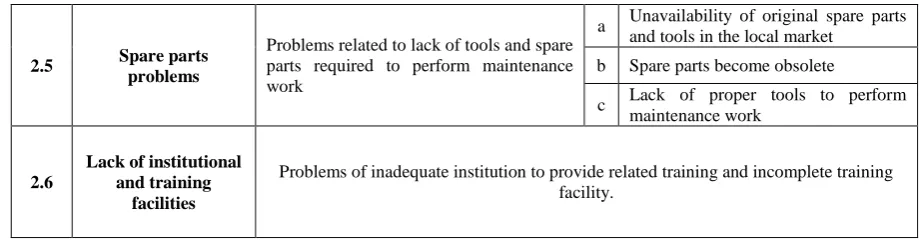
Based on the literature review and findings of the pilot test, 24 problems were identified. These problems have been categorized into six major classes of technical problems, management and administration, financial problems human-related problems, spare parts problems and lack of institutional and training facilities.
Further information on these categories and their related problem are described below:
Category Category description Detailed Problems
2.1 Technical problems
Problem associated with the technical aspects of conservation from the beginning to the end of the building life.
a Not considering a maintainability analysis
b Not using Life Cycle Cost (LCC) technique
c Usage of new material instead of original material
d Usage of sub-standard materials
e Poor quality control
f Unavailability or poorly written operation and maintenance manual
g As built documents not reflecting actual status of building works h Data feedback about maintenance
2.2
Management and administration
problems
Problems associated with management, planning, organization, performance and execution of maintenance task
a Poor management
b Method of classification of maintenance contractors
c Lack of uniform specifications and codes
d Lack of uniform maintenance contract
e Shortage of maintenance contract period
f
Lack of coordination between management groups and technical groups
g Non use of facilities after completion
2.3 Financial problems Problem associated with the budgeting control that aims to plan and control the use of resources to achieve the desired objectives
2.4 Human behaviour and attitudes
Problems related to weaknesses and human error as the experience of the workforce and their attitudes to understand the maintenance work
a Unavailability of experienced and skilled manpower
b Lack of number of specialized experienced maintenance contractors
c Importance of maintenance work not understood by public
2.5 Spare parts problems
Problems related to lack of tools and spare parts required to perform maintenance work
a Unavailability of original spare parts and tools in the local market
b Spare parts become obsolete
c Lack of proper tools to perform maintenance work
2.6
Lack of institutional and training
facilities
[image:3.595.61.521.70.191.2]Problems of inadequate institution to provide related training and incomplete training facility.
Table 1: Problem categories and details
3.0 Research survey
Taking into account the problems discussed above, a survey involving 63 professionals in the field of heritage management which includes of building managers (Nos = 8), industry practitioners (Nos = 36) and academics (Nos = 19) have been conducted to measure the evaluation of the relative importance of each of the above problems. A pilot study was initially carried out to verify the validity of the developed questionnaire on representatives of the building managers (Nos = 2), industry practitioners (Nos = 2) and academics (Nos = 2). The value obtained from Alpha Cronbach Reliability Test is 0.8739 which demonstrate significantly high.
3.1 Results of survey
Based on the response of the questionnaire, an importance index has been calculated to reflect the level of importance of these factors. The index was calculated as follows;
Importance index (I) =
Importance index (I) = ---
where;
ai = constant specifies the weight assigned to i xi = variables that specify the frequency of i,
The responses for importance index (I) are categorized as;
0% to 20% were categorized as “not important” 20% to 40% were categorized as “less important”
40% to 60 % were categorized as “moderately importance” 60% to 80% were categorized as “important”
80% to 100% were categorized as “very important”
4∑ xi
ai xi
X 100% 1 = 0
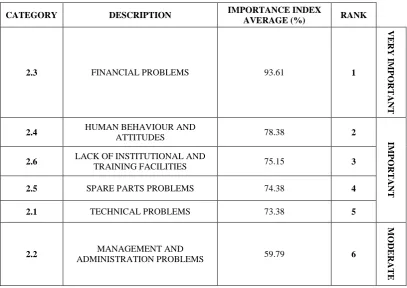
Based on the importance index (I) calculation, the factors listed were arranged in order according to the importance rank. The importance index of each category is a result of average of all its related problems. The results are shown in Table 2 for the categories for detailed problems.
Table 2: The importance index of each category
CATEGORY DESCRIPTION IMPORTANCE INDEX
AVERAGE (%) RANK
2.3 FINANCIAL PROBLEMS 93.61 1
VER
Y IMP
O
RTA
NT
2.4 HUMAN BEHAVIOUR AND
ATTITUDES 78.38 2 IMPOR
TAN
T
2.6 LACK OF INSTITUTIONAL AND
TRAINING FACILITIES 75.15 3
2.5 SPARE PARTS PROBLEMS 74.38 4
2.1 TECHNICAL PROBLEMS 73.38 5
2.2 MANAGEMENT AND
ADMINISTRATION PROBLEMS 59.79 6
MOD
ERA
TE
3.2 Results discussion
The analysis as presented in Table 2 for the categories problems showed the following conclusions;
a. This research has identified a total of 24 issues and problems affecting the implementation of maintenance work of Malaysians’ heritage buildings. The issues and problems then have been classified into 6 main categories of technical problems, management and administrative problems, financial problems, human behaviour and attitude problems, spare parts problems and lack of institutional and training facilities.
b. Of the six main categories, the financial problems were ranked as very important, while management and administrative problems ranked as moderately important. The rest of the categories are ranked as important.
c. These problems are the matter to be considered in efforts to improve future maintenance works and any efforts towards the improvement need to be done urgently.
4.0 Conclusions
5.0 Acknowledgement
Highest acknowledgement to Universiti Tun Hussein Onn Malaysia (UTHM), fellow researcher and those who are involve direct or indirectly in the complement of this study.
6.0 References
[1] Amir Fasha (2010), Pendekatan Penyenggaraan Bangunan Bersejarah, Pemuliharaan Bangunan Bersejarah, UPENA, Shah Alam
[2] British Standards Institution (1998), BS 7913:1998: Guide to the Principles of the Conservation of Historic Buildings, British Standards Institution, London.
[3]Alan M. Forster, Brit Kayan, (2009) "Maintenance for historic buildings: a current perspective", Structural Survey, Vol. 27 Iss: 3, pp.210 – 229
[4]Funso Falade (2006). Engineering and Globalisation in Developing Countries: Nigeria a Case Study, Proceedings of the 3rd African Regional Conference on Engineering Education, 26-27 September 2006, University of Pretoria, Pretoria, South Africa
[5] Lilawati Ab Wahab, A. Ghafar Ahmad and Badaruddin Mohamed (2008) Penyesuaigunaan Semula Bangunan Bersejarah Sebagai Hotel Bagi Menyokong Industri Pelancongan Warisan Negara. Proceedings of 7th. Annual Conference Management In Construction Researchers' Association (MICRA), 18-19th. June 2008, Kulliyyah of Architecture & Environmental Design, International Islamic University Malaysia (IIUM)
[6] Maintain Our Heritage (2004), Putting it off: How lack of Maintenance Fails our Heritage, Maintain our Heritage, Bath.
[7] Mohammad Ashraf, Zainal Abidin Akasah (2010), Built Heritage: Maintenance Matter, World Engineering Congress 2010, 2nd – 5th August 2010, Kuching, Sarawak, Malaysia, Conference on Engineering and Technology Education [8] Robiah and Ghafar (2010), Pendekatan Penyelenggaraan Bangunan Warisan di Malaysia, International Conference on
Preservation and Promotion of Heritage, 24-26 November 2010, Universiti Sains Malaysia, Pulau Pinang.
[9] Shahril Bazlin (2004), Pengurusan Penyenggaraan Bangunan – Kajian Kolej Rahman Putra Universiti Teknologi Malaysia, Universiti Teknologi Malaysia