Terms and Conditions of Use of Digitised Theses from Trinity College Library Dublin Copyright statement
All material supplied by Trinity College Library is protected by copyright (under the Copyright and Related Rights Act, 2000 as amended) and other relevant Intellectual Property Rights. By accessing and using a Digitised Thesis from Trinity College Library you acknowledge that all Intellectual Property Rights in any Works supplied are the sole and exclusive property of the copyright and/or other IPR holder. Specific copyright holders may not be explicitly identified. Use of materials from other sources within a thesis should not be construed as a claim over them.
A non-exclusive, non-transferable licence is hereby granted to those using or reproducing, in whole or in part, the material for valid purposes, providing the copyright owners are acknowledged using the normal conventions. Where specific permission to use material is required, this is identified and such permission must be sought from the copyright holder or agency cited.
Liability statement
By using a Digitised Thesis, I accept that Trinity College Dublin bears no legal responsibility for the accuracy, legality or comprehensiveness of materials contained within the thesis, and that Trinity College Dublin accepts no liability for indirect, consequential, or incidental, damages or losses arising from use of the thesis for whatever reason. Information located in a thesis may be subject to specific use constraints, details of which may not be explicitly described. It is the responsibility of potential and actual users to be aware of such constraints and to abide by them. By making use of material from a digitised thesis, you accept these copyright and disclaimer provisions. Where it is brought to the attention of Trinity College Library that there may be a breach of copyright or other restraint, it is the policy to withdraw or take down access to a thesis while the issue is being resolved.
Access Agreement
By using a Digitised Thesis from Trinity College Library you are bound by the following Terms & Conditions. Please read them carefully.
Trinity College Library Dublin
University of Dublin
Sligo 1921-23
The Aftermath of Revolution.
Michael Farry.
Submitted for the Degree of Doctor of Philosophy
at Trinity College, Dublin.
Department of Modem History.
This thesis has not been submitted as an exercise
for a degree at this or any other university
and is entirely my own work.
I agree that the university library may lend or copy this thesis on request.
...
ACKNOWLEDGEMENTS.
This study would never have been completed were it not for the help and encouragement
of many people who encouraged my interest in the topic and helped convince me that it
was possible to bring this thesis to completion.
In the first place I wish to express my gratitude to those Sligo veterans listed in the
bibliography and for their hospitality when approached, often with no prior warning. I
want to thank them for sharing their experiences with me and in some cases entrusting me
with valuable material. I also want to thank all those too numerous to mention who assisted
me in locating veterans and those relations of activists who gave me access to statements
and family papers.
I am grateful to the efficient staffs of the National Library, the National Archives, the
Military Archives, UCD Archives, the Valuation Office, the Representative Church Body
Library, the Grand Lodge of Freemasons Archive, the Institute of Celtic Studies and
Historical Research, the Garda Museum, Sligo County Library, Sligo Town Hall, the
Public Records Office, London. I wish to thank particularly the principals and Boards of
Management of the primary schools who allowed me access to their records.
I wish to thank Cecil Kilpatrick, the archivist of the Orange Order, who found
valuable information about that body in Sligo and Revd. Ian Henderson, Sligo, who sent
me detailed figures of Methodist numbers in Sligo at the relevant period. Peter Young and
Victor Laing of the Military Archives, Seamus Helferty of UCD Archives and John
McTernan, now retired, of Sligo County Library were especially assiduous in ensuring that
I had not overlooked any relevant material.
Present and former students, Fergus Campbell, Joost Augusteijn, Ferghal McGarry,
Tom Crean, Jane Leonard, Peter Hart and others gave essential help at critical times. Joe
Molloy helped when technical difficulties threatened to disrupt schedules. My brothers and
sisters, my close friends, my fellow teachers all deserve thanks for their unfailing interest
in my studies and encouragement to complete this work.
My supervisor, Dr. David Fitzpatrick, has been an unfailing source of support,
criticism and pertinent advice. His obvious belief that I could complete the study when my
own belief often wavered was the source of immense assistance and reassurance.
My wife Winifred, and children Fiona, Oisin, Sinead and Aisling have been unfailing
SUMMARY.
This thesis examines the 1921-23 period in County Sligo using a range of
contemporary sources. It first analyses the extent to which the county was politically and
militarily active during the War of Independence and concludes that Sligo’s contribution
was much less than counties studied by Hart, Fitzpatrick and Augusteijn.
It then examines the pre-Treaty and post-Treaty period chronologically and charts
the rise in the power and influence of the IRA and the tensions caused by this within the
county. In Local Government in particular there were bitter divisions which involved IRA
councillors allying themselves with vested local interests and attempting to control Sligo’s
local authorities. This split mirrored to a large degree the Treaty split. The escalation of
violence is also dealt with and the good showing of the anti-Treaty candidates in East
Mayo - Sligo constituency in the Pact election is demonstrated to have been a factor of the
geographical distribution of the candidates.
The course of the Civil War is dealt with in four different phases and the
effectiveness of the anti-Treaty side is shown to have been hampered by old animosities,
poor tactics and lack of co-ordinated action. Poor organisation and morale, and difficulties
with supplies, transport and numbers are shown to have been the reasons why the
government forces were unable to comprehensively defeat the opposition in County Sligo.
Six thematic chapters follow the first of which shows the degree to which the
physical and economic geography, of the county affected the course and conduct of the
war. Military incidents were most common in and near towns and communication
corridors. Fewer recruits for both sides came from the poorer areas of the county but the
distribution of anti-Treaty internees and pro-government army recruits was similar over the
whole county. The backgrounds of almost six hundred Sligo-born participants in the war,
anti-Treaty internees and government soldiers, when fully analysed showed that social
background was not a determining factor in the side taken.
Sligo suffered more during the Civil War than it did during the War of
Independence. A dramatic fall in the numbers of social and sporting functions testifies to a
period in which normal daily life was circumscribed country areas suffering to a greater
degree than did the town of Sligo. In particular the deterioration of the transport
infrastructure through destruction and lack of repairs imposed considerable hardship. The
of war. The turnover of most of Sligo’s co-operative creamery societies in 1923 was lower
than in 1922.
The confusion of the post-Treaty period as regards law and order and the rise of
factional strife led to a rise in lawlessness in early 1922 with petty crime, hooliganism and
robbery intermingling with agrarian agitation, intimidation of Protestants, attacks on
ex-RIC and politically motivated crime. For most of the period large areas of the county were
without effective law and order and the areas nominally under control by the government
forces seem to have suffered most.
CONTENTS.
Tables, Graphs and Maps.
Abbreviations.
i
iii
1"
INTRODUCTION.
COUNTY SLIGO 1914-1921.
1
9
2".
TRUCE AND TREATY.
The Position of the IRA.
Reactions to the Signing of the Treaty.
Arguments for and against the Treaty.
Conclusion.
37
37
48
56
62
3"
FROM TREATY TO CIVIL WAR.
January - May 1922.
The Election Campaign.
The Collins - de Valera Pact.
Analysis of the Election Results.
Conclusion.
64
65
73
84
92
96
4"
THE COURSE OF THE CIVIL WAR.
July 1922.
August- October 1922.
November 1922- January 1923.
January - June 1923.
Conclusion.
98
98
103
114
119
124
LOCAL GOVERNMENT DIVISIONS 1920-1923.
May 1920- June 1921.
Dismissal of Frank Jinks.
Amalgamation of Poor Law Unions.
126
126
132
IRA Interference in Local Government.
December 1921 - June 1922.
July 1922 - June 1923.
Conclusion.
141
146
149
155
6" THE GEOGRAPHY OF THE CIVIL WAR IN CO. SLIGO.
Distribution of Civil War Incidents.
Civil War and War of Independence Incidents Compared.
Civil War and Agrarian Incidents Compared.
Distribution of Civil War activists.
Comparison of Five Areas of the County.
Conclusion. 157 159 165 167 168 176 179
7" INDIVIDUAL COUNTY SLIGO PARTICIPANTS.
The Social Dimension of the Civil War.
Occupations of Fathers of Participants.
Land Valuation.
House Class and Valuation.
Ages of Participants.
Officers and Rank and File.
Conclusion. 187 187 192 195 198 201 205 207
8" DAILY LIFE DURING THE CIVIL WAR.
Communications.
Social and Sporting Events.
Sporting Activity.
School Attendance.
Food Prices.
Industrial Unrest.
Agricultural Prices.
Co-operative Creamery Societies.
9" LAW AND ORDER.
The Truce Period.
The post-Treaty Period.
Courts.
The Civil War Period.
Conclusion.
247
247
255
260
265
273
10: SLIGO PROTESTANTS AFTER THE REVOLUTION.
The Protestants of County Sligo.
Protestant Social Organisations.
1916-1922: A Succession of Disappointments.
Protestants as Victims.
The Decline in the Protestant Population.
Conclusion.
CONCLUSION.
APPENDIX: OCCUPATION CLASSES.
274
275
280
283
288
299
306
307
313
TABLES, GRAPHS AND MAPS. Tables: 3.1 5.1 6.1 7.1 7.2 7.3 7.4 7.5 7.6 7.7 7.8 7.9 7.10 7.11 7.12 7.13 8.1 8.2 8.3 10.1 Page 1922 General Election. Sligo - Mayo East constituency. Transfer of votes. 95
Sligo County Council: Voting patterns. 148
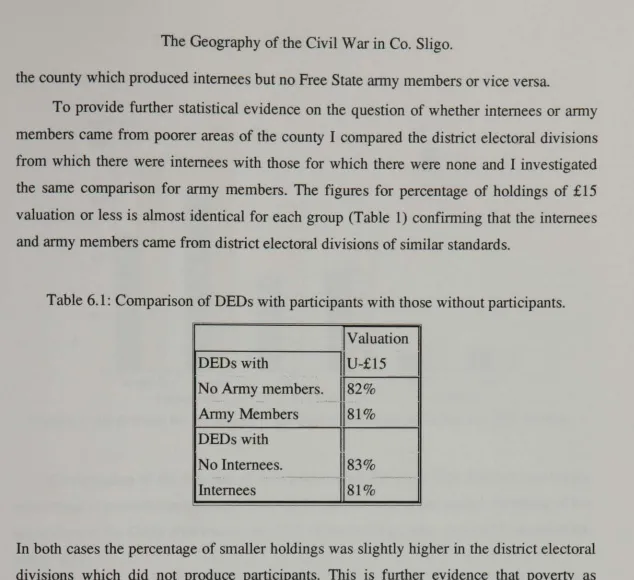
Comparison of DEDs with participants with those without participants. 173
Occupations of fathers of Sligo participants. 193
Occupations of fathers of participants from Sligo urban area. 195 Valuation of land holdings of families of Sligo participants whose
parents were farmers. 196
Participants whose parents rived on holdings of £15 or under compared to the
total percentage of holdings of £15 or under in each of the five areas of Sligo. 197 Family house class (1911 Census) of Sligo participants. 199
Family house valuations of Sligo participants. 199 Family house valuations of Sligo urban participants. 199
Ages of Sligo participants. 202
Position of Sligo participants in family. 204
Position of Sligo participants in farming families. 205
Age of rank and file and officers of the Free State army from Sligo. 206 Occupations of rank and file and officers of the Free State army from Sligo. 206 Valuation of land holdings of rank and file and officers of the Free State army
from Sligo. 207
Comparison of the number of social and sporting events held in County Sligo
during four periods 1921 - 23. 217
Percentage attendance at three County Sligo schools for the period
September 1921 to July 1923. 227
Business figures for Meehan Bros., Drapers, Sligo. 233
Decrease in the non-Catholic population of each of the counties
of Connacht, 1911 - 26. 299
Graphs: 6.1 6.3 6.4 8.1 8.2 8.3 8.4 8.5 8.6 8.7 8.8 10.1 10.2
Areas where the percentage of holdings of £15 or less was 80% or more. 174
Comparison of five areas of County Sligo by area. 178 Comparison of five areas of County Sligo by category. 178
Social and sporting events in County Sligo, August 1921 - June 1923. 216
The number of events in Sligo town as against the rest of the county 1921-3. 221 UK Retail Price Index, July 1921 - July 1923. 230
Index of prices in the Irish Free State, March 11922 - July 1923. 230 The prices of four commodities in Coolaney, 1922-23. 232
Livestock prices per quarter in Ireland and in Connacht, June 1921 - June 1923.237 Number of animals exported from Sligo and from Ireland during each
three months from March 1921 to March 1923. 240 Turnover of seven co-operative creamery societies in County Sligo
for the years 1921, 1922 & 1923. 242
Percentage of Catholic and non-Catholic farmers in County Sligo in 1926. 278
10.3
10.4
10.5
10.6
Percentage decline in the non-Catholic population in Sligo and in Ireland 1861-1926.
Non-Catholics as a percentage of total population of Sligo and of Ireland 1861-1911.
Number of families in each of the three Presbyterian congregations
in Sligo, 1914-24.
Population changes in each of five Methodist church areas in Sligo 1914-24.
300 300 303 304 Maps: 6.1 6.2 6.3 6.4 6.5 6.6 6.7 6.8 6.9 6.10 6.11 6.12 6.13 10.1 10.2 10.3
County Sligo: Places mentioned in the text.
Land Use capability, County Sligo. County Sligo Population Density.
Percentage of holdings under £ 15 valuation. County Sligo, towns and main routes.
Civil War incidents in County Sligo.
War of Independence incidents in County Sligo.
Sinn F6in conacre campaign February 1918. Agrarian incidents 1919-21.
Distribution of internees from County Sligo. Distribution of army recruits from County Sligo.
Sinn F6in clubs County Sligo, 1917-18.
Distribution of Garda recruits from County Sligo during the Civil War.
Five geographical areas of County Sligo.
Percentage of non-Catholic population in County Sligo by parish.
Number of Presbyterians in each parish in County Sligo. (1911 Census).
Number of Methodists in each parish in County Sligo. (1911 Census).
ABBREVIATIONS.
Adj.
AD UCD A/G AOH Batt. Bde. C-in-C CM. Co.C C/S DED/E
DELGD/I
GHQ GSWRH/A
IAOS IGCI/O.
IRA IRBL/G
MAM/D
MGW MP NA NLIo/c
OMN RDC R.H. RIC S.C. SCI RIC S.I. PRO PRONI QM QMG UIL W.P. Adjutant.Archives Department, University College Dublin.
Adjutant General.
Ancient Order of Hibernians.
Battalion.
Brigade.
Commander in Chief.
The Connachtman. County Councillor.
Chief of Staff.
Dfiil l~ireann.
Director of Engineering. p
D~iil Eireann Local Government Department. Director of Intelligence.
General Headquarters.
Great Southern and Western Railway Company.
Home Affairs.
Irish Agricultural Organisation Society.
Irish Grants Committee.
Intelligence Officer.
Irish Republican Army.
Irish Republican Brotherhood.
Local Government.
Military Archives, Dublin.
Minister for Defence.
Midland Great Western Railway Company.
Member of Parliament.
National Archives, Dublin.
National Library of Ireland.
Officer in Command. O’Malley Notebooks.
Rural District Council.
Roscommon Herald.
Royal Irish Constabulary.
Sligo Champion.
Sligo County Inspector Royal Irish Constabulary.
Sligo Independent.
Public Records Office, London.
Public Records Office of Northern Ireland.
Quartermaster.
Quartermaster General. United Irish League.
0
0
o
o
0
0 0 0
0
~5
09
0
0
INTRODUCTION.
"The unsavory history of the renaming of those factions as Republicans and Free Staters,
of the elevation of territorial jealousy into high-minded principle, and of the civil war
which pitted column against column, must await examination by some other student of
Chaos.’’1 Thus David Fitzpatrick ended his chapter on guerilla fighters in his pioneering
study of the years 1913 to 1921 choosing as many others had done before him not to
extend the scope of his study beyond the Truce and into the "unsavory history" of the Civil
War. Many of the published accounts written by participants have also dealt only with the
events of the War of Independence and few of the unpublished accounts by Sligo
participants which I have seen, many them written for the Bureau of Military History, deal
with their involvement in the Civil War. A notable exception is Frank Carty’s account
which deals in detail with his activities during the later conflict.2
The Irish Civil War has for long been a neglected area in Irish historical writing. The
residual bitterness caused by the terrible split and its subsequent hardening into a lasting
political manifestation has usually been given as the cause of this neglect: "The legacy of
the conflict is still so divisive that historical research remains far behind that into the
Anglo-Irish War") This in spite of two general works published in the 1960s on the Civil
War, each from a different viewpoint, Eoin Neeson’s The Civil War in Ireland 1922-23
(Cork, 1966), Calton Younger’s Ireland’s Civil War (London, 1968). Not until Michael
Hopkinson’s Green against Green: The Irish Civil War (Dublin, 1988) has there been a
detatched and analytical study providing a systematic guide to the politics and military
operations of the period. However its concentration on these two aspects is to the detriment
of any serious consideration of the war’s social or economic aspects. While Hopkinson is
particularly effective in analysing the military conduct of the war in the different areas he
does however state his belief that local studies of the period are needed to help fill out the
history of those years: "My own work on the regions is necessarily incomplete, and there is
a need for detailed local studies.’’4
This thesis then sets out to fill that gap and to provide a detailed study of the Civil
War period in County Sligo. While the study of the War of Independence in a local area,
1 David Fitzpatrick, Politics and Irish Life, 1913-1921 (Dublin, 1977), p. 231. 2 Frank Carty Statement, NLI, Collins Papers p913.
Introduction.
usually a county, has been common this is the first such sytematic study of a county during
the period from the Truce to the end of the Civil War. Wexford has to some extent been
covered in S6amus Mac Suain’s rather disjointed and undigested County Wexford’s Civil
War (Wexford, 1995) and a short account of the relatively few activities in Meath during
the Civil War is included in Oliver Coogan, Politics and War in County Meath, 1913-1923.
Peter Hart has also included the Civil War period in his recent work on violence and
community in County Cork 1916-1923.5 The period of the establishment of the Free State
and its defence against the republican opposition has also been the subject of a study by
Tom Garvin, 1922: The Birth of Irish Democracy. His treatment of the Civil War stresses
the self-rightousness and defiance of legitimate authority by the anti-Treaty side and treats
the victory of the government side as "a triumph for electoral democracy".6
The limiting of such a study to a county is not ideal since obviously activities and
effects of the war did not neatly fit in with county boundaries. For instance East Mayo
anti-Treaty forces joined with Sligo forces in the attack on Collooney during the early days of
the war and Frank Carty and his guerilla band regularly operated on both sides of the Sligo/
Mayo border as anti-Treaty groups in east Sligo likewise moved into Roscommon and
Leitrim when it suited. However for many practical reasons this study is confined to
County Sligo. One possible alternative would have been to deal with the whole 3rd
Western Division area encompassing all of Sligo and parts of Mayo, Roscommon, Leitrim
and later even north Fermanagh. However this division was not formed until late 1921 and
so was not an established entity in the early days of this study nor did it become one during
the course of the war. The practical advantages of using a clearly defined and long
recognised entity such as a county outweigh any slight difficulties this might entail.
However where reasonable I have been flexible in my implementation of this self-imposed
limit. For instance I have included the War of Independence deaths at the Ratra ambush in
Roscommon just outside the Sligo border as "Sligo deaths" since the IRA unit involved
was from south Sligo.
Why does Sligo county deserve the honour of being the subject of this study? The
county had not achieved a high profile in Irish history by the end of the nineteenth and
beginning of the twentieth century. Its Irish Party MPs though loyal and hard-working did
5 Peter Hart, The I.R.A. and its enemies: Violence and Community in Cork, 1916-1923
(Oxford, 1998).
Introduction.
not achieve any national prominence. It had no particular claim to be particularly active as
regards anti-government or agrarian agitation. It took no substantial part in any of the great
movements of the nineteenth century, preferring to follow loyally at a distance the current
national movement. It was not especially agitated at the time of the land war, ranking
fourth of the counties of Connacht as regards the number of agrarian outrages per ten
thousand persons during the period 1 January 1879 to 31 December 1882. The Sligo figure
was 32.4 as against the provincial average of 43.2 and Roscommon was the only Connacht
county with fewer such incidents. On the other hand Sligo appeared always to the fore in
its espousal of Irish nationalist orthodoxy. There had been little opposition to the Irish
Party machine in the county since the North Sligo election of 1891 when the Parnellite
candidate was defeated. None of the sitting Irish Party members had to face an election
between 1895 and 1918 and local elections, while eagerly fought, had little of the violence
associated with them as had similar events in Cork/ In Fitzpatrick’s measure of the
intensity of nationalist organisation 1916-19 Sligo was to the fore both as regards the
number of United Irish League members in 1913 and Sinn Ftin members in 1919.8 The
nationalist party in the ascendant appears always to have been embraced fulsomely by the
activists of Sligo eager to be to the fore in whichever appeared to be the party of the
moment. County Sligo, addicted to orthodoxy, was certainly not the place where one
would have expected a violent and prolonged confrontation with central law and order to
occur.
In the particular context of the War of Independence Sligo has usually been seen as
one of the more inactive counties. IRA headquarters had berated the Sligo IRA towards the
end of the War of Independence for its lack of activity and Se~n MacEoin later taunted the
Sligo IRA with their lack of action.9 During the Civil War there was much more activity in
County Sligo and it was one of the areas which gave the Free State army most trouble. The
IRA in the county was never completely defeated and there were still small numbers of
active guerillas operating there at the cease fire. Two of the principal leaders, William
Pilkington and Frank Carty were also still at large. The D~I constituency of Sligo and East
7 Hart, The IJ~.A. and its Enemies, p. 47.
8 David Fitzpatrick, "The Geography of Irish Nationalism, 1910-1921", in Past and
Present, lxxvii (1978). Statistical Appendix, pp 432-3.
9 Maryann Gialanella Valiulis, General Richard Mulcahy: Portrait of a Revolutionary
(Dublin, 1992), p. 57; Hopkinson, Green against Green, p. 10; Calton Younger,
Introduction.
Mayo was the only constituency where the anti-Treaty candidates polled a majority of the
votes in the June 1922 election. Thus the interest in and fascination with the Civil War in
County Sligo. Why should a county which appeared noticably lacking in bellicosity against
the foreign enemy see so much activity when the foes were native? The answers to this
questions should enlighten the history of the Civil War not only in County Sligo but
nationally.
Though there is an introductory chapter dealing with the 1914-1921 period this thesis
deals with the period from the July 1921 Truce to the end of the Civil War. This period
was chosen in the belief that it forms the smallest period which can usefully be examined
as a unit. The understanding of the origin and course of the Civil War depends on
understanding the developments in this period. The reaction of the people and the activists
to the Truce and the developments during the latter half of 1921 are vital in considering the
standing and the self-image of the IRA and nationalist politicians when the Treaty was
signed. In turn the reaction to the Treaty and the drift towards disagreement and faction
during the post Treaty period had a major role to play in determining the extent of the
divisions, the composition of the rival sides and even the duration of the war in the county.
In an attempt to assess many various aspects of the whole period this thesis has both
chronological and thematic elements. The first four chapters are arranged chronologically
and cover the period 1914 to 1923. Sources for these chapters include operation and
intelligence files of the Claremorris, Donegal and Western Commands of the Free State
army from the Military Archives as well as material in the Department of Defence files and
Collins Papers in the same repository. Similar material from the Mulcahy papers in the
UCD Archives and a smaller amount in the MacEoin Papers fill out the story from the
army side. The recently released Moss Twomey Papers also in the UCD Archives contain
much useful material from the anti-Treaty side including correspondence and reports from
the 3rd Western Division. There are also small quantity of captured anti-Treaty documents
in the Mulcahy Papers. Supporting material was provided by a number of statements
written at different times by participants, some for the Bureau of Military History, and
interviews with Sligo survivors recorded by Ernie O’Malley in the early fifties. Only one of
these had taken the pro-Treaty side in the Civil War. I interviewed a number of survivors
during the nineteen eighties, all except one of whom took part on the anti-Treaty side.
Introduction.
having an anti-Treaty local newspaper, the Connachtman, which continued to be published
until July 1922 and whose files in Sligo County Library are a valuable source of
information on anti-Treaty mentality and opinions during the pre-war period and the early
days of the conflict.
The first chapter looks backwards to the 1914-1921 period to ascertain and analyse
the extent to which the county was politically and militarily active during that period. It
examines the growth of Sinn Frin and the IRA and the scale and intensity of violence in
the county and compares such developments in County Sligo with developments in
counties studied by Hart, Fitzpatrick and Augusteijn. It will attempt to identify factors
which were instrumental in Sligo’s particular level of activity examining themes such as
level of policing, cycle of retaliatory violence, strong early radical organisations and the
ostracising of the RIC.
This is followed by a chapter on the Truce period when the extent to which the IRA
achieved a prominent position and basked in the glory of having apparently defeated the
foe is examined. It also examines the extent to which the IRA used this period to rearm and
reorganise and charts the tension which this caused between the political and the military
sides of the independence movement. How the signing of Treaty impacted upon the
general public as well as on the activists is also dealt with as is consideration of the public
arguments put forward in favour of or against the Treaty.
The following chapter on the confused post-Treaty period deals with the escalation of
minor violent incidents inside the county and those national incidents in which the Sligo
IRA members were involved as part of the 3rd Western Division. The important Easter
meeting in Sligo which was a major test of strength and will and which threatened full
scale violence in the town is dealt with. Both side’s involvement in and enthusiasm for the
campaign for the Pact election of June is considered and the results are assessed with a
view to explaining why the constituency of East Mayo - Sligo should be the only one in the
country to return an anti-Treaty majority.
The last chronological chapter, that on the course of the Civil War, deals with the war
in four different phases from the initial confrontations to the harrying of the small
anti-Treaty forces during the final phase. It assesses the degree of activity during the war and
compare it with War of Independence activity in Sligo. It examines the tactics, actions and
Introduction.
government forces were unable to comprehensively defeat the opposition at any stage. It
also examines the extent to which lack of co-operation among the republicans within the
3rd Western Division hampered their effectiveness during each stage of the war. The
question of why a county which was criticised for its inactivity during the War of
Independence could become so active and troublesome during the Civil War is addressed
during each of these chronological chapters and factors during these periods which led to
the increased status and self-confidence of the Sligo IRA are described.
Six subsequent chapters explore the period from six differents aspects. Firstly a
chapter on local government divisions examines the origins and course of such divisions
and the degree to which they were a reflection of a conflict between the centralising
tendency of the Dfiil Local Government Board and the parochialism of local politicians. It
investigates if this was a reflection of a split between the military and political wings of the
Sinn Frin movement. It also looks at the extent to which these divisions were predictors of
the later Civil War divide. The Dfiil 15~ireann Local Government Records in the National
Archives and the minute books of some of the various local government bodies in Sligo
County Library and Sligo Town Hall together with the local newspapers were the main
sources for this chapter.
The chapter on the Geography of the Civil War in County Sligo examines the degree
to which the physical and economic geography, land quality, communications and
topography of the county affected the course and conduct of the war. The distribution of
Civil War incidents is considered and compared with the distribution of War of
Independence and agrarian incidents. The geography of almost six hundred Sligo-born
participants in the war, anti-Treaty internees and government soldiers, is also considered.
The Internment roll books and the Army Census of 1922 in the Military Archives were
used to compile these lists of participants on each side.
Introduction.
side and those who fought on the Free State side and this thesis investigates this for County
Sligo. The backgrounds of these Sligo-born participants is fully analysed in order to assess
whether social background was a determining factor in the side taken. Father’s
occupations, valuation of land holdings and house valuation are used to examine if the
Civil War split had a social basis. The Valuation Books in the Valuation Office and the
manuscript census returns for 1901 and 1911 in the National Archives were used to
investigate the backgrounds of the participants.
None of the three histories of the Irish Civil War deals at any length with aspects
other than the military and political. This thesis deals with social and economic aspects as
well and chapter eight discusses the extent to which daily life was disrupted in County
Sligo by the Civil War. It looks in particular at communication systems, social functions,
sport, economic activity, prices and school attendance. It also examines this disruption
chronologically to discover if the disruption lessened as the war slowly dragged to its
conclusion. In assessing the war’s impact on the civilian population and describing the
effect of the conflict on everyday life information from various sources including local
newspapers, account books of local businesses and records of Sligo Agricultural Societies
in the National Archives and primary school attendance registers still in the schools.
The following chapter concentrates on the question of the breakdown of law and
order during the period. The success or otherwise of the rival systems of law and order
which attempted to operate in the county during the Truce to Treaty period, the post Treaty
P
period and the period of the war itself is documented. The D~iil Eireann Courts (Winding
Up) Commission records in the National Archives were a vital source for this chapter
together with Department of
Justice recordsin the same place.
The final chapter deals with the effect of the trouble on one particularly vulnerable
group in the county, the Protestant community. Of the Connacht counties Sligo had the
highest percentage of non-Catholics, almost 9%, in 1911. Chapter ten examines the extent
to which they were especially targetted either by the IRA or by unofficial elements who for
whatever reason wished to injure them. Of particular interest in the light of the evidence of
Peter Hart relating to County Cork, is the question of the existence of a co-ordinated
campaign to drive Protestants from their land and homes in Sligo by terror during this
period. The records of the Irish Grants Commission in the Public Record Office in London
Introduction.
the Protestant community in Sligo were membership records in the Grand Lodge of
Freemasons Archive, Dublin, and records of the Sligo Constitutional Club in Sligo County
Library. The Methodist Church in Sligo also supplied very useful Sligo area membership
records from the period.
1. COUNTY SLIGO 1914-1921.
To understand the post Truce and Civil War periods in County Sligo it is first necessary to
look at the events in that county during the period 1914 - 1921. The Civil War was not a
spontaneous outburst unheralded by earlier occurrences. Most of those involved in the War
of Independence, either politically or militarily, were also involved in the Civil War and it
seems likely that their motivation and actions were at least partly based on their
experiences during the earlier struggle. Some no doubt found the experience of being at
war under arms exhilarating and were glad when the struggle resumed, others at best
regarded the war as a necessary evil to be dispensed with as soon as possible. Perceptions
of what had actually occurred during the War of Independence also varied. Some
considered that the Volunteers had inflicted a defeat on the Crown Forces and were
reluctant to accept that this victory should be followed by capitulation at the conference
table. For the participants on the anti-Treaty side the Civil War was merely a continuation
of the earlier struggle for the ultimate goal of a Republic. They appeared most at home
waging the same sort of guerilla war as during the War of Independence rather than a war
in which they held strong posts in towns. The great change which took place over the
period was surely the transition from the pre-War position with the political side of the
nationalist movement supreme and apparently on the verge of achieving the goal of Home
Rule to that of a country in which armed bands of Irishmen and reinforced police regularly
inflicted acts of violence on each other. County Sligo, though not one of the more active
counties during the War of Independence, nevertheless saw its fair share of violence which
foreshadowed the more intense violence which was to be its lot during the Civil War. It is
necessary to have a basic understanding of the events and trends in the county in the
former period before we move on to consider the activities in the county during the latter.
Politically Sligo in 1914 was a picture of undisturbed surface uniformity. The
apparent political ascendancy of the Irish Parliamentary Party in the county at the time was
such according to Alex McCabe that the two Sinn F6in activists in the county were
regarded as "standing jokes".1 McCabe who was one of these, was also an IRB member
County Sligo 1914-1921.
and for a time the Connacht representative on its Supreme Council. He reported finding
very little support, especially from older IRB members, in his efforts to reorganise that
body in Sligo.2 There was no strong early radical organisation in County Sligo nor was
there any record of political dissent. There is no mention for instance of any Sligo
involvement in support of Sinn Frin in the North Leitrim by-election of 1907.3 Even a
political maverick such as John Jinks, Mayor of Sligo in 1914, operated as a faithful Irish
Party supporter and a loyal follower of the North Sligo MP.4 The Irish Parliamentary Party
through its constituency organisation, the United Irish League (UIL), was in control of all
public bodies. Sligo was one of the best organised counties in Ireland and at the end of
March 1913 ranked fourth in Ireland as regards membership per ten thousand of the UIL.
Between then and early 1916 while all Connacht dropped 10% Sligo membership dropped
only 3%, and the county was then ranked second? The last contested election in a Sligo
constituency had taken place in 1895 and the 1918 election was to be the first occasion on
which the two Nationalist MPs had to fight an election. The tardiness of the county in
organising corps of Irish National Volunteers before that body was officially supported by
the Irish Party is a measure of its degree of orthodoxy. A Sligo town branch was founded
on 1 February 1914 but the rest of the county was slow to follow.6 John Jinks assumed the
role of chief organiser and helped in the founding of some branches in North Sligo.7 South
Sligo was particular resistant to change and no Volunteer branch was formed there before
May. Ballymote, where Alex McCabe had been attempting to organise the IRB, did not
have a Volunteer branch until the end of July.8 When the Irish Parliamentary Party
early supporter and organiser of Sinn F6in and the Volunteers in Sligo. Served several terms of imprisonment 1917-1921. Elected Sinn Frin TD for South Sligo in December 1918 and returned as TD for Sligo from then until 1923.
2 Alex McCabe, "Cradling a Revolution" in An tOglach, (Christmas, 1962).
3 See Ciagm 0 Duibhir, Sinn F~in, The First Election 1908 (Manorhamilton, 1993). 4 John Jinks (1873-1934) was born in north Sligo but settled in Sligo town where he
established his own business as a publican, auctioneer and undertaker. He was a member of Sligo Corporation from 1898 and presided over the inaugural meeting of Sligo branch of the Volunteers. He was generally a loyal follower of Redmond though he had
supported a rival local candidate in 1909 when Thomas Scanlan was imposed by the party as North Sligo MP. See Michael Farry, Sligo 1914-1921: A Chronicle of Conflict (Trim, 1992), p. 2.
5 David Fitzpatrick, "The Geography of Irish Nationalism, 1910-1921", in Past and
Present, lxxvii (1978), Statistical Appendix, pp 432-3.
6 S.C., 7 Feb. 1914.
County Sligo 1914-1921.
officially backed the movement the number of corps increased dramatically.9 The county
quickly swung into line and by September 1914 Volunteer strength in Sligo had reached its
apogee with 44 corps and 4,951 members.~°
With the outbreak of war and the postponement of Home Rule the apparent solid
phalanx of support for the Irish Parliamentary Party began to crumble. The appointment of
a prominent County Sligo unionist landowner as County Inspection Officer of the
Volunteers,~1 with ideas of organising coastal defences against a possible German
invasion, brought expressions of dissent from some who felt that the purpose of the
Volunteers was different.12 This landowner soon resigned. Tom Scanlan MP, returning to
the town after Home Rule had received the Royal Assent, was heckled when he addressed
a meeting on Ireland’s duties to the Empire with special reference to the war effort and this
resulted in "a spirited bout of fisticuffs".13 The following day Redmond made his Woodenbridge speech which precipitated the split in the Volunteers. The majority of
Volunteer branches in Sligo sided with Redmond but the movement soon lost its vitality in
the county. Attempts to form a county board failed and in March 1915 the County
Inspector RIC reported that "the Volunteer movement appears dead". At the same time
there was a decline in the activity of the UIL branches in the county. The County
Inspector’s report of March 1915 said that "the UIL made no show of activity" and efforts
to revive the organisation in the second half of 1915 failed.14
The old orthodoxy of the UIL and the Irish National Volunteers was in its death
throes but it was not clear for some time what, if anything, was to replace it. During the
early part of 1916 it was evident that what the authorities called "Sinn Frin" was becoming
more active. In a review of 1916 the RIC County Inspector said that "the Sinn Frin party
were very active prior to the rebellion and were gaining adherents".~s There were other
May 1914.
9 See Sligo Co. Inspector RIC (SCI RIC) May 1914 Monthly Report, PRO, CO 904/93. 10 SCI RIC, Sept. 1914 Monthly Report, PRO, CO 904/94.
11 This was Major W.R. Hillas of Donnecoy, Templeboy. Letters to and from Hillas, and
other Sligo material relevant to the Volunteers, are in National Library, Dublin, Maurice Moore Papers, Ms 10544.
12 Though not from three who were later to be prominent in Sinn Frin, Alex McCabe,
Seamus Devins and Owen Tansy.
13 This disturbance was reported in the pro-unionist Sligo Independent, 26 Sept. 1914
though not in the nationalist Sligo Champion.
County Sligo 1914-1921.
signs including a blistering attack on "factionists" by South Sligo MP, John O’Dowd in
April 191616 and a letter from a Sligo unionist and landowner to the Irish Unionist Alliance
complaining of the government’s reluctance to deal with Sinn F6in, "a movement which is
directed against recruiting, and is I fear doing a great deal to stop it.’’17 W.R. Fenton, Clerk
of the Peace and Crown in Sligo told J.N. Wilson at the end of February 1916 that Sinn
F6iners in the county were "more numerous than people think". Two other of Wilson’s
interviewees mentioned Tubbercurry in particular as having a strong Sinn FEin element.Is
Reaction to the 1916 rising was overshadowed by reaction to the executions. The Sligo
Champion, a staunch supporter of Redmond, said "a sickening thud went through the heart
of Ireland with each fresh announcement [of executions]".19 Many of those UIL and AOH
branches still functioning in the county passed resolutions of support for Redmond in
conjunction with resolutions demanding the release of those interned.
When the releases came they were occasions of "cordial welcome" with even
political enemies paying tribute to the ex-prisoners and to the leaders of the rising.2°
During the rest of 1916 no public displays by Sinn F6in or the Irish Volunteers were
reported in the county. However all commentators reported a growth in membership and
activity of those groups concomitant with a decline in support for Redmond and the Irish
Party.21
It was the urban areas which first showed open dissent. In early 1917 a group on
Sligo Corporation which had the previous year opposed Jinks for the Mayoralty openly
declared their support for Sinn FEin. Many of them campaigned for Count Plunkett in
North Roscommon and their leader, Sligo merchant Dudley Hanley, was unopposed for the
Mayoralty in 1917. These Sligo town Sinn F6iners were generally Catholic shopkeepers
and businessmen and they were prominent in promoting the cause of Sinn F6in over the
next two years.22 Sligo Corporation granted the Freedom of Sligo to Count Plunkett and
16 S.C., 15
Apr. 1916.
17 Sir Malby Crofton to Irish Unionist Alliance, 11 Mar. 1916, PRONI, J.N. Wilson Papers
D989A/8/6).
18 J.N. Wilson notes on interviews with Sligo loyalists, 24 Feb. 1916, (PRONI, J.N.
Wilson Papers, D989A/9/7).
19 Editorial in S.C., 20 May 1916.
20 For example Jinks’ welcome for released Cliffoney man McGarrigle, reported in S.I., 10
June 1916.
2~ SCI RIC, June-Dec. 1916 Monthly Reports, PRO, CO 904/99-101.
County Sligo 1914-1921.
was the only public body in Sligo to send delegates to Plunkett’s Mansion House
Conference in April 1917. Their public profile declined with the start of the violent
campaign in which none of them played a prominent part and almost to a man they
supported the Treaty. Early 1917 was a period of growth in the number of Sinn Frin clubs
in the county, the County Inspector reporting two clubs in February but fifteen by July. At
the end of April a South Sligo Sinn Frin executive was formed at a meeting attended by
delegates from eight areas. The granting of the freedom of Sligo to Countess Markievicz in
July saw a large number of prominent national Sinn Frin figures spend the week-end in the
county attending public meetings. Public displays by Sinn Frin included the flying of flags
to mark the anniversary of the Easter Rising and celebrations of the South Longford and
East Clare by-election victories. Sligo Sinn FEiners had taken part in both campaigns. The
Gurteen area of south Sligo in particular saw large Volunteer demonstrations after both
victories, followed by arrests, trials and imprisonments.23 A column of reports from Sinn
F6in clubs began in the Sligo Champion in July 1917. By September the County Inspector
was reporting that "the Sinn Frin movement has spread all over the county" and at the end
of December he reported forty three Sinn Frin clubs in the county. Meetings, lectures and
aeraiochtai, sometimes attended by national Sinn Frin speakers, were held throughout the
county. When a vacancy arose on Sligo RDC in October 1917 the nominee of the local
Sinn Frin club was unopposed.24 The new political orthodoxy was by then in place.
An examination of the figures for Sinn Frin membership in County Sligo as reported
by the RIC County Inspector for the period September 1917 to July 1921 reveals a steady
rise with the membership peaking at around 4,300 in January 1919 and maintaining that
level until July 1920. In August 1920 the figure was reported as 6,222, though having the
same number of branches, and this was the figure given for each subsequent month until
July 1921. This last figure is highly suspect. There seems to be no plausible explanation for
the sudden and dramatic influx into the existing branches of the organisation in August
1920. Police stations had been closed down thus reducing the effectiveness of the force’s
intelligence gathering and this was the period when military action began to be undertaken
by the Sligo IRA.25 "Police stations are too few and the force too small to cope with the
state of affairs," the County Inspector wrote in his monthly report for June 1920. It is
23 S.C., 30 June & 11 Aug. 1917.
24 S.C., 20 Oct. 1917.
County Sligo 1914-1921.
therefore likely that the figure of 6,222 is a purely notional figure used by the County
Inspector to impress on his superiors the desperate situation as he saw it in County Sligo.
For the same month he also reported a large increase, from just under seven hundred to
over seventeen hundred, in the number of Irish Volunteers.
The figures reported by the RIC for increase in Sinn F6in membership in County
Sligo are similar to those for Mayo and Tipperary. Each reported about a ten fold increase
in numbers from June 1917 to January 1918 and another rise at the conscription crisis in
May 1918. In Sligo’s case the highest figure represented just over 10% of Catholic males.
The corresponding figure for Mayo was just over 6%.26 In January 1919 the figures for Sinn F6in membership per ten thousand people show Sligo as the fourth best organised
county in Ireland.27 Sinn F6in in Sligo achieved a membership higher than many of the
counties which were to become more active in military terms.
The Sligo County Inspector reported waning interest in Sinn F6in at the end of 1917
but this decline was dramatically halted by the conacre campaign of February 1918. Sinn
F6in took advantage of the till-more-land appeal by the government to harness agrarian
unrest. Conacre was commandeered in the name of the Irish Republic by large crowds led
by Volunteers or Sinn F6in officials all over the county but particularly in south Sligo.28
This part of the county had always been to the fore in agrarian agitation and this campaign
marked the allying of the new creed of Sinn F6in with the age old hunger for land. The
leader of this campaign was Alex McCabe and the Sligo town Sinn F6in leaders took no
part in it. Others involved included some who later came to prominence in the IRA War of
Independence campaign.29 The RIC County Inspector traced the start of the campaign to a
speech by Laurence Ginnell at a County Sligo meeting in early January 1918 though he
surmised that local Sinn F6iners had already made plans to start such a campaign.3° Forty
eight of the fifty indictable offences in County Sligo for February 1918 were related to this
26 Joost Augusteijn, From Public Defiance to Guerilla Warfare (PhD thesis Amsterdam,
1994), pp 24-25.
27 Fitzpatrick, The Geography oflrish Nationalism, pp 432-433. Sligo was third best
organised in Connacht behind Leitrim and Roscommon. PRO, UIL files, CO 904/20.
28 S.C., Feb. 1918; Interview with Alex McCabe, Irish Times, 6-7 May 1970; SCI RIC
Feb. 1918 Monthly Report, CO 904/105.
29 Frank O’Beirne for instance, who later became O/C Collooney Battalion IRA.
30 SCI RIC, Jan. 1918 Monthly Report, CO 904/105. Ginnell was a Nationalist MP who
County Sligo 1914-1921.
conacre campaign.3~ This movement brought a large number of activists into conflict with
the police in situations where there was little danger apart from arrest. Many were arrested
and imprisoned and there were demonstrations to mark their trials and again to mark their
release. These trials gave further chances of demonstrating opposition to the government
and of making a laughing stock of the proceedings.32 These events marked an important
stage in the radicalization of the Volunteers in terms of demonstrating the power of Sinn
F6in and its ability to circumvent the forces of the government without having to resort to
violence. It also began the process of alienating the RIC. After the conacre campaign the
Sinn F6in party found almost immediately a new focus for action in the fight against the
threat of conscription following the passing of the Conscription Bill on 16 April 1918. The
county united against the threat and Sinn F6in leaders, including those from Sligo town,
were to the forefront in the opposition. Neither Nationalist MP attended any
anti-conscription meeting in the county. "The Nationalist party has been completely swallowed
by the Sinn F6iners", reported the Sligo County Inspector in May.33 Sinn F6in found itself
leading a campaign which included or was supported by the local nationalist newspapers,
all the local government bodies, the trade unions and the Catholic clergy.34
These two campaign appealing as they did to two basic instincts, life and land, were
a perfect platform from which to launch an election campaign. From as early as June 1918
there are reports of clubs preparing for the election which would follow the end of the war.
"The Sinn FEiners worked hard and the organisation was complete down to the last detail",
the County Inspector reported.3s The two sitting Nationalist members were defeated
comprehensively as had been widely predicted. The Sinn F6in percentage of the valid poll
in North Sligo was 68% and in South Sligo 82%.36 What was the reason for the large
difference in the Sinn F6in vote in the two constituencies? There are indications that Sinn
F6in was stronger in South Sligo than in North Sligo. In February 1916 J.N. Wilson had
been told that while Redmond’s nominee would always be elected in North Sligo there
could be a break in South Sligo.37 In mid-September 1918 it was said that the task of 3~ SCI RIC, Jan.-Feb. 1918 Monthly Reports, PRO, CO 904/105.
32 In particular the trial of McCabe and his associates in Feb. 1918 when the defendants
smoked and sang songs during the hearing. (S.C., 2 Mar. 1918). 33 SCI RIC, May 1918 Monthly Report, CO 904/106.
3,,S.C., 20 & 27 April 1918.
35 SCI RIC, Nov. 1918 Monthly Report, CO 904/107. 36 Election results in S.C., 4 Jan. 1919.
County Sligo 1914-1921.
electing a Sinn FEin MP for South Sligo would be light.38 It appears that the contest in
South Sligo had been a foregone conclusion for some time even though the Nationalist
candidate was the venerable John O’Dowd, a Fenian veteran and a founder member of the
United Irish League. His opponent however was Alex McCabe, the best known Sinn
F6iner in the county, thanks mainly to the publicity surrounding his part in the conacre
campaign, his arrest and farcical trial. In North Sligo J.J. Clancy, although to the fore in
Sinn F6in, had not been as prominent. Thomas Scanlan had still, it seems, substantial
support in Sligo town where in John Jinks he had a powerful supporter. Jinks, a publican
and auctioneer, was a consummate local politician, and had built up a sizable personal
following which enabled him to survive the demise of the Nationalist party and continue to
be prominent in Sligo politics until his death in 1934. North Sligo constituency had a larger
percentage of non-Catholics than the southern constituency and this may have been a
factor, though the Sligo centre of the Irish Unionist Alliance advised its supporters not to
vote for either candidate.39 Catholic clergy were prominent as supporters on both sides in
each constituency but in South Sligo the most prominent and active nationalist clergyman,
Fr. P.J. O’Grady was one of McCabe’s proposers. On the other hand in North Sligo the
administrator of Sligo parish, Fr. Butler, was one of Scanlan’s proposers. The percentage of
the poll won by Sinn F6in in each constituency does not tell the full story. The turnout in
North Sligo was 72% and in South Sligo 62%. The Sinn F6in candidates got almost the
same percentage of the electorate (Clancy 49%, McCabe 51%) the difference being that
more anti-Sinn F6in voters turned out in North Sligo. Intimidation may have meant that
opponents of the new order were more fearful of exercising their franchise in the country
areas of South Sligo than in the more anonymous town of Sligo. Fitzpatrick also mentions
the fact that relatively Sinn F6in was weaker in towns: "The more rural the region, the
stronger Sinn F6in tended to
be.’’4°Of the contested constituencies in the country the Sinn
FEin share of the poll in South Sligo put it at 4th highest. This with the figures for Sinn
F6in membership marks Sligo as one of the most organised pro-Sinn F6in county in Ireland
in 1918.
The fact of a strong anti-Sinn F6in vote in North Sligo were reinforced by the results
of the Sligo Corporation election held in January 1919 under Proportional
38 Fr. P.J. O’Grady at Keash Sinn F6in meeting reported in S.C., 21 Sept. 1918.
39 Advertisement in SJ., 30 Nov. 1918.
County Sligo 1914-1921.
Representation.4~ The percentage vote obtained by the parties was as follows: Ratepayers
37%, Sinn Frin 31%, Labour 19% and independents 13%. However all the Labour
councillors and one of the independents were Sinn Frin members or supporters and a Sinn
Frin mayor was elected.42 The figures show that there was a strong and sizable anti-Sinn
Frin vote in Sligo town. There are no comparable figures from elsewhere for the period
and by the time of the next electoral test, the local elections of May 1920, the hold of Sinn
Frin and the Volunteers over the electorate had strengthened. In the Sligo County Council
elections Sinn Frin won every seat. Three ratepayers candidates opposed Sinn Frin in the
Sligo area but all failed to be elected. Four independents, including John Jinks, were also
unsuccessful. One independent candidate and one independent Sinn Frin candidate
withdrew before the election, the latter as a result of a visit by armed men.43 Those directly
elected to the County Council were not prominent Volunteers but many of those who were
later to be prominent IRA leaders were elected to the Rural District Councils and became
chairmen of these bodies. As such they were co-opted to the County Council. Two others,
both IRA officers, were co-opted. Sligo Brigade IRA wrote to the North Sligo Sinn FEin
Comhairle Ceantair asking them to nominate the O/C Grange Battalion, IRA for
co-option.44 This was done and he was co-opted. From South Sligo the O/C Ballymote
Battalion was co-opted. The Council was therefore composed of some who were
prominent IRA activists and many Sinn Frin politicians who never became active IRA
members. This constituted a potential source of division on the Council.
At its first meeting on 21 June 1920, the newly elected Council acknowledged the
authority of D~il l~ireann.45 On 30 June Sligo Corporation also acknowledged the authority
of the D~I. Neither body functioned to the complete satisfaction of the activists during the
remainder of the War of Independence. There were times when the anti-Sinn Frin minority
41 This was the only local government election to be held at this time and Proportional
Representation was used because of the complaints of Sligo ratepayers that their under-representation previously had led to mismanagement of Sligo Corporation. See Farry,
Sligo 1914-1921, pp 154 ff.
42 Almost half the independent vote was accounted for by John Jinks. The number of seats
obtained by each party was as follows: Ratepayers - 8, Sinn FEin - 7, Labour - 5, Independents - 4. Results from S.C., 25 Jan. & 1 Feb. 1919.
43 Nominations in S.C., 1 May 1920; Results in S.C., 5 & 12 June 1920; Intimidation
reported in S.I., 15 May 1920.
Copy of the letter from the IRA in the North Sligo Comhairle Ceantair Minute Book, Sligo Co. Library.
County Sligo 1914-1921.
on Sligo Corporation became a majority owing to absences due to imprisonment and active
service and there were attempts to bring the Corporation back under the wing of the British
Local Government Board.46 The same factors resulted in John Jinks defeating the Sinn
Frin nominee in the Sligo Mayoral election in January 1921.47 Dail 15_,ireann Local
Government Department was not happy with the way Sligo Corporation maintained its
allegiance and instanced two cases of communication with the enemy Local Government
Board.48 An inspector in Sligo in October 1921 reported on the poor quality of local
elected representatives and
officials.49Sligo County Council also had to function without
its more active IRA councillors and was criticised for some of its decisions including cost
cuttings exercises forced on it by the stoppage of British Local Government Board grants
and the non payment of rates.5°
After the split in the Irish National Volunteers small groups of the breakaway Irish
Volunteers existed in some areas of the county especially in Tubbercurry, Keash and
Cliffoney.51 The County Inspector estimated their number at 252 in May 1915.52
Volunteers in these areas were in readiness for the rising in 1916 but did not take any
action owing to the confusion caused by the countermanding
order.53Arrests following the
46 See report: "To be or not to be" in S.C., 8 Jan. 1921.
47 Michael Nevin statement, Sligo Co. Library; Report in S.C. & CM, 5 Feb. 1921.
48
Chief of Inspection to Local Government Inspector Sligo, 13 May 1921 and 8 July 1921,
NA, Dail Eireann Local Government files, Sligo Co. Council - Miscellaneous Papers, 8
Oct. 1921 -7 April 1922, DE LG 26/9.
49 Report by Local Government Inspector Sligo, 23 Oct. 1921, NA, Dai115~ireann Local
Government files, Sligo Co. Council - Miscellaneous Papers, 8 Oct. 1921 - 7 April 1922,
DE LG 26/9.
5°Farry, Sligo 1914-1921, pp. 197 ff.
51 Frank Carty statement, NLI, Collins Papers, p914. Charles Gildea mentions that he had
organised branches of the Hibernian Rifles in the same places. This group was created by
the Irish-American Alliance faction of the AOH. No mention of the Hibernian Rifles or
the Irish-American Alliance AOH is made by the RIC County Inspector during this
period. (Charles Gildea material in Fr. O’Kane Papers, Archdiocese of Armagh, Records
Centre, Armagh: Augusteijn, From Public Defiance to Guerilla Warfare, pp 40 ff.)
52 SCI RIC, May 1915 Monthly Report, PRO, CO 904/97. On St. Patrick’s Day 1916, there
were three Volunteer parades in the county. In Cliffoney, 50 Volunteers paraded, 69
paraded in Ballymote and 52 marched at a sports meeting in Mullinabreena. (Reports on
St. Patrick’s Day 1916, Sinn F6in Material, PRO, CO 904/23).
County Sligo 1914-1921.
rising were concentrated in the Cliffoney area where fifteen were arrested, eight of these
being released by early June.54 Joost Augusteijn compared figures for Tipperary, Wexford,
Mayo and Derry for Volunteer membership as a percentage of Catholic males in each
county. Comparing figures for Sligo with these it seems clear that in 1916 Volunteer
numbers in Sligo were at a comparable level to the other counties at 0.6%. In his monthly
reports for 1917 the Sligo County Inspector estimated the number of Volunteers in the
County Sligo at 220 and reported no increase during the year. Reported membership in
Mayo more than tripled during the year while membership in Tipperary remained static.
The conacre campaign and the anti-conscription campaigns of 1918 did not result in an
increase in Volunteer membership in Sligo. Comparing membership figures for January
1918 with November 1918 Sligo’s reported membership rose by 57% while Mayo’s rose by
174% and Tipperary’s by 214%.55 By early 1919 both Mayo and Tipperary had
membership rates of 2.6% of Catholic males while Sligo still languished at 1.2%. It was
late 1920 before there was a significant rise in the reported membership level in Sligo, up
to 4.7% and this had dropped again the following January to 3.2%. By summer 1920
Mayo’s rate had risen to
7%.56These figures indicate that Volunteer membership
developed later in Sligo and did not reach the same level as in more active counties.
The earliest actions by the Volunteers nationally were aimed at securing arms and
ammunition and in the light of the low membership of the Volunteers in Sligo it would be
expected that few arms would have been secured. This in turn would be expected to inhibit
further growth in membership and preclude effective action in the later stages of the war.
The RIC reported that in February 1918 eighteen rifles, thirty nine revolvers/pistols and
fourteen shotguns were in the possession of the Volunteers in County
Sligo.57This would
have allowed only one third of the Sligo Volunteers at the time to be armed. Mayo
Volunteers were reported as having twenty one rifles and Tipperary seventy eight rifles at
the same time.58 Two arms raids only were reported in Sligo in early 1918, both by
Volunteers in the Ballymote/Gurteen area of south Sligo resulting in the capture of twenty
54 S.C., 20 May 1916.
55 Mayo and Tipperary figures from Augusteijn, From Public Defiance to Guerilla
Warfare, table 1.5, p. 19. Sligo figures from SCI RIC, Jan. 1918 Monthly Report, CO
904/105 & Nov. 1918, Monthly Report, CO/904/107.
County Sligo 1914-1921.
firearms and 2000 rounds of ammunition.59 The Volunteers in Sligo as elsewhere raided
private houses for arms but this source usually provided only shotguns. The main potential
source of arms were the police but in Sligo the police had withdrawn from vulnerable
barracks before the IRA were in a position to attack these. In a sense the IRA in Sligo
"missed the boat" and by the time they had gained strength there were no easy targets.
Open illegal drilling became a popular way of demonstrating defiance by Volunteers
in late 1917. In the last three months of the year six such cases "without weapons or
uniforms" were reported by the RIC in County Sligo. The police did not prosecute, "No
doubt they are anxious to be prosecuted in order to gain a little notoriety" said a Sligo Head
Constable.6° These figures for Sligo are very low compared with those for other parts of
the country. In November 1917, 334 cases were reported countrywide, 272 in Munster.6~
During the first six months of 1918 there was a marked increase in the number of such
cases reported elsewhere in Connacht especially in Mayo. No such increase took place in
Sligo where the total number for the same period was a mere thirteen.62 Indictable offences
are another measure of the activity of the Volunteers. During the period July to November
1918 the Sligo RIC County Inspector reported that the county was quiet and peaceful "but
there is a widespread and deep-rooted spirit of disloyalty among a large section of the
people".63 Very few indictable offences were reported by him for that period.64 Indictable
offences in County Sligo were low and remained low for all of 1918 and 1919 with the
exception of February 1918 when fifty offences, forty eight of them agrarian, were
reported.65 The number fell the following month and remained below ten per month for the
rest of the year. For all of 1919 with the exception of June, July and August when agrarian
agitation raised the numbers to eight, fifteen and nine respectively, there were five or fewer
indictable offences per month. It was not until January 1920 that there was a significant
59 Batt Keaney statement in author’s possession; Interview with Alex McCabe, Irish Times
6-7 May 1970.
6° Illegal Drillings Midland and Connacht District, 1917, PRO, CO 904/122.
61Augusteijn, From Public Defiance to Guerilla Warfare, p. 7.
62 Jan-2, Feb-l, Mar-I, Apr-4, May-4, June-1. (SCI RIC, Monthly Reports 1920, PRO, CO
904/89-113).
63 SCI RIC, July 1918 Monthly Report, PRO, CO 904/106. 64July-5, Aug-0, Sept-6, Oct-0, Nov-3.
65 The February figures of course relate to the conacre campaign then in full spate in the county. In October 1918 there were no indictable offences reported in the county. All