THE EFFECT OF TEACHER GENERATED CONCEPT
MAPS ON LEARNING OF SECONDARY SCHOOL
PHYSICS
THE EFFECT OF TEACHER GENERATED CONCEPT MAPS ON LEARNING OF SECONDARY SCHOOL PHYSICS
Maizam Alias, Tun Hussein Onn University College of Technology, Malctyisa Aida Tukiran, Ungku Omar Polytechnic, Malaysia
Email:[email protected]
Abstract. Physics concepts underpin much higher level technical knowledge and therefore are crucial to success in many technical disciplines. However, misconceptions in elementary physics are quite prevalent among secondaiy school students. Therefore, it is important to identify and implement the most effective teaching and learning methods that can reduce instances of physics misconceptions. The aim of this study was to investigate the effect of using teacher generated concept maps on the learning of linear motion concepts in the secondary schools physics. The study used a pre and post-test quasi-experimental design method with a control group. The samples were two groups of form four students from a Teluk Intan Technical Secondaiy School in Perak, Malaysia consisting of 28 and 29 students for the experimental and control group respectively. The experimental group was taught physics with concept maps being one of the teaching and learning tools and the control group was taught physics without concept maps. Data were gathered on types and frequency of classroom interactions, students' perception of concept maps and their learning achievements in physics test. It was found that students in the concept mapping group were more participative in class and obtained a statistically significantly higher mean gain on the physics test (n=17.3) compared to the non-concept mapping class (n=12.9) withp < 0.001. The concept mapping group also performed better on the long-term achievement measure. It was concluded that teacher generated concept maps is an effective teaching and learning tool for promoting concept learning of linear motion in physics.
Category Full Paper
1 Introduction
Having knowledge and deep understanding of physics is important especially for those who intend to pursue a career in the technical disciplines such as engineering. Unfortunately misconceptions in physic are quite common among students (Palmer, 1998). These misconceptions usually persist to interfere with students' ability to master subsequent concepts that they need to learn at higher level (Halloun & Hestenes, 1985). Remediation when the students are at higher level can be time and effort consuming not only on the part of the students but also the teacher. The time and efforts allocated for remediation could be better used for acquiring the intended objectives for that level. Therefore, more effective methods need to be identified and used in the teaching and learning of secondary school and pre-college physics.
Efforts undertaken to improve concept learning in physics include using technology supported learning system (Albacete & VanLehn, 2000); innovative teaching approach such as the interactive conceptual instruction approach (Savinainen & Scott, 2002) and cognitive tools such as concept maps (Zieneddine & Abd-El-Khalick, 2001). Among the approaches mentioned here, concept mappings have been widely reported for purportedly giving good results in developing understanding of concepts in general. A concept map is a graphical based method that shows the relationships between the main concept and several others sub-concepts (Novak & Gowin, 1984). Its basic principle is 'the use of simple comprehensive texts containing facts, definitions and principles'. A concept map is said to be able to clarify the relationships between the various elements within a concept (Deshler, 1990). Some literature indicated that the act of drawing the map itself forces the person who draws it to confront his pre-conceived ideas and understanding of a concept and to seek clarifications where necessary (Inman, Ditson & Ditson, 1998; Ellis, Al Rudnitsky & Silverstein, 2004).
Other reported benefits of concept maps to teaching and learning in general include, increase effectiveness of teacher-students communication (Kinchin, 2003; Kinchin & Alias, 2005), improved efficiency in notes-taking (Srantesson, 1991) supports collaborative learning efforts (Belbin, 1981 & Stauble, 2005) and aids in memorization and recall (Deschler, 1990). Specific to learning in physics, results of better learning through concept maps have been reported by Pankratius, (1990); Normah & Tamby Subahan (1997) among others. Most of these studies however, were looking at the effect of students generated concept maps on learning. The effect of teacher generated concept maps has been less studied. Knowing the extent to which teacher generated concept map can influence learning is important because teacher generated maps is easily implemented and therefore can be of academic significance and practical significance.
1.1 Purpose of study
The main purpose of the study was to determine the effects (short-term and long-term) of teacher generated concept maps on students' understanding of physics concepts. In order to have a better understanding of how using concept maps may affect learning, it was also important to look at both the product (learning gain) and the process of learning itself, i.e., looking at what happens in the classrooms during the teaching and learning process. Therefore, it was also the aim of this study to look at how using concept maps affect classroom interactions. Since, perceiving something in a certain light has been known to affect a person's response to the object perceived; knowing students' perception towards the use of concept maps was also thought to be relevant for a better understanding of the effect of concept mapping technique on students' achievements. Four research questions were formulated for the study. The research questions
are:-(i) Is there a difference in the short-term learning gain between the group that does and the group that does not use concept maps?
(ii) Is there a difference in the long-term learning gain between the group that does and the group that does not use concept maps?
(iii) What are students' perceptions of the usefulness of concept maps in teaching and learning? (iv) Is there a difference in the frequency and type of classroom interactions between the group that
does and the group that does not use concept maps?
The scope of the study is limited to the effect of concept maps on the learning of six inter-related concepts in linear motion taught in form four physics namely, speed, distance, velocity, displacement, acceleration and deceleration. Only manually constructed concept maps in Bahasa Melayu were used in the study.
2 Research Methods
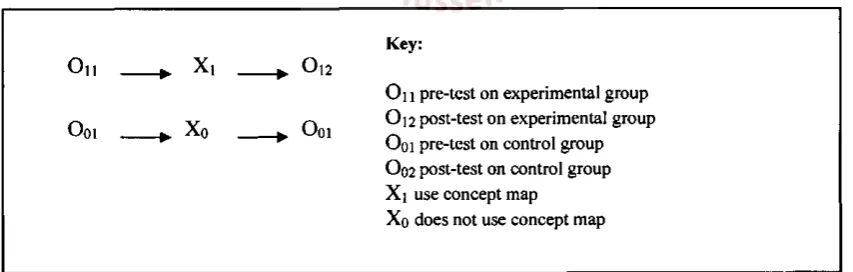
To answer the first and second research questions, the quasi-experimental design method of pre and post test with a control group was used. The research design is shown in Figure 1. The independent variable is "using or not using concept map" and the dependent variable was score on the physics achievement test. The participants for the study were two intact classes of form four mechanical engineering studies students from Teluk Intan Technical Secondary School located in Perak, Malaysia. The topic chosen was linear motion which is one of the earlier topics taught in form four physics. Mastering the concepts within this topic is important as they form the basis for learning of more advanced topics later on.
Key:
O n — • X ! _ „ O12
O i i pre-test on experimental group
Ooi • Xn > Ooi O12 post-test on experimental group
001 pre-test on control group 002 post-test on control group X i use concept map
[image:3.596.73.500.475.611.2]Xo does not use concept map
Figure 1: Research design for the study
acceptable in accordance with Rudner & Schafer (2001), two measurement experts who state that a teacher developed classroom test with a reliability estimate of 0.5-0.6 is acceptable. Therefore, the test instrument used in this study was considered to be adequately reliable for the purpose of this study.
The perception questionnaire was used to gather data on students' perception of the usefulness of concept maps to teaching and learning. It consisted of 14 items that requires the participants to give a rating of their agreements to a given statements on a scale of 1 (strongly disagree) to 5 (strongly agree). The reliability estimate based on the Cronbach alpha method is 0.84, which is consistent with reliability estimates of perception questionnaires from other such studies (Quek, Wong & Fraser, 2002) who obtained reliability estimates ranging from 0.5-0.9.
The observation schedule was used to gather data on class interactions. The schedule is divided into sections. Each section represents a 10 minutes session of class teaching. Observations were recorded for any actions by students that indicate interactions or non-interactions such as asking questions voluntarily, responding voluntarily, interacting with friends, writing down notes, giving opinions freely and sleeping in class. An assistant was trained to help with the gathering of the observation data. A video camera was also used to record events during the teaching and learning process.
2.1 Procedures
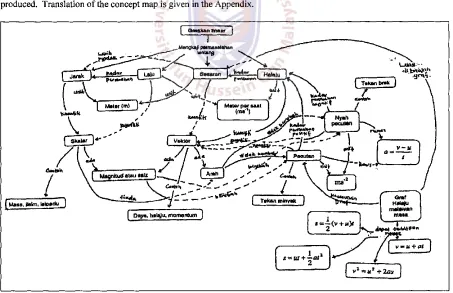
[image:4.596.74.527.386.679.2]Pre-test on physics were given to both groups prior to the intervention. During the intervention, the experimental group was taught the chosen physics concepts using concept maps as a teaching and learning tool while the control group was taught the same concepts without concept maps. In other words, the main difference between the learning experiences of the two groups was in the use of concept maps by teacher and students in the experimental group. A concept map was drawn progressively by the teacher in line with the progress of the lesson. At the end of the lesson, an overview of the main concept and its sub-concepts including their propositional links as shown in Figure 2 was produced. Translation of the concept map is given in the Appendix.
Both groups were taught by one teacher, therefore, teacher differences was not a source of confounding. Both groups also received a set of identical brief notes prepared in power-point presentations style. Both groups were given post -test after the class. Table 1 illustrates a typical unit of teaching and learning activity.
Table 1: Typical unit of teaching and learning activity
Concept map group Non-concept map group
• Teacher explains, • Teacher draw map, • Students copy map • Students encouraged to ask, • Students encouraged to expand on
the concepts by giving examples • Students asked to explain using the
concept map
• Teacher explains, • Teacher write notes • Students copy notes • Students encouraged to ask,
• Students encouraged to give examples to elaborate points
• Students asked to explain
3 Results and discussions
[image:5.596.112.480.163.269.2]Before presenting the results per-se, a check on group equivalence based on the pre-test scores will be shown first to be followed by the results on learning gains, perception towards concept maps and classroom interactions. The mean scores p on the pre-test were very similar for the two groups as shown by the descriptive statistics in Table 2. Having confirmed equal groups' variances (Levine's test with p>.05), comparison between the mean scores was carried out using an equal variance /-test. The /-test results showed that the difference was not statistically significant (Table 2). Therefore, the two groups were assumed to be equivalent with respect to their initial knowledge and understanding of linear motion concepts.
Table 2: Descriptive statistics and West results on initial group differences
Descriptive statistics Levine's Test Inde pendent /-test
Group H s F P / df P
Experiment 9.75 3.18 0.14 0.905 -0.093 55 0.926**
Control 9.83 3.10
** Difference is not statistically significant, />> 05
3.1 Learning gains
Two types of learning gain were investigated, immediate and long-term. Table 3 shows the descriptive statistics and the Mest results on difference in learning gains. The data were obtained immediately after the intervention and therefore this is considered as the immediate learning gain. The immediate mean gain score (p) for the experimental group (|i=7.53) is twice as much as the control group (n=3.03) and the difference is statistically significant at the 5% level of significance (p=0.000) based on an equal variance independent Mest. The equal variance independent /-test was used after ascertaining that the two groups have similar variances as indicated by the p-value for the Levine's test that is greater than 0.05. The statistically significant difference in the /-test result means that the experimental group obtained larger learning gain compared to the control group suggesting the benefit of teacher generated concept maps on learning.
Table 3: Descriptive statistics and /-test results for difference in learning gains
Descriptive statistics Levine's test Independent /-test
Group s F P t df P
Experiment 7.53 3.12 0.75 0.39 5.31 55 0.000*
Control 3.03 3.32
[image:5.596.100.489.360.479.2] [image:5.596.96.512.622.677.2]The effect size of the difference based on Bloom (1984) was computed as 1.1. According to Willingham, (2002), an effect size of as low as 0.25 can be considered practically significant and above 1.0 is considered exceptional in education research. Clearly, the gain in learning by the experimental group is not only statistically significant but most importantly it was academically and practically significant indeed.
[image:6.597.101.500.240.298.2]Table 4 shows the means for long-term gain measured six weeks after the pre-test. The control group experienced only a small drop while the experimental group experiences a big drop in long-term gain. Nevertheless, the mean in long-term gain of the experimental group is still larger than the mean of the control group. An equal variance /-test indicated that the difference was statistically significant at the 5% level of significance.
Table 4: Descriptive statistics and (-test result for difference in long-term learning gain
Descriptive statistics Levine's test Independent /-test
Group li s F P t df P
Experiment 4.39 3.201 1.790 0.186 2.08 55 0.042*
Control 2.34 3.143
*DifFerence is statistically significant, p<.05
Effect size obtained for the difference was 0.65 which is comparable to a study on long-term gain by Rohrer, el al.
(2005) who obtained an effect size of 0.75 in a study on the impact of over learning. Again, the gain is practically significant in accordance with Willingham (2002) and therefore, it appears that the impact of concept map on long term learning is also commendable. All data analysis results were based on SPSS version 13.
3.2 Perception towards the usefulness of concept maps
Overall rating by students on the usefulness of concept maps was high, (p. = 4.27) indicating that students perceive concept maps as a useful tool to their learning. The highest rating was for the item that measures the usefulness of concept map in promoting understanding (p= 4.57) which is consistent with the benefit of using concept maps as proposed by Novak & Gowin, (1984). The lowest rating is for the two items that asses students' tendency to use concept maps in discussion with teachers which is 3.75. The result here appears to be in contradiction to previous findings that support the positive role of concept maps in promoting discussion (Kinchin, 2003 and Kinchin & Alias, 2005). However, in the case of Kinchin and Alias (2005) the maps were students' generated and the questions were from the teacher who was trying to reduce misconceptions in the students. On the other hand, the maps in the current study were teacher generated and therefore most probably very clear to the students and therefore did not require many discussions. Further investigation is required in order to understand the real underlying causes of the lower rating for these particular items.
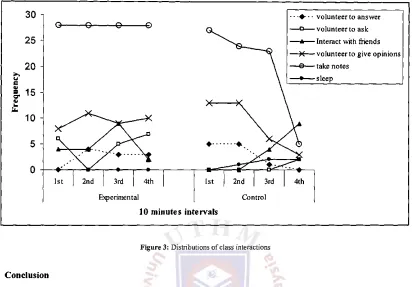
3.3 Class interactions
30 -••--- volunteer to answer
Q © © © volunteer to ask
25 -A— Interact with friends
-X—volunteer to give opinions
- 0 — take notes sleep
20
10
5
0
1st 2nd 3rd 4th 1st 2nd 3rd 4th
Experimental Control
[image:7.597.86.498.119.406.2]1 0 m i n u t e s i n t e r v a l s
Figure 3: Distributions of class interactions
4 Conclusion
This study sets out to determine whether teacher generated concept maps benefit students in the learning of linear motion concepts in secondary school physics. The findings indicate that students do learn better when concept maps are used in the teaching and learning of the concepts and students do retain more of what they have learnt in the long-term. The positive impact of teacher generated concept maps on both short-term and long-term learning was not only statistically significant but also academically significant. Therefore, serious considerations should be given to the adoption of concept maps as a teaching and learning tool in the learning of physics even at the level of only the teacher drawing the concept maps. The findings from the study also indicate that the use of concept maps promotes students-teacher and student-student interactions supporting active learning which is conducive to learning in general which is a factor contributing to the higher gain in learning. Students' positive perception towards concept maps in the current study could also be a factor explaining the positive impact on learning. It is not known however, if the same effect on learning will be found where students taught using concept maps have negative perceptions of concept maps. Therefore, future study could be carried out to determine if perceptions of concept maps have any bearing on classroom interactions and learning gain. The current findings were limited to teacher generated concept maps. The impact of students generated concept maps on learning gain may not be the same because students' attributes such as concept mapping skills and learning preferences may interact with learning. Studying the interactions between students' skills and preferences towards concept mapping may be the focus of future study.
5 References
Albacete, P. L. & VanLehn, K. A. (2000). Evaluating the effectiveness of a cognitive tutor for fundamental physics concepts. In L. R. Gleitman & A. K. Joshi (Eds.), Proceedings of the 22nd. Annual Conference of the Cognitive
Bloom, B. S. (1984). The 2 sigma problem: the search for methods of group instruction as effective as one-to-one tutoring. Educational Researcher, 13, 4-16.
Deshler, D (1990). Conceptual Mapping: Drawing charts of the mind in fostering critical reflection in Adulthood.
Eds. J. Mezirow, 336-353. San Francisco: Jessey-Bass.
Ellis, G. W., A1 Rudnitsky & Silverstein B. (2004). Using conceptual maps to enhance understanding in engineering education. International Journal of Engineering Education, 20(6). Online: http://www.smith.edu/engin-eep/papers/concept maps.pdf
Halloun, I. A. & Hestenes, D. 1984. Common sense concepts about motion. American journal of Physic, 55(11), 1056-1065
Inman, L. A., Ditson, L. A. & Ditson M. T. (1998). Computer-based concept mapping: promoting meaningful learning in science for students with disabilities. Information Technology and Disabilities [Online serial], 5(1 2). Available: http//www.rit.edu/~easi/itd/itdv05nl-2/article2.html
Kinchin, I. M. (2003) Effective teacher student dialogue: a model from biological education. Journal of Biological Education, 37(3), 110-113.
Kinchin, I. M. & Alias, M. (2005) Exploiting variations in concept map morphology as a lesson-planning tool for trainee teachers in higher education. Journal of In-service Education. 31(3), 569-591.
Normah Abd. Aziz & Tamby Subahan Mohd. Meerah. (1997). Salah konsep dalam kinematik di kalangan pelajar tingkatan 4: Penggunaan peta konsep. Jurnal Pendidikan, 22, 51-68.
Novak, J. D., & Gowin, D. B. (1984). Learning how to Learn. New York:Cambrige university Press.
Palmer D. H. (1998). Measuring contextual error in the diagnosis of alternative conceptions in science. Issues in Educational Research, <§(1), 65-76.
Pankratius, W. J. (1990). Building an organized knowledge-base: Concept mapping and achievement in secondary school physics. Journal of Research in Science Teaching, 27(4),315 333.
Puntambekar, S., Stylianou, A. & Hiibscher, R. (2003). Improving navigation and learning in hypertext environments with navigable concept maps. Human-Computer Interaction, 18(4), 395-428.
Quek C. L., Wong, A. F. L. & Fraser, B. J. (2002). Gender differences in the perceptions of chemistry laboratory
classroom environments. Queensland Journal of Educational Research, 18(2),164-182.
http://education.curtin.edu.au/iier/qier/qierl8/quek.html
Rohrer, D., Taylor, K.,. Pashler, H, Wixted, J. T. & Cepeda, N. J. (2005). The effect of overlearning on long-term retention. Applied Cognitive Psychology, I, 361 374. Published online 17 December 2004 in Wiley InterScience (www.interscience.wiley.com) DOI: 10.1002/acp.l083
Rudner, L. M. & Schafer, W. D. (2001). Reliability. ERIC Digest. Online http://www.ericdigests.org/2002-2/reliability.htm
Srantesson, I. (1998). Learning Maps And Memory Skill. 2nd Edition. United Kingdom:Kogan Page
Stauble, B. (2005). Using concept maps to develop lifelong learning skills: A case study. In The Reflective Practitioner. Proceedings of the 14th Annual Teaching Learning Forum, 3-4 February 2005. Perth: Murdoch University, http://lsn.curtin.edu.au/tlf/tlf2005/refereed/stauble.html
Willingham, D. T. (2002). Allocating student study time "massed" versus "distributed" practice. American Educator.
Online http://www.aft.org/pubs-reports/american_educator/summer2002/askcognitivescientist.html