The Implementation of Cell-Centred Finite Volume Method over Five
Nozzle Models
Abobaker Mohammed Alakashi
1, a, Hamidon Bin Salleh
1, b,
Bambang Basuno
1, c1 Faculty of Mechanical and Manufacturing Engineering, University Tun Hussein Onn Malaysia
(UTHM), Parit Raja, Batu Pahat, 86400 Johor, Malaysia
a [email protected], b[email protected], c[email protected]
Keywords: Cell-centered scheme, Nozzle, Finite Volume Method
Abstract. The continued research and development of high-order methods in Computational Fluid Dynamics (CFD) is primarily motivated by their potential to significantly reduce the computational cost and memory usage required to obtain a solution to a desired level of accuracy. The present work presents the developed computer code based on Finite Volume Methods (FVM) Cell-centred Finite Volume Method applied for the case of Quasi One dimensional Inviscid Compressible flow, namely the flow pass through a convergent divergent nozzle. In absence of the viscosity, the governing equation of fluid motion is well known as Euler equation. This equation can behave as Elliptic or as Hyperbolic partial differential equation depended on the local value of its flow Mach number. As result, along the flow domain, governed by two types of partial differential equation, in the region in which the local mach number is less than one, the governing equation is elliptic while the other part is hyperbolic due to the local Mach number is a higher than one. Such a mixed type of equation is difficult to be solved since the boundary between those two flow domains is not clear. However by treating as time dependent flow problems, in respect to time, the Euler equation becomes a hyperbolic partial differential equation over the whole flow domain. There are various Finite Volume Methods can be used for solving hyperbolic type of equation, such as Cell-centered scheme, Cusp Scheme Roe Upwind Scheme and TVD Scheme. The present work will concentrate on the case of one dimensional flow problem through five nozzle models. The results of implementation of Cell Centred Finite Volume method to these five flow nozzle problems are very encouraging. This approach able to capture the presence of shock wave with very good results.
Introduction
are various method can used for solving hyperbolic type of equation, they are namely Cell-centered scheme [2], Cusp Scheme [3] Roe Upwind Scheme [4]. The present work use a cell centred Finite Volume method applied for the case of will five models nozzle, they are namely: 1 convergent nozzle model , 1 divergent nozzle model and three other nozzle models belong to class of convergent divergent nozzle.
Governing Equation Flow Past Through Nozzle
The governing equation of fluid motion pass through a divergent nozzle which considered as quasi one dimensional and unsteady inviscid compressible flow can be written in the vector notation and conservative form as:[1]
The vectors of conservative variables , convective fluxes , and the source term read
In above equation the variable A denotes the nozzle area. The total enthalpy H is given by the formula
and the pressure p results according to:
The Cell Centred Finite Volume Method.
Fig. 1a: Control volume for the 1-D Euler solver [2]
Fig. 1a. show the sub domain in wich the governing equation of fluid motion Eq. 1 can be integrated over such sub domain to give the Eq. 1 can be written as:
The sub domain does not change with respect to time. To each sub domain, the discrete form can be approximate as:
If the control volumes are identical with the grid cells and if the flow variables are located at the centroids of the grid cells as indicated in Fig. 1b. that approach called as Cell-centred Finite Volume Scheme[5]. When evaluate the discretised flow equations, Eq. 4.a, one must supply the convective fluxes at the faces of a cell. How to define the convective fluxes at the face can be done by using one of the three following ways:
1- By the average of fluxes computed from values at the centroids of the grid cells to the left and to the right of the cell face, but using the same face vector (generally applied only to the convective fluxes)
2- By using an average of variables associated with the centroids of the grid cells to the left and to the right of the cell face.
[image:3.595.186.408.258.343.2]3- By computing the fluxes from flow quantities interpolated separately to the left and to the right side of the cell face (employed only for the convective fluxes).
Fig. 1b: Control volume of a cell-centred scheme in one dimension[2]
Thus, taking the cell face nJ+1 Fig. 1b. as an example, the first approach - average of fluxes – can
be approximated as:
Where;
The second possible approach - average of variables - can be formulated as follows:
The third methodology starts with an interpolation of flow quantities (being mostly velocity components, pressure, density and total enthalpy) separately to both sides of the cell face. The interpolated quantities - termed the left and the right state.[5]
Result and Discussion
The developed computer code applied for the case of flow through different 5 nozzle models. The first two nozzle models use the nozzle model according to Anderson [3] . Both nozzles are categorized as convergent divergent nozzle. For simplicity in explanition the first Anderson Nozzle denoted as Anderson Nozzle – A, which having distribution of cross section area along the nozzle A(x) defined as:
The Anderson second nozzle called as Anderson Nozzle – B has a cross section area distribution A(x) defined as:
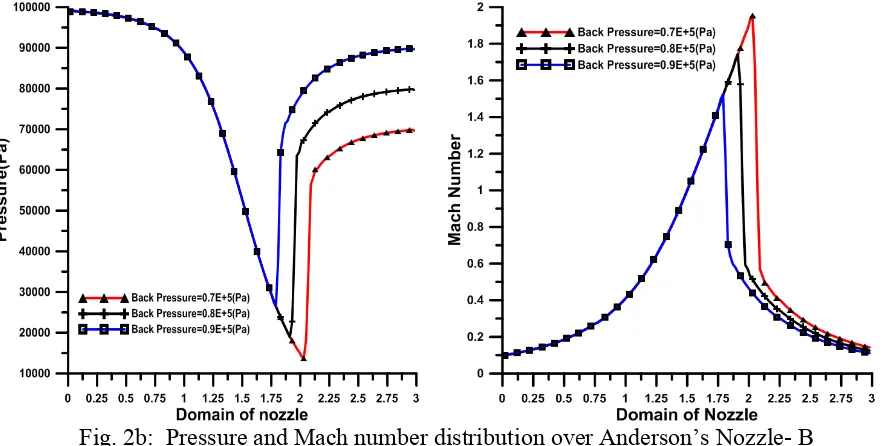
Here the gas assumed to behave as a perfect gas with heat coeffient ratio = 1.4 and the universal gas constant is equal to, . At the entry station, the pressure P is set equal to 100 kPa and the exit pressure may vary. For three different setting of the exit pressure, namely at exit pressure Pb = 70 kPa, 80 kPa and 90 kPa gives the result of distribution pressure and Mach
number along the nozzle for the case of Anderson Nozzle A as depicted in the Fig. 2a. While for the case of Anderson’s Nozzle – B as shown in the Fig. 2b.
[image:4.595.56.513.114.362.2]
Fig. 2a: Pressure and Mach number distribution over Anderson’s Nozzle- A
Fig. 2b: Pressure and Mach number distribution over Anderson’s Nozzle- B
Considering above, those two nozzles generate a normal shock wave inside the nozzle. As the exit pressure decrease, the location of normal shock wave move to further down stream.
The third nozzle model is the nozzle geometry adopted from Hoffmann with the distribution of cross section area is given as :
[image:4.595.74.515.402.625.2]
Fig. 3: Pressure and Mach number distribution over Hoffmann Nozzle.
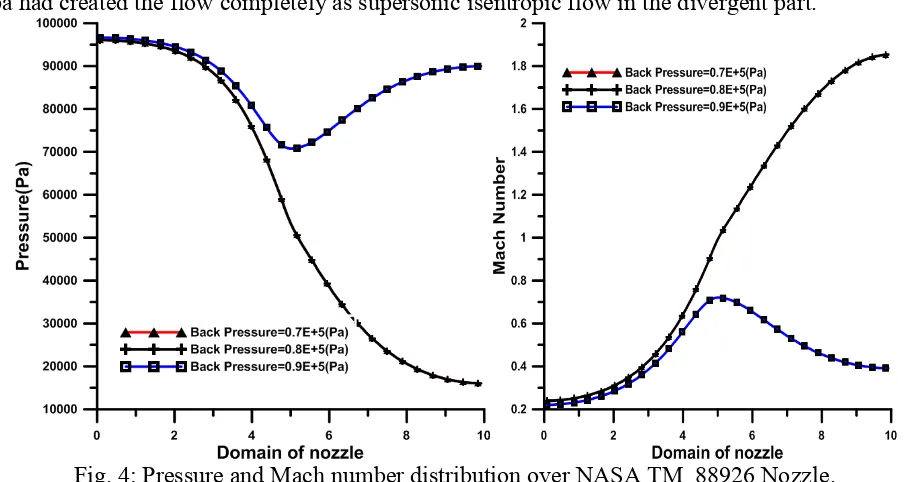
The Nasa report TM 88926 provided the nozzle geometry written in term of distribution of the cross section area A(x) along its axis is given as:
Applying the similar flow setting as it had been done to case of Anderson Nozzle gives their result as depicted in the Fig.4. Setting the back pressure similar to the Anderson nozzle for this type of nozzle does not produce the presence of the normal shock wave inside the nozzle. Setting back pressure at Pb = 80 Kpa and 90 Kpa bring the nozzle is not reaching the choked condition. As result
the flow back to the subsonic condition in the divergent section. While setting back pressure Pb = 70
Kpa had created the flow completely as supersonic isentropic flow in the divergent part.
Fig. 4: Pressure and Mach number distribution over NASA TM 88926 Nozzle.
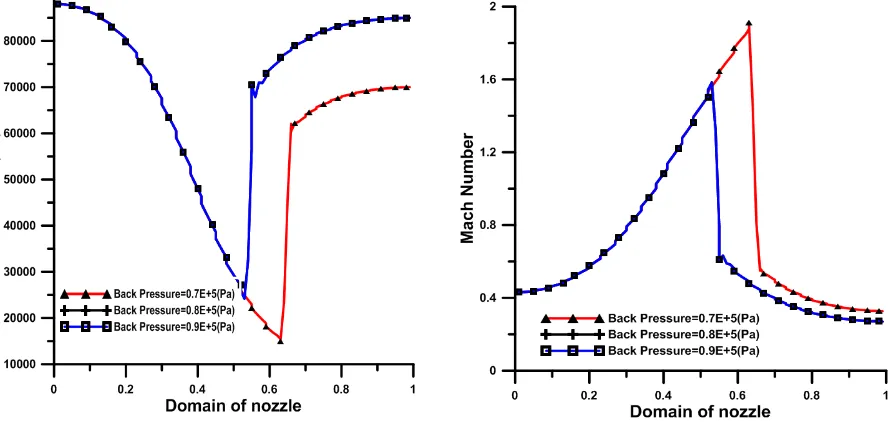
[image:5.595.70.524.456.697.2]In similar as Anderson Nozzle problem, for such geometry gives the distribution of pressure and Mach number as depicted in the Fig. 5.
[image:6.595.67.512.155.366.2]
Fig. 5: Pressure and Mach number distribution over Blazek’s Nozzle.
Conclusions
The Cell Centred Finite Volume method represent the numerical scheme which is able to solve the flow problem pass through nozzle. Different nozzle geometry gives different flow behaviour. Particular shape of nozzle may generate the flow inside nozzle goes to subsonic solution if the pressure ratio between entry and exit station is not having a sufficient value. Considering the result as shown in Fig.2, Fig.3 and Fig.5, it is clear indicated that the Cell Centred Finite Volume able to capture the presence of shock wave inside the nozzle without smearing or oscillatory solution near the shock. Therefore this approach can be considered as an appropriate approach for solving fluid flow problem from quasi one dimensional flow problems to two dimensional flow problem such as flow pass through airfoil or other two dimensional flow problems.
References
[1] K.. A . Hoffman and S.T .Chiang, Computational-Fluid-Dynamics Volume I, Engineering Education System, USA, 2000.
[2] J. Blazek, Computational Fluid Dynamics Principles and Applications, 2nd Ed., Switzerland,2001.
[3] J. D. Anderson, Jr, Computational Fluid Dynamics, the basics with applications, McGraw-Hill, 1995.
[4] J.C. Tannehill, D.A. Anderson. D. A, and R.H. Pletcher , Computational Fluid Mechanics and Heat Transfer, 2nd Ed., Taylor & Francis, New York, 1997.
![Fig. 1b: Control volume of a cell-centred scheme in one dimension [2]](https://thumb-us.123doks.com/thumbv2/123dok_us/8774094.900432/3.595.186.408.258.343/fig-b-control-volume-cell-centred-scheme-dimension.webp)