Original Citation
Nunn, Alex, Johnson, Steve, Monro, Surya, Bickerstaffe, Tim and Kelsey, Sarah (2007) Factors influencing social mobility. Technical Report. Her Majesty’s Stationery Office.
This version is available at http://eprints.hud.ac.uk/id/eprint/6057/
The University Repository is a digital collection of the research output of the University, available on Open Access. Copyright and Moral Rights for the items on this site are retained by the individual author and/or other copyright owners. Users may access full items free of charge; copies of full text items generally can be reproduced, displayed or performed and given to third parties in any format or medium for personal research or study, educational or notforprofit purposes without prior permission or charge, provided:
• The authors, title and full bibliographic details is credited in any copy; • A hyperlink and/or URL is included for the original metadata page; and
• The content is not changed in any way.
For more information, including our policy and submission procedure, please contact the Repository Team at: [email protected].
Corporate Document Services
Factors influencing social
mobility
Dr. Alex Nunn, Dr. Steve Johnson, Dr. Surya Monro, Dr. Tim Bickerstaffe and Sarah Kelsey
First Published 2007.
ISBN 978 1 84712 237 7
Views expressed in this report are not necessarily those of the Department for Work and Pensions or any other Government Department.
Contents
Acknowledgements ... vii
The Authors ...viii
Summary ...1
1 Introduction ...5
2 Policy and social context ...7
2.1 Summary ...7
2.2 Introduction ...7
2.3 The social and economic context ...8
2.3.1 Global processes of economic change ...8
2.3.2 Structural change and the labour market in the UK ...8
2.3.3 Trends in poverty and inequality ...9
2.4 The policy context: public policy since 1997 ...9
2.4.1 Background ...9
2.4.2 Recent policy interest in social mobility ...10
3 The concept of social mobility ...13
3.1 Summary ...13
3.2 Introduction ...14
3.4 Trends in, and debates on, social mobility in the UK ...16
3.4.1 The sociological tradition ...17
3.4.2 The economic tradition ...19
3.4.3 Definitions of class and social stratification ...21
3.5 International comparisons: contextualising the British experience ...25
3.6 Social mobility, economic growth and competitiveness ...26
4 Social capital, cultural and social mobility ...29
4.1 Summary ...29
4.2 Introduction ...30
4.3 Social capital ...30
4.4 Cultural capital ...33
5 Families, aspirations and the early years ...35
5.1 Summary ...35
5.2 Introduction ...35
5.3 The importance of the early years ...36
5.4 Family structures ...37
5.5 Innate characteristics and pre-school care ...38
5.6 Asset accumulation and transfer ...39
6 Education and social mobility ...41
6.1 Summary ...41
6.2 Introduction ...42
6.3 The ‘mediating’ role of education in social mobility ...42
6.4 Factors limiting the impact of education on social mobility ...43
6.4.1 Social class, educational participation and attainment ...43
6.4.2 Social class and choice of educational institution ...44
6.4.3 Social class and subject choice ...45
6.4.4 Parental involvement in schooling ...46
6.4.5 Wider societal influences on education and social mobility ...46
7 Employment and labour market experiences ...49
7.1 Summary ...49
7.2 Introduction ...49
7.3 The labour market and social mobility ...50
7.4 Barriers to employment ...52
7.4.1 Gender ...52
7.4.2 Ethnicity ...53
7.4.3 Disability ...53
7.5 The impact of Welfare to Work policies ...54
7.6 Progression in the labour market ...55
8 Health, wellbeing and social mobility ...57
8.1 Summary ...57
8.2 Introduction ...57
8.3 Two theses on the links between social mobility and health ...58
8.3.1 Social causation ...58
8.3.2 Health selection ...59
8.4 Work and wellbeing ...60
8.5 Disability and social mobility ...61
8.6 Social mobility and caring responsibilities ...62
9 Spatial and locational factors ...63
9.1 Summary ...63
9.2 Introduction ...63
9.3 Area-based influences on social mobility ...64
9.4 Housing ...65
9.5 Transport ...66
9.6 Communication via the new technologies ...67
10 Commentary: understanding social mobility ...69
10.1 Summary ...69
10.3 Understanding trends in social mobility ...71
10.3.1 Socio-economic trends ...71
10.3.2 Area-based factors ...72
10.3.3 Early years and education ...72
10.3.4 Overview ...73
10.4 Policy implications for the Department for Work and Pensions ...73
Appendix Literature search strategy ...77
References ...79
List of tables
Table 3.1 Standard Class Schema Models ...21 [image:7.595.97.506.121.413.2]List of figures
Figure 3.1 An alternative class schema for understanding social mobility in relation to Welfare to Work ...24Figure 8.1 Policies and strategies to promote social equity in health ...59
Acknowledgements
The Authors
Dr Alex Nunn is a Principal Research Fellow, Policy Research Institute at Leeds Metropolitan University. His research focuses on governance, social inclusion, labour markets and political economy. He has undertaken a wide range of commissioned research on behalf of government departments and other public bodies.
Dr Steve Johnson is Director of the Policy Research Institute and Associate Dean of Research in the Faculty of Business and Law at Leeds Metropolitan University. He has published widely on topics such as enterprise, skills, labour market policy and economic development.
Dr Surya Monro is a Senior Research Fellow at the Policy Research Institute, Leeds Metropolitan University. Her work focuses on social inclusion and equalities with a particular emphasis on gender, lesbian, gay and transgender equality.
Dr Tim Bickerstaffe is a Research Fellow at the Policy Research Institute, Leeds Metropolitan University. Formerly the Director of Research at the Low Pay Unit, his work and expertise focus on labour market policy and in particular on low pay and social inclusion.
Summary
Introduction and background
This document was commissioned by the Department for Work and Pensions (DWP) and has been compiled by the Policy Research Institute (PRI), Leeds Metropolitan University. The research examined the factors that are facilitating and inhibiting social mobility in the United Kingdom (UK) in the early years of the twenty-first century. This report presents an initial review of the literature on the factors influencing social mobility.
Policy and social context
There is a long history of research into social mobility, but political interest in the subject intensified during the 1980s and 1990s. As inequality increased, social mobility emerged as an alternative and partially compensating measure of social fairness. The concept also appeared to capture something of the social changes which resulted from changes to the industrial structure of the economy, themselves partially driven by pressures of globalisation. In recent years, concern over the subject has risen once again, as studies, research projects and consideration from within government turns to examine the impact of ten years of the present Labour government. In this context, several studies which suggest that social mobility may have declined in the UK have further strengthened strategic and political concern with the issue.
The concept of social mobility
Further, the study of social mobility can be differentiated into two distinct traditions: a sociological tradition and an economic tradition. The sociological tradition is based on an understanding of the structure of society defined by an occupational hierarchy, while the economic tradition tends to focus on income groups. Both of these approaches have significant merits for the study of social mobility. However, in terms of informing the development of policy responses within the remit of the DWP, an alternative social structure is suggested, based upon the quality of participation in the labour market (Section 3.4).
There is some debate about the importance of social mobility and its relationship with inequality and economic growth. On the one hand, high levels of inequality might be thought to constrain the potential for movement within the social hierarchy, leading to a double-bind of high inequality and low mobility. On the other, high levels of inequality and mobility might be thought to be good bedfellows, suggesting that sufficient incentives are built into the social structure to allow the economy to make the best use of its resources, allocating talented labour to high value jobs. To the extent that it is available, the evidence appears to favour the former argument, with those countries with higher levels of mobility also having lower inequality. There is also some evidence of causal linkages between inequality and low levels of mobility.
Trends in social mobility
Sociologists suggest that the social structure of the population did alter between the 1970s and the 1990s in relation to economic and industrial change as what had previously been described as middle-class occupations expanded and working class occupations contracted. However, the majority of work in the sociological tradition suggests that relative social mobility did not increase during that period despite significant expansions in the state education system. On this point, studies in the economic tradition largely concur and even suggest that levels of relative social mobility may have fallen for those in the lowest income groups. Additionally, international comparisons suggest that the UK compares unfavourably with several other European countries and Canada in terms of social mobility, and while the United States (US) has similar levels of social mobility to the UK, the UK’s position relative to the US has declined over recent decades.
Caution needs to be exercised when interpreting these trends. There is a significant time lag in the data, due to reliance on data for people who have achieved a final position in the social hierarchy. It is, therefore, inappropriate to draw firm causal conclusions about the impact of policy trends over the last decade on these longer-term social trends.
Factors influencing social mobility
important themes, but the complex relationship between these means that it is inappropriate to make firm judgements about the relative importance of one or another of them. In reality, they work in overlapping ways and in different combinations for different individuals. The factors involved are:
• Social capital – there is some evidence that traditional working class social capital has declined, which may have weakened its assumed negative effects on social mobility, while other ‘negative’ forms of social capital have emerged such as cultures of worklessness, anti-social behaviour and drug abuse. A lack of positive role models, peer pressure, poverty of ambition and risk aversion may serve as barriers to social mobility. By contrast middle-class families tend to have access to a wider range of social networks that are more advantageous from the point of view of enabling upward mobility and protecting against downward mobility.
• Cultural capital – can also help middle-class families to confer social advantages on their children, increasing their potential to move upwards and protecting them from downwards movement in the social hierarchy.
• Early years influences – are seen as key to influencing later life chances. Convincing evidence shows that early experiences such as the quality of the home environment, family structure, pre-school care and relationships with caring adults produce a pattern of development in later life that is hard to reverse even through schooling.
• Education – appears to be one of the most important factors influencing social mobility. However, there is considerable evidence that the introduction and expansion of universal education systems in the UK and Western Europe have not led to increasing levels of relative social mobility. This is due to a range of factors including the ability of middle-class families to take advantage of educational opportunities.
• Employment and labour market experiences – recent decades have seen the emergence of important labour market trends with implications for social mobility. First, substantial levels of worklessness and long-term economic inactivity have emerged in some areas and/or among specific population groups. Second, research has identified the emergence of a prominent ‘low-pay – no-pay’ cycle for some groups. There is also evidence that specific groups face particular disadvantages in the labour market and that women who take career breaks often have difficulty re-entering the labour market in the same position and therefore, frequently experience downward social mobility after having children.
• Area-based influences – localised environmental problems appear to combine with socio-economic disadvantage to produce negative area-based influences on potential for social mobility. For example, inequalities in access to private transport combined with poorer quality provision in some important public services in deprived areas may mean that lower socio-economic classes are unable to exercise effective choices over access to these services.
Implications for the Department for Work and Pensions
1 Introduction
This document has been compiled by the Policy Research Institute (PRI), Leeds Metropolitan University, as part of an exploratory research project – commissioned by the Department for Work and Pensions (DWP) – designed to examine the factors that are facilitating and inhibiting social mobility in the United Kingdom (UK) in the early years of the twenty-first century. Recent quantitative studies (notably Blanden et al., 2007) appear to indicate that social mobility may have stalled and that the UK compares unfavourably with many other countries.
2 Policy and social context
2.1
Summary
Box : Social and policy context – key points
• Global processes of political, social and economic change have impacted on the structure of the United Kingdom (UK) labour market including:
– the decline in large scale manufacturing employment;
– increasing demands for skilled labour among some employers; – a polarisation in job quality and wages.
• The 1980s saw rapidly increasing social and economic inequalities. While these increases have not continued, on many indicators the prevalence of poverty and inequality remain high in the UK compared both with periods before the 1980s and with other European countries.
• Social and welfare policies under the present Government have focused on combating social exclusion and work as the most effective route out of poverty.
• However, persistent poverty and inequality have led to some suggesting that more needs to be done to combat in-work poverty, including through sustaining and progressing in work.
• In this context there is a renewed political interest in social mobility and concern about research which suggests that social mobility has fallen, though this does not necessarily suggest that this has been the result of recent Government policy (see Section 3.4).
2.2
Introduction
landscape within which social mobility does, or does not, take place and recent Government policies which might have impacted upon it.
2.3
The social and economic context
.. Global processes of economic change
It is commonly held that since the mid-1970s, influential global processes have shaped the ways in which national economic and social policy is made in important ways. Over this period, nations have faced increasing pressures of competitiveness which have resulted in processes of increased adjustment to, and engagement with, the global economy. More recently still, the challenge of increasing global competition from emerging economies such as China or India has been cited as providing further impetus for increased social reform and change in the emphasis of public policy toward facilitating increased competitiveness (Blair, 2006; Brown, 2006).
Many authors identify the rise in international competition as qualitatively changing the nature of government and politics from the model of the Welfare State to the Competition State (Cerny, 2000; Cerny and Evans, 2004). The argument runs that where the Welfare State saw the role of the state as being to mediate the effects of the market on individuals and social groups, the competition state is concerned principally to enable enhanced competitiveness through providing its citizens with the tools and resources to cope with the risks of failure. The implications of these changes for global social change have been profound. Consideration of the impact on class structures is introduced in Section 3.4.3.
.. Structural change and the labour market in the UK
From the mid-1970s onwards the UK has witnessed significant changes in the sectoral structure of the economy. A number of core themes are prominent in these changes, including a shift away from unskilled and semi-skilled and manual employment and a shift from primary and manufacturing industries to service sector employment (Green, 2003). This has led to important shifts in the overall wage structure of the economy, with the differentials between low paid and higher paid work increasing significantly. Goos and Manning (2003) demonstrate, for the British case, that there has been a simultaneous increase in demand for labour in well paid and professional – or ‘lovely’ – jobs and a less marked increase in demand for low paid and service sector – or ‘lousy’ – jobs (resulting in lower unemployment), while demand for employment through ‘middling’ occupations (in skilled manufacturing for instance) has declined.
Since the early to mid-1990s, however, patterns of demand in the labour market have been substantially affected by a sustained period of economic growth. During this period, the employment rate has risen markedly while unemployment (but not economic inactivity), has fallen correspondingly. For instance, the employment rate now stands in excess of 74 per cent, one of the highest levels among comparable advanced economies and the government has set an ambitious aspiration of an employment rate of 80 per cent by 2010. In this context, the challenge for public policy has shifted noticeably from helping the short-term unemployed back into work to dealing with long-term economic inactivity (Freud, 2007), ensuring that in-work poverty does not hold back social inclusion (Harker, 2006) and that a predominance of low-skilled and low quality employment does not hold back economic competitiveness (Leitch, 2006).
.. Trends in poverty and inequality
Most research on poverty and inequality suggests that the period from the mid- to late-1970s and through the 1980s witnessed a large increase in inequalities on a variety of measures, particularly in terms of income (Palmer et al., 2006:31-2). Compared internationally, the picture of rising income inequality is not unusual among comparable countries in Europe and North America (Sibieta, 2007).
The last decade has not seen a continuation of the rising inequality seen in the previous decade but neither have there been dramatic falls (e.g. Brewer et al. 2006). The UK continues to have a higher proportion of its population in relatively low income categories than most other countries in the European Union. The picture on income inequalities is somewhat more complicated. Over the last decade, the incomes of the poorest tenth of the population have risen the least while the incomes of the richest tenth have risen the most, leading to a widening of inequality between the very richest and very poorest. However, the incomes of the second, third and fourth poorest tenths of the population have risen more quickly than for all other groups other than the richest (Palmer et al. 2006: 31-35).
This indicates that at the same time as a growing divide between the very rich and very poor, there has been a period of modest catch up in the rest of the income distribution, which suggests that the policies of in-work redistribution through tax credits work for some individuals and households but may not work so well for others. Two further implications arise from this data: First, inequality and poverty are still high in the UK compared to the period up to the 1980s and relative to many other comparable countries. Second, the growing divide between the very richest and very poorest may indicate a need for greater policy attention to be focused on the very poorest.
2.4
The policy context: public policy since 1997
.4. Background
relevance to social mobility since 1997, addressing, in particular, Welfare to Work, area based regeneration, public service reform and the current agenda.
Policies to address poverty and to foster equality of opportunity, rather than of outcomes, have been at the heart of the New Labour programme in government (e.g. Blair, 1994; Giddens, 2000). For the most part, the term ‘social exclusion‘ has been preferred as a concept to frame government policy as a reaction to the potential narrowness of conceptions of poverty and inequality (as associated with income alone) and the need to reflect the broader and multiple components of social disadvantage (e.g. see Giddens, 1998:104; 2000:105):
‘Social exclusion is about more than income poverty. It is a shorthand term for what can happen when people or areas face a combination of linked problems such as unemployment, discrimination, poor skills, low incomes, poor housing, high crime, bad health and family breakdown. These problems are linked and mutually reinforcing so that they can create a vicious cycle in people’s lives. Social exclusion is thus a consequence of what happens when people do not get a fair deal throughout their lives, and this is often linked to the disadvantage that they face at birth.’
(Social Exclusion Unit, 2004:7)
While policy initiatives to tackle the multiple components of social exclusion have been numerous, four main themes can be identified: Firstly, Welfare to Work policies have focused on three key issues: promoting work as the most effective route out of poverty (Her Majesty‘s (HM) Treasury, 2002) and ‘making work pay’ for those in otherwise low paid work; ensuring that ‘poverty traps’ do not act as a disincentive to employment; and, more recently, additional emphasis has been given to tackling inactivity and long-term exclusion from the labour market (Department for Work and Pensions (DWP), 2006). Area-based regeneration initiatives form a second strand of policy intervention. A third element has been to address child poverty and disadvantage in the early years, through initiatives such as SureStart (HM Treasury, 1998; 1998a; 1998b). Finally, recognising the need to respond to global competition, reform of the compulsory, adult and higher education (HE) system has been promoted to upskill the population (Department for Education and Skills (DfES), 2001; DfES, 2003). Cutting across all these policy areas has been a drive to reform public services, including introducing and strengthening choice in public services as both a mechanism for people to take responsibility for their own success but also as a means of levering up the quality of public service provision (Blair, 2002; OPSR, 2002; Cabinet Office, 2006; 2007).
.4. Recent policy interest in social mobility
complex and multiple barriers to employment faced by the long-term economically inactive and to upskill the rest of the workforce to cope with global competition.
However, the emphasis in Welfare to Work policy on work as the best route out of poverty has been questioned as a result of persistent levels of income inequality and poverty even among those that are in work (Palmer, et al.: 2006: 10-11; Brewer et al. 2006) and particularly as a result of missing an interim target in relation to the commitment to end child poverty (DWP, 2006a). For instance, the Harker Review of progress toward achieving the child poverty target noted that while many households were making the transition to having at least one member in work, the prevalence of low pay means that entering work may not be sufficient – in and of itself – as a route out of poverty. As such, Harker recommended the adoption of a ‘work first plus’ approach where increased emphasis would be given to skills acquisition (Harker, 2006: 36-52).
The Leitch Review of Skills (Leitch, 2006) similarly argued that action to improve the basic skills of job seekers needs, in many cases, to be augmented by a greater emphasis on skills development in work, with the suggestion of a specific objective for employment and skills services of ensuring sustainable employment and progression.
The issue of social mobility has also been raised recently by several politicians. For instance, announcing the review of Welfare policy that would result in the Freud report, Secretary of State John Hutton argued that:
‘We not only have to help people back into jobs – we have to try and help people progress up the career ladder as well…Helping individuals to acquire the skills, confidence and ambition to progress through the workplace has to be a core ambition for a dynamic welfare system.’
(Hutton, 2006)
Secretary of State for Education and Skills Alan Johnson (2006) also raised social mobility as an important issue, arguing:
‘It is actually getting harder for people to escape poverty and leave the income group, professional banding or social circle of their parents. In fact, it’s currently harder to escape the shackles of a poor upbringing in Britain than anywhere else in Europe…inequality and brakes on social mobility are real problems of great concern to all modern social progressives.’
3 The concept of social
mobility
3.1
Summary
Box : Conceptual issues – key points
• There are several aspects to the definition of social mobility as a concept. • Economists tend to measure social mobility in terms of income and
sociologists focus primarily on social mobility in terms of occupational status.
• Findings from the sociological tradition of research suggest that:
– absolute mobility increased for a period as a result of changes in the structure of British society. There is some evidence that this period of change may now be coming to an end;
– relative social mobility has not increased despite increased educational opportunities;
– there is some evidence of downward inter-generational mobility of individuals whose parents had been in semi-skilled or skilled manual work;
– where upward social mobility is present, this tends to be short-range rather than long-range.
• Findings from the economic tradition of research suggest that:
– social mobility in Britain fell between cohorts born in 1958 and 1970; – one explanation for declining social mobility is that children from better
off households have been better able to take advantage of improvements in the education system;
– other explanations for declining social mobility include the impact of early unemployment and the development of personality traits such as self-esteem and ‘application’;
– international comparisons suggest that the United Kingdom (UK) compares unfavourably with several other European countries and Canada in terms of social mobility and while the United States (US) has similar levels of social mobility to the UK, the UK’s position, relative to the US, has declined over recent decades.
• Findings from both economic and the sociological research suggest that there has been no increase in relative social mobility in post-war Britain. • Methodological concerns mean that it is difficult to arrive at firm conclusions
as to the direct impact of more recent Government policies on these longer-running trends.
• Research in the sociological tradition relies on occupation-based hierarchies and work in the economic tradition relies on income groups. Both of these have limitations and it may be more appropriate in relation to Department of Work and Pensions‘ (DWP’s) remit to focus instead on a social hierarchy based on the quality, security and sustainability of employment.
• Using this type of social hierarchy there is some evidence that there is limited scope for people in low quality and low paid work to progress in the labour market into better quality sustainable work. There is also evidence in the literature that people who have experience of unemployment are more likely to find themselves trapped in low quality ‘entry’ level employment, with limited opportunities to progress.
3.2
Introduction
Before addressing the factors that impact on social mobility it is necessary to understand what is meant by the term and to gain insight into the ways in which analysis of social mobility has developed over a period of time.
3.3
A general definition
Social mobility is usually defined as:
‘...the movement or opportunities for movement between different social classes or occupational groups.’
(Aldridge, 2003: 189)
‘The level of intergenerational mobility in society is seen by many as a measure of the extent of equality of economic opportunity or life chances. It captures the extent to which a person’s circumstances during childhood are reflected in their success in later life, or, on the flip-side, the extent to which individuals can make it by virtue of their own talents, motivation and luck.’
The importance of the concept of social mobility as a measure of social fairness has increased, being seen as a measure of equality of opportunity in a world where outcomes are not equal. Social mobility, therefore, is closely associated with related concepts such as inequality, social exclusion and inclusion, class and social stratification where mobility refers to movement between different and unequal social groups, or classes and between exclusion and inclusion. As Miller (2005) argues, chances for social mobility are one aspect of the concept of equality of opportunity, which itself is, in turn, one of the four foundational principles of social justice, alongside equal citizenship rights, a guaranteed set of minimum social rights and fair distribution of additional social rights that are outside of citizenship and the absolute social minimum.
Box : Definitions of social mobility Social mobility
Extract from A Dictionary of Sociology:
‘The movement – usually of individuals but sometimes of whole groups – between different positions within the system of social stratification in any society. It is conventional to distinguish upward and downward mobility (that is, movement up or down a hierarchy of privilege), and intergenerational from intragenerational or career mobility (the former referring to mobility between a family of origin and one’s own class or status position, the latter to the mobility experienced during an individual career, such as respondent’s first job compared to his or her present job). Other distinctions – most notably that between structural and non-structural mobility – are more contentious.’ ‘absolute mobility’, A Dictionary of Sociology. John Scott and Gordon Marshall. Oxford University Press 2005. Oxford Reference Online. Oxford University Press. Leeds Metropolitan University. 4 May 2007, <http://www. oxfordreference.com/views/ENTRY.html?subview=Main&entry=t88.e1453>
Intra-generational Inter-generational
The movement of individuals The achieved social position of an adult between different social classes compared with that of their parents. during their own lifetime.
Absolute Relative
Changes in the structure of The movement of an individual society so that the distribution of between different social classes,
the population between different regardless of changes in the distribution social classes changes. of the population between them.
Mobility between social groups and classes can also be thought of in generational terms. It is, therefore, useful to distinguish at the outset between intra-generational mobility and inter-generational mobility. Intra-generational mobility refers to the movement of individuals between different social classes during their lifetime and, in principle, can be measured between any two points during their life. However, studies of social mobility tend to show that there are strong relationships between the social positions of parents and those that their children subsequently occupy. As such inter-generational social mobility is also an important concern and refers to the difference between the social position of individuals at a particular point in their adult life (destination) with that of their parents (for example, Heath, 1981; Breen and Rottman, 1995).
Finally, it is useful to differentiate between ‘absolute’ and ‘relative’ social mobility (Payne and Roberts, 2002:3). Absolute social mobility usually refers to the proportions of individuals from one social group moving to another. Absolute mobility is, thus, a useful means of capturing large-scale social changes such as shifts in the industrial and occupational structure which resulted in the large-scale movement of large parts of the population (especially men) from manual occupations in heavy industry to administrative occupations in the service sectors.
Relative mobility refers to the likelihood of movement between different social classes. Relative mobility is present with or without changes in absolute mobility and might be juxtaposed with it to offer an analysis of the potential for individual mobility between social groups relative to broader social and economic changes affecting those groups. This is the approach taken in several high profile studies of social mobility in the UK (for example, Goldthorpe, 1987).
3.4
Trends in, and debates on, social mobility in the UK
(Erikson and Goldthorpe, 2002). The second – broadly economic – tradition tends to measure changes in income over time and between generations (Bowles and Gintis, 2002:5). Both of these approaches have advantages and disadvantages. For instance, changes in the occupational structure of society can help to illuminate patterns of social mobility but may also ignore the changing social and economic status awarded to occupations over time. On the other hand, while income mobility may avoid some problems associated with the changing status of particular occupations, a core advance in public policy over the last decade has been to recognise that income alone is not a sufficient determinant of social inclusion/exclusion. Additionally, data and discussion of trends in social mobility rely on data for cohorts born a long time ago, the most recent being in the 1970s. As such, influences on the social mobility of these groups will have extended across three decades. It is arguable, therefore, that the impact of policy initiatives under the New Labour governments of the last decade will have had relatively little impact on the findings on social mobility published even in the most recent reports. As such, caution needs to be exercised when considering ‘evidence’ of social mobility and in particular when ascribing causal influence to either prevailing economic and social conditions or changing public policy interventions.
.4. The sociological tradition
Within the sociological tradition there is a long history of research into social mobility in Britain, stretching back to the beginning of the last century, though the first general – nation-wide – study was the 1949 mobility survey (Heath and Payne, 1999:3). The study revealed a picture of rigid class structures and inequality in life chances:
‘…the general picture so far is of a rather stable social structure, and one in which social status has tended to operate within, so to speak, a closed circuit. Social origins have conditioned educational level, and both have conditioned achieved social status. Marriage has also to a considerable extent taken place within the same closed circuit.’
(Glass, 1954:21, quoted in Heath and Payne, 1999:3)
Despite these findings, the expectation was that reforms to improve equality of opportunity, such as the 1944 Education Act and the establishment of the post-war Welfare State, would make British society more open to social mobility (Heath and Payne, 1999:3).
words, working-class children were much less likely to end up in middle class occupations than were middle-class children (Goldthorpe, 1987).
As a counter to this, Peter Saunders (1995; 2002) concludes that the limited evidence of upward social mobility among working-class children is exactly what should be expected in a meritocratic society where social position is achieved by ability and effort. This is because:
‘...able parents (who in a meritocracy will be recruited into top positions) will be more likely to produce relatively able children (because of the genetic and environmental advantages that they can pass on), and these children will often, therefore, emulate the achievements of their parents.’
(Saunders, 2002:560-561)
Saunders points out one limitation to his meritocracy model, conceding that middle class parents may be able to protect their children from downward social mobility (1995:36-7; 2002:563-4).
Despite the apparent debate between Saunders on the one hand and Goldthorpe and colleagues on the other, the latter (e.g. Breen and Goldthorpe, 2002) acknowledge that a range of factors, including ability and effort but also environmental and societal factors explain the relationship between social origin in childhood and social destination in adulthood. They, therefore, accept that merit is an important factor determining social mobility but that the patterns in the data suggest that this alone is not sufficient and that other class-based social factors are also important. As such, it is not possible to conclude that Britain is a properly functioning meritocratic society but instead there are a range of social factors which mediate the effects of merit-based factors in determining opportunities for social mobility (Breen and Goldthorpe, 1999:22).
Other recent research in the sociological tradition suggests that the evidence in relation to relative social mobility is complex. For instance, Heath and Payne (1999) note the changing social position of specific occupations within the six class categories they use. Nonetheless, they identify the highest patterns of stability (or lack of mobility) being for higher grade professionals (Class I) at the top and among the working classes at the bottom of their schema. By contrast, men originating from the classes in the middle of the schema, particularly routine white collar occupations, were much less likely to stay in the same class as their fathers. Their findings also show that ‘short-range mobility is more common than long-range movement’.
that there might have been a marginal increase in the openness of society to social mobility subsequent to the undertaking of the 1972 study.
Research in the sociological tradition using more up to date data from the General Household Survey suggests that the trends in absolute mobility demonstrated by previous studies have levelled off in more recent years. Indeed, Goldthorpe (2004:205) comments that:
‘If late twentieth century Britain was in fact becoming a more mobile society, as some commentators have claimed then this was only in the sense of downward rather than upward movement within the class structure becoming more frequent.’
The downward absolute mobility referred to here stems largely from the declining prominence of skilled manual workers in the class schema. In terms of relative mobility, Goldthorpe’s most recent work suggests that there is very little evidence of sustained changes in social fluidity or societal openness despite increasing investment in education to bring about increased equality of opportunity (2004:222-3).
.4. The economic tradition
Research on social mobility, as opposed to income inequality, has a shorter history in the economic tradition than similar research by sociologists and usually compares the differences in income between parents and their children when they become adults (Corak, 2006:3).
One key strand in the economic tradition of inquiry in relation to social mobility focuses on the way in which families consciously act to ensure that the position of their children is maximised in the future. Such strategies include decision-making in relation to education and upbringing which are then mediated through natural endowments (talent, aptitudes), wider opportunities available in society and luck (Becker and Tomes, 1979:1181-4; Becker and Tomes, 1986:S1-3). Becker and Tomes assume a declining marginal rate of return on investments in education (human capital formation) and inheritability of natural endowments from one’s parents. One implication of this is that Government programmes to redistribute resources to poor families may be misguided. This is because they discourage parents’ own investment in their children’s human capital formation:
‘...progressive taxes and subsidies may well widen inequality in the long-run equilibrium distribution of income essentially because parents are discouraged from investing in their children by the reduction in after-tax rates of return.’
(Becker and Tomes, 1979:1182)
Research on income mobility in the UK has tended to address the issue within the context of rising inequality in the income distribution from the 1970s onwards (e.g. Dearden et al., 1997:47; Blanden et al., 2002:1; 2004:122-5) and thus, poses the question of mobility as one of fairness. In other words, if inequality between the rich and poor as social groups is widening, is there at least the opportunity for individuals to move from a relatively disadvantaged income status to a position of affluence? Evidence that this is possible might be seen to support a switch in policy emphasis from equality of outcomes to equality of opportunity and individualism, but evidence that it is not the case provides support to the thesis that the UK simply became a more unfair society as a result.
Dearden et al. (1997) use longitudinal data from the Natural Child Development Survey (NCDS) to highlight strong links between parental income and the income of their offspring as adults for a cohort of children born in 1958. To the extent that their study allows inter-generational comparison, it concludes that what mobility could be detected was accounted for by upwards movement from the bottom rather than downwards movement.
Blanden et al. (2002; 2004) consider inter-generational income mobility in more depth. They focus on children born in 1958 and 1970 and show that disparities in income mobility between children of parents in the top fifth and bottom fifth of the income distribution increased over the period, even though the cohorts were only twelve years apart and reached maturity in the context of a rapidly expanding higher education (HE) system.
In attempting to account for this, they identify the effects of the expansion of higher education and the ability of children, particularly women, from better off households to take advantages of the opportunities that this afforded:
‘We have found evidence that this fall in mobility can partly be accounted for by the fact that a greater share of the rapid educational upgrading of the British population has been focussed on people with richer parents …This seems to be an unintended consequence of the expansion of the university system that occurred in the late 1980s and early 1990s and an issue that needs to be borne in mind when considering future educational reforms.’ (Blanden et al. 2002:16)
.4. Definitions of class and social stratification
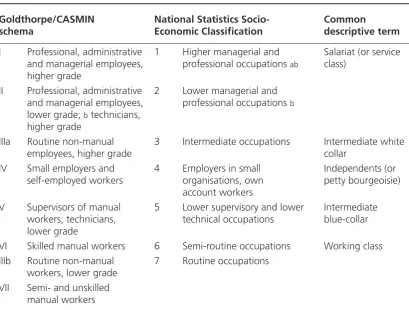
Research on social mobility in the sociological tradition tends to rely on an underpinning definition of class as shaped by employment relations. Measurement of generational differences in origins and destinations is undertaken via a class schema which is stratified by occupational groups and roles. For instance, the Goldthorpe model, developed for the 1971 Nuffield Study and the later Comparative Analysis of Social Mobility in Industrial Nations (CASMIN) study, propose a seven class model which can be collapsed into familiar distinctions between professional, intermediate and working classes. These models (see Table 3.1) have much to commend them and have become widely accepted. Indeed, the National Statistics Socio-Economic Classification is, in part, based upon it (Rose and O’Reilly, 1998).
Table . Standard Class Schema Models
Goldthorpe/CASMIN National Statistics Socio- Common
schema Economic Classification descriptive term
I Professional, administrative 1 Higher managerial and Salariat (or service and managerial employees, professional occupations ab class)
higher grade
II Professional, administrative 2 Lower managerial and and managerial employees, professional occupations b
lower grade; b technicians,
higher grade
IIIa Routine non-manual 3 Intermediate occupations Intermediate white employees, higher grade collar
IV Small employers and 4 Employers in small Independents (or self-employed workers organisations, own petty bourgeoisie)
account workers
V Supervisors of manual 5 Lower supervisory and lower Intermediate workers; technicians, technical occupations blue-collar lower grade
VI Skilled manual workers 6 Semi-routine occupations Working class IIIb Routine non-manual 7 Routine occupations
workers, lower grade VII Semi- and unskilled
manual workers
Goldthorpe and McKnight (2004).
[image:30.595.92.502.319.629.2]Class distinctions of this kind also fall victim to a variety of critiques which highlight contemporary patterns of globalisation, economic, social and political change to imply that traditional definitions of class are no longer useful in either social science enquiry or policy-related research. Perhaps the most influential of such critiques comes from Anthony Giddens, whose work underpinned much of the thinking behind the present Government’s Welfare to Work agenda. He argues that class is declining in importance as an analytical category for a variety of reasons, including the break-up of traditional conceptions of class culture and community homogeneity, especially in relation to manufacturing industries. As a result, he argues that fewer people follow the same life or career path as their parents, creating opportunities for greater choice and potential mobility. He also argues that class has declined as a structuring variable for political representation in the wake of the declining association with a class-based definition of self and group identity, which has been replaced by other aspects of identity (Giddens, 1994:14-15; 90-92; 143; 1998:20-23).
In response to such notions, Goldthorpe (2002) has argued that class remains a strong and useful analytical tool and structural feature of society. He finds continuing explanations in the continuity of origin-destination relationships for class to be thought of as an important explanatory variable. He also draws extensively on evidence from the work of Gallie. Gallie (1998; 2002) demonstrates that experiences of economic and workplace insecurity, poor job satisfaction, unemployment and negative life satisfaction are all closely related and are more pronounced among lower skilled and people in lower occupational class categories.
In addition, and tellingly, Gallie also considers work transitions within the life-cycle. The basic premise here is that employment insecurity and resulting problems may be thought of as tolerable if there are opportunities for upward job-mobility and are thus a ‘short-term inconvenience‘ experienced while passing through ‘entry’ level work. However, he cites evidence that only very few people in Britain move out of low paid employment and those that do so, do so quickly. As duration in low paid work increases, the chances of leaving it for better paid employment fall. Moreover, he argues that the extent of travel in income terms is often short, so that, for most, earnings increases are of a small scale. Finally, a large proportion of those that leave low paid employment do so to enter unemployment or inactivity. Gallie (2002:116-119) also shows that those with an experience of unemployment, even where they enter work, are likely to enter poor quality, temporary work with fewer opportunities for self control, where they have higher levels of perceived insecurity and where there are fewest chances for self-development and progression. Support for this position comes from studies of the polarisation of work (Goos and Manning 2003).
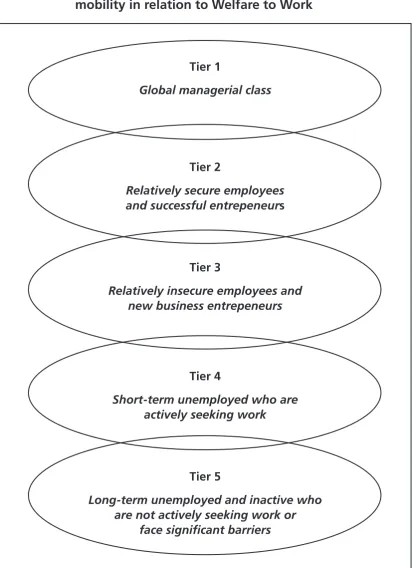
countries at the margins of the global economy and who are seriously excluded from the opportunities presented by it. Cammack (2002) uses a similar model but differentiates within the third level to identify a global labour force with greater segmentation, including workers who might compete for work even while outside employment. Based on the evidence of continued relative security for large parts of the UK workforce and of the large numbers of people who experience relatively long-term unemployment or inactivity, it may be argued that Cox’s model is too simplistic. However, if modified to take account of this, perhaps drawing on Cammack’s additional levels, a useful class schema emerges for thinking about social mobility in the UK from the point of view of Welfare to Work.
This is demonstrated in the five part schema of social stratification illustrated in Figure 3.1. This shows a global managerial class engaged in the senior management of international firms and in senior positions in Government and international organisations. Below this, Tier 2 incorporates people in more secure employment and operating largely in national, regional and local labour markets. Tier 3 incorporates individuals who are in work but are in a less secure position. In comparison with Tier 2 these employees will have less control over their working lives and have fewer opportunities for self-development and progression. Tier 4 includes people who are not in paid employment but are actively seeking and available for work. Within Tier 5 are those who face substantial, and often multiple, barriers to employment.
Figure . An alternative class Schema for understanding social mobility in relation to Welfare to Work
Tier
Global managerial class
Tier
Relatively secure employees and successful entrepeneurs
Tier
Relatively insecure employees and new business entrepeneurs
Tier 4
Short-term unemployed who are actively seeking work
Tier 5
Long-term unemployed and inactive who are not actively seeking work or
[image:33.595.92.505.131.700.2]3.5
International comparisons: contextualising the
British experience
Both the economic and the sociological literature suggest that social mobility in the UK is limited and that it may have become more limited over time. However, in order to fully understand the significance of this it is necessary to compare these conclusions with findings from other countries.
Noting the difficulties of methodological and data comparison between different countries, Blanden et al. (2005) combine their own analysis of intergenerational mobility in Britain, the US, West Germany and Canada with that of others (Bjorklund et al., 2005) for Britain, the US, Sweden, Norway and Finland. Blanden et al.’s (2005:7-8) findings suggest that the UK compares unfavourably with several other European countries and Canada in terms of social mobility and while the US has similar levels of social mobility to the UK, the UK’s position relative to the US has declined over recent decades.
Corak (2006) concludes that income mobility varies widely between rich countries. His data suggests that among the countries included in the study (Denmark, Norway, Finland, Canada, Sweden, Germany, France, the US and the UK), the UK ranks as having the least social mobility with somewhere between 43 per cent and 55 per cent of fathers‘ earnings advantage being passed on to their sons. The US ranks only slightly behind the UK. The same data indicates that northern European countries such as Denmark, Norway, Finland and Sweden as well as Canada all have much higher levels of apparent social mobility.
The CASMIN project considered patterns of social mobility in 12 European countries, the US, Japan and Australia. This produced findings which appeared to support the FJH thesis (Featherman, Jones and Hauser, 1975:340) that all countries ‘with a market economy and a nuclear family system demonstrated similar levels of relative social mobility‘ (Erikson and Goldthorpe, 1992).
A recent book substantially repeats and updates the CASMIN analysis (Breen, 2004). The findings suggest that patterns of absolute social mobility have converged across Europe, with all countries facing a shift from manual and particularly unskilled manual labour toward more service sector and administrative occupations. While this pattern is demonstrable in all countries in the survey, it is relatively more complete in Britain and the Netherlands than elsewhere and relatively incomplete in countries such as Ireland, Poland and Hungary where the transition from agriculture has not yet fully played out (Breen, 2004a:7-8; Breen and Luijkx, 2004:42-9).
3.6
Social mobility, economic growth and
competitiveness
There is some debate about the relationship between inequality, economic growth and social mobility. On the one hand, high levels of mobility might suggest that an economy is making the best use of its resources, allocating talented labour to high value jobs. On the other, high levels of inequality might constrain the potential for movement within the social hierarchy:
‘While it is widely assumed that high levels of social mobility are necessary to secure economic growth…it is also assumed that high levels of inequality will tend to restrict rates of social mobility. Yet inequality in occupational rewards is thought to provide a necessary incentive structure which promotes growth. Thus there is a paradox: both inequality and mobility are good for growth, yet one militates against the other.’
(Breen, 1997:429)
Underpinning the first assertion is a perception that inequality is necessary to provide the incentives for people to perform specific social roles and to apply their energy and ability to achieving mobility through the social hierarchy, as Davis and Moore (1945:242) argue:
‘As a functioning mechanism a society must somehow distribute its members in social positions and induce them to perform the duties of these positions. It must thus concern itself with motivation at two different levels: to instil in the proper individuals the desire to fill certain positions, the desire to perform the duties attached to them.’
4 Social capital, cultural and
social mobility
4.1
Summary
Box 4: Social and cultural capital – key points
• Social capital describes the quality and quantity of social networks and relationships within groups of individuals and families sharing similar identities and between those with different identities.
• From the point of view of social mobility, social capital can be advantageous or disadvantageous.
• Working class communities have traditionally tended to possess social capital that might operate against social mobility such as strong geographically and occupationally-based social networks.
• There is some evidence that traditional working class social capital has declined. While this may weaken the damaging effects on social mobility, other negative forms of social capital have emerged such as cultures of worklessness, anti-social behaviour and criminality and drug abuse.
• A lack of positive social capital, in the form of absence of positive role-models, can also limit capacity for upward social mobility.
• Middle-class families tend to possess different types of social capital which offer linkages to a wider range of more advantageous networks from the point of view of enabling upward mobility and protecting against downward mobility.
• Cultural capital describes the way in which ownership of cultural goods and possession of cultural knowledge and experiences can itself confer social position and can also facilitate or limit access to social groups. • There is some evidence that middle-class families tend to have beneficial
4.2
Introduction
One possible explanation for the opportunities and life chances that are available to some but not to others, is the quality of relationships and social networks that they are engaged in and the cultural experiences that they are open to. Social and cultural capital are concepts that have been used in recent years to describe these relationships and experiences. This chapter aims to explain the potential linkages between social and cultural capital and social mobility.
4.3
Social capital
Social capital is usually used to refer to the network of relationships (in terms of both quantity and quality) that derive from a particular social position or group membership (see Portes, 1998:1-3; Putnam, 2000). Underpinning much of Putnam’s work is a distinction between two forms of social capital: bonding and bridging, where the former refers to social networks and links within social groups who share similar characteristics and the latter refers to links between
different social groups.
In relation to social mobility Aldridge (2001, unpaginated) identifies social capital strongly with the ‘values and networks of contacts which parents pass onto their children’. Social capital affects the opportunities for personal and social development experienced by children and young people as well as structuring their expectations. Social norms within the peer group at school affect learning, and the wider community may also lack the type of social capital that supports learning. Pupil expectations and aspirations are also key to whether social mobility is experienced and these are influenced by the people around them (Murphy 2006).
It is important to note that from the point of view of social mobility the impact of strong levels of either bonding or bridging social capital may be complex. For instance, high levels of bonding social capital within traditional working class communities, for instance as situated around a particular industry (such as a large car manufacturer or coal mine) might be seen as constraining social mobility. Equally, the decline of these communities might be argued to open up opportunities for more diverse identities to come to the fore, leading to a decline in pre-destined class-based ‘life-time experience’ in the way argued by Giddens (1994, see Section 3.4.3).
‘Many people from low socio-economic groups do not think higher education is for them and are less confident about their ability to succeed; many do not know anyone who has been through higher education.’
(Murphy 2006: 29)
Peer pressure can negatively affect mobility, for example research shows that academically able children at a comprehensive were worried about other pupils thinking they were too clever (Power et al. 1998). Also, a child brought up in a neighbourhood and community with a high proportion of Incapacity Benefit (IB) claimants ‘is more likely to be influenced by a culture of welfare dependency and is more likely to become an IB claimant’ (Murphy 2006:44). It is this culture of worklessness that has been noted as a barrier to the success of many Welfare to Work initiatives (Dewson et al., 2007:39).
Webster et al. (2004) found that few of the socially excluded young people studied had established social networks beyond their immediate circle, which restricted the wider support and opportunities available to them. In the same way, research into successful techniques used by providers of Welfare to Work services to jobless young people also stresses breaking with cultures of worklessness, including separating individuals from negative peer group influences (Policy Research Institute, 2006:55). Similarly, research by the Joseph Rowntree Foundation (JRF) (2004) found that substantial positive change was reported by young people in desisting from offending and heroin use and that the support of family members and partners was key to leaving behind earlier social networks that encouraged these behaviours.
On the other hand, high levels of bonding social capital among middle class communities, and within the ‘middle class’ as a whole, might underpin and help to explain the apparent ability of middle class parents to protect their less able children from downward social mobility, as identified by Saunders (1995:36-7; 2002:563-4), Lucas (2001) and others (see Section 6). For example, one study found that 56 per cent of children whose parents have a professional career wish to have a professional career, compared to 13 per cent of those whose parents are partly skilled (Prime Minister’s Strategy Unit 2003). There is a further theme of importance concerning social mobility and social capital. Discussions in the literature support the current political emphasis upon a link between inadequate parenting and social problems, and the ‘determined aim to tackle the social problems of disadvantage by inculcating middle-class values at the level of the family’ (Gillies 2005: 838).
more likely to attend organised or educational activities, which research shows are associated with increased personal and social development, while poorer children are more likely to ‘hang out‘ with friends or watch TV – activities which are linked with poorer personal and social development (Margo et al. 2006).
Social capital also supports and inhibits social mobility amongst adults. There is a long history of research into ‘assortative mating’ (the pairing of individuals with similar social and/or educational characteristics in reproductive relationships) which suggests that this might be one mechanism by which inter-generational mobility is constrained and social stratification maintained (Mare, 2000). The links between assortative mating and intergenerational inequality are both genetic and social, with genetic inheritance and material and social factors being more likely to pass from one generation to the next (Ermisch and Francesconi, 2002). Empirical investigations of this, mainly in the US, have found some evidence of correlation not just between the income and social status of parents and sons but between sons and fathers-in law and parents-in law (Lam and Schoeni, 1994; Blanden, 2005; Ermisch, Francesconi and Sidler, 2006).
Ermisch and Francesconi (2002) review the research which indicates that assortative mating, based on spouse’s traits, plays an important role in social mobility. Around 40 per cent of men and women marry a partner of the same educational status – this has the effect of magnifying disparities. Marriage has been one of the major means by which both social mobility and stratification takes place, historically and cross-culturally.
Ermisch and Francesconi (2002) develop a model of behaviour based on utility-maximising behaviour by both parents and children.
‘The evidence supports the idea that richer parents are likely to have a larger and more valuable stock of both social capital and intellectual capital to pass on to their children.’
(Ermish and Francesconi 2002:i)
An aspect of social capital which acts as a barrier to mobility is the way in which certain groups ‘hoard opportunities’ for example, by constructing barriers to job entry, establishing excluding factors to membership of organisations, or using strategies to give children access to a good education (see Tilly 1998).
4.4
Cultural capital
Pierre Bourdieu pioneered the concept of cultural capital, which consists of familiarity with particular types of culture or activities, which can act as a powerful barrier to – or facilitator of – social mobility. Cultural capital is used to describe cultural goods, knowledge and experience which confer power or status in the social hierarchy. Here the relationship to social mobility is that cultural knowledge, goods and experiences can help to bridge access to social groups and ownership of it can bring power and social advantage. Cultural knowledge and familiarity may, thus, act as a ‘hidden’ barrier to social progress for those that do not possess it or for those that are associated with the ‘wrong’ forms of cultural capital.
Key aspects include the ways in which cultural and economic capital are traded, and the tensions between different groups of the elite – those whose power is mostly based on economic capital and those whose power mostly rests on cultural capital (see Brantlinger 2001). Vermeulan (2000) suggests that cultural explanations of social mobility are contentious – if the locus of social mobility is seen as culture, non-mobile groups can be blamed. Culture is defined here as a social heritage handed down over generations, so is difficult to separate from notions of social capital.
5 Families, aspirations and
the early years
5.1
Summary
Box 5: Family-based influences – key points
• Early years influences are seen as key to influencing later life chances, with convincing evidence that early experiences set in train a pattern of development that is hard to reverse even through schooling.
• Various studies have identified a range of possible causal explanations for this, including:
– innate/inherited characteristics;
– home environment, including loving/caring and supporting care givers, access to educational toys and stimuli, parental time and stress levels, nutrition and family structure;
– pre-school interventions such as childcare and education.
• However, it is difficult to attribute greater causal significance to one rather than another as they act in different combinations for different people and in different circumstances.
• There is evidence that the success of Scandinavian models of pre-school care is related to wider social trends such as greater socio-economic equality and the relative similarity of experiences between children of different socio-economic backgrounds.
5.2
Introduction
and factors which potentially explain social mobility and immobility. This chapter reviews the early years influences on social mobility, with a particular emphasis on the role of families in shaping aspirations.
5.3
The importance of the early years
The early years are seen in the academic and policy-related literature as being key to later social mobility (Reed and Robinson, 2005:285-6). The literature reveals a general consensus regarding the importance of family and education to the capacity of people to be upwardly socially mobile. For example, findings from a study for the Joseph Rowntree Foundation (JRF 2005) found that class origins were key to children’s occupational outcome but also that education, having economic assets in the home, and having a highly qualified mother were also very important. Considerable inequality is already apparent by the time children reach school. This clearly relates to factors such as social capital (see Chapter 4).
Studies such as Waldfogel (2004) suggest that early years developmental factors can be broken down into the following three categories: child endowment, parents/home environment and pre-school care/education, though it is difficult to attribute specific causal influence to each of these. Factors affecting child development include parental leave, income, social inheritance (see Delorenzi 2005), maternal depression (see Murphy 2006) breastfeeding and the duration of this (Paine et al. 1999) as well as the transmission of values between parents and their children which shape aspirations in later life (Miller, 2005:15).
Parental education is an important factor. Lochrie (2004) discusses the connections between child poverty, low educational attainment, family dysfunction and social exclusion in the United Kingdom (UK), and how educational opportunities for the whole family can transmit the motivation to succeed to children. Gutman and Feinstein (2007) show that parenting behaviour and socio-economic class are related but in complex ways. This study did show, though, that good levels of maternal education had positive benefits on child development and that where maternal education was lacking, parental behaviour became progressively more important as a determinant of child development. A range of immediate negative e