Modelling Knowledge Integration Process in Early Contractor
Involvement Procurement at Tender Stage - A Western Australian Case
Study
Abstract
Purpose
This paper aims to disseminate the knowledge integration process modelling throughout the phases of the Early Contractor Involvement (ECI) procurement methodology, to optimise the benefit of ECI procurement method. The development of the model was aimed at taking advantage from the associated benefits of integrating knowledge and of ECI procurement. ECI provides contractors with an alternative means to tendering, designing and constructing projects. Thus, this paper explores knowledge interconnectivity and its integration involving numerous disciplines with various stakeholders to benefit from the collaborative environment of ECI.
Design/Methodology/Approach
The methodology implemented in the research includes a thorough literature review to establish the characteristics of the ECI tender stage as well as the characteristics of knowledge to be integrated in an ECI setting. Following this, an embedded case study research methodology was employed involving 3 health care ECI projects undertaken by a Western Australian commercial contractor through 20 semi-structured interviews and project archival study, followed by the development of knowledge integration process models throughout the ECI process of the studied cases.
Findings
The research findings provide the basis to develop a knowledge integration process model throughout the ECI stages. The tender stage was found to be the most crucial stage for
knowledge integration, particularly from the main contractor’s perspective to impart change
and to influence the project outcome. The outcome of this research identifies the richness and interconnectivity of knowledge throughout the knowledge integration process in an ECI project starting from the intra-organisational knowledge integration process followed by the inter-organisational process of knowledge integration. This inside-out perspective of knowledge integration also revealed the need for mapping the implementation of knowledge integration from instrumental to incremental approach throughout the ECI stages in optimising the intended benefits of integrating knowledge.
Originality/Value
Keywords: Construction management, early contractor involvement, knowledge integration, knowledge management, procurement, tender stage
Paper type: Research paper
Introduction
Construction projects are undertaken utilising the expertise of numerous different stakeholders, all striving to ultimately achieve project delivery on time, within cost and to the satisfaction of the client (CEIID 2010; Sutrisna and Barrett 2007). The diversity of construction projects and varying requirements of project stakeholders has led to numerous procurement strategies formulated to achieve this end goal. Construction projects with higher technical and delivery complexity typically increase risks to the client, whereby the use of traditional procurement methods such as competitive lump sum tenders, may reduce the certainty in achieving the desired outcomes (Eddie and O'Brien 2007; Sutrisna 2004). In an effort to minimise the uncertainty, a range of relationship-based project delivery methods have been developed to systematically allocate and share risks through a collaborative
tendering environment (e.g. Scheepbouwer and Humphries 2011; Bakker et al. 2008;
Bresnen and Marshall 2000). These methods provide opportunities for all project stakeholders, including clients, consultants and contractors, to develop a project design and construction methodology in a co-operative manner, where delivery and budget risks can be minimised while overall project quality maintained (Mignot 2011). In Western Australia (WA), one of these relationship-based project delivery methodologies that have been recently introduced is the Early Contractor Involvement (ECI).
Perceived successes of ECI methodology within the Australian construction industry have resulted in its adaptation into the broader construction industry, where projects requiring certainty of delivery and risk mitigation may be able to benefit the most (Rahmani et al. 2016; Mignot 2011). In WA, an increased demand for the construction of health services, and hence healthcare facilities, throughout the state has mainly been driven by factors such as a growing and ageing population, rising community expectations, advances in medical technology and increase in the number of chronic illness sufferers (Government of WA 2014). In addition to the AUS$6.9 billion health service infrastructure under its management, the WA Department of Health was set to make further asset investment of AUS$993.6 million in 2014-2015 alone (Government of WA 2014). With complexity of their delivery and requirement for certainty of time, cost and quality characterising healthcare projects (e.g. Barlow and Köberle-Gaiser 2008; Manning and Messner 2008), ECI has been regarded as a suitable procurement method to achieve successful health services construction project in WA.
management support and general effectiveness of systems (Gold et al. 2001). To overcome such issues and barriers, a mixture of socialised and codified measures had been proposed to maximise leveraging of intellectual capital and exploitation of the knowledge cycle (Chen
and Mohamed 2010; Subashini et al. 2005). Given the novelty of ECI in Western Australian
building sector, a research project was set up to develop a knowledge integration model in ECI projects. Due to the variability between different construction projects, the research focuses on the knowledge integration in delivering healthcare projects due to the increased popularity of such projects in WA. This paper discusses the research findings from case study analysis of 3 contemporary health care construction projects in WA. From the investigation it was found that the most critical stage of knowledge integration for Contractors in an ECI scenario is at the tender stage. Reasons for this criticality came from the capacity to influence and change the outcome of a project with minimal cost or programme impacts (Rawlinson 2006). This encompasses influence on the design curve, identification, allocation and mitigation of risks, demonstration of competitive advantage and establishment of project relationships (Rawlinson 2006; Hampson and Kwok 1997). The ability to integrate knowledge at this stage to maximise the above mentioned influence, particularly in an ECI scenario, is consequently vital to the success of the project hence the focus on the tender stage in this paper.
ECI in Australia and the need to integrate knowledge
As a procurement alternative by the use of partnering techniques, ECI is one of the methods originating from the ‘boom’ in the UK markets at the turn of the millennium (Rahmani et al. 2012; Mosey 2009). With the earlier discussion on relational contracting commissioned by the Queensland Department of Main Roads (Manley and Hampson, 2000) followed by the first adoption of ECI in Australia by the Queensland road construction industry around 2004, ECI has been gaining popularity, especially in long term, high cost and/or complex projects (Edwards 2009; Eddie and O'Brien 2007). Scholars (e.g. Christie et al. 2012; Whitehead 2009) summarise the suitability of ECI in high-risk projects by arguing that ECI optimises risk management, risk allocation, price and control through risk identification and mitigation rather than allocation. Similar to the UK model, ECI procurement in Australia typically involves the client and its design consultants engaging with a contractor while design is still being developed or in some cases prior to design development, where the design team is within the contractor’s coordination. This is different from an alternative American model, construction management at risk, where the client undertakes a separate contractual relationship with the design team to that of the contractor, engaging with the contractor primarily for pre-construction services (Rahman and Alhassan 2012; Scheepbouwer and Humphries 2011).
Typically, ECI consists of 2 stages incorporating the project definition, design phases and project execution (DMR 2009; Whitehead 2009). This is consistent with other documents such as the Procurement and Contract Strategies (2009), written to reflect strategies available under New Engineering Contracts (NEC) in the UK. ECI can also be used in a three stage
model and as Walker and Lloyd-Walker (2012) classified, the third stage is the ‘operational
The typical process in an ECI project commences when the client releases an Expression of Interest (EOI) or alternatively requests pre-qualification criteria, followed by a Request for Proposal (RFP) to shortlisted contractors, asking for a range of items including fixed preliminaries, margin and risk contingency percentage as well as staffing and design analysis and alternative solutions, ensuring that the client is afforded maximum opportunity to assess competitiveness of prospective tenderers and award accordingly (Edwards 2009). Typically at this stage, needs and objectives of the project would have been identified, but development of design can range from sketch drawings to a reasonably detailed design, depending on client preference and project specific requirements and constraints at the time (Rahmani et al. 2012). After being awarded the contract for Stage 1, the contractor, in partnership with the client and design team, proceed with design development, typically aiming for at least 70% detailed design completion by tender submission, whist identifying, mitigating and appropriating risks as well as costing the project throughout this period (Christie et al. 2012; Rahman and Alhassan 2012). The contractor also has opportunity to bring value engineering and constructability to the fore throughout Stage 1 and where prescribed by project requirements may also undertake preliminary construction works. At the end of the Stage 1 ECI period, the contractor is typically requested to submit a ‘risk adjusted price’ in the form of a lump sum for remaining design and construction works and, jointly with the client, develop a target price as the basis for a pain/gain share formula in the contract. The contract will be typically structured to include ‘win-win’ shared incentives between the client and sponsor to encourage a ‘best for project’ attitude (Wamuziri 2013; Christie et al. 2012; Mignot 2011). Based on the design and final tender sum submitted by the contractor, the client will have the option to continue with the relationship and award the Stage 2 construction contract or reject the offer and seek alternative means for project delivery (DOIT 2012). Option to seek alternative project delivery helps to ensure the competitiveness of the final ‘risk adjusted price’ received from the contractor. Assuming the tender submission addresses what the client is looking for, the client will typically continue appointing the same contractor for the stage 2 ECI, with delivery to take place through more traditional processes, such as construct only or design and construct (DOIT 2012; Whitehead 2009).
It is generally argued that involving the contractor at the early design stage induces a sense of ownership of the project, with the Stage 2 contract acting as motivation for the contractor to maximise their involvement in Stage 1. Early involvement of the contractor also allows an increased opportunity for the whole-life-costing to be incorporated in the decisions to expand focus to the life of the asset rather than solely on capital costs (NEC 2009). ECI also considered beneficial towards the contractor’s ‘bigger picture’, i.e. fostering valuable relationships with clients with the intention of retaining the benefits into the future that enabled through trust (Rahmani et al. 2013). However, Christie et al. (2012) also noted that the ECI process can potentially remove some of the competitive edge from pricing due to the inherent nature under which the bid is produced, but at the same time also advocated the potential to minimise this issue (of less competitiveness in pricing) through the transparency in ECI process. The collaborative working environment of ECI is also considered suitable for complex projects that have inherent risk and uncertainty that can be effectively resolved through the transparent multi-team approach (Edwards 2009). In summary, the structure of the ECI process requires a broad range of knowledge to be managed from very early in the
process. From a contractor’s perspective, the combination of early involvement and a broad
contractor to create value to client as well as create efficiencies within its own business (Edwards 2009; Manley 2008).
For a contractor, being able to exploit a repeatable business is fundamental to achieving competitive advantage, whilst at practical level, driving a consistent approach to carrying out business through projects that are temporary in nature can also be considered vital. At a conceptual level, this consistent approach can be achieved through efficient and effective utilisation and management of knowledge (Egbu 2004). Consequently, the structure of the ECI procurement strategy magnifies the necessity of knowledge integration for the main contractor mainly to leverage on the organisations’ dynamic capacity and the ability to integrate internal and external knowledge (Ruan et al. 2012; Mitchell, 2006) to win and subsequently deliver the job. Whilst the internal knowledge refers to the knowledge within
the main contractor’s organisation (intra-organisational knowledge integration), the external
knowledge refers to the knowledge gained from interacting with other stakeholders (inter-organisational knowledge integration) during the stage 1 of the ECI. . As a knowledge-intensive industry, the construction sector is characterised by project orientation (temporary in nature), being demand-driven, and with fragmentation that present a number of challenges
when it comes to managing knowledge (Kale and Karaman 2012; Carrillo 2005; Subashini et
al. 2005). Scholars such as Chinowsky et al. (2009) and Dave and Koskela (2009) have agreed with this view and argued that the fundamentally unstable construction project networks involving architects, surveyors, contractors, trades persons and clients require constant re-initiation with each other on every new project, leaving little opportunity for the stable and time rich environment required for effective knowledge management practices to be implemented and established. This view is further reflected in the composition of project teams themselves, where team members, even in a chronological manner, are rarely comprised of the same individuals. However, although the unique and temporal project
characteristics encountered by construction organisations can inhibit the ‘natural’
mechanisms of learning normally available in permanent organisations, the repeatable processes undertaken throughout construction projects facilitate scope for transfer of
knowledge and learning (Carrillo 2005; Love et al. 2000). Within the construction industry
environment, these repeatable processes encompass data, information and knowledge retained within individual and organisational fluctuating processes, all of which, much like the knowledge cycle, move through a conceptual cycle, between a tacit state and an explicit object.
Senaratne and Sexton (2008) identified that in a problem-solving environment such as construction projects, the explicit and tacit forms of knowledge are seen respectively as stocks and flows (terms explored in further detail later in this paper), and when viewed from an organisational perspective can be interpreted as an ‘asset’ and a ‘process’. The understanding of knowledge as both an asset and a process (and also the way these forms exist and are articulated) is essential when managing and retaining knowledge (Kale and
Karaman 2012). Thus, the ability of an organisation to contain knowledge as an “objectively
must not be discarded, as the conceptual ‘flow’ of social experiences allows subconscious development, transmittal and maintenance of knowledge in social situations (Lindner and Wald 2011). Furthermore, the essential nature of this social context is confirmed by its capacity to allow integration of individual knowledge into a wider context of common task fulfilment throughout organisations while also leveraging this context to facilitate fostering of unique organisational abilities and consequential competitive advantage (Senaratne and Sexton 2008; Chuang 2004; Nonaka 1991). The need to integrate knowledge was originally advocated by Grant (1996) arguing the importance of integrating specialist and individual knowledge in performing tasks and forming organisational capability. When integrated and employed effectively, the use of knowledge in the social context can facilitate competitive advantage through avenues such as retained knowledge improving business processes and reduction of mistakes and poor performance through utilisation of lessons learnt (Carrillo 2005; Grant 1996). The social embeddedness of knowledge as well as the project-based nature of the construction industry have been perceived as the main sources of the unavailability of knowledge when and where needed (Facada 2013). Whilst summarising the superiority of ECI as the source of knowledge for the project participants, Song et al. (2009) also identified potential barriers in effective management that may prevent effective use of knowledge in projects. This is mainly due to the level of complexity in construction projects that involves a wider scope of knowledge to be integrated with lower level of common knowledge that may result in inefficient communication and inefficient integration of knowledge (Huang and Newell 2003; Grant 1996). Thus, in order to increase the likelihood to deliver the ECI stage 1 successfully and to be appointed for ECI stage 2, there is a need to effectively manage the integration of knowledge from the main contractors’ perspective to gain competitive advantage from ECI and for the project as a whole to benefit from such a collaborative approach that is gaining popularity in WA.
Knowledge, knowledge dynamism in organisations and key assumptions
There is a complex dialectic between those who define knowledge as a scientific truth that exists independently of human action, and those who argue that knowledge is socially constructed.
Whilst knowledge has been traditionally thought of as a static concept, something that exists independently of human beings, there are those who assert that knowledge is socially constructed and is completely determined by social structures. In this respect, knowledge is seen as a process that is context-specific. This social constructionist perspective has Marxist undertones and has been further revised by a view that human action determines knowledge (Habermas, 1984). Thus social interaction is the principle motor of knowledge and human beings are responsible for conditioning their own environment (Nonaka and Takeuchi, 1995). In this paper, the view taken is that knowledge is socially constructed and context specific.
This research also subscribes to Davenport and Prusak’s (1998, p. 5) definition of knowledge
Whilst accepting the existence and place of different schools of thought on organisations or firms, this paper subscribes to the knowledge-based view of firms. This helps with understanding of the relationships between firm capabilities and firm performance. Specifically, this approach suggests that knowledge generation, accumulation and application can be the source of superior performance. Given this stance on the knowledge based-view, the assumption is that the heterogeneous knowledge bases and capabilities among firms are the main determinants of performance. This position was also extended to view that construction organisations not only use different knowledge bases and capabilities in developing knowledge but also have differential access to externally generated knowledge.
Knowledge management in organisations is complex. In line with the works of Dierickx and Cool (1989), in this paper it is conceptualised that the underlying knowledge contributing to superior firm performance of construction organisations is in terms of “stocks” and “flows”. Stocks of knowledge are accumulated knowledge assets which are internal to construction organisations and flows of knowledge are represented by knowledge streams into the organisations or various parts of the organisations, which may be assimilated and developed into stocks of knowledge.
Whilst this article has attempted to simplify the dynamics of knowledge in organisational contexts for explicating the findings from its case studies, it is important to stress its complexity. There have been a number of models which have attempted to capture the flow and dynamics of knowledge in organisations. These include the SECI Model - the process of knowledge creation through socialisation-externalisation-combination-internalisation as per
Nonaka's (1994) and Nissen's (2006) knowledge flows model. Nonaka’s (1994) model
considers two dimensions for knowledge creation: epistemological dimension and ontological dimension. The first dimension is related to the conversion of knowledge from tacit level to explicit level, and from explicit level to the tacit level. The second dimension is related to the conversion of knowledge from individuals to groups and further to organisation. Through combining these two dimensions, Nonaka established a spiral model for knowledge creation and processing.
There are other writers that have both raised a number of limitations to Nonaka’s model, and
have also attempted to build up additional perspectives on knowledge creation and organisational knowledge dynamics (e.g. Agourram, 2009; Harsh, 2009; Bratianu, 2008, Gourlay, 2006; Styhre, 2004). Harsh (2009) observed that Nonaka’s model does not consider the fact that a significant part of the initial knowledge is flowing through the cycle many times, which actually means that there is a kind of reusable knowledge. He further contends that “It is a surprise that in spite of great attention to knowledge creation and sharing theories and issues, the reusable knowledge has not been discussed explicitly during
knowledge transformation in the Nonaka’s model” (Harsh, 2009, p.2). Harsh went further to
remind that any conversion or transfer of knowledge consumes time, which does not appear as a variable in the Nonaka’s model.
The Nissen’s (2006) model is based on the Nonaka’s model. However, it is extended to a three dimensional framework with time as a fourth dimension. Thus, Nissen extends
Nonaka’s two dimensional model to integrate two complementary dimensions: life cycle and
analysis of knowledge as energy shows that the entropy law can be considered to suggest that knowledge can be transferred and integrated (Bratianu and Andriessen 2008)
There are also other complexities to be taken into account in the dynamics of knowledge. These include the “stickiness” of knowledge, which connotes the difficulty of transferring knowledge within an organisation (Szulanski 2000), the recipient’s lack of absorptive capacity; causal ambiguity, and an arduous relationship between the source and the recipient
(Szulanski, 1996). Ideally, any knowledge management effort should incorporate all aspects
of the organisation through the integration of internal and external knowledge as well as capabilities (Ribenio 2009).
Considerations as explored into the complexities of the knowledge debate justify the criticality of knowledge integration within an organisation, with the dynamic of knowledge as
both a “stock” and a “flow” defining how knowledge in these forms can be managed. As the
responses of firms and concurrent knowledge integration practices at organisational level during procurement of health projects has not been explored in any great depth, the requirement to research and investigate in this area to understand what is required to leverage competitive advantage can be rationalised.
Research methodology
The formulation of the research methodology used in this paper was influenced by the research paradigm reflecting the philosophical underpinning of the research problem as well as the researchers’ cultural and personal preferences (Collis and Hussey 2009; Sutrisna 2009). As a philosophical underpinning that provided guidance to the research approach, the
interpretivist paradigm (Creswell 2009; Saunders et al. 2000; Guba and Lincoln 1994) is the
philosophical stance taken in this research focusing on exploration of the complexity of social phenomena and aiming to make sense of and understand the meanings others have of the world. The understanding of meaning is typically achieved through inductively developed theories and patterns constructed through exploration of data (Robson 2011; Sutrisna 2009). With contextual relevance being an integral part of the interpretivist philosophical stance, data collected and hence the analysis conducted in this research was qualitative (McKie 2002). Qualitative methods of inquiries have been considered reliable in analysing complex situation (Barret and Sutrisna 2009) and have been encouraged to be implemented in built environment research to enrich findings (e.g. Dainty 2008). This particular style of enquiry allows for exploration and understanding of knowledge at the ECI tender stage through the collection of rich data (refer to Sutrisna and Barrett 2007 for the definition of and discussion on rich data), including semi structured interviews and archival analysis, in order to develop the intended model of knowledge integration process in ECI projects.
As the aim of this paper is to model the knowledge integration within the main contractor organisation, the embedded case study approach implemented within a single organisation of a commercial contractor operating in Western Australia was considered suitable for this study. Consistent with the embedded case study techniques described in Yin (2014), within the single organisation, 3 embedded case studies (i.e. internal to the single organisation), in the form of construction projects, were identified for investigation from the contractor’s portfolio. The three cases were selected from the company’s portfolio based on the sector
the sector. Within these embedded case studies, ‘process units’, such as functions within the organisation, the documents and knowledge from each functions and their relationship with each other, were analysed. As discussed in the literature review section, the ECI process has only been adopted by the Australian commercial construction industry recently (Whitehead 2009; Swainston 2006). With clients and contractors becoming more familiar with the process, the opportunity to investigate the knowledge required and the processes of managing knowledge at an organisational level can be considered optimum.
A large commercial contractor practicing within Western Australia that had successfully carried out numerous ECI tenders (the “company”) was approached to participate in the research. The rationalisation behind selection of a single contractor was to establish a holistic
understanding of the ECI process approach from the main contractor’s point a view (a single)
organisation across multiple projects, as well as investigate the typology of knowledge needed through the ECI stages and how the knowledge can be integrated. Limitations of investigating a single organisation were acknowledged and considered in this paper, with data, findings and recommendations contextualised within one type of organisation. However, through focusing on a single organisation environment, the findings capture a holistic image of a specific organisational knowledge management methodology and aid further understanding of the knowledge integration requirements in ECI procurement, particularly in healthcare projects.
The number of respondents interviewed was fully determined by the achievement of data saturation (please refer to Barrett and Sutrisna 2009; Strauss and Corbin 1998 for data saturation). In this research, data saturation was achieved after conducting 20 semi-structured interviews with participants of projects, A, B, and C from the company comprising various roles, complemented by an archival study of the project files/reports. Respondents were identified and approached through a snowball-sampling methodology as described in Cohen
(2011) and also informed by the company’s database of employees involved in the selected 3
cases. Data analysis involves content analysis with a cross-case comparison technique where key themes were identified between cases and then coded (Collis and Hussey 2009). Table 1 presents the profile of the respondents.
‘Insert Table 1 Here’
Table 1. Characteristics of the respondents
2004) map of all 3 projects. The development of these is discussed in the section following the case study, i.e. the findings and discussion section.
Case study description
The company is a leading commercial contractor within the Australian construction sector and has offices in Australia as well as in a number of overseas locations with over 3,000 employees worldwide. The company has a wide and varied project portfolio and considers themselves a leader within the spheres of construction innovation and project delivery. As a large, fragmented organisation with multiple offices and work fronts, information and knowledge exchange plays an important role in the everyday functionality of the business. A suite of systems and processes that are primarily supported by a two tier intranet system are accessible to all project participants, act as the primary information repository and implemented to allow cross-project collaboration. Over the last 5 years, the Western Australian arm of the company has witnessed a significant proportion of its portfolio
consisting ECI procured projects, largely encouraged by the surge period of hospital
construction in WA. Driven by the inherent complexity and perceived success of ECI procurement in reducing risk, both the private and public health care sector clients have decided to adopt ECI. The embedded case studies of the 3 ECI hospital projects within the company’s portfolio are described below, illustrating the adaptability of the ECI process whilst highlighting differences in implementation approach.
The embedded case studies
Project A was a hospital extension and refurbishment, integrated into an existing facility with an element of new construction. Sequencing of works maintaining existing hospital functionality was imperative to this project. Of the 3 case studies, Project A is the most recent, with the stage 1 submission taking place in mid-2012. Unusual for an ECI project in Australia, the submission for project A consisted of a build-only, risk-adjusted guaranteed maximum price (GMP) submission and not a hybrid alliance-design and construct (D and C)
model as discussed by many scholars (e.g. Rahmani et al. 2013; Edwards 2009; Swainston
2006). Consequently, stage 1 was carried out under the guise of management contracting arrangement and Stage 2 as traditional build-only construction. Some of the defining characteristics recognised throughout the tender stage included a difficult, untrusting client who was unfamiliar with the ECI process in addition to limited availability of detailed design documentation throughout the period. The project bid team and client team were not co-located throughout the stage 1 ECI, rather they occupied separate offices, the former at another construction site and the latter within the existing facility.
construction concept, novation typically involve a contractual relationship between the original designer of the preliminary design with the main contractor to further develop the design. This enables the contractor to influence the design and include constructability factors (Walker and Hampson 2003). Project B also included a component of early construction works during stage 1. The company undertook the stage 1 ECI tender process on site at project B, where both the company and client B were co-located and worked in and shared the same office space in effort to facilitate the integrated team approach and transparent environment required through the ECI tender process.
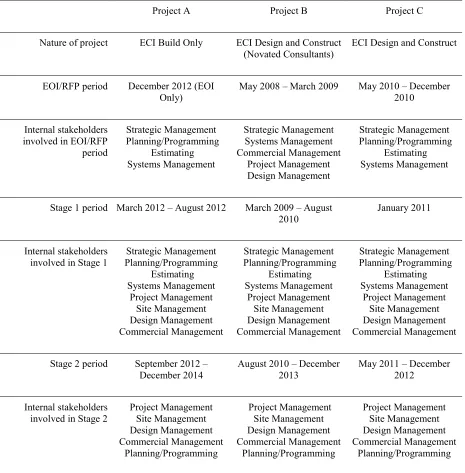
Project C consisted of the integrated construction of an essential services support facility, services tunnel and ancillary support buildings in an existing hospital precinct. This project was characterised by a large amount of mechanical and electrical plant and equipment. Sequencing of works throughout the construction period and maintaining existing precinct car parking was very important in this project. Project C was tendered for and won between the relevant tender periods of project A and project B. Project C was unique in comparison to projects A and B as its design was developed and submitted by the main contractor who had brought their own design team to the job. This led to the final submission being a fixed lump sum. Similar to project B, project C also consisted of a portion of early construction works during Stage 1 of the ECI. Project C was also the only project at the time of interviews that had reached practical completion. Due to early construction works, preparation of the Stage 2 bid was carried out onsite, with client C located within the existing facility. Unlike project A, being located within the same area allowed the company and client C to improve levels of collaboration throughout the tender period. Table 2 summarises the 3 cases.
‘Insert Table 2 Here’
Table 2. The summary of the 3 cases studied.
As evidenced from the case studies, a distinction exists between the ‘teams’ at each ECI stage. In principle, from expression of interest (EOI) through the ECI tender to construction, three separate teams exist, one at each stage, with characteristics of each matching knowledge requirements of the project stage. Between stages, a transition period took place where participants leaving the project would transfer their knowledge of the project to new members on decisions made and directions taken.
The team make-up commences with strategic, business development throughout the EOI and RFP period, growing into a large bid team during Stage 1, where the project delivery team would join those involved with the EOI and RFP to put together the tender. The stage 1 period was significant as it saw a combination of the permanent and temporary areas within the business.
Findings and discussion: Integrating knowledge at the ECI tender Stage
Through analysing the collected data in this research, it was found that both intra-organisational and inter-intra-organisational types of knowledge integration present in ECI tender stage. Whilst the inter-organisational aspects of knowledge integration have been widely researched and discussed (e.g. Lang 2004; Grant 1996), the intra-organisational side of knowledge integration has received less attention. Taking a more holistic view of studying organisational knowledge that consists of both inter-organisational and intra-organisational
perspectives (Easterby-Smith et al. 2008; Holmqvist 2003), this paper presents the findings
on both aspects of knowledge integration and what has been considered important in facilitating knowledge integration as considered by scholars including Ruan et al. (2012), Mitchell (2006) and Fong (2003), but argues intra-organisational knowledge integration as the main contribution of the research due to this area presented the greatest gap in available literature.
The tender stage of the ECI process requires different individuals and units/functions within the contractor, bringing together internal expertise, experience, and knowledge to work together in an integrated manner. Intra-organisational knowledge integration of this manner is required by the internal project team of the contractor firm to perform their function before they can subsequently work in collaboration with other firms, i.e. inter-organisational
integration (in a similar manner to ‘cross-functional project team’ described by Huang and
Newell (2003)). By working collaboratively with other firms within the project team to deliver the earlier stage of the ECI contract, the contractor also maximise their chance to be selected for the construction phase of the project. This ‘inside-out’ view of knowledge
integration, which begins with integrating intra-organisational knowledge in the contractor’s
internal team followed by inter-organisational integration, can be considered the needed approach in gaining competitive advantage for the contractor to secure the construction phase (stage 2) of an ECI project.
Intra-organisational knowledge integration
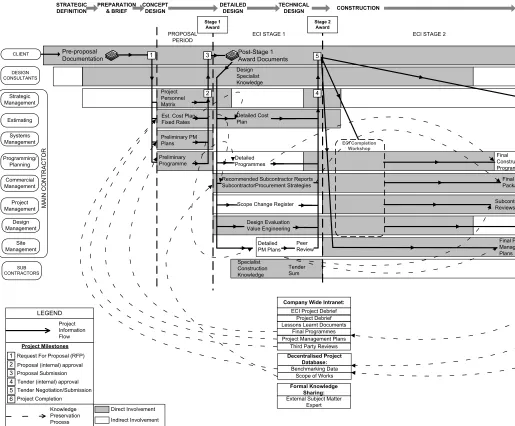
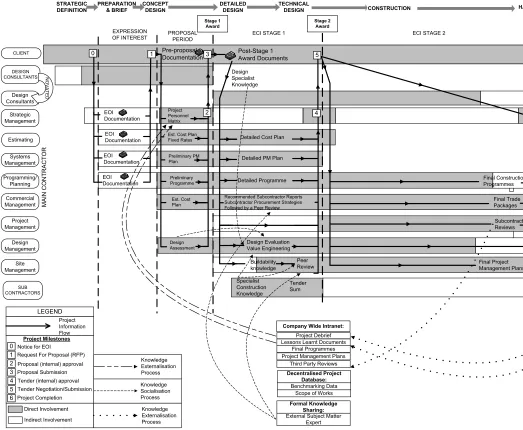
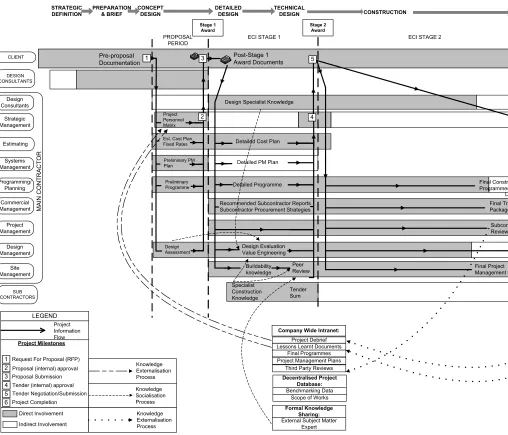
Originally coined by Grant (1996), the concept of knowledge integration involves codification of tacit knowledge into explicit rules (direction), organisational routines, the common language, organisational structure, the nature of task, the level of complexity in integrating differentiated knowledge and the organisational capacity for reconfiguring existing knowledge as a means of improvement. This was found consistent with the existing and well established intra-organisational knowledge views of organisations that emphasise on the exploitation of existing knowledge (Riege 2005; Holmqvist 2003). Subsequently, it can be argued that the exploitation of existing knowledge at the intra-organisational level involves conversion of tacit and explicit knowledge (Fong 2005; Nonaka and Takeuchi 1995). Adapted from Fong (2005), the conversion modes involving preservation, socialisation, externalisation and internalisation representing the intra-organisational knowledge integration at ECI tender stage from the case study is presented here.
reasons. Thus, the figures display knowledge preservation in project A and knowledge socialisation, externalisation and internalisation in projects B and C. The figures depicted the modelling process that tracked down the types of knowledge originated from different project organisation functions within the main contractor organisations as well as relevant external organisations including their direct/indirect involvement in the project. The breakdown of the
contractor’s organisation functions (into strategic management, estimating, system
management, programming/planning, commercial management, project management, design management and site management) was derived from archival analysis of the studied contractor organisation and further informed by interviews. The resulted diagrams/maps were communicated back to interviewees prior to their finalisation.
‘Insert Figure 1 Here’
Figure 1. The intra-organisational knowledge integration in project A showing knowledge preservation process only
‘Insert Figure 2 Here’
Figure 2. The intra-organisational knowledge flow in project B showing knowledge socialisation, externalisation and internalisation processes only
‘Insert Figure 3 Here’
Figure 3. The intra-organisational knowledge flow in project C showing socialisation, externalisation and internalisation processes only
Preservation: Explicit to explicit knowledge conversion
The Preservation mode of knowledge conversion aims to convert explicit knowledge into more complex and systematic sets of explicit knowledge, involving acquisition and
integration, synthesis and processing and also dissemination (Nonaka et al. 2000). Over the
three case studies (projects A, B, and C), knowledge exchanged through preservation was predominantly carried out through exchange and flow of documents integral to the tender process. In this scenario, documents were transferred between project participants at differing stages of the ECI process, usually transferred directly through the handover period. However, at the commencement of the project, these documents were also sourced from the decentralised databases of previous projects as well as the company’s intranet. Information on these documents included:
- Benchmarking data, where rates from projects were communicated and stored for use
on future projects
- Past programmes, where durations and rates were recorded and re-used in a ‘
- Past project management plans, where templates and methodologies were stored and re-used on new projects to assist evolution of plans.
Knowledge being utilised through preservation was identified as being used significantly throughout the EOI/RFP stages and Stage 1 to assist with formulation of the proposal and bid (projects A, B, and C) despite potential difficulties in utilising the intranet identified by respondents including lack of training in using intranet, lack of user friendliness and reliability issues. These difficulties were found consistent with reported barriers in achieving success in knowledge management strategy which includes barriers in individual, organisational, and technological dimensions (Riege 2005). The factual composition of the knowledge in a system such as the intranet in the case study means that the captured knowledge can be easily and reliably utilised when needed. However, from the case study the lack of contextual richness to aid decision making or to add value was identified, confirming the phenomenon described by Nonaka (1991) that the captured knowledge became dormant asset in which its underutilisation prevents full benefit realisation.
Socialisation: Tacit to tacit knowledge conversion
Throughout the tender stage, the company approached socialisation as the most important knowledge conversion process. Involving the conversion of tacit knowledge that is usually time and space specific, socialisation usually occurs through shared experiences and in many cases, in informal settings (Nonaka et al. 2000). In all three cases, socialisation occurred in the following processes;
- Handover between ECI Stages to ensure smooth transition between project members
and to help with understanding processes;
- Communication and collaboration with colleagues for experiential and anecdotal
knowledge;
- Assessing client requirements; and,
- Peer Reviews.
With an identified advantage of the ECI process being the collaborative nature through which the stakeholders work together particularly during Stage 1, the opportunity for this collaborative process to be reflected in the manner that the Contractor approaches transition between stages is evident.
This implies, as also identified throughout a number of the interviews, that the transition between ECI stages was dissimilar to traditional competitive tenders where the ‘bid team’ and the ‘project team’ are likely to have limited interaction, and instead, ‘handover’ was positively approached, supported and enforced by strategic management, to ensure smooth and comprehensive integration of knowledge, for the most part utilised through socialisation. The level of common knowledge among specialists fundamentally determines the efficiency of the knowledge integration (Huang and Newell 2003; Grant 1996).
“I think you’ll see that the ECI benefit to an extent is that your [bid] team’s involved in the job, so whilst yes they’ll still move away eventually, they’re involved right the way through. So… you’re [not] having to re-teach people, or [have someone] come in cold and try and learn what’s the contract, what’s this, what’s that? [Instead] they’ve been involved with those [bid] teams during the job, so everyone’s got pretty good knowledge of where the job sits…"
[Respondent 12, project B]
Review processes coined ‘peer reviews’ were carried out in this fashion to the handover between ECI stages. The ‘peer reviews’ were carried out on each project where senior company employees with a wealth of experience would hold a forum with specific project participants (such as site management or commercial management) towards the end of stage 1 bid process and essentially critique decisions made by the ‘bid team’ to scrutinise methodologies and rationale and to ensure that consistency of company virtues and culture was maintained and decision making was sound. On a job such as project B for example, where there were multiple sections of the project being bid by different ‘bid teams’, methodologies were reviewed to ensure consistency across the project. Similar to the way that the handovers were conducted, limited information was recorded from these meetings. What was recorded was typically a set of minutes and relevant action items for those being critiqued. These minutes would then be archived for reference primarily for the peer review. Thus, the peer review was conducted in an informal setting, and therefore conducive to encourage willingness for intra-organisational project participants to combine knowledge, which has been considered an important aspect in integrating knowledge (Fong 2005).
Externalisation: tacit to explicit knowledge conversion
‘Externalisation‘knowledge conversion was facilitated by the following techniques
throughout the projects;
- Subcontractor reviews
- Lessons learned forums; and,
- Project debriefs.
Knowledge that was externalised in this manner suffered a similar underutilisation as in ‘preservation’ above due to the perceived difficulties in locating answers in an efficient manner. Consequently, the externalised and preserved knowledge was rarely relied on during the tender and construction phases other than from a strategic management perspective, a theme similar to Nycyk’s (2011) observation of another Western Australian construction company. The findings here reflect the significance of the users’ motivational factors in using new information technology systems, namely the perceived usefulness, perceived ease of use and perceived enjoyment (Dias 2002).
Internalisation: Explicit to tacit knowledge conversion
Evidence of knowledge ‘internalisation’ relied heavily on internal staff knowing where knowledge was stored and leveraging it from there. This included methods encompassing;
- Project debriefs
- Lessons learnt forums
- Commercial management manual
Internalisation was effectively a judgement making technique based on ‘lessons learnt’ from
previous experience to make decisions on future projects. Generally, the internalisation process was carried out individually throughout different disciplines, where individual and collective records were shared and utilised by individuals as well as teams (Nonaka et al. 2000). Internalisation conversion was observed albeit limited to individual’s databases (projects A, B, C). The only exception to this was the utilisation of commercial management manual, setting out the commercial management processes in the company. This represents ‘fragmentation’ within the construction discipline (e.g. Egbu 2006), in which individuals are not fully utilising collective and shared knowledge.
Summary of intra-organisational knowledge integration
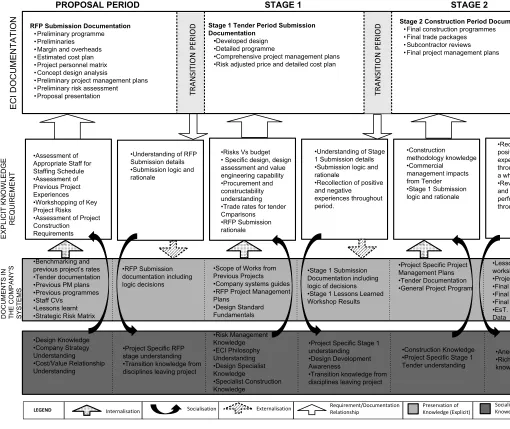
Fundamentally, the ECI process across the three cases required a multi-faceted intra-organisational team approach, where a range of different roles were forced to work together that are not traditionally intertwined in this way. Due to this team complexity and knowledge diversity, a range of knowledge management techniques existed throughout the tender stage, encompassing the entire knowledge conversion cycle. However, a lack of effective knowledge integration outside an intra-project perspective was evident, due to poor incentive and motivation factors coupled with a strong company-wide reliance on socialisation as a primary knowledge management tool. Subsequently, other knowledge management tools, such as lessons learnt forums, peer reviews and project management plans were not utilised to their full capacity. Furthermore, although it was evident that knowledge captured through externalisation existed, internalisation of this knowledge was underutilised due to poor storage and storing techniques. Figure 4 presents an illustration of the intra-organisational integration at the ECI tender stage of showing the internal project participant tacit knowledge at each stage, how these were combined through various conversion processes as well as the transition between needed knowledge into ECI documentation.
Figure 4. The generic knowledge integration model for ECI projects
Inter-organisational knowledge integration
The underpinning theoretical framework used in this paper was adapted from the Knowledge Integration concept proposed by Grant (1996). The inter-organisational knowledge integration for ECI tender stage in this research follows the Knowledge Integration Modes developed and advocated by Lang (2004). This includes integration with other stakeholders external to the contractor organisation which are needed to fulfil the aim of the project and can be classified into four modes, namely frontier, incremental, instrumental and combinative (identified based on the diversity of knowledge streams, tacit-ness of knowledge, and value created).
The movement from ‘traditional’ contracting towards ECI type contracting in the
construction industry can be perceived as a movement away from instrumental towards the incremental knowledge mode. The instrumental knowledge integration mode aims for the fulfilment of mere economic transactions mainly based upon explicitly codified knowledge and available capabilities whilst incremental knowledge integration model aims for the joint development of ‘communities of practice’ in fostering innovation and higher achievement (Lang 2004). Thus in line with the principles of the incremental model describing extensive system integration and extensive exchange of knowledge between producers and purchasers
to better match the purchasers’ needs, the ECI model facilitates much closer collaboration,
mainly between contractors and clients, to jointly develop a building or structure that will
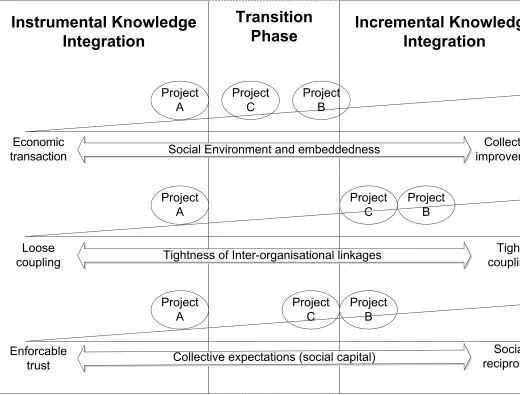
better serve the client’s need. The following Figure 5 maps the transition from instrumental
towards incremental knowledge integration modes in the 3 cases studied in this research.
‘Insert Figure 5 Here’
Figure 5: The transition from instrumental towards incremental knowledge integration modes in the 3 cases
Implications towards knowledge integration in the studied ECI projects
Of the 3 projects studied (projects A, B and C), a progression along the
integration-incremental transition can be identified between the projects and through using Lang’s (2004)
theory and can be categorised and modelled by social environment and embeddedness, tightness of inter-organisational linkages and collective expectations (social capital) (see Figure 6).
Social environment
instrumental-incremental transition of knowledge integration. Project B, for example, with shared responsibilities between the project team and novated consultants, led to a collective
improvement culture; a ’best for project’ attitude (Edwards 2009, 18). The mentality of this
was not come about by accident as numerous initiatives had been put in place to lead to
collaborative environment, such as the ‘One Team’ approach’ [respondent Q, projects A, B
and C] and was identified by the client as a defining factor in the success of the initial RFP bid. The ‘one team approach’ can be seen as an approach to perceive different project stakeholders as a united single entity. In project C, while the contractor benefited from having its own design team, reducing the need for collective improvement, in order to understand client design needs, cooperation between project teams was still required. Whereas in project A, with no design responsibility allocated to the contractor, remained a fundamentally economic transaction and contractor buy-in to project during the ECI stage was minimised. It is evident from these projects and the difference in the perceptions that the social environment was defined by the project procurement strategy.
Inter-organisational linkages
With the ECI approach being new to market, the consequential limited understanding by industry can mean that at each ECI stage, establishment and achievement of outcomes towards optimising results can be challenging. With intra-team relationships being essential
to the ECI process, Lang’s (2004) exploration of Inter-organisational linkages offers a logic
to explain ECI project successes, with loose coupling of inter-organisation linkages enabling possibility to access, assess and exploit resources whereas tight coupling will typically see better outcomes for both parties and realisation that project will require cooperation from all.
The social makeup of each of the 3 projects studied demonstrated the difference between project delivery models and their impact on inter-organisational linkages at the ECI stage. Project A, with a lack of co-location of project teams, experienced project stakeholders being segregated between different offices through the Perth metropolitan area. Without the constant and informal interaction and information/knowledge exchange, the distant relationships resulted in stakeholders such as the contractor retain a lack of understanding of the project and diminished investment in end product.
Project C can be considered a progression from the lack of connection in project A, with project stakeholders being located in different offices but at same location. Commencement of pre-contract construction works and a higher degree of control in design process by the contractor has led to a greater responsibility and better understanding of the project requirements. Being co-located, the stakeholders have developed a collective understanding of the project outcome that was reflected in a significant financial saving to the original budget of the project.
In summary, the social makeup of a project and inter-organisational linkages was directly affected by slight differences in delivery model philosophy, namely interaction and co-location of project teams as well as a united project attitudes and philosophies.
Collective expectations (social capital)
Through identifying the patterns in the studied projects, it can be argued that the sum of social environment and inter-organisation linkages directly affects the fostering of collective expectations (social capital) and trust. The enabling of trust allows social capital to be created between people and has a consequential effect on the creation of the products and the relationships in the team with strengthen knowledge relationships, both tacit and explicit (Lang 2004). Consequently, trust was developed and nurtured by the transparency in the ECI process. Design and risk profiles of the projects reflect this requirement of enabling trust, depending on investment of all parties to achieve maximum rewards of such a collaborative procurement. The reflection of this was demonstrated in project B as the leading example, with a fully integrated project team and mechanisms in place to optimise knowledge integration. Project C, with a contractor and buildability focused (gain-share incentivised) mentality revealed that a successful project will still be possible as long as management support towards constant and natural (non-forced) project team interaction was provided. Project A, being client-biased due to the client’s control of design, was reported as the least conducive for trust to develop.
Implications towards knowledge integration in ECI projects
In an ECI setting, the philosophy and mentality required in order for projects to be successful demand collective improvement and more holistic vision. Thus will enable the collaborative development of the design and subsequently construction delivery through the team-orientated nature of ECI. The broad range of knowledge required to be managed from very early stage in the process in effort to maximise risk identification and mitigation requires knowledge integration to take an incremental approach. With this approach perceived as key factors leading to collective improvement, tight coupling and social reciprocity (Lang 2004), the projects studied demonstrated that the social environment and inter-organisational linkages together lead to increased collective expectations and higher levels of trust. Project B provided the best example of conforming to this observation with initiative such as co-location of project teams and the inclusive united approach that directly impact on the success of integrating both intra-organisational and inter-organisational knowledge relative to the other 2 projects (please refer to figure 5). .
Conclusion
construction projects and provide the methodology to analyse and a basis to further implement knowledge integration in ECI construction projects.
Knowledge dynamics and integration in organisational and project settings are complex, however when managed effectively provide opportunities for increased effectiveness and performance improvements. With this in mind, the argument, that the success of a project
somehow can be linked back to experience is a valid but largely misunderstood concept. For
a contractor, leveraging knowledge can be considered integral to better understand business functionality and essential in achieving competitive advantage. Whilst facing the inherent difficulties throughout the delivery of construction projects, predominantly the fragmented and temporary nature the of the project environment, the project goals such as,. achieving project delivery on time, within cost and to the satisfaction of the client requires an approach that fully exploits knowledge within and external to the organisation.
A collaborative setting such as the ECI means that knowledge interchange during the tender period plays more important role, so much so that it should be fully integrated into the project team. Characterised by the open book philosophy unique to ECI, the leveraging of knowledge is both more evident and more integral to the success of the tender stage than in more traditional setting. Due to the increased importance of leveraging knowledge at ECI tender stage, knowledge from different stakeholders and disciplines needs to be fully and holistically integrated, not only to accommodate the transition of knowledge between ECI stages, but to also ensure knowledge is retained and reused through future projects.
Aiming to better understand the interconnection of knowledge within an ECI project, a research project was set up in Western Australia. The findings of this research called for better collaboration of those involved at the ECI tender stage, particularly from the main contractor’s perspective. Findings from the case study showed the need to integrate the
specific range of knowledge from different parts of the main contractor organisation (intra-organisational knowledge) as well as from other stakeholders in the project (inter-organisational knowledge) in order to increase the likelihood for success at the ECI tender stage. Results from the analysis of the intra-organisational knowledge integration indicated that generally once construction projects commence, little external knowledge from databases is used. This is due to the tendency of project staff to rely on socialisation and preservation methods, rather than utilising more integrated internalisation and externalisation knowledge integration approaches. The consequences of this mean that when searching for and utilising
knowledge in its current form, the ‘bigger picture’ knowledge was often not seen and when
conversely not relying on socialisation techniques, the users weren’t receiving crucial context of knowledge..
References
Agourram, H. (2009) ’The quest for the effectiveness of knowledge creation‘, Journal of Knowledge Management Practice, .10(2), June, pp.1-7.
Austroads, (2014), Building and Construction Procurement Guide – Principles and Options,
Sydney, New South Wales, Australia.
Bakker, E., Walker, H., Schotanus, F. and Harland, C. (2008), ‘Choosing an organisational
form: the case of collaborative procurement initiatives’, International Journal of
Procurement Management, 1(3), pp. 297-317.
Barlow, J. and Köberle-Gaiser, M. (2008), ‘The private finance initiative, project form and design innovation: The UK’s hospital programme’, Research Policy, 37(8), pp. 1392-1402.
Barrett, P. and Sutrisna, M. (2009), ‘Methodological strategies to gain insights into
informality and emergence in construction project case studies’, Construction
Management and Economics, 27(10), pp. 935-948.
Bratianu, C. (2008) ’Knowledge dynamics‘, Review of Management and Economical
Engineering, 7(5), pp.103-107.
Bresnen, M. and Marshall, N. (2000), ‘Building partnership: case studies of client-contractor
collaboration in the UK construction industry’, Construction Management and
Economics, 18(7), pp. 819-832.
Carrillo, P. (2005), ‘Lessons Learned Practices in the Engineering, Procurement and
Construction Sector’, Engineering, Construction and Architectural Management
12(3), pp. 236-250.
Chen, L. and Mohamed, S. (2010), ‘The Strategic Importance of Tacit Knowledge
Management Activities in Construction’,Construction Innovation 10(2), pp. 138-163.
Chinowsky, P., Diekmann, J. and O’Brien, J. (2009), ‘Project Organizations as Social Networks’, Journal of Construction Engineering and Management 136(4), pp. 452-458.
Christie, G., Weatherhall, M., Curran, L., Fox, C. and Vitas, S. (2012), ‘ECI: What is it. Why
use it and where is it going?
Chuang, S. H. (2004), ‘A Resource-Based Perspective on Knowledge Management
Capability and Competitive Advantage: An Empirical Investigation’, Expert Systems
with Applications 27(3), pp. 459-465.
Cohen, N. (2011), ‘Field Research in Conflict Environments: Methodological Challenges and
Snowball Sampling’, Journal of Peace Research, 48(4), pp. 423-435.
Collis, J. and Hussey, R. (2009), Business Research: A Practical Guide for Undergraduate
and Postgraduate Students 3rd ed., Palgrave Macmillan, Basingstoke, UK.
Creswell, J. W. (2009), Research Design: Qualitative, Quantitative, and Mixed Methods
Approaches, 3rd ed., SAGE Publications, Los Angeles.
Dainty, A. (2008) Methodological pluralism in construction management research, in Knight, A. and Ruddock, L. (eds) Advanced Research Methods in the Built Environment, Wiley-Blackwell, Chichester, pp. 1–13.
Dave, B. and Koskela, L. (2009), ‘Collaborative Knowledge Management: A Construction
Case Study’, Automation in Construction, 18(7), pp. 894-902.
Davenport, T.H. and Prusak, L. (1998) Working Knowledge, Harvard Business School Press,
Boston.
Dierickx, I. and Cool, K. (1989), 'Asset stock accumulation and sustainability of competitive
Dias, D. d. S. (2002). ‘Motivation for Using Information Technology’, In: Szewczak, E. and
Snodgrass, C. (Eds.), Human Factors in Information Systems, IRM Press, London, pp.
55-60.
DMR (2009), ‘Introduction: Early Contractor Involvement (ECI) Contract’, Standard
Contract Provisions Roads: Volume 6, Department of Main Roads, Queensland
Government, http://
www.tmr.qld.gov.au/-/media/busind/techstdpubs/...vol-6-eci/ECIManualIntro.pdf?.
Easterby-Smith, M., Lyles, M.A. and Tsang, E.W.K. (2008), ‘Inter-Organisational
Knowledge Transfer: Current Themes and Future Prospects’, Journal of Management
Studies, 45(4), pp. 677-690.
Eddie, M. and O'Brien, E. (2007), Early Contractor Involvement: Providing Greater
Certainty for Projects. Lazuli Enterprises. http://www.lazuli.com.au/uploads/pdf /EarlyContractorInvolvement.pdf, Accessed 27/10/13.
Edwards, R. (2009). Early Contractor Involvement (ECI) Contracts in the South Australian
Transport Infrastructure Construction Industry, Department for Transport Energy and Infrastructure, Adelaide, South Australia.
Egbu, C. O. (2004), ‘Managing Knowledge and Intellectual Capital for Improved
Organizational Innovations in the Construction Industry: An Examination of Critical Success Factors’, Engineering Construction & Architectural Management, 11(5), pp. 301-315.
Egbu, C. (2006), ‘Knowledge production and capabilities – their importance and challenges
for construction organisations in China, Journal of Technology Management, 1(3), pp. 304-321.
Flanagan, R., Lu, W.S., Shen, L. and Jewell, C. (2007), "Competitiveness in Construction: A Critical Review of Research." Construction Management & Economics, 25(9), pp. 989-1000.
Fong, P.S.W. (2003), ‘Knowledge creation in multidisciplinary project teams: an empirical
study of the processes and their dynamic interrelationship, International Journal of Project Management, 21(7), pp. 479-486.
Fong, P.S.W. (2005), ‘Co-Creation of Knowledge by Multidisciplinary Project Teams’, In: Love, P. E. D, Fong, P. S. W. and Irani, Z. (Eds.), Management of Knowledge in Project Environments, Elsevier Butterworth-Heinemann, Oxford, UK, pp. 41-56.
Forcada, N., Fuertes, A., Gangolells, M., Casals, M. and Macarulla, M. (2013), ‘Knowledge
management perceptions in construction and design companies’, Automation in
Construction, 29(January), pp. 83-91.
Gold, A. H., Malhotra, A., and Segars, A.H. (2001), ’Knowledge Management: An
Organizational Capabilities Perspective’, Journal of Management Information
Systems, 18(1), pp. 185-214.
Gourlay, S. (2006), ’Conceptualizing knowledge creation: a critique of Nonaka’s theory‘,
Journal of Management Studies, 43(7), pp.1415-1436
Grant, R. M. (1996), ‘Toward a knowledge-based theory of the firm’, Strategic Management
Journal, 17(Winter Special Issue), pp. 109-122.
DOIT (2012), Infrastructure Planning and Delivery: Best Practice Case Studies Volume 2,
Australian Government Department of Infrastructure and Transport, Canberra, ACT.
CEIID (2010), ’Infrastructure Procurement Options Guide’, Centre for Excellence and