University of Huddersfield Repository
AlHamadani, Baydaa
Retrieving Information from Compressed XML Documents According to Vague Queries
Original Citation
AlHamadani, Baydaa (2011) Retrieving Information from Compressed XML Documents According to Vague Queries. Doctoral thesis, University of Huddersfield.
This version is available at http://eprints.hud.ac.uk/id/eprint/11179/
The University Repository is a digital collection of the research output of the University, available on Open Access. Copyright and Moral Rights for the items on this site are retained by the individual author and/or other copyright owners. Users may access full items free of charge; copies of full text items generally can be reproduced, displayed or performed and given to third parties in any format or medium for personal research or study, educational or notforprofit purposes without prior permission or charge, provided:
• The authors, title and full bibliographic details is credited in any copy; • A hyperlink and/or URL is included for the original metadata page; and
• The content is not changed in any way.
For more information, including our policy and submission procedure, please contact the Repository Team at: [email protected].
Retrieving Information from Compressed XML
Documents According to Vague Queries
Baydaa Al-Hamadani
A Thesis Submitted to the University of Huddersfield in Partial Fulfilment of the Requirements for the Degree of Doctor of Philosophy
Acknowledgments
I would like to express my gratitude to my supervisor, Dr. Joan Lu, for her guides and for her continuous support through the different stages of this research. Dr. Joan was always finds the time for me not only to advise me but to listen even to the smallest problems and does her best to help me solving them.
My grateful and thanks go to the University of Huddersfield, who supported me financially and morally and gave me a great opportunity to complete my degree. Continuous thanks go to every member in this great University specially the technician team in the School of Computing and Engineering who never been hesitated or delayed in helping me and all the other researchers.
Great appreciations go to Dr. Christopher Newman and Dr. Hugh Osborn for being very helpful and for their great support to finish this research. I am really grateful for everything they have done to me.
Uncountable thanks to my husband (Raad) for encouraging and motivating me to complete this research. Without him this research would never see the light. I am really grateful for whatever he did to support me and being very patient. Moreover, I would like to thank my son (AlHasan) and my daughter (AlZahraa) for being so patient with me and being very understandable for my situation.
My warm appreciations go to my parents, who spent their lives dreaming of seeing this work completed and who supported me with all they have. I wish I can return a very small part of their favour. I also thank my mother in law, my sisters in law and all my relatives who were praying to see this work in this stage and who were supporting me all over the last few years.
Dedication
To my only love, Raad...
To my wonderful parents...
To my son and daughter...
To the unforgettable home...
Abstract
XML has become the standard way for representing and transforming data over the World Wide Web. The problem with XML documents is that they have a very high ratio of redundancy, which makes these documents demanding large storage capacity and high network band-width for transmission. Because of their extensive use, XML documents could be retrieved according to vague queries by naive users with poor background in writing XPath query. The aim of this thesis is to present the design of a system named “XML Compressing and Vague Querying (XCVQ)” which has the ability of compressing the XML document and retrieving the required information from the compressed version with less decompression required according to vague queries.
XCVQ first compressed the XML document by separating its data into containers and then compress these containers using the GZip compressor. The compressed file could be retrieved if a vague query is submitted without the need to decompress the whole file. For the purpose of processing the vague queries, XCVQ decomposes the query according to the relevant documents and then a second decomposition stage is made according to the relevant containers. Only the required information is decompressed and submitted to the user.
Table of
Contents
Acknowledgments ...2
Dedication ...3
Abstract ...4
Table of Contents ...5
Copyright Statement...7
List of Tables ...8
List of Figures ...9
List of Abbreviations ... 10
CHAPTER 1 Introduction ... 11
1.1INTRODUCTION ... 11
1.2RESEARCH HYPOTHESIS AND RESEARCH METHODOLOGY ... 12
1.3RESEARCH QUESTIONS ... 14
1.4MOTIVATIONS AND OBJECTIVES ... 15
1.5RESEARCH CONTRIBUTIONS ... 16
1.6OVERVIEW OF THE THESIS ... 16
CHAPTER 2 Research Background ... 18
2.1INTRODUCTION ... 18
2.2XMLCOMMENCEMENTS AND IMPORTANCE ... 18
2.2.1 XML document types ... 20
2.2.2 Java API for XML (JAXP) ... 22
2.2.3 XML Retrieval ... 23
2.2.4 XML Query Languages ... 25
- XPath ... 25
- XQuery ... 27
- XLink and XPointer ... 27
- NEXI ... 28
2.3TYPES OF QUERIES ... 28
2.4VAGUE QUERIES ... 30
2.5CHAPTER SUMMARY ... 31
CHAPTER 3 State of the Art Technology in Compressing and Querying XML Documents ... 33
3.1XML COMPRESSION TECHNIQUES ... 33
3.1.1 Queriable XML Compressors: ... 35
3.2PROCESSING VAGUE QUERIES TECHNIQUES ... 40
3.3PROBLEM IDENTIFICATION... 43
3.4CHAPTER SUMMARY ... 44
CHAPTER 4 XML Compressing and Vague Querying (XCVQ) Design ... 45
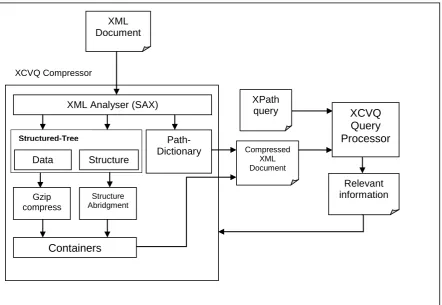
4.1SYSTEM ARCHITECTURE ... 45
4.2XCVQ-CDESIGN ... 47
4.2.1 Creating the Structured-Tree & its Abridgment ... 48
4.2.2 Creating the Containers ... 50
4.2.3 Compressing the Containers ... 51
- LZW Compression Technique ... 52
- Gzip Compression Technique ... 53
4.3XCVQ-CALGORITHMS AND THEIR CORRECTNESS ... 53
4.3.1 startElement algorithm ... 54
4.3.2 endElement algorithm ... 56
4.3.3 endDocument algorithm ... 57
4.4XCVQ-DDESIGN ... 58
4.5XCVQ-DALGORITHM AND ITS CORRECTNESS ... 60
4.6XCVQ-QPDESIGN ... 64
4.6.1 XPath Query ... 64
- Path Matching Expansion... 65
- Data Value Matching Expansion ... 69
4.6.2 Query Decomposer ... 71
4.6.3 Query relaxation ... 74
4.6.4 Ranking ... 78
4.6.5 Decompression ... 79
4.7CHAPTER SUMMARY ... 80
CHAPTER 5 XCVQ Testing, Evaluation and Discussion ... 81
5.1TESTING STRATEGY ... 81
5.1.1 Testing XCVQ’s Behaviour ... 81
5.1.2 Testing XCVQ’s Structure & Functionality ... 84
5.2TESTING FACTORS ... 85
5.3DATA PREPARATION ... 87
5.4TESTING ENVIRONMENT ... 88
5.5XCVQ-C AND XCVQ-DTESTING ... 88
5.5.1 XCVQ-C and XCVQ-D Testing: Stage-1 ... 88
5.5.2 XCVQ-C and XCVQ-D Testing: Stage-2 ... 91
5.6XCVQ-C&XCVQ-DEVALUATION ... 92
5.7XCVQ-QPTESTING... 95
5.7.1 QFT ... 95
5.7.2 QPT ... 96
5.8XCVQ-QPEVALUATION ... 98
5.9CHAPTER SUMMARY ... 100
CHAPTER 6 Conclusions and future work... 102
6.1CONCLUSION ... 102
6.2RECOMMENDATIONS ... 104
6.3FUTURE WORK ... 105
Publications ... 107
Reference List ... 108
Appendix-A: XPath’s EBNF ... 117
Appendix-B: Implementing XCVQ ... 120
Appendix-C: XML Corpus & XPath Benchmark ... 134
Appendix-D: Testing Results ... 139
Appendix-E: XPath Query Evaluation Benchmark ... 141
Appendix-F: Independent testing ... 144
Copyright Statement
The author of this thesis (including any appendices and/or schedules to
this thesis) owns any copyright in it (the “Copyright”) and she has given the
University of Huddersfield the right to use such Copyright for any
administrative, promotional, educational and/or teaching purposes.
Copies of this thesis, either in full or in extracts, may be made only in
accordance with the regulation of the University Library. Details of these
regulations may be obtained from the Librarian. This page must form part of any
such copies made.
The ownership of any patents, designs, trademarks and any and all other
intellectual property rights except for the Copyright (the “Intellectual Property
Rights”) and any productions of copyright works, for example graphs and tables
(“Reproduction”), which may be described in this thesis, may not be owned by
the author and may be owned by third parties. Such Intellectual Property Rights
and Reproductions cannot and must not be made available for use without the
prior written permission of the owner(s) of the relevant Intellectual Property
List of Tables
Table 2-1: Differences between Data-centric and Document-centric XML ... 21
Table 2-2: SAX and DOM features ... 22
Table 2-3: Query types ... 29
Table 3-1: The main differences between XML-conscious and XML-blind compressors ... 34
Table 3-2: The main limitations of some queriable XML compressors. ... 35
Table 3-3: A comparison between different compression techniques. ... 38
Table 3-4: Query types with the compression techniques process each. ... 43
Table 4-1: Compression granularity comparison. ... 52
Table 5-1: XCVQ Testing factors ... 85
Table 5-2: Average CR for all the tested XML compressors. ... 93
List of Figures
Figure 1-1: System Development Methodology (Morrison and George, 1995) ... 13
Figure 2-1: XPath Queries Examples. (a): CO query. (b) CAS query ... 24
Figure 2-2: The role of XPath between other XML query languages. (W3Schools.com, 2006a) ... 25
Figure 3-1: The distribution of the compression techniques over the years ... 39
Figure 4-1: Preliminary Architecture of XCVQ ... 46
Figure 4-2: The complete design of XCVQ ... 47
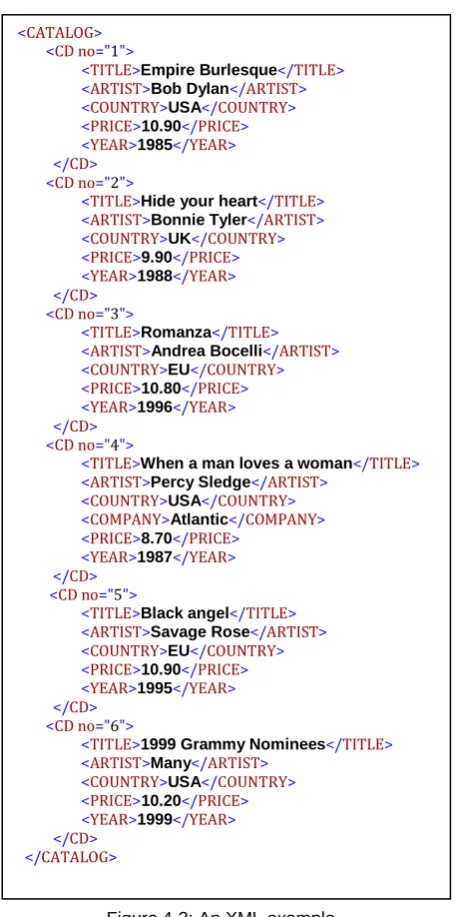
Figure 4-3: An XML example ... 49
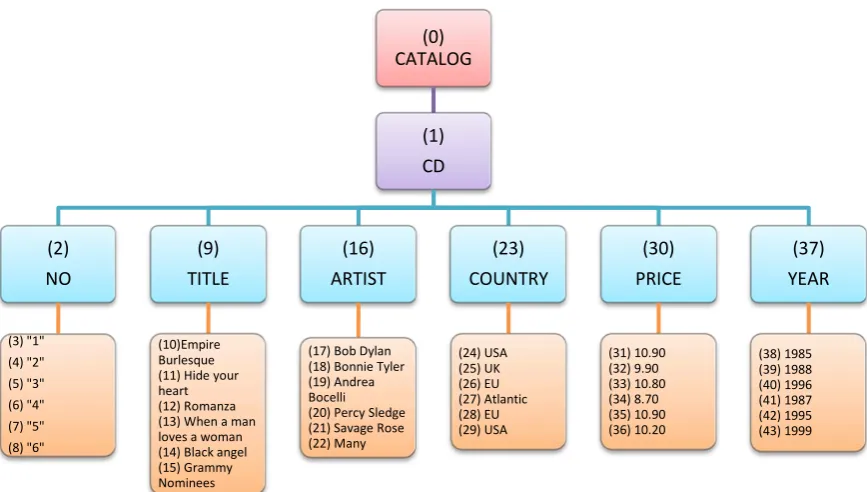
Figure 4-4: The structured-tree for the example in Figure 4-3 ... 50
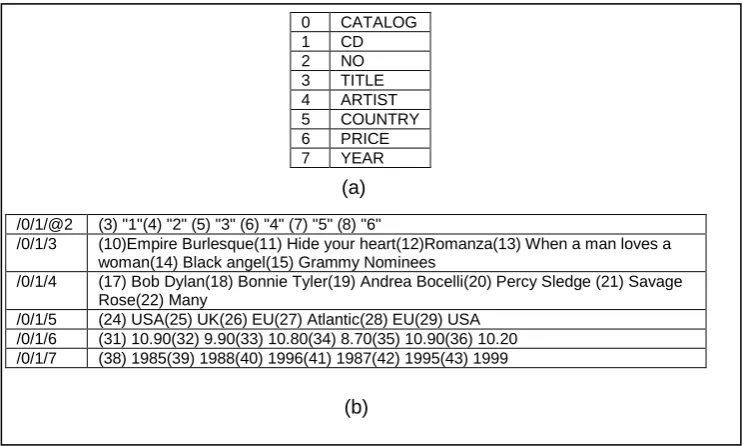
Figure 4-5: Creating containers process. (a) the path-Dictionary. (b) the container. ... 51
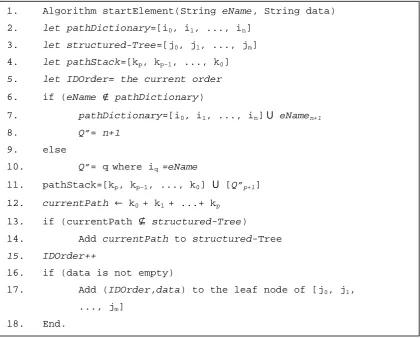
Figure 4-6: (startElement) algorithm ... 54
Figure 4-7: (endElement) algorithm ... 56
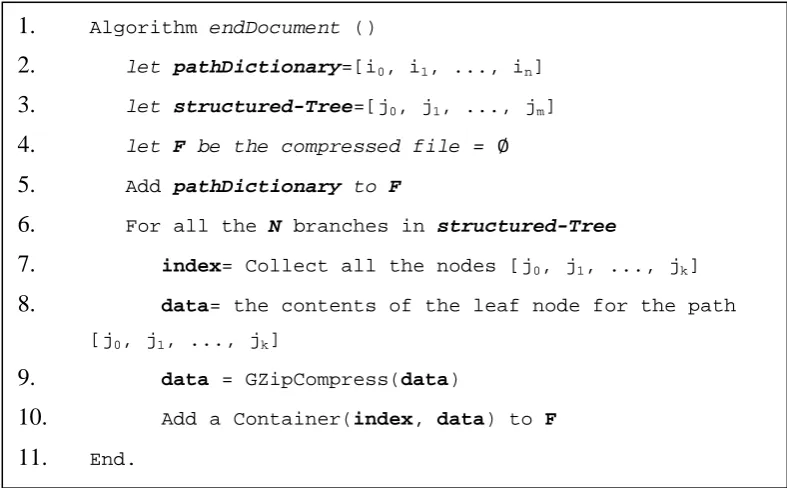
Figure 4-8: (endDocument) algorithm ... 57
Figure 4-6: Architecture of XCVQ-D ... 59
Figure 4-10: XCVQ-Decompression algorithm ... 62
Figure 4-11: The architecture of the query processor. ... 66
Figure 4-12: String-similarity match algorithm ... 68
Figure 4-13: The design of XCVQ-Query Decomposer ... 72
Figure 5-1: XCVQ State Graph ... 82
Figure 5-2: SCR for the XML corpus ... 89
Figure 5-3: (a) Structure Compression Time for the XML corpus and (b) Structure Decompression Time for the XML corpus. ... 90
Figure 5-4: CR for the XML corpus ... 91
Figure 5-5: (a) Compression Time and (b) the Decompression Time for the XML corpus. ... 92
Figure 5-6: Evaluating XCVQ-C CR. ... 93
Figure 5-7: Evaluating XCVQ-C CT ... 94
Figure 5-8: Evaluating XCVQ-D DT. ... 95
Figure 5-9: Testing XCVQ-QP Querying time ... 97
List of Abbreviations
API Application Programming Interface
CAS Content and Structure
CO Content Only
CR Compression Ratio
CT Compression Time
DOM Document Object Model
DR Data Ratio
DT Decompression Time
DTD Data Type Definition
EBNF Extended Backus-Naur Form
EXI Efficient XML Interchange
H Data Compression Entropy
INEX Initiative for the Evaluation of XML retrieval
JAXP Java API for XML
LZW Lempel-Ziv-Welch
NEXI Narrowed Extended XPath I
QFT Query Functional Test
QPT Query Performance Test
RD Regular Documents
SAX Simple API for XML
SD Structural Document
SDM System Development Methodology
SGML Standard Generalized Markup Language
TD Textual Document
W3C World Wide Web Consortium
XCVQ XML Compressing and Vague Querying
XCVQ-C XCVQ Compressor
XCVQ-D XCVQ Decompressor
XCVQ-QP XCVQ Query Processor
XML Extensible Markup Language
XPath XPath: a XML query language XQuery XQuery: a XML query language
CHAPTER 1 Introduction
1.1 Introduction
The eXtensible Markup Language (XML) is a World Wide Web Consortium
(W3C) recommendation which has widely been used in both commerce and
research. In recent years, we have witnessed a dramatic increase in the volume
of XML digital information that is either created directly as an XML document
or converted from another type of data representation. The importance of XML
is mainly due to its ability to represent different data types within one document,
solving the problem of long-term accessibility, and providing a solution to the
problem of interoperability (Al-Hamadani et al., 2009).
Due to the replication of the XML schema in each record, the XML document
is considered to be one of the self-describing data files, which means that these
kinds of files have a lot of data redundancy in relation to both its tags and
attributes (Ray, 2001). For the above reason the need to compress XML
documents is becoming increasingly dramatic. Furthermore, what has evolved is
the urgent need to retrieve information directly from the compressed documents
and then decompress only the retrieved information (Ferragina et al., 2006).
Because of the wide range of XML documents in use and the different kinds
of users, being able to deal with all kinds of queries has become a key issue.
Some of these queries may have imprecise constraints which cannot be
processed directly due to the grammar restriction in the existing query
languages. However, these types of queries, which are known as vague queries,
appear to be common when the users of the XML documents have little
knowledge about the document structure, or may lack the skills to write a precise
and meaningful query. Another type of vague queries occurs when the query is
presented without the presence of a Schema or the data type definition (DTD) of
the document.
According to the relevant literature, there are a number of techniques that
partial decompression. These techniques process almost all types of queries but
not the vague queries; admittedly, there are a number of researchers now trying
to process vague queries on the original XML document.
The research carried out in this thesis primarily concerns designing and
implementing a new technique called XML Compressing and Vague Querying
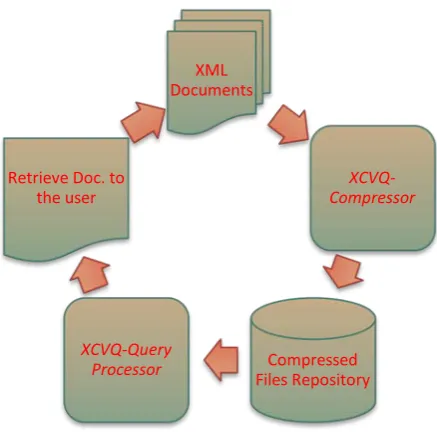
(XCVQ) which consists of two stages. In the first stage, it separates the data part
of the XML document into several containers according to the path of that data
within the document. Then each of the containers is compressed separately using
a back-end compressor. The second stage processes the vague queries by
decomposing them into multiple sub-queries, retrieves information from the
compressed XML document according to each sub-query, combines the
retrieved information according to the given query, and finally decompresses
only the most relevant information.
To eliminate the amount of technologies associated with the XML documents
and to make the process of compressing and retrieving information easier for the
inexperienced users, XCVQ is designed to be schema independent in both phases
of the compressor and the query processor.
1.2 Research Hypothesis and Research Methodology
This thesis is based on the following hypotheses:
1. The existing XML compression techniques can be improved to construct
a new schema independent XML compressor with a higher compression
ratio.
2. The redundancy in the XML documents significantly affects the size of
those documents and can be reduced to more than half of the original file
size.
3. The compressed XML document can be retrieved according to vague
queries. Vague queries are those queries which do not follow the
semantic rules of current query languages. They occur when the exact
matching user’s query does not retrieve the required information either
because of the lack of experience in writing a query or the absence of the
4. The necessity of retrieving information from more than one XML
documents without the need to specify an exact relative document.
The above hypotheses are tested throughout this research by using the
System Development Methodology (SDM) (Nunamaker et al., 1991; Morrison
and George, 1995; Hevner et al., 2004). This methodology has been widely used
by software developers and information system specialists (Meersman et al.,
2008; .Yousof et al., 2011) As depicted in Figure 1-1, this methodology consists
of four main stages:
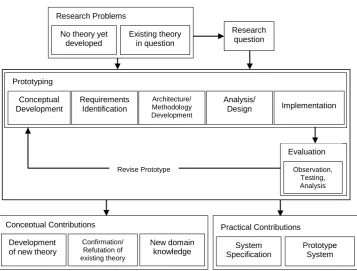
1. Identifying research problems: This stage focuses on drawing up the
research questions due in part to the lack of theories in the research field
and/or build upon existing theories. In this thesis, the research questions
are set from two XML fields, compressing the XML documents and
querying them. As a result, a new XML compressor is introduced
(CHAPTER-4) with the ability to retrieve information from the
[image:14.595.114.472.154.425.2]compressed document according to vague queries. The designed system
Figure 1-1: System Development Methodology (Morrison and George, 1995)
Research question No theory yet
developed
Existing theory in question Research Problems
Development of new theory
Confirmation/ Refutation of existing theory Conceptual Contributions System Specification Prototype System Practical Contributions New domain knowledge Conceptual Development Requirements Identification Prototyping Architecture/ Methodology Development Analysis/
Design Implementation
Observation, Testing, Analysis
Evaluation
may improve the querying process to retrieve information from XML
documents.
2. Prototyping and evaluation: In the second stage, SDM spotlights the
implementing or prototyping the proposed system. It starts by designing
the conceptual model of the proposed system, identifying the necessary
requirements, designing the complete architecture of the system, and then
implementing the system to prepare it for the evaluation process by
testing and analysing it. In this thesis, the complete architecture and the
detailed design of the system are laid out in CHAPTER-4, the
implementation part is in Appendix-F, and the evaluation process is
given in CHAPTER-5.
3. Conceptual and practical contributions: As a final stage, SDM sets
the main contribution to the knowledge. In this thesis all the
contributions, conclusions, and future developments are presented in
CHAPTER-6.
1.3 Research Questions
Following the SDM as shown in Figure 1-1, outlining the research questions
should be made before proceeding further with defining the actual prototype.
The research into this thesis focused on two main parts, each of which has its
own set of questions to be addressed:
1. Is it possible to design a new compression technique that has the ability
to compress XML documents and achieve a better compression ratio
without the need for the document’s schema or its DTD?
2. What is the influence of the structure redundancy on the overall size of
the XML document?
3. What are the main types of vague queries and when could they occur?
Has the existing XPath query language the ability to answer vague
queries? If not, what is the required expansion that should be made on
4. How does one determine the relevant XML document(s) from thousands
of documents without the need to scan them completely for time saving
purposes? And is it possible to retrieve information from more than one
XML document without the pre-specification of these documents using
one XPath query?
1.4 Motivations and Objectives
This work is initially motivated by the need to expand the XML query
languages. These languages are treating the user’s query in Boolean nature
(Campi et al., 2009) in which a specific XML node is selected if and only if it
satisfies exactly the query or part of it. This case applies more restrictions to the
inexperienced user or in the case of schema absence.
XML has become a focus for research in both the database as well as the
document research communities (Harrusi et al., 2006; Moro et al., 2008). This
research is motivated by the strength of XML such as its simplicity, the
separation of data from the structure, interoperability, and human and machine
readability. All these features and more make the XML document a reliable way
for data transformation on the web. However, the redundancy in the structure of
the XML documents enlarges their sizes, the very reason that inspired
researchers to produce compression techniques dedicated to XML. Other
researchers were interested in retrieving information from the compressed XML
document to make it easier to use these fairly large documents with low resource
devices. Although these techniques succeeded in answering several types of
queries, they are incapable of processing vague queries, which is yet another
motivation for this research.
The main objective of this research is to investigate the different types of
vague queries and set new methods to solve these queries in the case of existing
compressed XML document. The design and implementation of a system that
has the ability to compress the XML document and retrieve information from the
compressed file according to vague queries, let alone the need to decompress
Since it was very difficult to have access to the source code of an XML
compressor to be used as a first stage to achieve the main objective, another
objective therefore was to design and implement a new XML compressor that
has the ability to achieve a better compression ratio than the existing techniques.
1.5 Research Contributions
This research will contribute to the fields of XML compression and XML
retrieving in the following areas:
1. A new XML compression technique is introduced that compresses XML
documents efficiently and independently from their Schema or the DTD.
The designed compressor achieved a compression ratio of 1.83 which is
higher than the best existing techniques.
2. Identify the exact ratio of the redundancy of the XML structure. This
redundancy is abridged by up to half the size of the original file.
3. The main contribution of this research is the introduction of a new
method to answer vague queries, a kind of queries that can be submitted
by naive users or via the absence of the document’s schema. The new
method is adjusted to process the vague queries under the compressed
XML documents and retrieve the most related results.
4. Introduce the idea of retrieving information from XML documents
without specifying the exact documents that have the required
information.
1.6 Overview of the Thesis
Apart from Chapter 1, the thesis has six more chapters:
Chapter 2: Research Background. This second chapter sets forth the research
background including all the techniques used in the research process. The most
important features of XML documents are listed, accompanied by their types,
them, and their query languages. This chapter also lists all the query types and
provides a complete definition of vague queries.
Chapter 3: State-of-the-Art Technologies. This chapter is separated into two
main parts. The first one concentrates on discussing the main XML compression
techniques and sets the differences between them, their advantages and their
drawbacks. The second part discusses the techniques that have been used to
solve vague queries from XML documents.
Chapter 4: XCVQ Design. This chapter illustrates the design of the XCVQ
system starting with the main architecture of the complete system. Then it sets
the detailed design of the compressor, followed by the design of the
decompressor. This chapter ends by giving the complete design of the vague
query processor. It is supported by the algorithms that are used to answer the
research questions.
Chapter 5: XCVQ Testing, Evaluation and Discussion. This chapter sets all
the testing process for the XCVQ-compressor to obtain the compression ratio and
for the XCVQ-query processor to determine its functionality and the
performance. An extensive test has been done to compare XCVQ with the other
existing techniques. All the results of these tests can be seen in this chapter. It
ends with the discussion part that illustrates the main features, advantages, and
drawbacks for the designed system.
Chapter 6: Conclusion and Future Works. This chapter summarizes the main
conclusions and contribution of the research and suggests more development and
CHAPTER 2 Research Background
2.1 Introduction
This chapter provides the background to our research. It comprises several
key parts. The first one illustrates the most important techniques that motivate
and support this research. XML, being the most important key technology, is
presented in this section, alongside the structure of the documents which would
be crucial in the design of the compressor. XML query languages and the main
differences between them are also discussed because of their importance in
retrieving information from such documents.
2.2 XML Commencements and importance
Before the rise of the internet, 1980s witnessed the invention of Standard
Generalized Markup Language (SGML) as a way to display information
dynamically. Later, in 1995, W3C recommended SGML to be used for the
internet. Problems occurred when using SGML included the lack of widely
supported style sheets, complexity and instability in the software that were using
it, and the difficulties in interchanging SGML data due to its varying levels
among SGML software packages.
In 1996, the first XML working draft was intended to be a powerful substitute to
SGML. It was first recommended by the World Wide Web Consortium (W3C)
in 1998 to be used as a mark-up language for storing and exchanging data
through the web. The most recent recommendation was published in 2008,
which is the fifth edition of the XML (W3C, 2008). In a very short period of
time, XML has become the basis for data exchange through the Internet. This is
due to its several features such as the following (NG et al., 2006; Gerlicher,
Readability: XML is readable by both human and machine. This means that the data represented by XML can be used by different
users and by different parsing code.
Interoperability: This is the ability of the hardware and software to use XML documents without the need to make any changes to the
software or the data itself. This means that XML data is stripped of
any dependency on software and machine.
Long term usability: Since XML documents are represented using the Unicode; these documents are expected to stay in secure storage
and usage for years (Augeri et al., 2007; De Meo et al., 2007) .
Extensibility: This means that there are no fixed set of tags that should be used to represent data.
Generality: XML documents have the ability to represent different kinds of data representation such as images, sounds, videos, texts,
etc.
Internationality: Almost all written languages can be represented in XML documents since they support Unicode (Norbert and Kai,
2004).
In spite of all these advantages, XML has also some weaknesses:
• They have a huge amount of redundancy which makes these documents demand high storage memory to be archives, high band width to be
transmitted, and high cost to be processed.
XQuery. These technologies render the use of these documents
somewhat difficult especially with naive users or in cases where these
technologies are absent, it would be just as difficult as they are
considered necessary for dealing with XML documents.
• The problems that can occur when dealing with the document namespace should be carefully sorted out otherwise other problems and
complications could occur during the processing of these XML
documents.
2.2.1 XML document types
The main building blocks of any well-formed XML document are nested
open tags and their equivalent close tags. These tags can be formed as follows
(Hunter, 2000; Anders, 2009; Goldberg, 2009):
1. Elements: each element starts with an open tag (<p>) and ends with an
end tag (</p>). Everything between and including these tags are an
element. The general structure of an element is as follows:
<e at1=”v1” at2=”v2” atn=”vn”>d1d2d3…dm</e>
Such that n≥0, and m≥0
(1)
Each element has an element-name (e) which should follow the
following rules:
o Case sensitive names.
o Consist of characters, numerals, underscores and tabs.
o Start with a character or an underscore.
o Should not start with xml or XML.
Elements can have optional element-value ({d1d2d3…dm} in (1)) which
represent the actual data values for the XML document.
2. Attributes: attributes (if any) appear within an element and they provide
more information about that element. Each attribute has an
element-name, and an attribute-value ({v1,v2, … vn} in (1)) which can be
any printable character between a pair of quotations.
3. Data text: the data in a XML document could either be attribute-values
or element-values. This text can be a list of any keyboard printable
character from the Unicode set ({d1d2d3…dm} in (1)). Some escape
character should be used to embed some of the characters in the data text
such as (<), (>), (&), ("), and (') to represent (<),
(>), (&), (“), and (‘) respectively.
4. Comments: comments can be added anywhere in the XML document to
provide any further description but is not part of the main document. In
XML, the comment start tag is (<!--) and the end tag is (-->).
5. Declaration: this single statement (if any) should be the very first line of
the document. It supplies the XML processor with information such as
the version, encoding and other information about the document. Its start
tag is (<?xml) and its end tag is (?>).
Table 2-1: Differences between Data-centric and Document-centric XML
Criteria Data-centric Document-centric XML role Superfluous Significant Order Not very important Significant
Consumption Machine Human
Data granularity Fine Large
Examples Catalog and flight schedules Books and advertisements
Depending on the amount of data (attribute-values and element-values) in
the XML document, Bourret (2005); and Manning et al. (2008) classified XML
documents into two types, either data-centric or document-centric. Table 2-1
With data-centric XML documents the roles of the XML elements and attributes
are to arrange these data in atomics. These documents are usually created and
used by machines such as the XML documents that are generated by a Database
Management System, or those used to transfer data between different databases.
In contrast, XML role in document-centric XML documents is very
important since it is the only way to organize this document into large units of
information. The order of the elements inside these documents is important since
any change in the order can produce a completely different document.
2.2.2 Java API for XML (JAXP)
Java programming language, and some other languages, provides different
types of XML Application Programming Interface (API) such as SAX, DOM,
and XSLT (Violleau, 2001; McLaughlin and Edelson, 2006; Williams, 2009) in
order to process the XML documents by means of writing a computer
programme using several programming languages. SAX (Simple API for XML)
scans the XML document sequentially and throws up events that the
programmer can handle. These events are thrown by the parser when it detects
the start-document, end-document, start-element including a list of all its
attributes, end-element, and characters. The programmer should write suitable
codes for each event to process an entire XML document. Since each event
occurs only once for each element, all the required work needed to process the
document should be done in one cycle.
Table 2-2: SAX and DOM features
SAX DOM
Event based model Tree-like structure
Sequential access Random access
Required low memory Memory intensive
One scan for the document Multiple traverse for the
document
By using DOM (Document Object Model) parser, the document is
represented in the main memory of the computer as a tree-like structure. The
programmer can write the code to traverse this tree as many times as s/he needs.
Table 2-2 sets out the main features of SAX and DOM. It shows that using
DOM parser is memory consuming and since the aim of this research is to
reduce the amount of memory used to process the XML documents, the designed
system used SAX parser to process these documents.
While SAX and DOM parsers should be used through a programming
language, XSLT (XML Style-Sheet Language Transformation) is a declarative
language which is used to transform the XML document into another document
type (Tidwell, 2008; Williams, 2009). Its two main purposes are: (1) produce
HTML documents from XML documents for browsing purposes, and (2)
retrieve information from the XML document using the XPath.
2.2.3 XML Retrieval
XML retrieval is considered to be one of the semi-structured retrieval
techniques (Manning et al., 2008). This adds more challenges to meeting the
user’s needs. The first difficulty in structured retrieval is that the user requires
only parts of the documents and not the entire document like unstructured
retrieval techniques do (Stamatina et al., 2006). This challenge leads to another,
which is the identification of the most relevant parts from the document to the
user’s query. To solve this difficulty there are two approaches, either to retrieve
the largest units of the document that contains the required information (top
down) (Norbert and Kai, 2004; Jiaheng, 2006), or to retrieve the smallest unit
by starting the search from the leaves of the XML tree (bottom up) (Fuhr et al.,
2006).
Retrieving information from XML documents provides the users with the
extra abilities to specify the exact piece of information needed or to combine
different parts from of the document that meet the user’s need. The user’s
queries can specify the required information as well as the place where this
about “a table of all XPath functions in XPath description chapter”. In this case
the “XPath functions” and the “XPath description” are about the content of the
document, while the “table” and the “chapter” are about its structure.
XML documents can be retrieved according to their type either text-centric
or data- centric retrieval. In text-centric, an approximate matching process is
used to match the text of the query with the text of the document while the
structure role is as a framework within this process (Manning et al., 2008). Since
the matching process is done with the data part of the XML document, the
retrieved information is expected to be long and they should be ranked. On the
other hand, data-centric retrieval retrieves only attribute values and numeric data
using exact match. The retrieved information from this type is short and the
ranking is not significant.
Another classification for XML retrieving techniques is done according to
which part is more significant in the user’s query: the content part or the data
part (Hunter, 2000; Sanz, 2007). Content-Only (CO) queries are rich of text and
focus on the data part of the XML document. The user can add some structural
constraints to the query to specify the granularity of the required information. As
seen in Figure 2-1-(a), the XPath query focuses on retrieving the title and the
content of a paragraph which is considered the data content of the document. To
process these queries, some of the techniques use the traditional IR techniques
by completely ignoring the structural constraints and treat the XML document as
//title[title = “XML and XSLT”] and sec[par = “We declare our choice of an associated style sheet for an XML instance”]
(a)
//article/section/para[1]
(b)
a traditional text file, while other techniques decompose the query into several
small queries and process each one separately.
Content-And-Structure (CAS) retrieval takes into their considerations the
structural part of the XML document and provides the user with extra
advantages to accurately specify the exact part required from the relevant
document. The XPath example in Figure 2-1-(b) concentrates on finding the first
paragraph which is in a section for the specific article.
2.2.4 XML Query Languages
Different kinds of query languages have been proposed in order to retrieve
specific information from an XML document. All these languages have a
common feature in that the user should specify the exact XML document(s)
wherefrom s/he would like to retrieve the information. This section spotlights
the main features of some of the query languages which are either recommended
by W3C (XPath, XQuery, XPoint, and XLink) or used by Initiative Evaluation
of XML retrieval (INEX) working group (NEXI).
- XPath
Standing for XML Path language, it is a descriptive language which takes an
XML document and a user query as an inputs and produces specific nodes from
this document as output (Kay, 2004).
It is considered to be the core to all other XML query languages, as
illustrated in Figure 2-2 (W3Schools.com, 2006a). The main building blocks for
an XPath expression are: (1) expressions deal with atomic values which include
comparative and arithmetical operations, (2) expressions for selecting specific
nodes from a tree, and (3) operation on every item in a specific sequences, such
as using the “for” expression.
In 1990, W3C recommends XPath 1.0 as an XML query language (W3C,
1999). In 2010 W3C recommend the last version of XPath 2.0 to be a standalone
query language or to be embedded with XSLT or XQuery (W3C, 2010a). It
comes with some developments on the first version. These changes make XPath
easy to use, improve its interoperability, simplify the manipulation of string
contents and Schema-typed content, and to increase its efficiency. These
developments include: (Holman, 2002; Kay, 2004; W3C, 2007b; Kay, 2008)
1. Data types: XPath 2.0 offers new data types such as integers, single
precision, date, time, and any data type that can be defined by the user
through XML Schema.
2. Path expressions: Not very big changes on path expression compared to
XPath 1.0, only the ability to use the function call within the path
expression is a slight change.
3. Operators: addition operators are used to support XPath 2.0 functions.
Examples of these operators are: “is” to test if two expressions return the
same set of nodes, “<<” and “>>” to test the order of the two operands,
“except” and “intersect” to find the difference and the intersection
between two node sets, and “eq”, “ne”, “lt”, “le”, “gt”, “ge” to make
a comparison between atomic values and return a node set.
4. Functions: Some new functions are added to the list of the available ones
in XPath 1.0 such as: “max()”, “min()”, “avg()”, functions to
manipulate the new data types like date, time, and QNames,
generalization of string manipulation functions to deal with user-defined
types.
Path expressions thus provide a very powerful mechanism for selecting
nodes within an XML document, and this power lies at the heart of the
- XQuery
In 2007, W3C first recommended XQuery as an XML query language and
they made the last recommendation in 2010 (W3C, 2010b). This querying and
descriptive language uses XPath to retrieve information from XML documents
whereas the simplest XQuery expression is an XPath expression. The main
engine in XQuery is the “FLWOR” expressions which stand for
For-Let-Where-Order-Return. In these expressions, the “for” expression selects a specific node
list from a specific document which can be repeated several times within the
same expression. The “let” expression associates with each node in the node
list(s) generated by the first expression or another node retrieved from another
XML document. The “where” expression filters the resulting list according to a
specific condition. The “order” expression sorts the list according to a specific
atomic. Finally, the “return” expression specifies the required information from
the node list(s).
The main advantage of XQuery over XPath is that XPath by its own cannot
organize the output of the query in a specific format while XQuery does
(McGovern et al., 2003). Although XML Style sheet Language Transformation
(XSLT) can do organize the format of the retrieved information, but it could be
difficult for the user to use it due to its recursive-structure and mixed
name-spaces.
Another feature in XQuery is its capability to retrieve information from
more than one specified XML documents. XPath is suffering from the lack of
this feature.
Although it is considered to be very easy to use, XQuery is a read-only
query language. This means that XQuery does not have the ability to exchange
or create an XML document like SQL to the databases.
- XLink and XPointer
XLink stands for Linking Language and recommended by W3C in 2001
between two XML resources, or “extended” links between more than two XML
resources (W3Schools.com, 2006a). With the “simple” links, any element inside
the XML document can be linked with another resource such as an image, a text
file or even another XML document just like the “a” element in HTML which
performs Unidirectional link. When the link type is “extended” this means that
the link will be bidirectional between the XML document and the other
resource(s).
XPointer stands for XML Pointer Language and recommended by W3C in
2003 (W3C, 2002). It uses XLink to point to specific data part within the XML
document. This means that XPointer query should starts with the URI of the
document followed by “#” sign which indicates the starting of the XPointer
query which is actually an XPath query with some extra functions.
- NEXI
Stands for Narrowed Extended XPath I is an XML query language that follows
the steps of XPath with some modifications. First, the NEXI retrieval engine
designed to deduce the semantics from the query in reverse to XPath which has
predefined semantics. Furthermore, NEXI extended the use of the contains()
function, which is used by XPath to indicate an element that is contain a specific
content, to be about() function to indicate the element to be about the content.
This adjustment allows NEXI to deal with fuzzy queries. NEXI has been used
for several purposes, such as question answering, multimedia searching, and
searching heterogeneous document collections. (Trotman and Sigurbjornsson,
2005)
2.3 Types of Queries
Queries are questions written by users to search, change or retrieve a specific
piece of information from different types of files such as text, image, or database
files. Depending on the query functionality, they can be categorized into three
types. The first type is the selection queries which are responsible for selecting
and retrieving the relevant document or sub-documents and returning the results
specific action on the selected file or document, such as delete, add, or update a
piece of information. The third type is the aggregate queries which find the
statistical amount for the selected attributes such as average, max, min ...etc.
Table 2-3: Query types
Query type Description XPath Example Simple
queries (SQ)
Retrieve part of the document according to
general specification
List countries names //countries/country/name
Criteria queries (CQ)
Retrieve part of the document according to a
specific criterion.
List countries with less than 10 million population
//countries/country[population <
10000000]
Conjunctive queries (JQ)
Retrieve part of the document according to conjunction of two or more
criteria.
List industrial countries with less than 10 million population
//countries/country[economy=”industry”]
and //countr[population < 10000000]
Range queries (RQ)
Retrieve information according to a range between given minimum and
maximum values.
List countries with population between 6 million and 15 million
//countries/country[population > 6000000] and //countries/country[population < 15000000] Vague queries (VQ)
Retrieve information when there is no Boolean matching
between the user’s query and the relevant XML document (Stasiu et al., 2005; Rajpal et al., 2007).
List countries with population between 6 million and 15 million
/country/population between(6000000,
15000000)
Depending on their complexity, selection queries can be categorized into five
main types. Table 2-3 lists these types and describe their features supported by
an example for each type and its equivalent XPath query (written in Italic in the
level of complexity such that the simplest query retrieves general information
while the more complex query tries to retrieve more specific information.
Since vague queries are the central issue in this research, the following
section provides a brief description of such queries and how they can appear in
information retrieval domain.
2.4 Vague Queries
XML query languages force the users to follow their rigid rules to write a
syntactically true query. This process is not easy to be maintained even for
expert users (Huh et al., 2000). Moreover, in order to retrieve the required
information these languages require previous full knowledge about the
document’s schema what is considered to be difficult to ordinary users. If the
query does not follow the semantic rules of the querying language or it does not
meet the document’s schema, null information will be retrieved because these
query languages use Boolean conditions wherein a condition is either true (exact
match) or false (no match) (Campi et al., 2009). On the other hand, handling the
fault-tolerant for the user’s query makes it easier for the user to retrieve
approximate information when vague conditions appear in the query (Zhao and
Ma, 2009).
Vague queries are those that occur when exact matching queries fail to
retrieve the required information (Fuhr, 1999; Bodenhofer and Küng, 2001;
Zhang and Kankanhalli, 2003; Dutta et al., 2009). In this case the vague query
needs to be generalized to retrieve the relevant information and rank this
information in the bases of their relevancy. Vague queries can be cause by
several factors:
1. Schema: although XML Schema or its DTD are very important when
creating and developing the document, their absence during the
retrieving process leads to null information retrieved since all XML
query languages demand complete knowledge over them. Even if the
schema exists, it is difficult to figure out the exact structure of its XML
2. Users: there are two main kinds of XML retrieval users, the experts and
the naïve. The experts have the ability to write syntactically true queries
depending on their knowledge of the rules of the query language and
have the ability to navigate the document’s schema and write the
appropriate query. However, different kinds of XML schema available
such as XML Schema, DTD, and RNG, and even expert users are only
aware of one or two of them. On the other hand, the naïve users have low
experience in the rules of the language and in the schema navigation. The
latter case could produce vague queries which has spelling errors in
either the structure or the content of the document, different case used in
the query and in the original document, or out of order or weak path
(Florescu et al., 2000; Campi et al., 2009).
3. The query Language: all XML query languages do not have the ability to
retrieve approximate answers according to a user’s query. Moreover, the
functions in the query languages sometimes do not meet the user
requirement. All these restrictions in the languages can lead to vague
queries (Buneman et al., 2003; Norbert and Kai, 2004).
4. Unknown document: whenever a query is submitted, it should specify the
XML document(s) that has the required information. If the user does not
know the exact document or the information is disseminated in more than
one document, a vague query occurs (FAZZINGA et al., 2009).
2.5 Chapter Summary
This chapter described the origins of the XML technique and its
development. It showed the importance of the XML documents and their usage
as well as their drawbacks. Since these documents have a special structure, this
chapter provided a brief description of this structure and the different types of
chapter listed the well known APIs and described their features and differences.
Because this research lies in the field of XML retrieval, the chapter highlighted
different kinds of XML retrieval techniques and query languages used to retrieve
parts of the entire XML document. The main features of all types of queries are
CHAPTER 3 State of the Art Technology in
Compressing and Querying XML Documents
Since this research consists of two main parts, the XML compressor and the
vague query processor, this chapter discusses the main XML compression
techniques in its first part. It will highlight the advantages and disadvantages of
these techniques and discusses the differences between them. The second part of
this chapter will focus on the vague query processors used to retrieve
information from XML documents.
3.1 XML compression techniques
Recently, large numbers of XML compression techniques have been
proposed. Each of which has different characteristics. This section discusses the
differences between these compressors and their main features.
XML compressors can be classified into two classes either to be XML-blind
or XML-conscious compressors. XML-blind or general purpose compressors
deal with the XML document as a traditional text document ignoring its
structure and apply the general purpose text compression techniques to compress
them. These techniques can be classified into two main classes (Salomon, 2007),
either to be statistical or dictionary based compressors (Augeri et al., 2007;
Augeri, 2008). The statistical or the arithmetic compressors represent each string
of characters using a fixed number of bits per character. PPM, CACM3, and
PAQ are examples of this kind of compressors (Cleary and Witten, 1984;
Moffat., 1990; Alistair et al., 1998). On the other hand, dictionary compression
techniques substitute each string in the input by its reference in a dictionary
maintained by the encoder. WinZip, GZIP, and BZIP2 are examples of this
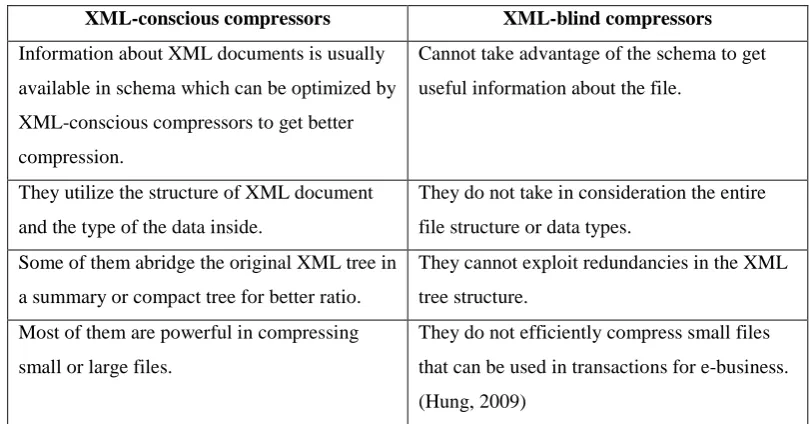
Table 3-1: The main differences between XML-conscious and XML-blind compressors
XML-conscious compressors XML-blind compressors
Information about XML documents is usually
available in schema which can be optimized by
XML-conscious compressors to get better
compression.
Cannot take advantage of the schema to get
useful information about the file.
They utilize the structure of XML document
and the type of the data inside.
They do not take in consideration the entire
file structure or data types.
Some of them abridge the original XML tree in
a summary or compact tree for better ratio.
They cannot exploit redundancies in the XML
tree structure.
Most of them are powerful in compressing
small or large files.
They do not efficiently compress small files
that can be used in transactions for e-business.
(Hung, 2009)
On the other hand, XML-conscious compressors try to utilize the structural
behaviour of XML documents in order to achieve better compression ratio and
less time in comparative with the XML-blind type. Table 3-1 sets the main
differences between the two aforementioned compressors types.
The main theory of data compression, which described in (Shannon, 1948), is
the formulation of the entropy rate (H) which indicates the limit to lossless data
compression. The value of (H) depends on the probability of each symbol in the
information source. The most popular entropy value is:
(Shannon, 1948) (2)
Where, is the probability of the symbol .
In this paper, Shannon proved that the compression ration cannot exceed the
value of (aH), where (a) is the number of symbols in the source.
Since XML are heterogeneous data, the theory of XML compressors is to
separate the data from the structure, separate the data into containers according
to the type of the data, and apply a general purpose compressor for each
container. This process can lead to produce an optimal compressor over
heterogeneous data. (Liefke and Suciu, 2000) developed the entropy value for
(Liefke and Suciu, 2000) (3)
Where, are the entropies for the sources, and are
the probabilities of these sources.
XML-conscious compressors can be classified according to their ability to
querying the compressed documents into two main sub-classes; these are
queriable and non-queriable compressors. While the queriable compressors have
the ability to retrieve information from the compressed XML document without
the need to completely decompress the document, the non-queriable XML
compressors are used to compress the XML documents for archival purposes
only and they achieved better compression ratio than the queriable compressors.
3.1.1 Queriable XML Compressors:
The main goal of this type of compressors is to provide the ability to the
compressed version of the XML document to be queried without complete
decompression them. The compression ratio for these compression techniques is
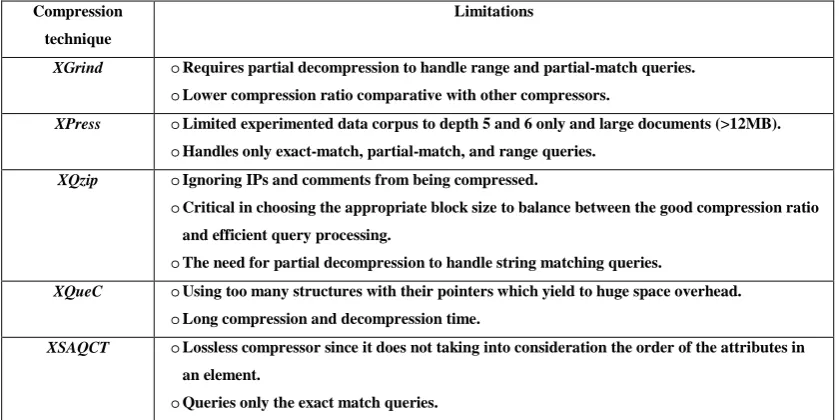
[image:36.595.93.513.554.764.2]lower than the blind-XML or the non-queriable techniques.
Table 3-2: The main limitations of some queriable XML compressors.
Compression technique
Limitations
XGrind oRequires partial decompression to handle range and partial-match queries. oLower compression ratio comparative with other compressors.
XPress oLimited experimented data corpus to depth 5 and 6 only and large documents (>12MB). oHandles only exact-match, partial-match, and range queries.
XQzip oIgnoring IPs and comments from being compressed.
oCritical in choosing the appropriate block size to balance between the good compression ratio and efficient query processing.
oThe need for partial decompression to handle string matching queries.
XQueC oUsing too many structures with their pointers which yield to huge space overhead. oLong compression and decompression time.
XSAQCT oLossless compressor since it does not taking into consideration the order of the attributes in an element.
SXSI oDesigned to increase the querying speed. oThe compression ratio has not been tested.
oSupports only navigational queries and string matching predicates.
However, these techniques are important when dealing with resource-limited
applications and mobiles. Some of these techniques are homomorphic
compressors, which mean that the compressed file is a semi-structured one. In
the next section, a brief description of some of these techniques will be given,
and Table 3-2 explains their main limitations.
The first queriable compressor is XGrind by (Tolani and Haritsa, 2000). This
technique replaces the elements and attribute names with the letters “T” and
“A” respectively, followed by a unique identifier which represents the
substituted element or attribute name. Moreover, it replaces the end tags with
“/” sign. The data part of the document is encoded using Huffman encoding. For
the purpose of querying the compressed document, XGrind’s query processor
finds the simple path to check whether it satisfies the path in the given query.
The main drawback with XGrind is that while it has the ability to process
exact-match and prefix-exact-match queries on the compressed documents, a whole range of
or partial-match queries require partial decompression to be handled.
In order to solve XGrind’s partial decompression problem, Xpress (Min et
al., 2003) uses the reverse arithmetic encoding method to encode the label paths
of the XML document as a distinct interval in [0.0, 1.0) . Using the relationships
between these intervals will allow for the ability to evaluate path expressions
more efficiently on the compressed XML document. Furthermore, by using this
method, XPress uses path-by-path matching instead of element-by-element
matching that has been used in XGrind. To encode the data part of the XML
document, XPress uses different compression techniques depending on the type
of the data and without the need to the human interference. (Min et al., 2009)
Because XGrind and Xpress are homomorphic, the relationship between the
size of the compressed document and the size of the original one is linear. To
solve this problem (Cheng and NG, 2004) proposed a new technique (XQzip)
that depends on extracting the Structure Index Tree (SIT) from the tree structure
makes this technique accomplishes higher compression ratio and faster query
evaluation.
Instead of using (SIT), XQueC (Arion et al., 2007) uses the structure
summary tree in order to efficiently stores the XML documents. The space
needed to store the structure summary (SS) is:
(Arion et al., 2007) (4)
This represents the summation of the space needed to store a tag node plus
the space needed to store all its successive nodes. Furthermore, instead of using
hash table to store the tags and attribute names, XQueC used the structural
identifiers, which has been used in some querying techniques (Al-Khalif A et al.,
2002; Grust, 2002; Halverson et al., 2003; Paparizos et al., 2003) in order to
uniquely identify a node in the XML tree. This technique considered to be the
first one that uses XQuery as a query language.
In their work, (Müldner et al., 2009) created an annotation tree to succinctly
store the structure of the XML document and use the containers to store the data
part of the document. Their compressor, named XSAQCT, has two versions; the
first was dependent on the XML Schema and the second was schema-free. They
showed that the first version is better than the second from the standpoint of
compression ratio even though it was slower.
Finally, (Arroyuelo et al., 2010) proved in their proposed SXSI compressor
that the XPath queries can be performed better when using an indexing
technique to compress the XML document. This technique is based on
producing a labelled tree from the XML Tree structure and then indexing this
tree into a bit array and compressing the data part of the document using a
general back-end compressor. Although the compression ratio of SXSI is not
calculated, the querying time and the retrieving quality are better than traditional
Table 3-3: A comparison of different compression techniques. Compression technique XML-Conscious Schema dependant
queriable Compression
technique Back-end compressor Average compression ratio WinZip (WinZip, 1990)
No No No Reducing
algorithm+
- 0.48
BZip2 (BZip2, 1996)
No No No
Burrows-Wheeler+
Huffman
- 0.24
GZip (GZip, 1992)
No No No LZ77+
Huffman
- 0.36
XMill (Liefke and Suciu, 2000)
Yes No No
Dictionary-based Gzip, Bzip2, PPM 0.55 Millau (Girardot and Sundaresan, 2000)
Yes Yes No
Dictionary-based
GZip, deflate 0.58
xmlppm (Cheney, 2001)
Yes No No Statistical
models
PPM 0.57
dtdppm (Cheney,
2005)
Yes Yes No Statistical
models
PPM 0.58
XWRT (Skibinski et
al., 2007)
Yes No No
Dictionary-based Gzip, LZMA, PPM 0.54 RNGzip (League and Eng, 2007)
Yes Yes No Deterministic
automaton
Tree
Gzip 0.58
LXC (Bonifati et
al., 2009)
Yes No No words
abbreviation
- 0.59
XGrind (Tolani and Haritsa, 2000)
Yes No Yes
Dictionary-based
Huffman 0.57
Xpress (Min et al.,
2003)
Yes No Yes
Dictionary-based Reverse encoding 0.57 XQZip (Cheng and NG, 2004)
Yes No Yes
Dictionary-based
Gzip 0.66
XQueC (Arion et al.,
2007)
Yes No Yes Binary
encoding
Depending
on the type of
data
0.68
(Müldner et al., 2009)
elimination PAQ8
SXSI (Arroyuelo et
al., 2010)
Yes No Yes FM indexing BWT n/t
Table 3-3 shows the main differences between the various compression
techniques mentioned above. It is clear that the compression ratio of all
XML-conscious compressors are better than traditional blind-compressors and the
compression ratios of the queriable compressors are still less than those of
non-queriable techniques.
Figure 3-1 demonstrates the distribution of the compression techniques over
the years, where NQC and QC refer to the non-queriable and queriable
compressors respectively. It shows that the years 2006 and 2007 witnessed an
increasing amount of compression for both queriable and non-queriable
techniques. The overwhelming rise in the number of queriable-XML
compressions in the years 2008 and 2009 reflects the importance of this type of
compressors.
Figure 3-1: The distribution of the compression techniques over the years
0 1 2 3 4 5
NQC QC
3.2 Processing Vague Queries techniques
In order to elevate the flexibility of querying XML documents, many
researchers have produced varied approaches to meet that need.
In their work (Damiani and Tanca, 2000) proposed a technique to solve
what they called “blind queries” which refers to the queries submitted with the
absence of XML schema. This technique first transforms the XML document
into a labelled graph and provides each node a number which represent the
importance of this node in the XML document. The graph then is expanded to
perform a fuzzy graph. To process the vague queries, it creates a graph for the
query and performed a similarity match between the two graphs.
According to the importance of approximate retrieval, (Schlieder, 2001)
proposed a query language named approXQL since the existing XML query
languages have the ability to answer queries according to exact matching only.
This language is designed to answer vague queries on data-centric XML
documents by encoding them into a labelled tree. It uses three pointers to encode
each node of the document’s tree by associating it with its pre-order number, the
number of its ancestors, and the pre-order number of its most right leaf. To
answer vague queries, it makes useful node transformation on them which are
insertion, deletion and renaming. Each transformation is associated with its cost
and the results that require less transformation cost are the most relevant once.
Instead of expanding a query language, (Amir-Yahya et al., 2002) proposed
a new algorithm that depends on converting the XML document and the user’s
query into a tree-like structure and perform some relaxation process on the latest
tree by deleting, inserting and renaming the nodes in that tree to be matched with
the original XML document. Each of these processes attached with a score in
order to compute the Top-k relevant answers. This technique solves the problem
of generating large amount of sub-queries when using the query re-writing
algorithm which has been used in approXQL. In this paper, the authors debate
applying the traditional IR techniques to retrieve approximate answers and they
prove that those techniques are not sufficient enough when dealing with XML
documents, however, converting the document to a tree-like structure and
In 2004, FleXPath technique has been proposed by (Amer-Yahia et al.,
2004). FleXPath depends on merging the XPath query language that has exact
matching with full text search that has approximate matching. First, the query is
converted to a tree and used it as a template to find the approximate matches
within the XML document. The query relaxation process used by FleXPath
depends on deleting a structural predicate if at least one of its nodes does not
belong to the document structure and the deletion process will not affect the tree
structure of the query. Furthermore, this technique performs more relaxation
such as contains-relaxation by replacing the parameter of the contains() function
with its ancestor, tag-relaxation by replacing a tag with its super tag,
value-relaxation, and type-relaxation.
Instead of relaxing the query, (Lalmas and Rolleke, 2004) transforms the
query to a conjunction query by adding an “OR” between the query’s path and
its predicate and changes each “AND” in the query with an “OR” to increase the
recall precision. In this technique the XML document passes into two
probabilistic transformation processes. In the first pass, each element, attribute
name, attribute value and element value is attached with a probability value to
indicate the importance of this element in the whole document using
probabilistic object-oriented logic. The output from the first pass is transformed
into probabilistic relational algebra expressions. This technique changes the
XML document into a new one which is much bigger than the original.
In the same year, (Mandreoli et al., 2004) proposed a new approach for
answering approximate queries to retrieve all the relevant parts of the XML
document not only the exact matching. This approach finds the syntactic
similarity between the XML Schema and the user’s query, written in XQuery
query language, and rewrites the query to match this Schema. It works with the
XML Schema instead of working with the XML document directly in order to
retrieve relative information from a repository of documents. Although this
technique has the ability to retrieve 90%