2017 2nd International Conference on Computer Engineering, Information Science and Internet Technology (CII 2017) ISBN: 978-1-60595-504-9
The Application of Improved Histogram
Equalization and Image Segmentation
in Satellite Image
XIAONING ZHOU, QIAN GENG, YAN HU and JIANMIN HAO
ABSTRACT
Reasonable image enhancement and image segmentation technologies help people to identify the object from original images, which cannot be easily recognized by naked eyes. A method of image recognition based on improved histogram equalization and image segmentation was proposed in this paper. By stretching the histogram in a custom range and excluding singular points, contrast of images was enhanced with more detail information. Then, feature vector in different color space was used to segment the object from original images. From testing, this method was proved to be efficient, simple and convenient to implement and can be used in real time system because of its simplicity.
KEYWORDS
Image Enhancement, Image Segmentation, Histogram Equalization, Color Space.
INTRODUCTION
With the development of digital acquisition technology and signal processing theory, more and more images are stored in digital form [1]. Various colors, outlines and shapes of objects in images can be recognized directly by human eyes. However, human eyes cannot make out certain object accurately and effectively because of its physiological limits or characteristics of some images, low contrast for instance.
Images are usually expressed and stored as large two-dimensional array. Colorful images, especially those with complicated objects and backgrounds, are often processed as multi-channel ones. Gray histogram is a kind of graph indicating relationships between the gray level of pixels and the probability of its occurrence.
The purpose of image enhancement is to make images more suitable for analysis and processing. People have proposed many kinds of methods to enhance contrast of original images and improve perceptibility of objects in the scene. Linear Transformation, Histogram Equalization (HE), and Histogram Specification are those common methods [2]. HE is widely used because of its simplicity and adaptability. But HE has its limitations: 1) image background noise may be enhanced unexpectedly, while contrast of useful information reduced because gray level of pixels chosen to process is at random, and 2) information of images, such as the peak in the gray histogram, its contrast is unnaturally enhanced after processing, which directly leads to low perceptibility of objects in the scene.
_________________________________________
The purpose of image segmentation is to separate the object from the background. The satellite image recognition has become an important application direction of image segmentation [3]. Multispectral cloud detection algorithm, a kind of image segmentation methods, is studied and applied widely, which helps people to recognize clouds. It usually uses several thresholds to recognize clouds. But cloud detection algorithm still has some weakness: 1) those thresholds calculated by different segmentation models make a segmentation result very subjective, which means low stability and generality of algorithms, and 2) its complexity makes computers difficult to process large amounts of satellite images.
In this paper, a method of image recognition based on improved histogram equalization and image segmentation was proposed. This method calculates distribution probability of gray level of pixels, and then excludes singular points to figure out cumulative distribution function (CDF) and probability distribution function (PDF) of gray level of pixels. Based on these functions, contrast stretch is made in custom range to get images with enhanced effects. After that, a threshold segmentation algorithm is established by analyzing color feature vectors of objects and comparing threshold values of them. Finally, objects in the image can be identified accurately in the scene.
METHODS
A. Histogram equalization (HE)
HE is a method in image processing of contrast adjustment using the image's histogram. Set the variable k, a random variable, to represent the pixel gray level of the image, the gray level distribution of original images can be represent as PDF [2].
Probability Distribution Function of the image can be computed as equation (1):
( ) ( ) /
P k n k n (k =0~255) (1)
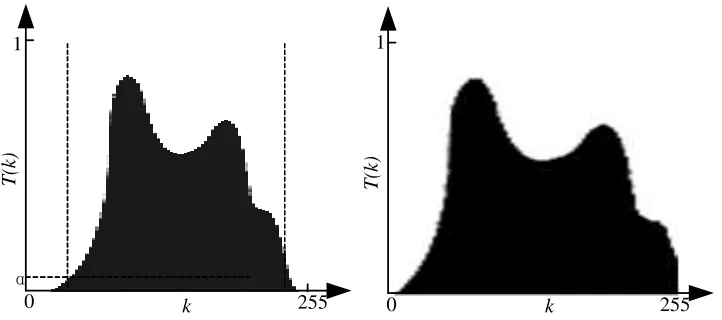
Where k is the kth gray level, n is the total pixel number of the image, n (k) is the number of pixels in the image having gray level k, and P (k) is the probability of the gray level. The relationships between the gray level of pixels and the probability of its occurrence are indicated, which is called gray histogram and shown in Figure 1.
To increases the global contrast of original images, the gray level needs to be stretched so that it can be evenly distributed. HE accomplishes this by effectively normalizing each gray level of pixels, getting CDF and adjusting gray level of each pixel. CDF of the image can be computed as equation (2). HE appropriates gray level s to gray level k of the input image using equation (3).
0 0
( ) k ( ) / k ( )
j j
T k n j n P j (2)
0 ( ) 255
k j
s P j (3)
and perceptibility of objects. Especially, processing the max/minimum gray level may degrades imaging quality. In addition, the gray level of pixels in processed image is reduced because of normalization, some color detail information may lose.
B. Improved Histogram Equalization
This proposed method is considered as improved histogram equalization. To avoid undesirable consequences from those background noises, we ignore values of cumulative distribution function which are less than α. The processed image has a normal brightness, not too much bright or too much dark. A contrast stretch improves the brightness differences uniformly across the dynamic range of the image, whereas tonal enhancements improve the brightness differences in the shadow (dark), mid tone (grays), or highlight (bright) regions at the expense of the brightness differences in the other regions. We establish a certain interface to set this dynamic range according to the specific use environment for optimal enhancement effect. The proposed HE appropriates gray level s to gray level k using following improved equation (4).
0, ( )
' '( ) ( ) ( ),
255, ( )
k MIN and T k
s T k T k MAX MIN others
k MAX and T k
(4)
C. Object segmentation
Color space distance measurement is to distinguish different components by calculating Euclidean distance [4]. Multiple-channel images can reflect more information. Let (Rc, Gc, Bc) is RGB value of any point in color image, then the corresponding color space feature vector is:
2 2 2
( C, C, C) ( C ) ( C ) ( C )
DR G B R-R G-G B-B (5)
α
0 0 255
1 1
255
k k
T
(k
)
T
(k
[image:3.612.127.488.485.645.2])
Figure 1. Spreading the intensity values (left: original HE; right: improved HE).
comparing objects' with backgrounds' threshold value, we segment the object and accomplish the object recognition.
RESULTS AND DISCUSSIONS
Test data come from MODIS satellite images which have more spectral channels, cover from visible to infrared light; and can provide abundant information. A number of experimental data show that the cloud information can be better displayed from band 0, 8 and 11 synthesis images. The color of cloud is normally white and light green.
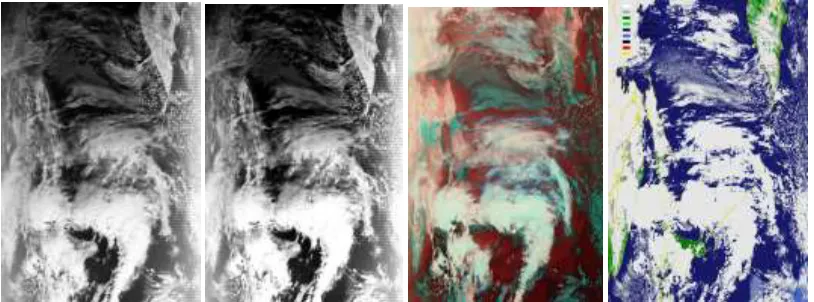
Firstly, gray histogram processing of original digital image was made; the data of original single channel images were read and transformed. We inverted the color of images and make processing of HE (see Figure 2a). Secondly, we processed the image by the method of improved histogram equalization (see Figure 2b). Then we created a false color synthesis images (see Figure 2c), by superimposing several single channel images; every single channel image is result of improved histogram equalization. Finally, we figured out color space feature vector of each pixel, segmented the object from the background, and identified cloud accurately (see Figure 2d). From the results above, it can be seen that the proposed method can segment accurately cloud from clear sky in the scene of satellite image. The boundary between the object and the background is very clear.
[image:4.612.95.502.449.600.2]The main advantages of the proposed method present in this paper are: 1) by stretching the histogram in a custom range and excluding singular points, contrast of images is improved with more detail information. We can obtain satellite images with satisfied enhancement effects and 2) by analyzing the color space feature vector of object, we can use a simple threshold comparison method to segment object from background more accurately.
Figure 2. The processing result of a MODIS image on 01:15 UTC, 01/01/2011 (left: HE; middle-left: improved HE; middle-right: false color synthesis; right: object (clouds) segmentation).
ACKNOWLEDGEMENTS
REFERENCES
1. Chen B. Q, Liu H. L., Meng F. B. 2009. “Current Situation and Development Direction of Digital
Image Processing Technology”, Journal of Jishou University (natural science edition), 30(1): 63-65.
2. Hu D H, LV X L, Wen L Q. 2012. “Image Enhancement Method Using Improved Histogram
Equalization”, Electro-Optic Technology Application, 27(6): 65-68.
3. Li W, Li DR. 2011. “The Cloud Detection Study of MODIS Based on HSV Color Space”, Journal
of Image and Graphics, 16(9): 1696-1701.
4. Tong G F, Li Y, Ding W, Yue X Y. 2015. “Review of remote sensing image change detection”,
Journal of Image and Graphics, 20(12): 1561-1571.
5. Zhao Y L,Zhang W C,Li Y H. 2016. “Novel contour-based corner detection with adaptive
threshold”, Journal of Image and Graphics, 21(11): 1502-1514.