2017 2nd International Conference on Computer Engineering, Information Science and Internet Technology (CII 2017) ISBN: 978-1-60595-504-9
Research of Acoustic Source Localization Technology
Based On Spatial Time Delay Estimation and
Intelligent Signal Analysis
YIBIN LI
ABSTRACT
The accurate and real-time localization of sound sources is the basis of machine intelligent technology and industrial and civilian positioning applications. It can provide basic help for many applications. In this paper, first, we investigate the applicability of the generalized cross correlation (GCC) delay estimation algorithm. Secondly, we analyze and study the method of acoustic source localization for the microphone array and design a unique spatial structure. Finally, the embedded system and the human-computer interaction interface are designed to collect and analyze the data so as to obtain the accurate and real-time location of the sound source.
KEYWORDS
Time Delay Estimation; Generalized Cross Correlation; Spatial Structure; Intelligent Analysis; Human-computer Interaction.
INTRODUCTION
This topic belongs to the application of basic research, and can be widely used in other applications that require the localization of sound sources. The localization technology of sound sources involves sampling, filtering, and various intelligent signal analysis and processing techniques. The device can capture and multiplex the sound source in space, and make use of various intelligent signal analysis and processing techniques to determine the exact spatial position of the sound source signal. We have made a preliminary understanding of acoustic source localization technology based on time delay estimation. By using acoustic source localization technique based on time delay estimation, the location of acoustic source can be described from angle and distance.
RESEARCH ON GENERALIZED CROSS CORRELATION (GCC) ALGORITHM
The GCC method weighted the signal in the power spectral domain, highlighted the relevant signal part and suppressed the part of the noise interference so that the peak value of the correlation function at the time delay was more prominent. [1] The method uses cross-correlation function to estimate the time difference (TODA) of sound reaching different microphones, and then combines the TODA value and microphone array space structure to estimate the sound source location.
As far as the two microphones are concerned, the cross-correlation function of the received signals f1 (t) and f2 (t) can be expressed as
(1)
f1 (t) and f2 (-t) perform convolution operations to obtain cross-correlation functions. The time difference between the source and the two microphone can be obtained by the value of the independent variable corresponding to the maximum value of the cross-correlation function. The Fourier transform of correlation function gives the cross-correlation spectrum of two channel signals
Gx12 (f ) = Α1 Α2G s (f ) e- j2Πf Σ12 + Gn (f ) (2)
The purpose of the GCC function is to reduce the effects of reverberation and noise on the DOTA, thus obtaining a more accurate time difference.
ANALYSIS AND RESEARCH OF ACOUSTIC SOURCE LOCALIZATION TECHNOLOGY BASED ON MICROPHONE ARRAY
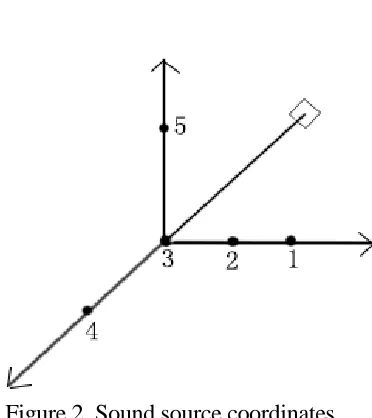
In order to determine the position of sound source by time difference, the geometric relation of sensors is studied. In the plane, for the two sensors, the time difference t is obtained by GCC, and the distance between the two sets is C. The relation between the phases of the received signal of the sensor is determined, and the sound source trajectory is determined to be a single lobe hyperbola. And the two groups of microphones, their hyperbolic intersection is the sound source position. Therefore, to locate the sound source on the same plane, at least 3 sensors are needed, and the sensors are not in the same line.
Figure 1. Using a linear array method.
TABLE 1. CONCLUSION.
symbol implication The relation between the time delay estimate and the target distance
12
The time delay of the array element 2versus the array element 1 c r r2 1
12
13
The time delay of the array element 3versus the array element 1 c r r3 1
13
[image:3.612.211.397.351.560.2]
Figure 2. Sound source coordinates.
On the basis of element 1, we eliminate the variables by cosine theorem and obtain the following conclusions:
) 2ct -)/(4ct 2c -) 2(ct -) ((ct =
r1 13 12 12 13
2 2 2
SIMULATION EXPERIMENT AND ANALYSIS OF EXPERIMENTAL RESULTS
(1) (2)
[image:4.612.102.496.107.328.2](3) (4)
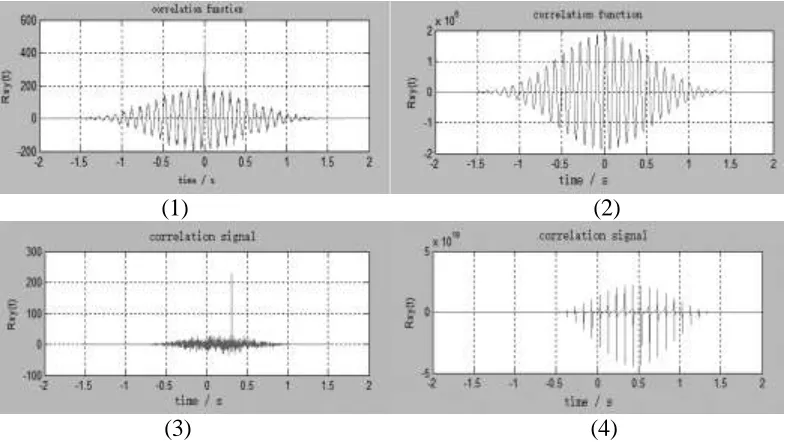
Figure 3. GCC algorithm.
As shown in Figure 1, the simulation result is 0 in the case of strong noise, which shows that GCC does not apply to the strong and impetuous environment.
Figure two shows that in the case of weak reverberation, the simulation result is 0.016, which is close to the ideal result. It is shown that the GCC algorithm can be used to obtain the correct results directly in a weak reverberant environment.
Figure three shows that in the case of random continuous signals, the simulation results are close to the ideal results, which shows that the GCC algorithm can deal with random continuous signals.
Figure four shows that in the case of discontinuous signals, the simulation results are seriously offset by correct conclusions, indicating that the GCC algorithm cannot deal with discontinuous signals.
CONCLUSION
REFERENCES
1. Cui, Weiwei, Cao, Zhigang and Wei, Jianqiang. “Time Delay Estimation Techniques in Source
Location”, Tsinghua University, 2006.
2. Bernard Widrow. “A microphone array for hearing aids”, Stanford University, 2002.
3. Ye, Yizhi, Huang, Jianmin. “Research and Application of Sound Source Localization Technology
in Industrial Field”, Shanghai Jiao Tong University, 2009.
4. Guo, Jincheng. “A Study on Sound Source Localization Technology Based on Microphone Array”.