2017 2nd International Conference on Artificial Intelligence: Techniques and Applications (AITA 2017) ISBN: 978-1-60595-491-2
Optimal Allocation of Distributed Generation Based on Adaptive
Genetic Algorithm
Bo JIANG
1, Liu YANG
1, Lei ZHAO
1and Qi JIANG
21
Xi'an, Shiyuan Road, No. 218, China
2
Xi'an, Wenyi Road, No. 101, China
*Corresponding author
Keywords:Distributed Generation, Genetic algorithm.
Abstract. Distributed generation (DG) has attracted extensive attention for the emergence of new energy, environmental protection requirements, and flexible and reliable. The addition of DG will have a great impact on the loss and voltage of distribution network .This paper changes the traditional way which makes the optimal power flow, voltage deviation minimum as target, using genetic algorithm, having large data theory to generate fault .When random failure occurred, with the islanding effect of DG, making the minimum economic loss caused by the lack of power supply as the objective function, to optimize the configuration of DG from the viewpoint of reliability, proven to reduce the economic losses significantly.
Introduction
With oil and other fossil energy supply tight, new energy development and awareness of environmental protection, developing new energy in distributed generation has become one of the important means of energy conservation and emission reduction. DG usually refers to the small power supply system on the user's side, including power generation equipment and energy storage devices. DG has changed the power flow mode, and has a great impact on network loss, power quality and so on.
The Influence of DG on Distribution Network
The influence of DG on distribution network is mainly reflected in two aspects: network loss and voltage. DG will undoubtedly change the power flow, and subject to the laws of nature of the wind and light as the energy source. The output power will inevitably be affected, and the voltage fluctuates. The system flow changes will inevitably change the node voltage and the power quality impact; on the other hand, this change will have a great influence on the system loss.
energy is realized under the premise of reliability, to operate economically. The above studies only aimed at economy, but ignored the requirement of reliability. Therefore, this paper proposes an optimization method based on reliability to solve the location and sizing of DG.
This paper takes the minimum economic losses caused by the lack of supply of power as the objective function, and takes the islanding effect of distributed power supply in distribution network failure into consideration, to evaluate the positive role of distributed generation access to reduce economic losses. According to the established network model of the topological structure of distribution network, based on the statistical data obtained node weight and economic density, and the fault information, evaluates the ability of DG to reduce the economic loss and uses the genetic algorithm to solve the optimization problem under the constraints of line.
Island Search
In the state of failure, the island is searched to reduce losses. Starting from the node where the distributed generation locate, with the capacity limit breadth first traversal of nearby nodes, under the premise of ensuring the rated power distributed power permit, as far as possible to ensure that load of large weight priority into the range of the island. The sum of the product of the weight and the load is taken as the objective function, i.e.:
∑
⊂=
t
d i
i i
t w L
d
MAX (1)
,
∑
⊂
≤ d i
i PDG
L (2)
(3)
ti ti
d
∩
d
′= ∅
。
(4)D is an island range, wiis node load weight, Liis node load, PDGis distributed generation
capacity, j is inter node lines, Ti represents the island range of the I node.
Algorithm Implementation
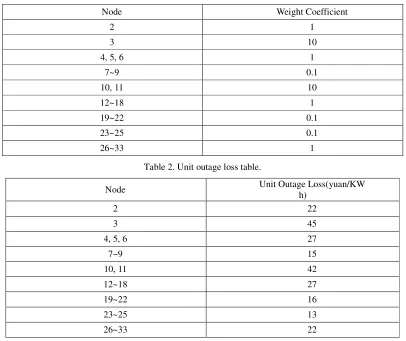
First treat the distribution network a network without load change. Large data technology is used to find typical day as node load. According to the regional economic production value, the economic loss caused by the unit electricity shortage in the node area is determined, and the production economic loss table is taken as an important consideration for the formation of the island and the judgment of fitness.
Mathematical Model
The objective function of the DG optimization model is as follows: the minimum economic loss caused by the lack of power supply is the objective function:
i i 1 i
i
minEL E LT
N
∑
= =
(5) In the formula, EL is the lack of electricity caused economic losses.i is the node.N is the number
of node. Eiis the economic loss caused by the loss of power per unit in the i node.Li is node load. ,
max j i j i, P,
P ≤
(6) The upper bound of DG penetration power of distribution network is:
P P
K
DG ≤η
∑
=1 i
i
(7) A is the transmission power factor of the distribution network; K is the number of DG.
Algorithm Solution Steps
A single point of failure occurs to each individual, and the fitness evaluation is performed after the island is generated. The average fitness of the multiple evaluation results is the final fitness of the individual. Taking the elite strategy, with the generation of the individual fitness ordered from small to large, to select the first three good performance of individuals, compared with the three worst adaptation of offspring, individuals with large fitness are replaced or retained to ensure the inheritance of good individuals.
The crossover probability of adaptive genetic operators is:
(
)
′ = , , avg avg max 2 c c1 1 c 1 cc f -f
f -f -P * P P P P (8) The mutation probability of the adaptive genetic operator is:
(
)
= , , avg avg max 2 m m1 1 m 1 mm f-f
f -f -P * P P P P (9)
In the formula: fmaxis the largest fitness value in the population, favgis the average fitness value
in the population, f′the larger fitness value of the two individuals to be crossed, f is the fitness
value of the individual which is about to change. In the paper,Pc1=0.9, Pc2=0.6,
1 m
P =0.05, Pm2 =0.1 are used as initial crossover and mutation probabilities.
The Analysis of Examples
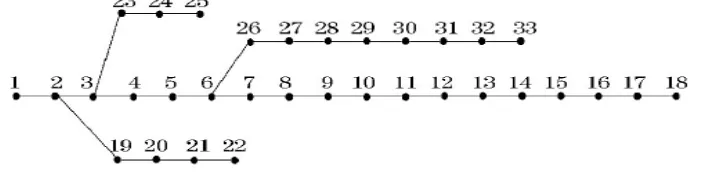
[image:3.612.130.484.549.638.2]This article uses the MATLAB software to carry on the simulation, takes 33 nodes as an example to carry on the analysis, the wiring diagram of the system is shown in figure 1.
Figure 1. 33 connection diagram of node.
Table 1. Weight table of nodes.
Node Weight Coefficient
2 1
3 10
4, 5, 6 1
7~9 0.1
10, 11 10
12~18 1
19~22 0.1
23~25 0.1
[image:4.612.103.509.79.420.2]26~33 1
Table 2. Unit outage loss table.
Node Unit Outage Loss(yuan/KW
h)
2 22
3 45
4, 5, 6 27
7~9 15
10, 11 42
12~18 27
19~22 16
23~25 13
26~33 22
The total capacity of the system is 6MVA.The total active load is 2756KW.The production value is 800 thousand yuan. Every node (not including the balance node) can access DG. The DG access capacity is not more than 30% of the total capacity and the genetic algorithm is set as follows:
The binary encoding of nodes takes 6 bit yards, and each node has 4 bit yards with the unit capacity is 0.05MW, and finally 10 units of code length. The population size is 20, the number of iterations is 50, crossover and mutation are adjusted dynamically with adaptive probability, the initial cross rate is set to Pc1=0.9, Pc2=0.6, and the mutation rate is set to Pm1=0.05, Pm2=0.1
To optimize the configuration, we can get the optimization results: 3 node access 150KW, 11 node access 400KW, 16 node access 300KW.When the fault occurs, 3, 11 and 16 nodes can be formed as the center of the island and within the scope of the island, the accumulated economic loss of 60 thousand yuan can be reduced. At the 7, 20 and 22 nodes to access the same capacity of DG, within the scope of its island can reduce the economic losses of 12 thousand yuan. Compared with the blind investment in DG, in this paper the optimal allocation scheme has better adaptability.
Summary
References
[1] Yuan Mianqi, Zou Zhenyu, Sun Kaiqi, Liu Hejin, Li Kejun. Optimal allocation of distributed generation and genetic algorithm based on differential evolution algorithm.[J]. China electric power, 2013, (01): 16-20.
[2] Han Tianxiong, Xiong Jiawei, Zhao Xian, Zhong Quan. Application of evolutionary programming algorithm to location and sizing of distributed generation [J]. Journal of Electric Power, 2013, (05):370-373.
[3] Ye Meng, Liu Wenxia, Zhang Xin. Location and sizing of distributed power supply considering voltage quality [J]. Modern Power, 2010, (04): 30-34.
[4], Wang Xiuli, Zhao Xingyong, Cao Jianwen, Yuan Xiaoming. Optimization design of location and volume of distributed power supply based on Improved Particle Swarm Optimization [J]. Journal of Dalian University of Technology, 2014, (03): 355-360.
[5] Ma Xiu fan, Cui Huanjun. Improved genetic algorithm in distribution network planning with distributed power application [J]. Journal of electric technology, 2011, (03): 175-181.