2017 International Conference on Computer, Electronics and Communication Engineering (CECE 2017) ISBN: 978-1-60595-476-9
Parameter Tuning in Random Forest Based on Grid Search Method for
Gender Classification Based on Voice Frequency
Muhammad Murtadha RAMADHAN
*, Imas Sukaesih SITANGGANG,
Fahrendi Rizky NASUTION and Abdullah GHIFARI
Computer Science Department, Faculty of Mathematics and Natural Sciences, Bogor Agricultural University, Indonesia
*Corresponding author
Keywords: Classification, Parameter tuning, Random Forest.
Abstract. Parameter optimization is one of methods to improve accuracy of machine learning algorithms. This study applied the grid search method for tuning parameters in the well-known classification algorithm namely Random Forests. Random Forests was implemented on the voice gender dataset to identify gender based on the human voice’s characteristics. There are two parameters that were tuned to obtain the optimal values. Those parameters are number of variables used in building trees and number of trees that involves in the classifiers. Experimental results on voice gender dataset show that the highest accuracy of Random Forest with parameter tuning is 0.96907 which is higher than the accuracy of the model without parameter tuning (0.9675). The optimal parameter for the best classifier is number of variables is 'sqrt' which is square root of parameters involved in dataset and number of trees is 300. This study shows that the tuning parameter results optimal parameters for developing the best classifier using Random Forests.
Introduction
Parameter tuning in machine learning algorithms is an important task in order to get optimal values of the parameters. Several studies have been successfully proposed and implemented methods in parameter tuning to obtain the classification models with higher accuracy. Friedrichs and Igel [3] proposed a general approach to determine the kernel from a parameterized kernel space in SVM based on the evolution strategy. This study shows that extended Gaussian kernels with scaling and rotating parameters can lead to a significantly better performance than standard Gaussian kernels. Bergstra and Bengio [6] studied random search and sequential manual optimization to optimize the hyperparameters of learning algorithms including Deep Belief Network (DBN). This study shows that random experiments are more efficient than grid experiments for hyper-parameter optimization in several learning algorithms because not all hyperparameters are equally important to tune [6]. Wenwen et al [9] proposed an improved grid
search algorithm as the extension of the traditional grid search algorithm in parameter optimization of support vector machine (SVM). Experimental results on the tumor gene datasets show that the proposed grid search algorithm has higher classification accuracy of principal component analysis (PCA)-SVM and kernel PCA (KPCA)-SVM compared to those the traditional grid search
algorithm. Dewancker et al. [5] proposes a mechanism for comparing the performance of multiple
optimization methods for multiple performance metrics in optimization problems that utilizes nonparametric statistical analysis. Klein et al [1] proposed a generative model for the validation
error as a function of training set size in order to accelerate hyperparameter optimization. This study developed Bayesian optimization procedure namely FABOLAS which often finds high-quality solutions 10 to 100 times faster than other Bayesian optimization methods.
The paper is organized as follows: introduction is in section 1. Research methodology including Random Forests and grid search method is briefly discussed in section 2. Section 3 explains results and discussion. Finally we summarize the conclusion in section 4.
Methods Dataset
The dataset used in this work is the voice gender dataset which is available at https://www.kaggle.com/primaryobjects/voicegender. The dataset consists of 3,168 recorded male and female voice samples that is commonly used for gender recognition by voice and speech analysis. There are 20 predictor variables and one target variable in the dataset. The class label of target variable is gender Male and Female. Number of objects with each label is 1584. Atributes’ descriptions in detail are provided at https://www.kaggle.com/primaryobjects/voicegender.
Random Forest Algorithm
Random Forest is categorized as an ensemble learning method that generates many classifiers and aggregate their result for prediction [2]. Breiman [8] explains that random forests are used in classification process by combining tree predictors such that each tree depends on the values of a random vector sampled independently and with the same distribution for all trees in the forest. In addition, random forests have different construction with standard classification or regression trees. Liaw and Weiner [2] explain that standard trees use the best split among variables in splitting each node, whereas each node is split using the best among a subset of predictors randomly chosen at that node.
The random forest algorithm (for both classification and regression) is as follows [2] : 1. Draw ntree bootstrap samples from the original data
2. For each of the bootstrap samples, grow an unpruned classification or regression tree, with the
followinff modification: at each node, rather than choosing the best split among all predictors,
randomly sample mtry of the predictors an choose the best split from among those variables.
(Bagging can be thought of as the special case of random forests obtained when mtry = p, the number
of predictors.)
3. Predict new data by aggregating the predictions of the ntree trees (i.e., majority votes for
classification, average for regression).
An estimate of the error rate can be obtained, based on the training data, by the following:
1. At each bootstrap iteration, predict the datanot in the bootstrap sample (what Breiman calls “out-of-bag”, or OOB, data) using the tree grown with the bootstrap sample.
2. Aggregate the OOB predictions. (On the average, each data point would be out-of-bag around 36% of the times, so aggregate these predictions.) Calcuate the error rate, and call it the OOB estimate of error rate.
Andy and Weiner [2] in their study show that OOB estimate of error rate is quite accurate, given that enough trees have been grown.
Grid Search Method
selected: 1. Probability of feeling unsafe to use methods which avoid doing an exhausive parameter search by approximation heuristics. 2. Comptutational time required to find good parameters by grid-search is not much more than that by advanced methods since there are only two parameters.
Result and Discussion
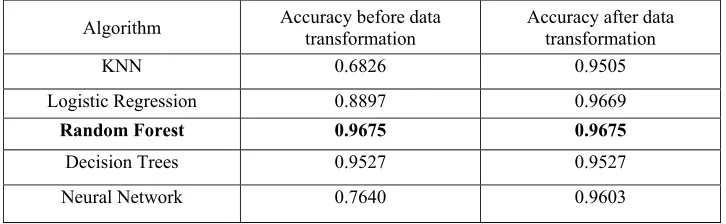
[image:3.612.125.488.260.372.2]This study implemented five classification algorithms on the voice frequency dataset. Those algorithms are K-Nearest Neighbor (KNN), Logistic Regression, Random Forest, Decision Trees and Neural Network. The accuracy of classifiers as the results of those algorithms are provided in Table 1. We applied the 7-fold cross validation in calculating accuracy of classifiers. The results shows that Random Forest has better performance than other classification algorithms with highest accuracy of 0.9675 on the dataset before and after transformation. We performed data transformation by converting the range value of main variables to the new interval of [0, 1].
Table 1. Accuracy of classification algorithm on the dataset before and after transformation.
Algorithm Accuracy before data transformation Accuracy after data transformation
KNN 0.6826 0.9505
Logistic Regression 0.8897 0.9669
Random Forest 0.9675 0.9675
Decision Trees 0.9527 0.9527
Neural Network 0.7640 0.9603
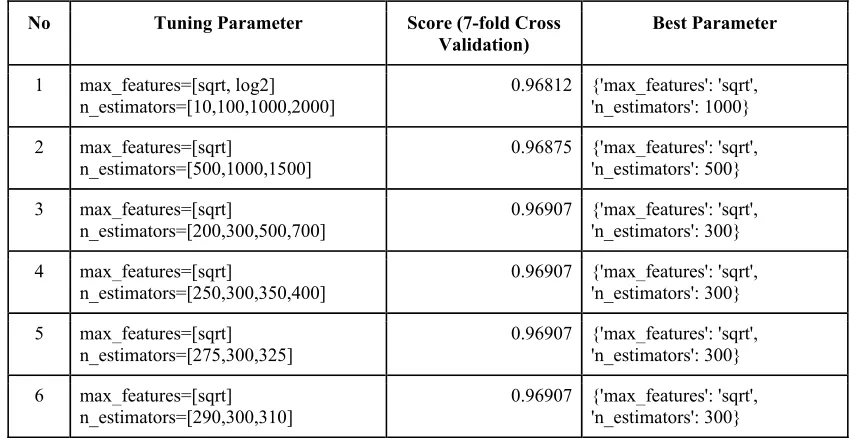
In order to improve accuracy of Random Forests, this study conducted tuning parameters of the Random Forests algorithm using the grid search approach. The Random Forests algorithm has several parameters to be adjusted in order to get optimal classifier. Two of those parameters are maximum number of variable used in individual tree and number of trees constructed for classifying new data. This study utilizes the class GridSearchCV which is available in Scikit Learn (http://scikit-learn.org). GridSearchCV considers all parameter combinations to obtain optimal values of parameters. In this method, all the possible combinations of parameter values are evaluated and the best combination is retained to results the best classifier.
Table 2. Best parameter of Random Forests as the results of tuning parameter using GridSearchCV.
No Tuning Parameter Score (7-fold Cross
Validation) Best Parameter
1 max_features=[sqrt, log2]
n_estimators=[10,100,1000,2000] 0.96812 {'max_features': 'sqrt', 'n_estimators': 1000}
2 max_features=[sqrt]
n_estimators=[500,1000,1500] 0.96875 {'max_features': 'sqrt', 'n_estimators': 500}
3 max_features=[sqrt]
n_estimators=[200,300,500,700]
0.96907 {'max_features': 'sqrt', 'n_estimators': 300}
4 max_features=[sqrt]
n_estimators=[250,300,350,400] 0.96907 {'max_features': 'sqrt', 'n_estimators': 300}
5 max_features=[sqrt] n_estimators=[275,300,325]
0.96907 {'max_features': 'sqrt', 'n_estimators': 300}
6 max_features=[sqrt]
n_estimators=[290,300,310] 0.96907 {'max_features': 'sqrt', 'n_estimators': 300}
According to Table 2, the highest accuracy of the classifier is 0.96907 at the parameter 'max_features' = 'sqrt' and 'n_estimators': 300. The accuracy of Random Forest without parameter tuning is 0.9675. Therefore the Random Forest model with those two parameters is used to classify the object in the voice gender dataset. Figure 1 illustrates the attribute’s score as the result of Random Forest at the best parameter. As shown in Figure 1, the attribute average of fundamental frequency measured across acoustic signal (meanfun) has the highest score of 0.3836 meaning that this variable has strong influence in the model to classify the object into the class Male or the class Female.
Figure 1. Attribute’s score of the voice gender dataset.
Summary
0.38
0.18 0.13
0.070.05
0.030.020.020.020.010.010.010.010.010.010.010.010.010.010.01 0
0.050.1 0.150.2 0.250.3 0.350.4 0.45
Scor
e
[image:4.612.80.528.426.629.2]values of maximum number of variable used in individual tree (max_features) as sqrt(n_features) and number of trees that want to be constructed in the model (n estimators) as 300. Based on the two optimal values of parameter, accuracy of Random Forest increases to 0.96907. The results show that tuning parameter has successfully generated the best classifier to classify a new data.
Acknowledgement
The authors would like to thank to Directorate of Student Affairs, Bogor Agricultural University, Indonesia for the support in the research process.
References
[1] A. Klein, S. Falkner, S. Bartels, P. Hennig, F. Hutter, Fast bayesian optimization of machine
learning hyperparameters on large datasets, Proceedings of the 20th International Conference on
Artificial Intelligence and Statistics (AISTATS) 2017.
[2] A. Liaw, and M. Wiener, Classification and regression by random forest, R news 2.3 (2002):
18-22.
[3] F. Friedrichs, C. Igel, Evolutionary tuning of multiple SVM parameters. Proceedings of the
12th European Symposium on Artificial Neural Networks (ESANN) 2004.
[4] C.W. Hsu, C.C. Chang, and C.J. Lin, A practical guide to support vector classification, (2003):
1-16.
[5] I. Dewancker, M. McCourt, S. Clark, P. Hayes, A. Johnson, G. Ke, A strategy for ranking
optimization methods using multiple criteria, JMLR: Workshop and Conference Proceedings 64:11–20, 2016, ICML 2016 AutoML Workshop.
[6] J. Bergstra, Y. Bengio, Random search for hyper-parameter optimization, Journal of
Machine Learning Research 13 (2012) 281-305.
[7] J. Han, J. Pei, M. Kamber, Data Mining: Concepts and Techniques, third ed., Waltham,
Elsevier, 2011.
[8] L. Breiman, 2001, Random forests, Machine learning, 45(1) (2001) 5-32.
[9] L. Wenwen, X. Xiaoxue, L. Fu, and Z. Yu, Application of improved grid search algorithm on
SVM for classification of tumor gene, International Journal of Multimedia and Ubiquitous Engineering, Vol 9 No 11 (2014) pp 181 – 188.
[10]M. Ataei, and M. Osanloo. Using a combination of genetic algorithm and the grid search