CONTROL MODEL DEVELOPMENT
FOR PACKED BED CHEMICAL REACTORS
Thesis
by
Rohi
tKhanna
In Partial Jilulfi.Ument
of
the Requirements for the Degreeof
Doctor
of
PhilosophyCalifornia Institute of Technology
Pasadena. California
1984
0 1984
Rohit Khanna
iii
To my parents for their support and encouragement
throughout my education and to my wife for her love
iv
This thesis would clearly not be possible without the guidance of my
advi-sor, Dr. Seinfeld. 1 am grateful that he was able to allow me to conduct research
in the areas of my interest without significant restrictions. His assistance is
greatly appreciated. I would also like to thank the National Science Foundation
tor their graduate fellowship that provided much of the assistance for this
research.
Much of the real credit for this thesis should go to my family. Without the
visions and foresight of my parents and without their high expectations this
would never have been possible. Most of all I would like to thank Debbie for her
love and support throughout the time at Caltech and especially on all those
nights when she wished that I could be home but understood that I had to work.
Finally, I would like to thank Dave and Barry for helping provide the outside
interests necessary to keep life stimulating and enjoyable and to retain
v
ABSTRACT
Although control algorithms have been conceived for industrial chemical
systems. their acceptance by industry has been slow due to a lack of direct
experimental evidence of their effectiveness and to volumes of conflicting, or at
least incompatible, recommendations on control structure design. This thesis
provides the basis for a concerted theoretical and experimental program in
mul-ti variable process control structure design for packed bed chemical reactors by
presenting an in-depth control analysis of a practical, multivariable, distributed
parameter system-the heat conduction problem defined by the simple diffusion
equation-using both frequency-domain and time-domain analyses and the
for-mulation, numerical solution, and analysis of a detailed model for packed bed
reactors, along with reduction to a low-order state-space representation suitable
for on-line process control.
The study of the heat conduction system allowed for consideration of
vari-ous control design techniques and the relation between measurement structure
and control system design. This study shows that the choice of measurements
and their locations significantly affects the optimal control design and the
use-fulness of the different design techniques and the importance of an accurate
process model and the necessity of model reduction to a low-order state-space
representation for control structure design and implementation.
The second portion of this study provides a detailed mathematical modeling
analysis of packed bed catalytic reactors that significantly extends previous
stu-dies· in the detail of the model and in the consideration of all aspects of the
vi
general view that modeling simplifications are desired since they lead to a
reduction in numerical solution effort is contested, and it is shown that many
simplifications are no longer necessary with today's advanced computational
capabilities. A unified approach to dynamic reactor modeling is developed and
its importance in the accurate description of dynamic and steady state reactor
behavior, in the investigation of reactor start~up or the effects of process distur~
bances, and in lhe development of an accurate reduced stat~space model for
the design of control structures to stabilize the reactor under various distur~
vii
TABLE OF CONTENTS
Acknowledgement
Abstract
Notation
1. Introduction
1. Objectives of the Current Work
2. Industrial Control Considerations
3. Review of Experimental Control Studies
2. llultivariable Control Structure Design for a Heat Conduction System
1. Introduction
2. Preliminary Analysis
1. Model Red.uctiun.
2. CantrolZa.lTility
3. Root· Locus
3. Tim~ Domain Analysis
1.
qptimal
Ccmtrol2. Mod.a.l Cr:mtrol
4. Non-Interacting Control
1. Prn"Ject .Dynamic Cl>f111>ensa.tion
2.
Stea.d.y Sta.te .Decrru:pling3. Set .Pm:nt O>mpensa.tion
4. Inner-Loop .Decoupli:ng
viii
5. Inverse Nyquist Array
6. Characteristic Locus Method
1. Ba.sic System Analysis
1. O:tse !: Measurements z1=0.3, z2=0.7 2. Chse II: Measurements z1=0.4, z2=0.6 3. Chse III: Measurements 2 1 =0.4, z2=0.8
2. Inner Loop .Analysis
1. Qzse I: Measurements Zt=0.3, z2=0.7
2. Chse II: Measurements z 1 =0.4, z2=0.6
3. Cb.se III: Measurements~ l;;;:Q.4, ze;;;;0,6
3. Modified Inner-Loop Analysis
7. Control System Performance
1. Case I: Mea.su.rements z 1 =0.2, z2=0.8
2. Ca.se II: Mea.surem.ents z1=0.3, z2=0.?
3. Case III: Measurements zl=0.4, z2=0.6
4. Cb.se IV: Mea.su.rem.ents z 1=0.4, z2=0.6
8. Discussion of Control Analysis
3. U:athem.aticalllodel of a Packed Bed Catalytic Reactor
1. Introduction
2. Review or Packed Bed Reactor Modeling
3. Model Development for Packed Bed Catalytic Reactors
1. Reactor System
2. Reacf:ion .Ni:netics
3. Formation of OJmplete Mathematical Model
4. Mathematical Rela.tianships
ix
5. N'tl.t71.BriDal Solution
199
1. Solution Techniques
200
2. Orthogonal Collocation
204
3. Model Reduction
20f
4. Numerical Sim:ulaticm
216
4. Model Analysis
223
L Modeling Pa.rameters 224
2. Steady-State Beha:uiar 229
3. Dynamic Sim:ula.tian.s
230
4. EJ!ects oJ RtuJ.clrYr Dperati:ng Conditions 232
5. Radial Ccmcentra.ticm Analysis 234
6. Adiabatic Analysis
238
7. ImprYrtance oJ Thermal Well 239
8. Dispersion Effects
241
5. OCFE Model Analysis
271
1. Fcrrmulation of oc;:Ji'B' Technique
272
2. Madel Comparisons
279
6. Control Model Development
293
1.
State-Space Representation293
2. Model Linea:ri.rza.ticm. 296
1.
Linearization of the Reaction Rates297
2.
Lin.earizatian of the Al.gellraic Equations298
3. Linearization of the Differential Equa.titm.s300
4. Nu:rnerical Sol~ of the Li:n.earisl:ed Model
302
3. State-Space Si.m:ulatians
304
X
1. Model Discretization
2. Physical Modeli:ng Sim:plifications
1. Horrwgeneous Analysis
2. Quasi Steady State Approzi:ma.tion
3. Negligible EJn.ergy Accumulation in Gas
3. Model Reduction
1. Davison's Method.
2. Marshall 's Method.
4. Discussion of Reduced. Model
4. Results and Di.scUSBi.on of Future Experimental Studies
1. Conclusions of Current Analysis
2. Parameter Estimation and Model Verification
3. Control Model Configuration
4. Control System Design
5. Appendices
1. Computer Programs for Heat Conduction Problem
2. Normalized Packed Bed Reactor Model
3. Radial Collocation of Packed Bed Reactor Model
4. Computer Model of the Packed Bed Reactor
5. Orthogonal Collocation on Finite Elements Model
a.
Linear Packed Bed Reactor Model6. References
xi
A
ft.v.J3v
B
c
c
d
D
F
xii
state matrix
collocation weights for first and second derivative
control matrix
concentration, g-moles I cm5
element ij of measurement matrix C
heat capacity, call g °K
measurement matrix
disturbance vector
radial collocation weights
bulk molecular diffusivity, em 2 I sec activation energy, call g-mole
pressure dependence constants for steam-shift reaction rate
element ij of inner-loop compensator
:r
inner-loop compensator
element of process transfer function
Gp
controller transfer function
interaction compensator transfer function
process transfer function
set point compensator transfer function
heat transfer coefficient between phase i and j, cal!sec em aK
xiii
molar ftu.x relative to molar average velocity
k thermal conductivity
reaction rate constant
Blake·Kozeny constant
diagonal gain element of K
radial (axial) thermal conductivity, cal/sec em °K
K diagonal proportional gain matrix
methanation reaction rate constants, atm-1
low and high frequency compensators
equilibrium constants, atm-2 for methanation
Lagrangian polynomials
L reactor length, ern
controllability matrix
molecular weight of gas, g I g·mole
molar ftu.x with respect to stationary coordinates
-p pressure, atm
total pressure neglecting mole change, atm
closed-loop characteristic polynomial
partial pressure of species i, atm
open-loop characteristic polynomial
Q
r
r
R R
R'
Rg
t
t
T u
Ug
u
v
X
xiv
open~loop transfer function
radial coordinate. em
normalized radial coordinate, r /R1 radial collocation point
reaction rate, g~mole/sec cm3
closed-loop transfer function
radius of thermal well and outer wall, respectively, em
normalized reaction rate
universal gas constant, 1.91:i7 cal/g~mole aK
time. sec
normalized time for heat conduction problem
absolute temperature, aK
control vector
control inputs to heat conduction system
interstitial velocity of gas, em/sec
internal energy
overall heat transfer coefficient between phase i and j, cal/ sec °K
normalized ftuid velocity, u1/~
volume, cm3
weighting functions
XV
xi mole fraction of species L g-mole if g-mole total
y normalized temperature distribution for heat conduction problem
y output vector
y0 normalized temperature distribution at t=O
Yd desired normalized temperature distribution
y, normalized mole fraction,
Xt.rx&
z axial coordinate, em
z normalized space coordinate for heat conduction problem
xvi
Greek letters
a
(J
6
1'}
7
"
p
a
dimensionless axial dispersion, oc: Pe;1
dimensionless radial dispersion, oc: Pe;1
moles CO reacted in methanation per total inlet moles
void fraction of bed
dimensionless heat capacity
dimensionless heat transfer coefficient, oc: St
dimensionless heat generation parameters
eigenvalues
Biot numbers
diagonal matrix of eigenvalues
viscosity
constants from radial collocation
normalized radius of therma well,
Ro/R1
dimensionless heats of reaction
density, g/cm3
dimensionless reaction coefficients
dimensionless pressure drop,
Pz=LIPz=e-
1normalized time, (t ·il~o)IL
normalized temperature.
TIT
I.)xvii
Subscripts and Superscripts
0 value at inlet
b reactor bed
f value at outlet
g gas
h heat
m mass
M methanation reaction
r radial
s solid catalyst
s
steam-shift reactiont thermal well
w cooling wall
z
axialbased on inlet conditions
steady state
Chapter 1
-2-One of the major difficulties in the application of advanced process control
theories to industrial chemical processes is the lack of complete understanding
of the chemical process and the inability to predict system behavior in the
pres-ence of unknown and uncharacterized disturbances. This difficulty is
com-pounded by physical and chemical interactions or nonlinear coupling of the
pro-cess variables. Although complex control algorithms have been conceived for
industrial chemical systems, their acceptance by industry has been slow due to
a lack of direct experimental evidence of their effectiveness and to volumes of
conflicting, or at least incompatible, recommendations on control structure
design. Significant research efforts are necessary in duplicating industrial
processes in a research setting and providing a unified approach to the
mathematical modeling and control structure design.
This thesis provides the basis for a concerted theoretical and experimental
program in multivariable process control structure design for packed bed
reac-tor systems. Along with the detailed design and construction of both a kinetics
and pilot-scale control reactor {Strand, 1984), this work presents the necessary
prerequisites to a substantial effort in the study of the applicability of process
control theory to a laboratory- or pilot-scale industrial chemical process. In
view of these objectives, this thesis is divided into two major sections:
- an in-depth analysis of a practical. multivariable, distributed
parame-ter system-the well-defined beat conduction process defined by the
simple diffusion equation-using both frequency-domain and
time-domain analyses and
-the formulation, numerical solution, and analysis of a detailed
low-order state-space representation suitable for on-line process control.
The first section of this work, the analysis of the heat conduction problem,
is presented in Chapter 2 and is a self-contained presentation of many of the
control aspects of a multivariable, distributed parameter system (Khanna and
Seinfeld, 1982). Although this heat conduction system is much simpler than the
packed bed reactor, a considerable amount of insight into control structure
design can be obtained from this process since the control aspects are not lost
in the complexity of the mathematical system as they may be in an initial
detailed control study of the experimental packed bed reactor. In particular, an
analysis of a number of multivariable process control strategies, including
non-interacting control, optimal control. inverl:!e Nyquist array, and characlerislic
locus techniques, is carried out theoretically on a one-dimensional. two-input
heat conduction system. The potential improvements in control performance
through the usc of extra measurements and through the appropriate selection
of measurement locations is assessed and a new non-interacting control
stra-tegy, termed inner-loop decoupling, is developed.
The remainder of this thesis centers on the complete dynamic modeling
analysis of a packed bed reactor, along with reduction to an accurate low-order
state-space representation suitable for control studies. According to Jutan et al.
( 1977). this is
-4-In view of these comments, this study allows accurate description of dynamic
and steady state reactor behavior for process optimization and design. for the
investigation of reactor start-up or the ef:J'ects of process disturbances, and for
the analysis and design of control structures. Various common assumptions
and model structures are considered, and the appropriate numerical solution
techniques are discussed. This analysis is not intended to be specific to any
par-ticular packed bed reactor system but rather to present a detailed study of
modeling techniques, assumptions, and solutions and to develop a unified
approach to dynamic reactor modeling and control model development. The
work significantly extends previous studies in the detail of the mathematical
model and in the systematic consideration of all aspects of the model
-5-1.2 INDUSTmAL CONTROL CONSIDERATIONS
Until only recently, the process control industry has been dominated by
applications to mechanical or electrical processes where systems are generally
well-defined and numerically simple due to minimal nonlinearities and relatively
simple physical characteristics. Even so-called 'modern' control theories
developed in the 1960's have only played an important role in fields such as
robotics and the space program. Their applicability to complex industrial
chem-ical processes which are inherently burdened by nonlinearities, large time
delays, and distributed parameter behavior has been extremely limited in spite
of an enormous effort by researchers. Although significant theoretical efforts
have been made by many research groups in the development of control
algo-rithms for ill-defined distributed parameter systems as are common in the
chemical industry, these efforts have not found wide application in actual
indus-trial problems. Thus during the past twenty years, a significant control 'gap' has
developed between process control theory and practice (Foss, 1973; Seborg and
Edgar, 1982).
Due largely to increased costs for energy, increased governmental safety
and environmental restrictions, and increased foreign competition, significant
efforts are now being made by industry to modernize and automate production
facilities with a major emphasis on integrating energy requirements and
improv-ing throughputs and system performance (Ray, 1981). Additionally with the
major improvements and general acceptance of computers suitable for on-line
control, attempts at applying sophisticated control theories are only now
begin-ning. One of the conclusions of the discussion on the problem of the control
'gap' between academic theories and practice is that there exists a ·pressing
need for careful, systematic studies of the design and implementation of control
behind the current theoretical and experimental program for which this thesis
provides a basis.
Several steps are necessary prior to developing and testing control
stra-tegies. These include the design and construction of a pilot-scale system
pos-sessing much of the modeling characteristics and control difficulties of the
actual industrial process, the development of an accurate mathematical model
for process design and analysis, and the reduction of the full model to one
suit-able for control structure design and on-line control. The first of these steps
was performed by Strand (1984), and the latter two steps are the concern of this
current work. A packed bed nonadiabatic chemical reactor was selected as the
chemical process to be studied due to its complexity and inherent control
difficulties and its extensive industrial importance for carrying out exothermic,
gas phase reactions.
Upon completion of these preliminary research efforts. the elements of the
control structure:
• the measured variables,
• the manipulated variables,
• the control configuration connecting the measured and manipulated
variables, and
• the control logic governing the behavior of the manipulated variables
can be considered. In particular, it is important to determine control
struc-tures that make optimal use of the availiible measurements in the chemical
pro-cess. Although in general there may be quite a few measured variables available,
they may not be the variables of most concern, and these variables may need to
be reconstructed using the process model. An example of this is the
-7-outlet concentrations may need to be estimated. Further problems with
meas-urements result from various random and systematic errors or noise in the
measurements and long delays due to the complexity of the chemical or
physi-cal analyses.1 The use of an accurate process model can in many cases minimize
these diffl.culties by allowing prediction of some unavailable measurements, by
improving the knowledge of the system performance through simulations, and
by allowing design improvements to the process.
Thus the central role played by dynamic and steady state models in the
design and optimization of chemical processes and in the development and
application of control strategies justifies considerable effort in their
develop-ment. The philosophy of this modeling work is presented by Foss ( 1973),
'Forms
ot
the models range from sets of nonlineardifferential equations to empirically or experimentally derived transfer functions. The forms of the models may not be selected arbitrarily: they are determined in part by the control objectives and the type of control analysis to be pursued. In short, process modeling is a substantial and crucial task, and by no means routine. .. . The operation of control systems of modern design also requires estimates of the process states used for control. This requires a process modeL perhaps different than that used for design calcula-tions, and a means of rapid solution of the model equa-tions."
The work presented in this thesis is intended to minimize the diffl.culties
associ-ated with process modeling by providing an accurate unified approach to the
model development for packed bed chemical reactors.
-8-1.5 REVIEW OF EXPERIIIENTAL CONTROL S'I'UDIES
Several experimental laboratory-scale packed bed reactor systems have
been studied in terms of control considerations. Table 1.2-1 outlines some of
the work done by several groups that have made significant contributions in this
area. Their work is by no means the extent of control applications for chemical
processes (there is much published work on the control or separation processes
and other reactor configurations) but is the major extent of published
experi-mental application of control techniques to packed bed reactors.
The Denmark group (Clement and Jorgensen, 1981; Clement et al., 1980;
Hallager and Jorgensen, 1981; Sorensen, 1977; Sorensen et al., 1980) considered
an adiabatic pilot-plant chemical reactor with the reaction between oxygen and
hydrogen over an alumina supported platinum catalyst. Initial dynamic
model-ing and experimental studies were carried out by Hansen and Jorgensen (1974,
1976ab) and by Sorensen (1976). The group considered various reactor and
control models and investigated control strategies based on optimal control.
direct Nyquist arrays, and the self-tuning regulator.
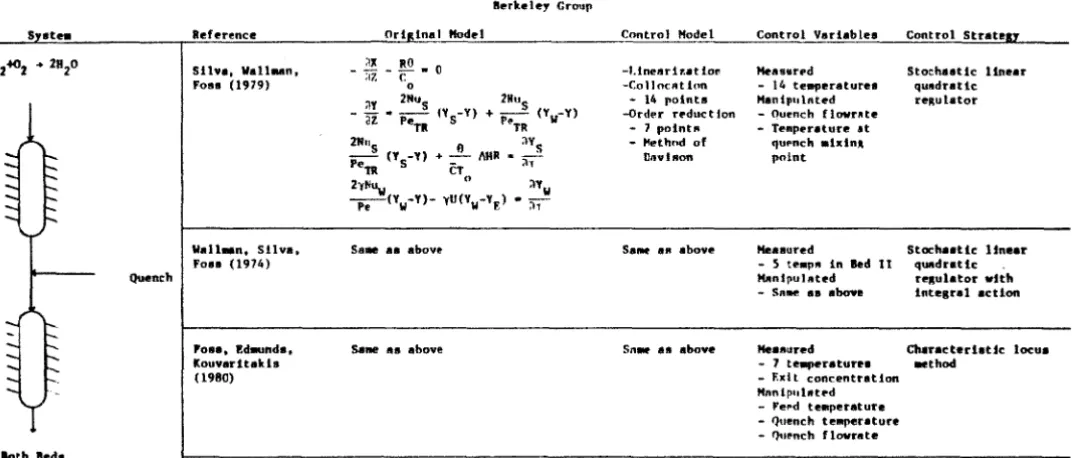
The Berkeley group (Foss et al., 1980; Michelsen et al., 1973; Silva et al.,
1979; Vakil et al., 1973; Wallman et al., 1979) studied the same hydrogen/oxygen
system but used a two-bed reactor structure with an interstage quench stream.
Again the beds were taken as adiabatic, and various control strategies were
de-vised. The first control studies by Silva et al. (1979) and Wallman et al. (1979)
considered the control of the quench fiowrate and temperature using
tempera-ture measurements and a product concentration estimator using the stochastic
linear quadratic regulator and multivariable integral control. The latter work
by Foss et al. (1980) uses the tlowrate and temperature of the quench stream
tempera-
-9-ture using the characteristic locus method of control system analysis. A major
significance of their work was the consideration of the large number of available
measurements and the appropriate choice of control contlguations.
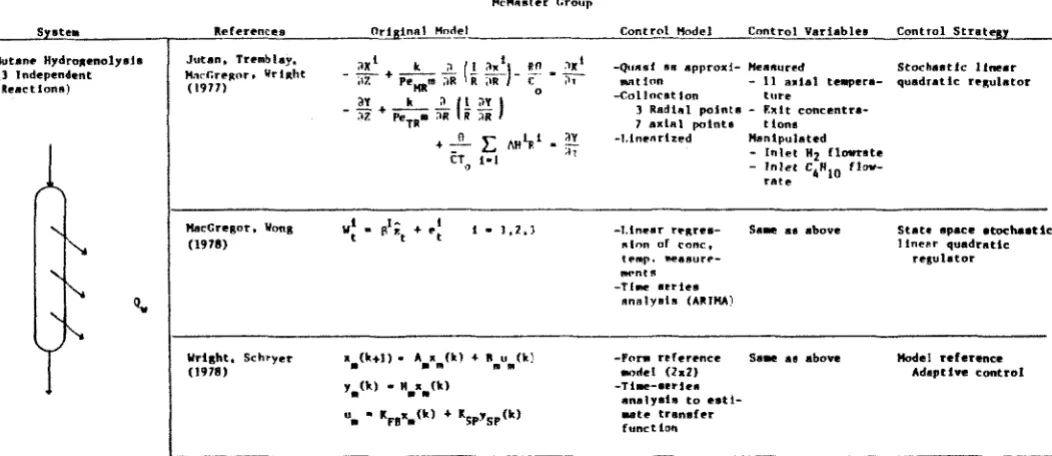
The McMaster group (Jutan et al., 1977; MacGregor and Wong, 1978; Wright
and Schryer, 1978) considered the hydrogenolysis of butane carried out over a
nickel on silica gel catalyst in a nonadiabatic packed bed reactor. The work by Jutan et al. ( 1977) provides an excellent foundation for packed bed reactor
modeling and control studies for multiple reaction systems by specifically
con-sidering the state-space model development, the parameter estimation and
sto-chastic disturbance identification, and on-line linear quadratic control. The
ear-lier work by MacGregor and Wong (1978) and Wright and Schryer (1978) deviated
from the mechanistic approach to reactor modeling taken by most studies
where models are developed by careful consideration of the important chemical
and physical phenomena occurring within the process. They considered the use
of statistical methods to identify process transfer functions from empirical
input/ output process data. They then applied a model reference adaptive
con-troller and a state-space stochastic linear quadratic regulator.
Finally. the dynamic behavior of an autothermal reactor with internal
countercurrent heat exchange using the steam-shift reaction was modeled by
Bonvin (1980) and Bonvin et al. (1979, 1980). Modal control using state
feed-back was found appropriate for stabilizing the reactor around an unstable
f)pnMRrk Group
Syat8 leferencu Orleln~l Hodel Cont_':£!._!fodel Control Variables Control Stnteu
H
2 + o2 + 2H2o
Acllabattc
Sorensen (1977) Cleaent. Jorf(l!'nsen, Suren•n•n (191!0)
Cle..nt • JorR.ensen (198!)
RallaAf!r. Jor~ten
' " " (!'Jill)
2
-~+--l_U_!t~.o
;l7. PeMl" ;)Z2 C
0
2
- ~ + _ I _ ~ - ~~ (~-Y )
:•~ Perz" az2 r"TR w
Same 111 s above
- fl_ fiHR • _;l!
CT ;Jt
0
x(t) • A(q- 1)x(t-1)+8(q-l)u(t-d) +e(t)+c or
Kl(t) • ·~(t)OI + el(t)
Table 1.2-1
- Cot }:watton (4-A rotnts) - 1~tne~trized
Snmr AS above
Mtaftsured
- 1l t""'P"rature - 6 o2 concentration - Tnt<1l flow-rate Hanhmlated
- J-"l'f"tl teaperat1.1f't!
- o2 feed
concen-tration - Tntnl ftovrate
s .... _. .as above
- te.1At 8CJUATeR Same AS above !dent H lent ton
- Tf.e series
Model
Summary of Published Research on Packed Bed Reactor Control
Stochastic linear qu•dratlc reRulator
Direct Nyquist array
Hfl<lll ... u -tuntna
r<Jiulator (LQR)
I
~
Syate.
11
2..02 + 2H2o
~~
....
----
~
loth lleda AUabattc
Quench
Reference
Silva, Vallun, Fou (1979)
Wall•n, S!lva, Fon (1974)
Pose. !d.unda.
Kouvar1taltls (1980)
ortgina I llod•d
rlX RO • c - ;iZ - co
2Nu
~ • _ _ s (ts-Yl
- oZ PeTR
Berke t ey Group
2Hu 5
+ - p - {Yw-Yl
~TR
211u5 Y) + ...!!._ AIIR
- - (Ys- -PeTR CTo
avs -~
2)'~"w(Y -Y)-yU{YW-YE) Pe W
Sa.e aa
above-Salle aa above
avw
-~
Control Hodel
-tlneari7.atlor~
-Co II ocRtl""
- 14 points -Drdt'r r .. ductlon
- 1 point" - l!t!thnd of
D-nvlfaon
Sa• att above
[image:28.796.110.651.184.413.2]Sn.- as abov~
Table 1.2-1 Continued
Control Variables
Measurpd
- 14 te,..,eraturea ManipulAted - {luench flovr•te
- Te•perature at quPnch •lxinA roint
Heaaured
- 5 tell!'~ in lied It
Man!pu!At..d - Sa.e aa above
Me•attred - 7 te....,raturn - F.xl t concentration Mnntpulltt .. d
- r.,.d te,..,erature
- Quench te....,rature
- Qu•nch flovrate
Control Strateu Stochastic linear
quadratic
re~~tulator
Stoc:haettc Unear
q~drattc
re11ulator vtth integral aetlon
McM~tat~r Group
SysteM Jlef.,r•ncu Original Hodel Control Hodel Control Variableo Control Strategy I
lutan• Hydro11HolyaJa
0 Jndepen4ent Reactions)
0..
lfonadta .. t tc
Jut an • Tre-mb 1-av.
H~rr.re~or. Wrt~ht
( 1977)
MacGregor, Wong (1'178)
Wright, Schtye1" (1978)
ax 1 t. ~ ( 1 a.1J ~~~ ~x 1
- TfZ + PeHRm ;:;R R ;tjt - ~ • ; l l
at k altav}
- ~z + Pen• :>R i! :lR
+-!-
E
""~~ CT 1•10
wl • ciA + 1
t " P.t .. t i - 1,2,}
X
.
(k+l) • A..
X (It) + II.
u..
(k)y
. .
(k) • II x..
(k)"• • KFB"• (k) + K;pYsp (It)
ay
-~
-Qmtsf !ls .llppro-xi-Hettftur~d
IMtion - 11 adal
t•~era--Collocllt ton ttn-e
J Ra~id pointe - 1\x!t concentra-7 axlltt pointe
-l.in•Arhed
-t.tne-ar t'e~re-s
Rion or cone,
ttt"'''4 ~~~easur~
MPnts -Ttae- •trie-s
analysis (AUMA)
-Fo-rw Tl!fe-rence
...,del (2z21 -Tt.e-•erte-tt
ana I yah to eati-ute- transfer functt()tt
tiona Manipulated - In I et 112 floon:ote - lnl<?t c61110 f l
-rate
Sa• ae above
SaM ae above
Table L2-1 Continued
Stochaatfc ltnear quadrat tc rekulator
State space atochaatic
II near quadratic
r~1uletor
Model reference
Adaptive control
[image:29.793.98.624.183.411.2]Chapter 2
:MULTIV.ARIABLE CONTROL STRUCTURE DESIGN FOR
-
14-2.1 INTRODUCTION
Classical process control techniques were largely developed on a trial and
error basis, with the theoretical concepts developed later to substantiate the
empirical results. The classical controller was based on a input,
single-output (SJSO) system with three types of possible control action-proportionaL
integral, and derivative-based on the feedback error. Although design
tech-niques such as root-loci, Bode diagrams, and Nyquist plots led to empirical rules
for setting the appropriate amounts of control action, these methods were
lim-ited to SISO systems. Since most processes have multiple inputs and outputs,
additional considerations became necessary, due to the failure of single-loop
analysis for interacting loops. Since frequency-domain methods dominated con-trol system design in the scalar case and led to relatively simple concon-trollers, it is
not surprising that considerable effort went into extending these methods to the
multivariable case. However, direct extension of scalar frequency-domain
pro-cedures was not possible, and major modifications of the existing theories were
necessary to meet the design objectives. Furthermore, design complexities were
often enhanced due to the additional objective of noninteraction. Nevertheless,
several excellent frequency response procedures were developed in the late 60's
and 70's, led by the work of Rosenbrock, MacFarlane, and Kouvaritakis.
At the same time, ''modern" control techniques were developed. These
methods rely on an exact knowledge of the system state, which is reconstructed
from a finite number of measurements using current theories in optimal
filter-ing, smoothfilter-ing, and estimation. The ideas have been extended to account for
modeling and measurement uncertainties and inaccuracies. Although these
''modern" methods, which rely heavily on variational calculus and dynamic
pro-grarn.ming, generally lead to a more complex control structure, they are less
-
15-control objectives, such as the minimization of the variance in the state vector.
This chapter describes an in-depth analysis of a practical. multivariable,
distributed parameter system using both frequency-domain and time-domain
analysis. As a typical distributed system, a one-dimensional, heat conduction
problem is considered. The process is described by the difiusion equation
tJ2y(z,t)
az
2By(z.t)
Bt (2.1-1)
where the temperature distribution, y(z,t). is dependent on the space coordinate
z. which is normalized (0.0
<
z<
1.0) with respect to the thickness of thesys-tern, and on time, which is normalized so that the coefficient corresponding to
the thermal difiusivity is unity. For simplicity, the controls u1(t) and u2(t) are
taken to be the heat fiuxes at z ""' 0 and z ""' 1. Thus the initial and boundary
conditions are
y(z,O)
=
Yo(z) (2. 1-2)By(z.t)
j
=
-ut(t) .Clz •=O
By(z,t)
j
=
u2(t).az
•=1(2. 1-3)
Although this heat conduction process is a relatively simple control
prob-lem due to the simplicity of the model and ease of obtaining measurements. the
analysis leads to conclusions that can be extended to general, multivariable
control theory. Actually the system is an excellent choice, since Equations (2.11)
-(2.1-3) can be solved analytically to give the temperature distribution for any
control action. Thus model reduction and control design techniques can be
applied to the reduced system and compared with the actual process model.
Additionally, the heat conduction system is a highly interacting process with
implicit transportation lags.
-
16-can be performed. Since most frequency-response techniques require a
low-order, lumped, state-space representation, model reduction is an important
step in the analysis. Section 2.2 discusses the model lumping and reduction
using exact techniques. Additionally, an analysis of output and system
control-lability, along With a multivariable root-loci analysis, is presented. Much insight
can be obtained from these preltminary considerations.
Section 2.3 discusses the time-domain analysis of both the lumped and
dis-tributed models of the system. Both optimal feedback control and modal
tech-niques are discussed in detail, along With derivations of the control schemes.
Since much work has been published on the application of optimal control
theory to the single-input, one-dimensional heat conduction problem and since
little additional complexity 1s introduced in the optimal analysts by adding
another control. this aspect is not dealt With in detail.
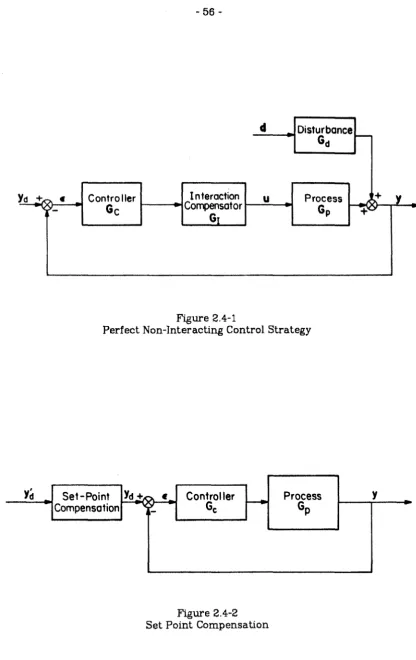
Section 2.4 considers non-interacting control. Since a major difficulty in
multivariable, feedback control design arises from the steady state and dynamic
interactions that occur between the various input and output variables. it is
usually desirable to reduce these interactions. If they can be reduced
sufficiently, single-loop control theories can be applied directly to each of the
non-interacting loops. The technique of perfect, non-interacting compensation
is attempted for this purpose. However since such compensation is in many
cases impractical or excessively complicated, other methods that only eliminate
steady state interactions are also considered. Finally, a new method, that uses a
relatively simple control structure to eliminate all steady state and dynamic
interactions, is considered. This procedure, called inner-loop decoupling, makes
use of extra available measurements through an inner-loop structure.
frequency-responsA analysis are also studied. Section 2.5 discusses the application of
Rosenbrock's (1962) inverse Nyquist array technique, which is an extension of
the classical Nyquist stability criterion. Section 2.6 analyzes the heat
conduc-tion system using the characteristic locus method. The analysis is based on the
latest refinements of the technique originally introduced by Belletrutti and
MacFarlane (1971). The current work provides a systematic approach for
designing a proportional-integral controller with the best compromise of system
stability, interaction, integrity, and accuracy.
Section 2.7 presents an overall analysis of the control system performance.
Using computer simulations of the responses of both the lumped model and the
actual system to step input changes, the effectiveness of the various control
designs are compared. This analysis leads to conclusions about the model
reduction and design techniques that can be extended to general, multivariable
-
16-2.2 PRELllliNARY ANALYSIS
Difficulties arise in the control system design of distributed parameter
sys-tems because of state variations in both time and space. The thrust of many of
the feedback control design techniques for distributed systems is to reduce the
system to a lumped one and then to take advantage of the many theories
avail-able for lumped parameter control design. However, problems arise in that all
of the analysis performed on the lumped system is dependent on the method
and accuracy of the reduction. Although considerable model reduction is
neces-sary to reduce computational complexities in the design procedures, excessive
or inaccurate reduction can lead to a system whose behavior is quite different
from that of the original process.
2.2.1 Yodel Reduction
To obtain the lumped parameter model for a system described by partial
differential equations, many efficient techniques are described in the literature.
In particular, much work has been published on various lumping strategies for
linear diffusion equations. A particularly useful means of treating both linear
and nonlinear partial differential equation systems is the method of weighted
residuals along with other pseudo-modal techniques, such as finite element
methods (Norrie and DeVries, 1973) or the use of spline functions (Finlayson,
1972). The method of weighted residuals is comprised of the following basic
techniques, depending on the choice of the weighting function (Prabhu and
McCausland, 1970; Ray, 1961):
a. Galerkin's Method (Lynn and Zahradnik, 1970; Newman and Sen,
-
19-b. Method of Subdivisions
c. Method of Moments
d. Method of Collocation (Finlayson, 1972)
e. Least Squares Method.
Although these techniques are quite powerful, Mahapatra (1977) points out that
solutions using the method of weighted residuals often require considerable
effort to determine the set of orthogonal coordinate functions and a high·order
lumped model for accurate results. To eliminate these difficulties, spatial
discretization techniques (Leden, 1976; Mahapatra, 1977) are often quite useful
tor linear ditfus10n systems, since they retain the physical characterist1cs of the
system. However, they too often lead to high-order lumped models.
Thus to improve the accuracy and reduce the order of the model, it may be
best to use an exact reduction technique. Since the heat equation is governed
by a parabolic equation, exact lumping can be performed using a Laplace
transform in time or through a modal analysis. The latter, which is simply an
application of the separation of variable solution procedure, is quite attractive
for systems which can be made self-adjoint, since the technique leads directly to
the eigenvalues and eigenfunctions (modes) of the system. If the eigenvalues
are real, discrete and well spaced, the modal representation is a convenient
method to reduce the order of the system, since only the dominant modes need
be retained for design purposes.
Both the Laplace transform and modal analysis techniques were applied to
the one-dimensional heat conduction problem. Other techniques have been
dis-cussed in detail in the literature. Although the methods can be shown to lead to
equivalent results, the modal analysis leads directly to a lumped, state-space
cited by Prabhu and McCausland (1970), but the technique is well suited to the
linear diffusion problem because time and space variables are easily separated
and an analytic solution is possible.
Consider the system described by Equation
(2.1-1),
scaled so that y0(z)=O.Taking the laplace transform with respect to time gives:
sy(z
s)
= d2y(z,s), dz2 ,
which has the solution
y(z,s) =A sinh ...JSz
+
cosh...JSz . After application of the boundary conditionsdy(O,s) _ ( )
- -u1 s
dz dy(l.s) dz = u2(s) .
the solution in the Laplace domain is
y(z,s) = GJ'(z,s)u(s).
where
T _ [ ] _ fl cosh( 1-z)-Vs cosh zv'S
J .
Gp- g1(z,s) 'g2(z,s) - v'Ssinhv'S ' v'ssinh..JS
(2.2-1)
(2.2-2)
(e.z-s)
(2.2-4)
(2.2-5)
(2.2-6)
Thus a distributed transfer function representation is obtained, from which a
simple feedback control strategy can be env{sioned
(Figure 2.2-1).
Theclosed-loop distributed transfer function is
y{z,s)
Yd(z,s) (2.2-7)
However in general, measurements will only be available as discrete points. If
-
21-Figures 2.2-2 and 2.2-3 with
(2.2-8)
Note that Figure 2.2-3 is equivalent to Figure 2.2-1 with Gc(z,s)
=
Gc(s)A
Using contour integration to invert Equations (2.2-4)-(2.2-6), the
time-domain representation of the solution can be obtained. The inverse of g,;(z,s) is
the sum of the residues of estg1(z,s). Each g,(z,s) has an infinite number of
sim-ple poles at Sn
=
-n2rr2, n
=
1, 2, 3, ... and a pole at s0=
0.0. Simple expansions ofthe numerator and denominator of estg,(z,s) about s0
=
0.0 lead to a residue of1. 0 at s0. The residues at Sn are obtained by Taylor expanding sinh ....; s about
sn
and applying residue theory. This results in
- 1!2t,
g1(z.t)
=
1.0+2:
2.0(-~)ncosnrr(l-z) e-n nn=l
g2(z,t) ::::: 1.0 +
~
2.0( -1) ncos n1rz e-n2wl1.(2.2-9)
n=l
Then using convolution theory. the t1me-domain behaVior is directly related to
the control action:
t
y(z,t) :::::
fo
G(z.t--r)u(1)d1 G'l'(z,t)=
[g1(z,t), g2(z,t)] . (2.2-10)Since the time-domain results are obtained as an infinite series of
exponen-tials with eigenvalues Xn
=
n21r2, the Laplace-domain behavior can also be
represented as an infinite series with y(z,s) being described by Equation (2.2-4)
along with the following:
GJ(z,s)
=
[.L+
f:
2(-l)ncosnrr(1-z),.L+
f:
2(-l)ncosnrrzl .(
2.2_11 )S n=l s-Xn s n=l s-Xn
Then if the series can be truncated after the first few terms without excessive
-22-However since separation of variables for the one-dimensional heat
conduc-tion system leads to a self-adjoint operator With real. discrete eigenvalues,
modal decomposition is attractive for this system. The problem can be
redefined using the Dirac delta function:
By1~·t)
= 02~~~,t)
+
~(z-o)ut(t)
+ o(z-1)ll2(t)z
=o-,
z
=
1 +~~.t)
=
o .
(2.2-12)
It can be proven that this change is rigorous by integrating Equation (2.2-12)
across the infinitesimal intervals 1-< z < 1 +and
o-
< z < o+. For example:,.o+
B,.o+
B [~y)
o-~-
,.o+
;
0_ ¥t-dz =
Jo-
oz BZ]dz +fo-
6(z-D)u1(t)dz +Jo-
c5(z-1)ll2(t)dz (2.2-13)Thus
But
~"}
=
0 at z = o- : therefore~i
= -u1 ( t) at z = o+. Thus formulation(2.2-12) is equivalent to that described by Equations (2.1-1)- (2.1·3).
The space and time variables can then be separated by assuming a solution
of the form
..
y(z,t) ::: ~ an(t)~n(z)
n=O
..
t5(z-D)u1(t) +o(z-1)u2(t)
=I;
bn(t)9'n(Z) .n=O
A!ter substituting into (2.2-12) and simplifying, the equations become
-23 ~
n
=
0, 1. 2, ... . (2.2-15)z=O
-'-:;;...;-=
dscn(z) 0 'z
=
1 dzBy choosing the separation constant as -An,
n=O, 1, 2, ... . (2.2-16)
Clearly (2.2-16a) is a self-adjoint differential equation that can be solved to yield
(2.2-17)
after application of the boundary conditions from (2.2-15). Because (2.2-16a) is
a homogeneous, self-adjoint differential equation With homogeneous boundary
conditions, the eigenfunctions, Equation (2.2-17), are orthogonal. It is
con-venient to choose the arbitrary constant
An
so as to make the eigenfunctionsorthonormal, i.e.,
1
fo
sc~(z) dz=
1.0 (2.2-18)The appropriate choice of An leads to
{ 1.0
Y'n(Z)
=
-.n_
cos n1izn=O
n= 1. 2 .... (2.2-19)
Then by application of the orthogonality of the eigenfunctions
1
e.n(t)
=
fo
sPn(z)y(z,t) dz , (2.2-20)Thus
1
bn(t)
=
fo
9'n(z)[o(z-O)ut(t) +o(z-l)u2(t)] dz=
9'n(O)ul(t) +9'n(l)lll,l(t).n=O n=1,2, ...
(2.2-21)
(2.2-22)
Since the eigenvalues,
7\n
=
n21T2, increase rapidly with increasing n, thesys-tern can be accurately represented by the first few eigenfunctions, n
=
0, 1. ... , N.The process model can then be obtained as an Nth-order lumped state-space
representation with theN+ 1 states a0, ... , aN.
X(t)
=
Ax(t) + Bu(t) , y(z,t)=
Cx(t) . where1 1
'-'Z
-..JZ
(2.2-23)
The resulting feedback control system can be drawn in block diagram form
(Fig-ure 2.2-4)
In theory, the control scheme of Figure 2.2-4 (and of Figure 2.2-1) requires
the complete temperature profile, y(z,t), of the system. However, Ray (1981)
-25-L measuring y(7,,t) at many points i
=
1. 2, ... , M and using an optimalsmoothing technique to approximate y(z,t),
ii. measuring y(Zt.t) at a few points and using a state estimator to
esti-mate y(z,t),
iii. or measuring y(zt.t) an N+l spatial points and letting
y(t)
=
[y(zt.t). y(z2.t), .... y(zNH.t)]C= (2.2-24)
Then y(t)
=
Cx:(t) or x(t)=
C 1y(t) as long as z1 .... , ZN+l are selected tokeep C nonsingular.
Actually it is possible to control the system by taking measurements at M points,
where M
<
N+l. For tbis case, the system should be controlled by using setpoints on the outputs rather than on the states, since the N+ lth-order state
vector x:(t) cannot be obtained uniquely with M
<
N+l measurements.Regardless of the technique for estimating y(z.t), the appropriate transfer
function representation can be obtained by converting to the laplace domain.
With Yo (z)
=
0,x(s)
=
(sl -A)-1 Bu(s), y(z,s)=
Cx:(s) , (2.2-25)or with measurements at M distinct points:
-26-Thus the lumped parameter system process transfer function is given by
(2.2-27)
2.2.2 Controllability
The distributed system has been lumped through an N eigenfunction
decomposition. Before attempting to design a control strategy for the lumped
system, an analysis of system and output controllability is necessary.
Although the concept of controllability is formally defined in many
refer-ences (Brockett, 1970; Douglas, 197Z; Lee and Marcus, 1967; Ray, 1981), it is
con-venient to consider a system completely controllable if some control action
exists that will take the system from any given initial state to any specified final
state in finite time. The necessary and suffi.cient condition for complete
control-lability of the system described by (2.2-23) with N-1 states and two controls is
that the controllability matrix
It:
' 1
..JZ
1
-"2
0
-(_,.2~-JZ
(2.2-28)
has rank N-1. Since
It:
has full rank for all N, the system is completelycontroll-able. Thus the two controls u1 and u2 are capable of influencing all of the states.
However, the lumped. analysis will be based on k measurements. Thus a
more important concept is that of output controllability, i.e., the controls must
-27-4'
=
[CBI CABI ...
l
CAN-lB] (2.2-29)must have rank k for the system to be output controllable. It can easily be
shown that, for the heat conduction system, output controllability is assured if
no two measurements are taken at the same point.
It can be concluded that, for k distinct measurements, the lumped,
one-dimensional heat conduction system is completely controllable with heat fiux
control at z
=
0 and z=
1. Thus multivariable lumped parameter control theorycan be applied to the state-space representation of the system. However, it
should be recalled that this analysis or controllability is dependent on the
accu-racy of the model reduction and lumping. Although the approximate lumped
parameter system has been shown to be completely controllable, the actual
dis-tributed system may indeed be only partially controllable. Additionally, care
must be taken in making conclusions from this type of analysis, since no
con-sideration of the physical constraints of the system have been made.
2.2.3 Root-Locus
The concept of root-locus analysis is basic to classical control system
design for single-input, single-output processes. The root-locus diagram is
advantageous since it describes the character of the response as the gain of the
controller is continuously changed, by allowing rapid determination of the roots
of the characteristic equation. Although scalar root-locus techniques are
well-known, the multivariable root-locus problem is relatively new. Kouvaritakis
(1978), Kouvaritakis and MacFarlane (1976ab), and Kouvaritakis and Shaked
( 1978) describe the technique and discuss the analysis of system zeros.
The objective of the root-locus method is to investigate the behavior of the
-28-form
Gc =
ki. For the modal-lumped representation of the heat conductionsys-tem, the process transfer function was shown to be Gp
=
C(si-A)-1B. Thecharacteristic equation is then (Hsu and Chen, 1968)
(2.2-30)
where P0 (s) is the open-loop characteristic polynomial and Pc (s) is the
closed-loop characteristic polynomial. Then if we detine
si-A -B
z(s)
=
(2.2-31)C Om,m
the n-m-d closed-loop characteristic frequencies1 will tend toward the roots of
z(s)
=
0 as k increases. These roots are the finite zeros of the process. For thetwo-control. 3rd-order, heat conduction system, there is one finite zero and two
infinite zeros if CB has full rank. If CB has lost rank, all three zeros will be
infinite. This occurs for the following choices of measurement locations:
Z1 0.20 0.33 0.40 0.60 0.67 0.80
z
2 0.60 0.67 0.80 0.20 0.33 0.40Thus for any combination of outputs other than these, there will be one finite
zero given by z(s)
=
0. The solution to this is8
=
41T2(c-a)
V2(ad-bc)+(a-c) (2.2-32)
-29-This root is finite for all z1 and Za other than those listed above, since the
denominator of Equation (2.2-32) is then nonzero.
The root-loci for the system are the loci of the roots of the characteristic
equation
+4k(ad-bc)]s +Brr2~k(a-c)+Brr4] (2.2-33)
as k varies from 0 to cc. Obviously, the poles (k
=
0) of the system are at s=
0,-rr2 and -4rr2 independent of the measurements. As k approaches infinity,
(2.2-33) reduces to
~(ad-bc)s + (a-c)s + 4rr2(a-c)
=
0which is equivalent to (2.2-32) above.
(2.2-34)
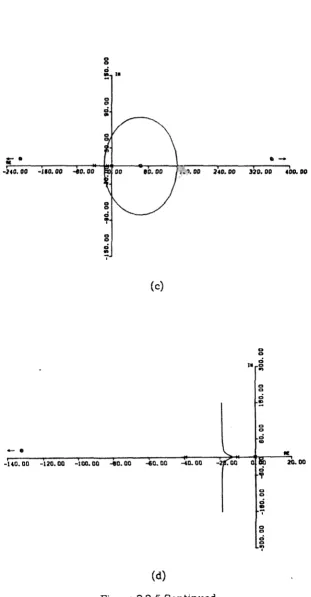
Figure 2.2-5 shows the root-loci for various measurement locations. Both
symmetric and unsymmetric cases were studied. For the symmetric cases, the
root-loci remain stable (in the left-half plane) at high gains for z1
s:
0.33;whereas, the loci become unstable at high gains lor 0.33
<
z1 < 0.50 . This isexpected due to the large lag time between the control action at z1
=
0 and itseffect on the output. The symmetric cases with
z
1 andz
2 reversed, i.e.,z
1>
0.50and z2
<
0.50 (not shown), lead to root-loci identical to those in Figure 2.2-5except that the locus beginning at -1r2 approaches +oo rather than -co. Thus
such a system is less stable.2 Additionally from the root-loci analysis. the
-30-responses for the (0.2,0.8) case are expected to be non-oscillatory; whereas, for
all other cases, oscillations are expected at moderate to high gains.
It can be concluded that, for symmetric measurements with z1
<
0.33 or for the unsymmetric case (0.4,0.8), system stability is insured even for highgains. Thus a proportional controller may provide adequate control action.
Since the other cases lead to instability at high gains, more complicated control
Yd(z,s) i'L >(
-E'(Z,S)
-
31-Gc(s) u(s) -... Gp(Z,s)
Figure 2.2-1
Distributed Feedback Control Design
Measuring Device
Figure 2.2-2
Process
Gp(Z,S)
Feedback Control Strategy with N Discrete Measurements
y(z,s)
-32-Yd(z,s)
A
Yd( s)+/0\ E( s)~
Gc(s) u(s) __ Gp(Z,S) y(z,s)A
Figure 2.2-3
Modified Feedback Control Strategy with N Discrete Measurements
Yd(z)+/0\ E(Z t)
Gc(z,t) u(t)
x=
Ax
+Bu y(z,t)'<:1
'
y(z,t)=
Cx(
t)-Figure 2.2-4
-33--.
-·
-uo. oo -no. oo -100. oo -10. oo ...o. oo -•o. oo -20. oo
(a)
-·
-·
I .. 0
II
..
g•
...
0 0 .; If;
0 0•
...
•
0 0 0•
• D D .,;-..
..
.,;"'
.. ..
.,;...
II H.OO•
40.00...---~-,,-.,----,---i--..---. ... --....--~-+-
....
r--"...:., -2110. 00 ..,.o. 00 -200. 0 -160.00 -120.00 .eo. 000
..
.,;,.
..
"" .,; :!: • (b)Figure 2.2-5
Root-Loci Diagrams for Various Outputs
a. (0.2,0.8) b. (0.3,0.7) c. (0.4,0.6) d. (0.4,0.8)
...
8
! ..
g
-34-
·--1to. oo -JJo. oo -eo. oo 011 2411. 110 J:lO. 011 tOO. 110
(c)
D D
II
..
...
D"'
"'
..
!:
..
"'
..
..
-·
•
-uo. oo -120. oo -too. oo -eo. oo -60. oo -to. oo
..
20..00 'I'0
"'
..
..
-.
"'
..
..
..
.., I
[image:51.613.152.463.94.691.2](d)
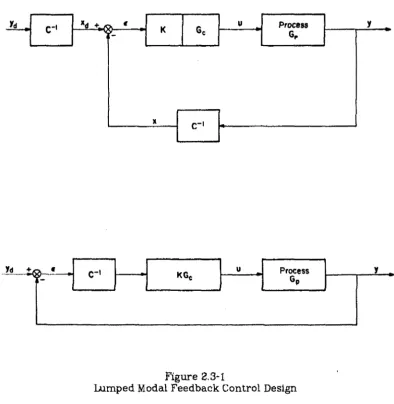
2.3 TlME-DOM.AlN ANALYSIS
The time-domain approach for control system analysis utilizes the
differential or difference equations directly rather than using transfer functions,
as in the frequency-domain analysis. Although the time-domain technique is
actually older than frequency response techniques, its development was slow
due to the difficulty of making calculations in the differential domain. :rhe
emergence of digital computation as a widely accepted tool led to a resurgence
of interest in time-domain analysis. In particular, the techniques of state
esti-mation, optimal control, modal control, and adaptive control rose to the
fore-front of research. Although these methods have a strong theoretical basis, they
only became practical with the development or small and reliable digital
com-puters: capable of high-speed information processing. Consideration of ideas for
which frequency-domain techniques were inappropriate, such as simultaneous
control of several interacting variables. and the application of different types of
controller objectives, such as the minimization of energy consumption, became
practical.
Of the many time-domain procedures. optimal control and modal control
are the most common techniques and thus have been studied extensively for
both lumped and distributed parameter systems. The one-dimensional diffusion
equation has often been used to illustrate the application of these methods.
Due to the many studies of these theories and on their application to heat
con-duction systems, only a cursory examination of the techniques will be
presented. Additionally. other methods such as adaptive control and state
esti-mation will not be considered in this theoretical analysis of the heat conduction
-36 ~
2.3.1 Optimal CGntrol
Optimal control methods can be divided into two schemes-open- and
closed-loop. When an excellent mathematical model of the system is available in
terms of differential equations, open-loop control schemes can be useful for
start-up, shut down, and other transient conditions. However in practice, most
models contain some error; therefore, closed-loop schemes are often necessary
for satisfactory controller performance. since they involve feedback of process
measurements. Regardless of whether open or closed~loop control is to be used,
the technique involves the selection of an index which measures the
perfor-mance of the system, from which the optimal control strategy is selected as that
which minimizes this index. A major difficulty in the design of an optimal
trol system is the establishment of the criteria for optimality. The optimal
con-trol procedure is in contrast to the other techniques that try to obtain
satisfac-tory responses in terms of offset, gain margin or decay ratios, since once the
cri-teria is selected a unique solution is obtained.
As previously mentioned, much work has been published concerning
optimal control of parabolic systems such as that described by the heat
equa-tion. McCausland (1970), Prabhu and McCausland (1970), and Mahapatra (1977)
studied time-optimal control of the linear diffusion process. For such control,
the objective is to force the system to reach the desired design conditions in
minimum time. Others (Betts and Citron, 1972; Sakawa, 1964: Sheirah and
Hamza, 1974) treated the problem of optimal control of the heat conduction
problem by minimizing the deviation of the temperature distribution from the
desired distribution throughout time. Additionally much literature is available
on the general problem of optimal control of distributed parameter systems.
-37-quadratic control, which leads to an optimal, state-feedback control law.
Numerous papers have been written on this problem, including several on its
application to parabolic systems (Ahmed and Teo, 1981; Matsumoto and Ito,
1970; Wang, 1975). This technique uses a quadratic penalty function to control a
system at a set point without excessive control action and not exceeding
accept-able levels of state. The method is readily applicaccept-able to either a lumped model
of the system or to the original distributed model.
For the heat conduction system, the lumped parameter model is described
by the linear differential equation
i=Ax+Bu, y=Cx 1 (2.3-1)
with A. B, i:ind C defined by Equations (2.2-23) and (2.2-26). The objective of this
technique is to obtain the feedback law which minimizes the performance index
(2.3-2)
where Sp, F(t), and E(t) are symmetric, positive definite weighting matrices which describe the relative importance of reaching the desired set point Xo.
=
0,using small levels of the state and using little control action. If the desired set point is nonzero, then deviation variables can be used to
convert
the problem tothe above form. Thus let Xo. and lld be the desired steady state values. Then
let-ting
u'
=
u -Uci (2.3-3)and recognizing that at steady state
Aid
+
Blld.
=
0, Equation (2.3-1) becomesi.' =AX+ Bu' (2.3-4)
-sa-Then from quadratic feedback control theory (Bryson and Ho, 1969; Ray, 1981),
the feedback control law is
u(t)
=
~-
K(t)(x-X<~.) (2.3-6)where K(t) is given by
K(t)
=
E-lJil'S(t) (2.3-7)and S(t) is found by solving the Ricatti equation backward from tF:
s(t)
=
-SA- ATs + sm:-t]jl's- F. S(tp)=
Sp. (2.3-8) Thus a proportional feedback controller with time-varying gain has beendesigned to control the system while minimizing the index given by Equation
(2.3-5). This control structure is quite useful because the lime-varying gain K(t)
can be determined otT-line since it does not depend on x(t) or u(t). Then if tp """
oo and A, B, F, and E are constant, S(t) becomes constant. It is the solution to
sm:-
1J3l'S- SA- ATS- F=
0 (2.3-9)In this case, the controller is simply a constant gain proportional controller.
The linear-quadratic problem can also be applied to the distributed
param-eter system described by Equations (2.1-1) - (2.1-3). The objective is then to
minimize the index
(2.3-10)
-39-profile. The derivation of the optimal control law is carried out using the
pro-cedure described by Ray (1981). The results are:
1
u1(t)
=
-Eo-
1fo
S(O,s,t)y(s,t) ds(2.3-11)
where S(r,s,t) can be computed ofHine from
St.(r,s,t) = -S88 -
Srr
+ S(r,O,t)E01S(O,s,t)+ S(r.l.t)E}1S(l.s,t)- Fo(r-s) (2.3-12)
with the boundary conditions
Sa(r.l.t)
=
S.(r,O,t)=
Sr(O,s,t)=
Sr(l,s,t)=
0 (2.3-13)and terminal condition
S(r,s,tr)
=
Sr(r,s)=
S,O(r-s) (2.3-14)Thus linear-quadratic optimal control can readily be applied to the heat
conduction system to obtain the feedback control law using either the lumped
or distributed parameter model. However several problems exist with the
optimal control technique. MacFarlane (1972) points out that optimal
controll-ers provide gain margins far in excess of those required for stability, are often
difficult to tune on-line and may be of low integrity to transducer failures.
Addi-tionally there are several other major concerns:
i. Optimal control design requires an accurate model of the system. This can
lead to difficulties in the lumped parameter design due to errors
intro-duced by model reduction. Even in the distributed parameter design,
model inaccuracies could be quite large due to heat losses or inefficiencies
~
40-ii. Optimal control design requires all of the system states to be JiCcessible.
Thus for the lumped model. the technique is restricted to the case where
the number of measurements equals the order of the model and the
meas-urement matrix is nonsingular. Only then are the states accessible from
the measurements:
(2.3-15)
For the distributed parameter design. the entire temperature profile y(z.t)
is needed. Considerable effort has been directed at overcoming this
difficulty by using observers or Kalman-Bucy f:Uters to recover the
inacces-sible states. Much literature has been published on combining such
tech-niques with optimal linear quadratic control.
iii. Optimal control design requires a selection of the weighting matrices
Sr.
F,and E. Unfortunately, in many chemical engineering applications. the
choice of the weighting matrices may be quite difficult. For the heat
con-duction system. no easy criterion is available for selecting the weights. <