S T U D Y P R O T O C O L
Open Access
A smartphone application for treating
depressive symptoms: study protocol for a
randomised controlled trial
M. Deady
1*, D. A. Johnston
1,8, N. Glozier
3, D. Milne
4,5, I. Choi
3, A. Mackinnon
1, A. Mykletun
6,9,10,11, R. A. Calvo
4,
A. Gayed
2, R. Bryant
7, H. Christensen
1and S. B. Harvey
1Abstract
Background:Depression is a commonly occurring disorder linked to diminished role functioning and quality of life. The development of treatments that overcome barriers to accessing treatment remains an important area of clinical research as most people delay or do not receive treatment at an appropriate time. The workplace is an ideal setting to roll-out an intervention, particularly given the substantial psychological benefits associated with remaining in the workforce. Mobile health (mhealth) interventions utilising smartphone applications (apps) offer novel solutions to disseminating evidence based programs, however few apps have undergone rigorous testing. The present study aims to evaluate the effectiveness of a smartphone app designed to treat depressive symptoms in workers. Methods:The present study is a multicentre randomised controlled trial (RCT), comparing the effectiveness of the intervention to that of an attention control. The primary outcome measured will be reduced depressive symptoms at 3 months. Secondary outcomes such as wellbeing and work performance will also be measured. Employees from a range of industries will be recruited via a mixture of targeted social media advertising and Industry partners. Participants will be included if they present with likely current depression at baseline. Following baseline assessment (administered within the app), participants will be randomised to receive one of two versions of the Headgear application: 1) Intervention (a 30-day mental health intervention focusing on behavioural activation and mindfulness), or 2) attention control app (mood monitoring for 30 days). Participants will be blinded to their allocation. Analyses will be conducted within an intention to treat framework using mixed modelling. Discussion: The results of this trial will provide valuable information about the effectiveness of mhealth interventions in the treatment of depressive symptoms in a workplace context.
Trial registration: The current trial is registered with the Australian and New Zealand Clinical Trials Registry (ACTRN12617000547347, Registration date: 19/04/2017).
Keywords: Depression, Workplace, Mhealth, Treatment
Background
Depression is now recognised as one of the leading causes of disability worldwide [1]. As well as being rela-tively common [2], depression can also be very debilitat-ing [3], with core symptoms inclusive of; an absence of positive affect, persistent low mood, and low activity [4]. Persons with severe depressive symptoms report serious
difficulties in all aspects of their life, including work, home, and social activities [5]. In response to the increased identification and recognition of depression [6], there has been greater emphasis on the development of innovative and effective psychological treatments.
The treatment of depression, both pharmacologically and with non-pharmacological interventions, remains a critical area of ongoing clinical research. There is substan-tial evidence supporting the efficacy of psychotherapy in the treatment of both sub-clinical [7] and clinical levels of depression [8]. Whilst cognitive behaviour therapy (CBT) * Correspondence:[email protected]
1Black Dog Institute; Faculty of Medicine, UNSW, Sydney, Australia
Full list of author information is available at the end of the article
remains the most empirically supported treatment [9], other therapies such as behavioural activation therapy (BAT) has been shown to be equally effective and also less complex to administer [10]. Service use statistics indicate that despite the effectiveness of such treatments, few people readily access these services [11]. Overcoming identified barriers to accessing psychotherapy such as cost, convenience and accessibility [12] may enhance people’s
ability to access evidence based treatments.
Despite experiencing depression many people still re-main as active participants in the workforce [13]. Ongoing employment is associated with numerous individual bene-fits such as economic, psychosocial, and emotional well-being [14]. Given its immediacy and core role in the lives of individuals, the workplace may be an avenue for provid-ing psychological interventions to those who might not otherwise access mental health services in a conventional manner [15]. Interventions implemented in the workplace have been found to be effective in improving both mental health and occupational outcomes [16]. This highlights an added benefit of workplace interventions as medical inter-ventions in isolation have not shown as positive an effect on work-related outcomes when compared to workplace interventions [17]. To date, most workplace interventions face accessibility and scalability issues, thus limiting the opportunity for employees to access these services. This issue appears to be particularly prevalent in workers employed in industries where roles are mobile and/or iso-lated; work hours are often intermittent or excessive; and tasks may be repetitive and high-risk (e.g. such as con-struction, transport and mining). These industries tend to be male-dominated (males > 70% of workforce) [18] and are associated with higher rates of mental health concerns [18]. Technological innovations, namely smartphones, provide an opportunity for individuals in such roles to learn how to manage their wellbeing and seek further sup-port if required [19].
Mobile health (mhealth) technologies are increasingly being recognised as an effective means through which mental health interventions can be disseminated in the population [20,21]. Such interventions overcome numer-ous barriers associated with treatment seeking, including stigma, cost, and accessibility [20]. Encouragingly, there is preliminary support that mhealth interventions can effect-ively treat symptoms in adults with depression [22]. More-over, mhealth interventions offer the opportunity for an autonomous, user-directed approach that motivates and offers personalised support by allowing the delivery of content to be tailored to an individual’s interests and needs [23]. This may be particularly advantageous to workplace contexts where, individualised interventions are associated with more consistent outcomes than organ-isational wide interventions [24]. However, of the many mhealth interventions available on the market, few have
been trialled [20] and even fewer have been specifically tailored to a workplace setting.
The proposed HeadGear trial aims to evaluate the effectiveness of a new smartphone app in treating depressive symptoms in a workplace context.
Methods
Design
The aim of the current study will be achieved through a multicentre randomized controlled trial, with two parallel arms. The trial will compare two smartphone app-based in-terventions: a novel intervention app designed for the treat-ment of depression (Headgear) and an attention control app (mood monitoring). Assessments will occur at baseline, post-intervention (5-weeks), and at 3-month follow-up. The study is registered with the Australian New Zealand Clinical Trials Registry (ACTRN12617000547347) and has ethical approval from the University of New South Wales (UNSW) Human Research Ethics Committee (HC17021). Consent to participate in the trial will be obtained electron-ically from all participants. The study will be conducted in accordance with the Helsinki Declaration [25] and is com-pliant with the CONSORT guidelines [26].
Setting and participants
The study will recruit Australians who are currently employed, and will sample more selectively from a range of male-dominated industries [27]. In Australia, these industries include agriculture/forestry/fishing, utility ser-vices (electricity, gas, water and waste), wholesale trade, manufacturing, transport/postal/warehousing, mining, and construction [28]. Emergency services and defence also fit this definition, but were not considered unique industries by the ABS, though for this study they will also be considered as male-dominated.
Industry partner organisations will assist with recruit-ment by promoting the study among specific groups or their entire workforce. We will aim to recruit at least 850 employed adults across Australia. Organisations that elected to participate will promote the study via their respective health and wellbeing officers, along with email and newsletter advertisements. The study will also be promoted via members of the research team presenting at partner worksites. Social media advertising targeted at employed people will also be utilised to recruit individ-uals employed externally of partner organisations using an evidence-informed advertising approach [29]. Both males and females will be recruited.
Eligibility criteria
also be excluded from this trial (although still permitted to use the app) if they do not have substantial levels of depres-sive symptoms at baseline, as indicated by either a PHQ-9 score below 15, or the PHQ-9’s algorithm for a diagnosis for Major Depressive Disorder (MDD) not being met [30]. Participants were excluded if they were under 18 or not currently employed. No exclusion criteria were in place regarding comorbidities or medication use.
Interventions
Active intervention: HeadGear
The intervention condition, HeadGear, is a smartphone application-based intervention utilising Behavioural Acti-vation Therapy (BAT) and mindfulness-based therapies. Behavioural Action is a therapy based on learning theory that reconnects people to an environment of positive reinforcement, incorporating elements of value driven ac-tion and goal setting [31,32]. When delivered face-to-face, BAT has been shown to perform as well as CBT for the treatment of depression [33] and preliminary evidence that this translates in mhealth form [34]. The other com-ponent utilised in Headgear, Mindfulness, draws on medi-tation practices to allow individuals to gain further insight into their emotional, physical, and/or cognitive experience to ultimately shape it [35]. Mindfulness has been identified as a transtherapeutic process that targets transdiagnostic mental processes [36], as evidenced by its effect in treating a range of psychopathologies including but not limited to mood, anxiety and substance use disorders [37,38].
The therapeutic component of HeadGear encourages the user to complete one‘challenge’each day (5–10 min per day), over 30 days. These ‘challenges’ incorporate a variety of evidence-based BAT and mindfulness tech-niques and skills, including psychoeducational videos, value-driven activity planning and goal-setting, practice exercises, and techniques for developing coping and resilience (e.g., problem solving, improving sleep, mini-mising alcohol use, and/or assertiveness training). Other components of the Headgear intervention app include mood monitoring, a skill‘toolbox’(progressively built as the skills are completed), and a technical service help-line. Steps have been taken to promote user motivation and engagement by incorporating a ‘daily challenge’ framework where the user is ‘rewarded’ (through skill tokens) upon completing each daily challenge. A chal-lenge framework has been shown to increase the general appeal of an app [39–41]. In addition to these elements, the Headgear application has been designed using par-ticipatory approaches and iterative human-computer interaction design strategies [42,43].
Attention-matched control
The attention-matched control condition is a smart-phone application that will have the same name and a
virtually identical look and ‘feel’ as the intervention version of Headgear and is accessed in the same man-ner. However, there is no skill development and no component of behavioural activation or mindfulness therapy. To control for the attentional component of the HeadGear application, the control condition will en-courage users to use the inbuilt mood monitor daily over a 30-day period and users will also have access to the ‘risk calculator.’
Procedure
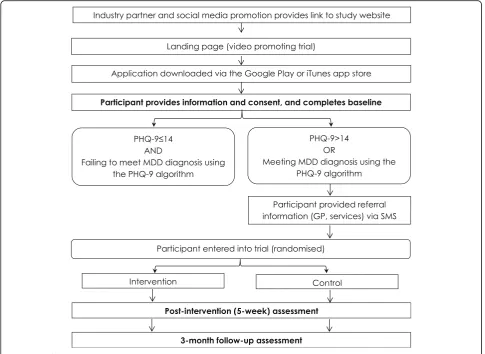
All interested users will be directed to their respective app store (iTunes or Google Play) directly via a dedi-cated website (headgear.org.au) where participants regis-ter and provide their phone number. Informed consent will be sought digitally via both the website and the app itself. This provides information around the study aims, risks and benefits, confidentiality and dissemination of results. After consent and app download participants will undergo initial screening. Participants who meet the inclusion criteria will then be randomised to receive ei-ther the full HeadGear app or the attention-matched control version of the app. Participants will be blinded to their allocation. All participants will be provided with appropriate referral information to health services and crisis lines and will be encouraged to seek help from their GP (if this has not already occurred) while com-pleting the trial. The flow of participants through the study phases is shown in Fig.1.
Random allocation
Randomisation will occur immediately following comple-tion of the baseline assessment using automated proce-dures integrated into the trial management software. The algorithm for randomisation will consist of a block design, stratified by industry type, with a block size of 10.
Assessment
Administration of assessments
Post-intervention assessment will occur at 5 weeks’ post-baseline, to allow users extra time to complete the 30-day program. Participants will be reminded to complete the post-intervention assessment via text messages to phone numbers provided in order to address for the possi-bility that users may delete the app during the trial. Partici-pants will complete an online questionnaire similar to the baseline measure (see Table 1), and again at 3 months post-baseline (“3-month follow-up”). Participants will
receive up to three text messages and a call at each follow-up assessment time point, linking them to an online platform through which they can complete the assessment. On completion of each assessment, participants will be entered into a draw to win one of four $200 Visa gift cards.
Specific measures used in online assessments
The PHQ-9 will be used to measure depression symptom-atology [50]. The PHQ-9 is a reliable and valid nine-item
[image:4.595.56.542.88.442.2]Fig. 1Flow of participants through the trial
Table 1Assessment measures
Baseline Post-intervention 3-month follow-up
Demographics ×
Patient Health Questionnaire-9 item (PHQ-9) [44] × × ×
General Anxiety Disorder-2 item (GAD-2) [47] × × ×
World Health Organisation-5 (WHO-5) Well-Being Index [45,46] × × ×
Connor-Davidson Resilience Scale 10-item (CD-RISC10) [48] × × ×
Health and Work Performance Questionnaire (HPQ) [49] × × ×
Service utilisation and management items × × ×
[image:4.595.57.538.606.732.2]measure of depression severity over the past 2 weeks [44,
51]. Each of the nine items of the PHQ-9 is scored as 0 (not at all), 1 (several days), 2 (more than half the days), or 3 (nearly every day). Scores are summed to provide a total score (score range 0–27 with 0 indicating no depressive symptoms and 27 indicating all symptoms occurring nearly daily). The criterion and construct validity of the PHQ-9 has previously been demonstrated, with 73% sensi-tivity and 98% specificity in detecting major depression compared to clinician-based assessment [28, 50] and, regardless of diagnostic status, typically represents clinic-ally significant depression [50]. The measure has excellent internal consistency (Cronbach α> 0.85 in multiple sam-ples) and test-retest reliability (α= 0.84) [52].
Anxiety will be measured using the 2-item Generalised Anxiety Disorder scale (GAD-2) [47]. The GAD-2 consists of the two core criteria for generalized anxiety disorder, which have been shown to be effective screen-ing items for panic, social anxiety, and post-traumatic stress disorders [47]. The GAD-2 begins with the stem question: “Over the last 2 weeks, how often have you been bothered by the following problems?” Response options are “not at all”, “several days”, “more than half the days”, and “nearly every day”, scored as 0, 1, 2, and 3, respectively (total ranging from 0 to 6). A total scale score≥3 is suggested as a cut-off point between the nor-mal range and“probable anxiety”[47].
Resilience will be measured by the 10 item
Connor-Davidson Resilience Scale (CD-RISC-10) [53]. The CD-RISC-10 is a self-rated measure, with each question rated on a 5-point scale from 0 (‘not true at all’) to 4 (‘true nearly all the time’). The CD-RISC-10 has been shown to differentiate between individuals who function well after adversity and those who do not and measures the core features of resilience and the ability to tolerate experiences [53]. It is believed that increased resilience may reduce rates of mental ill health [54].The scale demonstrates high internal consistency (Cronbach’s α= 0.89), construct validity, and test-retest reliability in the general population and in clinical settings [48]. Total scores range from 0 to 40 with higher scores corresponding to greater resilience. The scale has been shown to have good concurrent validity, with higher resilience on the scale associated with lower levels of perceived stress [48] Validity is high relative to other measures and reflects differentiation in resilience among diverse populations, showing that higher levels of resilience are consistent with lower levels of perceived stress vulnerability [48].
Wellbeing will be assessed using the 5-item WHO Wellbeing Index (WHO-5) [45, 46]. Participants are asked to self-report on the presence or absence of well-being on a 6-point scale ranging from 5 (‘all of the time’) to 0 (‘none of the time.’) Raw scores range from 0 to 25
where 0 indicates the worst possible quality of life while a score of 25 represents the best possible quality of life. A score≤13 or an answer of 0 or 1 on any of the five items shows poor wellbeing. WHO-5 is a psychometric-ally sound measure of well-being with high internal consistency (Cronbach’sα= 0.84) and convergent associ-ations with other measures of well-being [55].
Work Performance will be measured using three items (performance items A10, A11, A12) from the Health and Work Performance Questionnaire (HPQ) [49]) and two additional items pertaining to: i) sickness absence over the past month (days absent more generally, and days absent specifically for mental health reasons), and ii) weeklong sickness absence over the past 6-months (weeks absent more generally, and weeks absent specific-ally for mental health reasons).
Service use and management items comprised of seven items assessing lifetime and past month service use, along with current medication use. Participants were also asked about their abilities (perceived capability and effectiveness) to manage their mental fitness, and auton-omy (choice and freedom) in management. These were scored on a 7-point Likert scale from strongly disagree to strongly agree.
Safety protocol
In any trial concerned with mental health, there is the po-tential for participants to experience psychological dis-tress. Those who meet criteria for the trial will within the app trigger the user to be directed to a“get support”page (at each assessment point) and will suggest the participant seek further help from these support services or their gen-eral practitioner (GP). Additionally, an optional call-back service for individuals requiring further support or direc-tion is provided. This call-back will be conducted by a team-member with psychology training, within 4 days, with the purpose to guide participants into necessary care arrangements. If the team member still has concerns for the participant’s safety, an accredited psychiatrist will con-tact the participants within the next 24 working hours. Participants will also receive an SMS with a range of sup-port service contacts, and another reminder to consult with their GP regarding their mental health.
Study hypotheses and outcomes
Secondly, it is hypothesized that—relative to the control group—HeadGear Intervention participants will have lower rates of depressive disorder as detected by the PHQ algorithm at all follow-up time points. We also hypothe-sise that the intervention group will have reduced levels of anxiety symptomatology, and improved wellbeing, resili-ence, and work performance, at all follow-up time points, relative to controls.
Primary outcome
The primary outcome measure of the study will be the level of depressive symptomatology (as measured by the PHQ-9) at the 3-month follow up period.
Secondary outcomes
A range of secondary outcomes will be considered, includ-ing change in anxiety symptomatology (as measured by the PHQ-2) at both 5-week and 3-month follow up. Other secondary outcomes include incident caseness of depres-sion at 5-week and 3-month follow-up (as measured by the PHQ-9 diagnostic algorithm), and the level of depres-sion symptoms (PHQ-9) at 5-week follow up. Finally, change in Wellbeing (as measured by the WHO-5) and change in occupational functioning (as measured by the HPQ and sickness absence questions) at both 5-week and 3-month follow-ups will be outcomes of interest.
Statistical analysis
Analysis plan
Primary analyses will be undertaken on an intent-to-treat basis, including all participants as randomised, regardless of treatment received or withdrawal from the study. Like-lihood based methods (mixed-model repeated measures (MMRM)) methods will be favoured to analyse change in the primary outcome measure (PHQ-9). A priori planned comparisons of change from baseline across the 3-month follow up period will be used to test the primary hypoth-esis. An unstructured variance-covariance matrix will be used to accommodate relationships between observations at different occasions. Variables found to be substantially imbalanced between groups post randomisation will be tentatively included in these models and retained if statistically significant and influential on outcomes. Simi-lar analyses of scaled secondary measures will assess differential change due to intervention arm. Mathematical transformation or categorisation of raw scores may be undertaken to meet distributional assumptions and ad-dress any violation of assumptions attributable to outliers.
Baseline characteristics will be used to define subgroups that would be the targeted if the app were offered as treat-ment. Group membership will be used for models to evalu-ate moderation of effectiveness by adding approprievalu-ate interaction terms and undertaking planned comparisons. The effect on outcome of level of baseline depressive
symptom levels, level of functional improvement and re-cruitment method at baseline will be explored using an analysis of covariance approach using baseline measures as a covariate and including a covariate by intervention arm interaction term in models. The effectiveness of the active intervention at clinically relevant levels of baseline covari-ates will be assessed using planned comparisons while the lowest values of covariates associated with a significant benefit of the intervention will be established using a Johnson and Neyman [57] approach.
All tests of treatment effects will be conducted using a two-sided alpha level of 0.05 and 95% confidence intervals.
Sample size
As a treatment, the size of the effect of the intervention is anticipated to be moderate. Meta-analysis of previous trials of internet and mobile based treatment of depres-sion showed a large effect size of g =−0.90 [22]; how-ever unguided interventions typically show smaller effect sizes. Power calculations were carried out using the R package simR [58]. Power was set at 80%, alpha at 0.05, 2-tailed tests, and a correlation of .50 between pre- and post- intervention scores was assumed. Based on these calculations, a sample size of 266 per group was needed (total N= 532). A conservative dropout rate of 40% at follow-up was estimated. An initial sample of 851 will therefore be recruited for the trial.
Dissemination
Results of this study will be disseminated for publication in peer-reviewed journals and key findings presented at national and international conferences.
Discussion
This study is planned to be the largest randomised con-trolled trial of a smartphone intervention for depression. By targeting the workers, this trial will provide valuable evidence regarding the effectiveness ofmhealth interven-tions in treating depressive symptoms in a workplace context. Given the substantial impact that depression has on the individual and the employer, if shown to be effective, this program would allow for a simple and eco-nomical means by which an organisations or govern-ments could disseminate a tailored intervention for workers. Given the proliferation of untested smartphone applications, the dissemination of evidence based prod-ucts into the workplace, and indeed the wider commu-nity, remains a pressing need.
intervention may not only be protective for the individual concerned, but may also assist in overcoming the issue of individuals delaying or not receiving treatment [60]. From an economic standpoint, it is has been established that, for the workplace, such an approach is more cost-effective for the organisation [61]: utilising smartphone technologies would improve upon this cost-effectiveness. It is also hoped that dissemination via workplaces and social media will help engage individuals who would not usually access help via the health care system.
This study will provide valuable evidence regarding the effectiveness of mhealth tools in the treatment of depres-sive symptoms. Despite the proliferation of mental health apps, there is scarce research on the effectiveness of such apps. Indeed, in a systematic review of the literature on smartphone interventions, only five mental health apps were empirically tested and only one of these did not re-quire the input from a mental health professional [20]. mHealth interventions offer advantages in that they in-crease user autonomy and anonymity, which may be im-portant as stigma [62] and lack of knowledge of services [63] can impact upon help-seeking behaviour in the work-place. An intervention developed for the workplace also carries the benefit in that it could ameliorate some of the financial burden placed solely on the healthcare system.
The proposed trial does carry with it a number of limi-tations. The use of a smartphone app as a delivery mo-dality does mean that the intervention is unguided and that the user is responsible for managing their inter-action with the program. Thus, trial attrition and disen-gagement are expected issues [64, 65]. It is worth noting, however, that this has also been an issue for face-to-face psychotherapy trials [66]. The reason for drop out in both mhealth and face-to-face trials is often multi-faceted, and whilst can be related to engagement with the program, it is rarely only due to dissatisfaction [67].To account for potential drop out, two procedures were put into place. Firstly, all follow-up communication would occur via phone numbers to ensure that if the participant uninstalled the app before the follow-up period, the participant could still be reached. Secondly, conservative drop-out estimation and the use of statis-tical methods robust to data missing at random, it is believed that this limitation will be minimised.
Another limitation of the present trial is related to the reli-ance on self-reported depressive symptoms, rather than a diagnosis of depression achieved through a structured diag-nostic interview. This is a common issue faced by most similar trials given the constraints around time and re-sources. To overcome this issue, we will use a well-validated measure (PHQ-9) that contains two methods for classifying depression: 1) threshold total score above 14 (sensitivity = 67%; specificity = 95%) [68] or 2) meeting the depression algorithm’s criteria (sensitivity = 0.53; specificity = 0.94) [69].
By using both methods, we are confident that participants without significant symptomatology will be excluded and those with significant symptomatology will be included.
The treatment of depression utilising evidence based mhealth interventions remains an important area of clinical research. The Headgear trial will be the largest trial of a smartphone application that seeks to offer an alternate or augmentation to traditional face-to-face therapy through which working adults can manage their mental health and wellbeing. This trial will be unique in that it is advertising a treatment via a workplace setting, and allowing for the assessment of clinical and occupational outcomes. Finally, the Headgear Trial will provide much needed information on the general effectiveness of evidence-based interventions (BAT and mindfulness) delivered through smartphone technology.
Funding
This study was developed in partnership with beyond blue with donations from the Movember Foundation. RAC is funded by an Australian Research Council Future Fellowship FT140100824. SBH and MD are supported by funding from iCare and NSW Health.
Availability of data and materials
The anonymized datasets generated and analysed during the current study will not be publicly available due to legal and ethical restrictions.
Dissemination
The current trial has received ethics approval from the University of New South Wales Human Research Ethics Committee (HC17021). Research findings will be disseminated via peer reviewed journals, conferences and internal reports.
Authors’contributions
All of the other authors contributed to reviews of the manuscript and the original research design and the analysis of data. All authors read and approved the final manuscript.
Ethics approval and consent to participate
The proposed trial has received ethical approval from the University of New South Wales (UNSW) Human Research Ethics Committee (HC17021). Prior to study participation all participants viewed and consented to the information that was provided in the Participant Information Sheet.
Competing interests
All researchers have remained independent from the funders in the completion and submission of this work. All authors have no conflict of interest or competing interests to declare, except that the intellectual property of the smartphone application is jointly owned.
Publisher’s Note
Springer Nature remains neutral with regard to jurisdictional claims in published maps and institutional affiliations.
Author details
1Black Dog Institute; Faculty of Medicine, UNSW, Sydney, Australia.2School of
Psychiatry, UNSW Sydney, Sydney, Australia.3Central Clinical School, Brain
and Mind Centre, Faculty of Medicine and Health, University of Sydney, Sydney, Australia.4School of Electrical and Information Engineering, University of Sydney, Sydney, NSW 2006, Australia.5School of Systems
Management and Leadership, Faculty of Engineering and IT, University of Technology Sydney, Sydney, Australia.6Department of Mental Health and
Suicide, Norwegian Institute of Public Health, Oslo, Norway.7School of Psychology, UNSW Sydney, Sydney, Australia.8MRC Cognition and Brain
Sciences Unit, University of Cambridge, Cambridge, UK.9Department of
Work and Mental Health, Nordland Hospital Trust, Bodø, Norway.11Centre for
Research and Education in Forensic Psychiatry and Psychology, Haukeland University Hospital, Bergen, Norway.
Received: 4 December 2017 Accepted: 17 May 2018
References
1. Organization, W.H., Depression and other common mental disorders: global health estimates.2017.
2. Slade T, et al. 2007 National Survey of mental health and wellbeing: methods and key findings. Aust N Z J Psychiatry. 2009;43(7):594–605. 3. Harvey SB, et al. Depression and work performance: an ecological study
using web-based screening. Occup Med (Lond). 2011;61(3):209–11. 4. American Psychiatric Association. Diagnostic and Statistical Manual of
Mental Disorders (DSM-5). 5th ed. Washington, DC: APA; 2013.
5. Kessler RC, et al. The epidemiology of major depressive disorder: results from the National Comorbidity Survey Replication (NCS-R). Jama. 2003;289(23):3095–105. 6. Harvey SB, et al. Is the prevalence of mental illness increasing in Australia? Evidence from national health surveys and administrative data, 2001–2014. Med J Aust. 2017;206(11):490–3.
7. Cuijpers P, et al. Psychotherapy for subclinical depression: meta-analysis. Br J Psychiatry. 2014;205(4):268–74.
8. Cuijpers P, et al. Psychotherapy for depression in adults: a meta-analysis of comparative outcome studies. J Consult Clin Psychol. 2008;76(6):909–22. 9. Butler AC, et al. The empirical status of cognitive-behavioral therapy: a
review of meta-analyses. Clin Psychol Rev. 2006;26(1):17–31. 10. Richards DA, et al. Cost and outcome of Behavioural activation versus
cognitive Behavioural therapy for depression (COBRA): a randomised, controlled, non-inferiority trial. Lancet. 2016;388(10047):871–80. 11. Olfson M, Marcus SC. National trends in outpatient psychotherapy. Am J
Psychiatr. 2010;167(12):1456–63.
12. Mohr DC, et al. Barriers to psychotherapy among depressed and nondepressed primary care patients. Ann Behav Med. 2006;32(3):254–8. 13. Sanderson K, Andrews G. Common mental disorders in the workforce:
recent findings from descriptive and social epidemiology. Can J Psychiatry. 2006;51(2):63–75.
14. Modini M, et al. The mental health benefits of employment: results of a systematic meta-review. Australas Psychiatry. 2016;24(4):331–6. 15. Tan L, et al. Preventing the development of depression at work: a
systematic review and meta-analysis of universal interventions in the workplace. BMC Med. 2014;12(1):74.
16. Joyce S, et al. Workplace interventions for common mental disorders: a systematic meta-review. Psychol Med. 2016;46(4):683–97.
17. Nieuwenhuijsen K, et al. Interventions to improve occupational health in depressed people. Cochrane Database Syst Rev. 2008;2(2):CD006237.
https://doi.org/10.1002/14651858.CD006237.pub2.
18. Roche AM, et al. Men, work, and mental health: a systematic review of depression in male-dominated industries and occupations. Safety and health at work. 2016;7(4):268–83.
19. Deady M, et al. Designing smartphone mental health applications for emergency service workers. Occup Med. 2017:kqx056.
20. Donker T, et al. Smartphones for smarter delivery of mental health programs: a systematic review. J Med Internet Res. 2013;15(11):e247. 21. Calvo RA, et al. Computing in mental health. In: Proceedings of the 2016
CHI Conference Extended Abstracts on Human Factors in Computing Systems. San Jose: ACM; 2016.
22. Josephine K, et al. Internet-and mobile-based depression interventions for people with diagnosed depression: a systematic review and meta-analysis. J Affect Disord. 2017;223:28–40.
23. Calvo R, et al. Positive computing: a new partnership between psychology, social sciences and technologists (editorial introduction), vol. 6; 2016. 24. Reynolds S. Psychological well-being at work: is prevention better than
cure? J Psychosom Res. 1997;43(1):93–102.
25. Association, W.M. World medical association declaration of Helsinki: ethical principles for medical research involving human subjects. Jama. 2013; 310(20):2191–4.
26. Schulz KF, Altman DG, Moher D. CONSORT 2010 statement: updated guidelines for reporting parallel group randomised trials. BMC Med. 2010;8(1):18. 27. Australian Bureau of Statistics. Australian and New Zealand standard
industrial classification. Canberra: Australian Bureau of Statistics; 2008.
28. Kroenke K, Spitzer RL. The PHQ-9: a new depression diagnostic and severity measure. Psychiatr Ann. 2002;32(9):509–15.
29. Choi I, et al. Using different Facebook advertisements to recruit men for an online mental health study: engagement and selection bias. Internet Interventions. 2017;8:27–34.
30. Kroenke K, Spitzer RL, Williams JB. The PHQ-9: validity of a brief depression severity measure. J Gen Intern Med. 2001;16(9):606–13.
31. Hopko DR, et al. Contemporary behavioral activation treatments for depression: procedures, principles, and progress. Clin Psychol Rev. 2003;23(5):699–717. 32. Lejuez CW, et al. Ten year revision of the brief behavioral activation treatment
for depression: revised treatment manual. Behav Modif. 2011;35(2):111–61. 33. Richards DA, et al. Cost and outcome of Behavioural activation versus
cognitive Behavioural therapy for depression (COBRA): a randomised, controlled, non-inferiority trial. Lancet. 388(10047):871–80.
34. Ly KH, et al. Behavioural activation versus mindfulness-based guided self-help treatment administered through a smartphone application: a randomised controlled trial. BMJ Open. 2014;4(1):e003440.
35. Brown KW, Ryan RM, Creswell JD. Mindfulness: theoretical foundations and evidence for its salutary effects. Psychol Inq. 2007;18(4):211–37.
36. Greeson J, Garland EL, Black D. Mindfulness: a transtherapeutic approach for transdiagnostic mental processes. Wiley Blackwell handbook of mindfulness. 2014:531–62.
37. Hofmann SG, et al. The effect of mindfulness-based therapy on anxiety and depression: a meta-analytic review. J Consult Clin Psychol. 2010;78(2):169. 38. Zgierska A, et al. Mindfulness meditation for substance use disorders: a
systematic review. Subst Abus. 2009;30(4):266–94.
39. Titov N, et al. Improving adherence and clinical outcomes in self-guided internet treatment for anxiety and depression: randomised controlled trial. PLoS One. 2013;8(7):e62873.
40. Matthews M, et al. Designing mobile applications to support mental health interventions. In: Jo L, editor. Handbook of Research on User Interface Design and Evaluation for Mobile Technology. London: IGI, Information Science Reference; 2008. p. 635–56.
41. Bakker D, et al. Mental health smartphone apps: review and evidence-based recommendations for future developments. JMIR Mental Health. 2016;3(1):e7. 42. Deady M, et al. Designing smartphone mental health applications for
emergency service workers. Occup Med. 2017;
43. Calvo RA, Peters D. Positive computing: technology for wellbeing and human potential. Cambridge: MIT Press; 2014.
44. Kroenke K, Spitzer RL, Williams JBW. The PHQ-9. J Gen Intern Med. 2001; 16(9):606–13.
45. Bech P. Measuring the dimensions of psychological general well-being by the WHO-5. QoL Newsletter. 2004;32:15–6.
46. Bech P, Gudex C, Staehr Johansen K. The WHO (ten) well-being index: validation in diabetes. Psychother Psychosom. 1996;65:183–90.
47. Kroenke K, et al. Anxiety disorders in primary care: prevalence, impairment, comorbidity, and detection. Ann Intern Med. 2007;146:317–25.
48. Connor KM, Davidson JR. Development of a new resilience scale: the Connor-Davidson resilience scale (CD-RISC). Depress Anxiety. 2003;18(2):76–82. 49. Kessler RC, et al. The world health organization health and work
performance questionnaire (HPQ). J Occup Environ Med. 2003;45(2):156–74. 50. Spitzer RL, et al. Validation and utility of a selfreport version of PRIMEMD
-the PHQ primary care study. JAMA. 1999;282(18):1737–44.
51. Spitzer RL, Kroenke K, Williams JB. Validation and utility of a self-report version of PRIME-MD: the PHQ primary care study. Primary care evaluation of mental disorders. Patient health questionnaire. JAMA. 1999;282(18):1737–44. 52. Kroenke K, Spitzer RL, Williams JBW. The PHQ-9 - validity of a brief depression severity measure. J Gen Intern Med. 2001;16(9):606–13. 53. Campbell-Sills L, Stein MB. Psychometric analysis and refinement of the
connor–Davidson resilience scale (CD-RISC): validation of a 10-item measure of resilience. J Trauma Stress. 2007;20(6):1019–28.
54. Southwick SM, Vythilingam M, Charney DS. The psychobiology of depression and resilience to stress: implications for prevention and treatment. Annu Rev Clin Psychol. 2005;1:255–91.
55. Krieger T, et al. Measuring depression with a well-being index: further evidence for the validity of the WHO well-being index (WHO-5) as a measure of the severity of depression. J Affect Disord. 2014;156:240–4. 56. Imamura KKNF, Matsuyama Yutaka TA, Akihito S, Rino U, Sonoko K, Kiyoto K.
57. Johnson PO, Neyman J. Tests of certain linear hypotheses and their application to some educational problems. Stat Res Memoir. 1936;1:57–93. 58. Green P, MacLeod CJ, SIMR. An R package for power analysis of generalized
linear mixed models by simulation. Methods Ecol Evol. 2016;7(4):493–8. 59. Lerner D, Henke RM. What does research tell us about depression, job
performance, and work productivity? J Occup Environ Med. 2008;50(4):401–10. 60. Wang PS, et al. Twelve-month use of mental health services in the United
States: results from the National Comorbidity Survey Replication. Arch Gen Psychiatry. 2005;62(6):629–40.
61. Whiteford HA, et al. The work outcomes research cost-benefit (WORC) project: the return on investment for facilitating help seeking behaviour. Aust N Z J Psychiatry. 2005;39:A37.
62. Hanisch SE, et al. The effectiveness of interventions targeting the stigma of mental illness at the workplace: a systematic review. BMC Psychiatry. 2016;16(1):1. 63. French MT, et al. Factors that influence the use and perceptions of employee
assistance programs at six worksites. J Occup Health Psychol. 1997;2(4):312. 64. Leykin Y, et al. Results from a trial of an unsupported internet intervention
for depressive symptoms. Internet Interventions. 2014;1(4):175–81. 65. Donker T, et al. Internet-delivered interpersonal psychotherapy versus
internet-delivered cognitive behavioral therapy for adults with depressive symptoms: randomized controlled noninferiority trial. J Med Internet Res. 2013;15:e82. 66. De Maat S, et al. Relative efficacy of psychotherapy and pharmacotherapy in the
treatment of depression: a meta-analysis. Psychother Res. 2006;16(5):566–78. 67. Christensen H, et al. Free range users and one hit wonders: community
users of an internet-based cognitive behaviour therapy program. Aust N Z J Psychiatry. 2006;40(1):59–62.
68. Manea L, Gilbody S, McMillan D. Optimal cut-off score for diagnosing depression with the patient health questionnaire (PHQ-9): a meta-analysis. Can Med Assoc J. 2012;184(3):E191–6.