R E S E A R C H A R T I C L E
Open Access
Personality functioning in anxiety disorders
Stephan Doering
1*, Victor Blüml
1, Karoline Parth
1,2, Karin Feichtinger
1, Maria Gruber
3, Martin Aigner
4,
Hemma Rössler-Schülein
5, Marion Freidl
3and Antonia Wininger
1Abstract
Background:The Alternative DSM-5 Model for Personality Disorders as well as the upcoming IDC-11 have established a new focus on diagnosing personality disorders (PD): personality functioning. An impairment of self and interpersonal functioning in these models represents a general diagnostic criterion for a personality disorder. Little is known so far about the impairment of personality functioning in patients with other mental disorders than PD. This study aims to assess personality functioning in patients with anxiety disorders.
Methods:Ninety-seven patients with the diagnosis of generalized anxiety disorder, panic disorder, or phobia, and 16 healthy control persons were diagnosed using the Structured Clinical Interview for DSM-IV (SCID-I and -II) and were assessed by means of the Structured Interview for Personality Organization (STIPO) to determine the level of personality functioning.
Results:While all three patient groups showed significant impairment in personality functioning compared to the control group, no significant differences were observed between the different patient groups. In all three groups of anxiety disorders patients with comorbid PD showed significantly worse personality functioning than patients without. Patients without comorbid PD also yielded a significant impairment in their personality functioning when compared to the control group.
Conclusions:Anxiety disorders are associated with a significant impairment in personality functioning, which is significantly increased by comorbid PD. There are no differences in terms of personality functioning between patients with different anxiety disorders.
Keywords:Personality functioning, Generalized anxiety disorder, Panic disorder, Phobia, Personality disorder
Background
Personality functioning has been introduced into the diagnosis of personality disorders (PD) by the two new classifications of mental disorders. Section III of the fifth edition of the Diagnostic and Statistical Manual of Men-tal Disorders (DSM-5) [1] contains an Alternative Model for Personality Disorders (AMPD; p. 761). In this model the general criterion A for PD is a“moderate or greater impairment in personality (self/interpersonal) function-ing” (p. 761). This impairment is assessed by means of the DSM-5 Levels of Personality Functioning Scale (p.775) that comprises four dimensions: (1) self: identity, (2) self: self-direction, (3) interpersonal: empathy, and (4) interpersonal: intimacy. The so called beta draft of the upcoming International Classification of Diseases
(ICD-11) contains a very similar description of “ prob-lems in functioning”as a general diagnostic criterion for PD, consisting of impaired functioning of“aspects of the self (e.g., identity, self-worth, accuracy of self-view, self-direction), and/or interpersonal dysfunction (e.g., ability to develop and maintain close and mutually satis-fying relationships, ability to understand others’ perspec-tives and to manage conflict in relationships)”[2,3].
Mental health and, as a consequence, psychosocial func-tioning are not only determined by the presence or absence of psychopathological symptoms, but also by basic functions of personality. In psychoanalytic theory, these functions are subsumed under the heading of psychic structure. Synonyms like personality structure, personality organization, or per-sonality function are used frequently. Historically, Sigmund Freud was the first one who conceptualized psychic structure within his topographical model of conscious, preconscious, and unconscious psychic realms [4]. Later he developed his * Correspondence:[email protected]
1Department of Psychoanalysis and Psychotherapy, Medical University of
Vienna, Währinger Gürtel 18-20, A-1090 Wien, Austria
Full list of author information is available at the end of the article
structural model by separating the ego, the id, and the super-ego as psychic structures [5]. Hartmann emphasized the relevance of ego functions for psychosocial adaptation as opposed to neurotic conflicts in the aetiology of mental dis-orders [6]. In his conceptual work Kernberg [7,8] elaborated the impact of early experiences in relationships on the mat-uration of psychic structure or–in his words–personality organization. He was the first to define different levels of per-sonality functioning and developed the Structural Interview as a clinical instrument for the assessment of personality organization [9]. The Structural Interview focuses key di-mensions of personality function, i.e., identity integration, quality of object relations, defence mechanisms, superego in-tegration (moral values), aggression, and reality testing. Ac-cording to Kernberg, individuals with good (normal/ neurotic) personality functioning show a consolidated iden-tity, good quality of object relations, mature defence mecha-nisms, solid moral values and behaviour, secure reality testing, and are able to control their aggressive impulses. Pa-tients with impaired personality function (Kernberg coined the term“borderline personality organization”for this group) suffer from identity diffusion, i.e., their internal images of the self and significant others are contradictory, superficial, and not integrated. Moreover, they are not able to maintain stable interpersonal relationships, are vulnerable to stress (employ primitive defence mechanisms), suffer from impaired im-pulse control, especially in terms of self-directed and other-directed aggression, and tend to have less stable moral values and behaviour. The most severely disturbed patients function on a psychotic level. In addition to an even worse personality functioning in all of the described domains they suffer from an impaired reality testing.
Since the Structural Interview is a clinical tool that does not allow for a reliable quantification of personality func-tioning, Kernberg and colleagues developed the Struc-tured Interview for Personality organization (STIPO) [10] for research purposes. This 100-item interview addresses the domains mentioned above and results in a profile of personality functioning on seven dimensions and a total score on a six-point scale. The interview has been vali-dated in its English original version and the German translation [11, 12]. The STIPO contains seven dimen-sions (see Methods section), the first two of which– iden-tity and object relations – correspond to the two dimensions of the AMPD of DSM-5 and the personality functioning domains of the ICD-11 draft [1,2].
During the last decade, a growing number of studies have been published that focus on personality function-ing. It was demonstrated that patients with PD, espe-cially borderline, show a worse personality functioning compared to patients with previously so called axis I dis-orders [11, 13], and that a higher symptom severity in borderline patients goes along with worse personality functioning [14]. However, very few studies have yet
assessed personality functioning in disorders other than PD, e.g. in substance use disorders [15,16].
The investigation of personality functioning in anxiety disorders seems of particular interest, since theoretical assumptions postulate different levels of functioning in different anxiety disorders. Eckhardt-Henn et al. (p.91) published a model that assigned the lowest level of per-sonality functioning to patients with generalized anxiety disorder, a higher one to agoraphobic and panic disorder patients, and the highest one to individuals with specific phobias [17].
This study was undertaken to test the hypothesis that patients with different anxiety disorders reveal different levels of personality functioning, by assessing mental dis-orders including PD (formerly axis I and II disdis-orders) ac-cording to DSM-IV [18] as well as personality functioning.
Methods
Study design
This study was approved by the ethics committee of the Medical University of Vienna, Austria on March 27, 2012 (IRB No. 1037/2012). After receiving detailed infor-mation about the study all subjects gave written in-formed consent. Patients and control subjects were diagnosed according to DSM-IV [18] by means of SCID-I and -SCID-ISCID-I [19, 20] and underwent the Structured Inter-view for Personality Organization (STIPO) [10].
The patients were recruited between 2012 and 2017 at (1) the outpatient unit of the Department of Psycho-analysis and Psychotherapy, (2) the inpatient and out-patient units of the Department of Psychiatry and Psychotherapy, Division of Social Psychiatry of the Med-ical University of Vienna, (3) the Department of Psych-iatry of the University Hospital Tulln, and (4) the outpatient clinic of the Vienna Psychoanalytic Society. In addition, a healthy control group from the community was recruited. In these individuals a screening with the Brief Symptom Inventory (BSI) [21] took place before the interviews (results are not reported here). All pa-tients and control subjects received a compensation of€ 50 for the participation in the study.
Subjects
Inclusion criteria for all subjects were: (1) age≥18 years and (2) sufficient knowledge of the German language. An additional inclusion criterion for patients was: (3) diagnosis of generalized anxiety disorder or panic dis-order or specific phobia.
(5) a GSI (Global Severity Index) > 0.26 in the BSI screening and (6) any DSM-IV diagnosis according to SCID-I and -II.
Instruments
Demographic data
The following demographic data were collected by means of a questionnaire: name, age, gender, marital sta-tus, educational stasta-tus, and occupational status.
Structured clinical interview for DSM-IV (SCID-I and -II)
The SCID represents the American Psychiatric Associa-tion’s official instrument for the diagnosis of mental dis-orders according to DSM-IV. The structured interview contains questions addressing every single diagnostic cri-terion of the mental disorders of DSM-IV. The interview consists of two parts: SCID-I [20] for the assessment of all mental disorders except PD, which are evaluated by the SCID-II [19].
Structured interview for personality organization (STIPO)
The STIPO [10] was developed by Otto F. Kernberg and colleagues at the Cornell University New York. It repre-sents the structured version of the Structural Interview that was developed by Kernberg in the 1980s [8,9]. The interview contains 100 items that are addressed by one or more specific questions. The single-item rating is made by the interviewer on a three point scale with operationalized descriptions for each level: 0 = pathology absent, 1 = minor impairment, 2 = significant to severe impairment. The interview covers seven domains: (1) identity, (2) object re-lations, (3) primitive defences, (4) coping/rigidity, (5) ag-gression, (6) moral values, and (7) reality testing and perceptual distortions. Two different scoring systems can be used: (a) Guided by operationalized anchors each do-main and subdodo-main is rated on a five-point scale with “1”standing for the absence of pathology to“5”indicating most severe impairment of personality functioning, an overall rating is generated from the ratings of the seven di-mensions; (b) the arithmetic mean values are calculated for all dimensions and sub-dimensions from the single item scores (range: 0–2). Based on scoring system (a) six different levels of personality organization (i.e., personality functioning) are provided for the overall rating: (1) nor-mal, (2) neurotic 1, (3) neurotic 2, (4) borderline 1, (5) borderline 2, and (6) borderline 3. Satisfactory reliability and validity of the English as well as of the German ver-sion of the instrument have been demonstrated [10,11].
Both interviews were conducted by four well-trained postgraduate psychologists or medical doctors (A.F., K.F., K. P., M.G.) with proven reliability for the STIPO (ICC with expert ratings ≥0.7). One interviewer con-ducted both interviews in one and the same patient.
Statistics
T-tests and one-way ANOVA were used for group com-parisons of the level of personality functioning. Due to multiple testing in the group comparisons of the STIPO dimensions Bonferroni correction was employed and a level of significance of p< 0.006 was defined. Linear re-gression analyses were calculated for the evaluation of the effects of the type of anxiety disorder and comorbidity with personality disorder(s). IBM SPSS Statistics 24 (IBM Corporation, Armonk, New York, USA) was employed.
Results
Sample characteristics
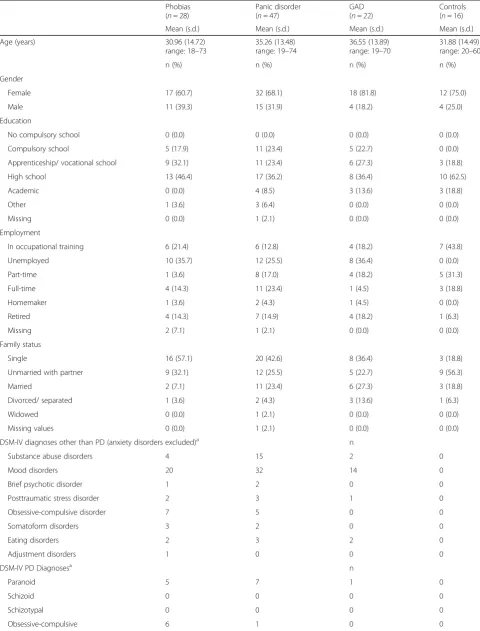
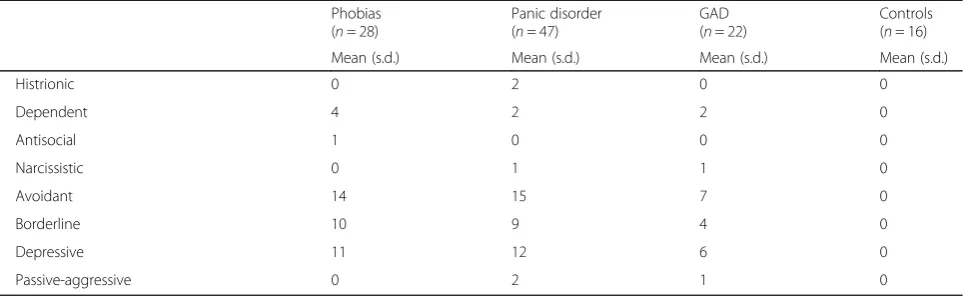
In total, 97 patients and 16 healthy control subjects were included into the study. In the patient group, 22 were suf-fering from generalized anxiety disorder, 47 had panic dis-order (with or without agoraphobia), and 22 phobias. Demographic data and diagnoses according to DSM-IV (American Psychiatric Association 1994) are given in Table1. Regarding disorders other than PD (including the anxiety disorder) 26 (26.8%) had one diagnosis, 37 (38.1%) had two, 22 (22.7%) had three, 9 (9.3%) four, and 3 (3.1%) five or more diagnoses. Sixty-three (64.9%) were suffering from a comorbid personality disorder. Twenty-two (22.7%) had one personality disorder, 23 (23.7%) had two, 14 (14.4%) three, 2 (2.1%) four, and 2 (2.1%) five or more. There were no significant differences regarding comorbidity between the three groups of patients with anxiety disorders.
Tests for normality of homogeneity of variance
Before using t-tests and ANOVA, tests for normality and homogeneity of variance were conducted. Neither the presence of PD nor the STIPO overall scores were nor-mally distributed in the three subgroups of anxiety disor-ders. Shapiro-Wilk statistics for presence of PD in the three groups ranged from W = .508 to .628 withp< .001 and for the STIPO overall score W = .865 to .896 withp < .001, except for GAD withp= .011.
However, no significant inhomogeneity of variances occurred in the above mentioned subgroups. For this reason, it was decided to use the parametric tests the re-sults of which are reported below.
Level of personality functioning in the groups of anxiety disorders
Table 1Sample characteristics (n= 113)
Phobias (n= 28)
Panic disorder (n= 47)
GAD (n= 22)
Controls (n= 16)
Mean (s.d.) Mean (s.d.) Mean (s.d.) Mean (s.d.)
Age (years) 30.96 (14.72)
range: 18–73
35.26 (13.48) range: 19–74
36.55 (13.89) range: 19–70
31.88 (14.49) range: 20–60
n (%) n (%) n (%) n (%)
Gender
Female 17 (60.7) 32 (68.1) 18 (81.8) 12 (75.0)
Male 11 (39.3) 15 (31.9) 4 (18.2) 4 (25.0)
Education
No compulsory school 0 (0.0) 0 (0.0) 0 (0.0) 0 (0.0)
Compulsory school 5 (17.9) 11 (23.4) 5 (22.7) 0 (0.0)
Apprenticeship/ vocational school 9 (32.1) 11 (23.4) 6 (27.3) 3 (18.8)
High school 13 (46.4) 17 (36.2) 8 (36.4) 10 (62.5)
Academic 0 (0.0) 4 (8.5) 3 (13.6) 3 (18.8)
Other 1 (3.6) 3 (6.4) 0 (0.0) 0 (0.0)
Missing 0 (0.0) 1 (2.1) 0 (0.0) 0 (0.0)
Employment
In occupational training 6 (21.4) 6 (12.8) 4 (18.2) 7 (43.8)
Unemployed 10 (35.7) 12 (25.5) 8 (36.4) 0 (0.0)
Part-time 1 (3.6) 8 (17.0) 4 (18.2) 5 (31.3)
Full-time 4 (14.3) 11 (23.4) 1 (4.5) 3 (18.8)
Homemaker 1 (3.6) 2 (4.3) 1 (4.5) 0 (0.0)
Retired 4 (14.3) 7 (14.9) 4 (18.2) 1 (6.3)
Missing 2 (7.1) 1 (2.1) 0 (0.0) 0 (0.0)
Family status
Single 16 (57.1) 20 (42.6) 8 (36.4) 3 (18.8)
Unmarried with partner 9 (32.1) 12 (25.5) 5 (22.7) 9 (56.3)
Married 2 (7.1) 11 (23.4) 6 (27.3) 3 (18.8)
Divorced/ separated 1 (3.6) 2 (4.3) 3 (13.6) 1 (6.3)
Widowed 0 (0.0) 1 (2.1) 0 (0.0) 0 (0.0)
Missing values 0 (0.0) 1 (2.1) 0 (0.0) 0 (0.0)
DSM-IV diagnoses other than PD (anxiety disorders excluded)a n
Substance abuse disorders 4 15 2 0
Mood disorders 20 32 14 0
Brief psychotic disorder 1 2 0 0
Posttraumatic stress disorder 2 3 1 0
Obsessive-compulsive disorder 7 5 0 0
Somatoform disorders 3 2 0 0
Eating disorders 2 3 2 0
Adjustment disorders 1 0 0 0
DSM-IV PD Diagnosesa n
Paranoid 5 7 1 0
Schizoid 0 0 0 0
Schizotypal 0 0 0 0
groups showed significant impairment. The distribution of the level of personality organization in the four groups is depicted in Table3. Post-hoc comparisons (least significant difference; Bonferroni corrected level of significance p < .004) revealed highly significant differences between con-trols and all three groups of anxiety disorders (p< .001) and non-significant results between the groups of anxiety disor-ders (p= .625 to .838).
In correspondence to the overall score, the seven di-mensions of the STIPO did not show relevant differ-ences between the groups of anxiety disorders. Within all groups the best personality functioning occurred in the domain of moral values, which indicates a low level of antisocial tendencies. Also the aggression and reality testing domains yielded slightly higher levels of person-ality functioning than the remaining scales.
Comorbid personality disorders and level of personality functioning
In view of the high number of comorbid personality dis-order diagnoses in the sample it was tested, whether a PD
is of more relevance for personality functioning than the type of anxiety disorder.
A linear regression analysis was conducted to further explore the influence of anxiety disorders as well as co-morbid PD on personality functioning. It turned out that only the presence of a PD was significantly associated to with personality functioning, but not any of the three anxiety disorders - a comorbid PD impaired personality functioning (T= 8.121,p< .001).
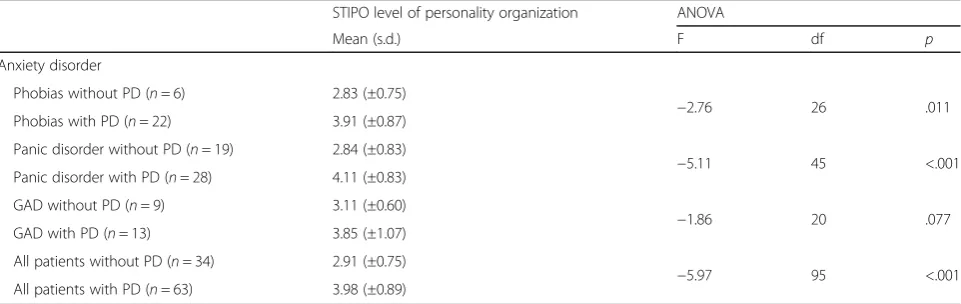
However, an ANOVA excluding all patients with PD still yielded a significantly worse personality function-ing in patients compared to controls (F = 14.020, df = 3, p< .001). Patients without comorbid PD showed a moderate impairment of personality function with a mean STIPO score of around 3, which indicates a lower neurotic level, whereas patients with comorbid PD revealed a mean STIPO score around 4, which stands for a higher borderline organization (see Table4).
[image:5.595.57.544.99.247.2]Finally, when all 113 subjects were included in a cor-relation analysis of number of PDs diagnosed and the Table 1Sample characteristics (n= 113)(Continued)
Phobias (n= 28)
Panic disorder (n= 47)
GAD (n= 22)
Controls (n= 16)
Mean (s.d.) Mean (s.d.) Mean (s.d.) Mean (s.d.)
Histrionic 0 2 0 0
Dependent 4 2 2 0
Antisocial 1 0 0 0
Narcissistic 0 1 1 0
Avoidant 14 15 7 0
Borderline 10 9 4 0
Depressive 11 12 6 0
Passive-aggressive 0 2 1 0
PDpersonality disorder,GADgeneralized anxiety disorder
a
[image:5.595.57.547.553.714.2]More than one diagnosis per patient included
Table 2Personality organization in the different groups of anxiety disorders (n= 113)
Phobias (n= 28)
Panic disorder (n= 47)
GAD (n= 22)
Controls (n= 16)
ANOVA
(including controls)
ANOVA (without controls)
Mean (s.d.) Mean (s.d.) Mean (s.d.) Mean (s.d.) F df pa F df
pa
STIPO dimensions
Identity 2.79 (±0.83) 2.62 (±0.85) 2.64 (±0.95) 1.25 (±0.45) 13.88 3 <.001 0.35 3 .70
Object relations 2.68 (±0.86) 2.51 (±0.98) 2.45 (±0.91) 1.44 (±0.63) 7.34 3 <.001 0.43 3 .66
Primitve defenses 2.86 (±0.85) 2.70 (±0.98) 2.77 (±0.92) 1.19 (±0.40) 15.01 3 <.001 0.27 3 .78
Coping/ rigidity 3.43 (±0.69) 3.04 (±0.81) 3.36 (±0.79) 1.56 (±0.51) 25.03 3 <.001 2.65 3 .08
Aggression 1.89 (±0.88) 2.09 (±0.91) 2.05 (±1.09) 1.00 (±0.00) 6.53 3 <.001 0.38 3 .69
Moral values 1.61 (±0.69) 1.60 (±0.71) 1.68 (±0.95) 1.19 (±0.54) 1.64 3 .19 0.10 3 .91
Reality testing and perceptual distortions 2.04 (±1.04) 2.26 (±1.01) 1.86(±1.04) 1.13 (±0.34) 5.66 3 .001 1.18 3 .31
Total score 3.68 (±0.95) 3.60 (±1.04) 3.55 (0.96) 1.50 (±0.63) 22.52 3 <.001 0.12 3 .89
GADgeneralized anxiety disorder,ANOVAanalysis of variance,STIPOStructured Interview for Personality Organization
a
STIPO overall score a highly significant correlation emerged (r= 0.596,p< .01).
Discussion
Our data demonstrate that anxiety disorders are associ-ated with an impaired personality functioning, which is moderate when no comorbid personality disorder is present and more severe in case of comorbid PD. There are no differences in personality functioning between phobias, GAD, and panic disorder, either with or without comorbid PD.
The hypothesis derived from psychoanalytic theory that GAD patients are characterized by a worse person-ality functioning followed by panic disorder patients and phobia patients with the best functioning could therefore not be confirmed. In contrast, it seems that anxiety dis-orders can occur on all levels of personality organization from mild impairment (“high neurotic level”) to the low-est level (“low borderline level”) (see Table 3). It is pos-sible that in first level care settings patients with anxiety disorders with higher personality function can be found
compared to patients in our study of secondary and ter-tiary care settings. In a Swedish study by Sundquist et al. about half of the patients with PD were only present in the primary care setting and never showed up in second-ary or tertisecond-ary care settings [22].
The pattern of personality functioning within the seven domains of the STIPO seems to reflect the com-parably high ratio of avoidant and depressive PD and the lower prevalence of Cluster A and B PD in the sample (see Table1). One might assume that Cluster C PD show a higher impairment in the realms of relational function-ing as well as copfunction-ing with and defendfunction-ing against stress. However, the validity study of the German version of the STIPO [10] revealed a similar pattern in a sample with a much higher ratio of Cluster A and B PD. Thus, person-ality functioning appears to be rather independent from the symptoms and characteristics of specific PDs.
A very high comorbidity between anxiety disorders and PDs has previously been shown. Grant et al. [23] re-ported from the National epidemiologic survey on alco-hol and related conditions (NESARC) that in 41.8% of patients with any anxiety disorder a comorbid personal-ity disorder is present. In treatment seeking patients with anxiety disorders this number rises to 59.6%. Thus, our finding of 64.9% of comorbid PDs in a population from psychiatric in- and outpatient units is in line with this earlier finding. It can be assumed that a study recruiting subjects with anxiety disorders outside the mental health care system would have found somewhat lower rates of comorbid PDs and, thus, a slightly better personality functioning.
[image:6.595.57.291.110.244.2]Our study adds to these previous findings the result that even in absence of a personality disorder patients with an anxiety disorder show significant impairment in their personality functioning. As a consequence, the treatment of patients with anxiety disorders should take into consideration the presence of personality problems. Table 3Personality organization in the different groups of
anxiety disorders (n= 113) Phobias (n= 28)
Panic disorder (n= 47)
GAD (n= 22)
Controls (n= 16)
n (%) n (%) n (%) n (%)
STIPO level of personality organization
1–normal 0 (0.0) 0 (0.0) 0 (0.0) 9 (56.3)
2–neurotic 1 2 (7.1) 7 (14.9) 2 (9.1) 6 (37.5)
3–neurotic 2 11 (39.3) 17 (36.2) 10 (45.5) 1 (6.3)
4–borderline 1 10 (35.7) 11 (23.4) 7 (31.8) 0 (0.0)
5–borderline 2 4 (14.3) 12 (25.5) 2 (9.1) 0 (0.0)
6–borderline 3 1 (3.6) 0 (0.0) 1 (4.5) 0 (0.0)
GADgeneralized anxiety disorder,STIPOStructured Interview for Personality Organization
Table 4Personality organization (STIPO overall scores) in the different groups of anxiety disorders with and without comorbid personality disorders (n= 97)
STIPO level of personality organization ANOVA
Mean (s.d.) F df p
Anxiety disorder
Phobias without PD (n= 6) 2.83 (±0.75)
−2.76 26 .011
Phobias with PD (n= 22) 3.91 (±0.87)
Panic disorder without PD (n= 19) 2.84 (±0.83)
−5.11 45 <.001
Panic disorder with PD (n= 28) 4.11 (±0.83)
GAD without PD (n= 9) 3.11 (±0.60)
−1.86 20 .077
GAD with PD (n= 13) 3.85 (±1.07)
All patients without PD (n= 34) 2.91 (±0.75)
−5.97 95 <.001
All patients with PD (n= 63) 3.98 (±0.89)
[image:6.595.58.539.571.723.2]On the one hand, a diagnosis of personality functioning as well as PD should be mandatory in every patient. The newly developed instruments for the assessment of the levels of personality functioning according to DSM-5 serve this purpose, e.g., the self-report form of the DSM-5 Level of Personality Functioning Scale [24, 25]. Moreover, well-established questionnaires and interviews exist that can be employed. For example, the Inventory of Personality Organization (IPO) [26, 27], the Struc-tured Interview for Personality Organization (STIPO) [10, 11], and the Operationalized Psychodynamic Diag-nosis (OPD-2) [28]. It has recently been shown that the DSM-5 levels of personality functioning can be reliably assessed by untrained raters from audio-recorded STIPO interviews [29] as well as OPD-2 interviews [30]. For a general assessment of personality function and screening purposes, the DSM-5 LPFS or questionnaires can be used, while the multidimensional and more extensive in-terviews like the STIPO or OPD-2 yield a much more comprehensive assessment of the different domains of personality functioning, which is highly valuable for clin-ical treatment planning as well as for detailed research questions.
On the other hand many treatment failures in patients with anxiety disorders might be attributable to impaired personality functioning and comorbid PD [31–33]. This is of high clinical relevance, since it is known, that treatment response rates are low, e.g. 48% in generalized anxiety dis-order as reported by Hunot et al. [34] in their Cochrane review. If one assumes, that most of the randomized-con-trolled treatment studies exclude patients with comorbid PD, the relevance of sub-threshold/ mild impairment of personality functioning might be of even greater import-ance for treatment outcome. Personality functioning can be improved by psychotherapy, which has been shown by Doering et al. [35], but it will need specialized treatment approaches that focus not only on symptoms of the anx-iety disorder, but also on specific domains of the patient’s personality [36]. If we follow the presumption that person-ality pathology complicates the treatment of anxiety disor-ders and has to be addressed before sustainable symptom remission can occur, specific treatments should be offered to patients with both, anxiety disorder and impaired person-ality functioning. Treatments that have demonstrated their efficacy in improving personality functioning are Transference-focused Psychotherapy (TFP) [35,37–39] and - with some limitations due to the lack of specific out-come criteria in the conducted RCTs - Schema-focused Psychotherapy (SFT) [40, 41], Mentalization-based Treatment (MBT) [42–44], and Dialectical Behavior Therapy (DBT) [45,46].
Limitations of this study can be found in the relatively low sample size in two of the three groups of patients with anxiety disorders, and in the recruitment at psychiatric
hospital units. This reduces the generalizability of the ab-solute numbers regarding personality functioning in anx-iety disorders, which probably is somewhat better in the general population than in the treatment seeking sub-population. However, the result that all anxiety disor-ders occur on almost all levels of personality functioning can be regarded as mainly independent from the recruit-ment bias. In future studies with larger sample sizes it will be interesting to evaluate the specific influence of cluster B vs. cluster A or C PDs, or even of specific PDs like borderline.
Conclusions
An impairment of personality functioning is highly fre-quent in all anxiety disorders and has to be taken into consideration for diagnosis and treatment of patients with anxiety disorders. There are no differences between the anxiety disorders with regard to their personality functioning, and comorbid PD further impair personality functioning.
Abbreviations
AMPD:Alternative Model for Personality Disorders; ANOVA: Analysis of Variance; BSI: Brief Symptom Inventory; DBT: Dialectical Behavior Therapy; DSM-5: Diagnostic and Statistical Manual of Mental Disorders–Fifth Edition; DSM-IV: Diagnostic and Statistical Manual of Mental Disorders–Fourth Edition; GAD: Generalized Anxiety Disorder; GSI: Global Severity Index; ICC: Intraclass Correlation; ICD-11: International Classification of Mental and Behavioral Disorders, 11th Revision; IPO: Inventory of Personality Organization; LPFS: Levels of Personality Functioning Scale;
MBT: Mentalization-based Treatment; NESARC: National Epidemiologic Survey on Alcohol and Related Conditions; OPD-2: Operationalized Psychodynamic Diagnosis, Second Edition; PD: Personality Disorder; SCID-I: Structured Clinical Interview for DSM-IV, Axis I; SCID-II: Structured Clinical Interview for DSM-IV, Axis II; SFT: Schema-focused Psychotherapy; STIPO: Structured Interview of Personality Organization; TFP: Transference-focused Psychotherapy
Funding
This study was funded by the Jubilaeumsfonds of the Austrian National Bank, project # 15078. The funding body did not take any influence on the design of the study and collection, analysis, and interpretation of the data and on writing the manuscript.
Availability of data and materials
The datasets generated and analysed during the current study are not publicly available due to the European General Data Protection Regulation (GDPR), but are available from the corresponding author on reasonable request, if possible in accordance with the GDPR.
Authors’contributions
SD developed the study design, carried out the statistical analyses, and drafted the manuscript, AW, KP, KF, MG recruited the patients, have been responsible for data acquisition, VB, MF, HRS, MA contributed substantially to data analyses and interpretation of data. All authors contributed substantially to a number of revisions of the manuscript and gave final approval for its submission.
Ethics approval and consent to participate
This study was approved by the ethics committee of the Medical University of Vienna, Austria on March 27, 2012 (IRB No. 1037/2012). After receiving detailed information about the study all subjects gave written informed consent.
Competing interests
None of the authors reports any competing interests. Stephan Doering and Victor Blueml are currently acting as Associate Editors for BMC Psychiatry.
Publisher’s Note
Springer Nature remains neutral with regard to jurisdictional claims in published maps and institutional affiliations.
Author details
1Department of Psychoanalysis and Psychotherapy, Medical University of
Vienna, Währinger Gürtel 18-20, A-1090 Wien, Austria.2Department of Psychology, Webster Vienna Private University, Wien, Austria.3Department of
Social Psychiatry, Medical University of Vienna, Wien, Austria.4Department of
Psychiatry, University Hospital Tulln, Tulln, Austria.5Vienna Psychoanalytic
Society, Wien, Austria.
Received: 29 June 2018 Accepted: 30 August 2018
References
1. American Psychiatric Association. Diagnostic and Statistical Manual. 5th ed. Washington, DC: American Psychiatric Publishing; 2013.
2. Reed GM. Progress in developing a classification of personality disorders for ICD-11. World Psychiatry. 2018;17(2):227–9.
3. World Health Organization. ICD-11 for Mortality and Morbidity Statistics (ICD-11 MMS) 2018 version. 6D10 Personality disorder.https://icd.who.int/ browse11/l-m/en#/http%3a%2f%2fid.who.int%2ficd%2fentity%2f941859884
(2018). Accessed 9 August 2018.
4. Freud S. Die Traumdeutung. Gesammelte Werke Bd. II/III. Frankfurt am Main: Fischer Taschenbuchverlag; 1900/1999.
5. Freud S. Das ich und das Es. Gesammelte Werke Bd. XIII. Frankfurt am Main: Fischer Taschenbuchverlag; 1923/1999. p. 235–89.
6. Hartmann H. Ich-Psychologie und Anpassungsproblem. Int Z Psychoanal Imago. 1939;24:62–135.
7. Kernberg OF. Borderline conditions and pathological narcissism. New York: Jason Aronson; 1975.
8. Kernberg OF. Severe personality disorders. New Haven: Yale University Press; 1984.
9. Kernberg OF. The structural interviewing. Psychiatr Clin North Am. 1981;4: 169–95.
10. Clarkin JF, Caligor E, Stern B, Kernberg OF. Structured interview of personality organization (STIPO). New York: Weill Medical College of Cornell University; 2003.
11. Stern BL, Caligor E, Clarkin JF, Critchfield KL, Hörz S, Maccornack V, Lenzenweger MF, Kernberg OF. Structured interview of personality organization (STIPO): preliminary psychometrics in a clinical sample. J Pers Assess. 2010;92:35–44.
12. Doering S, Burgmer M, Heuft G, Menke D, Bäumer B, Lübking M, Feldmann M, Hörz S, Schneider G. Reliability and validity of the German version of the structured interview of personality organization (STIPO). BMC Psychiatry. 2013;13:210.
13. Huber D, Klug G, Wallerstein RS. Skalen psychischer Kompetenzen (SPK). Ein Messinstrument für therapeutische Veränderung in der psychischen Struktur. Incl. Manual und Interviewleitfaden. Stuttgart: Kohlhammer; 2006. 14. Hörz S, Rentrop M, Fischer-Kern M, Schuster P, Kapusta N, Buchheim P,
Doering S. Strukturniveau und klinischer Schweregrad der Borderline-Persönlichkeitsstörung. Z Psychosom Med Psychother. 2010;56(2):136–49. 15. Rentrop M, Zilker T, Lederle A, Birkhofer A, Hörz S. Psychiatric comorbidity
and personality structure in patients with polyvalent addiction. Psychopathology. 2014;47(2):133–40.
16. Di Pierro R, Preti E, Vurro N, Mededdu F. Dimensions of personality structure among patients with substance use disorders and co-occuring personality disorders: a comparison with psychiatric outpatients and healthy controls. Compr Psychiatry. 2014;55(6):1398–404.
17. Eckhardt-Henn A, Heuft G, Hochapfel G, Hoffmann SO. Neurotische Störungen und Psychosomatische Medizin. 8. Auflage ed. Stuttgart: Schattauer; 2009.
18. American Psychiatric Association. Diagnostic and Statistical Manual. 4th ed. Washington, DC: American Psychiatric Publishing; 1994.
19. Fydrich T, Renneberg B, Schmitz B, Wittchen HU. Strukturiertes Klinisches Interview für DSM-IV Achse II: Persönlichkeitsstörungen. Göttingen: Hogrefe; 1997.
20. Wittchen HU, Zaudig M, SKID-I FT. Strukturiertes Klinisches Interview für DSM-IV, Achse I. Göttingen: Hogrefe; 1997.
21. Franke RB. BSI: brief symptom inventory von Derogatis - deutsche version. Göttingen: Beltz; 2000.
22. Sundquist J, Ohlsson H, Sundquist K, Kendler KS. Common adult psychiatric disorders in Swedish primary care where most mental health patients are treated. BMC Psychiatry. 2017;17:235.
23. Grant BF, Hasin DS, Stinson FS, Dawson DA, Chou SP, Ruan WJ, Huang B. Co-occurence of 12-month mood and anxiety disorders and personality disorders in the US: results from the national epidemiologic survey on alcohol and related conditions. J Psychiatr Res. 2005;39:1–9.
24. Morey LC. Development and initial evaluation of a self-report form of the DSM-5 Level of Personality Functioning Scale. Psychol Assess. 2017; 29(10):1302–8.
25. Hopwood CJ, Good EW, Morey LC. Validity of the DSM-5 levels of personality functioning scale-self report. J Pers Assess. 2018;https://doi.org/ 10.1080/00223891.2017.1420660.
26. Clarkin JF, Foelsch PA, Kernberg OF. The inventory of personality organization (IPO). Unpublished manuscript. New York: Weill Medical College of Cornell University; 1995.
27. Lenzenweger MF, Clarkin JF, Kernberg OF, Foelsch PA. The inventory of personality organization: psychometric properties, factorial composition, and criterion relations with affect, aggressive dyscontrol, psychosis proneness, and self-domains in a nonclinical sample. Psychol Assess. 2001;13:577–91. 28. OPD Task Force. Operationalized Psychodynamic Diagnosis–OPD-2.
Manual of diagnosis and treatment planning. Cambridge, MA: Hogrefe & Huber Publishers; 2008.
29. Preti E, Di Pierro R, Costantini G, Benzi IMA, De Panfilis C, Madeddu F. Using the structured interview of personality organization for DSM-5 level of personality functioning rating performed by inexperienced raters. J Pers Assess. 2018;https://doi.org/10.1080/00223891.2018.1448985.
30. Zimmermann J, Benecke C, Bender DS, Skodol AE, Schauenburg H, Cierpka M, Leising D. Assessing DSM-5 level of personality functioning from videotaped clinical interviews: a pilot study with untrained and clinically inexperienced students. J Pers Assess. 2014;96(4):397–409.
31. Ansell EB, Pinto A, Edelen MO, Markowitz JC, Sanislow CA, Yen S, Zanarini M, Skodol AE, Shea MT, Morey LC, Gunderson JG, McGlashan TH, Grilo CM. The association of personality disorders with the prospective 7-year course of anxiety disorders. Psychol Med. 2011;41(5):1019–28.
32. Crawford TN, Cohen P, First MB, Skodol AE, Johnson JG, Kasen S. Comorbid Axis I and Axis II disorders in early adolescence: outcomes 20 years later. Arch Gen Psychiatry. 2008;65(6):641–8.
33. Skodol AE, Geier T, Grant BF, Hasin DS. Personality disorders and the persistence of anxiety disorders in a nationally representative sample. Depress Anxiety. 2014;31(9):721–8.
34. Hunot V, Churchill R, Teixera V, Silva de Lima M. Psychological therapies for generalised anxiety disorder (Review). Cochrane Database Syst Rev. 2007;(1): CD001848.
35. Doering S, Hörz S, Rentrop M, Fischer-Kern M, Schuster P, Benecke C, Buchheim A, Martius P, Buchheim P. Transference-focused psychotherapy v. Treatment by experienced community psychotherapists for borderline personality disorder: randomized controlled trial. Br J Psychiatry. 2010;196(5):389–95.
36. Benecke C, Huber D, Staats H, Zimmermann J, Henkel M, Deserno H, Wiegand-Grefe S, Schauenburg H. A comparison of psychoanalytic therapy and cognitive behavioral therapy for anxiety (panic/agoraphobia) and personality disorders (APD study): presentation of the RCT study design. Z Psychosom Med Psychother. 2016;62(3):252–69.
37. Yeomans F, Clarkin J, Kernberg O. Transference-focused psychotherapy for borderline personality disorder: a clinical guide. Washington DC: American Psychiatric Publishing; 2015.
38. Levy KN, Meehan KB, Kelly KM, Reynoso JS, Weber M, Clarkin JF, Kernberg OF. Change in attachment patterns and reflective function in a randomized control trial of transference-focused psychotherapy for borderline personality disorder. J Consult Clin Psychol. 2006;74:1027–40. 39. Tmej A, Fischer-Kern M, Doering S, Buchheim A. Psychotherapy and
40. Arntz A, van Genderen H. Schema therapy for borderline personality disorder. Chichester: Wiley-Blackwell; 2009.
41. Giesen-Bloo J, van Dyck R, Spinhoven P, van Tilburg W, Dirksen C, van Asselt T, Kremers I, Nadort M, Arntz A. Outpatient psychotherapy for borderline personality disorder. Randomized trial of Schema-focused therapy vs transference-focused psychotherapy. Arch Gen Psychiatry. 2006;63:649–58. 42. Bateman A, Fonagy A. Psychotherapy for borderline personality disorder.
Mentalization-based treatment. Oxford: Oxford University Press; 2004. 43. Bateman A, Fonagy P. Effectiveness of partial hospitalization in the
treatment of borderline personality disorder: a randomized controlled trial. Am J Psychiatry. 1999;156:1563–9.
44. Bateman A, Fonagy P. 8-year follow-up of patients treated for borderline personality disorder: mentalization-based treatment versus treatment as usual. Am J Psychiatry. 2008;165(5):631–8.
45. Linehan MM. Cognitive-behavioral treatment of borderline personality disorder. New York: Guilford Press; 1993.