2017 2nd International Conference on Computer Science and Technology (CST 2017) ISBN: 978-1-60595-461-5
Research and Application about Posture
Recognition Based on G-Sensor
Bi-ya XU
1,a*, Yin-wei ZHAN
2and Yang SHAO
31,2,3 School of computer, Guangdong University of Technology, Guangzhou,
Guangdong 510006, China.
*Corresponding author
Keywords: G-sensor, Acceleration sensor, Integral calculation, Dynamic time warping, Posture recognition.
Abstract. At present, without full use of the mobile phone around us, most of the research in human body posture recognition field is use camera or portable acceleration sensor to collect data. In this paper, G-sensor built- in mobile phone is use to collect data. After gaining joint point’s space three-dimensional coordinates through motion acceleration integral, a set of vectors calculated by those data are put up as the description of every pair’s joint points, which changes instead of motion trajectories. Then using the DTW (dynamic time warping) algorithm recognize position category, the results show that this gesture recognition method has good recognition effect.
Introduction
Human posture recognition, as a new field of study, has the important theoretical research value. How to collect data accurately and gain individual motion to complete setting task after computer’s analysis is the purpose of the research on human motion recognition,
Up to now, the research [1,2] of human motion recognition mainly based on the way of visual interaction and non-visual interaction. As representative of non-visual interact, sensor technology has attracted researcher’s attention in recent years. By now, some researchers [3] have been able to successfully identify some of the common
human daily actions, such as walking, running, jumping, sit, stand, etc.,but for some
accurate human motion recognition problems still remain to be solved.
G-sensor built-in mobile phone is a kind of accelerometer sensors that can convert
exercise or gravity to electrical signals. When the object’s position changes, such as
shaking, drop, rotation, up, down et, acceleration accompany could be converted into electrical signals by G-sensor and obtained posture data after analysis of the microprocessor.
This paper mainly uses G-sensor built-in mobile phone to collect upper limb movement data. Unlike the mainstream research direction that recognition human posture depend on extracting acceleration features, in this paper, confirm joint point’s space three-dimensional coordinates through posture acceleration integral, then using the DTW(dynamic time warping)algorithm recognize human posture category.
Data Collection and Processing
Collecting Posture Data by Mobile Phone
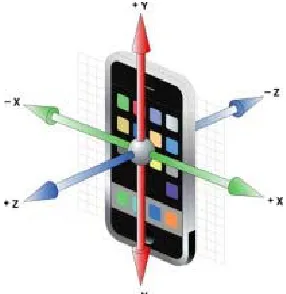
and port of the server. Then sending data to server. Sensor’s coordinate system relative to the phone screen is show as Fig.1. The x axis horizontal to the right, the y axis vertical upward and the z axis is perpendicular to the phone's screen.
Figure 1. The coordinate system of the mobile phone.
Data Denoising
Generally speaking, the acceleration sensor is calibrated before going out of the factory, but the data output will result in an error when install it in the mobile device, in addition, the original data collected by the mobile phone sensor will carry noise. So, this paper adopts the moving average filter [4] method to deal with the noise data.
The average value filtering is a basic method of filtering the image based on the local statistical information of the image, which find all the pixels’ average value in the template, and then apply the average value to the current data point (x). Namely, g(x)=1/m ∑f(x), m refers to the total number of data which contains the current pixels.
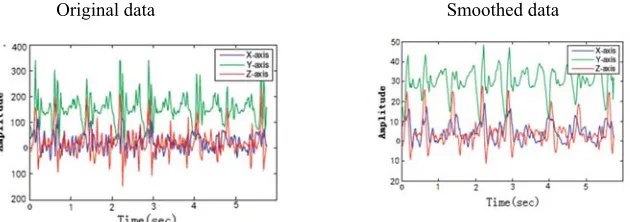
Moving average filter is to conduct the signal data processing based on the average filter. When read the acceleration sensor data, the researchers need to regard the horizontally placed phone as coordinate points. The X axis refers to the left and right direction of the phone, Y axis refers to the front and back direction of the phone. If there is no acceleration, the value of x and y should be zero theoretically, z should be -g, but the sample data (x, y, z) of acceleration sensor when the phone is static can be
seen on the top part of Fig.2. In fact, the value of the sensor is considered to be wrong
when there is ±5 jitters noise.
This paper corrects the acceleration count (x, y, z) based on the ratio of the two factors M and round. And then uses the moving average filtering method to deal with the noise by using the existed acceleration. For example:
(x’, y’, z’) = mv − filter (round , , M , L) (1)
Original data Smoothed data
[image:3.612.117.494.83.201.2]
Figure 2. Static state of the handset acceleration reading.
The average and variance of the original acceleration sensor statistics are as follows:
(mx, my, mz) = (−14.07, −14.63, −279.31) And
σ ,σ ,σ = (2.13,2.13,2.75)
After the smoothing process, the acceleration sensor reads data can be shown as follows:
mx′, my′, mz′ = (−2.27, −2.89, −55.61)
And
σ ’,σ ’,σ ’ = (0.16,0.21,0.23)
Moving smoothing technology can eliminate both jitters noise and smoothed data
by narrowing the standard deviation and averaging. Fig.3 shows the readings of the
acceleration sensor in the mobile phone which has conducted smooth process.
Original data Smoothed data
Figure 3. The value of acceleration in the mobile phone.
Data Segmentation
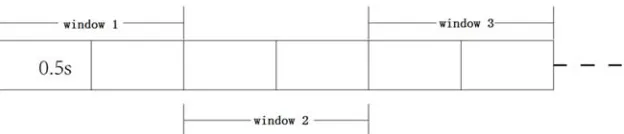
Generally speaking, one of the most popular methods for the data segmentation is called “sliding window segmentation method [5]”. The window size ranges from 0.5s to1s. As the identification of the specific position, this experiment takes a thorough consideration towards the duration and type of postures. It divides the processed data into multiple time windows by using sliding window segmentation method. The time of each window is 1.0s, and each pairs of adjacent windows have 50% overlap. The
[image:3.612.153.468.446.557.2]Figure 4. Window division diagram.
Posture Recognition
Get the Joint Space Position
Some of the researches [6] find that use the acceleration integral mark to calculate the spatial tracing model. This article applies this kind of method to the experiment, and it obtains real-time three-dimensional acceleration of the phone by making full use of the acceleration sensor which stays inside of the mobile phone. One of the most important steps is to conduct integration towards the acceleration data.
Assume to get the sample from time t0, from t0 to t, the calculation relationship
between the displacement s(t), the velocity v(t) and the acceleration a(t) in the continuous time domain is as follows:
s(t) = v(t)dt s(t ) (2) v(t) = a(t)dt v(t ) (3)
Specifically, s(t0) is the cumulative displacement of system from 0 to t0, and V (t0)
is the instantaneous velocity at time t0.Since the acceleration sensor outputs a set of
discrete data, this paper tries to get the instantaneous velocity of the mobile phone along the X, Y and Z axes of the acceleration sensor based on the higher mathematics and numerical analysis.
v t = v t − ∆t ∆ ∗ ∆t (4)
v t = v t − ∆t ∆ ∗ ∆t (5)
v t = v t − ∆t ∆ ∗ ∆t (6)
According to the acceleration vector addition algorithm, by conducting velocity vector addition towards the speed of X, Y, Z axis, and finally get the instantaneous movement speed of the mobile phone in the three-dimensional space.
v t = v t v t v t (7)
Similarly, the space displacement of the mobile phone in the time period is as follows:
s∆ t = (s t − s t − ∆t ) (s t − s t − ∆t ) (s t − s t − ∆t ) (8)
Then the spatial coordinates of the mobile phone at time t is:(Sx[t],Sy[t],Sz[t]).
Vector Representation of Postue
Fix the mobile phone in the arm wrist, elbow, and shoulder, access to the joint point of the three-dimensional space coordinates, adjacent joints can be presented according
changes of the posture of the human body changes from the movement trajectory of the joint point to the joint vector. This paper defines six sets of joint vectors, and this
[image:5.612.270.361.116.222.2]can be shown in Table 1.
Figure 5. Vector representations of joints. Table 1. Joint vector definition.
Joint vector name vector Vector definition
Right shoulder vector SR Shoulder joint center → right shoulder joint
Right shoulder vector ER Right shoulder joint → right elbow joint
Right arm vector WR Right elbow joint → right wrist
Left shoulder vector SL Shoulder Center → Left Shoulder Joint
Left upper arm vector EL Left shoulder joint → left elbow joint
Left arm vector WL Left elbow joint left wrist
Posture Recognition Algorithm
This paper determines the human body posture by making full use of dynamic time warping (DTW) algorithm [7,8]. The main function of the DTW algorithm is to compare the test template with all the templates of the reference template library. Then compare the reference template of the minimum amount and determine whether the test template belongs to the same category. Judge the recognition results and they can be concluded as follows:
Suppose there are two time series Q and P, Q is the test sequence, the length is n, P is the reference sequence, the length is m: Q=q1, q2,...qi...qn ; P=p1, p2, ..., pm.
Construct the distance matrix of the sequences Q and P, then the final distance DTW(Q,P):
D q , p = d q , p min D q , p , D q , p , D(q , p ) (9)
DTW(Q, P) = D(q , p ) (10)
Here, the d q , p refers to the distance between q and p , D q , p refers to
the cumulative distance between q and p .This paper regard the joint vector
changes as the posture, the distance between joint vectors can be measured by the angle, select the training personnel with different statures to complete the same target action at different rotational speeds.
Take out samples with the same size and calculate its s similarity d with other samples. Set the threshold a, get the average data for these samples which are
complying with d <= a, and then get the standard reference template R1 for this
behavior. Calculate the standard template for the remaining behavior in order to
[image:5.612.113.499.262.368.2]WL}, I refers to nonempty subset.
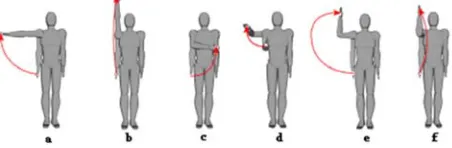
Define six kinds of identification postures, as shown in Fig.6, they are elbow lateral
raise, elbow extension, elbow flexion, elbow lateral raise, elbow lift aside, elbow lift forward.
Figure 6 Identifies the human postures.
Experimental Results and Analysis
[image:6.612.203.429.133.207.2]In this paper, six kinds of difference postures is use to identification the effect of recognition human posture by accelerometer built-in mobile phone, which include elbow lateral raise, elbow extension, elbow flexion, elbow lateral raise, elbow lift aside, elbow lift forward. The experiment selected 100 different training samples for each posture. The test results are shown in Table 2:
Table 2. Posture recognition results.
Experiment result show that after processing the data collected by G-sensor, dynamic time programming (DTW) algorithm have a precise recognition to the posture we
define in the above. But this method of identification is required for specific
regulations. Due to the large amount of calculation of the DTW (dynamic time
warping) algorithm, program’s running often have a significant delay, therefore it is not suitable apply to all kinds of posture recognition.
Conclusion
In this paper, G-sensor built-in mobile phone is used to collect data. After gaining joint point’s space three-dimensional coordinates through posture acceleration integral, a set of vectors calculated by those data are put up as the description of every pairs joint points, which changes instead of posture trajectories. Establish a simple gesture template, then using the DTW (dynamic time warping) algorithm recognize position
category. Experiments show that the gesture recognition method for simple posture
References
[1] Xue Yang. Human posture model based on single acceleration sensor[D]. Guangzhou: South China University of Technology, 2011.
[2] Ru Chengguan. Research on Sensor-based Activity Recognition[D].Zhejing: Zhejiang University,2016.
[3] Wang, S., Yang, J. and Chen, N., et al. Human activity recognition with user-free accelerometers in the sensor Networks[C]. IEEE Int. Conf. Neural Networks and Brain,2005,2:1212-1217.
[4] Khan, A. M., Lee, Y. K., Lee, S., et al. Accelerometer’s position independent physical activity recognition system for long-term activity monitoring in the elderly[J]. Medical & biological engineering & computing,2010,48(42):1271-1279. [5] Coskun. D., Incel. O, D., Ozgovde. A. Phone position/placement detection using accelerometer: Impact on activity recognition[C]. Intelligent Sensors, Sensor Networks and Information Processing(ISSNIP),2015 IEEE Tenth International Conference on. IEEE,2015:1-6.
[6] Lin Nan, Li Dongshen, Li Hongnan. A Method of Testing Acceleration Integral Velocity and Displacement Based on Zero Initial Value[J]. Chinese Science: Technical science, 2016,46:602–614.
[7] Zhang Xiongwei, Chen liang, Yang Gubing. Modern Voice Processing Technology and Application[M]. Beijing: Machinery Industry Press,2003.