2017 3rd International Conference on Electronic Information Technology and Intellectualization (ICEITI 2017) ISBN: 978-1-60595-512-4
Research on Measurement of Liquid
Refractive Index Using Fem to
Second Laser Frequency Comb
Han Jia, Tuo Zhao, Weiwei Yang and Guangzheng Jia
ABSTRACT
In this paper, we develop a method to measure the refractive index of liquid at different temperatures applying the femtosecond laser frequency comb. The measurement principle isto testthe phase changes of the measuring signal caused by light traveling through the liquid, then calculating the refractive index according to the phase difference between water and air. The experiment on measuring the water refractive index at temperature from 20oC to 60oC was performed, and the measuring results show a satisfactory accuracy.
INTRODUCTION
The refractive index is an important optical characteristic of liquid, and it will change with the temperature. There are two common methods of measure the liquid refractive index. One is to measure the incident angle and reflection angle when light travels from the air to the liquid surface, and calculate the refractive index based on the laws of retraction and reflection [1]. This method is simple and convenient but hard to get a high precision. The other is to calculate the refractive index indirectly based on the principle of light interference and diffraction. This method can obtain an accurate measuring result, however, its measurement
__________________________
Han Jia, Department of Precision Mechanical Engineering, Shanghai University, Shanghai, China.
Tuo Zhao, School of Marine Science and Technology, Tianjin University, China.
process is more complex, and the result accuracy is limited by experimental conditions.
To improve measuring result, a new method is presented for measuring the refractive index of liquid with temperature variation applying the femtosecond laser frequency comb [2]. Frequency comb is widely used in laser machining, dimensional measuring technology, optical spectroscopy and many other fields. A frequency comb is shown as recurrent pulses laser in time domain, also as many single wavelengths in spectral domain. According to its features in time domain and spectral domain, these wavelengths can be transformed to a radio frequency (RF) standard [3]. Thus, the frequency comb is considered as a transfer bridge between the optical frequency and the RF, which is also known as the characteristics of transmitting the time and length reference.
This method combines the refraction law of light and the characteristics of frequency comb, applying the phase change of the measured light and reference light, then analyze the collected frequency spectrum signals, and calculate the refractive index of liquid. This method not only is easy to operate, but also has high precision and high sensitivity with sensing extremely tiny changes of temperature.
MEASUREMENT PRINCIPLE
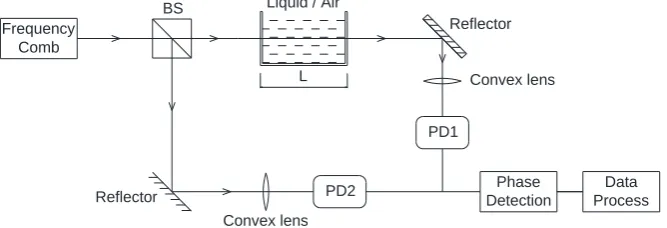
The measurement principle is shown in Figure 1. The pulse laser is split into two parts at beam splitter (BS), the measuring beam and the reference beam. The measuring beam, after travelling through a liquid vessel, is detected by photodetector (PD1) as the measuring signal. Because the thickness of the vessel wall is far less than the width of the vessel, its influence from the thickness on the result can be neglected. And the reference beam is received by photodetector (PD2) after reflection and focusing, then considered as the reference signal.
Liquid / Air Frequency
Comb
BS
PD2 Phase
Detection
Data Process PD1
L
Reflector
Reflector
Convex lens
[image:2.612.132.466.513.627.2]Convex lens
According to reference [4], the light intensity of the single signal detected by photodetector is
2 2 2
1
2A cos (2 frept p p ) 2A
I , (1)
Where frep is the repetition frequency, A is the amplitude of the beam, and φp, φp+1 are the phases of adjacent longitudinal modes. Then the total signal can be expressed by
0
1 2
2 2 2
[ ]
2 ij cos 2 ( ) 2 ij
i j
rep j i
A j i f t A
I , (2)
Where i, j are the ordinal number of different longitudinal modes (i<j).
Actually, laser source will produce a slight vibration during testing; in order to eliminate its influence on measurement results, we apply two groups of experiments to measure the difference between the phases caused by the liquid or air in vessel respectively. When the light travels through different mediums, the phase differences will also change, and the relationship between the refractive index and the phase differences can be expressed by
0 1
;
2 ( rep ceo)
Ln
c jf f
(3)
2 ,
2 ( )
g
rep ceo
Ln
c jf f
(4)
Where n0, ng is the relative refractive index of air and liquid respectively, L is the width of vessel, and c presents the light speed in vacuum, and fceo is carrier-envelope offset.
Then the refractive index can be measured via a series of optical path differences corresponding to the liquid without the knowledge of the specimen properties, and the measuring signal is finally expressed by
100 100 0
1 2
2 2 0 2
[ 2 2 ]
2 cos 2 ( ) 2
( ) ( )
ij ij
i j
g rep
rep ceo rep ceo
Ln Ln
A j i f t A
c jf f c jf f
=I . (5)
EXPERIMENTAL RESULTS
rate is 100MHz with the wavelength of 515nm, and its output signals at time domain and spectral domain are shown in Figure 2.
(a) (b)
Figure 2. The measurement signal at (a) time domain and (b) spectral domain.
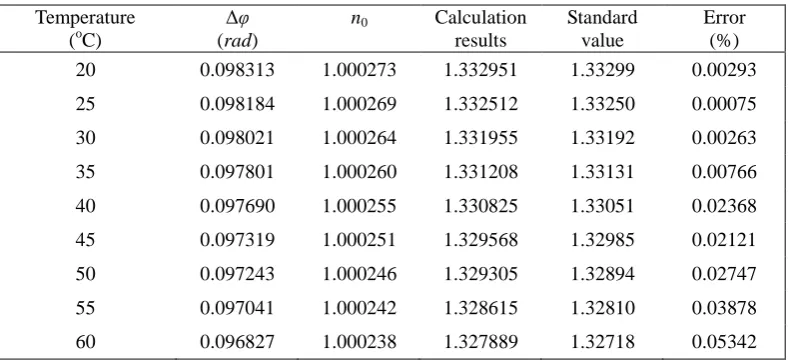
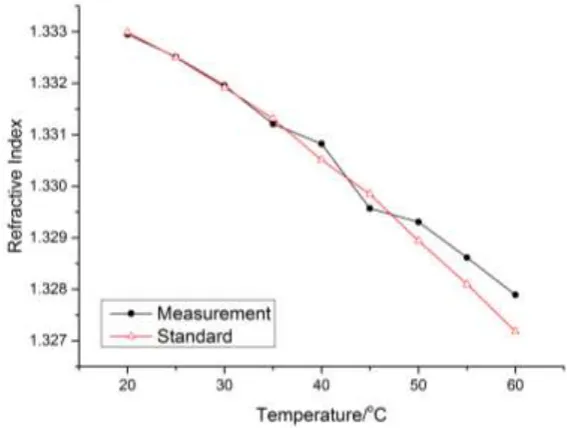
[image:4.612.112.469.123.262.2] [image:4.612.102.498.479.659.2]The experiment was conducted at the atmospheric pressure of 101.325 kPa and the relative humidity of 50%. The length of vessel is 141.1mm. We set the recording frequency of 20kHz and the sampling time is 10 seconds. Then we obtain about 200000 groups of measuring results. After removing gross error, the average value of data is used to calculate the phase changes of measuring signal, and the calculation results are listed in Table I. Then the refractive index of water is calculated by Equation (3), and the calculation results of refractive index are compared with the standard value at different temperature of 20oC to 60oC [5], which are listed in Table I, and the curves are shown in Figure 3. The measuring results are similar with the standard values, and the relative error will increase with the temperature rise, but no more than 0.6%.
TABLE I. MEASURING RESULTS. Temperature
(oC)
Δφ
(rad)
n0 Calculation results
Standard value
Error (%) 20 0.098313 1.000273 1.332951 1.33299 0.00293
25 0.098184 1.000269 1.332512 1.33250 0.00075
30 0.098021 1.000264 1.331955 1.33192 0.00263
35 0.097801 1.000260 1.331208 1.33131 0.00766
40 0.097690 1.000255 1.330825 1.33051 0.02368
45 0.097319 1.000251 1.329568 1.32985 0.02121
50 0.097243 1.000246 1.329305 1.32894 0.02747
55 0.097041 1.000242 1.328615 1.32810 0.03878
Figure 3. The curve of refractive index with different temperature.
CONCLUSIONS
In this paper, we develop a method to measure the refractive index with femtosecond laser frequency comb. Applying a self-designed experimental system, we measure the refractive index of distilled water with different temperatures. The measuring results have a satisfactory accuracy compared with the standard value, the errors of measurement are extremely small at low temperature, but will be large with temperature increasing. These errors are mainly from the measurement error from the width for the vessel and the thermometer, which will be discussed in the future for practical application.
REFERENCES
1. M. Born and E. Wolf, 1999, Principles of Optics, Cambridge University, 7th ed.
2. Zhongyi Wei, 2006, The 2005 Nobel prize in physics and optical frequency comb techniques, Physics,35(03), 213-217.
3. S. T. Cundiff and J. Ye, 2003, Colloquium: Femtosecond optical frequency combs, Rev. Mod. Phys. 75, 325-342.
4. Hanzhong Wu, Fumin Zhang, Jianshuang Li, Shiying Cao, Xiangsong Meng, and Xinghua Qu, 2015, Intensity evaluation using a femtosecond pulse laser for absolute distance measurement, Appl. Opt. 54. 5581-5590.