2017 3rd International Conference on Computer Science and Mechanical Automation (CSMA 2017) ISBN: 978-1-60595-506-3
A Preliminary Exploration of Software Development with Usage-oriented
Zhong-Xu HU
1, Xiao-Hua XU
1, Chang-Ji SHAN
2and Yong YU
31
Zhaotong University Network and Information Center Yunnan Zhaotong China 657000
2Zhaotong University College of Physics and Information Engineering, Yunnan Zhao Tong 657000
3
Yunnan University College of Software, Yunnan Kunmin 650500, [email protected]
[email protected], [email protected], [email protected]
Keywords: Usage-oriented, Software, Production tools, High quality software.
Abstract: Regarding software as a tool of social production, this article was used to explore it‘s development process—the process of software development also is the process of making tools. Standing at the usage of "software tools", exploring the method of usage-oriented in order to improve the efficiency of solving the problem; Developing software when software tool is used in the usage scenario in order to ensure the software which is developed more efficiency software—high quality software.
Preface
It reported that the method of the software engineering has been issued by NATO since 1986 to be fit for the development needs and be sure to develop overwhelmingly available and overly reliable software. Fortunately, it had a lot of achievements and practical experience. What’s more, the software engineering was an independent subject under the efforts of specialists who are from all over the world[2]. During the software engineering, it went through the idea and method of the Structure Programming[3,4], Object-Oriented Programming[5], User Centered Design, Aspect- Oriented Programming and so on. Those methods developed high-grade software system and put forward sundry guidelines or reference model. But it still is difficult for us to find out the software’s serviceability and how to develop the high serviceability and the use of high quality. At the same time, the use of high quality is increasingly concerned by human and has been brought into the public. As a tool, it is one of more important issues whether software will prompt the work efficiency.
The Resolution and Issue
As a tool, it is important to comprehend its reliability and quality. Furthermore, it is more significant to focus on the usability, the user experience and so on. At present, the experts who are at home and board made some results on the software development methodology, the software availability, the AOP and so on.
The Software Development Methodology of Structure-Oriented, Object- Oriented
It is a milestone which the method of structured programming [4] was come up with by E.W. Dijikstra in 1968.Its major point is to use the top-down programming, the progressive refinement programming and the modular programming. The software consists of order, choice, circum rotation[4]. During the development, the modular programming uses the stepwise analysis and simplifies approach. It seems that the issue can be solve easily. In fact, it is difficult to solve the abstract analysis and accomplish of the software.
relation if it order the bottom-up object-oriented to develop system[6]. So the method of the object-oriented and the structured programming must be interdependent and complementary in software development. Both of them have pros and cons.
The User Centered Design
The user centered design is a kind of system engineering. It adopts model-driver method to prompt the serviceability. Moreover, it plays a very important role in improving the satisfaction and competitiveness of the software products. The runtime environment and demand of CS have been increasing openness and dynamic[9]. The demands become more and more humanized. The ideal that the user centered design has been more and more acceptable. The usability of the engineering theory and method has gotten more and more attention and application in software development.
The expert who are at home and aboard came up with a series of models, approaches and policy in serviceability. It includes the user centered design, the evaluation methods of design and the compass of the serviceability[10-12,14].
The following is the international standard:
For a particular purpose, the products have effectiveness, efficiency and satisfaction for a particular user in a particular environment[11,14].
The AOP
The AOP serves as a supplement to the OOP. The AOP resolved the crosscutting concerned. On the basis of this, it will prompt the level of the modularization[8]. It can reduce the difficulty of the requirement analysis to direct mapping to build set up a better modular architecture and cut the cost of later reconfiguration, upgrades and maintenance. [14]
The literature[15] mentioned that may pay attention on the non-functional characteristic of software in the software development demand stage during the research of AOP. The non-functional Requirements is shorts for NFRs[16,17]. Functional requirements—FRs described the function that the software system must achieve. It described the conception of “what the software should do” .NFRs is a kind of special demand[16] and it can be regard as “the supporting facilities” of the functional requirements.
It didn’t describe the conception of “what the software should do”. But it described the conception of “How to do it”. Such as security, reliability, predictability, external requirement.
All in all, the user and the software usability increasingly obtained attention, but the software must guarantee that it can resolve actual issue rather than bringing the extra trouble for humanity's life and work when the user use it in their actual life and work. In other words, a software can’t carry out the task actually, even if it can do it theoretically[ 1].So it will be a useless software.
The quality of software: Whether or not the user can use the software product to do what he wants to do? Whether or not it can make the user be happy and satisfied? How about the efficiency? Therefore, the software development should pay more attention on application— application-oriented software engineering.
The Usage-Oriented Programming for Software Development
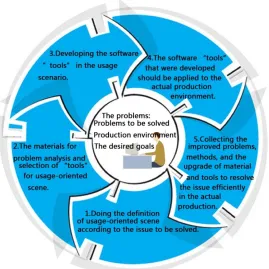
So far, the experts got a series of results in software usability and how to guarantee its quality, but there are many failures in the practical application. So there are massive researches need to be launched and thorough study. Based on the user-oriented and direction-oriented of software engineering theory and practical foundation, will further develop the theories of software development, and coming into the theory of usage-oriented software engineering. The unified and systematic management and production of software development makes it possible to develop software that can not only be used, but also improve work efficiency—high-quality software.
Figure 1. Process of the usage-oriented software development.
The Requirements Definition of Usage-Oriented
In all software engineering theory, the requirements definition is the first work which is regard as a definitive factor for a successful software development. During the software development of usage-oriented, the requirements definition must originate from the real scene. The developer should find out the indeed existent in real scene. The detailed operation:
The staff of software requirements definition directly participate in practical work in question territory. Experiencing the solution which is found out in working. And they should know what kind of tool and approach can prompt the efficiency.
The staff of software requirements definition can experience summary the software—how to present “the tool”, so that it is easy to study and to operate.
All in all, the developer should enter into the scene before software development with the actual work and pick up the demand from the actual work. Finding the most realistic problem models with the requirements definition of usage-oriented, which is the basis of producing tools that improve the efficiency.
The Software Development Management of Usage- Oriented
The process of software development regards as a process which is made by tool. The tool making is to solve the actual work needs, improve the efficiency. Not only do consider the availability of software, also need to consider the software which can't bring trouble to users. Such as: the complicated process; the cumbersome steps, etc. It must be a friendly interface, simple operation steps, easy to learn and use. The following are some development and management:
1, At the beginning of the development should certain presentation forms: PC application,
network application, traditional PC usage, PDA or a variety of presentation forms need to be considered.
2, According to the needs of the representation, be sure what kind of software development technology—the material and choice of producing tools. Not using the more advanced development tools, making the better, more useful software product.
just the interface or human-computer interaction. Be ensure the way of software development is like making better tools.
The Maintenance and Upgrades of Usage-Oriented for Use
Software during the process of use, there are some things to do in order to solve the problems of the actual service. First, it can achieves the upgrades and maintenances according to summarizing the advantages and disadvantages, the production tool to adjust the raw material. Such as: digging tools it was invented as the form of the original stone for the development of hardware, and then by the work of cultivated land, the modern development of mechanical equipment for cultivated land.
Standing at the perspective of software’s application model, it was from the initial mode standalone to C/S model step by step. Then it developed as B/S mode. Recently, with the great development of mobile Internet, the software is mainly used in mobile application direction development.
At the point of making software development tools, the software development tools has been developed from the first machine language to assembly language, and gradually developed a H-language, including the development language of structure-oriented language, object-oriented language, for WEB and mobile application.
Thus, in the software maintenance for usage-oriented should can quickly adjust and make suitable tools according to the new material, new problems.
Summary
In this paper, the software development process as a production process of the production tool, software development are a series of tool production activities which are used to solve practical problems. Discussing the software engineering of usage–oriented—the scenarios of usage–oriented, developing in the actual environment and the usage-oriented SDM can make software developers create software which is more good for popularization, application, higher quality, higher efficiency—tools.
Acknowledgments
This work is supported by the National Natural Science Foundation of China (61462091).
References:
[1] Larry L. Constantine Lucy a. d. Lockwood. Liu Zhengjie, translated. Usage-oriented software design [M]. Beijing: China Mechanical Press, 2011:3.
[2] Yang Fuqing. Reflections on the Development of Software Engineering Technology [J]. Journal of Software, 2005 (1): 1-7.
[3] E.W. Dijikstra. The Structure of The Multi programming System. Communications of the ACM, 1968, 5:341.
[4] Wang Dejun, Hao Yong-fang. The SP was compared with OOP. Railway Computer Applications. 2003 (11): 13 to 15.
[5] Yin Feng. The review of software engineering method. Journal of Changsha University. [J]. 2005, 9:89-93.
[6] Xie Jiping Liu Hanzhe. From a SP to the OOP. Journal of Yunnan RTVU. [J]. 2002 (3): 7-9.
[7] Moqian, Liuxiao. The software engineering guide of AO. Computer Engineering [J]. 2007 (7): 62.
[9] Zhang Liping, Liu Zhengjie etc. The serviceability testing and evaluation of IT [J]. Computer Engineering and Application, 2003 (9): 73.
[10] ISO 9241-11, Ergonomic requirements for office work with visual display teminals [S].
[11] Nielsen J. Usability engineering [M]. Liu Zhengjie. Beijing: machine Press, 2004.
[12] Juristo Natalia, Ferre Xavier. How to integrate usability into the software development process[C] Proceeding of the 28th International Conference on Software Engineering 2006, ICSE 06, Shanghai China, 2006: 10791080.
[13] Li Jianguang Shen Limin and Zhao Chengxia. Research on the usability evaluation method for user-oriented software [J]. Computer Application and Software, 2011:61.
[14] Kiczales G, Lamping J, Mendhekar A, et al. Aspect-oriented programming [C]/LNCS 1241: Proceedings of the 11th European Conference on Object-oriented programming (ECOOP '97), Finland, 1997. [S.l.]: Springler-Verlag, 1997:220-242.
[15] Fang Yiqiu, Ran Huafeng and Ge Gunwei. The aspect-oriented requirement modeling based on use case. Computer engineering [J]. 2009 (6): 44.
[16] Yang Hanming, Zhang Lichen. Research on the non-functional characteristics of aspect-oriented software. Computer Technology and Development [J]. 2011 (2): 112.