2016 Joint International Conference on Artificial Intelligence and Computer Engineering (AICE 2016) and International Conference on Network and Communication Security (NCS 2016)
ISBN: 978-1-60595-362-5
An Augmented 0-day Attack Graph Generation Method
Yang YU
a,*, Chun-He XIA
b, Xiao-Yun HU
c, Jia-Jin CAO
dBeijing Key Laboratory of Network Technology, Beihang University, Beijing, China
a[email protected], b[email protected], c[email protected], d[email protected]
*Corresponding author
Keywords: Attack Graph, 0-day Vulnerability, Network Defense.
Abstract. Attack graph is an important tool for analyzing network attack. However, the traditional attack graph does not take 0-day vulnerability into account. It is difficult to analyze the attack path with 0-day vulanrability based on traditional attack graph. In this work, we modelled the 0-day vulnerability and its exploiting rules, and bulit an augmented 0-day attack garph, which enables us to analyze the attack path with 0-day vulnerability. The experiment indicated that we could get the attack path with 0-day vulnerability.
Introduction
Nowadays, network attack tends to be multi-step and multi-point. A successful attack case always includes multiple attack springboard and various attack means. As an important tool for analyzing the penetration of network attack from initial state to target state, the attack graph could effectively analyze the development of network attack. However, the existing researches on attack graph pay more attention on how to improve the efficiency of attack graph generation algorithm, but less attention to 0-day vulnerability. As we all known, stuxnet, as an influential ATP(Advanced Persistent Threat) attack, uses four 0-day vulnerabilities of microsoft [1]. And it has made a huge impact on network and the real world. It is difficult to analyze the features of 0-day vulnerability, since they are random and difficult to be predicted. But if we do not take 0-day vulnerability into consideration, we could only get an incomplete attack graph. And we could not analyze the attack path with 0-day vulnerability. Therefore, further study on how to model the 0-day vulnerability and its exploiting rules, and add the 0-day vulnerability into attack graph is needed. In this work, we proposed an augmented 0-day attack graph (AZAG) to solve the problem.
Related Work
The features of 0-day vulnerability do have regularities. The general character of vulnerability and the exploiting rule of 0-day vulnerability will be reviewed in this section.
The existing studies of 0-day vulnerability are always based on the characteristics of known vulnerability. There exist inevitable connections between 0-day and known vulnerability, such as the cases, effect, occurance position, etc [2]. McQueen et al. [3] predict the number of 0-day vulnerability in a time interval according to the analyze on the life cycle of known vulnerability. Zhang et al. [4] use the method of data mining to predict the occurance time of the next 0-day vulnerability of a special software. Lie et al. [5] build a microscopic model of vulnerability for predicting the number of vulnerability. These researches give us great inspiration. The foundation of studying 0-day vulnerability is to find the common character of known vulnerability and unkonwn vulnerability.
launching the attack. Attack consequent is the attack ability promotion after performing attack. Host consequent is the effection on the host after performing attack. Venter et al.[7] divides the vulnerability into 13 categories based on its effection. The categories include passward cracking and sniffering, information gathering, backdoor, trojan and remote controlling, unauthorized remote connection, privilege promotion, masquerading, mis-configaration, DDoS and buffer overflow. However, these categories are not completely based on the effect of vulnerability, for example, masquerading, mis-configaration and buffer overflow are actually the behaviors of vulnerability exploiting.
CVE divides the vulnerability into 3 categories based on its effection, including privilege promotion, DDoS and information leakage [8]. There are few researches on the exploiting rule of unknown vulnerability. Wang and Ingols et al. [9] divide the exploiting rule of unknown vulnerability into 2 categories, including local exploiting rule and remote exploiting rule. Wang et al. [9] define that the antecedent of remote exploiting rule includes the service of source host, the connection between source host and destiny host, and the privilege attacker obtained. The antecedent of local exploiting rule includes the service of source host and the privilege attacker obtained. They also define the consequent of unknown vulnerability exploiting rule as privilege promotion.
Though some researches on the properties of 0-day vulnerability have been done, further study on 0-day vulnerability should be taken. In this work, we summarized the properties of 0-day vulnerability, and modelled the 0-day vulnerability and its exploiting rule. Then we proposed an augemented 0-day attack graph (AZAG).
Augmented 0-day Attack Graph Definition
In this section, we will propose the definition of augmented 0-day attack graph. Definition 1
Augmented 0-day Attack Graph(AZAG) is a directed acyclic graph, denoted as
AZAG
,
A AZ G
S OE E P P, , , ex, suc,P Roe,
. S is the property node of AZAG. OE is the observationevent node of AZAG. E is the exploiting action node of AZAG. Pex, Psuc and Poe are respectively the probability of exploiting, the probability of successfully exploiting and the probability of observation event. R is the relation of property node and action node. AZAG could be formally described as
below.
Property node S could be divided into 3 classifications: the initial property node Sini, the internal property node Sint, and the terminal property node Sext.
Definition 2
Observation Event Node(OE) is the security event which is captured by security equipment. Since there are positive alarm and negative alarm, the possibility of observation event is not always 1. It relates to the performance of security equipment.
The property node of AZAG could be devided into two types, including fact property node and possibility property node. And these two types nodes could be merged as union property node. Definition 3
Fact Property Node(FPN), denoted as si, is the fact of network and host, which could be gathered
from the network. siS, and p(si)=1.
Definition 4
Possibility Property Node(PPN), denoted as sj, is the property reducted from exploiting rules. The
Definition 5
Union Property Node(UPN) is the property merged by FPN and PPN, which are from the same exploiting rule. In this study, 0-day vulnerabilities of the same type were merged as one 0-day vulnerability.
Classification of Vulnerability and Exploiting Rule Description
In this section, the classification of vulnerability exploiting rule will be proposed first. And then we give the formal description of exploiting rule.
The researches on the classification of vulnerability exploiting rule are always based on specific target or scenario. Ou et al.[10] propose the classification from two aspects, including exploiting range an exploiting effect, which we think is the most consistent with our study scenario. In our study, We classify the exploiting rule by three dimensions. Based on the range of exploiting action, the exploiting rule could be devided into local vulnerability rule and remote one. Based on whether the vulnerability is discovered or not, the exploiting rule could be devided into known vulnerability rule and unknown one. Based on the effectiveness of vulnerability exploiting, the exploiting rule could be devided into three types, including privilege promotion rule, DDoS rule and information leakage rule. Then the formal description of exploiting rule could be given as Eq.(1). Rrule represents remote vulnerability rule, while Lrulerepresents local one.
rule rpre rpost rule lpre lpost
rpre hs hv hc hp ex r lpre h
r zr kr
zr zrpe zrddos zrfile zrex
kr krpe krddos krfile krex
rpost hp hf s ex
=( , ) =( , ), ( , , , , , ) ( , , , .
R S S L S S
S s s s s s E S s
E e e
e e e e e
e e e e e
S s s s s
s hv hp ex l
l zl kl
zl zlpe zlddos zlfint zlex
kl klpe klddos klfint klex
lpost hp hf s ex
, , , , ), ,
, , .
s s s E
E e e
e e e e e
e e e e e
S s s s s
(1)
Srpre is the antecedent of Rrule, which includes host service shs, host connection shc, host privilege shp, host vulnerability shv, extended antecedent sex and remote exploiting action Er. Srpost is the consequent of Rrule, which includes host privilege shp, file state shf, service state ss and extended consequent sex. The remote exploiting action Er includes known remote vulnerability exploiting action ekr and unknown one ezr. ekr includes four types of exploiting action: remote privilege promotion ekrpe, remote DDoS ekrddos, remote information leakage and the extended action ekrex. ezr also includes four types of exploiting action, which is the same as ekr, but the target is 0-day vulnerability.
We could obtain from the formal description of exploiting rule that 0-day vulnerability could be divided into six categories, including remote privilege promotion, local privilege promotion, remote DDoS, local DDoS, remote information leakage and local information leakage.
As Ou et al. [10] did in their study, we also use prolog to descirbe the network fact and attack rules. In addition, we add the description of 0-day vulnerability and its exploiting rule.
To represent 0-day vulnerability, we define: zdayVulnerability(Hostname, VulID, type).
Hostname is the name of source host. VulID is the ID of 0-day vulnerability. ‘type’ is the type of 0-day vulnerability.
To represent exploiting action of Er and El, we define: exploit (Attacker, SourceName, DestinyName, VulID).
AZAG Generation Algorithm
In this secion, we will propose the AZAG generation algorithm.
Assume that the number of property node is P, exploiting rules is R, host is H. Then the time
complexity is O (P3R). Since P=mH, the time complexity is O (m3H3R). m and R are always
constants, so the time complexity is O(H3).
Experiments and Result Analysis
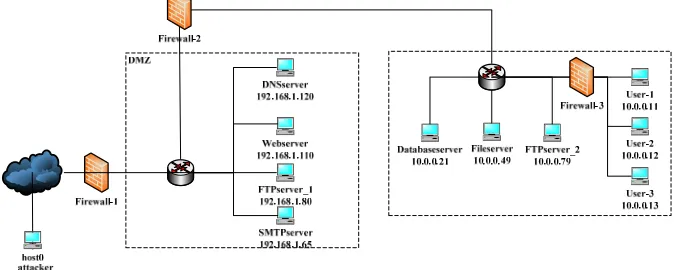
[image:4.612.138.476.532.667.2]The topology of the experiment network is shown as Figure 1. Each host in the network has one known vulnerability and six different types of 0-day vulnerabilities. The target property is privilege promotion on Database Server. DDoS and information leakage vulnerabilities will not appear in the attack path, since the effection of these two types vulnerabilities could not be used as springboard to the target property.
Figure 1. Topology of Experiment Network.
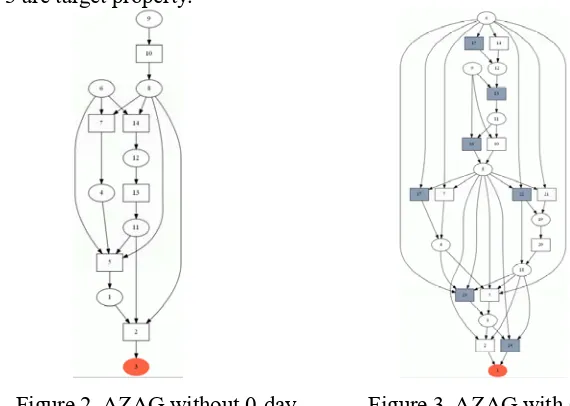
Fig. 2 and Fig. 3 are target property.
Figure 2. AZAG without 0-day. Figure 3. AZAG with 0-day.
Gray rectangle in Fig. 3 is 0-day vulnerability exploiting action, while the white one is known vulnerability exploiting action. There are 9 attack paths and 13 nodes in Fig. 2, while there are 286 attack paths and 24 nodes in Fig. 3. In the 286 attack paths, the attack path containing 1 to 6 0-day vulnerabilities is respectively 40, 76, 55, 83, 20 and 3, which could be obtained from the algorithm of AZAG generation. That is, we could also generate the AZAG whose attack paths contain no more than n 0-day vulnerabilities, and n[0,6]. After comparing Fig. 2 and Fig. 3, the node whose number
[image:5.612.344.429.78.263.2]is 14 in Fig. 3 is the exploiting action of “CVE-2007-3039” on DNS server, which is not contained in Fig. 2. That is, according to the introduction of 0-day vulnerability, new known vulnerabilities could be added to the attack path, which should also be considered in the process of network defense.
Summary
In this work, we modelled 0-day vulnerability and its exploiting rule. Then we proposed the algorithm of generating AZAG which could describe 0-day vulnerability. After building AZAG, we could analyze the attack paths with 0-day vulnerabilities. According to AZAG, we find that known vulnerabilities which are not considered in traditional attack graph could be exploited in AZAG. AZAG allows us take a new perspective on network defense.
Acknowledgement
This work was supported by China Aviation university-industry project No.CXY2011BH07. The authors would like to thank the anonymous reviews and the editors for their valuable comments.
References
[1]M. Kenney. Cyber-Terrorism in a Post-Stuxnet World, J. Orbis. 59.1(2015) 111-128.
[2]A. Tripathi, U.K. Singh. Taxonomic analysis of classification schemes in vulnerability databases. The 6th IEEE International Conference on Computer Sciences and Convergence Information Technology (ICCIT). NJ: IEEE, 2011: 686-691.
[image:5.612.181.239.84.269.2][4]S. Zhang, D. Caragea, X. Ou. An empirical study on using the national vulnerability database to predict software vulnerabilities. Database and Expert Systems Applications. Berlin: Springer, 2011: 217-231.
[5]C. Lie, X. Zhao, K. Chen, et al. An software vulnerability number prediction model based on micro-parameters, J. Journal of Computer Research and Development. 7(2011) 1279-1287.
[6]Q. Liu, J. Yin, Z. Cai, et al. Uncertain-Graph Based Method for Network Vulnerability Analysis, J. Journal of Software. 6. (2011) 1398-1412.
[7]H.S. Venter, J.H. Eloff. Harmonising vulnerability categories, J. South African Computer Journal. 2.29(2002) 22-24.
[8]Scap. CVE vulnerability. http://cve.scap.org.cn/.
[9]L. Wang, S. Jajodia, A. Singhal, et al. k-zero day safety: A network security metric for measuring the risk of unknown vulnerabilities, J. IEEE Transactions on Dependable and Secure Computing. 11.1(2014) 30-44.