1997 - 024
October 1, 1997
Studying Balanced Allocations with Differential Equations
Michael Mitzenmacher
d i g i t a l
Systems Research Center 130 Lytton Avenue Palo Alto, California 94301
http://www.research.digital.com/SRC/
Studying Balanced Allocations with Differential Equations
∗
Michael Mitzenmacher
yAbstract
Using differential equations, we examine theGREEDYalgorithm studied by Azar, Broder, Karlin, and Upfal for distributed load balancing [1]. This approach yields accurate estimates of the actual load distribu-tion, provides insight into the exponential improvementGREEDYoffers over simple random selection, and allows one to prove tight concentration theorems about the loads in a straightforward manner.
1
Introduction
Suppose that n balls are placed into n bins, with each ball being placed into a bin chosen independently and uniformly at random. Let the load of a bin be the number of balls in that bin after all balls have been thrown. It is well known that with high probability, the maximum load upon completion will be approximatelylog log nlog n [8]. (We use with high probability to mean with probability at least 1−O(1/n), where n is the number of balls. Also, log will always mean the natural logarithm, unless otherwise noted.)
Azar, Broder, Karlin, and Upfal considered how much more evenly distributed the load would be if each ball had two (or more) choices [1]. Suppose that the balls are placed sequentially, and each ball is placed into the less full of two bins chosen independently and uniformly at random with replacement (breaking ties arbitrarily). In this case, they showed that the maximum load drops to log log nlog 2 +O(1)with high probability. If each ball instead has d choices, then the maximum load will belog log nlog d +O(1)with high probability. Having two choices hence yields a qualitatively different type of behavior from the single choice case, leading to an exponential improvement in the maximum load; having more than two choices further improves the maximum load by only a constant factor. This result has important implications for distributed load balancing, hashing, and PRAM simulation [1].
Following Azar et al., we refer to the algorithm in which each ball has d random choices as GREEDY(d). In this paper, we develop an alternative method of studying the performance ofGREEDY(d) using differential equations. The differential equations describe the limiting performance of ofGREEDY(d)as the number of balls
and bins grows to infinity. As we will demonstrate, the description of the limiting performance proves highly
∗A preliminary version of this work appeared in the Proceedings of the 37th Annual Symposium on the Foundations of Computer
Science, October 1996. y
GREEDY, our methods provides a great deal of intuition behind the proof of the behavioral difference between
one and two choices.
Our motivation in studying this problem is twofold. First, we wish to demonstrate and highlight this methodol-ogy, and encourage its use for studying random processes. While this methodology is by no means new, its uses have been surprisingly limited. The technical results justifying the relationship between families of Markov processes and differential equations date back at least to Kurtz [13, 14]. Karp and Sipser provided and early use of this technology to study an algorithm for finding maximum matchings in sparse random graphs [11]. Other past applications in the analysis of algorithms include [9, 12], and more recently many more have been found (see, for example, [2, 3, 15, 17, 21] to name a few).
Our second motivation is to demonstrate the power of using two choices. This idea dates back at least as far as the work of Eager, Lazowska, and Zahorjan [7], who examined the problem in a dynamic load balancing setting based on viewing processors as single server queues. In the static setting, this idea was also studied by Hajek [9], who used the same approach we undertake to determine the fraction of empty bins. The aforementioned exponential improvement in behavior was noted and proven first in a paper by Karp, Luby, and Meyer auf der Heide [10]. The work by Azar et. al. examined a simpler model that clarified the argument as well as provided many new results. Related work by the author [16, 17], as well as by others [20], examines the power of two choices in dynamic settings. Continued work in the area includes recent work by Stemann [19] and Czumaj and Stemann [6].
In the rest of the paper, we explain the derivation of the differential equations that describe theGREEDYstrategy
of [1] and compare the results from the differential equations with simulations. We also demonstrate how the equations give more insight into the behavior ofGREEDYand how the equations relate to the work in [1].
2
The Differential Equations
In this section, we demonstrate how to establish a family of differential equations that can be used to model the behavior of theGREEDYstrategy of [1]. Recall that we begin with m balls and n bins. Balls arrive sequentially, and upon arrival, each ball chooses d bins independently and uniformly at random (with replacement); the ball is then placed in the least loaded of these bins (with ties broken arbitrarily).
2.1
The empty bins problem
We set up the problem of the number of empty bins by developing a Markov chain with a simple state that describes the balls ans bins process. We first establish a concept of time. Let Y(T)be the number of non-empty bins after T balls have been thrown. Then{Y(i)},i =0. . .m,is clearly a Markov chain. Moreover
E[Y(T +1)−Y(T)]=1−
Y(T) n
d
,
since the probability that a ball finds all non-empty bins among its d choices is(Y(T)/n)d.
The notation becomes somewhat more convenient if we scale by a factor of n. We let t be the time at which exactly nt balls have been thrown, and we let y(t)be the fraction of non-empty bins. The the claim is the random process described above is well approximated by the the trajectory of the differential equation
d y
dt =1−y
d, (1)
where this equation has been obtained by using for the limiting value d y the expected change in y. That the random process given by the Markov chain closely follows the trajectory given by the differential equation follows easily from known techniques, such as for example Kurtz’s Theorem, or the similar work on random graphs by Wormald. (As previously mentioned, the balls and bins process has a natural interpretation in terms of random bipartite graphs.) This connection with the differential equation yields the following theorem:
Theorem 1 Suppose cn balls are thrown into n bins according to theGREEDY(d) protocol for some constant c. Let Ycn be the number of non-empty bins when the process terminates. Then limn→∞E[Ycnn ] = yc, where
yc <1 satisfies
c=
∞
X
i=0
ycid+1
(id+1).
Proof: The preconditions for Kurtz’s theorem (see [18, Theorem 5.3] or [14, Chapter 8]) are easily checked for the one-dimensional system described by (1), so by Kurtz’s theorem we have that this differential equation is the correct limiting process.1 Instead of solving (1) for y in terms of t , we solve for t in terms of y: dtd y =
1 1−yd =
P∞
i=0yid. We integrate up to some time t , yielding
t=
∞
X
i=0
y(t)id+1
(id+1). (2)
From equation (2), given d we can solve for y(t)for any value of t using for example binary search. One can also attempt to find an equation for y in terms of d and t ; standard integral tables give such equations when
d = 2,3 and 4, for example. When t = c, all of the balls have been thrown, and the process terminates.
1It appears that there might be a problem here since we consider events occurring at discrete time steps, instead of according to
We may actually use Kurtz’s Theorem to obtain a concentration result (again, see [18, Theorem 5.3] or [14, Chapter 8]).
Theorem 2 In the notation of Theorem 1,|Ycnn −yc|is O q
log n
n
with high probability, where the constant
depends on c.
One can also obtain entirely similar bounds using Ycn more straightforward martingale arguments. In the
following, we assume familiarity with basic martingale theory; see, for example, [4, Chapter 7] for more information. We use the following form of the martingale tail inequality due to Azuma [5]:
Lemma 3 [Azuma] Let X0,X1, . . .Xmbe a martingale sequence such that for each k,
|Xk−Xk−1| ≤1. Then for anyα >0,
Pr(|Xm−X0|> α
√
m) <2e−α2/2.
Theorem 4 In the notation of Theorem 1,Pr(|Ycn−E[Ycn]|> α
√
cn) <2e−α2/2for anyα >0.
Proof: For 0≤ j ≤ cn, letFj be theσ-field of events corresponding to the possible states after j balls have
been placed, and Zj =E[Ycn|Fj] be the associated conditional expectation of Ycn. Then the random variables
{Zj}cnj=0form a Doob martingale, and it is clear that|Zj−Zj−1| ≤1. The theorem now follows from Lemma 3.
Theorem 4 implies that Ycn is within O( p
n log n) of its expected value with high probability; however, the martingale approach does not immediately lead us to the value to which Ycn/n converges. This is a standard
limitation of the martingale approach: in contrast, the differential equations approach allows us to find the mean as well as prove concentration around the mean.
2.2
Bins with fixed load
We can extend the previous analysis to find the fraction of bins with load k for any constant k as n → ∞. We first establish the appropriate Markov chain. Let si(t)be the fraction of bins with load at least i at time t , where
again at time t exactly nt balls have been thrown. Then the corresponding differential equations regarding the growth of the si (for i ≥1) are easily determined:
dsi
dt = (s
d
i−1−sid) for i ≥1;
s0 = 1.
d =2 1 million d =3 1 million Prediction Simulation Prediction Simulation
s1 0.7616 0.7616 0.8231 0.8230
s2 0.2295 0.2295 0.1765 0.1765
s3 0.0089 0.0089 0.00051 0.00051
s4 0.000006 0.000007 < 10−11 0
[image:6.612.185.442.70.185.2]s5 < 10−11 0 < 10−11 0
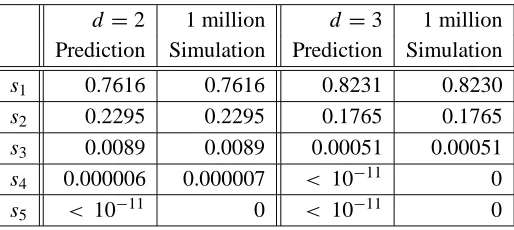
Table 1: Predicted behavior forGREEDY(d) and average results from 100 simulations with 1 million balls.
The differential equations have the following simple interpretation: for there to be an increase in the number of bins with at least i balls, the d choices of a ball about to be placed must all be bins with load at least i−1, but not all bins with load at least i.
In contrast to Section 2.1, where we could derive a formula for the fraction of empty bins, we are not aware of how to determine explicit formulae for si(t)in general. These systems of differential equations can be solved
numerically using standard methods, however; for up to any fixed k and t , we can accurately determine sk(t).
By applying Kurtz’s theorem (as in Theorem 2) or martingale arguments (as in Theorem 4) one can show that these results will be accurate with high probability.
We also demonstrate that our technique accurately predicts the behavior of theGREEDY(d)algorithm by com-paring with simulation results. The first and third columns of Table 1 shows the values of si(1)for d =2 and
d = 3 as caclulated from the differential equations. We use these values as predictions for the process where we throw n balls into n bins. From the predictions with d = 2, one would not expect to see bins with load five until billions of balls have been thrown. Similarly, choosing d = 3 one expects a maximum load of three until billions of balls have been thrown. These results match our simulations of several hundred runs with up to thirty-two million balls, the largest simulation we have attempted. We also present the averages from one hundred simulations of one million balls for d =2 and d =3, which demonstrate the accuracy of the technique in predicting the behavior of the system. Further simulations reveal that, in general, the solution given by the limiting system of differential equations becomes more accurate as n grows, and the deviation from this solu-tion is small, as one would expect. This accuracy is a marked advantage of this approach; previous techniques have not provided ways of concretely predicting actual performance.
2.3
Relationship to O
(
log log n
)
bounds
We can also use the differential equations to provide an alternative derivation of a key idea from the proof of the upper bounds on the maximum load ofGREEDY(d). The approach of looking at the underlying differential equations provides insight into how the sk decrease, which is essential to determining the O(log log n)bounds.
We begin by focusing on the case where the number of balls n equals the number of bins n, and consider the limiting description given by the differential equations as n→ ∞.
from (3)
dsi
dt =s
d i−1−s
d
i ≤[si−1(1)d]
for all t ≤1 and hence by integrating
si(1)≤[si−1(1)]d. (4)
One can calculate s1(1)directly from Theorem 1, and it follows from a simple induction on (4) that si(1)≤[s1(1)]d
i−1
.
In other words, the si(1), which represent the limiting fraction of bins with load at least i after all balls have
been thrown, decrease doubly exponentially, as the i is in the second level of the exponent. Using Kurtz’s theorem one obtains a high probability result for the case of a finite number of balls n.
Theorem 6 Let win be the fraction of bins with load at least i when n balls are thrown into n bins using GREEDY(d). Then for any >0 and fixed i,wni ≤(1+)[s1(1)]d
i−1
with probability at least 1−ec(log i)n2for some suitable constant c.
Proof: The proof is a direct application of Kurtz’s Theorem, with the error bounds as given in [18, Theorem 5.3].
This doubly exponential decrease in the si(1)(or, equivalently, of thewni) is a key step of the proof of Azar et
al in [1], where it is proven via an inductive use of Chernoff bounds. Theorem 6 shows that this induction can
be replaced by applying Kurtz’s theorem to the differential equations, at least up to any fixed constant value of i. This approach has some advantages. Most importantly, Lemma 5 and the corresponding inductive bound for si(1)seem quite natural and make transparent how the si decrease. Additionally, using this approach can
improve the additive O(1)term in Theorem 4 of [1].
Intuitively, this doubly exponential decrease suggests that if we look at bins with load at least i∗ = dlog log nlog d +γe, whereγ =(log 2−log log(1/s1(1)))/log d, then then
si∗+1≤[s1(1)]d
log log n/log d+γ
≤ 1
n2,
and hence with high probability there will be no bins with load at least i∗+1.
argument that underlies Kurtz’s Theorem, we can circumvent this restriction somewhat (up until the point where
siis 1/n1/2+δfor anyδ >0), but at some point when siis sufficiently small it seems we have to explicitly handle
this case directly, as is done in Theorem 4 of [1]. We omit details of these more extensive arguments, since their form would be almost entirely a restatement of Theorem 4 of [1], replacing their use of Chernoff bounds with an equivalent martingale argument. A general framework that would allow us to apply the differential equations in this instance in a more straightforward manner would clearly be appealing, since the differential equations do make clear the behavior of the si.
In the case of m balls and n bins, a similar argument to Lemma 5 and Theorem 6 holds when m = cn for
some constant c. As in Section 2.1, when m = cn, the infinite process runs until time c; if m is not a linear
function of n, the time until the process terminates is dependent on n, and Kurtz’s theorem cannot be applied. For Lemma 5, the appropriate result becomes
si(c)≤c[si−1(c)]d.
By noting that sc2+c(c)≤1/(c+1)(the fraction of bins with load at least x cannot be more than c/x ), one may
again inductively show as before that the tails of the loads are doubly exponentially decreasing. Improvements can be made in the constants by using the differential equations to find better starting points than sc2+c(c) ≤
1/(c+1)for the induction.
3
Conclusion
There are significant advantages to using differential equations to study randomized load balancing problems. The insight one gains about the problem and the numerical accuracy one obtains are quite convincing. More-over, when the corresponding state spaces are finite dimensional, applying Kurtz’s Theorem can yield simple proofs of the limiting behavior. A general framework for dealing with spaces that are not necessarily finite dimensional would greatly simplify using this approach in developing bounds such as the O(log log n)bounds of [1]. We expect this approach will find a great deal of further use in the analysis of load balancing schemes, as well as other algorithmic areas.
References
[1] Y. Azar, A. Broder, A. Karlin, and E. Upfal, “Balanced Allocations”, Proceedings of the 26th ACM
Sym-posium on the Theory of Computing, 1994, pp. 593–602.
[2] D. Achlioptas and M. Molloy, “The Analysis of a List-Coloring Algorithm on a Random Graph”,
Pro-ceedings of the 38th IEEE Symposium on Foundations of Computer Science, 1997.
[3] M. Alanyali and B. Hajek, “Analysis of simple algorithms for dynamic load balancing”, preprint. To appear in Mathematics of Operations Research.
19, 1967, pp. 357-367.
[6] A. Czumaj and V. Stemann, “Randomized Allocation Processes”, Proceedings of the 38th IEEE
Sympo-sium on Foundations of Computer Science, 1997.
[7] D. L. Eager, E. D. Lazowska, and J. Zahorjan, “Adaptive load sharing in homogeneous distributed sys-tems”, IEEE Transactions on Software Engineering, Vol. 12, 1986, pp. 662–675.
[8] G. Gonnet, “Expected Length of the Longest Probe Sequence in Hash Code Searching”, Journal of the
ACM, Vol. 28, 1981, pp. 289–304.
[9] B. Hajek, “Asymptotic Analysis of an Assignment Problem Arising in a Distributed Communications Protocol”, Proceedings of the 27th Conference on Decision and Control, 1988, pp. 1455–1459.
[10] R. M. Karp, M. Luby, and F. Meyer auf der Heide, “Efficient PRAM Simulation on a Distributed Memory Machine”, Proceedings of the 24th ACM Symposium on the Theory of Computing, 1992, pp. 318–326.
[11] R. M. Karp and M. Sipser, “Maximum Matchings in Sparse Random Graphs”, Proceedings of the 22nd
IEEE Symposium on Foundations of Computer Science, 1981, pp. 364-375.
[12] R. M. Karp, U. V. Vazirani and V. V. Vazirani, “An Optimal Algorithm for On-line Bipartite Matching”,
Proceedings of the 22nd ACM Symposium on the Theory of Computing, 1990, pp. 352–358.
[13] T. G. Kurtz, “Solutions of Ordinary Differential Equations as Limits of Pure Jump Markov Processes”,
Journal of Applied Probability Vol. 7, 1970, pp. 49-58.
[14] T. G. Kurtz, Approximation of Population Processes, SIAM, 1981.
[15] M. Luby, M. Mitzenmacher, M. A. Shokrollahi, D. Spielman, and V. Stemann. “Practical Loss-Resilient Codes”, Proceedings of the 29th ACM Symposium on the Theory of Computing, 1997, pp. 150–159.
[16] M. Mitzenmacher, “Load Balancing and Density Dependent Jump Markov Processes”, Proc. of the 37th
IEEE Symp. on Foundations of Computer Science, 1996, pp. 213–222.
[17] M. Mitzenmacher, “The Power of Two Choices in Randomized Load Balancing”, Ph.D. thesis, University of California, Berkeley, September 1996.
[18] A. Shwartz, A. Weiss, Large Deviations for Performance Analysis, 1995, Chapman & Hall.
[19] V. Stemann, “Parallel Balanced Allocations”, Proceedings of the Eighth Annual ACM Symposium on
Parallel Algorithms and Architectures, 1996, pp. 261–269.
[20] N.D. Vvedenskaya, R.L. Dobrushin, and F.I. Karpelevich. “Queueing System with Selection of the Short-est of Two Queues: an Asymptotic Approach”, Problems of Information Transmission, Vol 32, 1996, pp. 15–27.
[21] N. C. Wormald, “Differential Equations for Random Processes and Random Graphs”, Annals of Appl.