COST: A SERVICE-ORIENTED SIMULATION
ARCHITECTURE
1,2ZHANG RUI, 1WANGZHITENG,
2MAOSHAOJIE, 2SUNXIGANG
1PLA University of Science &Technology, Nanjing 210007, China
2the 28th Research Institute of China Electronics Technology Group corporations, Nanjing 210007, China
ABSTRACT
Community of Simulation task (CoST) is a simulation architecture based on a service-oriented architecture to achieve seamless integration and interoperability of command information system. It servitize the simulation resources through combination the simulation service and completes CoST by management and coordinated simulation resources. Firstly, this article introduced in the CoST involves simulation service, simulation resources, CoST, CoST members as well as simulation service system concept and CoST's principle. Secondly, the article describes CoST's architecture and key technologies of simulation task to solve problem. Finally, combining tasks of joint training simulation control system with hierarchical structure describes CoST’s application in detail.
Keywords: SOA, CoST, Network-centric Warfare, Joint Training Simulation of Control System
1. INTRODUCTION
As the scale and structure of simulation system constantly expanding, because High Level Architecture (HLA) interoperation and reuse level is low, by the support of distributed construction, isomerism, the coordination, the interoperability, entrusted with significant responsibility and the performance new distributional modeling simulation systems feel weak day by day[1]. Service-oriented concepts [2] and distributed technologies (grid [3], cloud computing technology[4]) widely applied in the fields of engineering and non-engineering, solution a variety of resources security dynamics shares in conjunction with reuse, interoperability, dynamic optimal dispatching issues. How to apply the concepts of service orientation and cloud computing and technology in the field of modeling and simulation, supporting construction and operation of new distributed modeling and simulation system, has become pressing issues in modeling and simulation of field, also makes of the current research focuses[5-9].Network Centric Simulation and Global Information Grid which has been proposed and developed rapidly and has profound influence to the union command control system construction system construction method and the pattern. In the future, the combined military operation will depend on the military information grid to connect with weapon platform and other information system in the combat. It will be the information operation domain network combat
ISSN: 1992-8645 www.jatit.org E-ISSN: 1817-3195
2. THE CONCEPT AND PRINCIPLE OF
COST
2.1 Basic concept
Simulation service: Simulation service is provided by simulation resources that can be shared. In accordance with the principles of service-oriented, service of simulation resources, achieve simulation capability description and get through service-oriented mechanism, management and simulation service calls, achieve the goal of simulation resource sharing.
Simulation resources: Simulation resources refer to the modeling and simulation activities, providing simulation services can run on its own system.
CoST : In order to complete a simulation task, simulation resources distributed in the network according to the modular concept, by configuring the simulation resources relation between simulation service, building simulation application business logic, form meets simulation tasks require temporary simulation application system.
CoST member: CoST member is agent in CoST. It substitutes CoST and accepts CoST’s management and responds to calling simulation resources service from CoST.
Simulation services structure: Simulation service system simulation is all simulation services in the field of organizational structure. Specific simulation resource is the instance of the service in the simulation service system.
2.2 Principle
According to simulation task of needs, heterogeneous simulation resources distributed in network are registered to simulation service system and these simulation resources could be quickly combined up according to needs to create a temporary of virtual simulation system to complete simulation task. When virtual simulation system is dissolved and released corresponding simulation resources in the virtual simulation system that calls CoST.
With the advancement in networking and multimedia technologies enables the distribution and sharing of multimedia content widely. In the meantime, piracy becomes increasingly rampant as the customers can easily duplicate and redistribute the received multimedia content to a wide range. Insuring the copyrighted multimedia content is appropriately used has become increasingly critical.
3. THE GENERAL SIMULATION
PLATFORM DESIGN AND STRUCTURE OF COST
The General simulation platform design and structure of CoST is designed to take fully into account the reuse of existing simulation development results to meet the needs of future development of modeling and simulation technology as far as possible. It should obey principles as follows:
a. Platform can integrate and transform the existing simulation results referring to the existing functions, structure, and interfaces of simulation results. Both of commercialization and practicability should be the target. Existed simulation results should be classified and reorganized on the basis of the existing simulation module to classify the platform components.
b. Platform and simulation application mainly run on the windows operating system environment, so core technologies should be based on the windows operating system environment.
c. Platform design should take SOA (Service Oriented Architecture) modeling and simulation technology development trends into account and follow the component package and service-oriented thinking as soon as possible.
In the general simulation foundation platform reference model, the abstract architecture and the abstract component elements described with the lamination model. As the design principle, its model is shown in the figure 1.
Simulation configuration
graphic display
Simulation engine
Data accessing management
Simulation monitors
Resource pool management Geographic
Information Service Simulation application
Core services layer General support
layer
simulation base layer
DIS service RTI service
Simulation algorithm database
special support
layer Information processing simulation component
Command and decision
simulation component ...
Simulation record
simulation replay
Protocol conversion Simulation
control
simulation clock management
Information distribution Discrete-event
services
Simulation foundation database
Simulation model database
Fig.1.General Simulation Model
The special support layer directly faces the different simulation users and the application domain, its function service is closely connected with the special request of different simulation application domain and provide the simulation component for the special-purpose simulation system, for example: Information processing simulation component, direction decision-making simulation component and so on. Simulation application commonality supported layer provides common features that you want to build a simulation application system services, including simulation configuration control, simulation, simulation, simulation clock management monitor repetition of the record, protocol conversion, graphics display, geo-information services, resource management, and so on.
General support layer includes the simulation of various common services, providing common support for simulation applications, such as monitoring, simulation information, simulation, simulation clock management, model management, and so on. These services are not closely linked to specific simulation application and providing the basis for the upper simulation support environment, to form a common simulation specific component. This services layer should provide generic calling interface as far as possible and mask underlying implementation differences.
Core services layer includes the core simulation of distributed interactive simulation, simulation engine service and packaged services, including RTI service and DIS service in distributed environment. It needs to provide simulation application development and integrate core services, including simulation engine, access services, data management, distributed interactive simulation of discrete events services, information distribution, and so on.
The simulation base layer consists of underlying data environment for the simulation of the underlying database, algorithm library and model library in Simulation application system.
Services layer include discrete event simulation clock management, service management, simulation, data access features such as scheduling, communication services, information distribution service. In this layer, service interface can be called up through core services layer by provided functions and can also be called by the upper layer. Simulation resources mainly include various types of simulation algorithm in base simulation model library and the underlying simulation database library, this layer is mainly for simulation data model and persistence layer and storage permanent and temporary data in model simulation. Various kinds of databases have formed the data and the resource environment upper-level simulation application together to support operation, records and other activities for simulation application. Because resource library with a good design is important for the simulation configuration running efficiency and easily to use, so simulation resources layer based on resources provided the database application must be based on the simulation of actual needs, to be further optimized on the basis of the existing database structure design, to form a well design and accessed faster, easier to extend, basic resources database. At the same time, it also considers the appropriate data maintenance, backup, recovery, migration, synchronization, security, audit, management tools to ensure normal operation of the repository.
4. KEYTECHNOLOGIESINCOST
Key technologies in CoST including the simulation resources service, the simulation task question solves, supports platform for network centralization simulation movement based on services, the network centralization simulation buses technology and so on. This paper's focal point is simulation resource services and solving problem for simulation tasks.
4.1 Simulation Resource Services
ISSN: 1992-8645 www.jatit.org E-ISSN: 1817-3195
4.2 Solving Problem For Simulation Tasks
4.2.1 Task modeling
Task modeling is on the basis of the task requirements and business process design process. The person participating in this phase of the general simulation and modeling analysis although clearly knows the design of business processes, but may not has a rich knowledge of it, therefore, the BPEL modeling versatility will be limited. Therefore, in this stage, we use the rich semantic expression and the rich logical model of a process modeling language BPMN (Business process modeling Notation) to express the process logic visually. It makes up the task imbalance between demand and IT technologies. In addition, BPMN also provides business process analysis, simulation and other function. Above all, it can be mapped to BPEL definition, preparing for the next stage in the business process definition.
4.2.2 Service discovery
Service discovery refers to the service needed by simulation resources, simulation service system simulation resource registry of services to related nodes. The registration information contained service named by the simulation resources, service marking, operation name, parameter name and type, mailing address, port, protocols and so on. When you need to call service, you can directly find nodes according to simulation characteristic of service to get the simulation in the simulation service system service. After the discovery of services, you can call simulation resources based on registration information.
4.2.3 Service composition
Service composition stage, and business process design are conversed into business process define. Here the BPMN map into BPEL define and the related of operation, this method can analysis and get related of simulation service component according to operation defined. In simulation service system, in the finding simulation service component and needs of simulation service component, it can define he related operation of logic order in accordance with business process. Simulation service component will be combined together to complete task needs of process. Finally by binding the relevant contact simulation tasks and CoST community to call simulation resources. In the service composition stage, first, the service flow design is transformed the service flow definition, and BPMN is mapped the BPEL definition and the correlation operation. It may analyze and gain the related simulation service module based on operation definition in the search simulation service module in the simulation service system. After
finding module which simulation service needs, It may combine the simulation service module refers to the service flow definition and the correlation operation logical order and form one to be able to complete the duty demand the flow, finally form the relation with the simulation duty community member through the binding related simulation service. Finally, the simulation resources transfer comes true.
In this process, any participation in the service portfolio of simulation services component error will cause the entire task failing and, therefore, must be tested for every simulation service units, each simulation service unit after you complete the test, or to the entire service portfolio design process to ensure correctness of business processes.
5. APPLICATIONINSTANCE
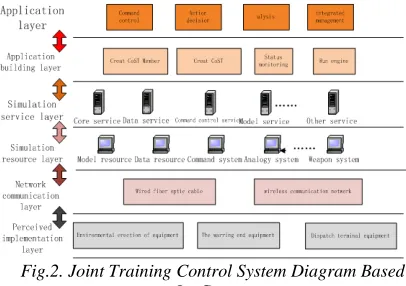
[image:4.612.317.520.478.621.2]Many existing simulation systems are independent. For example, HLA RTI has many versions of standards and mutually incompatible, causing many simulation systems being not capable of being shared by other systems, resulting in a simulation resource idle and wasting resources. Simulation resources are converse to services through CoST, and simulation resources are combined to achieve simulation from CoST’s management and coordination tasks can be a good solution to the problem. Taking joint training control system as example, CoST has been built, according to its hierarchical structure shown in Figure 2.
Fig.2. Joint Training Control System Diagram Based On Cost
In the network communications layer, perceived implementation layer’s real-time simulation service information is passed to the upper layer through the wire cable and wireless communication networks.
Simulation resource layer includes existing models, data resources, command and control system and the simulation resource of weapon system.
In simulation service layer, CoST members can conveniently call simulation services in the form of heterogeneous, distributed simulation resources including simulation operation management and service management, simulation clock management, resource services registration. It also includes simulation, integrated positioning information distribution, CoST management and other core services. In addition, it also includes data services, services, models, services and so on.
The application layer to build the simulation task CoST members as well as CoST based on the task requires.
Applications layer map the business process design for a business process defined under Director conditioning, command and control, operational decisions, analysis and evaluation to integrate management features such as the formation of business process design, you can call the service consolidation COST according to the defined business processes, ultimately achieving the specified system features. When finishing the task simulation task, CoST will be dissolved.
Assuming shared resources available in CoST include simulation and resources. The simulation resources include:
a. Command and control system (C2, information processing services provided C2.S1 and displays the service C2.S2).
b. Story generation system (I, providing drama service I.S1).
c.Three of radar intelligence simulation (ISR1, and ISR3, ISR1, ISR2, ISR3 features the same, ISR1.S1, ISR2 provides information services. S1、 ISR3. S1)
d.Weapon platforms (W, with weapons platform location information service W.S1), ISR3 and other resources are heterogeneous simulation, weapons platform mounting system.
The simulation core services include:
a. Simulation core server (t, providing clock advance service T.S1 management service T.S2).
b.Simulation resource server (R, provides R.S1 simulation resource management service).
First of all, it should describe the simulation resources based on simulation resource metadata specification and simulation resource servers to register through the registration tool. In the registration process, Simulation resources are changed to service messages. Since ISR3 is a heterogeneous service resources, dynamic library development agreement algorithm for it to achieve the parameters and protocol conversion. Services and service dependencies are configured the CoST In accordance with the set of resources. Simulation resources set select a command and control system C2, I plot system, ISR1 and simulation of radar intelligence simulation core services T.
Service set C2.S1 select C2 information processing services and display service C2.S2, select radar intelligence simulation intelligence service ISR1.S1, service I.S1, the plot of the drama system simulation clock management services of core services T.S2 T.S1 and community management services. In service relationships of dependent set, all members of the CoST need T.S1 and T.S2. Information processing service runs C2.S1 relies on ISR1.S1 providing radar intelligence and intelligence services ISR1.S1 I.S1 provide for the creation story. The relation can be described as follows:
When CoST is initializing, simulation service bus complete the subscribing and publishing operation for all subscription service. It can be show in the figure 3.
{ }
{ 1 1 }
1 2 1 1 2
1 1 1 2 2 1 2 1 2 2
1 1 1 2 1 2
2 , , 1,
2. , 2. , . , . , . , .
2. 1. , 2. . , 2. 2. , 2. . , 2. . , . . , . . , 1. 1 . , 1. 1 .
R C I ISR T
S C S C S I S ISR S T S T S
C S ISR S C S T S C S C S C S T S C S T S L
I S T S I S T S ISR S T S ISR S T S
= =
→ → → → →
=
→ → → →
ISSN: 1992-8645 www.jatit.org E-ISSN: 1817-3195
Fig.3. Subscribe Message And Publish Message In Cost
When the plot services (I.S1) receive the clock advance message (M4), published the plot data message (M3); And when the intelligence service of radar Simulator (ISR1.S1) published after the M3 received radar information message (M1). Information processing service (C2.S1) received information the M1 data message (M2). Display services (C2.S2) M2 received after the show. When the intelligence service (C2.S1) received information the M1 data message (M2), Display services (C2.S2) show after receiving M2.
6. CONCLUSION
In order to achieve seamless integration and interoperability of command information system, this paper propose CoST concepts, principles, and architecture, and several key technologies are described in details. This article describes CoST based on the practice and application of hierarchical structure of CoST control system for joint training. Next step, we will apply the actual building CoST principles building demonstrates systems to verify the theory put forward in this article from the practical point of realizing simulation architecture and network centric command information system for seamless integration and interoperability.
ACKNOWLEDGEMENTS
This work was supported by National Natural Science Foundation of China (Grant no. 70791137).
REFERENCES:
[1] Huang Jijie, LI Bohu, Chai Xudong, Research on Adaptive Simulation Based on HLA in Grid Environment, Journal of System Simulation, Vol.14, No.5, 2008, pp.1479-1482.
[2] Sun Liyang, Mao Shaojie, Lin Jianning, Research on Service-oriented Network Simulation and runtime support platform,
Computer Science, Vol.38, No.3, pp. 2011,
159-161.
[3] Huai Jinpeng, Hu Chunming, Li Jianxin, CROWN: Service-oriented Grid Middleware System and Trust Management, Science in
China Series F: Information Sciences, Vol.10,
No.6, 2006, pp.1127-1155.
[4] LI Bo-hu, CHAI Xu-dong, HOU Bao-cun, LI Tan, ZHANG Ya-bin, YU Hai-yan. Networked Modeling &Simulation Platform Based on Concept of Cloud Computing—Cloud Simulation Platform, Journal of System
Simulation, Vol. 21, No.17, 2009, pp.
5292-5299.
[5] Zhang Heming, A solution of multidisciplinary collaborative simulation for complex engineering systems in a distributed heterogeneous environment, Science in China
Series F: Information Science, Vol. 52, No.10,
2009, pp. 1848-1862.
[6] Mao Shaojie, Li Yuping, Lin Jianning, Research on Concepts and Technique of Network-centric Simulation, JOURNAL OF
SYSTEM SIMULATION, Vol. 22, No.7, 2010,
pp. 1660-1663.
[7] GAO Wu-qi, KANG Feng-ju, ZHONG Lian-jiong, FU Yan-fang. Cloud Simulation Technology Based on HLA Evolved, Journal
of System Simulation, Vol. 22, No.7, 2011, pp.
1643-1647.
[8] Michi Henning, Mark Srpuiell. Distributed Programming with ice [E]. http://www.zeroc.c-om/ ice.html.2011.
[9] Sun Liyang, Mao Shaojie, Lin Jianning, Deng Kebo. Research of Net-Centric Simualtion Operation Support platform, Command
Information System & Technology, Vol. 1,
No.6, 2010, pp. 30-35.
[10]Zhiteng Wang, Hong-jun Zhang, Rui Zhang, Ying Xing, Dejun Ye. The application of MDA in distributed services of Run-time Infrastructure, Advances in Computer Science
and its Applications, Vol. 2, No. 2, 2012, pp.
345-349
C2.S2 C2.S1
T.S2 T.S1 I.S1 ISR1.S1
M5 M4
M5
M4 M4 M4
M4
M5 M5 M5
M1
M3 M2
M5 M5 M5 M5 M5 M5
M4
M4 M4 M4 M4 M4
M3 M3
M1 M1
M2 M2
Message Subscribe table Publish table
M4
M5
M3 M1 M2
① ②
③ ④
⑤