ISSN: 1992-8645 www.jatit.org E-ISSN: 1817-3195
111
IDENTIFICATION OF A PRODUCTION SYSTEM USING
HAMMERSTEIN-WIENER AND NARX MODELS
1
HICHAM FOURAIJI, 2BAHLOUL BENSASSI
1
laboratory PMMAT university HASSAN II Facultyof science Casablanca, Morocco. 2
laboratory PMMAT university HASSAN II Facultyof science Casablanca, Morocco.
E-mail: [email protected], 2 [email protected]
ABSTRACT
In this paper we present a new approach to modeling dynamic production systems with discrete flow. This method is based on the automatic knowledge domain, in order to build a mathematical model that accurately formalizes the behavior of the studied system. The approach adopted for this study is the parametric identification of nonlinear systems (Hammerstein-Wiener system and NARX model). The production system studied will be considered as a black box, which means that the inputs and outputs data of the system will be used to identify the internal system parameters.
Keywords: Production System, Hammerstein-Wiener Model, NARX Model, Parametric Identification.
1. INTRODUCTION
In recent decades, industrial companies are facing major changes in their environment, global competition, an uncertain market, and customers increasingly demanding. These constraints require responsiveness and flexibility of enterprises in order to adapt the capacity of production systems to changes in demand and internal risks and/or external chains of production. Which requires a thorough knowledge of the systems studied.
Difficult to control, these systems continue to pose serious problems in the design, modeling and control. Indeed, the study of production systems, as any type of dynamic system, proves a very difficult task to achieve, and requires very often that we have mathematical models of these systems. These models can be derived directly from physical laws that govern the behavior of the system, but it is often impossible to obtain a priori knowledge complete and accurate of all model parameters. In this case, to refine and clarify that knowledge, we use an estimate based on observed input-output system behavior model.
We are referring here to the identification approach, which denotes the set of methodologies for mathematical modeling of systems based on actual measurements from the real system [1].
our context we are interested in identifying production logistics systems based on non-linear parametric blocks- oriented models as (NARX and
Hammerstein-Wiener models). Before going further, let's look at what offers literature in the field of modeling and identification of production systems in supply chains. It is interesting to see what concepts are now and what techniques or approaches to modeling and identification have been discussed developed.
K.LABADI and all presented a modeling and performance analysis of logistics systems based on a new model of stochastic Petri nets. This model is suitable for modeling flow evolves in discrete amounts (lots of different sizes). It also allows to take into account more specific activities such as customer orders, supply inventory, production and delivery batch fashion [2]. N.SAMATA in all proposed modeling global supply chain using Petri nets with variable speed. He transposed the concepts developed on the traffic to the supply chain typical production (manufacturing). They also proposed a modular approach for modeling the different actors in the supply chain is still based on the formalism of Petri nets to variable speed [3].
ISSN: 1992-8645 www.jatit.org E-ISSN: 1817-3195
112 of their work lies in the fact that they have simulated the game continues production and studied the interactions between the continuous model and the discrete data exchanged with the control part. This allows to simulate and control the system without using the actual operative part [5].
H.SARIR and all exhibited a new method for modeling and controlling inventories in progress in the production lines by analogy with the macroscopic model for controlling a hydraulic tank. They used the concept of automatic control for controlling and mastering inventory in progress [6]. H.SARIR and all have also presented a model of a production line using behavioral identification in discrete-time transfer functions, where they used the PEM algorithm for the construction of models and the simulation was carried out on the GUI identification (IDENT) MATLAB © [7]. K.TAMANI and all have made an approach for controlling flow of products, where they broke down the system studied as elementary production modules. They studied thereafter, the control flow through each module production and supervision which was based on fuzzy logic [8].
This literature review shows us that production systems in logistics chains today, represent a focus for scientific research in the identification, modeling and control field.
Modeling approaches are many and varied, but it appears that the methods of analysis and design of production systems combining different approaches are preferred. Indeed recent bring an ease of analysis or greater use or opportunities set out simplified.
Through the same literature review, we found that the modeling of logistics systems production based on non-linear parametric models oriented blocks like NARX Hammerstein-Wiener model and are rarely used.
We present in the next section, the definition and identification procedure. we present in the third section nonlinear block-oriented models. the fourth section focuses to the method of parameter estimation and model validation. in the fifth section we present the case study and the results obtained.
We conclude the section by presenting a conclusion and perspectives.
2. IDENTIFICATION METHOD
A mathematical model is always an approximation of the real system. In practice, the complexity of the system, limited prior knowledge of the system and incomplete observed data
preclude an exact mathematical description of the system. However, even if we have a complete knowledge of the system and sufficient data, an accurate description is often not desirable because the model would be too complex to be used in an application. Therefore, identification of the system is considered approximate modeling for a specific application on the basis of the observed data and the knowledge of the previous system.
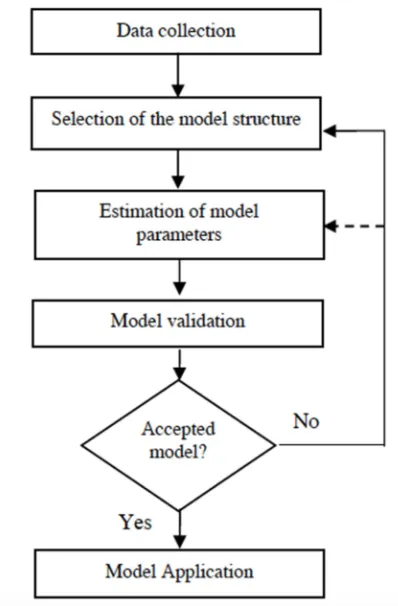
The identification procedure, in order to arrive at an appropriate mathematical model of the system is described in detail in (Figure 1) .
Selecting a set of models is determined completely by the prior knowledge of the system. This choice of a set of candidate models is probably the most important step and most difficult in a system identification procedure.
Then to estimate the model parameters must choose an algorithm to estimate or a criterion to be minimized (Figure 2).
[image:2.612.326.525.406.709.2]After that, a validation step model considers the question of whether the model is good enough for its intended use.
ISSN: 1992-8645 www.jatit.org E-ISSN: 1817-3195
113 If then the model is considered appropriate, the model can be used, otherwise, the procedure must be repeated, which is most often the case in practice. However, it is important to conclude that, because of the many important choices to be made by the user, the system identification procedure includes a loop to obtain a validated model.
3. NONLINEAR SYSTEMS
Most dynamical systems can be better represented by nonlinear models. The non-linear models are able to describe the behavior of the overall system over the entire operating range, while the linear models are not able to bring the system about a given operating point. One of the most frequently studied classes of nonlinear models are called oriented blocks models, which consist of a combination of linear and non-linear blocks [9].
There are different types of nonlinear system identification methods. There are a number of nonlinear models. However, two non-linear models will be described in the present paper.
3.1 Narx Model
A nonlinear autoregressive exogenous model (NARX). The estimate block of non-linearity, a combination of the non-linear function and the linear ARX function in parallel, the output of the card to the regressor model output. The NARX structure is shown in Figure.3.
The NARX model equation can be written in (1): 1 When y is output. r are the regressors. u is input and L is a autoregressive with exogeonoues (ARX) linear function. d is a scalar offset. g(u-r) represents output of nonlinear function and Q is projection matrix that makes the calculations well conditioned.
3.2 HAMMERSTEIN-WEINER MODEL
This model describes the dynamic systems using input and output static nonlinear blocks, in series with a model error output for dynamic linear block, the output of this block is distorted by the nonlinear static. The following structure describes the Hammerstein-Wiener model.
The linear sequence of the Hammerstein-Wiener model is implemented by an error output model and nonlinear blocks containing nonlinear estimators [1].
4. ESTIMATION AND VALIDATION
METHODS
4.1 Estimation Methods
Nonlinear blocks identification of nonlinear systems are implemented using non-linear functions or estimators. In this paper, two types of estimators, containing either a network or a sigmoid wavelet used with NARX, and Hammerstein-Wiener models. Both of sigmoid and wavelet network estimators use the neural network composing an input layer, an output layer and a hidden layer using wavelet and sigmoid activation functions as shown
in Figure 5.
ISSN: 1992-8645 www.jatit.org E-ISSN: 1817-3195
114
4.1.1 Sigmoid network (sn) activation function
The sigmoid network nonlinear estimator combines the radial basis neural network function using a sigmoid as the activation function. This estimator is based on the following expansion (2) :
2
when u is input and y is output. r is the the regressor. Q is a nonlinear subspace and P a linear subspace. L is a linear coefficient. d is an output offset. b is a dilation coefficient., c a translation coefficient and a an output coefficient. f is the sigmoid function, given by the following equation:
1 1 3
4.1.2 Wavelet network (wn) activation function
The term wavenet is used to describe wavelet networks. A wavenet estimator is a nonlinear function by combination of a wavelet theory and neural networks [14]. Wavelet networks are feedforward neural networks using wavelet as an activation function, based on the following expansion in equation (4) :
! ∗ ! !
# ∗ # #
4 u and y are input and output functions. Q and P are a nonlinear subspace and a linear subspace. L is a linear coefficient. d is output offset. as and aw are a scaling coefficient and a wavelet coefficient. bs and bw are a scaling dilation coefficient and a wavelet dilation coefficient. cs and cw are scaling translation and wavelet translation coefficients. The
scaling function f (.) and the wavelet function g(.) are both radial functions, and can be written as equations (5) and (6).
exp 0,5 ∗ ′∗ 5
dim /∗ ∗ exp 0,5 ∗ /∗ 6
In system identification process, the wavelet coefficient (a), dilation coefficient (b) and translation coefficient (c) are optimized during learning to obtain the best performance model.
5 VALIDATION MODEL
This step is to check whether the model accurately represents the system found studied.
We compare the model outputs and observed outputs of the system until the best model is reached. This is done using criteria such as the quality of the fit to the estimation data, the final prediction error (FPE) and Akaike information criterion (AIC) [12] The percentage of higher accuracy in shape is obtained from the comparison between the experimental and modeling curves signals by the following equation (7) :
! 1 100 ∗ 1 23 423 4 Ÿ 5 7
Where Y is the simulated output, y is the measured output and Y is the mean of output. FPE is Akaike Final Prediction Error for estimated model which the error calculation is defined as equation (8) :
7 8 9 :1 ;
1 ;< 8 Where V is the loss function, d is the number of estimated parameters, and N is the number of estimation data. The loss function V is follow in equation (9) where θn represents the estimates parameters.
Final prediction Error (FPE) provides a measure of model quality by simulating the situation where the model is tested on a different data set. The Akaike Information Criterion (AIC) as shown in equation (10) is used to calculate a relative comparison of models with different structures [13].
ISSN: 1992-8645 www.jatit.org E-ISSN: 1817-3195
115
6 STUDY CASE
[image:5.612.91.288.558.713.2]To illustrate the parametric identification approach explained in Section 2, we propose to study the case of a production line for singleproduct, turning inflows into outflows. This production line consists of three machines, of the same production cadence, with a negligible time transfer between machines.
Fig 6 illustrates the processing line studied.
Then we represent the production system as a "black box system" when the input is u(t) and output is y(t).
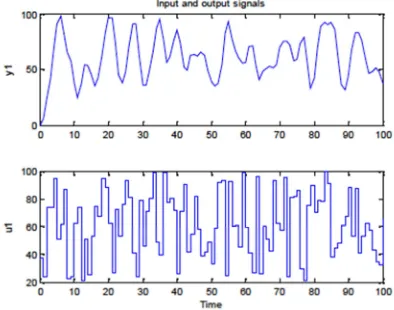
The input and output of the production line illustrated in Figure 8, have been extracted from the information system of the company (ERP).
These data are used to determine the model system studied by comparing models (NARX and Hammerstein-Wiener models), like structures in the model. The data is divided into two parts.
The first part is used to determine the model of the system and the second is used for the validation of the model.
By applying the identification procedure explained above, we simulated each model with multiple levels, we found that the NARX model gives the best fit with 95.75%, while the Hammerstein-Wiener system gives us a model with fit 94.74%.
The figure below presents a comparison between the estimated outputs and the measured outputs of each model.
ISSN: 1992-8645 www.jatit.org E-ISSN: 1817-3195
116 7. CONCLUSION
The originality of this work lies in the projection inspired methods in the field of automatic systems for production logistics.
It has been proposed modeling "black box" of a production line from the observed inputs and outputs.
To estimate the parameters of the studied system, we opted for block-oriented nonlinear models (NARX and Hammerstein-Wiener), which are known by their simplicities, and using the sigmoid networks and wavelet networks for estimating the parameters of models used
The tests showed that the best fit was given by the NARX model with a better fit of 95.57%.
More future work will be in this direction, including minimization of the identification error to achieve higher rate adjustments and the application of other estimation models.
REFRENCES:
[1] L. Ljung, System Identification: Theory for the User, 2nd Ed. New Jersey: Prentice Hall PTR, 1999.
[2] K.Labadi, Contribution à la modélisation et l'analyse des chaines logistique à l'aide des réseaux de Pétri, thèse de doctorat, Université de Technologie de Troyes 2005.
[3] N.Smata, C.Tolba, D.Boudebous, S.Benmansour, J. Boukachour, Modélisation de la chaîne logistique en utilisant les réseaux de Pétri continus, 9e Congrès International de Génie Industriel, Canada, (Oct.2011).
[4] F. Petitjean, P. Charpentier, J-Y. Bron , A. Villeminot, Modélisation globale de la chaine logistique d’un con structeur automobile, "e-STA" :La Revue électronique Sciences et
Technologies de l’Automatique, NÆ1 Spécial JD -JNMACS’ 07 2ème partie, 2008.
[5] B. Rohee, B. Riera, V. Carre-Menetrier, JM. Roussel, outil d’aide à l’élaboration de modèle hybride de simulation pour les systèmes manufacturier, "Journées doctorales du GDR MACS (JD-MACS'07), Reims, France , 2007. [6] H.Sarir, L’intégration d’un module d’a ide à la
décision (contrôle de flux entrée-sortie) basé sur le modèle régulation de niveau dans le système MES (Manufacturing Execution System, Colloque SIL–Concours GIL Award, (Déc. 2011).
[7] H. Sarir, B.Bensassi, Modélisation d’une ligne de fabrication d’un sous ensemble de l’inverseur de pousse par la méthode d’identification, IJAIEM : international journal of application or innovation in engineering and management, ISSN 2319 – 4847 Volume 2, Issue 6, (Juin 2013).
[8] K. Tamani, Développement d’une méthodologie de pilotage intelligent par régulation de flux adaptée aux systèmes de production, thèse de doctorat, université de Savoie, France, (Déc.2008).
[9] Z.M.Yusoff, Z.Muhammad, M.H.F. Rahiman, M.N. Taib, ARX Modeling for Down-Flowing Steam Distillation System, IEEE 8th International Colloquium on Signal Processing and its Application, 2012.
[10] Z.Muhammad, Z.M.Yusoff, M.H.F. Rahiman, M.N. Taib, Modeling of Steam Distillation Pot with ARX Model, IEEE 8th International Colloquium on Signal Processing and its Application, 2012.
[11] K. Ramesh, N. Aziz and S.R. Abd Shukor, “Nonlinear Identification of Wavenet Based Hammerstein Model – Case Study on High P urity Distillation Column”, Journal of Applied Sciences Research, 3(11): 1500-1508, 2007 [12] H. Akaike, “A new look at the st atistical model