ISSN: 1992-8645 www.jatit.org E-ISSN: 1817-3195
EFFICIENT BELIEF PROPAGATION WITH CENSUS AND
INTENSITY MEASURE
XIAOFENG WANG, HONGKE WANG
College of Mathematical and Physical Sciences, Chongqing University of Science and Technology,
Chongqing 401331, China
ABSTRACT
Stereo matching is one of the most active research areas in computer vision. In this paper, a novel stereo matching is proposed that utilizes Census measure and pixels-based intensity measure into data term of Belief Propagation algorithm. Traditional data term of Belief Propagation lies on pixels-based intensity measure, and its effect is not very well. We combine intensity and Census algorithm into data term, run through Belief Propagation algorithm and acquire more accurate results. This proposed method may be more exacter than traditional BP algorithm. The experimental results demonstrate the superior performance of our proposed method.
Keywords: Stereo Matching, Belief Propagation, Markov Network, Census Measure, Intensity
1
INTRODUCTIONOver the past few years, stereo matching has been many advances in the development of different algorithm. The stereo matching is basically a problem of correspondence of the image pairs. The methods solving the stereo matching problem may be classified into categories: global methods and local methods. Global methods minimize a global energy function to find the disparity map. Many effective global methods have been reported in literature, including Belief Propagation, Graph Cuts, etc [1, 9].
Belief Propagation (BP) algorithm works by passing messages around the graph using Markov Random Field (MRF) models [2, 3]. This method can be less sensitive to occlusion region and textureless region. However, traditional data term lie on pixels-based intensity measure, and its effect is not very well. Census measure based on non-parametric measure is more robust in outliers, radiometric changes, image noise, camera gain and textureless region. So combining Census measure and pixels-based intensity measure in data term of Belief Propagation algorithm is more accurate, because accurate of BP algorithm lie on the precision of correspondence of the image pairs.
The main contribution of this paper is combining Census measure and pixels-based intensity measure into data term of Belief Propagation algorithm. This algorithm produces excellent results both on the Middlebury test set, especially near the occluded
areas, and more exacter than traditional BP algorithm.
The paper is organized as follows. In Section 2, after reviewing previous work, we give overview of the approach. The results of our comparison are presented in Section 3, and results shows the efficacy of our optimization framework on the Middlebury data set .Section 4 concludes.
Recently, BP algorithms have attracted more attention due to their good performance. Sun had formulated stereo matching problem as a Markov network [14]. Gang Li [4] introduced the principle of geometric consistency to stereo matching based on Belief Propagation. Yang defined a hierarchical BP to refine the disparity in the occluded and low texture areas [6, 10]. Sun has devised a symmetric framework and used the conventional BP to minimize the energy field [15]. But traditional data term of BP algorithm only lie on intensity measure, the effect of stereo matching is not very well.
ISSN: 1992-8645 www.jatit.org E-ISSN: 1817-3195
the better results in local and global stereo matching methods [13].
So we show that the method combining pixel-based intensity and census algorithm is an effective regularizer to improve effect of stereo matching.
2
OVERVIEW OF THE PROPOSEDALGORITHM
We start by briefly reviewing the improved BP algorithm. Our algorithm review consists of two steps:
2.1 Belief Propagation
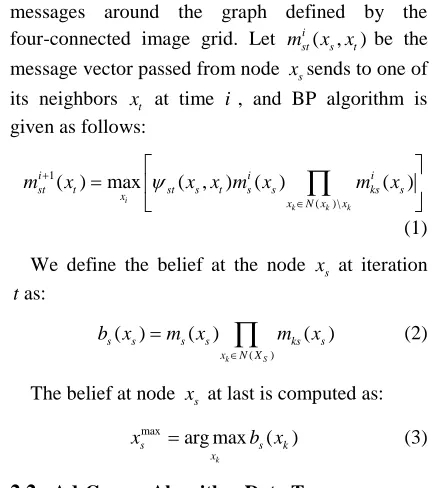
Belief Propagation algorithm (BP) is an iterative inference algorithm inferring on Markov random fields [4, 5]. We use the max-product algorithm to find the approximate minimum cost value of energy functions.
The typical BP algorithm works by passing messages around the graph defined by the
four-connected image grid. Let i ( , )
st s t
m x x be the
message vector passed from node xssends to one of
its neighbors xt at time i , and BP algorithm is
given as follows:
1
( )\
( ) max ( , ) ( ) ( )
i
k k k
i i i
st t st s t s s ks s
x
x N x x
m+ x ψ x x m x m x
∈
=
∏
(1)
We define the belief at the node xs at iteration
tas:
( ) ( ) ( ) ( )
k S
s s s s ks s
x N X
b x m x m x
∈
=
∏
(2)
The belief at node xs at last is computed as:
max
arg max ( )
k
s s k
x
x = b x
(3)
2.2 Ad-Census Algorithm Data Term
BP algorithm based on global methods includes data term and smoothness term. Data term often depends on intensity differences measure, but there are a large amount of errors in these measures.
Census algorithm is a non-parametric measure [15], which is based on the local order of intensities. This measure may increase robustness of windows-based methods to outliers including radiometric changes, image noise, camera gain and textureless region [12]. In our approach, we use an
improved self-adapting dissimilarity measure that combines sum of absolute intensity differences and Census-based measure. The algorithm above is more robust in camera gain, bias and textureless region.
( , ) CENSUS
C p d encodes images with relative
orderings of pixel intensities other than the intensity values, and CAD( , )p d is then defined as follows:
( , ) 1 ( ) ( )
3
Left Right
AD i i
C p d =
∑
I p −I p(4)
The AD-Census cost value
C
(
p
,
d
)
is thendefined as follows:
+
=
(
(
,
),
)
)
,
(
p
d
C
CENSUSp
d
CENSUSC
ρ
λ
(
(
,
),
)
AD
AD
p
d
C
λ
ρ
(5)
For
C
CENSUS(
p
,
d
)
, we use a9
×
7
window toencode each pixel’s local structure in a 64-bit string.
( , ) CENSUS
C p d is defined as Hamming distance of the
two bit strings; while CAD( , )p d is defined as the
average intensity difference. Where
ρ
(
c
,
λ
)
is arobust function on variable [7]:
(
,
)
1
exp(
)
λ
λ
ρ
c
=
−
−
c
(6)So, data term of BP algorithm is changed as:
)
,
,
(
)
,
,
(
)
,
,
(
x
y
d
D
x
y
d
D
x
y
d
D
=
SAD+
ϖ
CENSUS(7)
[image:2.612.85.301.349.593.2]ISSN: 1992-8645 www.jatit.org E-ISSN: 1817-3195
Figure 1: Census Measure Map On The Data Teddy Set
3
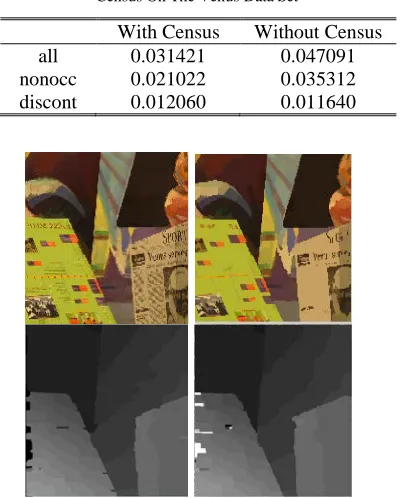
EXPERIMENTSThe proposed method was using the Middlebury data set [1]. In order to compare the BP without Census and the BP with Census in data term, we show results and pictures in Table 1 and Fig 2 with error threshold 1 on the Middlebury data set by measuring the percentage of pixels “Venus”. From Table 1 and Fig 2, we see that BP with Census is better than BP without Census in all pixels, pixels in non-occluded areas, in the textureless areas. Because only pixel-based measure, such as absolute differences, is not enough accurate, especially in occluded areas and the textureless areas. However, non-parametric measure relies on relative ordering of pixels and is robust in radiometric changes. So combining non-parametric matching and pixel-based matching performs better than only pixel-based matching measure[8].
[image:3.612.319.519.128.377.2]We often evaluate the performance using percentages of ‘bad’ pixels among: all pixels, pixels in non-occluded areas, pixels near disparity discontinuities. Where the subset of non-occluded pixels, denoted as “nonoccl”; the subset of the pixels near the occluded areas, denoted as “disc.”; the subset of the pixels being either non-occluded or half-occluded, denoted as “all.” The data show that our algorithm works pretty well. These results demonstrate the effectiveness of our Belief Propagation based on absolute intensity differences and Census measure for stereo matching.
Table I : Contrast In Bp With Census And Without Census On The Venus Data Set
With Census Without Census
all 0.031421 0.047091
nonocc 0.021022 0.035312
discont 0.012060 0.011640
Figure 2: Results On Middlebury Data Sets In “Venus”. From Left To Right Order: Left Reference Images, Right
Reference Images Extracted Disparity Maps With Gradient Census, Extracted Disparity Maps Without
Census.
all. nonocc. discont.
0 0.005 0.01 0.015 0.02 0.025 0.03 0.035 0.04 0.045 0.05
bad m
at
c
hi
ng pi
x
e
ls
per
c
ent
age(
%
)
[image:3.612.319.511.471.638.2]With census Without census
Figure 3: Histograms Of Bad Matching Pixels Percentage Result About BP With Census And Without Census In All Pixels ,In Non-Occluded Areas, In Textureless Areas On
The Venus Data Set .
ISSN: 1992-8645 www.jatit.org E-ISSN: 1817-3195
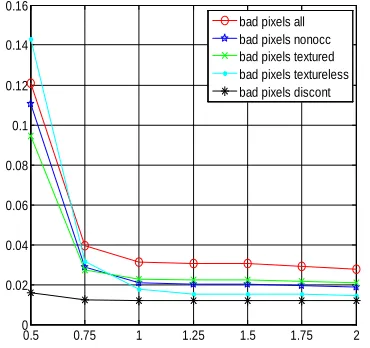
ranging from 0.5 to 2, including all pixels ,pixels in non-occluded areas, pixels in occluded areas, pixels in textured areas, pixels in textureless areas. Fig 4 shows that Belief Propagation based on absolute intensity differences and Census measure for stereo matching performs better at seven different thresholds.
0.5 0.75 1 1.25 1.5 1.75 2
0 0.02 0.04 0.06 0.08 0.1 0.12 0.14 0.16
[image:4.612.102.287.192.366.2]bad pixels all bad pixels nonocc bad pixels textured bad pixels textureless bad pixels discont
Figure 4: Error Statistics For The Percentage Of Bad Matching Pixels At Seven Different Thresholds Ranging
From 0.50 To 2.0 Pixels On The Venus Data Set ,Including All Pixels ,Pixels In Non-Occluded Areas, Pixels In Occluded Areas, Pixels In Textured Areas, Pixels
In Textureless Areas.
4
CONCLUSIONBP algorithm only based on absolute intensity differences in data term is far from accurate. In this paper, we present new algorithm to improve preciseness of stereo matching. We combine absolute intensity differences and Census measure of non-parametric measure into data term, run through BP algorithm and acquire more accurate results. Experimental results are evaluated on Middlebury data sets, showing the superior performance of the proposed method. Future work should be aimed at improving the accuracy of disparities in occluded areas, textureless areas using BP algorithm.
ACKNOWLEDGEMENTS
This work is supported by the Science and Technology Foundation of the Education Department of Chongqing (KJ121404), Innovation team of Chongqing University of Science & Technology (1809013) and Research Foundation of
Chongqing University of Science & Technology (CK2011Z15).
REFRENCES:
[1] D. Scharstein, R. Szeliski, “A taxonomy and evaluation of dense two-frame stereo correspondence algorithms”, International Journal of Computer Vision, Vol. 47, 2002, pp. 7–42.
[2] O J Woodford, P H S Torr, I D Reid, A W Fitzgibbon, “Global Stereo Reconstruction under Second Order Smoothness Priors”, In Proc. CVPR, Vol. 12, 2006, pp.1-8.
[3] A. Klaus, M. Sormann, K. Karne,
“Segment-Based Stereo Matching Using Belief Propagation and a Self-Adapting Dissimilarity Measure”, Vol. 3, 2006, pp.15-18.
[4] G. Li, S. W. Zucker, “Surface geometric constraints for stereo in belief propagation”, In Proc. CVPR, 2006, pp.2355–2362.
[5] A. Klaus, M. Sormann, K. Karner, “ Segment-based stereo matching using belief propagation and a self-adapting dissimilarity measure”, In Proc. ICPR, Vol. 12, 2006, pp. 15-18.
[6] Q. Yang, L. Wang, R. Yang, H. Stew´enius, D. Nist´er, “Stereo matching with color-weighted Correlation, hierarchical belief propagation and occlusion handling”, IEEE TPAMI, Vol. 31, 2009, pp. 492–504.
[7] X. Mei, X. Sun, M. Zhou, S. Jiao, H. Wang, X. Zhang, “On Building an Accurate Stereo Matching System on Graphics Hardware”, In Proc. CVPR, 2011, pp.467-474.
[8] H. Ishikawa , D. Geiger, “Rethinking the prior model for stereo”, In Proc. ECCV, 2006, pp. 526–537.
[9] Brownm Z, Burschka D, Ihager G D,“Advances in computational stereo”,IEEE Transactions on Pattern Analysis and Machine Intelligence, Vol. 8, 2003, pp.993-1008.
[10] Q. Yang, L. Wang, Narendra Ahuja ,“A constant-space belief propagation algorithm for stereo matching”, CVPR, 2010, pp.1458-1465
ISSN: 1992-8645 www.jatit.org E-ISSN: 1817-3195
[12] R. Zabih , J. Woodfill, “Non-parametric local transforms for computing visual correspondence”, in Proceedings of the European Conference of Computer Vision, Stockholm, Sweden, May 1994, pp. 151–158. [13] Heiko Hirschm¨uller , Daniel Scharstein,
“ Evaluation of Stereo Matching Costs on Images with Radiometric Differences”, IEEE Trans. Pattern Analysis and Machine Intelligence, Vol. 31, 2009, pp. 1582-1599. [14] J. Sun, N. Zheng, Y. Shum, “Stereo matching
using belief propagation”, IEEE Transaction on Pattern Analysis and Machine Intelligence, Vol. 7, 2003, pp.787-800.