University of East London Institutional Repository: http://roar.uel.ac.uk
This paper is made available online in accordance with publisher policies. Please
scroll down to view the document itself. Please refer to the repository record for this
item and our policy information available from the repository home page for further
information.
To see the final version of this paper please visit the publisher’s website.
Access to the published version may require a subscription.
Author(s):
Capiluppi, Andrea; Beecher, Karl.
Article title:
Structural Complexity and Decay in FLOSS Systems: An
Inter-Repository Study
Year of publication:
2009
Citation:
Capiluppi, A; Beecher, K. (2009)
‘Structural Complexity and Decay in
FLOSS Systems: An Inter-Repository Study’
13th European Conference on Software
Maintenance and Reengineering (CSMR 2009)
March 24-27, 2009 Fraunhofer IESE,
Kaiserslautern, Germany pp.169-178
Link to published version:
http://dx.doi.org/10.1109/CSMR.2009.37
DOI:
10.1109/CSMR.2009.37
Structural Complexity and Decay in FLOSS Systems:
An Inter-Repository Study
Andrea Capiluppi
Karl Beecher
Centre of Research on Open Source Software – CROSS
Department of Computing
University of Lincoln, UK
{
acapiluppi,kbeecher
}
@lincoln.ac.uk
Abstract
Past software engineering literature has firmly estab-lished that software architectures and the associated code decay over time. Architectural decay is, potentially, a major issue in Free/Libre/Open Source Software (FLOSS) projects, since developers sporadically joining FLOSS projects do not always have a clear understanding of the underlying architecture, and may break the overall concep-tual structure by several small changes to the code base.
This paper investigates whether the structure of a FLOSS system and its decay can also be influenced by the reposi-tory in which it is retained: specifically, two FLOSS repos-itories are studied to understand whether the complexity of the software structure in the sampled projects is compara-ble, or one repository hosts more complex systems than the other. It is also studied whether the effort to counteract this complexity is dependent on the repository, and the gover-nance it gives to the hosted projects.
The results of the paper are two-fold: on one side, it is shown that the repository hosting larger and more active projects presents more complex structures. On the other side, these larger and more complex systems benefit from more anti-regressive work to reduce this complexity.
1
Introduction
The “success” of FLOSS projects in past literature has been empirically evaluated via process and resource at-tributes, such as the frequency of releases, the number of developers, or by using proxies of their pool of users. In other words, the evolvability of FLOSS systems has been used as a term of reference for their success [10, 34, 17]. In terms of Lehman’s laws of software evolution, FLOSS (E-type) systems, when growing in size and capabilities, will also grow in complexity as they evolve (according to the 6th
law). They will also require increasing levels of work done to control complexity (i.e. “anti-regressive work”, as termed in the 2nd law) and quality (as stated by the 7th law) [26] in order to maintain their evolvability. Among FLOSS well-known projects, such as the so-called LAMP stack (Linux, Apache, MySQL, Perl), the Debian family, and *BSDs, have achieved higher evolvability than others [30]. Their evolvability has been made possible by attracting a large community of users, as well as a strong and dynamic base of developers [34]. The user community initiates the need for change while the developers make it happen [33], and both are key factors in the evolution process [10].
A by-product of the continuous evolution of software systems has been identified in the deterioration of the in-tegrity of the software. Such deterioration may manifest itself as growing complexity [25], and/or the loss of archi-tectural and conceptual integrity [32]. This phenomenon, sometimes called code decay in the literature (e.g. [16]) is likely to make it progressively more difficult to understand the inner workings of the software and, hence, to imple-ment functional additions and changes. Similarly to tradi-tional in-house software, it has been noted that increasing the size of FLOSS systems has an effect on their underly-ing complexity: a growunderly-ing pattern has been detected when evaluating complexity with either the traditional cyclomatic measures [27] (as studied in [8] and [22]), or counting the compilation warnings [28] as a proxy for FLOSS system’s complexity. It was also observed that the anti-regressive work and size had similar growth patterns [8].
The evolvability of FLOSS systems has been found un-evenly distributed when mining large repositories, such as SourceForge [17]: the vast majority of hosted projects is small, with few developers and does not go beyond the first public release [23]. On the other hand, it has been found that the repository in which they are retained acts as an ex-ogenous factor for the evolvability of FLOSS projects [4, 7]. Results have in fact shown that, on average, different types
of repositories benefit from different levels of evolvabil-ity and success: repositories with low barriers to entry for developers (such as SourceForge) are more likely to show lower evolvability, while forges with a stricter control of access (such as the Debian distribution) have been proven to host more evolvable projects.
The present paper builds upon the concept of the FLOSS repository being a differentiating factor for project evolv-ability: on top of that, it argues that these exogenous factors affect other internal product attributes also. Specifically, we study two well knwon FLOSS repositories, Debian and SourceForge: it will be studied whether those repositories that experience higher levels of evolutionary activity (De-bian, as found in [4]) also contain projects that have higher levels of structural complexity. We also investigate whether the effort for controlling complexity shows also differences with repositories with less activity (e.g., SourceForge).
This paper is structured as follows: section 2 introduces the definitions of the empirical study, section 3 defines the research hypotheses, the statistical tests and the met-rics used to reject or not the null hypotheses. Section 4 will present the results of these tests, and the description of what differences were detected when comparing the struc-tural characteristics of different FLOSS repositories. Sec-tion (threats) will encompass the threats to validity of the empirical study, while section 6 concludes, presenting also potential future works.
2
Empirical Study Definition and Planning
This section introduces the definitions used in the fol-lowing empirical study and presents the general objective of this work, and it does that in the formal way proposed by the Goal-Question-Metric (GQM) framework [3]. The GQM approach evaluates whether a goal has been reached, by associating that goal with questions that explain it from an operational point of view, and providing the basis for applying metrics to answer these questions. This study fol-lows this approach by developing, from the wider goal of this research, the necessary questions to address the goal and then determining the metrics necessary for answering the questions. By following the GQM, two research ques-tions will be proposed, that in turn will be distilled into hy-potheses to be statistically tested in the next section 3.
Goal: The long term objective of this research is to un-derstand whether different FLOSS repositories receive dif-ferent levels of evolutionary activity, and whether this fact is correlated to different levels of complexity. In terms of Lehman’s laws, the goal is to demonstrate that different FLOSS repositories face different levels of complexity.
Question: Two research questions are proposed:
• Do the projects in each repository have significantly different levels of complexity on average?
• And, if there is such difference, is there a correlation between a larger evolvability of FLOSS projects and the amount of work done to control their complexity (i.e., anti-regressive work)?
Metric: Source code is organized in files which pro-vide both creation and storage units and separate the total code into portions that can be separately compiled. In gen-eral, within these files, programmers create functions, pro-cedures or methods (depending on the programming lan-guage) that perform operations on the data, so that the de-sired computations are performed. The various functions contained in the same file may differ in dimension and other attributes, and provide a good trade-off between too fine (as in “lines of code”) and too course (as in “source files”) gran-ularity. Based on this trade-off, functions are selected as the basic unit of study in our research. We take advantage that there are simple and well-defined approaches to measure complexity at the function level. All the metrics used in this study will be focused on the level of granularity of source functions (or methods).
2.1
Definitions
The attributes considered in the present study are de-scribed below:
Coupling: this attribute measures the degree to which each source element relies on other elements (i.e. how in-terconnected is the code) [13, 1]. Since this study is conducted at the function level, the union of all the function calls (and method invocations) form the net-work of couplings in a system. Each coupling can be uniquely categorized as inbound (c in) or outbound (c out) (or fan-in and fan-out), depending on the di-rection of the call. For example, function “sign off” (Figure 1) has two inbound (fan-in) and three outbound (fan-out) couplings.
Instability: from past literature, instability is the ratio of fan-out coupling (c o) to total coupling (c o + c i) such that I = c o
(c o+c i).This metric is an indicator of
the resilience to change of software components (as in source functions) [21]. The range for this metric is 0 to 1, withI = 0indicating the lowest instability for
an element andI= 1indicating a completely unstable
element. The example in figure 1 therefore hasI =
Figure 1. example of ‘inbound’ and ‘out-bound’ couplings for the function “sign off”
2.2
Motivation
This work is based upon previous work carried out by the authors [5]. In that work, six FLOSS repositories were studied to test the hypotheses that they could be consid-ered to belong to a type based on their characteristics, and that each type attracted different rates of development. As a result, FLOSS repositories were identified as exogenous drivers that influence the evolutionary activity of their mem-ber projects. The test was done by taking a sample of 50 projects from each repository (totalling 300 projects in all) and comparing four historical indicators for each project: commit rates, number of commiters, size, and age.
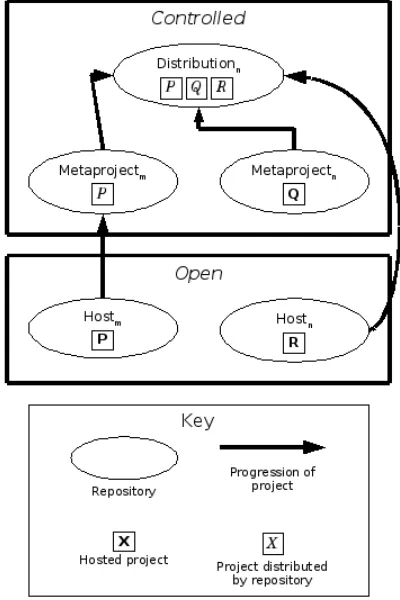
From the repositories examined, three repository types were proposed and defined (open host, metaproject, and dis-tribution). It was also pointed out (after a related study [4]) that a project may transition between repositories (illus-trated in figure 2), and that its resulting evolutionary activity can change in a way consistent with its new host repository. While the previous works examined process metrics, this work is the first step to adapting the same investigative ap-proach to product metrics. As stated in the goal above, this line of work will ascertain if the rates of evolutionary ac-tivity already identified are related to the resulting product complexity. This first step will examine just two reposito-ries (Debian and SourceForge), and will be expanded to a greater number of repositories in later work.
2.3
Repository Samples
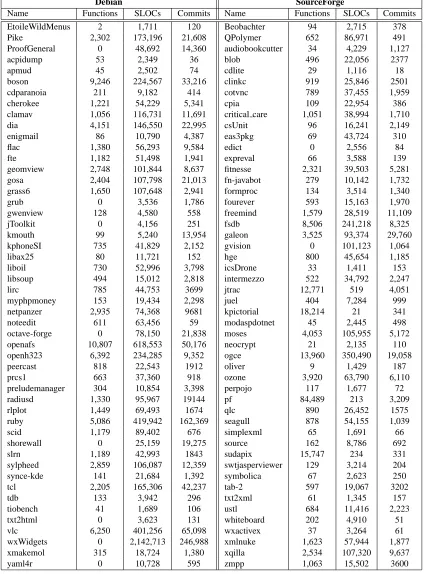
The two FLOSS repositories to be mined (Debian and SourceForge) are introduced here. A sample of 50 individ-ual projects was chosen from each repository by a random-izer, and each project was checked to ensure that it was not also available in the counterpart repository. A checkout was then performed on each member project of each sample’s development trunk (from either their CVS or SVN source control repositories); any branches were ignored. The list of analyzed projects is shown in Table 6. Each of these projects was then analyzed to obtain the metrics needed to perform the investigation; the measures for the study are those introduced above, and summarized in the columns of Table 6.
Both Debian and SourceForge allow administrators to la-bel their project’s development status. In order to compare projects with a similar status, only the “stable” branch of the repositories was considered for study. Considering projects with similar status means highlighting the most evolvable projects in both samples; but also dealing with pools of sim-ilar sizes, thus avoiding inaccurate comparisons.
Debian A distribution of Linux that hosts a large number of FLOSS projects. At the time of writing more than 20,000 projects are listed under the “stable” label.
SourceForge.net A well-known repository enabling the hosting and management of a wide variety of free software projects. At the time of writing there are over 20,000 projects in the with the label “produc-tion/stable” alone.
Figure 2. FLOSS forges and progression of projects between them
3
Research Hypotheses
[image:4.595.325.525.286.586.2]allowing either a retention of the null hypothesis (H0), or a
rejection of it in favour of the alternative hypothesis (H1).
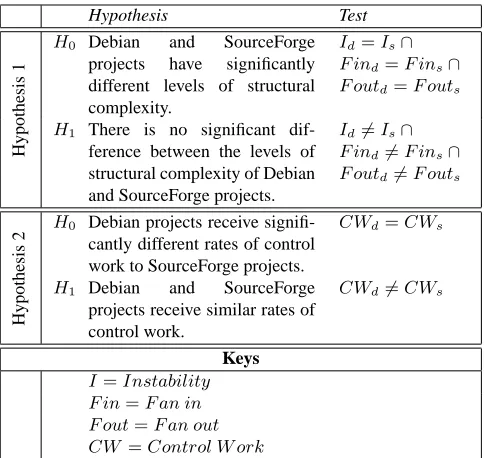
The hypotheses, metrics and statistical tests used are sum-marized in Table 1.
3.1
Hypothesis 1
The first hypothesis concerns the structural complexity of the interconnected components that form each of the project’s source code. It postulates that each repository will contain projects that, on average, possess a level of struc-tural complexity consistent with the amount of evolutionary activity it receives. The provisions for testing this hypothe-sis are shown in table 1.
Hypothesis Test H y p o th es is 1
H0 Debian and SourceForge projects have significantly different levels of structural complexity.
Id=Is∩
F ind=F ins∩
F outd=F outs
H1 There is no significant dif-ference between the levels of structural complexity of Debian and SourceForge projects.
Id6=Is∩
F ind6=F ins∩
F outd6=F outs
H y p o th es is
2 H0 Debian projects receive signifi-cantly different rates of control work to SourceForge projects.
CWd=CWs
H1 Debian and SourceForge projects receive similar rates of control work.
CWd6=CWs
[image:5.595.50.292.250.479.2]Keys I=Instability F in=F an in F out=F an out CW =Control W ork
Table 1. Summary of the hypotheses to be tested
For each project, all functions are extracted and their fan-in, fan-out and instability calculated, and the three summary statistics also calculated (mean, maximum and variance). Each summary statistic is then combined, per repository, into a distribution to allow comparison of samples.
3.2
Hypothesis 2
The second hypothesis concerns the work done to orga-nize and control the structural complexity of the compo-nents (i.e., source functions). It postulates that each reposi-tory will contain projects that, on average, have received an historical level of work done to its structure that is consis-tent to the amount of evolutionary activity it receives. That
is to say, repositories that have a history of greater evo-lutionary activity contain projects that have received more work done to control their structural complexity than repos-itories receiving lesser evolutionary activity.
To test this hypothesis, projects from both repositories will each have a series of uniformly spaced snapshots taken from their history: this will be achieved by dividing the number of commits in three distinct periods. Given the number of commits N, the three snapshots are taken in
these dates:
FP: First point; the snapshot taken on the date of commit numberN3
1.
MP: Mid point; the snapshot taken on the date of commit number2N3 .
LP: Last point; the latest available snapshot (i.e., on the date of commit numberN).
The overall number of commits for all the projects is re-ported in Table 6.
Within each snapshot, each function’s fan-out and insta-bility was compared to its counterpart in the succeeding snapshot, where a counterpart exists. Functions that have reduced in value between snapshots are counted: the control (i.e., anti-regressive) work between two snapshots is the rate of reduction in these values. Preferably, the number of in-tervals should be larger to provide more precise results, and it is intended that further work will address this. However, three points provides a simple minimum that determines if further, more fine-grained investigation is warranted.
4
Results
Hypothesis 1 This section summarizes the findings that were collected by evaluating the first research hypothesis. The attributes presented above were evaluated at the latest available change recorded in the CVS or SVN repositories. For each project in the two samples, the mean and variance values of all the measures were used to compare the forges. The maximum value was also used where appropriate.
To determine the statistical test to be used, a Kolmogorov-Smirnov test was applied to the data sets to establish a goodness of fit to the normal distribution, using the R programming language [14]. The distributions were found to be non-parametric, so the Wilcoxon unpaired
rank-sum test (also known as the Mann-Whitney U test), a
statis-tical significance test for non-parametric data, was selected. Table 2 shows the results of the significance tests; these are one-tailed tests assuming that Debian possesses larger
1This arrangement was chosen instead of selecting snapshots1, N 2,
Mean Maximum Variance
Fan-in p= 0.0003 p= 0.0012 p= 0.019
Fan-out p= 0.0003 p <0.0001 p <0.0001
[image:6.595.49.287.72.119.2]Instability p= 0.09* - p <0.0001*
Table 2. Results of p-values for hypothesis 1, one-tailed test
values, excepting * values, where the reverse is true. They show that Debian projects can be considered more com-plex in terms of functional coupling due to their greater in-terconnectedness. However, the extent to which they are significantly more complex is questionable. Whilst De-bian projects consistently display levels of coupling that are more excessive and within a much greater range, the mean values do not differ consistently.
Hypothesis 2 This hypothesis builds upon the evolution of the projects within the repositories, and three snapshots in time (as detailed above in section 3.2) of the source code are taken and analyzed. It was hoped to apply this analysis to all projects under investiation; however, the amount of data storage and processing required per project was very large. Given this eventuality, coupled with the authors’ planning to extend this investigation to other repositories, it was decided to take only the five largest projects from each sample and split each project into three uniformly spaced points from an evolutionary point of view. Table 3 summa-rizes the evolution (in terms of SLOCs) of the five largest projects within SourceForge and Debian in the three se-lected points in time. Major changes can be noted in the Debian sub-sample, up to a maximum of 500% of the initial size (e.g., the boson project); whereas the projects within the SourceForge set have less evolvability, with a maximum increase of 30% of the initial size (the moses project).
sf
.n
et
FP MP LP
fsdb 238,673 228,739 241,218 moses 81,289 99,791 105,955 ozone 73,755 89,061 63,790 QPolymer 87,248 86,939 86,971 xqilla 91,884 92,682 107,320
d
eb
ia
n
boson 37,325 124,116 224,567 dia 95,191 120,736 146,550 openafs 522,667 595,220 618,553 openh323 52,014 84,045 234,285 Pike 73,377 143,906 173,196
Table 3. Growth in size – SLOCs
As discussed above, the investigation of the amount of anti-regressive effort by the FLOSS developers into their
systems involved the comparison of the two attributes fan-out and instability in three temporal points (FP, MP, LP). Specifically, the reduction of these two attributes between subsequent points was recorded twice (FP→MP, and MP
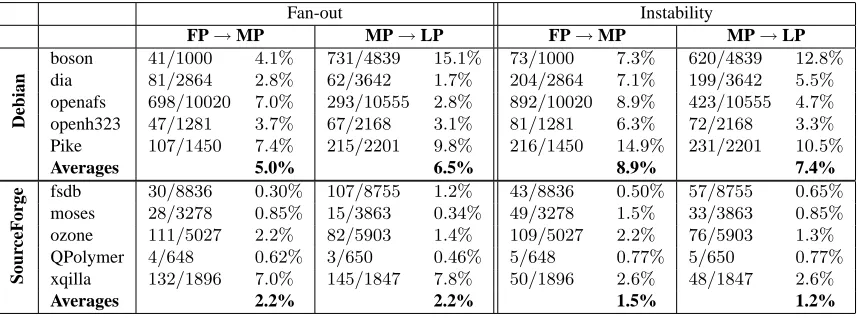
→LP, respectively), and the results reported in Table 4. As visible in the table, the sub-sample of Debian projects consistently receive a greater amount of architectural con-trol work: on average, the fan-out was more reduced in the Debian subsample than in SourceForge subsample in the comparison both FP→MP (5% against 2.2%) and MP→
LP (6.5% against 2.24%). Also the instabilities reflect this divide, both in the first comparison (on average, the 8.9% of the Debian subsample received a reduction of instabil-ity, against the 1.51% of SourceForge), and in the second one (7.36% against 1.23%). Interestingly, the one project in the SourceForge sample that contradicts this tendency has recently, since the data was gathered, been introduced into the unstable branch of Debian, rather than the stable branch under investigation.
Further to the total control work performed, the effort given to curbing excessive fan-out was also investigated. A fan-out value of greater than 7 was designated as exces-sive [29]; similarly to the work shown in table 4, the pro-portion of excessive functions brought below this threshold between the historical snapshots in each project was cal-culated (see table 5). As a general result, the same above trends appear here as well: debian achieves an average of 9.52% in FP→MP and 10.90% in MP→LP and less vari-ance; SourceForge achieves smaller amounts, on average 7.88% in FP→MP and 6.52% in MP→LP, but a larger variance.
FP→MP MP→LP
sf
.n
et
fsdb 1/407 0.2% 5/375 1.3%
moses 1/81 1.2% 1/115 0.90%
ozone 10/93 10.8% 6/81 7.4%
QPolymer 2/14 14.3% 0/12 0.0%
xqilla 17/132 12.9% 19/83 23.0%
d
eb
ia
n
boson 6/39 15.4% 67/215 31.2%
dia 3/118 2.5% 8/183 4.4%
openafs 48/781 6.1% 22/822 2.7%
openh323 5/43 11.6% 6/87 6.9%
[image:6.595.315.541.451.575.2]Pike 7/59 12.0% 10/107 9.3%
Table 5. Number of functions with excessive fan-out reduced
5
Related Work
[image:6.595.70.265.524.654.2]Fan-out Instability
FP→MP MP→LP FP→MP MP→LP
D
eb
ia
n
boson 41/1000 4.1% 731/4839 15.1% 73/1000 7.3% 620/4839 12.8%
dia 81/2864 2.8% 62/3642 1.7% 204/2864 7.1% 199/3642 5.5%
openafs 698/10020 7.0% 293/10555 2.8% 892/10020 8.9% 423/10555 4.7%
openh323 47/1281 3.7% 67/2168 3.1% 81/1281 6.3% 72/2168 3.3%
Pike 107/1450 7.4% 215/2201 9.8% 216/1450 14.9% 231/2201 10.5%
Averages 5.0% 6.5% 8.9% 7.4%
S
o
u
rc
eF
o
rg
e fsdb 30/8836 0.30% 107/8755 1.2% 43/8836 0.50% 57/8755 0.65%
moses 28/3278 0.85% 15/3863 0.34% 49/3278 1.5% 33/3863 0.85%
ozone 111/5027 2.2% 82/5903 1.4% 109/5027 2.2% 76/5903 1.3%
QPolymer 4/648 0.62% 3/650 0.46% 5/648 0.77% 5/650 0.77%
xqilla 132/1896 7.0% 145/1847 7.8% 50/1896 2.6% 48/1847 2.6%
[image:7.595.83.512.71.230.2]Averages 2.2% 2.2% 1.5% 1.2%
Table 4. Work done to reduce coupling between snapshots (number of functions with fan-out and/or instability reduced)
The evolution of software is a research area with a strong history in software engineering, and research into FLOSS-specific evolution has been an area of growing significance since works such as Godfrey and Tu’s [20] demonstration of the growth of the Linux kernel that ran counter to tra-ditional software engineering experience. Since the begin-ning of the 2000s a number of works have investigated the evolutionary dynamics of software projects developed in a distributed heterogeneous environment and have addressed a wide spectrum of attributes. As well as the analysis of pro-cess and resource attributes, the free availability of develop-ment artefacts has allowed the relatively easy examination of how product attributes change over time, including the product size [15, 18, 20, 24], complexity [9], and the nature of its structure [9, 19].
This paper specifically addresses the structural charac-teristics of FLOSS, explicitly the organization of the soft-ware’s constituent components. A number of measures for doing this exist and, in past work, such characteristics have been examined at varying levels of granularity and with consideration to specific paradigms. After the development of structured programming relatively simple measures of modular structure were developed and refined. For exam-ple, coupling (a simple count of connections that measures the interconnectedness of a module [12]) was refined into a more complicated form, whereby a connection was judged qualitatively [31]; this allows a “strength” to be assigned to a connection, but is a somewhat informal measure that does not lend itself easily to automated measurement. Similar de-velopments have occurred with respect to measures that are specific to object-oriented design only [11, 6]. Structural metrics, like these examples, have been used as measures to investigate the affects of interconnectedness on maintain-ability attributes such as ripple effects [35], fault-proneness
[2] and maintenance effort [11].
Many existent FLOSS projects belong to some type of repository, i.e. an organized central location for the pur-pose of managing and controlling software development. Most previous empirical works in FLOSS have used a small number of exemplary projects, thereby affecting the gen-eralizability of their findings, but some works have taken large samples of projects [15, 17]. These samples have nor-mally been taken from a specific repository, whereas this work builds on previous works by the author [5, 7] in which samples are taken from multiple distributions in order to perform a comparison of them using statistical significance testing. Part of this line of research shows that reposito-ries can be considered as being one of a set of types, and each type tends to undergo a particular level of evolutionary activity as evidenced by the average size, age, number of developers and rate of commits. Projects may originate in any repository type and transition between them.
6
Conclusions and Future Works
This paper has been built on top of existing results [4, 5], claiming that the rate of evolvability of a FLOSS project can be influenced by the repository it resides in. By carrying out a comparative analysis between two FLOSS reposito-ries (Debian and SourceForge), it evaluated the architectural structure of a sample of projects from each, and argued that the same structure is influenced by the repository itself, as an exogenous factor. Three attributes were used as proxies of architectural structure: fan-in, fan-out and instability.
with excessive and more varied levels of interconnected-ness. Apart from a low significance in the instability (i.e., 90%), it could also be satisfactorily concluded that the av-erage values differed significantly.
A second investigation was also carried out: a sub-sample of five of the largest projects was taken from each sample and its characteristics studied in three subsequent temporal points (FP, MP, LP), equally spaced; specifically, the work done to reduce the two attributes “fan-out” and “instability” was measured between FP and MP, and be-tween MP and LP. Results showed that the proportion of functions that received complexity control work was con-sistently greater in the case of Debian (apart from a single SourceForgeproject that, interestingly, has now been intro-duced into the unstable branch of the Debian project).
The two results as summarised here confirm the earlier working hypothesis: FLOSS repositories act as exogenous factors in the evolution of the projects they contain. In fact, the greater effort and evolvability observed in Debian projects [4] is mirrored by the amount of complexity con-trol done at the architectural level, when comparing it with SourceForge.
As future works, two main areas have been considered: at first, this work will be extended by including more repos-itories in the investigation. Specifically, more representa-tives for each of the repository types identified in figure 2 will be will not only ascertain the architectural evolution of metaprojects, but could also lend more empirical weight to the generalizability of the findings.
In addition, the findings of the hypothesis 2 will need to be investigated further by decreasing the granularity of the intervals in order to provide a more precise set of results. A snapshot every month will be considered in order to give more visibility to phases of maintenance and refactoring, which could bias the results. When refactoring is followed by another type of maintenance, the latter might increase complexity again. The three intervals as above would be too coarse, and produce different results depending on whether the analysed point was before or after these activities.
7
Threats to Validity
• Construct validity The study has been able to make use only of available data. It is possible, for example, that the project initialization pre-dates the first mea-surable piece of historical data and is therefore beyond the reach of our analysis. Further to this point, the de-velopment status assigned to a project requires human judgement. Whilst in the Debian project this is a very systematically prescribed process, the status assigned to a SourceForge project is the result of the subjective judgement of the administrator. There is therefore the risk that some projects in the SourceForge sample are
not fairly considered “stable”.
• Internal validity The permissive nature of FLOSS de-velopment means that it is possible, even encouraged, for individual projects, or parts of them, to be included in more than one repository. Hence, when randomly sampling projects from individual repositories, it is possible that a sampled project may be found in an-other unknown location and that its evolution is also influenced by this unknown repository. The assump-tion is therefore made that any such confounding ef-fect, if present, is negligible.
• Internal validity Because of the large amount of anal-ysis necessary the evaluation of coupling was auto-mated by analysis software, which is presently at a level of sophistication that has the following conse-quences: 1) Test suites, when included within the soft-ware package, are included in the analysis and so con-tribute to the perceived level of structuredness. It is arguable whether or not test suites should be consid-ered “part of the software”. For example, in the De-bian sample, 14 out of 50 projects had a directory that appeared to function as a test suite; 2) The level of cou-pling is limited to being derived from a static view of the software; hence, dynamic coupling is not detected.
• External validity Further to the previous point, the large amounts of analysis and storage space required meant that the investigation into hypothesis 2 required a sub-sample to be taken rather than both samples in its entirety. It is desireable for future work to explore ways in which analysis can be made much more effi-cient and so allow the analysis of a greater number of projects.
References
[1] E. A. Audun Foyen and L. C. Briand. Dynamic coupling measurement for object-oriented software. IEEE Trans. Softw. Eng., 30(8):491–506, 2004.
[2] V. R. Basili, L. C. Briand, and W. L. Melo. A validation of object-oriented design metrics as quality indicators. IEEE Transactions on Software Engineering, pages 751–761, Oc-tober 1996.
[3] V. R. Basili, G. Caldiera, and D. H. Rombach. The goal question metric approach. In Encyclopedia of Software En-gineering, pages 528–532. John Wiley & Sons, 1994. See also http://sdqweb.ipd.uka.de/wiki/GQM.
[4] K. Beecher, C. Boldyreff, A. Capiluppi, and S. Rank. Evo-lutionary success of open source software: An investigation into exogenous drivers. Electronic Communications of the EASST, 8, 2008.
[6] L. C. Briand, J. W. Daly, and J. Wust. A united framework for coupling measurement in object-oriented systems. IEEE Transactions on Software Engineering, pages 91–121, Jan-uary/February 1999.
[7] A. Capiluppi, C. Boldyreff, and K. Beecher. Quality factor and coding standards – a comparison between open source forges. In Proceedings of the Second International Work-shop on Software Quality and Maintainability, 2008. Co-located with the 12th European Conference of Software Maintenance and Reengineering.
[8] A. Capiluppi and J. Fern´andez-Ramil. Studying the evolu-tion of open source systems at different levels of granularity: Two case studies. In IWPSE ’04: Proceedings of the Prin-ciples of Software Evolution, 7th International Workshop, pages 113–118, Washington, DC, USA, 2004. IEEE Com-puter Society.
[9] A. Capiluppi and J. Fern´andez-Ramil. A model to predict anti-regressive effort in open source software. In 23rd IEEE International Conference on Software Maintenance, pages 194–203. IEEE, 2007.
[10] A. Capiluppi and M. Michlmayr. From the cathedral to the bazaar: An empirical study of the lifecycle of volunteer community projects. In J. Feller, B. Fitzgerald, W. Scac-chi, and A. Sillitti, editors, OSS, volume 234 of IFIP, pages 31–44. Springer, 2007.
[11] S. R. Chidamber and C. F. Kemerer. A metrics suite for object oriented design. IEEE Transactions on Software En-gineering, pages 476–493, June 1994.
[12] L. Constantine and E. Yourdon. Structured Design. Prentice-Hall, 1979.
[13] S. D. Conte, H. E. Dunsmore, and Y. E. Shen. Software en-gineering metrics and models. Benjamin-Cummings Pub-lishing Co., Inc., Redwood City, CA, USA, 1986.
[14] P. Dalgaard. Introductory Statistics with R. Springer, 2002. [15] A. Deshpande and D. Riehle. The total growth of open
source. In B. Russo, E. Damiani, S. A. Hissam, B. Lun-dell, and G. Succi, editors, OSS, volume 275 of IFIP, pages 197–209. Springer, 2008.
[16] S. G. Eick, T. L. Graves, A. F. Karr, J. S. Marron, and A. Mockus. Does code decay? assessing the evidence from change management data. IEEE Trans. Softw. Eng., 27(1):1– 12, 2001.
[17] R. English and C. Schweik. Identifying success and tragedy of floss commons: A preliminary classification of source-forge.net projects. In Proceedings of the 1st International Workshop on Emerging Trends in FLOSS Research and De-velopment, Minneapolis, MN, 2007. ICSE.
[18] D. M. German. An empirical study of fine-grained software modifications. volume 11, pages 369–393, Hingham, MA, USA, 2006. Kluwer Academic Publishers.
[19] D. M. German and A. Hindle. Measuring fine-grained change in software: Towards modification-aware change metrics. In METRICS ’05: Proceedings of the 11th IEEE International Software Metrics Symposium, page 28, Wash-ington, DC, USA, 2005. IEEE Computer Society.
[20] M. W. Godfrey and Q. Tu. Evolution in open source soft-ware: A case study. In Proceedings of the International Con-ference on Software Maintenance, pages 131–142, 2000.
[21] I. Gorton and L. Zhu. Tool support for just-in-time ar-chitecture reconstruction and evaluation: an experience re-port. In Proceedings of the 27th International Conference on Software Engineering, pages 514–523, St. Louis, Missouri, USA, 2005.
[22] I. Herraiz, J. M. Gonzalez-Barahona, and G. Robles. To-wards a theoretical model for software growth. In MSR ’07: Proceedings of the Fourth International Workshop on Min-ing Software Repositories, page 21, WashMin-ington, DC, USA, 2007. IEEE Computer Society.
[23] J. Howison and K. Crowston. The perils and pitfalls of min-ing sourceforge. In Proceedmin-ings of the international work-shop on mining software repositories (msr 2004, pages 7– 11, 2004.
[24] S. Koch. Evolution of open source software systems – a large-scale investigation. In Proceedings of the First Int. Conf. on Open Source Systems, pages 148–153, July 2005. [25] M. M. Lehman. Programs, cities, students, limits to growth?
Programming Methodology, pages 42–62, 1978.
[26] M. M. Lehman, J. F. Ramil, P. D. Wernick, D. Perry, and W. M. Turski. Metrics and laws of software evolution - the nineties view. In Proceedings of the 4th International Sym-posium on Software Metrics, pages 20–32, 1997.
[27] T. J. McCabe. A complexity measure. IEEE Transactions on Software Engineering, pages 308–320, December 1976. [28] T. Mens, J. Fernandez-Ramil, and S. Degrandsart. The
evo-lution of Eclipse. In Proc. International Conference on Soft-ware Maintance (ICSM), pages 386–395. IEEE Computer Society Press, 2008.
[29] G. A. Miller. The magical number seven, plus or minus two: Some limits on our capacity for processing information. The Psychological Review, 63:81–97, 1956.
[30] A. Mockus, R. T. Fielding, and J. D. Herbsleb. Two case studies of open source software development: Apache and mozilla. ACM Transactions of Software Engineering and Methodology, pages 309–364, July 2002.
[31] M. Page-Jones. The Practical Guide to Structured Systems Design. Yourdon Press, 1980.
[32] D. L. Parnas. Software aging. In ICSE ’94: Proceedings of the 16th international conference on Software engineer-ing, pages 279–287, Los Alamitos, CA, USA, 1994. IEEE Computer Society Press.
[33] G. Robles, J. J. Amor, J. M. Gonzalez-Barahona, and I. Her-raiz. Evolution and growth in large libre software projects. In Eighth International Workshop on Principles of Software Evolution, pages 165–174, 2005.
[34] G. Robles and J. M. Gonzalez-Barahona. Contribu-tor turnover in libre software projects. In E. Damiani, B. Fitzgerald, W. Scacchi, M. Scotto, and G. Succi, editors, OSS, volume 203 of IFIP, pages 273–286. Springer, 2006. [35] F. G. Wilkie and B. A. Kitchenham. Coupling measures and
Debian SourceForge
[image:10.595.85.511.93.667.2]Name Functions SLOCs Commits Name Functions SLOCs Commits EtoileWildMenus 2 1,711 120 Beobachter 94 2,715 378 Pike 2,302 173,196 21,608 QPolymer 652 86,971 491 ProofGeneral 0 48,692 14,360 audiobookcutter 34 4,229 1,127 acpidump 53 2,349 36 blob 496 22,056 2377 apmud 45 2,502 74 cdlite 29 1,116 18 boson 9,246 224,567 33,216 clinkc 919 25,846 2501 cdparanoia 211 9,182 414 cotvnc 789 37,455 1,959 cherokee 1,221 54,229 5,341 cpia 109 22,954 386 clamav 1,056 116,731 11,691 critical care 1,051 38,994 1,710 dia 4,151 146,550 22,995 csUnit 96 16,241 2,149 enigmail 86 10,790 4,387 eas3pkg 69 43,724 310 flac 1,380 56,293 9,584 edict 0 2,556 84 fte 1,182 51,498 1,941 expreval 66 3,588 139 geomview 2,748 101,844 8,637 fitnesse 2,321 39,503 5,281 gosa 2,404 107,798 21,013 fn-javabot 279 10,142 1,732 grass6 1,650 107,648 2,941 formproc 134 3,514 1,340 grub 0 3,536 1,786 fourever 593 15,163 1,970 gwenview 128 4,580 558 freemind 1,579 28,519 11,109 jToolkit 0 4,156 251 fsdb 8,506 241,218 8,325 kmouth 99 5,240 13,954 galeon 3,525 93,374 29,760 kphoneSI 735 41,829 2,152 gvision 0 101,123 1,064 libax25 80 11,721 152 hge 800 45,654 1,185 liboil 730 52,996 3,798 icsDrone 33 1,411 153 libsoup 494 15,012 2,818 intermezzo 522 34,792 2,247 lirc 785 44,753 3699 jtrac 12,771 519 4,051 myphpmoney 153 19,434 2,298 juel 404 7,284 999 netpanzer 2,935 74,368 9681 kpictorial 18,214 21 341 noteedit 611 63,456 59 modaspdotnet 45 2,445 498 octave-forge 0 78,150 21,838 moses 4,053 105,955 5,172 openafs 10,807 618,553 50,176 neocrypt 21 2,135 110 openh323 6,392 234,285 9,352 ogce 13,960 350,490 19,058 peercast 818 22,543 1912 oliver 9 1,429 187 prcs1 663 37,360 918 ozone 3,920 63,790 6,110 preludemanager 304 10,854 3,398 perpojo 117 1,677 72 radiusd 1,330 95,967 19144 pf 84,489 213 3,209 rlplot 1,449 69,493 1674 qlc 890 26,452 1575 ruby 5,086 419,942 162,369 seagull 878 54,155 1,039 scid 1,179 89,402 676 simplexml 65 1,691 66 shorewall 0 25,159 19,275 source 162 8,786 692 slrn 1,189 42,993 1843 sudapix 15,747 234 331 sylpheed 2,859 106,087 12,359 swtjasperviewer 129 3,214 204 synce-kde 141 21,684 1,392 symbolica 67 2,623 250 tcl 2,205 165,306 42,237 tab-2 597 19,067 3202 tdb 133 3,942 296 txt2xml 61 1,345 157 tiobench 41 1,689 106 ustl 684 11,416 2,223 txt2html 0 3,623 131 whiteboard 202 4,910 51 vlc 6,250 401,256 65,098 wxactivex 37 3,264 61 wxWidgets 0 2,142,713 246,988 xmlnuke 1,623 57,944 1,877 xmakemol 315 18,724 1,380 xqilla 2,534 107,320 9,637 yaml4r 0 10,728 595 zmpp 1,063 15,502 3600