JPD:4:1: 3
Developing a Strategy-based Instruction Approach to Teaching and
Learning Modern Languages to train
ab-initio
Primary PGCE Trainees
Mario Moya, Department of Teacher Education, University of Bedfordshire
Introduction
This study was underpinned by the work of Rubin (1975), O’Malley & Chamot (1990), Oxford (2011), and Cohen & Macaro (2007), all of whom acknowledge that there are various automatic and unconscious strategies that learners use in their first language (L1) that can also be used when learning another language (L2). This premise is the foundation of the strategy-based instruction (SBI), proposing the development of self-regulation of learning through the use of meta-cognition to assist learners in identifying and using strategies to facilitate L2 learning. A modified version of this approach, incorporating an element of collaborative learning within a model of cognitive apprenticeship, was used to simultaneously develop trainees’ L2 subject knowledge and teaching skills.
Context
The study emerged after noticing behaviours associated with anxiety and stress displayed by generalist primary PGCE trainees when learning modern languages during the initial two weeks of the course. Importantly, 30 trainees participated in a pilot study where a modified SBI model was used to reduce learning tension, challenge negative attitudes to L2 learning, and to provide the necessary knowledge and competences to develop L2 skills whilst increasing teaching confidence. The results obtained in the pilot study informed a second cycle of enquiry during the trainees’ school experience. Two groups were used, namely an experimental group, where the modified SBI approach using cognitive apprenticeship was applied, and a control group, where a more traditional approach was followed in a vertical training model where the mentor, viewed as the expert, indicated areas for the trainees to improve. Of the 30 trainees who had received training in SBI, nine (9) taught in the experimental group and nine (9) in the control group. The focus of enquiry in the second cycle was two-fold: first, testing out a training model where trainees would simultaneously develop subject knowledge and teaching skills, sharing their expertise with the mentors whilst learning from them; and secondly, comparing learning outcomes between the SBI and another teaching approach.
Language-learning Strategies
Language-learning strategies are defined as ‘techniques or devices a learner may use to acquire knowledge’ (Rubin, 1975, p. 43), which are ‘consciously chosen by learners for the purpose of regulating their own learning’ (Griffith, 2007, p. 2), ‘behaving as former steps or techniques students employ to improve their progress in internalising, storing, retrieving, and using the L2’ (Oxford, 1990, p. 175). A teaching model based on language strategies is defined by Ze-sheng (2008, p. 1) as:
JPD:4:1: 4
A Revised Version of SBI: A Comparison with Chamot’s Model
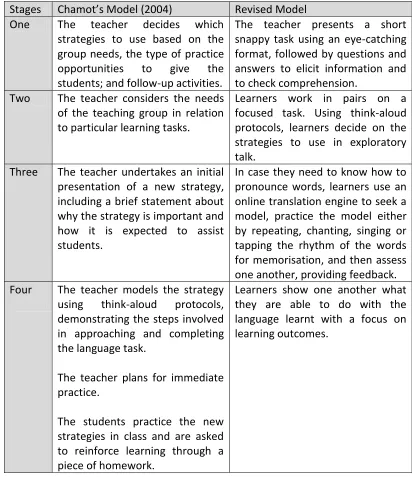
[image:2.595.90.502.231.708.2]Chamot (2004) presents an SBI approach, which depends on the expertise of the teacher in pre-selecting strategies according to learners’ needs, whilst explaining the way in which strategies are utilised to complete language tasks. This version sought to provide trainees with independence by self-regulating their learning and setting up their own L2 learning goals. Although Think Aloud Protocols (TAP) are used in Chamot’s model, in this version, these encourage exploratory talk. The table provides a comparative summary:
Table 1: Comparative table: two models of a strategy-based approach Stages Chamot’s Model (2004) Revised Model One The teacher decides which
strategies to use based on the group needs, the type of practice opportunities to give the students; and follow-up activities.
The teacher presents a short snappy task using an eye-catching format, followed by questions and answers to elicit information and to check comprehension.
Two The teacher considers the needs of the teaching group in relation to particular learning tasks.
Learners work in pairs on a focused task. Using think-aloud protocols, learners decide on the strategies to use in exploratory talk.
Three The teacher undertakes an initial presentation of a new strategy, including a brief statement about why the strategy is important and how it is expected to assist students.
In case they need to know how to pronounce words, learners use an online translation engine to seek a model, practice the model either by repeating, chanting, singing or tapping the rhythm of the words for memorisation, and then assess one another, providing feedback. Four The teacher models the strategy
using think-aloud protocols, demonstrating the steps involved in approaching and completing the language task.
The teacher plans for immediate practice.
The students practice the new strategies in class and are asked to reinforce learning through a piece of homework.
Learners show one another what they are able to do with the language learnt with a focus on learning outcomes.
Research Method
JPD:4:1: 5
when developing membership to a community of practice, practitioners (including the researcher, trainees and mentors), align themselves with conditions or characteristics of practice. Jaworsky (2006, p. 190) explains that, ‘alignment can be a critical process in which the individual questions the purposes and implications of aligning with norms of practice’ leading to a process of enquiry. The author argues that enquiry becomes both a theoretical principle and a position useful to investigate teaching practice as this regards ‘teaching as a learning process’ (ibid, p. 191), whose purpose is to improve practice and come to a better understanding of it (Altrichter et al., 2008).
A mixed-method approach to data collection was followed, including a standardised questionnaire to determine anxiety levels based on Oxford (1990); this was analysed using descriptive statistics, observations of teaching following the schedule of Allen et al. (1984), reflective writing (field notes, journals and logs), focus groups and a standardised language audit based on the levels descriptors of the Common European Reference Framework for Languages (Little, 2005). The qualitative data analysis followed a dialectical approach (Buss, 1979), which broadly corresponds to practitioner action research.
Table 2: Participants' sample
First Cycle Pilot Study
Second Cycle Main Study Groups
30 trainees
Control Experimental
Sample 9 trainees
9 mentors 18 pupils
JPD:4:1: 6
Findings Pilot Study
Upon observing that the trainees displayed a variety of negative behaviours towards L2 learning, a standardised questionnaire (Foreign Language Anxiety Class Scale, Oxford, 1990) was administered, with the results analysed using descriptive statistics. The score showed that anxiety levels were low, corresponding to pre-conceived beliefs. Rifkin (2000, p. 394) in Kouritzin et al. (2007), suggests that, to ‘overcome learners’ counterproductive beliefs, educators must first know what those beliefs are and where they come from’. A focus group provided a better understanding for the perceived anxiety, with views summarised and then grouped into three categories, namely (a) negative attitudes, (b) perceived lack of ability and (c) low self-esteem, all arising from past learning experiences. In order to challenge these perceptions, the researcher implemented an intervention stage based on the modified version of the SBI approach. Data from journals were analysed following a word count technique showing that, as the trainees developed their practice in using the approach, their reflections focused less on their concerns regarding L2 subject knowledge and more so on their developing skills. The observations of trainees solving tasks and the analysis of conversation transcripts showed that the talk partner technique provided an intimate environment for practising the L2 with the trainees feeling less inhibited about making mistakes. Finally, the language audit results showed that, by the end of 12 hours of instructions, all trainees achieved level A1 of the CERF in reading, followed by listening (n=22), writing (n=19) and speaking (n=17).
Second Cycle: Main study Experimental Group (EG)
This study took place in an urban mixed school attended by a large number of pupils for whom English was an additional language (EAL). Three groups of participants took part: trainees who had attended the SBI training in the pilot study, school-based mentors and the pupils taught by both the trainees and the mentors.
[image:4.595.70.529.509.766.2]
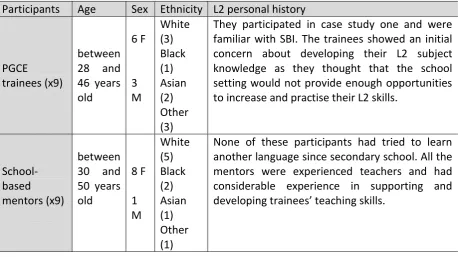
Table 3: Participants in case study two
Participants Age Sex Ethnicity L2 personal history
PGCE
trainees (x9)
between 28 and 46 years old 6 F 3 M White (3) Black (1) Asian (2) Other (3)
They participated in case study one and were familiar with SBI. The trainees showed an initial concern about developing their L2 subject knowledge as they thought that the school setting would not provide enough opportunities to increase and practise their L2 skills.
School-based mentors (x9)
between 30 and 50 years old 8 F 1 M White (5) Black (2) Asian (1) Other (1)
JPD:4:1: 7
Pupils (x18)
between 9 and 10 years old 12 F 6 M White (9) Black (4) Asian (4) Other (1)
None of the pupils had attempted to learn another language or had been in contact with a non-native speaker of English and displayed a variety of attitudes towards learning an L2.
This group was taught using a modified version of the SBI approach within the model of cognitive apprenticeship: whilst the trainees provided support to mentors in the development and use of language strategies to learn an L2, the mentors, in return, embedded into different areas of the curriculum and modelling teaching practice the new language and provided support with trainees’ teaching skills.
Data were collected using observations, focus groups at the beginning and at the end of the school experience, reflective writing (field notes, logs and journals) and a language audit.
Mentors:
Similar views to those of the trainees in the pilot study were gathered; however, the mentors were willing to learn. Both the trainees in the pilot study and the mentors agreed that a class teacher did not possess enough subject knowledge to teach L2, attributing this expertise to a specialist teacher—a view indicative of the influence of a secondary school model where L2 is often taught as a distinctive subject.
The observations of mentors teaching L2 showed that, as they gained in confidence and language skills, they took increasing risks when planning and delivering lessons. They would normally follow the models provided by the trainees but would make adjustments or introduce topics from a novel perspective using the target language in creative ways. The mentors gradually developed their confidence by linking the L2 with other areas of the curriculum, as shown below:
Date: 06/12
Topic: talking about pets, describing size and colour using ‘and’.
Comments: JS tended to rely on trainee to pronounce words when children asked questions. Although JS had revised the key language items in advance with the trainee, she was very concerned about making mistakes.
Date: 21/02
Topic: Numeracy
Comments: JS used numbers in French to do a mental calculation exercise as a starter activity. She modelled the activity with the trainee and then let the children to play a game using numbers in the target language. JS was confident with the subject knowledge.
Date: 18/04
Topic: Science – The solar system
JPD:4:1: 8
The audit results, which were similar to the pilot study, showed that reading was the skill mentors developed more consistently whilst speaking was the least developed. Cohen (2011) explained that language skills do not develop all at the same time and with the same level of competence—regardless of the strategies used.
Trainees:
Both lesson observations and journal entries showed an increasing awareness of how language strategies supported L2 subject knowledge acquisition. Trainees discussed with confidence how learning strategies facilitated L2 learning, showing a developing reflexivity and autonomy. Finally, the language audit results indicated that reading and listening were the skills trainees developed the most at level A2, whereas mentors performed better in speaking.
Pupils:
High levels of engagement were recognised amongst pupils and, as they became more familiar with the use of different strategies, they were able to use different procedures for learning and to support their peers. However, it became clear that pupils were not aware of the full array of strategies available to them which meant that a lot of time was spent unproductively as the focus necessarily switched from language learning to strategy learning. By the end of the teaching experience reading was the most developed skill whilst listening and writing followed suit; however, speaking was not as developed as listening or writing.
Control Group (CG):
This study took place in a large middle urban mixed school with a population from different social and linguistic backgrounds. Spanish had been taught for a long time and the school followed a teaching approach known as presentation, practice and production (PPP).
JPD:4:1: 9
[image:7.595.66.534.113.346.2]
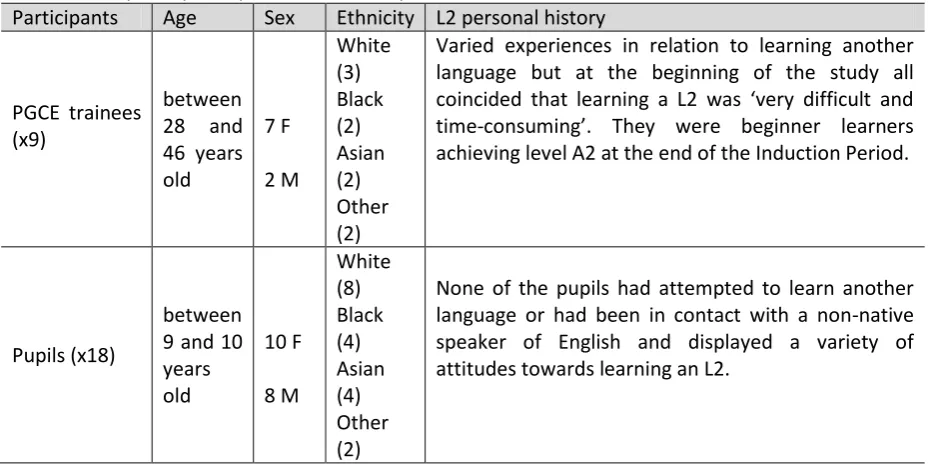
Table 4: Sample of participants in case study three
Participants Age Sex Ethnicity L2 personal history
PGCE trainees (x9)
between 28 and 46 years old
7 F 2 M
White (3) Black (2) Asian (2) Other (2)
Varied experiences in relation to learning another language but at the beginning of the study all coincided that learning a L2 was ‘very difficult and time-consuming’. They were beginner learners achieving level A2 at the end of the Induction Period.
Pupils (x18)
between 9 and 10 years old
10 F 8 M
White (8) Black (4) Asian (4) Other (2)
None of the pupils had attempted to learn another language or had been in contact with a non-native speaker of English and displayed a variety of attitudes towards learning an L2.
Presentation, Practice and Production (PPP)
The approach used in this group consisted of three stages:
Presentation: The teacher drew learners’ attention to a specific form or structure through contextualised use. The teacher encouraged learners to formulate a rule to explain the use of the structure under consideration. Learners were given the opportunity to produce the form themselves in controlled circumstances.
Practice: Teachers’ control eased gradually and learners worked on the particular form, initially in controlled conditions and then in freer exchanges, using pictures and other visual or verbal stimuli.
Production: Learners engaged in open practice, free of teacher control, where the focus was on meaning. The aims were to consolidate what had been learnt in the preceding phases and extend learners' ability to apply the item in other contexts.
Trainees:
The training model followed a mainstream practice of interaction between mentor and trainee where the former was the one modelling teaching for trainees to follow. In interviews, trainees claimed that knowing the topics in advance of lessons was useful because they had an opportunity to revise and, if unsure of their subject knowledge, they could ask mentors for support. The trainees were not keen on adapting their teaching if this was not explicitly stated by mentors who checked plans prior to trainees’ lessons in their role as experts.
JPD:4:1: 10
of other subjects. This was reflected in the results of the language audit, showing that only three trainees managed to move up a sub-level and only in reading.
Pupils:
Spanish was taught twice a week, with pupils not appearing excited about these lessons; the lack of motivation normally led to different forms of disruption. However, the children were eager to use their language skills. Children’s production was formulaic and exchanges were memorised by rote learning facilitated by the use of long repetition drills. The language audit results showed that all pupils in the sample achieved level A2 with a high development in all skills, with speaking being the most developed.
Findings
Using a talk partner technique facilitated exploratory talk, encouraging adult learners (trainees and mentors) to develop their L2 subject knowledge, challenging negative past experiences, reducing learning anxiety, and increasing teaching confidence. The use of strategies also encouraged self-regulation, giving mentors and trainees’ independence in planning what to learn and how this should be done.
The model of cognitive apprenticeship used in the EG showed that both trainees and mentors built upon each other’s strengths by working collaboratively. This resulted in a transformation of teaching practices, enabling mentors to learn from trainees and vice versa. A training model based on a linear relationship, as used in the CG, only focused on the trainees emulating the mentors, perpetuating practice.
Although the learning outcomes resulting from the SBI approach with adult learners were positive, this was not the case with children. The PPP model provided a structure for learning which was highly controlled by the teacher as opposed to the learners themselves, as was the case in the EG. Children following the PPP model achieved better outcomes than those in the EG. The children in the CG could use the L2 with better memory recollection, accurate pronunciation and grammatical accuracy. Although better results were achieved in the CG, the L2 production was much more scripted and highly controlled than children using language strategies, who were more willing to try out spontaneous language. Finally, the number of children becoming disengaged in the CG was considerably higher than those in the EG, who managed to remain on-task for longer periods without losing focus, producing fewer opportunities of low-level disruption.
Conclusion
JPD:4:1: 11
References:
Allen, P., Fröhlich, M. & Spada, N. (1984) The communicative orientation of language teaching: an observation scheme. In Handscombe, J., Orem, R. & Taylor, B. (Eds.) TESOL, Washington, D.C.: TESOL.
Altrichter, H., Feldman, A., Posch, P. & Somekh, B. (2008) Teachers investigate their work: an introduction to action research across professions. 2nd Ed. Oxon: Routledge.
Buss, A. (1979) A dialectical psychology. New York: John Wiley & Sons Inc.
Chamot, A. (2004) Issues in language learning strategy research and teaching. Electronic Journal of Foreign Language Teaching, vol. 1, issue 1, pp. 14 - 26.
Cohen, A. & Macaro, E. (2007) Language learning strategies. Oxford: OUP.
Griffith, C. (2007) Language learning strategies: students’ and teachers’ perceptions. English Language Teaching Journal, vol. 61, issue 2, pp. 91-99.
Jaworski, B. (2006) Theory and practice in mathematics teaching development: critical inquiry as a mode of learning in teaching. Journal of Mathematics Teacher Education, vol. 9, pp. 187-211.
Kouritzin, S.; Piquemal, N. & Nakagawa, S. (2007) Pre-service teacher beliefs about foreign language teaching and learning. Journal of Multilingual and Multicultural Development, vol. 28, issue 3, pp. 220-237.
Lave, J. & Wenger, E. (1991) Situated learning: legitimate peripheral participation.. Cambridge: CUP.
Little, D.D.L. (2005) The Common European Framework and the European Language Portfolio: involving learners and their judgements in the assessment process. Language Testing, vol. 22, no. 3, pp. 321-336.
O'Malley, J. & Chamot, A. (1990) Learning strategies in second language acquisition. Cambridge: CUP.
Oxford, R. (2011) Teaching and researching language learning strategies. Harlow: Pearson. Oxford, R. (1990) Language learning strategies: what every teacher should know. New York:
Newbury House/Harper Collins.
Rifkin, B. (2000) Mentoring foreign language teaching assistants, lecturers and adjunct faculty. Michigan: Heinle & Heinle.
Rubin, J. (1975) What the good language learner can teach us. TESOL Quarterly, Volume 9, pp. 41 - 51.