consider when developing
legislation and policy to improve
discovery of child abuse
by Dr Emma Davies, Dr Ben Mathews,
and Professor John Read
IALS Student Law Review | Volume 2, Issue 1, Autumn 2014 Special Issue, pp. 9-28 | Page 9 This work is licensed under a Creative Commons Attribution-NonCommercial-NoDerivs 3.0 Unported License
Abstract
In the United Kingdom, recent investigations into child sexual abuse occurring within schools, the Catholic Church and the British Broadcasting Corporation, have intensified debate on ways to improve the discovery of child sexual abuse, and child maltreatment generally. One approach adopted in other jurisdictions to better identify cases of severe child maltreatment is the introduction of some form of legislative mandatory reporting to require designated persons to report known and suspected cases. The debate in England has raised the prospect of whether adopting a strategy of some kind of mandatory reporting law is advisable. The purpose of this article is to add to this debate by identifying fundamental principles, issues and complexities underpinning policy and even legislative developments in the interests of children and society. The article will first highlight the data on the hidden nature of child maltreatment and the background to the debate. Secondly, it will identify some significant gaps in knowledge that need to be filled. Thirdly, the article will summarise the barriers to reporting abuse and neglect. Fourthly, we will identify a range of options for, and clarify the dilemmas in developing, legislative mandatory reporting, addressing two key issues: who should be mandated to report, and what types of child maltreatment should they be required to report? Finally, we draw attention to some inherently different goals and competing interests, both between and within the various institutions involved in the safeguarding of children and the criminal prosecution of some offenders. Based on this analysis we offer some concluding observations that we hope contribute to informed and careful debate about mandatory reporting.
Introduction
“Child abuse or maltreatment constitutes all forms of physical and/or emotional ill-treatment, sexual abuse, neglect or negligent treatment or commercial or other exploitation, resulting in actual or potential harm to the child’s health, survival, development or dignity in the context of a relationship of responsibility, trust or power.” (World Health Organisation, 1999).
This WHO definition summarises the many dynamics and types of child maltreatment. At the severe end of the spectrum of maltreatment, there can be serious adverse physical, mental health, behavioural, educational, social, and economic consequences.1 This article deals with issues related to the central challenge for society in how to identify severe cases of child maltreatment that occur in private, against children who are typically unable to protect themselves or seek assistance. It is
1 X. Fang; D. Brown; C. Florence; J. Mercy , 'The economic burden of child maltreatment in the United States and implications
IALS Student Law Review | Volume 2, Issue 1, Autumn 2014Special Issue: Law Reform and Child Protection |Page 10 therefore necessary to start with the data on the hidden nature of child maltreatment before outlining the background to the debate in England and Wales.
Hidden nature of child maltreatment
Analysis of data of reports to child protection authorities in the USA and Canada shows that children and perpetrators rarely report abuse themselves. 2 Child abuse and neglect occurs in a situation of power imbalance characterised by physical, psychological, emotional, cognitive, social and/or economic inequality and dependency. It is unsurprising then that children rarely disclose their own suffering, and, in severe cases, those who inflict the abuse or neglect are unlikely to.
The extent of undisclosed abuse in the general population is, by definition, an unknown quantity. However, it is clear from the discrepancy between population incidence studies and officially-recorded identified cases that significant child abuse remains hidden in all countries in which research has been conducted.3 To provide some specific examples, research indicates that many children do not disclose to authorities physical violence causing injury.4 For sexual abuse, which is most frequently perpetrated by a trusted figure known to the child, and which is often accompanied by a multifactorial power dynamic, nondisclosure and long-delayed disclosure is typical5. In addition to the influence of the power dynamic, non-disclosure and delayed disclosure are further entrenched due to the inherent secrecy, the grooming process, and feelings of shame, guilt and embarrassment, which are characteristic of child sexual abuse.6 Nondisclosure can also be influenced by threats and fear of reprisals to the child or other family members7, and by the child’s pre-verbal state or youth.8 Nondisclosure is also indicated in clerical abuse, a situation also characterised by multifactorial power dynamics.9
Some examples indicate the extent of non-disclosure and delayed disclosure. In New Zealand, only 4% of 191 women who had received therapy as adults for childhood sexual abuse had told someone about the abuse immediately, and only 13% had told someone a year after the abuse started. More than half (54%) took more than ten years to tell. The average time was 16.3 years. In only 15% of cases had the abuse ever been ‘reported to the Police or to a child protection worker such as a social worker’.10 In the USA, Smith11 found that only 12 per cent of 288 female child rape victims had ever reported their assaults to authorities, and over 25 per cent had never disclosed their
2 B. Mathews , 'Exploring the contested role of mandatory reporting laws in the identification of severe child abuse and neglect'
[2012] In M Freeman (ed) Current Legal Issues; Law and Childhood Studies, Oxford University Press, Oxford 302
3 B. Millard; J. Flatley (2010). Experimental statistics on victimisation of children aged 10 to 15: Findings from the British Crime
Survey for the year ending December 2009 England and Wales. London: Home Office Statistical Bulletin 11/10; p 11; National Crime Intelligence Service (2005). UK threat assessment: the threat from serious and organised crime 2004/5–2005/6. London: NCIS; C. May-Chahal; P. Cawson, 'Measuring child maltreatment in the United Kingdom: A study of the prevalence of child abuse and neglect' [2005] Child Abuse & Neglect 969; L. Radford; S. Corral; C Bradley; H. Fisher; C. Bassett, Child abuse and neglect in the UK today (1st, NSPCC., London 2011); AJ. Sedlak; J. Mettenbur; M. Basena; I. Petta; K. McPherson; A. Greene; S. Li,Fourth National Incidence Study of Child Abuse and Neglect (NIS-4): Report to Congress (US Department of Health and Human Resources. Administration for Children and Families, Washington DC 2010)
4 See Millard n 3 above
5 M. Paine; D. Hansen, 'Factors influencing children to self-disclose sexual abuse' [2002] Clinical Psychology Review 271; D.
Smith; E. Letourneau; B. Saunders, 'Delay In disclosure of childhood rape: Results from a national survey' [2000] Child Abuse & Neglect 273; McElvaney, 'Disclosure of child sexual abuse: Delays, non-disclosure and partial disclosure. What the research tells us and implications for practice' [2013] Child Abuse Review doi: 10.1002/car.2280
6 See McElvaney n 5 above; S. Kogan , 'Disclosing unwanted sexual experiences: results from a national sample of adolescent
women' [2004] Child Abuse & Neglect 147; P. Ney; C. Moore; J. McPhee; P. Trought , 'Child abuse: A study of the child’s perspective' [1986] Child Abuse & Neglect 511
7 S. Palmer; R. Brown; N. Rae-Grant; M. Loughlin , 'Responding to children’s disclosure of familial abuse: What survivors tell
us' [1999] Child Welfare 259
8 L Berliner; J.R. Conte, 'The process of victimization: The victims' perspective ' [1990] Child Abuse & Neglect 29
9 P. Parkinson; K. Oates, 'A. Jayakody ‘Breaking the long silence: Reports of child sexual abuse in the Anglican Church of
Australia' [2010] Ecclesiology 183; John Jay College of Criminal Justice. (2004). The nature and scope of sexual abuse of minors by Catholic priests and deacons in the United States, 1950-2002. Washington, DC: United States Conference of Catholic Bishops
10 J. Read; K. McGregor; C. Coggan; D. Thomas, 'Mental health services and sexual abuse: The need for staff training. ' [2006]
Journal of Trauma and Dissociation 33
IALS Student Law Review | Volume 2, Issue 1, Autumn 2014Special Issue: Law Reform and Child Protection |Page 11 assault to anyone prior to the study. A national study in the USA found that of 416 women and 169 men who suffered child sexual abuse, 33 per cent and 42 per cent respectively had never disclosed it before the study, and a further 24 per cent and 14 per cent had only disclosed at least one year after the events.12 In the United Kingdom, a national study found that 10 per cent of respondents reported having been sexually abused as a child involving sexual contact, with a further 6 per cent reporting experience of non-contact abuse;13 figures which far exceed cases coming to the attention of government agencies. This raises the fundamental question of the role of the State in bringing more cases to its attention.
Background to the UK debate
England and Wales currently have ‘statutory guidelines’ that emphasise to professionals who work with children the importance of sharing information with each other and of reporting their concerns about child maltreatment. However, at the time of writing there is no legislation that places a legal duty on anyone to report suspected child abuse or neglect
Child abuse occurring within institutions, and developing advocacy movements
In England and Wales, there is a growing movement of adult survivors of sexual abuse in schools and religious institutions that is demanding stronger actions from the State. While this institutional phenomenon of abuse is not new, the movement that is speaking out to demand action is a relatively new phenomenon. It follows in the path of the child protection, women’s and children’s movements that have brought various forms of child abuse and neglect onto the political agenda in the last half century.14 This newer social movement is challenging the State to work out the best ways to respond. These challenges to the status quo are healthy signs of a robust liberal democracy if the child protection system, the experiences of children, and the health of the public as a whole is to continually improve.
Animating this movement are recent high profile prosecutions of teachers in schools,15 and investigations into the BBC16 and the Catholic Church,17 which have documented long-standing child sexual abuse within some institutions. Cases investigated in English schools in 2011 and 2012 indicate that this is not only a historical problem. In 2013, the National Crime Agency examined child sexual abuse in institutional settings and the House of Commons Home Affairs Select Committee looked into systemic responses to organised child sexual exploitation. Both investigations similarly recommended that options for a form of mandatory reporting should be given serious consideration.
Discussions have come to the attention of parliamentarians with the result that on 24th March 2014, The Secretary for State, Rt Hon Gove responded to a parliamentary question with the following comment:
‘I have had the opportunity … to talk to one victim of abuse who, I have to say, made a compelling case for mandatory reporting in a regulated setting. I had hitherto been concerned that mandatory reporting might create more work for children’s services departments than it would generate safety for children, but the specific case for reporting in regulated settings is one that we are actively reviewing.’
12 D. Finkelhor; G. Hotaling; I. Lewis; C. Smith , 'Sexual abuse in a national survey of adult men and women: Prevalence,
characteristics, and risk factors' [1990] Child Abuse & Neglect
13 See May-Chahal; P. Cawson n 3 above
14 D. Finkelhor, 'The ‘Backlash’ and the future of child protection advocacy: Insights from the study of social issues ' in JEB
Myers (eds), The Backlash: Child protection under fire (Thousand Oaks: Sage Publications., 1994)
15< http://truevisiontv.com/films/details/97/> accessed 05/10/2014 chosen for coverage in the Mail and the Times. 16
<http://www.nspcc.org.uk/news-and-views/our-news/child-protection-news/13-01-11-yewtree-report/yewtree-report-pdf_wdf93652.pdf> accessed 05/10/2014
17 Conclusions of the UN Committee on the Rights of the Child on the Vatican
IALS Student Law Review | Volume 2, Issue 1, Autumn 2014Special Issue: Law Reform and Child Protection |Page 12 On March 25th 2014, the National Society for the Prevention of Cruelty to Children announced their intention to engage in the debate about ‘how to strengthen professional and institutional duties in order to better protect children’.18 The year before the 2015 general election, the issue appears to be on the radar of both major political parties. It remains to be seen whether this debate will lead to thoughtful, effective change, and whether it will be sustained into the next term of government.
Gaps in knowledge
One feature of this context which impedes fully-informed discussions, yet which suggests areas where improvements can be made, is in the existing evidence base about the nature and extent of different types of child abuse and neglect both generally, and within institutions. Although it is well recognised that research evidence is only one dimension in policy development,19 sound policy responses should be informed by sufficient and reliable evidence about the phenomena. This allows an informed assessment of the presence and extent of relevant problems, which can then be used to generate appropriate responses.
Data on reporting of child abuse and neglect, and outcomes of reports
There are sporadic reports about the prevalence of child maltreatment in the UK20 that give an indication of the prevalence of maltreatment. However, despite occasional data on reports of child maltreatment, there are no detailed annual data collected or published by the relevant Department (previously the Department for Children, Schools and Families, now the Department for Education) about the reports made by different reporter groups (e.g. police, teachers, nurses, doctors, social workers) of known or suspected cases of each different type of child abuse and neglect, and the outcomes of those reports by maltreatment type and reporter group. This means that we cannot know ‘how well’ we are doing in identifying severe cases of child maltreatment, or in responding to them, either as a whole, or by specific type of child abuse. This impedes identification of where we are doing reasonably well, where we are doing less well (including understanding the extent of undesirable systems burden created by reporting practices that are not desired or merited), and of problems that can be solved.
Although this lack of data and knowledge is by no means unique to the UK, it is a significant problem. Any response to public health problems, including child abuse and neglect, should ideally incorporate a commitment to both the assessment dimension of the public health model (diagnosis of the problem by data collection and analysis) to inform its policy dimension (use of the knowledge generated to develop strategic policy) and its assurance dimension (actual design and delivery of educational and treatment services).21 Hence, more comprehensive research and improved administrative data provides a better understanding of current referral patterns and outcomes, consolidating baseline data to inform optimal responses and developments to legislation and policy and practice, which can then be monitored over time.
18 <http://www.nspcc.org.uk/news-and-views/latest-news/2014/mandatory-reporting/mandatory-reporting_wda101963.html>
accessed 05/10/2014
19 E. Davies; E. Rowe, 'From research, through policy and politics to practice: Learning from experience' [2014] International
Journal of Sociology and Social Policy 34
20 See May-Chahal; P. Cawson n 3 above
21 B. Turnock, Public Health: What It Is and How It Works (4th, Jones and Bartlett, Sudbury, MA. 2009); L. Gostin, Public Health
IALS Student Law Review | Volume 2, Issue 1, Autumn 2014Special Issue: Law Reform and Child Protection |Page 13 The institutional context
Abuse within institutions presents particular challenges for government, local government, and community institutions. A primary role of the Local Authority Designated Officer (LADO) is to capture concerns and allegations of child abuse and neglect from a range of community institutions. However, each LADO currently collates data differently. York Consulting (2012) identified 4536 allegations of child physical or sexual abuse committed by teachers or non-teaching staff in schools from an examination of records in 110 Local Authorities. The vast majority of cases were not reported to external agencies and there was considerable variation in reporting practices across schools and local authorities. Outcomes from 21% of the allegations were unknown. The authors recommended standardisation of processes and systems for recording of allegations of abuse. This would enable better monitoring of the impact of policies and guidance determined by central government.
Many of the protocols within community organisations (e.g., sports clubs and religious institutions) encourage investigations of allegations against volunteers and staff to be handled internally first, with reporting upwards in the hierarchy of the institution, not outwards to another agency with less vested interest in protecting the reputation of the institution (e.g., Football Association Guidelines, 2014; United Nations Committee on the Rights of the Child, 2014). The United Nations Committee on the Rights of the Child report on the Vatican is particularly informative; confidentiality agreements and lack of prosecutions of known perpetrators of sexual abuse are clear. The extent to which similar processes occur in other community institutions is unknown as confidentiality agreements can prevent abuse coming to the attention of the State. If legislation could reduce institutions’ ability to hide known child abuse, and data collection processes were improved, the extent of the problem within community organisations that look after children would be better understood.
Professionals’ knowledge, attitudes, perceptions and reporting practices
In addition, there are few studies about important dimensions of the child abuse reporting context. This is a multifaceted and complex context, and the relevant questions are many and varied. However, generating reliable evidence about these phenomena is necessary to avoid operating from an uninformed position, or based on simplistic generalisations. What do the members of different professional groups know about their policy-based duty to report different kinds of child maltreatment? To what extent is their knowledge accurate? What do they know about the different kinds of child maltreatment? Are they reasonably adept in knowing the indicators of maltreatment, and do they know how to make a useful report? Do they know when they should not report, but take some other kind of helpful action? What are their attitudes towards reporting? Have they reported cases of severe abuse or neglect when they knew or had a sufficient suspicion it had happened or was happening? If not, why not, and what would have helped them? What are their perceptions of current child welfare systems? Are they reluctant to report some kinds of abuse, and if so, why, and how might this be remedied? For different professional groups, and for different types of child maltreatment, what factors influence and impede effective reporting? Do any particular reporter groups display clearly inappropriate reporting, and if so, what factors contribute to this? Are there reporter groups who report very effectively, and if so why? Are reporters adequately trained to be able to fulfil their reporting role? What educational measures are most effective in preparing reporters for their role? Do child protection systems interact effectively with reporters?
IALS Student Law Review | Volume 2, Issue 1, Autumn 2014Special Issue: Law Reform and Child Protection |Page 14
Barriers to Reporting
In jurisdictions both with and without mandatory reporting laws, there are factors that inhibit reporting of cases of child abuse and neglect. Some of these are inherent to this difficult context. For example, many health conditions, and many other normal adversities suffered in childhood, mimic the indicators of various types of abuse and neglect, and so it can be very difficult to confidently diagnose a situation as involving maltreatment. Studies have frequently found a key factor in failing to report cases of abuse is that the reporter is not sufficiently certain that the situation in fact involves maltreatment.22
Of itself, this should not produce an unreasonably negative impression of reporting practice, or the influence or effectiveness of reporting policies or laws. No law or policy in this context is created on the basis that ‘perfect’ reporting will eventuate. For some forms of abuse, it is extremely difficult to distinguish between injury or behaviour caused by abuse as opposed to being caused by non-abusive conditions, even for the few groups of reporters such as doctors and nurses who can make physical examinations and ask questions of the child and her or his parents. Many medical conditions closely mimic abuse-related injuries. Serious intentional head injuries are often misdiagnosed.23 Sexual abuse is very difficult to identify even with physical examinations; even penetrative abuse frequently leaves no physical sign of occurrence24. This does not mean that a social policy such as legislative or policy-based reporting has failed. It should be remembered that the fair measure of a policy’s success is not whether it is ever unsuccessful, or even unsuccessful some of the time;25 rather, it should be approached on the basis of whether, on balance, the policy creates a better situation for those whose welfare it is developed.
In addition, many instances of ‘failure’ to report arise from low-level circumstances of abuse or neglect, or arise in other situations where there is an acceptable reason for not reporting. On their face, these ‘failures’ to report may appear to evince a failure of policy in action; but in fact, some of them may be appropriate exercise of discretion. So, where studies show that a proportion of reporters have on occasion not reported a suspected case, it needs to be borne in mind that the case or cases they chose not to report may have involved, for example, a very mild situation of neglect which should not have been reported, or a situation which the reporter knew had already been brought to the attention of welfare agencies and was being dealt with.
Yet, there is reason to believe that some instances of failure to report contravene the letter and spirit of the reporting law or policy. There appear to be some more common reasons for such action. Among the most commonly identified reasons for professionals not reporting abuse and neglect in other countries are inadequate training in the indicators of child abuse leading to a lack of awareness of probable abusive situations, lack of knowledge of reporting obligations and procedure, fear of negative consequences for reporters, and fear of negative results of reporting for the child26. While most paediatricians in the USA perceived child protection intervention positively,27
22 J-Y Feng; M. Levine , 'Factors associated with nurses’ intention to report child abuse: a national survey of Taiwanese nurses'
[2005] Child Abuse & Neglect 783; S. Kalichman; C. Brosig , 'Practicing Psychologists’ Interpretations of and Compliance with Child Abuse Reporting Laws' [1993] Law and Human Behavior 83; B. Mathews; K. Walsh; M. Rassafiani, 'Teachers reporting suspected child sexual abuse: results of a three-State study' [2009] University of New South Wales Law Journal 772; G. Zellman, 'Child Abuse Reporting and Failure to Report among Mandated Reporters' [1990] Journal of Interpersonal Violence 3
23 C. Jenny; K. Hymel; A. Ritzen , 'Analysis of Missed Cases of Abusive Head Trauma' [1999] JAMA 681
24 J. Anderst, N. Kellogg, I. Jung, 'Reports of Repetitive Penile-Genital Penetration Often Have No Definitive Evidence of
Penetration' [2009] Padiatrics 403,
25 Victorian Law Reform Commission. (1988). Sexual Offences Against Children, Report No 18, Victorian Law Reform
Commission, Melbourne.
26 K.M. Alvarez, M.C. Kenny, B. Donohue, KM Carpin, 'Why are professionals failing to initiate mandated reports of child
maltreatment, and are there any empirically based training programs to assist professionals in the reporting process? ' [2004] Aggression and Violence Behavior 563; B. Mathews; C. Goddard; B. Lonne ; S. Short; F. Briggs, 'Developments in Australian laws requiring the reporting of suspected child sexual abuse' [2009] Children Australia 18; A.M. Pietrantonio; E. Wright; K.N. Gibson; T. Alldred; D. Jacobson; A. Niec, 'Mandatory reporting of child abuse and neglect: Crafting a positive process for health professionals and caregivers ' [2013] Child Abuse & Neglect 102
27 E.G. Flaherty; R.D. Sege; J. Griffith; L.L. Price; R. Wasserman; E. Slora, 'Pediatrician characteristics associated with child
IALS Student Law Review | Volume 2, Issue 1, Autumn 2014Special Issue: Law Reform and Child Protection |Page 15 paediatricians in Canada and the USA who have had negative experiences of child protection services may be less likely to report, for fear of doing more harm than good.28 Furthermore, American paediatricians’ direct experiences of the court system, positive or negative, has also been found to affect whether or not they would be inclined to report again.29 The extent to which these issues reflect the perceptions and actions of paediatricians and other child-focused professionals in England and Wales is unknown. Further, these findings need to be treated with care, as they may apply to some, but not all types of abuse or neglect, and to some, but not all reporter groups. In addition, reporters may possess certain attitudes or perceptions about the consequences of reporting, which influence their choice not to report, which are factually incorrect. Nevertheless, these findings can indicate areas where law, policy, systems and supportive mechanisms like reporter training can be enhanced.
Reporting by medical professions in the UK
One particular barrier to reporting can be confined to jurisdictions without mandatory reporting legislation and its protective shields for reporters. In England and Wales, paediatricians have reported anxiety about parental complaints and fear of disciplinary action if reports are made and subsequently not substantiated. 30 High-profile cases of complaints against some paediatricians appear to have impacted on others’ willingness to report and to take on leadership roles in child protection in the health system in the UK.31 Government departments and the House of Lords have since provided reassurance and confirmation that paediatricians’ first legal duty is to the care of the child so that reports should be made where appropriate32, but it appears that anxiety within the profession remains. The existence and fear of complaints and civil administrative proceedings in the UK is understandable and is made possible because, unlike jurisdictions with mandatory reporting legislation – where reporters receive immunity from such actions – a softer policy-based duty to report provides no such protection. This is one advantage of situating reporting duties in legislation as these shields for reports made in good faith can be provided by legislation, but not by policy. In addition, for the few outlier situations of bad faith reports, legislation can render the reporter liable to damages in common law and, where applicable, professional misconduct consequences.
Training to overcome barriers
Professionals who work with children should have child protection training in an effort to ensure that they record, link up and report signs of abuse. Training on safeguarding children can help professionals to understand signs and dynamics of abuse and severe neglect, the role of the reporter and the roles of other safeguarding team members, develop sound attitudes towards reporting and confidence in the value of their role in the child protection system, and can increase understanding of how to implement the current policies of their institutions.33 Studies have repeatedly found that mandated reporters often have not had the training required to equip them to fulfil their role, which
28 See Pietrantonio n 26 above; R. Jones; E. Flaherty; H. Binns, 'Clinicians’ Descriptions of Factors Influencing Their Reporting
of Suspected Child Abuse: Report of the Child Abuse Reporting Experience Study Research Group ' [2008] Pediatrics 259
29 A.D. Theodore; D.K. Runyon, 'A survey of pediatricians’ attitudes and experiences with court cases of child maltreatment'
[2006] Child Abuse & Neglect 1352
30 L. Haines; J. Turton, 'Complaints in child protection ' [2008] Arch Dis Child 4; Royal College of Paediatrics and Child Health.
(2004). Child protection complaints survey. London: RCPCH.
31 R. Mittal; R. Marsden; A. Elbadri, 'Are future paediatricians trained for handling child protection issues?' [2005] Arch Dis Child
A42–3; B. Mathews; H. Payne; C.; D. Chadwick, 'A Way To Restore British Paediatricians’ Engagement With Child Protection' [2009] Archives of Disease in Childhood 329
32 P. Cummins; D. Scott; B. Scales, Report of the Protecting Victoria's Vulnerable Children Inquiry (Department of Premier and
Cabinet, Department for Children, Schools and Families and Department of Health, State of Victoria 2007) Volume 3; JD v East Berkshire Community Health NHS Trust & Ors, [2005] UKUL 23
33 K. Walsh; M. Rassafiani; D. Butler; A. Farrell, 'Teachers reporting suspected child sexual abuse: results of a three-State
IALS Student Law Review | Volume 2, Issue 1, Autumn 2014Special Issue: Law Reform and Child Protection |Page 16 can produce both failure to report, and clearly unnecessary reporting. 34 Evidence indicates that reporters how have received training demonstrate better reporting practice35, and it is generally accepted that high quality and repeated training is highly desirable. However, the evidence-base for the differential quality of specific training programmes appears very weak36 and it is unclear what components and mechanisms of training are most likely to work best for respective reporter groups.
Those persons who are required by such laws to report suspected maltreatment require excellent, and repeated, training to ensure they have a sound knowledge of the indicators of various types of maltreatment, what types of maltreatment they are required to report, the state of mind required which activates their reporting duty (which is not certainty, or even a state of mind near this; reporters are not expected to be perfect), the protections provided to them upon making a report, and how to make a report.
Moreover, training about laws, policies and processes may not be capable of addressing all dimensions of the ways that adults respond to child maltreatment. Festinger’s seminal social psychological theory of ‘cognitive dissonance’ may provide some insight into why it might appear that some adults find it difficult to ‘see’ child abuse in front of them. Cognitive dissonance is a process that occurs when conflicting attitudes, beliefs or behaviors make people feel uncomfortable.37 So to reduce that feeling of discomfort, people need to change one of their attitudes, beliefs or behaviors. So, for example, a situation where a colleague is pleasant to work with, yet the adult is also seeing the colleague working inappropriately with a child in his care, might raise conflicting thoughts about the colleague. To reduce this discomfort, the adult might be tempted to disregard the inappropriate contact witnessed between the colleague and the child, hereby reducing the anxiety associated with dissonance while preserving a positive image of the colleague. Attitudinal change is a required goal of an effective training approach.
Many people are frightened of conflict. Some will avoid it all costs. It might be terrifying to get involved and take the risk of being wrong. The defense mechanism of ‘rationalization’ may also likely help people to avoid intervening e.g., this is not my job; nothing will happen anyway; by saying something I might make matters worse; who knows where the bruises come from – the child may have fallen over; I don’t know the exact procedures to follow, and so on. And perhaps of most importance, it takes courage to intervene. The process of denial of the child’s pain serves to protect adults from something that is hard to cope with, especially, perhaps, if they have experienced child abuse or neglect themselves. This ‘gaze aversion’ is precisely what influenced Kempe’s38 recommendation for a legal obligation to require professionals to act on clear cases: they were consciously avoiding doing anything about the child’s situation. When New Zealand psychiatrists and psychologists were asked why they sometimes do not ask adult patients about child abuse, the two most common responses were that they had more important or urgent things to deal with and that it would cause distress to patients. None identified the possibility that talking about abuse might also be
34 N. Abrahams, K. Casey, D. Daro, 'Teachers' knowledge, attitudes, and beliefs about child abuse and its prevention' [1992]
Child Abuse & Neglect 229; C.W. Christian, 'Professional Education in Child Abuse and Neglect' [2008] Pediatrics S13; A. Reiniger; E. Robison; M. McHugh , 'Mandated Training of Professionals: A means for improving reporting of suspected child abuse' [1995] Child Abuse & Neglect 63; R. Hawkins; C. McCallum, 'Mandatory notification training for suspected child abuse and neglect in South Australian schools' [2001] Child Abuse & Neglect 1603; M. Kenny , 'Teachers’ attitudes toward and knowledge of child maltreatment' [2004] Child Abuse & Neglect 1311; B. Mathews, 'Teacher Education to Meet the Challenges of Child Sexual Abuse' [2011] Australian Journal of Teacher Education 13; S. Starling; K. Heisler; J. Paulson, 'Child Abuse Training and Knowledge: A National Survey of Emergency Medicine, Family Medicine, and Pediatric Residents and Program Directors ' [2009] Pediatrics e595; K. Walsh; R. Bridgstock; A. Farrell , 'Case, teacher and school characteristics influencing teachers’ detection and reporting of child physical abuse and neglect: Results from an Australian survey' [2008] Child Abuse & Neglect 983; See also Mathews etc. n 22 above
35 See Mathews and Kenny n 34 above 36 Note 26; See Pietrantonio n 26 above
37 L. Festinger, 'Cognitive dissonance' [1962] Scientific American 93
38 CH. Kempe; FN Silverman; BF Steele; W. Droegemueller; HK Silver , 'The Battered Child Syndrome' [1962] Journal of the
IALS Student Law Review | Volume 2, Issue 1, Autumn 2014Special Issue: Law Reform and Child Protection |Page 17 distressing to them.39 Training programmes need to go beyond knowledge of correct procedures and address the inevitable anxiety (sometimes described as ‘vicarious traumatization’) that can accompany confronting child abuse.40
There are no studies of many child-focused professionals’ (e.g., teachers and nurses) perceptions of the barriers and facilitators to reporting familial or extra-familial child maltreatment. This lacuna is one part of the gap in the evidence base in the UK as discussed above. In March 2014, the Department for Education (2014) published research priorities and questions on child protection, social work reform and intervention.41 These questions are intended to encourage government agencies, independent researchers, local authorities and non-government agencies to develop research projects in response. They included (p. 13):
· How could professional awareness of abuse and neglect be improved to achieve more appropriate referrals, and what motivates professionals to refer, or not?
· What are the barriers which prevent professionals who work with children referring safeguarding concerns about individual children to social services in an effective and timely manner?
· What interventions – including training, new procedures or regulations and legal requirements – have been shown to be most effective in improving the quality and consistency of referrals?
If this commitment to developing a robust evidence base is translated into reality, the UK will be well placed to formulate a thoroughly informed strategy to improve responses to serious child abuse and neglect in various professions who work with children, and child protection generally.
Options for Mandatory Reporting
Mandatory reporting legislation refers to specific kinds of statutory obligations that place a legislative duty to report designated types of child maltreatment on specified groups of persons, usually named occupational or professional groups who frequently encounter children in the course of their work. The underlying concept is to impose a requirement on designated people who are well-placed to detect cases of severe child maltreatment to report known and suspected cases to the attention of government agencies, so that measures can be taken to ensure the child is safe, that the maltreatment stops, that rehabilitation can be provided, that the needs of the child and the family can be identified and supported and, when appropriate, the perpetrator can be held to account.
There is some form of mandatory reporting in all 72 Australian, Canadian and American states, provinces and territories.42 There are also equivalent laws in some European countries e.g. Spain and France, although there are queries about their effectiveness.43 The laws set out which types and extents of maltreatment must be reported, and by which reporter groups. The state of mind activating the reporting duty is specified – usually in terms such as ‘suspects on reasonable grounds’ or sometimes ‘believes on reasonable grounds’, which technically is a higher state of certainty. Mechanisms for reporting (i.e. when and how the report is to be made and to whom) are detailed. Legislation nearly always includes a penalty for failure to report where the reporter has the required state of mind and chooses not to report. However, increasing quality reporting is the primary intention
39 J. Read; P. Hammersley; T. Rudegeair, 'Why, when and how to ask about child abuse' [2007] Advances in Psychiatric
Treatment 101
40 See Read n 39 above
41 <https://www.gov.uk/government/publications/social-work-and-child-protection-research-priorities-and- questions> accessed
05/10/2014
42 B. Mathews; M. Kenny, 'Mandatory Reporting Legislation in the USA, Canada and Australia: a Cross-jurisdictional Review of
Key Features, Differences and Issues' [2008] Child Maltreatment 50; See Mathews n 26 above
IALS Student Law Review | Volume 2, Issue 1, Autumn 2014Special Issue: Law Reform and Child Protection |Page 18 of the legislation, not prosecution of reporters. So, despite provisions enabling it, prosecution is infrequent in all jurisdictions.44 Mandatory reporters are given a guarantee of confidentiality concerning their identity as the reporter. In addition, provided the report is made in good faith, the reporter has immunity from liability in civil, criminal and administrative proceedings in relation to the report. This is an important difference between mandatory reporting legislation and the policy position in place via the statutory guidance currently implemented in England and Wales: legislation can protect reporters in ways that a policy cannot.45
A spectrum of approaches to designing a mandatory reporting law
For the most part, legislation requires professionals to report all concerns of sexual abuse, and severe cases of neglect, physical abuse, and psychological abuse. However, there is no single method of designing a mandatory reporting law and different jurisdictions have adopted slightly different variations to the basic schema, resulting in some jurisdictions’ mandatory reporting law being of broader scope than others. The dimensions of difference are, most prominently, which kinds of maltreatment have to be reported, and which groups have to report.
Accordingly, a spectrum of approaches can be identified. Some jurisdictions have a very narrow approach: Western Australia, for example, only requires reports of sexual abuse, and has a fairly restricted group of mandated reporters (police, teachers, doctors, nurses, midwives). A broader but still relatively narrow approach is exemplified in the Australian States of Victoria and the Australian Capital Territory, which only require reports of sexual abuse and physical abuse. Several jurisdictions restrict the reporting duty to situations where not only is the harm condition present, but the reporter believes the child does not have a parent who is willing and able to protect the child. A conventional approach, representing the normal middle range of the spectrum, is to require reports of serious harm or likely harm across all four categories of abuse, and to impose the requirement on a broad range of reporter groups. Beyond this, some jurisdictions in Australia, Canada and the USA have an even broader approach, which includes the normal conventional approach and adds new categories of harm which must be reported, such as a duty to report children’s exposure to domestic violence, as a duty for doctors to report exposure of a child to illegal drug activity, and a duty to report prenatal substance abuse before birth, or after birth.46
It can also be noted that different jurisdictions have adopted various ways of defining severe or serious maltreatment that must be reported.47 There are inevitably challenges of definition and implementation to pursue the intent of the legislation, namely to ensure that the most serious cases are brought to the attention of the State. With sexual abuse, this is somewhat easier to define; often, the law requires reports of all suspected cases of sexual abuse without consideration of the extent of harm, reflecting the view that sexual abuse is always of sufficient seriousness to warrant a report. For physical abuse, laws sometimes provide exhaustive or non-exhaustive lists of the injuries which must be reported, but in other instances, the conceptual term of ‘significant harm’ or a synonymous term is used, to leave the discretion in the hands of the reporter. For emotional abuse, the conceptual term of ‘significant harm’ or a synonymous term is used. The use of conceptual terms, such as ‘significant harm’, have the advantage of not unduly restricting the reporter’s judgment, but can cause problems due to ambiguity and vagueness. There is something to be said for incorporating as much clarity as possible in the legislation; however, good training should also provide reporters with clarity about the cases which should and should not be reported. For neglect, the duty is usually expressed as some variation of a failure to provide basic care and necessities of life so as to cause significant harm.
In sum, the major differences between existing laws lie in which groups of people are required to report; what types of child maltreatment have to be reported; the severity of harm that triggers the
IALS Student Law Review | Volume 2, Issue 1, Autumn 2014Special Issue: Law Reform and Child Protection |Page 19 duty to report and whether risks of future maltreatment (as well as past abuse) can trigger a duty to report.48 A legislature intending to create its first reporting laws, and any legislature continually monitoring its existing legislative approach, will benefit from careful consideration of several questions. Regarding the nature and scope of the laws, such questions include:49 (i) What types of maltreatment are required to be reported? (ii) Which occupations are to be mandated reporters? (iii) What state of mind is required to activate the reporting duty? (iv) What extent of harm, if any, is required to be reported; is this harm qualification the same for each subtype; and how is this to be expressed? (v) Are reports required only of past or present abuse, or are reports also required of suspected risk of future abuse (and if so, how is this to be expressed)? Legislatures and policymakers also will need to consider how reporters are to be trained, since it is well established that legislative reporting duties alone are insufficient.
Potential advantages and risks of mandatory reporting
The primary advantage offered by a legislative duty to report suspected serious maltreatment is that it is likely to result in better identification of cases and fewer instances of persons knowing or suspecting serious cases of abuse and choosing to ignore them. In the current UK context, the revelations of sexual abuse in particular, which continued to be perpetrated for years and sometimes decades, despite people knowing about it, has prompted a demand that some action occur to improve reporting of these cases and to prevent or at least minimise the likelihood of such wilful failure to respond. The sexual abuse context is particularly relevant because a small but nevertheless significant proportion of offenders have very large numbers of victims and continue to offend for decades; if their conduct had been interrupted earlier, many victims would not have suffered. Organisations such as the Coalition of Adult Survivors of Child Abuse is advocating for changes in legislation to make it mandatory for adults working in ‘regulated activities’ to report suspected abuse, with a criminal sanction for failure so to do.50 Regulated Activities are defined in the Safeguarding Vulnerable Groups Act 2006 (Schedule 4; Part 1).51 The definition covers a wide range of activities in which children are cared for in loco parentis by adults other than parents e.g., children’s homes, hospitals and schools.
A question raised is whether the reporting legislation does in fact result in better case identification. It is true that there is no perfect system and some abuse will remain unreported in all countries, including those with mandatory reporting,52 even when some cases are known. However, it does appear that mandatory reporting laws increase detection of serious abuse, and this has been acknowledged by Parliamentary debates in various jurisdictions as a driving force behind decisions to introduce the laws. The enhanced case identification is demonstrated by:
comparisons of overall case identification in jurisdictions with and without mandatory reporting53 comparisons of case identification by a specific reporter group (e.g. teachers) in jurisdictions with
and without mandatory reporting (for example, in Australia, over a two year period, teachers in a jurisdiction without mandatory reporting made three times fewer substantiated reports of child sexual abuse than did teachers in jurisdictions with mandatory reporting)54;
48 See Mathews n 2 above 49 See Mathews n 42 above
50 <https://twitter.com/mandatenow> accessed 05/10/2014
51 http://www.legislation.gov.uk/ukpga/2006/47/schedule/4 accessed 05/10/2014 52 See Sedlak n 3 above
53 B. Mathews; DC Bross , 'Mandated policy is still a policy with reason: Empirical evidence and philosophical grounds ' [2008]
Child Abuse & Neglect 511; B. Mathews; K. Walsh; D. Butler; A. Farrell, Report for New South Wales, Queensland and Western Australia: Teachers reporting child sexual abuse: Towards evidence-based reform of law, policy and practice (Queensland University of Technology, Brisbane 2010)
IALS Student Law Review | Volume 2, Issue 1, Autumn 2014Special Issue: Law Reform and Child Protection |Page 20 comparisons of case identification in jurisdictions before and after the introduction of mandatory
reporting;55
evidence regarding the influence of a legal duty changing a decision not to report a suspected case.56
The Victorian Law Reform Commission57 analysed empirical evidence and commissioned an independent analysis, and concluded (p 54-56, 66):
‘in each case [of the available evidence] there is evidence that a mandatory reporting law produces beneficial reporting behavior and better outcomes for children subject to sexual abuse.’
‘In short, mandatory reporting can significantly increase the detection of abuse without a massive waste of investigative resources, and without greater unwarranted intrusion into people's lives than a voluntary reporting system.’
‘criticisms [of mandatory reporting] have generally been directed at particular [implementation-related] aspects of the reporting systems, not at the principle of mandatory reporting itself’.
Opponents of mandatory reporting legislation claim that it has inadvertently reduced systemic ability to respond effectively to the most serious familial child abuse and neglect. Some commentators argue that more reports are unsubstantiated in countries with mandatory reporting and thus a higher proportion of time is wasted in at best futile, and at worst damaging, investigations.58 The primary fear is that mandatory reporting overloads the system so that children who are in most need of protective services lose out. This argument has been rejected by a major government inquiry in New South Wales, Australia, because non-mandated reporters make nearly half of all reports, and because a large proportion of reports are multiple reports about the same small group of children.59 Justice Wood and other recent Australian government inquiries in Victoria60 and Queensland have not recommended repeal, but have recommended enhancements for practical implementation. The number of children involved in all maltreatment notifications in Australia has fallen from 207,462 in 2008/09 to 173,502 in 2011/12,61 indicating that the ‘child protection net’ is not being continually and unsustainably widened. Increasing use of differential response mechanisms have likely contributed to this. Nevertheless, this argument against mandatory reporting requires careful unpacking in order to identify the broader political decisions and practical assumptions that sit underneath the argument.
First, it is clear that overall, mandatory reporting laws have increased the numbers of both substantiated and unsubstantiated reports in countries where they are implemented, compared with the situation before mandatory reporting.62 The precise extent to which more children are safer as a result is unknown. However, more abused and neglected children do come to the attention of welfare agencies and substantiation rates appear higher. For example, the number of children in
55 D. Lamond, 'The impact of mandatory reporting legislation on reporting behaviour' [1989] Child Abuse & Neglect 471; See
Mathews n 2 above
56 See Mathews n 26 above; H. Webberley, 'Child maltreatment reporting laws: Impact on professionals’ reporting behavior'
[1985] Australian Journal of Social Issues 118
57 See Victorian Law Commission n 25 above
58 F. Ainsworth, 'Mandatory reporting of child abuse and neglect: does it really make a difference?' [2002] Child & Family Social
Work 57; P. Hansen; F. Ainsworth, 'Australian child protection services: A game without end' [2013] International Journal of Social Welfare 104; M. Harries; M. Clare , Mandatory Reporting of Child Abuse: Evidence and Options; Report for the Western Australian Child Protection Council; Discipline of Social Work and Social Policy (University of Western Australia, Perth 2002); G.B. Melton; B. Holaday; R. Kimbrough-Melton, 'Community Life, Public Health, and Children’s Safety' [2008] Family and Community Health 84; E. Munro; N. Parton, 'How far is England in the process of introducing a mandatory reporting system? ' [2007] Child Abuse Review 5
59 J. Wood (2008). Report of the Special Committee of Inquiry into Child Protection Services in New South Wales, Sydney 60 See Cummins, Scott & Scales n 32 above
61Child protection Australia (Australian Institute of Health and Welfare, Canberra 2011–12) Child Welfare series no. 55. Cat.
no. CWS 43
IALS Student Law Review | Volume 2, Issue 1, Autumn 2014Special Issue: Law Reform and Child Protection |Page 21 substantiated cases since introduction of the laws has increased. Data from substantiation rates indicate higher case identification in jurisdictions with mandatory reporting opposed to those with it.63
Second, it appears that in systems with mandatory reporting the majority of statutory social workers’ time is not spent on investigations, but on addressing the needs of children and families. It is hard to access data on percentage costs in time spent on investigations within the system, but Darke and Jonson-Reid64 documented estimates ranging from 7.05% to less than 14% (including reunification services) of expenditure in child protection services in the USA is spent on investigations.
Third, investigations that lead to no substantiated abuse or neglect still frequently uncover problems that require help for the child and or the family.65 It is well understood that interventions early in the life of a problem are easier to deal with and might prevent abuse occurring. The thresholds for substantiation vary according to the pressure on the system as well as the needs of children and families. Unsubstantiated cases can still be a trigger for other needed services. Where investigated, many outcomes of investigations that are ‘not substantiated’ still involve abuse, and result in the provision of helpful services to children and families; in the USA a greater number of children and families in unsubstantiated cases receive helpful services than do those in substantiated cases.66 There are many reasons for a finding even after investigation of ‘not substantiated’, including presence of evidence of harm but absence of sufficient evidence of abuse, presence of evidence of abuse but absence of sufficient evidence of present harm, and direct referral to welfare agencies.
Fourth, related to this, for many reasons, it is not appropriate to simply look to substantiation rates of all reports as a reflection of the merit of mandatory reporting, or to define all unsubstantiated reports as unmerited reports and as ‘over-reporting’.67 Non-mandated reporters such as neighbours and family members make around 40% of all reports. Many reports are not investigated at all, but may be screened out, added to a known child’s file, or referred immediately to supportive welfare agencies to assist with family need. Arguably a better reflection of reporting ‘effectiveness’, especially if assessing the investigation burden, is the substantiation rate of investigated cases and the practical outcome for the child and family of investigated cases where the report is not substantiated. This is not to say that there is no evidence of poor reporting practice. It appears, for example, that substantial increases in ‘undesired reports’ in the experience of some jurisdictions can be traced to reporting by one reporter group of one kind of maltreatment, in circumstances where the legislation and implementation of it was clearly flawed.68 These instances should and can be guarded against. Legislation, reporter training and public education should clearly define what should and should not be reported and should enable efficient reporting practice.
Finally, it has been argued that limited resources in the system mean that the focus in England and Wales should be doing better with the cases that are already reported rather than overloading the system with new cases.69 Data does indicate that demand is currently outgrowing expenditure on children’s services and there are indications that ‘child protection is becoming more tightly rationed’.70 Yet, if we accept that a system with some form of mandatory reporting produces better identification of cases of severe abuse and neglect, then this argument appears to ignore the
63 See Mathews & Bross n 53 above
64 B. Drake; M. Jonson-Reid, 'A response to Melton based on the best available data' [2007] Child Abuse & Neglect 343 65 See Darke & Jonson-Reid n 64 above
66 US Department of Health and Human Services, Child maltreatment 2007. (2009). US Government Printing Office,
Washington: DC.
67 B. Drake, 'Unravelling ”Unsubstantiated”' [1996] Child Maltreatment 261; P. Kohl; M. Jonson-Reid M; B. Drake, 'Time to leave
substantiation behind: findings from a national probability study' [2009] Child Maltreatment 17; See Darke & Jonson-Reid n 64 above; See also Mathews n 2 above
68 See also Mathews n 2 above
69 E. Munro (29th June, 2011). The Education Committee discussion of The Munro Review of child protection
<http://www.parliamentlive.tv/Main/Player.aspx?meetingId=8746> accessed 05/10/2014
IALS Student Law Review | Volume 2, Issue 1, Autumn 2014Special Issue: Law Reform and Child Protection |Page 22 situation of children whose experience will not come to the attention of welfare agencies. It suggests an acceptance that many of these cases of abuse will remain private, and that these children cannot be better protected with the involvement of the State in England and Wales. Such a conclusion seems to contain a fatalistic resignation to the status quo, which is difficult to imagine existing for other serious social and health concerns. Doubtless, there are frustrating systemic constraints, but surely we should continue to exhaust every avenue to expand systemic capacity and triaging and response methods by any and all political, financial and systemic means so that we can improve the performance of our role. If the extent of the success of the child protection system is simply accepted as always being bounded by the financial limits imposed on the system by the government of the day, then that is a recipe for a vulnerable and unprincipled system.
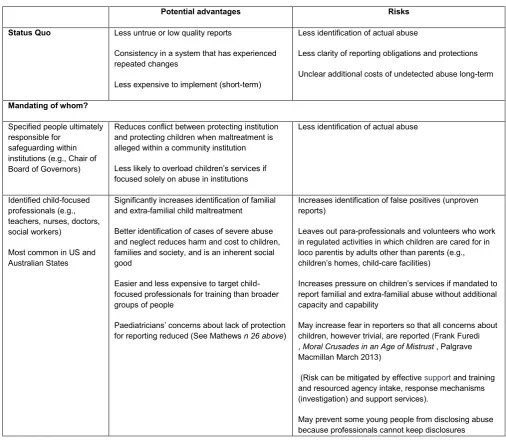
[image:14.595.41.548.326.766.2]Table 1 outlines the likely outcomes of various options for mandatory reporting focusing on the two key questions: mandating of whom, and about what? The broader the groups of people or employees of institutions mandated to report and the broader the types of maltreatment to be reported, the greater the likelihood of increased pressure on children’s services. This is particularly so in relation to the most common forms of maltreatment, emotional abuse and neglect within the family.
Table 1: Mandating whom, about what? Potential advantages and risks
Potential advantages Risks
Status Quo Less untrue or low quality reports
Consistency in a system that has experienced repeated changes
Less expensive to implement (short-term)
Less identification of actual abuse
Less clarity of reporting obligations and protections
Unclear additional costs of undetected abuse long-term
Mandating of whom?
Specified people ultimately responsible for
safeguarding within institutions (e.g., Chair of Board of Governors)
Reduces conflict between protecting institution and protecting children when maltreatment is alleged within a community institution
Less likely to overload children’s services if focused solely on abuse in institutions
Less identification of actual abuse
Identified child-focused professionals (e.g., teachers, nurses, doctors, social workers)
Most common in US and Australian States
Significantly increases identification of familial and extra-familial child maltreatment
Better identification of cases of severe abuse and neglect reduces harm and cost to children, families and society, and is an inherent social good
Easier and less expensive to target child-focused professionals for training than broader groups of people
Paediatricians’ concerns about lack of protection for reporting reduced (See Mathews n 26 above)
Increases identification of false positives (unproven reports)
Leaves out para-professionals and volunteers who work in regulated activities in which children are cared for in loco parentis by adults other than parents (e.g., children’s homes, child-care facilities)
Increases pressure on children’s services if mandated to report familial and extra-familial abuse without additional capacity and capability
May increase fear in reporters so that all concerns about children, however trivial, are reported (Frank Furedi , Moral Crusades in an Age of Mistrust , Palgrave Macmillan March 2013)
(Risk can be mitigated by effective support and training and resourced agency intake, response mechanisms (investigation) and support services).
IALS Student Law Review | Volume 2, Issue 1, Autumn 2014Special Issue: Law Reform and Child Protection |Page 23 confidential (See Walsh n 33 above)
All people within ‘regulated activities’ ‘Regulated Activities’ are defined in the Safeguarding Vulnerable Groups Act 2006 (Schedule 4; Part 1)
More significantly increases identification of
familial and extra-familial child maltreatment May significantly increase identification of false positives (unproven reports)
May increase fear in reporters so that all concerns about children, however trivial, are reported (Frank Furedi , Moral Crusades in an Age of Mistrust , Palgrave Macmillan March 2013)
May significantly increases pressure on children’s services if mandated to report familial and extra-familial abuse without additional capacity and capability
Prevents some young people from disclosing abuse to a trusted adult (See Walsh n 33 above)
All citizens
(Most common in Canadian States)
May increase identification of familial and
extra-familial child maltreatment May significantly increase identification of false positives May significantly increase pressure on children’s services without additional capacity and capability
May stop some young people from disclosing abuse (See Walsh n 33 above)
Mandating about what?
Sexual abuse in
institutions only Easier to define sexual and severe physical abuse in legislation for the purposes of reporting
Better identification of cases of these subsets of cases reduces harm and cost to children, families and society, and is an inherent social good
Members of professions involved have heightened professional and ethical role
Does not capture familial abuse and is theoretically and practically unsound as shown by flawed experiment in Queensland, Australia where such legislation was enacted (2004) and later expanded to all cases regardless of perpetrator (2012)
Creates a hierarchy in which familial abuse might be perceived as less serious than abuse in institutions. Sexual and severe
physical abuse within institutions only
All sexual and serious physical abuse (familial and extra-familial)
Better identification of cases of sexual abuse and severe physical abuse reduces harm and cost to children, families and society, and is an inherent social good
Creates a hierarchy in which emotional abuse and neglect might be perceived as less serious than sexual or physical abuse
Sexual, severe physical, serious emotional abuse and neglect within institutions
Likely increase in case identification in these
subsets of cases More difficult to clearly define serious emotional abuse and neglect for the purposes of reporting
Does not capture familial abuse
Inadvertently creates a hierarchy in which familial abuse might be perceived as less serious than abuse in institutions.
Sexual, severe physical, serious emotional abuse and neglect
(Most common in other countries)
Better identification of all these cases of severe abuse and neglect
Members of professions involved might have heightened professional and ethical role
Difficult to clearly define serious emotional abuse and neglect for the purposes of reporting
Greater risk of overloading children’s services without additional capacity and capability
Professionals arguably need most autonomy when dealing with emotional abuse and neglect; hardest to define.
Need to ensure clear legislation, adequate training of reporters and public, and adequate systemic capacity
MR by all citizens about all types of child abuse and neglect
IALS Student Law Review | Volume 2, Issue 1, Autumn 2014Special Issue: Law Reform and Child Protection |Page 24
Different goals and competing interests
This section will put discussions of mandatory reporting options into their broader context by identifying some of the different goals and competing interests in safeguarding policy and practice. We argue that the nature of the power dynamics involved in various processes of abuse and neglect creates tensions between competing interests within, and between, our family and community institutions. The system needs to balance these tensions by responding differentially to different types of
abuse and neglect and by ensuring that professionals are clear about their and each other’s’
roles.
Managing different roles between agencies
A medico-legal frame of reference emphasises surveillance and detection of severe maltreatment with statutory and professional interventions at its core.71 Within this framework, there are different professional roles in the system that in combination help keep children safe, help children to heal, help adults to change their behaviours and, when necessary, prosecute the offenders. Collaboration is not always straightforward, and there are tensions between roles in the team, which can have competing agendas. For example the police and CPS roles to prosecute offenders can conflict with the roles of health and social care to help children and their families to heal.
In the early 1990s, the US Advisory Board on Child Abuse and Neglect argued for more emphasis on prevention of familial child abuse and neglect, with evidence-based parenting programmes (e.g., Olds, Henderson & Kitzman)72 and a whole of community approach to encouraging protection of children73 at its core. They concluded that mandatory reporting laws have inadvertently interfered with communities’ responsibilities for child welfare because of the focus on doing wrong.74 There is debate in the literature about the extent to which this emphasis on prevention can constructively co-exist with a medico-legal framework that emphasises detection, investigation, professional interventions and legal proceedings.75
There are tensions between a criminal justice sector response to crimes against children and a communitarian philosophy that puts less emphasis on accountability for offending through the State and more emphasis on changing adult behaviour in the interests of the child. These tensions are particularly strong in familial cases of abuse and neglect, which might be one of the reasons why, compared to reports made, a disproportionate number of cases that reach criminal courts involve allegations of extra-familial child sexual abuse.76 Much serious physical assault and severe neglect of children is unseen by the criminal courts. On one level, this makes sense, as children frequently do not want perpetrator(s) within their family convicted; they just want the abuse to stop. However, this can mean that some children do not see justice done for crimes against them.
So, this is a sensitive, nuanced field in which the rights of the child to safety and security often have to be balanced with competing interests. This is most pronounced within families. For example, children’s rights to safety conflicts with battered mothers having the right to choose to stay in violent relationships and abusive parents having the right to opportunities to change their behaviours.77 Sadly, there are often no perfect solutions in complex cases of familial abuse and neglect.
71 See Mathews & Bross n 53 above; See also Darke & Jonson-Reid n 64 above; See also Kempe n 38 above.
72 D. Olds; CR. Henderson; H. Kitzman, 'Does prenatal and infancy nurse home visitation have enduring effects on qualities of
parental caregiving and child health at 25 to 50 months of life? ' [1994] Pediatrics 89
73 G.B. Melton, ' Treating Children Like People: A Framework for Research and Advocacy' [2005b] Journal of Clinical Child &
Adolescent Psychology 646; See Melton, Holaday & Kimbrough-Melton n 58 above
74 G.B. Melton, 'Mandated reporting: a policy without reason' [2005a] Child Abuse & Neglect 9 75 See Mathews & Bross n 53 above; See also Melton n 74 above
76 K. Hanna; E. Davies; C. Crothers; E. Henderson , 'Child witnesses’ access to alternative modes of testifying in New Zealand'
[2012] Psychiatry, Psychology and Law 184; J. Plotnikoff; R. Woolfson , Measuring up? Evaluating implementation of Government commitments to young witnesses in criminal proceedings (1st, NSPCC, London 2009)
77 S. Pizzini, 'The backlash from the perspective of a county child protective services administrator ' in JEB Myers (eds), The