i
STAGING THE SENSATION
MARGARET STEINER
A report submitted in partial fulfilment
of the requirements of the School of Arts and Digital Industries, University of East London, for the degree of
Doctor of Fine Art
ii
Contents
Page
1 Introduction 1
2 Autobiographical context 3
3 Artists 6
4 Theory 16
5 Creative practice 24
6 Professional practice 46
7 Conclusion 49
8 Reference list 53
9 Bibliography 56
10 Appendix 1 – Additional images from creative practice 57
11 Appendix 2 – Reviews of exhibitions 86
1
Introduction
The main concerns of this work lie in examining the role of architecture in staging the sensation of the psychological uncanny. This document describes my research and practice since the Proposal was written in 2008 (Steiner, 2008).
Central to this enquiry is the notion of the uncanny house - that of my childhood in post-war suburban London. Buildings and lives had been lost and damaged. I attempt in my research to acquaint myself with, and understand, the
background to my early years. My memories as the child in the house, together with my later experience of being within built spaces, form the basis of the investigation.
I write about the artists who have influenced my work during the doctoral programme. The study of these artists has enabled a progression from formal considerations towards a greater psychological and emotional content. In the paintings of Antoni Tàpies and Giorgio Morandi I looked at colour and form; three-dimensional spatial considerations in the work of Nathan Coley and Richard Serra; the architecture of fear of Edward Hopper and Egon Schiele; the lonely architectural settings of George Shaw and Vilhelm Hammershøi; and the psychological content of the work of Käthe Kollwitz and Hughie O'Donoghue.
Three main areas of theory have been researched. The first is the uncanny house as described in the work of Anthony Vidler. Particularly relevant to my work are his references to the uncanny house having the possibility to be both homely and cosy, and concealed and kept from sight. The dark dwellings of my
memory are also recalled by his descriptions of houses in 19thc. Gothic
literature.
2
The third area of research concerns the experience of being within a built space. This resumes an enquiry begun during BA studies, about the
consciousness of being within built spaces. It concludes with a reference to the writing of Maurice Merleau-Ponty and his theories of the body being sensitive to its surroundings.
My creative practice of the five years of the doctoral programme is described. Modelmaking was used during the early part of the programme. Models were used to investigate the terraced houses of the suburbs and reflect on the lives of their occupants. I write of the uncertainty experienced when I was no longer able to make models, and how this led to the use of a set of press photographs from the second world war. I describe the significance of these photographs to my creative practice and how new photographs were made from the originals, giving them a different interpretation.
Finally, the advances of the latest phase of my practice are reviewed. I
acknowledge the value of drawing as an effective medium with which to express myself. I describe my reticence in confronting the people in the war
3
Autobiographical context
Childhood
I was born towards the end of the second world war and spent my childhood in the East London suburbs. These outer suburbs were not so heavily bombed as the centre of London and from my small world among the terraced houses, I had no perception or understanding of world events or the trauma suffered by the family and community. My memories of my early years are few and they are of dark internal spaces. I remember a kitchen, some stairs and a stair cupboard, the dark relieved only by small domestic details. It was only in subsequent years that I was aware of indirect references made to people and property that were lost or damaged. My father's responsibilities took him to construction sites throughout East London. As a child I could sometimes accompany him and my love of buildings began with these visits.
Architecture and engineering
I began my art education in 1996 as a mature student after a career in building services engineering. My interest in architecture and engineering derived from two sources. I was influenced, as a young child, by my father's connection with the construction industry, and my education at a technical school enabled me to seek a career in what had been a male dominated industry and which satisfied my desire, as a young woman in the 1960s, for equality of opportunity. I worked for consultancy practices of architects and engineers, and began day-release
study, in 1979, of building services engineering. On completion of the CIBSE1
Associate examinations, I transferred, in 1986, to the Bank of England's Printing Works where my specialism was air-conditioning and ventilation systems.
As a services engineer, one has to become familiar with all those parts of buildings not usually seen: rooftops, ducts and underground passageways. One has to engage with, and understand, dark internal spaces and the threads and continuity of their services. There is also a heightened awareness of one's own presence in large energy transfer installations: the inherent danger of water and gas systems at high pressures and temperatures.
4
My empathy with, and affection for, the built environment endures, and has continued to inform my practice and theory.
Fine art
I studied fine art at the University of East London between 1998 and 2003, at BA and MA level. From 2003 I concentrated on exhibiting my work until beginning preparation for the doctoral programme in 2007.
I was able to choose, from the BA curriculum, a residency and a thesis which both had buildings as their focus. I could relate to them with the same
familiarity as I had as an engineer, but on the basis of a different enquiry.
The three months residency, at Waltham Abbey church in Essex, was a splendid opportunity to study this one building – the crypt, the tower, the roof-space: timbers and organ pipes. It also provided an invaluable introduction to the history and customs of Christianity which gave me the confidence to select further investigation into church architecture for a thesis subject. For this, I chose three Wren churches in London. The purpose of the research was to identify the visual characteristics of these buildings which produced in me feelings of awe. These, I found, were verticality and contrast – the dominant verticality of the structure, and the contrast of light and dark – between the bright sunshine outside and a dark interior, or the darkness of a winter
afternoon and a candlelit interior. I expanded my self-determined brief: it was impossible not to notice that contrasts affecting the other senses, smell and hearing, affected me very much. Developing concurrently was my awareness of being within built spaces: the consciousness of oneself in a greater world.
I was able to combine the disciplines of engineering and fine art by choosing projects which enabled me to base my artistic practice on research of the built environment.
5
practice using my recent studies of buildings as source material. It followed two distinct lines of inquiry: one was directly influenced by my engineering
background, the other an attempt to break away from that constraint. I sought to develop an artistic language from a position in which my engineering roots tied me to the literal image and influenced my use of perspective. I questioned the validity of abstraction, the use of depth in the visual field, and my preference for restrained use of colour. But, most importantly, my paintings did not express the empathy I had for the built environment. These issues were not resolved at the time of my final MA exhibition, and my determination to continue to use paint finally led me to put aside the literal image. I engaged for the first time with the painted surface of a canvas, preferencing the use of material and colour over the image. The making of these paintings was a response to the uncertainty I was experiencing and revealed an unexpected pleasure in working intuitively with paint.
Between 2003 and 2007, I made and exhibited paintings of buildings which eschewed the spontaneous use of paint in favour of a descriptive use of the literal image.
6
Artists
My central concern, during the doctoral programme, has been to develop an artistic language in which architecture may be shown to stage the sensation of the psychological uncanny. In this section I introduce the artists whose work I have studied and who have in some way helped me to progress my own. The sequence is one that mirrors my developing practice: from the formal
considerations of colour and form towards a deeper psychological content.
Artists whose work has been relevant to me are Antoni Tàpies and Giorgio Morandi; Nathan Coley and Richard Serra; Peter Doig, Egon Schiele and Edward Hopper; George Shaw, Vilhelm Hammershøi and finally, Käthe Kollwitz and Hughie O'Donoghue.
The work of Antoni Tàpies2 continues to have a profound emotional effect on
me. The use of the cross within his work, with all its connotations, is contrasted with the use of the 'humble material' – sand or earth. Represented are the walls within which he and his compatriots lived during the civil war in Spain. Kuspit writes (1996, p.241) that 'Tàpies's wall is Catalan...suffering engrained; wounds that cannot heal; emotional conflict that cannot be resolved'. Or perhaps the sand and earth echo in my memory because they are the materials of the building site on which I spent happy childhood hours with my father.
2 Appendix 2, note 1.
1
Antoni Tàpies
Collage sobre materià (2001)
Mixed media, paint and collage on wood
2
Giorgio Morandi
7
The placement of bottles in the paintings of Giorgio Morandi creates an
interplay of the physical relationships of masses and spaces that might be found in buildings, or the psychological relationships of people. The description of the solids is by subtle use of colour and tone – they are crowding or caressing or isolated. I find the paintings have, as de Salvo and Gale have written (2001, p.11), an 'intensity which belies their simplicity'.
I include here two artists who produce three dimensional work: Richard Serra and Nathan Coley. For different reasons, both were important to me in the early years of the programme.
Working with papers is a simple and direct means of expression but one to
which I had not previously given credibility. Seeing Nathan Coley's models3, of
all the religious buildings in Edinburgh, supported my emerging interest in working in card at a small scale. They covered the gallery floor with no pretence to be other than scored and folded cardboard and I found the
3 Appendix 2, note 2.
3
Nathan Coley
The Lamp of Sacrifice (2004) Cardboard
4
Richard Serra
8
characteristics of the material as forceful a presence as the buildings they represented.
The other three dimensional work is that of Richard Serra. His 'Snake'4 is
extremely powerful in its disorientation effect. Its three walk-through steel plates form the most psychologically controlling space I have experienced, generating a strong sense of self-awareness and unease.
For examples of the psychological uncanny in architecture, I look to Edward Hopper, Egon Schiele and Peter Doig.
Of these, Hopper's work conveys to me most strongly the emotions of fear and loneliness in an architectural setting. Dorment writes (2004) that he creates 'the atmosphere of a place and not its pictorial representation'. Renner (2006) writes about the transformation of the outer view to an inner psychological scrutiny and about his use of light, colour and barrier devices to defamiliarise the building and its setting. His painting style is spare, almost devoid of texture; strong sunlight and dark shadows describe masses and spaces some of which Levine (1988, p.10) shows by comparative photographs to be manipulated to
'suit expressive needs'. An example from Renner (2006, p.42) is Rooms for
Tourists which shows 'an ambivalent, Freudian world in which the things that comfort us and the things we find unsettling are implicitly shown to have the
4 Appendix 2, note 3.
5
Edward Hopper
Rooms for Tourists (1945) Oil on canvas
6
Egon Schiele
9
same origins. The house defies the night, offering comfort and in every sense accommodation'. But, there is nobody to be seen in the house, its emptiness is mocking, and the impression of comfort and security is soon dispelled. The house is exposed in the harsh glare of light which, I believe, conveys anger and contempt at the deception and the impossibility of finding such things.
I find the paintings by Egon Schiele particularly powerful, and the text by Steiner (1993, p.86) expands my understanding: 'I went to towns that seemed endless and dead, and felt sorry for myself'. Schiele's black and dead towns; are not to do with 'observation and aestheticization of historical decline'...'but reflect his own condition'. 'The dead or black town is for Schiele the phenomenological epitome of a condition in the human spirit…no topographical precision is called for not even...people'. 'The walls, windows and roofs of the houses have physiognomies all their own, facial eloquence that expresses the lives of those who live there'. He dispenses with verifiable topography and concentrates on 'facial expressions' of the houses. The anthropomorphic characteristics of the buildings are the ones I engage with. There is much here that corresponds to my memory and experience and it is interesting to note that there are no people in the paintings. The 'dead town' paintings are supporting my enquiry into architecture 'staging the sensation' of the psychological uncanny.
The Pine House (Rooms for Rent) by Peter Doig similarly offers no comfort or security for its occupants.
Interviewed by Scott (2007, p.10) he explains his methodology: that his paintings are made with the help of photos and newspaper cuttings, some spoiled with paint or dirt and thus 'He tried to avoid becoming involved in nostalgia...a lot of the images I used for these paintings were things that
reminded me of my experience rather
7
Peter Doig
10
than things that were directly from my experience', and, particularly relevant for my practice, he was interested in what buildings represent…'often they seem to be anthropomorphized'.
A look of desolation in the painting is created by the shell of the house and bare branches. It contains no figures but geraniums bloom in the window boxes and indicate an unseen human presence. Directly relevant are the observations by Catherine Grenier and Patricia Ellis. Grenier (2007, p.135) sees in Doig's paintings a sense of sadness, fearfulness and uncertainty, and perhaps 'family histories and things best kept hidden. A painting may be filled with things but still record an emptiness'. Ellis (2007) asks 'Is it possible to construct the ideal habitat, or is 'outside' more comforting and familiar? The safety of the refuge is called into question across Doig's oeuvre'. The means of achieving this are different in the two paintings: Hopper's painting directs the gaze to focus firmly within the pictorial space of the canvas with an intensity which increases the viewer's involvement and unease. Doig's painting 'implies a world that
continues beyond its boundaries' and involves the viewer in speculation of the unseen sinister event waiting to happen. Searle (2007, p.59) writes that 'Doig's paintings present a narrative that is ongoing'. He comments on their transitory nature and the passing of time. We are encouraged to ask 'what happens next?'.
11
I consider that Shaw's use of colour and painting technique, the spatial relationship of each building to its neighbour and the arrangement within the picture boundary, all emphasise the recognisable, resolute confidence of the public face of the suburb and the possibility for turmoil behind the façade.
The paintings of the Danish artist Vilhelm Hammershøi5 continue to provide
inspiration. A gentle melancholy and sense of loss is achieved with a subtle intensity; and his affection and sensitivity for the spaces and architectural elements which contain them are evident. I have viewed his work in
Copenhagen. Due to a provincial gallery refurbishment, additional paintings were collected there and available to view. I find his use of colour particularly
beautiful – in Interior, Strandgade 30, small, loose, dry brushstrokes are layered
light and dark – building up an extraordinary delicate richness with very few hard edges defining the planes.
5 Appendix 2, note 4.
8
George Shaw
Ash Wednesday: 7.00am (2004-5) Humbrol enamel on board
9
Vilhelm Hammershøi
12
Examples of the work of Käthe Kollwitz6 and Hughie O'Donoghue are included.
As the images of buildings became less defined in my practice, and the
awareness of their occupants became greater, the power of the representation of people and their emotions by these two artists had great impact on me.
Käthe Kollwitz's concerns were the poverty and death of peasants in late 19thc.
Germany. She then lost a son in Flanders in 1914. Her media were
predominantly drawing and print and she worked in cycles: The Weavers; The Peasants' War; Death. Each cycle contains causes, reactions, violence, defeat and death. Zigrosser writes (1969, p.xiii) 'The protagonist'...is a woman...but 'it was not so much as woman but as mother that she looked at life…an authentic voice of womankind'. She was (1969, p.ix) a 'dramatic artist who dealt in
human emotions and who evoked them with great subtlety through gesture and facial expression'.
The portrayal of the bond between mother and child is emotionally very strong,
enhanced by the monotone print techniques. After the Battle shows a mother
looking for a child: its softly rendered dark greys enhancing the point of contact between the hand of the mother and the face of the child. The method of working in cycles I found to be very effective, in telling the story and
6 Appendix 2, note 5.
11
Käthe Kollwitz
The Survivors (1923) Lithograph 10
Käthe Kollwitz
13
emphasising it. So many of Kollwitz's images echo my own emotion. They are of people trying to escape incarceration and there is an intensity to their
containment which seems to offer no relief or escape. Their anguish is plain.
Hughie O'Donoghue is the final artist to be included . His concerns and
interests are of the same period as mine, but, where my primary interest was for buildings, he has preferenced the people who were engaged in wartime
activities.
Hyman (2008) observes his use of photographs and archives, a methodology that parallels my own. He combines found and family photographs in order to construct a narrative that brings together different times, places and lives. He is able, writes Hyman (2008, p.10), to 'personalise history and focus on the
minutiae of individual lives'.
The use of photographs in the work gives it a melancholy nostalgia. However, each painting is overlaid with contemporary brush marks which, I find, lifts them from sentimentality and brings them forcefully into the present, while at the same time referring to the past.
12
Hughie O'Donoghue
Flanders and the Narrow Seas (2005-6) Oil on linen canvas incorporating transparent photographic component
13
Hughie O'Donoghue
Prodigal Son (2004)
14
The Changing Face of Moo Cow Farm is a series of painted drawings by
Hughie O'Donoghue. I was delighted to come across aerial photographs of the
original 'Moo Cow' farm, and directions to its location, at the Thiepval7 Memorial
on the Somme, France. Mouquet (known as 'Moo Cow') Farm, was above the site of a German underground stronghold and was destroyed in 1916.
7 Appendix 2, note 6.
14 M Steiner
Moo Cow Farm in 2011 (2011) Photograph
15
Hughie O'Donoghue
The Changing Face of Moo Cow Farm 1-9 No. 7 (2007)
Mixed media on paper
16 M Steiner
15
The Moo Cow Farm series is an 'imaginative reconstruction' (James Hyman Gallery) by O'Donoghue, worked on old paper military diagrams, the lines of which still show through the paint, and which provide another, poignant, link to the past. The current building is the one which I photographed (image 14, above). It was rebuilt close to its original position.
O'Donoghue's paintings, writes Hyman (2008, p.11), with their 'insistence on every mark and brushstroke, are not just about excavating the past but also about the artist's own engagement with it' and (2008, p.22) 'discovering lost histories'.
16
Theory
The main concerns of this work lie in examining the role of architecture in staging the sensation of the psychological uncanny, particularly with regard to the house and family of the post-war suburbs of my childhood.
This section is a summary of the theories investigated during the doctoral programme and is divided into three parts: the uncanny house, the photograph and the experience of being within built spaces.
The uncanny house
The theories of Anthony Vidler underpin my work and it is from his text on contemporary buildings and the uncanny (1992, p.27) that I have taken the title of this work. Central to this enquiry is the notion of the uncanny in the house as
described by Vidler (1992). Heimlich and unheimlich are translated from the
German into homely and unhomely. In Daniel Sanders' German Dictionary, of
1860, heimlich is translated as 'belonging to the house or family; familiar, with
agreeable restfulness and security'. But heimlich has a second meaning which
is 'concealed and kept from sight'. 'Its meaning', writes Vidler (1992, p.25) 'develops in the direction of ambivalence, until it finally coincides with its
opposite, unheimlich'. The progression from heimlich to unheimlich –
comfortable, cosy, through to secret, obscure, concealed and finally terrifying has influenced my investigation. Also, to define the principle, Sanders uses
Friedrich Schelling's idea that 'unheimlich is the name for everything that ought
17
Freud used the German meaning of the words heimlich and unheimlich,
together with Schelling's theory of the uncanny, to progress Jentsch's theory of 'simple intellectual uncertainty' and propose that this is 'only understandable by the theory of repression' which might give rise to behavioural problems and phobias.
Dark dwellings fill my memory. The house, writes Vidler (1992, p.17), is a
'favoured site for uncanny disturbances' in 19thc Gothic literature – where its
'apparent domesticity, its residue of family history and nostalgia' is subject to a sense of 'lurking unease rather than a clearly defined source of fear'.
The uncanny house might be abandoned: desolate, with blank windows and walls; rooms gloomy, silent and confined. Poe's description (Galloway, 2003) of the inside of the house in 'The Fall of the House of Usher', and particularly the small picture of a dark corridor with mysterious light revealing 'its exceeding depth below the surface of the earth', mirrors exactly my experience, as an engineer, of being in the dark, damp, spaces of underground tunnels and ducts. In them I felt oppression and seclusion, but not fear, and I was never subjected to such traumas as the occupants of the House of Usher.
Melville's story 'I and my Chimney' (Gutenberg, 2008) describes the dominating
character of the chimney which is placed centrally within the narrator's house, and his anthropomorphic relationship with it. The chimney is master but is threatened with destruction. The narrator fears 'losing the one permanence of his dwelling, fears confrontation with his wife and fears loss of manhood'. It is a symbolic architecture, its 'inner recesses hiding unknown mysteries and its external walls impermeable and silent'. These stories use the house as a setting for psychological disturbances and illustrate the role of architecture in staging the sensation of the psychological uncanny.
In his article Take One (Architecture,1999) Vidler writes of architecture and film
and the potential to set up a relationship between mental and physical
18
experiences of everyday life would, through the lens of architecture, gain significance and appear in stronger relief'.
The suburbs are described by John Burnside and Gaston Bachelard.
Burnside's poem Suburbs (2006, p.2) exactly expresses my feelings as I walked
the familiar streets in the early days of the doctoral programme: the 'suburb always has an abstracted quality like a sentence learned by heart and repeated till the words are finally magical; and 'the suburb has its own patterns;
arrangements of bottles on steps...'. They are the suburbs as I see them now but not the places in my memory and my creative practice has taken me to
darker places. From Bachelard's ThePoetics of Space (1958, pp.47, 57, 17) I
reproduce here fragments of text which describe the remembered house: 'the remembered house transcends geometric space; it is scattered inside me and conserved in fragmentary form; it contains centres of boredom and solitude; it appeals to our consciousness of verticality and centrality'. Transcending geometric space, and in fragmentary form, my childhood home is condensed into a few impenetrably dense memories. I retain them more as a feeling than a visual memory. The only details I remember are of a kitchen floor with a low-level tap from a wash boiler, and the dark boarding on the inside of a stair cupboard.
My memories of the dwellings of my childhood can be described as
claustrophobic, dark places and spaces. These dark spaces, if they had not been blown apart during the war, were the epitome of what Walter Benjamin
described in Hanssen (2006) about 19thc. dwelling, but which remained true in
the middle of the 20thc. as bearing 'the impression of its occupant...the 19thc.
was addicted to dwelling. It conceived the residence as a receptacle for the person, and it encased him with all his appurtenances so deeply in the
19
and brings back memories of stuffed birds in glass domes, clocks and chenille tablecovers; narrow stair carpets on dark stairs leading to darker rooms
upstairs, the geography of which I was ignorant.
This poetic nostalgia is moderated by Lefebvre (1991, p.120-12, italics in original), who writes about the house: it 'has a merely historico-poetic reality
rooted in folklore...or in ethnology . This memory, however, has an obsessive
quality: it persists in art, poetry, drama and philosophy. What is more, it runs through the terrible urban reality which the twentieth century has instituted, embellishing it with a nostalgic aura...the dwelling passes everywhere for a special, still sacred, quasi religious and in fact almost absolute space.'
These insights into the suburbs overlay my memories and the sentiments they express have helped to define my own.
The photograph
My enquiry has been into the post war years of my childhood in the suburbs. Memories are few, so photographs have been central to the understanding of family life. I have a few photographs of my close family: some seaside visits, the adults clothed as if for the city; some studio photographs of me as a baby – an interesting use of scarce resources; photographs of my father and aunt in service uniforms. These people are, to me, remote: I see them but don't enter their lives. They smile back at me from a different world.
20
models8. I quote here ideas from Roland Barthes and Edward Cadava on the
relationship of photography with history and time.
From Barthes' Camera Lucida: (1980, p.4) 'What the Photograph reproduces to
infinity has occurred only once'; and: (1980, p.76, italics in original) 'In
Photography I can never deny that the thing has been there. There is a
superimposition here: of reality and of the past'. The following extract from Barthes (1980, p.79) introduces a concept which also has relevance to my practice, the Real and the Live: 'For the photograph's mobility is somehow the result of a perverse confusion between two concepts: the Real and the Live; by attesting that the object has been real, the photograph surreptitiously induces belief that it is alive, because of that delusion which makes us attribute to Reality an absolute, somehow eternal value; but by shifting this reality to the past...the photograph suggests that it is already dead.' This layering of time has been a significant factor in my experience of using the old photographs.
In Words of Light by Cadava, (1997, p.92) I have found theories which deepen my understanding of the connection between photography, history and death: 'Both matter and memory, object and representation, the image condenses enormous periods of an infinitely dilute existence into a few more differentiated moments of an intense life and in doing so abbreviates a very long history'. He quotes Kracauer: (1997, p.xxviii) 'What makes photography photography is not its capacity to present what it photographs, but its character as a force of interruption'. 'That the photograph is always touched by death means that it offers us a glimpse of history to which we no longer belong', and quoting Walter Benjamin: (1997, p.11) 'What we know that we will soon no longer have before us...this is what becomes an image...the image bears witness to an experience that cannot come to light...the having been there now forms part of the
referential structure of our relationship to the photograph...takes the form of a haunting'. The 'glimpse of history to which we no longer belong' and the 'experience that cannot come to light': this is what I am exploring in my theory and practice.
21
I re-photographed many small parts of the original wartime photographs and found beauty in the destruction they depicted. Relevant for the remaking of the photograph in my practice, David Company is quoted by Bull (2004) on 'late photography' – 'images that are not of an event itself but rather of the traces of an event'. 'The decisive moment' is no longer captured by (still)
photography...often such photographs are now no longer a trace of what happened but a 'trace of a trace'. On reflection, my practice developed the trace to be greater than the event. This is probably what, unconsciously, I intended.
The experience of being within built spaces
The ambition of the doctoral work has been to identify, understand and communicate ideas of architecture staging the sensation of the psychological uncanny. In this section, I examine my personal response to being within built spaces beginning with a summary of investigations undertaken before starting the doctoral programme.
My interest in, and awareness of, being in built spaces began during my BA residency in Waltham Abbey church. The text to which I referred at the time
was Alister Hardy's The Spiritual Nature of Man in which he gathers together
experiences of people who felt some unexplained presence, or consciousness, or spirituality, when being within a built space.
I contributed to a series of lectures at Waltham Abbey at the end of my
residency, explaining, or attempting to explain, the way that I felt conscious of myself being within certain built spaces, not necessarily religious buildings, and I remember that several people in the audience were eager to recount their own experiences. This is supported by Pallasmaa (2005, p.11) who writes: 'The ultimate meaning of any building is beyond architecture; it directs our
consciousness back to the world and towards our own sense of self and being'.
In attempting to explain the way in which I interpret information from the
22
reinforced by Lefebvre: (1974, p.200. italics in original) '...space does not consist in the projection of an intellectual representation...but that it is first of all
heard (listened to) and enacted (through physical gestures and movements)' and (1974, p.183) 'Objects touch one another, feel, smell and hear one another then they contemplate one another with eye and gaze. One truly gets the impression that every shape in space, every spatial plane, constitutes a mirror and produces a mirage effect that within each body the rest of the world is reflected, and referred back to, in an ever-renewed to-and-fro reciprocal reflection, an interplay of shifting colours, lights and forms'.
These observations on experiencing one's surroundings are underpinned by the work of Maurice Merleau-Ponty. As Anthony Quinton has summarised in
Bullock and Woodings (1983, p.508): Maurice Merleau-Ponty 'insisted...on the bodily nature of sense perception as a physical interaction between the
embodied perceiver and the world he perceives. Each acts on the other: the world by supplying opportunities for agency to the perceiver, the perceiver by endowing his environment with meaning and form'.
Baldwin (2004, p.15) expands this theory: Merleau-Ponty discusses the 'status of the body. He aims to show how the conception of the body as simply an object within the world fails to do justice to the body's contribution to our experience of the world'.
Merleau-Ponty has written: 'In short, my body is not only an object among all other objects, a nexus of sensible qualities among others, but an object which is
sensitive to all the rest, which reverberates to all sounds, vibrates to all colours, and provides words with their primordial significance through the way in which it receives them. It is not a matter of reducing the significance of the word 'warm' to sensations of warmth by empiricist standards, for the warmth which I feel when I read the word 'warm' is not an actual warmth. It is simply my body which prepares itself for heat and which, so to speak, roughs out its outline.' (1945, p.275, italics in original). So when, in a built space, I 'read' the walls and
23
sounds, 'vibrating' to colours. My body will interact with the qualities of the architectural space, and will superimpose onto them my own experiences. Previously lived experiences become part of us and we project this experience on to the way we interpret our surroundings. My experiences of architectural spaces, as the child in the post-war house and of underground tunnels and ducts, are a major factor in my interpretation of architecture staging the sensation of the psychological uncanny.
24
Creative practice
My creative practice, in seeking an effective means of expression, has included model making, photography and drawing. This section contains an account and analysis of each.
Model making
The practice of the early part of the programme was derived from my affectionate relationship with buildings.
I transferred my own fears and insecurities to a small model house9. This
cardboard model was placed in vulnerable situations and photographed at each location. In these photographs, I had found a means of expressing my
emotions. The doctoral investigation into how architecture could be shown to stage the sensation of the psychological uncanny developed from here.
I constructed a card model of the house of my childhood and photographed cast shadows on it – abstract and linear – of branches and barbed wire. They slice and wound its form, and represent the physical and psychological damage sustained by the house and its occupants.
9 Appendix 1, images 1 and 2.
17
House with cast shadows
(2008) Cardboard model Size: approximately 300x300x300 mm
25
The suburban house of my memory has two contradictory characteristics - the regularity, silence and discretion of the outside and the restrained instability of family life within. I made models, as I reflected on these contradictions, of the façades of terraced houses in a suburban street and of the living rooms inside.
Taking the hearth as a symbol of the centre of the family home, I worked in different ways to deconstruct it. I wished to convey something of the loss, of people and property, experienced by all families in this post-war period.
I constructed models of the living room – with a deserted hearth, a fractured
hearth10 and lastly a decaying hearth11. In these, the model is the artwork.
With each successive model, the hearth, as symbolic centre of the home, became increasingly distressed.
These concepts are more easily communicated by exaggeration. More difficult to articulate is a visual language describing the qualities of reserve – a worn tiredness, a drab cleanliness.
10 Appendix 1, image 8. 11 Appendix 1, image 9.
18
Deserted hearth
26
The model of terraced houses, in a low-relief wall frieze, illustrates the repetition of the module, the containment and insularity of each, and the isolation of its occupants. Each is enclosed within a hedge and fence. Identical façades were presented, the turbulence within was concealed.
19
Terraced house
(2009) Cardboard model (part)
Size: approximately 400x300x100 mm
20
Terraced houses
27
The models of suburban houses were a reflection on the insularity and changed lives of the families within. The construction and presentation of these models enabled me to express my thoughts and emotions in a way that other
methodologies had not. The models successfully expressed my empathy with the built environment, but the potential of model-making was not fully realised because I developed an allergy to the materials and could no longer use them.
Photography
A period of uncertainty followed, as I tried to find another medium which had the same expressive qualities. In fact, it was the trigger for a new body of work based on a set of press photographs of the second world war.
Aware of their content, but not wanting to look at them, this pack of photographs had lain unopened in my cupboard for more than 40 years. As a child, just after the war, I felt inexplicable guilt and envy and exclusion: guilt that I missed the horrors of war; envy of those who thought it the best time of their lives;
exclusion because I received only nuances, undercurrents: 'not for the children'. Looking at these photographs, and being able to work with them with the
detachment of an artist, was confronting these feelings.
21
Second world war press photograph of Wesel
28
The photographs are of very fine quality, perfectly preserved, and unflinching in their depiction of the damaged people and buildings in England and the Rhine towns. I visited some of these towns to look for traces as they appeared in the photographs. Most had been completely destroyed and have been rebuilt differently, but two sites, one in Blerick, Netherlands, and one in Cologne, Germany, were identifiable. I spoke to two elderly gentlemen in Blerick, on the street where the photograph was taken, and they remembered the events of the time. This, for me, was one of the most memorable experiences of the doctoral programme and provided a significant emotional input to my work. I have, with these photographs, been introduced to the post-war suburbs, not only of
London but in the Netherlands and Germany. The location no longer matters: the buildings, the people, the wounds, were the same.
22
Press photograph
Blerick, Netherlands in 1945
29
The nature of my enquiry, and my practice, were both fundamentally
transformed by engaging with the press photographs. Buildings had been my central concern but the people in the photographs could not be ignored. They are leaving, escaping, all walking with bundles of bedding and babies, carts, layers of clothing. Where did they go? Did they eat or sleep or die?
23
Blerick, Netherlands in 2010
(2010)
Digital Photograph
24
Second world war press photograph
30
I inherited this collection of photographs, but their history and photographers are unknown. They were, nevertheless, the insight I needed into the conditions at the time with just enough personal ownership for their message to be
reinforced. I could not have found a better, more meaningful, illustration of the sad and serious years of my enquiry.
Their content was overwhelming, and I could not initially see in what way they could be used to further my practice. I began by simply re-photographing many small parts of the originals. Re-photographing them in evening sunlight gave a delicate colour and beauty to what had been a monochrome image. I
re-photographed them overlaid with twigs so that they acquired another two layers of information: the twig and its shadow. The sensibilities of the results were quite surprisingly different. Images of subtlety and beauty replaced the crisply defined realism of the originals. But this generated further questions about the way I was distancing myself from them by technique and time.
How is the work to be viewed? As a historical document being re-photographed in the present time and lit by an instantaneous and unique sunray? Has the re-photographing strategy been used as a device to reduce the violence of the original, to distance or disguise? Are the modifying strategies a way of dealing with guilt and the moral doubts about looking? Yes, in part, I am still denying events and not admitting reality, but I think there is inherent beauty in the original photographs and I have instinctively and superficially looked for ways to enhance it. Ultimately, my work is not made with anger. Louise Bourgeois, when questioned by Paul Herkenhoff (2003, p.18) 'Is there an emotion one can be possessed by and still make art?' her reply: 'Yes, compassion. Without compassion there is no work, there is no life, there is nothing...'. It is not the political and military history that interests me, it is the insight into social and personal history which these photographs give. They are a record of the years
of my birth and childhood. I personalised the press photographs12, but they did
not, in themselves, contain sufficient substance to define and communicate my own experience.
31 25
Street in Wesel
(2009) Part original re-photographed. Digital photograph
26
Clock in Cologne
32
Drawing
In May 2010, I had what can only be described as a breakthrough in my practice. In retrospect it was a simple and logical step: to acknowledge my enthusiasm for drawing and overcome my reservations about its value and credibility. Illogically perceived reservations, in that notebook drawings have formed the one consistent part of my practice throughout my life. One of these is shown below and further images are in Appendix 1.
My experience of engineering drawing has predisposed me to representation
and the use of line. The first set of pastel drawings13 were of enclosed ducts
and alleyways in which lines were used to create tone. The responsiveness of the dry drawing media – pastel, charcoal and chalk sticks, and the enjoyment I have in using them, encouraged me to experiment with 'losing the line'.
I made a series of small format drawings to test my emotional response to a methodology giving priority to the abstract use of materials. In these, the line was lost altogether (see image 28 below). The result was that the pieces, superficially attractive in their use of materials, did not speak to me unless I
13 An example in Appendix 1, image 31.
27
33
superimposed recognisable building elements onto them. So the line was not lost, but I did, thereafter, allow the materials to make a much greater emotional contribution to the work.
The drawings made next were the most significant of the doctoral period. In them were raised fundamental issues of meaning and intention. They led, subsequently, to a body of work resulting in the first satisfactory merging of theory and practice. The drawings were from three sets: small, drawn
28
Damaged Buildings
34
monoprints of figures, larger chalk drawings of figures and building drawings in black pastel on white paper.
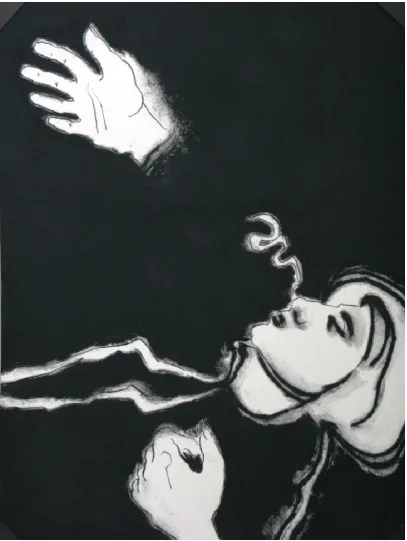
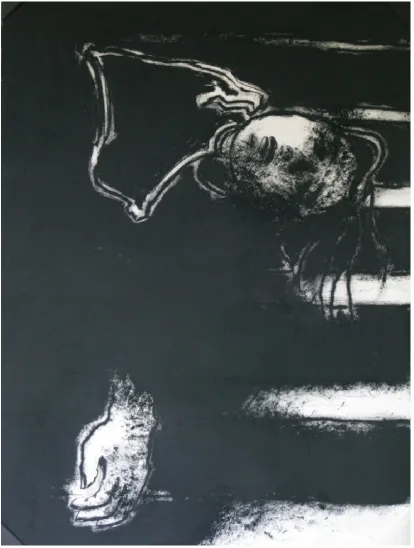
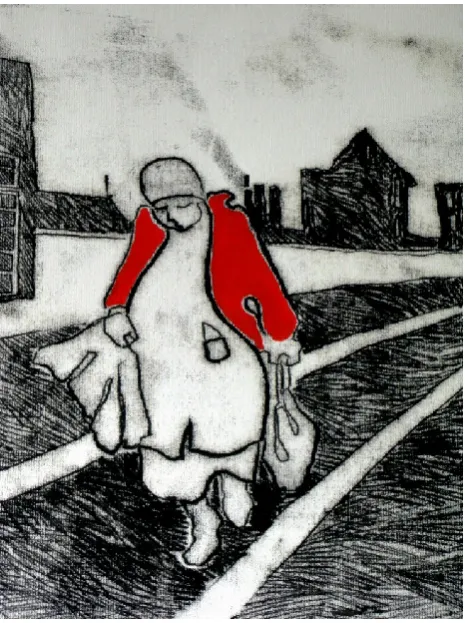
The monoprints, an example shown below, were of figures taken from books of images of war-damaged towns. They were the means of beginning to establish a relationship with the inhabitants: one which I had instinctively turned from with a fear of becoming involved in their lives – a fear of knowing too much. This was the first time I had engaged with the people of the period rather than their buildings and for this reason they were important.
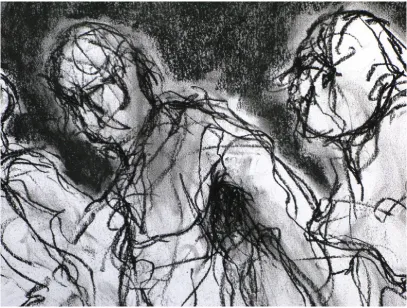
The larger figure drawings (see example below) were made with no planning or reference. They were an unconscious eruptive response to the frustration of recognising that my underlying enquiry was really about the people, but that I did not have the necessary authority to deal with it.
29
Man falling
(2011)
35
My concern was for the people: how could they be omitted from a study of my childhood in the post-war suburbs? But I did not have that close connection with which to understand their lives in the same way as I understand buildings. And to look was uncomfortable, being impolite, staring. I was aware that here was an inconsistency in my practice that should be resolved but about which I felt inadequate, especially when comparing my personal experience to that demonstrated in the drawings of Käthe Kollwitz.
The building drawings14 were made in a soft black pastel on heavy watercolour
paper. The quality of depth in velvety blackness was used to describe built spaces: dark corners and enclosed alleyways. None of these images were taken from war photographs and at first seemed to be outside the scope of
14 Images 31 and 32 below.
[image:37.595.109.517.75.383.2]30
Figure drawing (part)
(2011)
36
research. But I had confidence in their production; in the realisation that the use of black pastel was articulating a relevant emotion. More than that, the physicality of the blackness had a reinforcing power of its own.
31
Passageway 1
37 32
Passageway 2
38
Dr. Sarah Taylor15 commented on the content of the drawings and the
predominance of black: was I aspiring, searching; was I enclosed or escaping? I think, yes, to all these observations, and I think they refer again to the dark internal spaces of the house in the suburbs.
Still, at this time, the question remained about whether I would continue my practice 'looking at' or 'being within' buildings. In other words, am I being a remote observer, or am I emotionally involved in the experience of being enclosed? And how could either solution be made to integrate with my research subject? My childhood memory of being within dark spaces is clear and it has been one of the strongest emotions revealed during the doctoral programme, but this rather nebulous concept contradicts the objectivity required as an engineer to understand, and draw, buildings.
So at this point in my practice, I had found an artistic language with which to describe a dark space but I had not established whether I was in it or outside. I had established the need to include people in my work but they were not yet
integrated within the whole16. I tried first to integrate figures and buildings into
the same drawing, in every style and at every scale. In all of them, the drawing style was not compatible – confident and considered marks for the buildings and spontaneous, poorly conceived, figure drawings. Nothing was satisfactory until my anxiety was dissipated and I could relax into regarding my drawn
figures as separate from the distressing images I saw in the war photographs. I had learned a little of their lives and that was now another facet added to my own experience. The sum of my experience could now be used in my creative practice, and my investigative methodology has become the same for the figures as it always has been for the buildings.
The question of whether I am 'looking at' or 'being within' buildings was resolved as I placed the figures into the black spaces of my memory. They are there instead of me, or perhaps with me or, ultimately, they are a substitute for me.
15 Dr. Sarah Taylor conducting an artists' forum at University of East London, March
2011.
39
40 33
Figure in black space
(2011)
41 34
Figure in building
(2011)
42
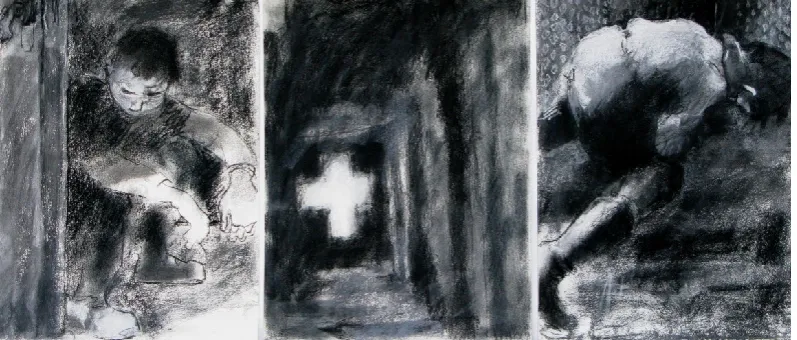
I conclude with images of preparatory drawings for exhibition (image numbers 35-38).
For the figures, fragments of cityscape and building structure, I have referred to photographs taken during, and immediately after, the war. The dark spaces, steps and passageways are taken from my own experience.
The four sets of drawings are:
Image no. 35: Steps which offer a way out of the darkness into the light are contrasted with fallen figures who failed to escape.
Image no. 36: Figures in attitudes of despair are placed with fragments of their shattered environment.
Image no. 37: Questioning the future of a young life from a city that was destroyed.
Image no. 38: Two figures which represent my childhood memories of dark domestic spaces placed with a passageway which offers a route to the world beyond.
My knowledge of buildings and underground ducts, the insight I have gained into the traumatic lives of the people in the post-war suburbs and the emotions I hold as a result of these things have been brought together in these drawings. The architecture of my current practice is not included for itself but as a means of focusing on, and intensifying, my personal experience. The role of
43
35 Figu
44
36 Figu
res
a
nd
fr
ag
m
en
ts
P
rep
ara
tory
draw
ing
s
on
p
ap
er
S
iz
e:
5 x
45
0x
34
0 m
45 37
Figure and destroyed city
(2012)
Preparatory drawings on paper Size: 3 x 340x450 mm
38
Figures and dark spaces
(2012)
46
Professional practice
Solo exhibitions
2004 National Trust Treasurer's House, York, paintings.
Acrylic on canvas, York city buildings and landscape.
2002-3 ID Gallery, Colchester, paintings.
Acrylic on canvas, Colchester historic buildings.
2002 City Screen, York, paintings.
Acrylic on canvas, York riverside buildings.
2000 Waltham Abbey Church, Waltham Abbey, drawings.
Drawings sold for the Church at completion of residency.
1999 Epping Forest Field Study Centre, drawings.
Promotional display for the Field Study Centre.
Joint exhibitions
2011 AVA Gallery, University of East London, drawings.
Monoprint and pastel drawings on paper, people and buildings.
2011 AVA Gallery, University of East London.
Pastel drawings on paper, buildings.
2010 Queen's Theatre, Hornchurch, paintings.
Oil on canvas, landscape.
2010 AVA Gallery, University of East London, photographs.
Photographs remade from war-time press photographs.
2010 AVA Gallery, University of East London, models and paintings.
Card models, war damaged rooms; oil on canvas, building details.
2009 AVA Gallery, University of East London, models and photographs.
Model frieze of suburban street and photographs of them.
2009 AVA Gallery, University of East London, models and photographs.
Models of room interiors and photographs of them.
2004 Kings Langley School, Kings Langley, paintings.
47
Selected exhibitions
2009 Parndon Mill Gallery, Harlow, paintings.
Oil on canvas, landscape.
2008 Parndon Mill Gallery, Harlow, paintings.
Oil on canvas, landscape.
2005 Gibberd Gallery, Harlow Civic Centre, Harlow, painting.
Oil on canvas, building detail.
Residencies
2000 Waltham Abbey Church, Waltham Abbey.
Drawing and painting, leading community groups in art classes.
1999 Epping Forest Field Study Centre, Epping Forest.
Drawing and painting, forest landscape.
Commissions
2005-6 For Albemarle Developments Ltd., paintings.
Acrylic on canvas, historic building restorations.
2005-6 For private client, paintings.
Oil on canvas, landscape.
2003-5 For Lexden Restoration and Development, paintings.
Acrylic on canvas, historic building restorations.
2003 For private client, paintings.
Acrylic on canvas, historic village buildings.
Critical reflection of professional practice undertaken during the programme
48
In spite of my continuing artistic education, and developing artistic language, the work I exhibited returned to a content and style with which I was confident. The building drawings of York and Colchester were a transition between engineering and art. They were popular, they all sold and led to commissions. But they were of limited public interest – they were bought by people who knew the buildings. They were not general enough, did not convey any emotion, to be of wider interest. To continue them would have been to use a technique only; there would have been very little creativity or emotion in them. This was my position at the beginning of writing the doctoral proposal.
My creative practice methodology has changed frequently during the five years of the programme. I have felt throughout that each artwork was exploratory – research rather than product – and that each was part of the journey. In fact, I have had a clear objective in what I wanted to communicate, but had not achieved the best way to say it. In these circumstances, I have not had the confidence to seek to exhibit more widely.
It is not until the final year of the programme that I have felt that I have a product which conveys my experience and intention, and that it is my own invention. I had supposed that my doctoral research subject was too personal and introspective to be of interest to others. But the reason for creating artwork must be for communication. I have demonstrated that the characteristics of material and mark making have a voice of their own. In fact, the image is itself, and for these reasons, it becomes more widely accessible. It is not merely an illustration but has been created from my particular accumulated experience.
I now have the confidence to exhibit the work and will seek out opportunities to do that, both with my colleagues and by myself.
49
Conclusion
This section is a reflection on my conceptual position and achievement at the end of the doctoral programme. In the Proposal document written in 2008 (2008, pp.13-14), I wrote of the intention to investigate the role of architecture in staging the sensation of the psychological uncanny, particularly of the house and family of the post war suburbs in which I grew up.
Two theories of Anthony Vidler defined this: that the uncanny house might be homely and cosy, and 'concealed and kept from sight' (1992, p.24); and his
reference to the house as a 'favoured site for uncanny disturbances in 19thc.
Gothic literature', with 'lurking unease rather than a clearly defined source of fear' (1992, p.23). These ideas resonated with my memories of the suburban house.
I also wrote of my experience, as an engineer, of working in underground tunnels and ducts. The stagnant blackness touched all my senses, helped to define and reinforce the concepts of the uncanny.
Since then, I have read, and been influenced by, the theories of Bachelard, Lefebrvre and Benjamin about inhabiting space and dwelling. I have read about the role of the photograph in works by Barthes and Cadava, and about the function of the senses in the works of Pallasmaa and Merleau-Ponty.
My intention was, at the beginning of the programme, to use a factual representation of architecture to stage the sensation of the uncanny. It was
Bachelard's The Poetics of Space that first suggested to me that perhaps I was
being too literal and there might be a different, or better, way to approach my subject.
50
Cadava expanded my understanding of the photograph as being subject to interpretations of history and time.
The introduction to Merleau-Ponty's writings, however, gave the greatest insight to my developing practice. The enlightening concepts, of the body within the world, brought together all the strands of my previous experience in such a way that I could press forward my practice.
It is evident that my practice throughout the programme has seen a reduction in using architecture for itself. Whereas I had been expecting to continue to use my knowledge of buildings, I have in fact, quite properly, strayed from the comfort zone, away from buildings towards the unknowns of people and emotions. The doctoral programme has, for this reason, been my most valuable learning experience. The two disciplines, engineering and fine art, share methodologies of design and specification but differ in that engineering solutions do not engage with emotions. So the creation of artwork examines a different layer; excavates the psyche at a greater depth; stimulates the
imperative of communicating something of personal significance.
I have been aware of a gradual shedding of layers of expectation and pretence: of using unsuitable media, or methodologies. It was a process of eliminating pre-conceived ideas, of being personally exposed, in order to arrive at a kernel of truth. This truth I found, firstly, when writing the proposal. I wanted to investigate and communicate my particular experiences of being within built spaces. And, secondly, during the programme, I found a means of expressing it.
I made models of suburban houses during the early years of the programme which allowed me a direct engagement with the built structure. The
51
followed this disruption to my practice, gave emphasis and urgency to my selection of a suitable replacement medium.
My artistic language has, since then, evolved to take the most simple form and materials: drawings on paper in pastel. The tactile physicality of these materials enables a direct statement to be made which engages my emotions. When a model is the product, to a much greater degree, the outcome has to be
determined in advance. I find, when comparing the two methodologies, that the planning and construction skills used in modelmaking suppressed the
spontaneity and emotional input that I have discovered in using paper and pastel.
I had expected to use representational buildings in my artwork to create a sense of the uncanny. Buildings have for me an anthropomorphic quality and I had used them as a substitution for people, seeing in them the characteristics I chose. They did not interfere with my emotions, whether they were benevolent or gruesome. I have used second world war press photographs as source material. I have been surprised at the beauty revealed by re-photographing small parts of them and I have acknowledged that I have used this strategy as a distancing technique. In summary, I did not want to be disturbed; I wanted to distance unwelcome emotions and personal involvement.
But ultimately, success was only achieved because I had to identify with the people who lived in those buildings. This was remarkably difficult to achieve. I have never engaged closely with people. I have seldom photographed people, even close family. So in my recent work, I have achieved another
breakthrough: that of trying to share and interpret the lives of others.
52
With these concepts in place, I have found a new confidence. There is now an inevitability, a rightness, about my continuing practice. I expect the work to evolve, but with less anxiety, and with a calm focus that had been lacking before.
How has this transformation been realised? By producing a probing and honest proposal and then keeping to its spirit and direction; by the regular insightful participation of my Supervisors; by dealing with problematic issues in a rational, investigative manner.
I have brought together all the strands that were introduced in the proposal. I have identified my version of the uncanny as being the black space. I have come a little closer to the inhabitants of the post-war suburbs: instead of seeing building details, I saw their emotion and ultimately my own.
53
Reference list
Bachelard, G. (1958) The Poetics of Space. Translated by Maria Jolas. Boston:
Beacon Press. 1994 edition.
Baldwin, T. (ed.) (2004) Maurice Merleau-Ponty: basic writings. London:
Routledge.
Barthes, R. (1980) Camera Lucida. Reflections on Photography. Translated by
Richard Howard. London: Vintage Classics.
Bull, S. (2004) Documentary Photography in the Art Gallery available at
http://www.engage.org (Accessed: 29 September 2011)
Bullock, A. and Woodings, R.B. (eds.) (1983) The Fontana Dictionary of Modern
Thinkers. London: Fontana Press.
Burnside, J. (2006) Selected Poems. London: Cape Poetry.
Cadava, E. (1997) Words of Light, Theses on the Photography of History.
Chichester: Princeton University Press.
Coldwell, P. (2006) Morandi's Legacy, Influences on British Art. Exhibition at
Abbot Hall, Kendal and the Estorick Collection, London [Accompanying book] London: Philip Wilson Publishers.
Dorment, R. (2004) The Daily Telegraph, 24 May.
Dunne, A., Hyman, J. and van Krimpen, W. (2008) Hughie O'Donoghue: Lost
Histories, Imagined Realities. Gemeentemuseum Den Haag in association with James Hyman Gallery.
Ellis, P. (2007) Essay on Peter Doig available at http://Saatchi-gallery.co.uk (Accessed: 26 October 2007)
Fonsmark, A., Krämer, F. and Sato, N. (2008) Hammershøi. London: Royal
Academy of Arts.
Freud, S. (1919) The Uncanny available at
http://people.emich.edu/acoykenda/uncanny.htm (Accessed: 27 November 2007)
Galloway, D. (ed.) (2003) Edgar Allan Poe. The Fall of the House of Usher and
Other Writings. London: Penguin Books.
Grenier, C., Scott, K. and Searle, A. (2007) Peter Doig. London: Phaidon Press
Ltd.
54
Hanssen, B. (ed.) (2006) Walter Benjamin and the Arcades Project. London:
Continuum International Publishing Group.
Herkenhoff, P., Schwartzman, A. and Storr, R. (2003) Louise Bourgeois.
London: Phaidon Press Ltd.
Hubbard, S. (24 March 2008) Review of Hughie O'Donoghue: The Geometry of
Paths, James Hyman Gallery available at http://www.independent.co.uk (Accessed: 01 October 2011)
James Hyman Gallery (2011) notes about Hughie O'Donoghue and Moo Cow
Farm available at http://www.jameshymanfineart.com (Accessed 02 October
2011)
Kuspit, D. (1996) Idiosyncratic Identities. Cambridge: Cambridge University
Press.
Lefebvre, H. (1991) The Production of Space. Tr. Nicholson-Smith, D. Malden:
Blackwell Publishing.
Levin, G. (1998) Hopper's Places. 2nd Edn. London: University of California
Press, Ltd.
Melville, H. (1855) I and my Chimney available at http://www.gutenberg.org
(Accessed: 20 November 2007)
Merleau-Ponty, M. (1945) Phenomenology of Perception. Translation: 1958
Routledge and Kegan Paul. Routledge Classics, 2002. Abingdon: Routledge.
Morphet, R. (2003) Antoni Tàpies Fourteen Paintings. Exhibition held at the
Waddington Galleries, March-April 2003 [Exhibition catalogue].
O'Donoghue, H. (2008) Lost Histories, Imagined Realities. Den Haag:
Gemeentemuseum Den Haag, in association with James Hyman Gallery. [Exhibition catalogue]
Pallasmaa, J. (2005) The Eyes of the Skin, Architecture and the Senses.
Chichester: John Wiley & Sons Ltd.
Price, M. (1994) The Photograph. A Strange, Confined Space. California:
Stanford University Press.
Renner, R.G. (2006) Edward Hopper, 1882-1967, Transformation of the Real.
Köln: Taschen.
de Salvo, D. and Gale, M. (2001) Giorgio Morandi. London: Tate Publishing.
55
Sillars, L. (ed.) (2011) George Shaw,The Sly and Unseen Day, Gateshead:
Baltic Centre for Contemporary Art.
Steiner, M. (2008) Staging the Sensation, Proposal for Professional Doctorate
in Fine Art.
Steiner, R. (1993) Schiele 1890-1918 The Midnight Soul of the Artist.
Translated by Michael Hulse. Köln: Benedikt Taschen Verlag GmbH. Taylor, S. (25 March 2011) Seminar at University of East London.
Vidler, A. (1992) The Architectural Uncanny, Essays in the Modern Unhomely.
London: The MIT Press.
Vidler, A. (1999) Take One. Architecture; December 1999, Vol. 88 Issue 12,
p81, 1p. Available at http://web.ebscohost.com (Accessed: 20 January 2009)
Zigrosser, C. (1969) Prints and Drawings of Käthe Kollwitz. New York: Dover
56
Bibliography
Cork, R. (1991) French Cathedrals, Drawings by Dennis Creffield. Exhibition at
the Albemarle Gallery, February-March 1991. [Exhibition catalogue].
Folsach, K .von and Lund, N. (1995) Dansk kunst i Davids Samling – fra
Philipsen til Saxbo. Denmark: Davids Samling.
Galloway, D. (ed.) (2003) Edgar Allan Poe, The Fall of the House of Usher and
Other Writings. London: Penguin Books Ltd.
Hardy, A. (1979) The Spiritual Nature of Man. Oxford: Clarendon Press.
Hastings, M. (2008) The Faces of World War II. London: Cassell Illustrated,
Octopus Publishing Group Limited.
Le Corbusier (1975) Ronchamp. Translated by Jacqueline Cullen. Reprint,
Germany: Verlag Gerd Hatje, 1991.
Magee, B. (1998) The Story of Philosophy. London: Dorling Kindersley.
Merleau-Ponty, M. (1948) The World of Perception. Translated by Oliver Davis.
London: Routledge, 2008.
Moorhouse, P., Saumarez Smith, C., Schama, S. and Wiggins, C. (2005) John
Virtue London Paintings. London: National Gallery Company Limited. [Exhibition Catalogue]
Sharr, A. (2007) Heidegger for Architects. Abingdon: Routledge.
Shaw, F and J. (1990) We Remember the Blitz. Loughborough: Echo Press Ltd.
57
Appendix 1, Additional images from creative practice
:
2
Card house on precipice
(2007)
Digital photograph 1
Card house encircled
(2007)
58 3
Mouchy, September 2008
(2008)
Notebook drawing in ball-point pen Size: 180x180 mm
4
Mouchy, September 2008
(2008)
Notebook drawing in ball-point pen Size: 180x180 mm
5
Colmar, October 2008
(2008)
59 6
Card house and shadows
(2008)
Cardboard model and twigs Size approx. 500x500x500 mm
7
Card house in trees
(2008)
60 8
Fractured hearth (2009) Cardboard models
Size approx. 400x600x100 mm
9
Decaying hearth (2009)
61 10
Chair in the corner (2009)
Digital photograph of cardboard models
Model size approx. 300x300x300 mm
11
Chair under window
(2009)
Digital photgraph of cardboard models