Munich Personal RePEc Archive
On testing equality of distributions of
technical efficiency scores
Simar, Leopold and Zelenyuk, Valentin
Institut de Statistique, Université Catholique de Louvain, Belgium,
EERC, UPEG
14 December 2004
I N S T I T U T
D E
S T A T I S T I Q U E
UNIVERSIT´E CATHOLIQUE DE LOUVAIN
D I S C U S S I O N
P
A
P
E
R
0434
ON TESTING EQUALITY OF DISTRIBUTIONS
OF TECHNICAL EFFICIENCY SCORES
SIMAR, L. and V. ZELENYUK
On Testing E quality of Distributions of
Technical E fficiency Scores
Léopold Simar
*and Valentin Zelenyuk
**Abstract
The challenge of the econometric problem in production efficiency analysis is that the very
efficiency scores to be analyzed are
unobserved
. Recently, statistical properties have beendiscovered for a class of estimators popular in the literature, known as data envelopment
analysis (DE A) approach. This opens a wide range of possibilities for a well-grounded
statistical inference about the true efficiency scores from their DE A-estimates. In this
paper we investigate possibility of using existing tests for
equality of two distributions
for such acontext. Considering statistical complications pertinent to our context, we consider several
approaches to adapt the Li (1996) test to the context and explore their performance in
terms of the size and the power of the test in various Monte Carlo experiments. One of
these approaches showed good performance both in the size and in the power, thus
encouraging for its wide use in empirical studies.
Keywords: Kernel Density E stimation and Tests, Bootstrap, DE A.
Last Revision: December 14, 2004
* Institut de Statistique, Université Catholique de Louvain, Belgium.
Mailing address:
20 voie du Roman Pays, B 1348, Louvain-la-Neuve, Belgium. Tel. : + 32-10-474308, fax : + 32-10-473032.[email protected]
.** Institut de Statistique, Université Catholique de Louvain, Belgium and UPE G at E ROC and E ERC of “Kyiv-Mohyla Academy”, Kyiv (Kiev), Ukraine.
Mailing address:
20 voie du Roman Pays, B 1348, Louvain-la-Neuve, Belgium. Tel. : + 32-10-474311, fax : + 32-10-473032.[email protected]
.1. Introduction
A typical research question of many empirical studies in the area of efficiency and
productivity analysis attempts comparing differences in efficiencies among various groups
in an industry or region (e.g., private vs. public) or differences across time for the same
group(s). One way to approach this type of questions is to use non-parametric kernel
density estimator, which is becoming more and more popular in many applied areas,
including empirical economics.
Some attempts of using the kernel density estimators (KDE ) have already appeared
in efficiency analysis (see, for example, Färe and Grosskopf (1996), Simar and Wilson
(1998), Kumar and Russell (2002)). A natural way of inferring on differences in efficiency
distribution in this case would be to employ statistical tests of equality of two densities, for
example those based on the Hall (1984) central limit theorem (CLT) for degenerate
U-statistics or its extensions. These include tests proposed by Mammen (1992), Anderson et
al. (1994), Li (1996, 1999) and Fan and Ullah (1999).
The goal of this paper is to adapt one of such tests, in particular the one proposed
by Li (1996), to the context of comparing distributions of efficiency scores. The challenge
of the problem here is that the random variables (efficiency scores) whose distributions are
compared are
unobserved
. Is it reliable to use their estimates from data envelopment analysis(DE A)—in order to test the equality of
true
distributions oftrue
efficiency scores? Recentdiscovery of statistical properties of this popular estimator (which before was called
deterministic) gives hopes for the positive answer, along with some warnings.
There are at least four major concerns pertinent to analysis of distributions of
DE A-estimated
efficiency scores
. One is the issue ofbounded support
of the (random) efficiencyscores distributed across population of given firms, with most of the mass often being near
the bound. The other three concerns come directly from the fact that
estimated
(rather thanthe
true
) efficiencies are used. Namely, in a finite sample, the estimated efficiency scores arebiased
andnot independent
. These two problems vanish asymptotically—but with a rate ofconvergence that depends on the dimension of the DE A model, which is the fourth
concern of our context. Thus, the
goal
of this paper is to address these concerns andcarefully adapt an existing test to the context of DE A-based efficiency analysis. At the end,
we suggest to researchers a reliable tool for comparing densities of true Farrell-type
2. Theoretical Model
Assume the technology of a firm
k
(k = 1, …, n
) is characterised by the setT
,} :
) ,
{ (
x
y
x
can
produce
y
T
≡
, (2.1)where N
N
x x
x =( 1,..., )'∈ℜ+ denotes the vector of
N
inputs, while the vector ofM
outputs is denoted by y =( y1,..., yM)'∈ℜM+ . E quivalently, the technology can be characterised by theoutput sets
} ) , ( : { )
(
x
y
x
y
T
P
≡
∈
,
x
∈
ℜ
N+ . (2.2)Throughout, we assume that the technology satisfies the usual regularity axioms of
production theory, under which the Shephard (1970)
output
distance function} { :ℜ+N ×ℜ+M →ℜ1+∪ ∞ o
D , defined as
)} ( / : inf{ ) ,
(
x
y
y
P
x
D
o≡
θ
θ
∈
(2.3)gives a complete characterisation of the technology, in the sense that1
) ( 1
) ,
(x y y P x
Do ≤ ⇔ ∈
.
(2.4)This function is particularly convenient as a criterion for technical efficiency of any
particular firm
k
since, roughly speaking, it gives a ‘measure’ (valued between 0 and 1) of adistance from a point
y
k inP
(x
k) to the ‘upper’ boundary ofP
(x
k), measured along theray from the origin. Such efficiency criterion often appears in another form, as the output
oriented
Debreu
(1951)-Farrell
(1957) measure oftechnical
efficiency
, defined for all) ( k k
x
P
y
∈
as2) , ( / 1 )} ( :
max{ )
,
(
x
ky
ky
kP
x
kD
ox
ky
kTE
≡
θ
θ
∈
=
. (2.5)Formally, if we let the technological frontier be the ‘upper’ boundary of
P
(x
k) defined as
)} , 1 ( ),
( ),
( :
{ )
( = ∈ℜ ∈ ∉ ∀ ∈ ∞
∂ k +M k
λ
kλ
x P y x
P y y
x
P (2.6)
then,
0<Do(xk, yk)<1 ⇔ yk ∈P (xk), yk ∉∂P (xk), yk ≠0, (2.7)
and thus we will call the particular observation ( k, k)
y
x
astechnically
inefficient, withinefficiency score given by (2.5) (or its reciprocal). Alternatively, ( k, k)
y
x
is calledtechnically
efficient (having efficiency score equal unity) if and only if) ( 1
) ,
( k k k k
o x y y P x
D = ⇔ ∈∂ (2.8)
Finally, Do(xk, yk)=0, if and only if
y
k= 0
. Also, for further reference, we will denotethe Farrell-type efficient ‘reference’ point for any
y
∈
P
(x
)—the radial projection ofy
onto the technological frontier ∂P(x) with
y
∂(x
). Formally,) ( ) , ( / ) , ( )
(x yTE x y y D x y P x
y∂ = = o ∈∂ (2.9)
There are also other measures of technical efficiency offered in efficiency literature.
However, the Debreu-Farrell measure seems to have been the most popular—for its
relative computational simplicity, intuitive interpretation, relationship to duality theory in
economics and, most importantly, possession of various desirable mathematical properties
(e.g., see Russell, 1990).
There are also various ways of estimating the
true
frontier ofP(x)
and thetrue
efficiency score
TE
(x,y
) for anyy
∈
P
(x
). Apparently, one of the most popular of them isthe Data E nvelopment Analysis (DE A) estimator, which we consider in the next section.
3. The DE A estimator
In this section we focus on the class of estimators of the Farrell (1957) type (in)efficiencies
known under the general name—Data E nvelopment Analysis (DE A). There are many
variations in this class, all intending to estimate the technological
frontier
of some set-wisecharacterisation of the technology and then to compute a point estimate of efficiency
scores for each observation, relative to the estimated frontier. While we will consider only
the very basic, most commonly used DE A model (that takes output orientation, assumes
variable returns to scale and free disposability of inputs and outputs), the extension to
One fundamental assumption in most DE A estimations is that all firms have
access
to the
same
technology, denoted withT
, or its sections,P(x). This access is determined bycertain physical laws and current understanding of these laws by the humanity. This
assumption is needed to justify the estimation of
one
frontier
for all the firms in a sample,often called the (estimated)
best practice frontier
. Although, all firms have the access to thesame technology, this does not guarantee that all firms, in a particular point in time, are
able to exploit this technology in the same way. That is, the conditions of the access to this
best-practice technology and its utilisation might be different for each firm. Namely, some
internal or external factors pertinent to each specific firm (e.g., principal-agent problems,
government interventions, particular institutions, etc) may create additional restrictions (not
always observed by researchers) on the accessibility or/and utilisation of the best practice
technology at a given moment in time. Despite optimisation behaviour, such restrictions
are likely to cause some firms or even distinct groups of them to be below the
‘best-practice’ frontier. The goal of the DE A estimator is to measure ‘how far’ each firm is from
this frontier by assigning for each firm an estimate of its (in)efficiency score, which will
represent all those restrictions on efficient use of the technology in a cumulative, residual
fashion.
A closely related fundamental assumption of the DE A estimator is that all observed
input-output combinations (
x
k,
y
k),k = 1, …, n
arefeasible
underT
. In other words,Prob
{ (x
k,y
k)∈
T
} = 1,k = 1, …, n
. This assumption implicitly allowsno
measurementerrors and
all
deviations from the frontier are assumed to be due to technical inefficiency.However, all the data (input, output) as well as the unobserved inefficiency levels are
allowed to be random and follow some
unknown
distributions. Finally, we also assume thetrue technology set,
T
, is convex.Here, we consider the most common DE A estimator that allows for variable
returns to scale and free disposability of inputs and outputs. The
best practice frontier
undersuch assumptions is estimated by an empirical analogue of (2.6) as
)} , 1 ( ),
( ˆ ),
( ˆ :
{ ) (
ˆ = ∈ℜ ∈ ∉ ∈ ∞
∂P x y +M y P x
λ
y P xλ
, (3.1)where
: {
) (
ˆ M
y x
P = ∈ℜ+ m
n
k
k m
k
y
y
z
≥
∑
=1
,
m = 1, ..., M,
i nk k n
k
x
x
z
≤
∑
=1
0
≥
k
z
,k = 1, ... , n
,1 1
=
∑
= n k kz
} . (3.2)Notably, Pˆ(x) is the
smallest convex free-disposal hull
that fits the observed data and ∂Pˆ(x) isits ‘upper’ boundary, a ‘
piece-wise linear
’ estimate of the true best-practice frontier ofP
(x
).The DE A estimator of individual
technical
efficiency at a fixed point (x, y
), iscomputed relative to this estimated frontier—as a solution to the following linear
programming problem (LPP)
: { max ) , ( ˆ ,..., , 1
θ
θ z zn
y x E
T = m
n
k
k m
k
y
y
z
≥
θ
∑
=1
,
m = 1, ..., M,
i nk k n
k
x
x
z
≤
∑
=1
,
i = 1, ..., N,
0
≥
k
z
,k = 1, ... , n,
1 1=
∑
= n k kz
} . (3.3)or )} ( ˆ : { max ) , ( ˆ ,..., , 1 x P y y x E T n z z ∈
=
θ
θ
θ
The next section formally outlines the data generating process and summarises the resulting
known statistical properties of this basic version of the DE A estimator.
4. Known Statistical Results for the DE A E stimator
First, it is obvious that
Pˆ(x)⊆P(x), and thus
∂Pˆ(x)is a
downward biased
estimator of
) (x P
∂
. As a result,
TEˆ(x,y)is a downward biased estimator of
TE(x,y), i.e.,
) , ( ) , ( ˆ
1≤TE x y ≤TE x y , ∀ y∈Pˆ(x) (4.1)
The statistical asymptotic properties also have recently been discovered for the DE A
estimator presented above. In particular, (3.2) is consistent and is a maximum-likelihood
estimator of the frontier of
P(x)
, as shown by Korostelev et al (1995) for the univariate(one-output or one-input) case. More recently Kneip et al. (1998) have shown consistency
and derived the rates of convergence of the DE A technical efficiency estimator (3.3) for
the multi-output-multi-input case. Gijbels et al. (1999) have discovered the limiting
distribution of DE A in the 1-input-1-output case and recently, Kneip et al. (2003) have
These statistical results require additional assumptions on the data generating
process (DGP). Let us first represent the problem by using the
polar
coordinates ofM
y
∈
ℜ
+ defined by the modulusω
=
ω
(
y
)
∈
ℜ
1+, whereω
(
y
)
≡
y
'
y
, and the angle1
]
2
/
,
0
[
)
(
∈
−≡
My
π
η
η
, whereη
m≡
arctan(y
m+1/y
1), if y1 >0 orη
m≡
π
/2, if y1 =0for
m = 1, …, M-1
. Now, we assume:3A1.
{ (xk, yk) : k=1,...,n} areindependent
random variables on theconvex
technology setT
. All observations { (xk, yk) : k=1,...,n} can be partitioned intoL sub-samples
(bysome exogenous criterion) such that each sub-sample
l
(l = 1, …, L
) represents adistinct
sub-group l
(l = 1, …, L
) of interest that exists in the population (e.g., public vs.private firms in an industry).
A2.
For alll
(l = 1,…,L
),
the inputsx
∈
ℜ
+N has densityf
x,l(x
) , with compact supportN +
ℜ
⊆
ℵ
.A3
. For alll
(l = 1,…,L
) and all x∈ℵ, the vectorη
≡
(
η
1,...,
η
M−1)
has a conditional p.d.f. )| ( ), |
(
x
f
ηx lη
on[
0
,
π
/
2
]
M−1 and the modulusω
has a conditional p.d.f.) , | (
), , |
( x
fωηx l
ω
η
.A4
. For alll
(l = 1,…,L
), all x∈ℵ, and allη
∈
[
0
,
π
/
2
]
M−1there exist constants
ε
1>
0
and
ε
2>
0
such that ∀ω
∈[ω
( ( )),ω
( ( ))−ε
2]∂ ∂
x y x
y , f(ω|η,x),l(
ω
|η
,x)≥ε
1,l = 1,
…, L
, wherey
∂(x
) was defined in (2.9).A5
. The technical efficiency measureTE
(x
,y
) is differentiable in both its vectors.Since all the groups have access to the same technology
T
, the lower boundary of thesupport )
f
(ω|η,x),l(ω
|η
,x
is the same for each group,l = 1, …, L
. So that,} 0 ) , | ( :
sup{ )) (
(
y
∂x
=
ω
∈
ℜ
1+f
( |,x),lω
η
x
>
ω
ωη (4.2)and the relation between
ω
(y
) and the technical efficiency at (x, y
),TE
(x
,y
), is now )( / )) ( ( ) ,
(
x
y
y
x
y
TE
=
ω
∂ω
. (4.3)
Although the same efficiency measure (4.3) is applied for all firms in the population, the
efficiency score it yields for particular points may have different densities
f
(ω|η,x),l(ω
|η
,x
)for different sub-populations of firms
l
(l = 1, …, L
). From now on, the superscriptl
onthe measure (4.3) will imply that this measure has been applied to a firm belonging to
group
l
(l = 1, …, L
).Importantly, note that A3 along with (4.3) implies the existence of a conditional (on
) ,
(
η
x
) density forTE
l(x
,y
),l = 1, …, L
(with the support [1,∞)), which we will denotewith )
f
l(TE
|η
,x
. Moreover, A4 along with (4.3), implies that] 1 , 1 [ ,
) , |
(
TE
η
x
≥
ε
1∀
TE
∈
+
ε
2f
l ,l = 1, …, L
. Finally, with assumptions A1-5, theDGP, denoted with
℘
=
℘
(P
(x
),g
l(TE
,η
,x
),l
=
1,...,L
) is completely defined throughthe
joint
densities of (TE,η
,x) ,) ( ) | ( ) , | ( ) , ,
(
TE
x
f
TE
x
f
(| ),x
f
;x
g
lη
=
lη
ηx lη
xl ,l = 1, …, L
, (4.4)each with the support Ω≡[1,∞)×[0,
π
/2]M−1×ℵ . It is this DGP that we assume has generated our sample Ξn ={ (xk, yk) : k=1,...,n} of independent observations thatare identically distributed
within
each sub-groupl
(l = 1, …, L
) but not necessarilyacross
them.
These assumptions allow us to employ the Kneip et al., (1998) theorem to claim
that the DE A estimator is consistent, and the rate of convergence is given by
) (
) , ( )
, (
ˆ
−
=
−2/(M+N+1)p l
l
n
O
y
x
TE
y
x
E
T
. (4.5)It is worth noting that the DGP defined above still assumes that
all
firms haveaccess
to thesame
technology, but the conditions of this access (“how easy it is to get to the frontier”)are allowed to be different for different sub-groups. Such DGP can be well justified for
considering many economic phenomena. Differences in regulation regimes, ownership
structures, environments, various institutions, etc., pertinent to different groups within the
population, may have
systematic
differences in economicincentives
or just ‘physical’capabilities of firms in different sub-groups (sub-populations) to reach the
frontier
of thesame
technology. For example, private firms are often expected to have different incentivesfor being closer to the frontier than state-owned firms. Also, firms under average-cost
under the rate-of-return regulation, or/and unregulated firms. More of philosophical
grounds for presence of inefficiency can be found in the seminal work of Liebenstein
(1966, 1992) about his concept of “X-efficiency”. The DE A thus can be viewed as an
estimator of X-efficiency, based on the Debreu-Farrell type efficiency measure. In all the
examples given above, the marginal densities that generate technical (in)efficiency (as well
as densities generating inputs and outputs) for these firms might be different across
sub-groups, while still having common best practice technology.
5. The E ssence of the Li (1996) Test for E quality of Two Densities
Although the test of Li (1996, 1999) can be used for multivariate cases, our context is
univariate and we would thus consider only the univariate version of the test in this paper.
Suppose we are interested in comparing densities of two random variables,
U
A,U
Z∈
ℜ
1for which the random samples, {uA,k : k=1,...,nA} and {uZ,k : k=1,...,nZ}, representing the two sub-groups in a population, A and Z, respectively, are available.
Formally, letting
f
l denoting density of distribution of a random variableU
l (
l = A, Z
), ournull and alternative hypotheses would be:
H
0: )( ) ( Z Z AA
u
f
u
f
=
,H
1: )( ) ( Z Z AA
u
f
u
f
≠
, on a set of positive measure.For testing such hypotheses, Mammen (1992), Anderson et al. (1994), Li (1996, 1999) and
Fan and Ullah (1999), have considered the integrated square difference criterion
(
f
u
f
u
)
dt
(
f
u
f
u
f
u
f
u
)
du
I
≡
∫
A( )−
Z( ) 2=
∫
A2( )+
Z2( )−
2 A( ) Z( )
=
∫
f
A(u
)dF
A(u
)+
∫
f
Z(u
)dF
Z(u
)−
∫
f
A(u
)dF
Z(u
)−
∫
f
Z(u
)dF
A(u
) (5.1)(which satisfies the property that I ≥0 and I =0 if and only if
H
0 is true) and suggestedslightly different empirical analogues for it as tests statistics. A particularly convenient
statistic has been proposed by Li (1996, 1999) and extended by Fan and Ullah (1999).
Using Hall (1984) CLT, Li (1996) have shown that a consistent and asymptotically normal
estimator of (5.1) is obtained by replacing the unknown distribution functions FA(⋅) and
) (⋅
Z
(
)
∑
=≤
≡
l l n k k l l nl
I
u
u
n
u
F
1 , , 1 )( ,
l = A, Z
where
I
{X
} is the indicator function so thatI
{X
} = 1 if statementX
is true, and zerootherwise, and the unknown densities in (5.1) are replaced with the non-parametric kernel
density estimators, ˆ
f
A,nA(⋅
) and () ˆ,nZ
⋅
Z
f
, where∑
=
−
≡
l l n k l k l l l n lh
u
u
K
h
n
u
f
1 , , 1 ) (ˆ ,
l = A, Z
. (5.2)Here, )
h
l=
h
(n
l is the smoothing parameter (bandwidth) obtained using some optimalcriterion for each sub-group
l = A, Z
,4 whileK
is an appropriate kernel function (e.g.,Gaussian density) and
u
is a point at which we aim to estimate the density. The latter isoften chosen to be the observed points, {uA,k : k=1,...,nA} and {uZ,k : k=1,...,nZ},
so that the statistic becomes
∫
∫
∫
∫
+
−
−
=
ˆ ( ) ( ) ˆ ( ) ( ) ˆ ( ) ( ) ˆ ( ) ( )ˆ , , , , ,
,
f
u
dF
u
f
u
dF
u
f
u
dF
u
f
u
dF
u
I
nAnZh A AnA Z ZnZ A ZnZ Z AnA
−
Κ
+
−
Κ
=
∑
∑
∑
∑
= = = =h
u
u
n
n
h
h
u
u
n
n
h
k Z j Z n k n j Z Z k A j A n k n j A A Z Z AA , ,
1 1 , , 1 1 1 1
−
Κ
−
−
Κ
−
∑
∑
∑
∑
= = = =h
u
u
n
n
h
h
u
u
n
n
h
k Z j A n k n j A Z k A j Z n k n j Z A Z A AZ , ,
1 1 , , 1 1 1 1 (5.3)
Further, Li (1996) notes that the statistic based on (5.3) with the ‘diagonal’ terms removed,
i.e.,
−
Κ
−
+
−
Κ
−
=
∑
∑
∑
∑
= ≠ = = ≠ =h
u
u
n
n
h
h
u
u
n
n
h
I
k Z j Z n k j k n j Z Z k A j A n k j k n j A A nd h n n Z Z A A Z A , , 1 , 1 , , 1 , 1 , , ) 1 ( 1 ) 1 ( 1 ˆ
−
Κ
−
−
−
Κ
−
−
∑
∑
∑
∑
= ≠ = = ≠ =h
u
u
n
n
h
h
u
u
n
n
h
k Z j A n k j k n j A Z k A j Z n k j k n j Z A Z A AZ , ,
1 , 1 , , 1 ,
1 ( 1)
1 ) 1 ( 1 . (5.4)
has performed better (in most Monte Carlo experiments) than the one based on the
centred version of (5.3), which may cause size distortions for finite samples. Letting
Z A n =n /n
λ
, and assumingλ
n →λ
,asnA →∞, whereλ
∈(0,∞) is a constant, Li (1996)shows that after appropriate ‘standardisation’, the limiting distribution of (5.4) is standard
normal, ) 1 , 0 ( ˆ ˆ ˆ , , , 2 / 1 , , N I h n J d h nd h n n A nd h n n Z A Z
A ≡ →
λ
σ
(5.5)where
σ
ˆλ,h is a consistent estimator of=
2(
∫
(
f
A(u
)−
f
Z(u
))
du
)(
∫
Κ
(u
)du
)
2 22
λ
σ
λ ,obtained as
−
Κ
+
−
Κ
=
∑
∑
∑
∑
= = = =h
u
u
n
h
h
u
u
n
h
k Z j Z n k n j Z n k A j A n k n j A h Z Z AA , ,
1 1 2 2 , , 1 1 2 2 , 1 2 ˆ
λ
σ
λ[
∫
]
∑
∑
∑
∑
Κ
−
Κ
−
−
Κ
−
= = = =du
u
h
u
u
n
n
h
h
u
u
n
n
h
k Z j A n k n j Z A n k A j Z n k n j Z A n Z A A Z ) ( 2 , , 1 1 , , 1 1λ
λ
. (5.6)6. Adapting the Li Test to the DE A Context
In this section we will be interested in comparing distributions of
efficiency
scores
for twosub-groups, A and Z, in an economic system (industry, country, etc). Let us first check the
satisfaction of regularity conditions used in Li (1996). According to A1-A5, the
true
technical efficiency scores in each sub-group, {TEA,k : k=1,...,nA} and
} ..., , 1 :
{ Z,k Z
n k
TE = , are distributed
independently
(and identically within each sub-group)with densities fA(⋅) and fZ(⋅), respectively. (Contemporaneous correlation is allowed between the two samples.) In real world, however, the true independent efficiency scores
are unobserved but estimated with DE A, which are independent only asymptotically, while
in finite samples they are dependent (by construction) with unknown structure of
dependency. It is thus not clear whether the original Li-test would perform well in this
context. The assumption A1-A5 also ensure that
f
A(
⋅
)
and fZ(⋅) are continuous andbounded in ℜ1 and have some distribution functions
F
A(
⋅
)
and FZ(⋅), respectively. Forsimplicity, we will also use the Gaussian kernel to estimate these densities, which is a
Since construction of the test statistic essentially involves formulas for kernel
density estimator, the special issues pertinent to the kernel density estimation in DE A
context, might be important in the Li-test context as well. The first is the issue of
bounded
support
in density estimation, since it is known that the standard kernel density estimator isinconsistent at the boundary. This can easily be circumvented by using the Schuster
(1985)-Silverman (1986) reflection method, which provides the consistent estimator 5
≥
−
−
+
−
≡
∑
= . , 0 , ) 2 ( 1 ) ( ˆ 1otherwise
b
u
h
u
u
b
K
h
u
u
K
nh
u
f
n k R i R i R R (6.1)A natural question is whether one also needs to use this (or other) method for adapting the
Li-test to the DE A context. In his Monte Carlo experiments, Li (1996) have considered
application of his test to the case of Uniform density and obtained good performance. Our
case is somewhat more severe than the uniform: most of the mass might be very close to
the bound and we know that the estimator for such case can give very poor fit. However,
note that for symmetric kernels, the estimation procedure (6.1) is equivalent to estimating
) ( ˆ
2f u using (5.2) from the original data {
u
1,...,u
n}, on the bounded support, but with abandwidth selected from the
reflected
data {u
1,...,u
n,2b
−
u
1,...,2b
−
u
n} , which we denoteas hR. Hence, the reflected analogue of (5.3), will be twice as much as (5.3), given hR, i.e.,
d h n n nd h n n R d h n n R nd h n n R h n
nA Z R
I
A Z RI
A Z RI
A Z RI
A Z RI
, , , ,, , , , , , ,
, ˆ ˆ 2ˆ 2ˆ
ˆ
≡
+
=
+
, (6.2),where ndRn h
R Z A
I
ˆ ,, , is part ofR h n nA Z R
I
ˆ , , , involving only diagonal terms of it. Using the Hall(1984) theorem, similarly as Li (1996), we get that (for a univariate case)
) 1 , 0 ( ˆ ˆ 2 ˆ ˆ ˆ , , , 2 / 1 , , , , 2 / 1 , ,
N
I
h
n
I
h
n
J
d h nd h n n R A h R R nd n n R A nd R n n R R Z A R Z A ZA
≡
=
→
λ
λ
σ
σ
(6.3)where we have also used the fact that ˆ2, , 2ˆ2
R R λ,h
h
R
σ
σ
λ=
. Thus, the statistic based onreflection method is essentially the same as the original Li (1996) test, with the difference
being a factor of 2 and the fact that the bandwidth used in estimation of statistic is
obtained from the data with reflection rather than the original data. As we will see in
Monte Carlo experiments, (6.3) does not improve upon the original Li (1996) statistic in the
sense that both of them have similar performance (e.g., bootstrap estimated sizes of the
test are not significantly different from each other and from the true sizes.) This suggests
that despite the fact that reflection method is useful in density estimation
per se
, it isessentially not needed for adapting the original Li-test to the case of comparing the
densities with bounded support (with a lot of mass near the bound).
The second is the issue of using not the true random variables whose densities we
want to compare, but their estimates which, in finite samples, are downward-biased and
dependent.6 The Li (1996) test is
asymptotic
in nature, so the problem of the finite-samplebias and dependency of DE A-estimated efficiency scores is mainly an empirical problem.
For example, it might be that due to high sampling variation or noise from the DE A
estimation, researchers may run into the
type-I
(incorrectly reject the true Ho) andtype-II
(failing to reject the incorrect Ho) errors more often than they would under the (unrealistic)
situation when the true efficiency scores are known. If so, such inference may bring
researchers to misleading conclusions and incorrect policy recommendations. It also might
be that since the bias problem influences, in the same fashion, the estimation of
both
densities under comparison, then the overall ‘damage’ might happen to be not so
significant for the test itself, especially under the null. Experimental evidence through
Monte Carlo experiments is clearly needed here.
Overall, even in large samples, and especially in finite samples, the performance of
the original Li-test adapted to the DE A context using the (first order) Normal
approximation might be far from desirable. As a result, carefully designed bootstrap may
be needed to improve its performance. In fact, Li (1999), using the true random variable,
give some Monte Carlo evidence that the bootstrap provides better inference than the use
of normal tables. This shall not be surprising, given the asymptotically pivotal nature of the
statistic. In the next section, we will consider several bootstrap algorithms in the aim of
suggesting the most reliable one for empirical research.
7. Bootstrapping the ‘adapted to DE A context Li-test’
It is now known that the naïve bootstrap is inconsistent for the individual DE A-estimates
(e.g., see Simar and Wilson, 2000 for details). On the other hand, Kneip et al. (2003) had
proven consistency property of the
sub-sampling
bootstrap—when the sub-sample size issmaller than the original sample size. They also provide Monte Carlo evidence that earlier
suggested
smooth
bootstrap is an approximation of the consistent sub-sampling bootstrap.In principle, we could use the two-stage approach: first correct for the bias in the DE A
efficiency estimates using one of the consistent versions of bootstrap for DE A and then, at
the second stage, use these bias-corrected estimates in the Li-test for comparing the true
densities of the true efficiency scores. Analysing such approach under various
Monte-Carlo scenarios is very computer-time-consuming, even with modern computers (just one
bootstrap bias-correction procedure may take several hours, since it requires LP
optimisation for each efficiency score). Instead, we will use (slightly modified) sample of
original DE A estimates for using in the Li-statistic, which in turn we bootstrap to obtain
p-values. Results from various Monte Carlo scenarios yield evidence of good performance of
such algorithms under moderate dimensions of DE A model, requiring much less computer
time than the tests that would involve bias correction.
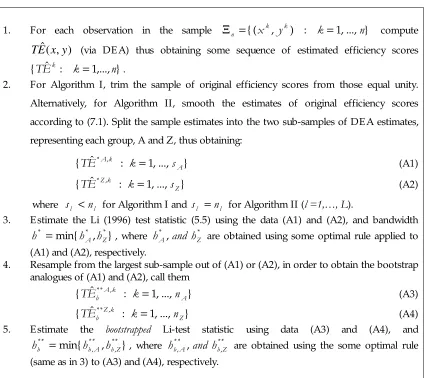
Specifically, we will analyse two bootstrap alternatives. The first one, call it
Algorithm I
, is based on computation and bootstrapping the Li-statistic using the sample ofDE A-estimates
trimmed
from those that are equal to unity, i.e., just ignore the ‘spuriousones’ for the sake of the test. The second one, call it
Algorithm II
, is based on computationand bootstrapping the Li-statistic using the sample of DE A-estimates where those equal to
unity are ‘
smoothed
’ away from the bound by adding a small noise, say within 5%-quantile ofthe empirical distribution of ˆ( k, k)
y x E
T ignoring those equal unity, but of order smaller than the noise of estimation (suggested by the rate of convergence). Formally, the
smoothing is made by
+ =
=
otherwise y
x E T
y x E T y
x E T y
x E
T k k
k k k
k k k
k
), , ( ˆ
1 ) , ( ˆ , ) , ( ˆ ) , (
ˆ*
ε
(7.1)
where
ε
k =Uniform(0, min{n−2/(M+N+1),a} ),a
is theα
-quantile of the empiricaldistribution of TEˆ(xk, yk) ignoring those equal unity. For the sake of reader’s convenience, the complete description of both bootstrap algorithms for Li-statistic in DE A
context is given in the next table.
< Insert Table 1 here >
The obtained
bootstrap
estimates of DE A-adapted Li-statistic can then be used toestimate the
p-value
of the test, by using{
}
∑
=
>
=
−
Bb
nc n n b nc
n
nA Z
J
A ZJ
I
B
value
p
1
, ,
*
, ˆ ˆ
1
ˆ , (7.2)
8. Monte-Carlo Investigation of the Size of the Test
The goal of this section is to illustrate the methods described above on some examples
where we know the ‘truth’ and thus can get a feeling of the performance of the proposed
techniques.
8.1. Simulated E xample 1: Does Reflection Improve the Size of the Test?
In efficiency analysis, researchers often expect (or assume) efficiency distributions are
skewed so that most of the mass is close to efficient bound (unity in our case) with a
diminishing tail towards higher inefficiency—manifesting economic agent’s tendency to
strive for full efficiency or a level near it. A typical example for such a distribution can be
constructed from normally distributed variable, truncated at unity. Here, we assume that
the
true
technical efficiency isTE
l,k=
1+
u
l,k, where , ~ ( l, l2)k l
N
u
+µ
σ
,l = A, Z
, where 0= = Z
A
µ
µ
andσ
A=
σ
Z=
1. For this example, assume that the true (realisations) ofefficiency scores are known and our goal is to see if, in such ideal conditions, the
application of the reflection principle to the original Li-test would bring any improvement
100, 200} with MC = 1000 and B = 400 (which would allow also comparing our results to
those of Li, 1999; For real data, we would recommend
B
largerthan 1000). We estimatefour values of the true (nominal) sizes: { 0.01, 0.05, 0.10, 050} .7
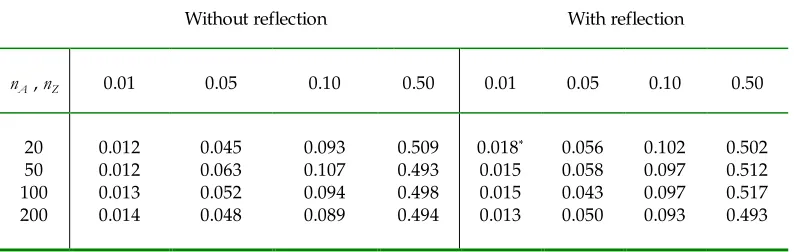
From Table 2, one can see that the bootstrap estimated sizes of the
original
Li-testapplied to ‘observed’ (in simulation) true efficiency scores are already very close to the true
sizes, statistically insignificantly different from them, and so is the test that accounts for
boundary issue via the reflection principle. As a result, in our future investigations we will
not worry about the reflection issue.8
< Insert Table 2 here >
8.2. E xample 2: Algorithm I vs. Algorithm II in Different Dimensions
Now we consider the main problem of the paper: the case when the true efficiency scores
are
not
observed but estimated via DE A. And, the goal of the experiment is to see whatapproach performs better: (i) trimming the estimates that equal to unity, (Algorithm I), or
(ii) smoothing them according to (7.1), with
α
= 5% (Algorithm II). DE A is anon-parametric estimator and the shape of technology does not matter much for it, as long as it
satisfy the regularity assumptions on DE A (especially convexity). What matters the most,
however, is the dimension of the DE A problem (number of inputs and outputs in DE A
specification), as suggested by the rate of convergence (4.5). So we will consider only one
technology type, Cobb-Douglass, but in different dimensions—to investigate an impact of
curse of dimensionality. Specifically, assume that the true technology frontiers are
characterised by the Shephard’s output distance function of the following forms,
) /(
) ,
( 02.5
3 . 0 1 * *
x x y y x
Do = (8.1)
) /(
) ,
(x y* y* x10.1x20.15x30.2x04.05
Do = (8.2)
) /(
) ,
(x y* y* x10.1x20.15x03.2x40.05x50.25x60.07x70.08
Do = (8.3)
7 The 95% Monte-Carlo confidence intervals (with 1000 replications) for these values would be approximately { (0.0037, 0.0163), (0.0362, 0.0638), (0.081, 0.119), (0.4684, 0.0316)} , respectively.
where
y
* is the technically efficient output level, given input levels (x
1,x
2)', which weassume are both coming from
Uniform
(0,1
) distribution for each sub-group.
The ‘observed’output
y
(for each group) is obtained as lk lkTE
y
y
,=
*/ , . Here, we assume that the null istrue, in particular,
µ
A =µ
Z =0 andσ
A=
σ
Z=
0.3, thus ( l,k)≈
1.24TE
E
, and considerfour sub-sample sizes:
n
A =n
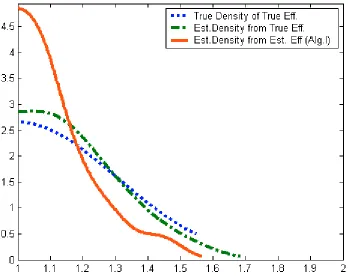
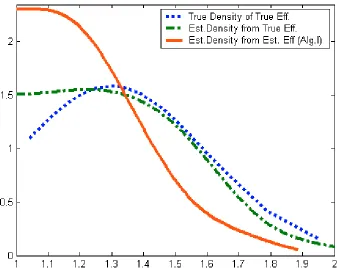
Z = { 20, 50, 100, 200} , with MC = 1000 and B = 400.In Figure 1, we produce three curves for a typical Monte-Carlo replications for this
scenario and in Figure 2 we have
µ
=
0.3 andσ
=0.3. For both cases we haven
= 50 andtechnology (8.1). The dotted curve is the true density of the true efficiency scores. The
dash-dotted curve is the corresponding estimated density when the true efficiency scores
are observed, but their density is estimated via (6.1). Finally, the dashed curve is estimated
density when the true efficiency scores are unobserved but their density is estimated via
(6.1) from the DE A-estimates (except those equal unity)—the situation faced in reality by
practitioners. We use Gaussian kernel and Sheather and Jones (1991) method for
estimating
h
. One can clearly see the empirical issue raised in our paper: the problem ofusing the DE A-estimates in place of the true but unknown efficiency scores.
< Insert Figure 1 Here> < Insert Figure 2 Here>
The ‘double’ estimation (of efficiency and of density) produces density estimate that may
look quite differently than the true density. In particular, the downward bias of the DE
A-estimates results in ‘too much’ mass allocated near the bound. The density estimation based
on the smoothed DE A estimates via (7.1) was allocating even more mass close to the
bound (figures for which are not presented for the sake of space). This is of course only
one replication presented that seemed typical to us. In some draws the fit was better, in
others it was worse. Increase in sample size certainly tended to improve the fit, while
increase in the dimension tended to worsen it. All this naturally raises questions and
perhaps serious concerns about reliability of Li-test for the case of comparing distributions
of efficiency scores that are unobserved but estimated via DE A, which we now analyse.
The results of our size investigation, presented in Table 3, are quite interesting and
encouraging. For the case of two inputs, results presented in Table 3 suggest that (under
the null) the estimated sizes for both algorithms are in most cases insignificantly different
Algorithm I was significantly different from its nominal value of 0.01. When we increase
dimension to 4 and 7 inputs, we sometimes could not obtain the bootstrapped p-values for
Algorithm I. This is because the number of observations on the frontier (to be deleted in
Algorithm I) increases with the dimension, resulting in too few observations or even in
estimated variance being very close to zero for some bootstrap samples. The estimated
sizes for Algorithm II for these cases, however, were mostly insignificantly different from
the nominal sizes. In case when it was possible to compute the p-values for both
Algorithm I and II, their performance was very similar. On this basis, we conclude that the
two bootstrap algorithms, I and II, for the Li (1996, 1999) test adapted to the DE A context
are reliable in terms of size of the test, with Algorithm II being more robust to the curse of
dimensionality problem and, in our experiments, always had correct size at 5% and 10%
levels, which are those most commonly used in practice.
< Insert Table 3 here>
9. Monte-Carlo Investigation of the Power of the Test
The goal of this section is to investigate the power of the test (i.e., probability of correctly
rejecting the false null hypothesis) in different dimensions of DE A model. We will
compare the power of test based on Algorithm II
vs.
the power of the test based on thetrue
efficiency scores, which are known in Monte-Carlo study and can be considered as abenchmark for comparison. In particular, we investigate the power of the test in the case
of different modes/means (before truncation) of efficiency distributions. Here we take the
set-up of simulation example 1, but assume
µ
A=
0,σ
A=
0.4, while} 1 , 9 . 0 ,..., 9 . 0 , 1 { ,
∈
−
−
=
δ
δ
µ
Z andσ
Z=
0.4. So, whenδ
=
0, the null hypothesis istrue. We consider three sample sizes:
n
A =n
Z = { 20, 50, 100} , with MC = 1000 and B =400. For the insight onto the impact of curse of dimensionality we present results for
several technologies. In particular, for the case of 20 observations in each group we use
(8.1), (8.2) and two more technologies,
) /(
) ,
(x y* y* x10.1x20.15x03.2
Do = (9.1)
and
) /(
) ,
(x y* y* x10.1x20.15x30.2x04.05x50.25
Do = , (9.2)
while for the case of 50 and 100 observations in each group we use technologies defined in
First of all, it must be quite intuitive that the power functions for algorithms II shall
outperform that of I, unless too much noise is added. This is because algorithm II
always
uses more observations than algorithm I (which ignores observations equal unity),
especially for large dimensions, and this was confirmed in all our simulations (not
presented). Thus, we only present the power functions for algorithm II, where DE
A-estimates are obtained under different dimensions and compare them to the case when the
true (realizations) of efficiency scores are used in the original Li (1996, 1999) test.
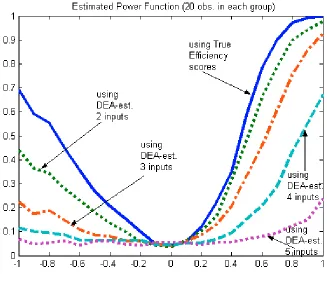
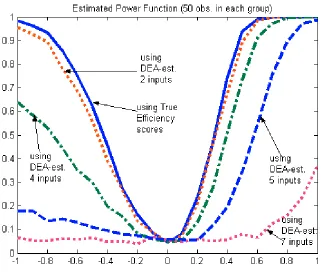
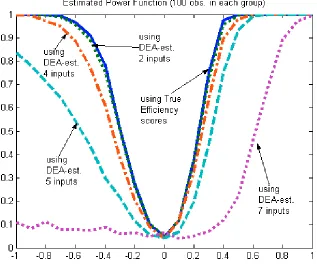
For convenience, we present the results by plotting the estimated power functions
(for nominal size of 0.05) in Figures 3-5, while numerical values are reported in the table in
the appendix. Remarkably, although the size of the test was very good relative to the true
(nominal) size even for 20 observations in each sample, the estimated power functions
suggest that the power of the test for such a small sample as 20 is quite low, especially
when the dimensions of the DE A model is high. Note that the power functions for 20
observations in each group are very asymmetric with a flatter left tail—warning about
reliability of the test conclusions based on such small samples, even for the case when the
true
efficiency scores are used (in original Li test).The power function for the algorithm II based on 2-input-1-output DE A-estimates
of efficiency mimics the asymmetric shape of that based on
true
efficiencies, getting quiteclose to this ‘ideal’ when the two distributions have different modes (after truncation), but
worse for the case when the two distributions being different are having the same (unity)
mode. This pattern is repeated for higher dimensions as well, such that the higher the
dimension the worse is the power—manifesting the curse of dimensionality problem of the
DE A estimator. Again, this problem is especially clear when the two distributions have the
same mode. The case of 5-input-1-output case with 20 observations in each group yields
the power function that is virtually flat—alerting about the danger of misleading
impression about equality of distributions from such large dimension relative to such small
samples.
< Insert Figure 3 here>
Observing and comparing Figures 4 and 5 to Figure 3 brings some optimistic
feeling. The pattern is similar, but the larger the sample size the less asymmetry and the
steeper are the power functions. The curse of dimensionality problem reduces with
increase of the sample, as it is expected to be. For example, for the case of 100
case becomes almost identical with the power function for the case when the true
efficiency scores had been used. E ven the power function from the estimates in the
4-input case also becomes much closer to that based on the true efficiency scores—when we
compare 100 observations case with 50 observations case and certainly relative to 20
observations case. For 5-input model, the performance of the test improves for 50
observations and becomes reasonably good for 100 observations case (but the left tail still
lags behind).
< Insert Figure 4 here> < Insert Figure 5 here>
Importantly, the power function from the estimates in the 7-input case is quite
unsatisfactory even for 100 observations case (very flat). The intuition for this is in the fact
that high dimension of DE A model relative to the sample size leads to many observations
being on the estimated frontier (due to being ‘unique in their own way’) in both groups and
thus smoothing such estimates according to mechanism (7.1) ‘homogenises’ a big chunk of
the two samples. So the resulting smoothed samples look much more the same than their
populations are and the test statistic thus would have less power than it should when the
true efficiency scores are (unrealistically) observed.
An issue in itself deserving special attention is the asymmetry of the power
functions, which luckily vanishes when the sample size increases. The reason for this
asymmetry is in the nature of the distributions analysed. Namely, we deal with
distributions truncated on one side, highly asymmetric and, as can be observed from the
figures, the true alternative hypothesis that presumes mode greater than unity in one
distribution vs. unity-mode for another is more empirically identifiable than when
comparison is between two asymmetric distributions with unity modes. (Additional Monte
Carlo experiments for comparison of symmetric distributions confirmed this conjecture.)
In other words, the test has greater power in distinguishing distribution with what Simar
and Zelenyuk (2003) called as tendency for ‘pathological inefficiency’ (non-unity mode) vs.
distribution where firms are having tendency to full efficiency, represented by (unique)
10. Conclusion
The goal of this paper was to provide researchers with a reliable tool for testing equality of
distributions of Farrell-type
efficiency
scores between groups of decision making units(plants, firms, etc) within a population (industry, country, region, etc). We have considered
two major specifics pertinent to analysis of distributions of DE A-estimated efficiency
scores and investigated ways to incorporate them to testing procedure. One is the issue of
bounded support
of the distribution of efficiency scores. The other is the usage ofestimated
rather than the
true
efficiencies, which are then used toestimate
thetrue
densities oftrue
efficiency scores. Such estimates are biased and not independent—problem that vanishes
asymptotically, but with a rate of convergence that depends on DE A dimension.
We incorporated this knowledge into considering various algorithms for testing
equality of densities based on Li (1996, 1999) test. We demonstrated that the reflection
method is unnecessary here. We also considered two algorithms that handle the problem
of ‘spurious mass at the bound’: Algorithm I simply ignores the boundary estimates and
Algorithm II smoothes such estimates by adding uniform noise of order smaller than the
speed of convergence of the DE A estimator. Limited Monte Carlo evidence suggests that
both algorithms have good size (insignificantly different from nominal one). However,
Algorithm II was more
robust
to the increase in dimension.Finally, the results of investigation of the
power
of the test suggest that, for relativelysmall dimensions of DE A model (e.g., 2 or 3 inputs and 1 output for 50 observations in
each group), the power is quite good—close to the ‘ideal’ case, when
true
efficiency scoresare used in testing. However, the curse of dimensionality problem (of the DE A estimator)
is indeed a problem here: When the dimension is high relative to the sample size (e.g., 5
inputs, 1 output, for 20 observations in each group) then the power of the test is quite low.
Very low power (although correct size) was also identified for 7-input-1 output case for 50
(and to some extent even for 100) observations in each group, especially when compared
distributions in both groups have unique unity mode (no pathological inefficiency).
Overall, we conclude that given no abuse with the dimension of DE A model
relative to the sample size, the Li (1996) test, adapted via our Algorithm II, is a reliable tool
for testing equality of distributions of unknown but DE A-estimated efficiency scores. For
the sake of brevity we had not presented an application here, but an interested reader is
referred to recent applications of this method to Henderson and Zelenyuk (2004) and
References
Anderson, N., Hall, P. and Titterington, D.M. (1994), “Two Sample Test statistics for Measuring Discrepancies between Two Multivariate Probability Density Functions Using Kernel-based Density E stimates,”
Journal of Multivariate Analysis
, 50, 41-54.Debreu, G. (1951), “The coefficient of resource utilization,”
Econometrica
, 19, 273-292.E fron, B. (1979), “Bootstrap methods: another look at the jackknife,”
Annals of Statistics
7, 1-26.Farrell, M.J. (1957), “The Measurement of Productive E fficiency,”
Journal of Royal Statistical
Society
, Series A, General, 120, part 3, 253-281.Fan, Y. and A. Ullah (1999) “On Goodness-of-fit Tests for Weakly Dependent Processes Using Kernel Method.”
Journal of Nonparametric Statistic
s 11(1–3), 337–60.Gijbels, I., E . Mammen, B.U. Park and L. Simar (1999), "On E stimation of Monotone and Concave Frontier Functions",
Journal of the American Statistical Association
94, 220-228.Hall, P. (1984), “Central Limit Theorem for Integrated Square E rror of Multivariate Nonparametric Density E stimators,”
Annals of Statistics
, 14, 1-16.Hall, P. (1992),
The Bootstrap and Edgeworth Expansions
, Springler, New York.Kneip, A., L. Simar and P. Wilson (2003a), “Asymptotics for DE A E stimators in Non-parametric Frontier Models”,
Discussion Paper #0317, Institut de Statistique,
Université
Catholique de Louvain
, BelgiumKneip, A., B. Park and L. Simar (1998), “A Note on the Convergence of Nonparametric DE A E stimators for Production E fficiency Scores”,
Econometric Theory
14, 783-793.Korostelev,A., Simar,L. and Tsybakov, A.B.(1995), “On estimation of monotone and convex boundaries,”
Publ. Statist. Univ. Paris
XXXIX 1, 3 –18.Li, Q. (1996), “Nonparametric Testing of Closeness between Two Unknown Distribution Functions,”
Econometric Reviews
15, 261-274.Li, Q. (1999), “Nonparametric Testing the Similarity of Two Unknown Density Functions: Local Power and Bootstrap Analysis,”
Nonparametric Statistics
11, 189-213.Liebenstein, H. (1966). “Allocative E fficiency vs. ‘X-E fficiency’,”
American Economic Review
56, 392-415.
Leibenstein, H. and S. Maital (1992). “E mpirical E stimation and Partitioning of X-Inefficiency: A Data-E nvelopment Approach,”
American Economic Review
82, 428-433.Mammen, E . (1992),
When Does Bootstrap Work? Asymptotic Results and Simulations
, Springler, New York.Pagan, A. and A. Ullah (1999),