Sadibolova, R. and Longo, Matthew R. (2014) Seeing the body produces
limb-specific modulation of skin temperature. Biology Letters 10 (4), ISSN
1744-9561.
Downloaded from:
Usage Guidelines:
Please refer to usage guidelines at or alternatively
Short Title: Seeing the Body Modulates Skin Temperature 1
2
3
4
5
6
7
Seeing the Body Produces Limb-Specific Modulation of Skin Temperature 8
9
Renata Sadibolova, Matthew R. Longo* 10
Department of Psychological Sciences, Birkbeck, University of London 11
12
13
In Press, Biology Letters
14
15
16
Address correspondence to: 17
Matthew R. Longo 18
Department of Psychological Sciences 19
Birkbeck, University of London 20
Malet Street 21
London WC1E 7HX 22
24
25
27
Vision of the body, even when non-informative about stimulation, affects somatosensory processing. 28
We investigated whether seeing the body also modulates autonomic control in the periphery by 29
measuring skin temperature while manipulating vision. Using a mirror-box, the skin temperature was 30
measured from left hand dorsum while participants: (a) had the illusion of seeing their left hand, (b) 31
had the illusion of seeing an object at the same location, or (c) looked directly at their contralateral 32
right hand. Skin temperature of the left hand increased when participants had the illusion of directly 33
seeing that hand but not in the other two view conditions. In experiment 2, participants viewed 34
directly their left or right hand, or the box while we recorded both hand dorsum temperatures. 35
Temperature increased in the viewed hand but not the contralateral hand. These results show that 36
seeing the body produces limb-specific modulation of thermal regulation. 37
38
Keywords: Body Representation, Thermal Regulation, Autonomic Control, Mirror Box 39
1. INTRODUCTION 41
42
Vision of the body, even when entirely non-informative about stimulation, has widespread effects 43
on somatosensation, enhancing tactile spatial acuity [1, 2], reducing acute pain [3, 4], increasing 44
somatosensory intracortical inhibition [5], and reducing perceived tactile distance [6]. While such 45
effects are diverse, they are consistent with effects limited to the central nervous system, for example 46
by visual modulation of GABAergic inhibition in somatosensory cortex [3, 5, 7]. It is unknown how 47
widespread the effects of seeing the body are and whether they might extend beyond somatosensory 48
processes in the CNS. 49
We investigated whether seeing a limb modulates temperature regulation in that limb. In 50
Experiment 1 we used the mirror box illusion [8], asking participants to look into a mirror aligned 51
with their body midline and view the reflected image of their right hand, which appeared to be a direct 52
view of their left hand behind the mirror. We measured skin temperature from the left hand dorsum 53
while participants: (a) had the illusion of directly seeing their left hand, (b) had the illusion of seeing a 54
non-body object at the same location, or (c) looked directly at their contralateral right hand. In 55
Experiment 2, we measured skin temperature from both hands while participants looked directly at 56
either one. 57
58
2. MATERIALS AND METHODS 59
60
(a) Participants
61
Sixty predominantly right-handed individuals participated, thirty in experiment 1, (23 female; 62
age: M = 32 years, SD = 7), and thirty in experiment 2 (14 female; age: M = 32 years, SD = 13). 63
64
(b) Procedure
65
Both experiments used a non-contact infrared thermometer (Precision Gold N85FR, Maplin 66
each repeated twice. The first three blocks included one of each condition, counterbalanced across 68
participants according to a Latin square. The last three blocks were performed in the reverse order. 69
In Experiment 1, participants sat at a table with their index fingers on Velcro discs 20 cm on 70
either side of a mirror aligned along their midline and facing their right hand. Across conditions, 71
participants saw: the mirror reflection of their right hand which appeared to be a direct view of their 72
left hand (View Hand condition), a non-hand object reflected at the same location (View Object
73
condition), or a direct view of their right hand (ViewOther Hand condition). 74
Following baseline temperature measurement, the mirror (or right hand) was uncovered for 75
two minutes and temperature was recorded from the left hand dorsum every 10 seconds. Participants’ 76
subjective experience of the mirror illusion was assessed with a short questionnaire [3, 6] after each 77
block. Because it was unclear how long any effect might take to emerge, we classified the first minute 78
as an induction period, analogous to the period of stimulation used to induce the rubber hand illusion 79
[9, 10], and excluded it from analyses. Our analyses accordingly focused on the 2nd minute (test 80
period). 81
In Experiment 2, participants directly viewed their right hand, left hand, or the object for three 82
minutes while temperature was recorded from both hands in alternation. Participants placed their 83
hands with palms down 60 cm apart on marked positions across the table. Two occluders (50x30 cm) 84
blocked vision of the right and left hand. After a baseline temperature measurement, the appropriate 85
occluder was removed to allow vision of the right or left hand, or the object was placed directly in 86
front of the participant. Skin temperature was recorded every 10 seconds, alternating between the 87
right and left hand . As in Experiment 1, the first minute was treated as an induction period and 88
excluded from analyses. 89
90
3. RESULTS 91
Experiment 1
92
The questionnaire data are shown in Table 1 and suggest that the mirror box created a 93
95
questionnaire responses across the conditions (self-reported ratings)
questionnaire item mean (s.e.m.) view hand mean (s.e.m.) view object view other hand mean (s.e.m.) “It felt that I was directly looking at my
hand rather than at mirrored image.” 1.64** (.31) -2.55** (.20) 3 (0)
“It felt like the hand I was looking at was
my hand.” 2.23** (.25) - 2.93** (.03)
“Did it feel like the hand you were looking
at was right or left hand?” 24.40** (4.89) - 100 (0)
** p < .001
96
Table 1: The illusion questionnaire responses. Items 1 and 2 used a Likert scale with +3 97
being “Strongly Agree” and -3 being “Strongly Disagree”. Item 3 used a 0-100 scale with 0 98
being “Strongly Left Hand” and 100 being “Strongly Right Hand”. 99
100
101
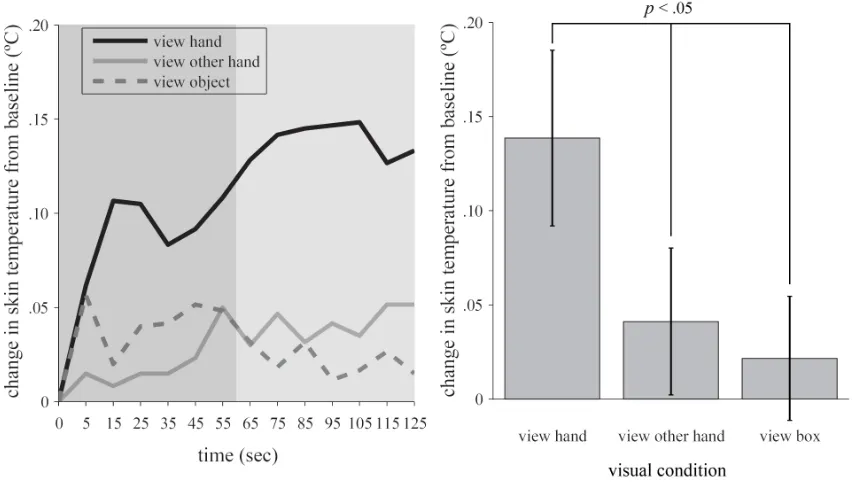
[image:6.595.85.511.416.658.2]102
Figure 1: Changes in the left hand dorsum skin temperatures (Experiment 1). Left panel: The 103
block. The analysis focused on test period (light grey). Right panel: Mean temperature 105
increase in test period across experimental conditions. Error bars are one S.E.M. 106
107
108
The temperature data are shown in Figure 1. Skin temperature of the left hand (compared to 109
baseline) differed significantly across the three conditions, F(2,58) = 3.43, p = .04, η2 = .11. There 110
was a clear increase from baseline in the View Hand condition (0.139°C), t(29) = 2.97, p = .01, dz =
111
.54, but not in the View Object (0.022°C), t(29) = .66, n.s., or View Other Hand (0.041°C), t(29) = 112
1.06, n.s., conditions. The increase in the View Hand condition was significantly larger than that in 113
the View Object, t(29) = 2.56, p = .02, dz = .47, and View Other Hand, t(29) = 2.05, p = .0495, dz =
114
.37, conditions. We found no correlation between the temperature increase in View Hand condition 115
and self-rated experience of seeing the left hand in mirror (Table 1, Question 1), r(30) = -.06, n.s. 116
The baseline temperature showed a slight decrease across successive blocks in a regression 117
analysis (mean ß = -.046°C), though this did not reach significance, t(29) = .84, n.s.
118
119
Experiment 2
120
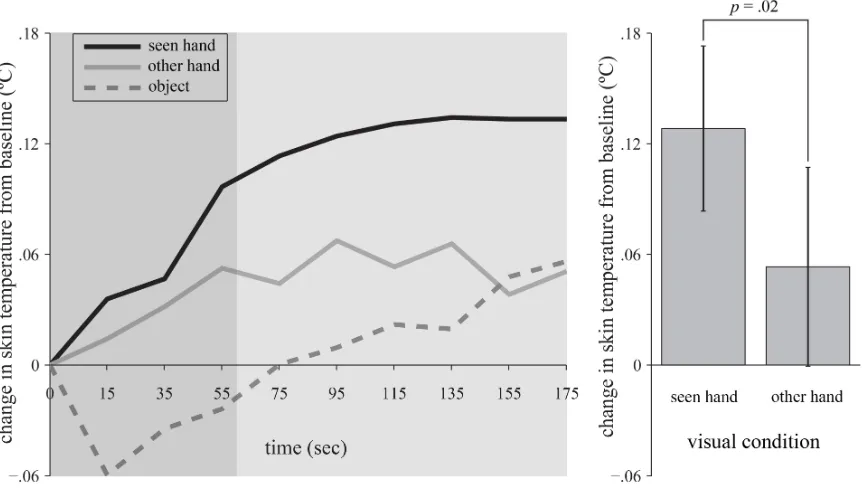
Table 2 suggests that the left and right hand temperatures (relative to baseline) were higher 121
when participants viewed that hand compared to looking in a direction of their other hand or box. This 122
is supported by a significant interaction between the visual condition and location of temperature 123
recordings, F(2,58) = 5.40, p = .01, η2 = .16 There was no main effect visual condition, F(2,58) =
124
1.10, n.s., nor a difference in temperatures recorded from the right and left hand, F(2,58) = .14, n.s. 125
126
mean change in skin temperature (ºC)
measured right hand measured left hand
experimental condition mean (s.e.m.) mean (s.e.m.)
view of the right hand 0.17 (0.05) 0.05 (0.04)
view of the non-hand object (box) -0.01 (0.06) 0.06 (0.05)
Table 2: Changes in hand dorsum skin temperature. Temperature was recorded from both 127
hands in each experimental condition (Experiment 2). 128
[image:8.595.80.511.160.407.2]129
Figure 2: Changes in skin temperature of the right and left hand dorsum (Experiment 2). Left
130
panel: The time course of temperature change of the seen same hand, other hand, and object 131
conditions compared to the baseline. The analysis focused on test period (light grey). Right
132
panel: Mean increase in temperature of measured hand in the seen hand and other hand 133
conditions. Error bars are one S.E.M. 134
135
136
To follow up this significant interaction we ran a 2x2 ANOVA on the hand-view conditions 137
including factors ‘viewed hand’ (right, left) and ‘measured hand’ (seen hand, other hand). Skin 138
temperature was increased for the seen hand compared to the other hand (Figure 2), F(2,58) = 6.34, p
139
= .02, η2 = .18. Critically, there was no main effect of right vs. left hand, F(2,58) = 1.85, n.s., nor an
140
increase was statistically significant in the seen hand condition, t(29) = 2.87, p = .01, dz = .52, but not
142
when the other hand or box were viewed, t(29) = .99, n.s., and t(29) = .53, n.s., respectively. 143
144
4. DISCUSSION 145
146
Looking at your hand increases its temperature, but does not affect the contralateral hand. 147
Moreover, viewing a non-hand object, even if in the exact location of the hand, does not result in 148
temperature increase. These findings demonstrate that vision of the body produces limb-specific 149
modulation of thermal regulation and thus they add to a growing literature reporting the widespread 150
effects of vision on bodily stimuli processing [1-6]. 151
Our findings have intriguing similarities with recent results showing temperature modulation 152
in the rubber hand illusion. In this illusion, touch applied synchronously both to a prosthetic hand and 153
one’s own hidden hand produces the compelling feeling that the rubber hand actually is one’s hand 154
[9-11]. The experience of ownership over the rubber hand produces a limb-specific temperature drop 155
in the hidden hand [12, 13]. Moseley and colleagues [12, 14] suggest that the experience of 156
ownership over the rubber hand displaces the actual hand, resulting in ‘disownership’ and reducing 157
homeostatic control in the limb. Our results can be interpreted as reflecting the opposite process, an 158
enhanced ownership over the seen limb resulting in increased homeostatic control and temperature. 159
Several psychiatric and neurological conditions involving disruptions of body representation 160
have also been found to feature disordered thermoregulation, including complex regional pain 161
syndrome (CRPS) [15, 16], schizophrenia [17], phantom limb pain [18], and self-injurious behaviour 162
[19]. CRPS, for example, is associated with increased pain, decreased tactile sensitivity on the 163
affected limb [20, 21], somatosensory disinhibition [22], and reduced temperature on the affected 164
limb [15, 16]. Intriguingly, vision of the body has the opposite effects in healthy participants, reducing 165
pain [3, 4], enhancing tactile sensitivity [1, 2], enhancing somatosensory inhibition [5], and increasing 166
Thus, vision of the body appears to produce real-time enhancement of a coherent 168
constellation of characteristics, which appear to be impaired in CRPS, suggesting that these 169
characteristics may arise from a single cortical network. Moseley and colleagues [14] recently 170
presented the idea of a ‘body matrix’, a putative cortical network integrating multisensory and 171
homeostatic functions to represent the body and the space immediately surrounding it. The diverse 172
effects produced by vision of the body could result from limb specific modulation of body matrix 173
activity. Consistent with this proposal, in a recent fMRI study we found that seeing the body while 174
receiving painful stimuli increased functional connectivity between visual and posterior parietal areas 175
and both somatosensory cortices (SI and SII) as well as areas known to be involved in homeostatic 176
control, including the insula and anterior cingulate cortex [23]. 177
The causal mechanism underlying our findings remains uncertain. One possibility is that in 178
addition to modulating somatosensory processing, vision of the body also modulates the autonomic 179
nervous system directly, analogous to the effect reported above in CRPS. Alternatively, seeing the 180
body may modulate activity in motor cortical areas. While seeing the body does not induce obvious 181
movement of the hand, it could produce sub-threshold muscular activation which could drive the 182
effect we report. Future research should investigate this issue. 183
184
185
References 187
1. Kennett, S., Taylor-Clarke, M., Haggard, P. 2001 Noninformative vision improves the spatial 188
resolution of touch in humans. Curr. Biol. 11, 1188-1191. 189
2. Harris, J. A., Arabzadeh, E., Moore, C. A., Clifford, C. W. 2007 Noninformative vision 190
causes adaptive changes in tactile sensitivity. J. Neurosci. 27, 7136-7140. 191
3. Longo, M. R., Betti, V., Aglioti, S. M., Haggard, P. 2009 Visually induced analgesia: Seeing 192
the body reduces pain. J. Neurosci. 29, 12125-12130. 193
4. Mancini, F., Longo, M. R., Kammers, M. P. M., Haggard, P. 2011 Visual distortion of body 194
size modulates pain perception. Psychol. Sci. 22, 325-330. 195
5. Cardini, F., Longo, M. R., Haggard, P. 2011 Vision of the body modulates somatosensory 196
intracortical inhibition. Cereb. Cortex 21, 2014-2022. 197
6. Longo, M. R., Sadibolova, R. 2013 Seeing the body distorts tactile size perception. Cognition
198
126, 475-481. 199
7. Haggard, P., Iannetti, G. D., Longo, M. R. 2013 Spatial sensory organization and body 200
representation in pain perception. Curr. Biol. 23, R164-R176. 201
8. Ramachandran, V. S., Rogers-Ramachandran, D., Cobb, S. 1995 Touching the phantom limb. 202
Nature 377, 489-490. 203
9. Botvinick, M., Cohen, J. 1998 Rubber hands 'feel' touch that eyes see. Nature 391, 756. 204
10. Tsakiris, M., Haggard, P. 2005 The rubber hand illusion revisited: Visuotactile integration 205
and self-attribution. J. Exp. Psychol. Hum. Percept. Perform. 31, 80-91. 206
11. Longo, M. R., Schüür, F., Kammers, M. P. M., Tsakiris, M., Haggard, P. 2008 What is 207
embodiment? A psychometric approach. Cognition 107, 978-998. 208
12. Moseley, G. L., Olthof, N., Venema, A., Don, S., Wijers, M., Gallace, A., et al. 2008 209
Psychologically induced cooling of a specific body part caused by the illusory ownership of an 210
artificial counterpart. Proc. Natl. Acad. Sci. U.S.A. 105, 13169-13173. 211
13. Hohwy, J., Paton, B. 2010 Explaining away the body: Experiences of supernaturally caused 212
14. Moseley, G. L., Gallace, A., Spence, C. 2012 Bodily illusions in health and disease: 214
Physiological and clinical perspectives and the concept of cortical 'body matrix'. Neurosci. &
215
Biobehav. Rev. 36, 34-46. 216
15. Moseley, G. L., Gallace, A., Spence, C. 2009 Space-based, but not arm-based, shift in tactile 217
processing in complex regional pain syndrome and its relationship to cooling of the affected limb. 218
Brain 132, 3142-3151. 219
16. Moseley, G. L., Gallace, A., Iannetti, G. D. 2012 Spatially defined modulation of skin 220
temperature and hand ownership of both hands in patients with unilateral complex regional pain 221
syndrome. Brain 135, 3676-3686. 222
17. Chong, T. W., Castle, D. J. 2004 Layer upon layer: Thermoregulation in schizophrenia. 223
Schizophr. Res. 69, 149-157. 224
18. Nikolajsen, L., Jensen, T. S. 2001 Phantom limb pain. Bt. J. Anaesth. 87, 107-116. 225
19. Symons, F. J., Sutton, K. A., Bodfish, J. W. 2001 Preliminary study of altered skin 226
temperature at body sites associated with self-injurious behavior in adults who have developmental 227
disabilities. Am. J. Ment. Retard. 106, 336-343. 228
20. Moseley, G. L. 2008 I can't find it! Distorted body image and tactile dysfunction in patients 229
with chronic back pain. Pain 140, 239-243. 230
21. Gierthmühlen, J., Maier, C., Baron, R., Tölle, T., Treede, R.-D., Birbaumer, N., et al. 2012 231
Sensory signs in complex regional pain syndrome and peripheral nerve injury. Pain 153, 765-774. 232
22. Lenz, M., Höffken, O., Stude, P., Lissek, S., Schwenkreis, P., Reinersmann, A., et al. 2011 233
Bilateral somatosensory cortex disinhibition in complex regional pain syndrome type I. Neurol. 77, 234
1096-1101. 235
23. Longo, M. R., Iannetti, G. D., Mancini, F., Driver, J., Haggard, P. 2012 Linking pain the and 236
body: Neural correlates of visual analgesia. J. Neurosci. 32, 2601-2607. 237
Acknowledgments 239