Journal of Criminal Law and Criminology
Volume 6 | Issue 2
Article 8
1915
Mental Tests and Practical Judgments
Leon A. Carley
Follow this and additional works at:
https://scholarlycommons.law.northwestern.edu/jclc
Part of the
Criminal Law Commons,
Criminology Commons, and the
Criminology and Criminal
Justice Commons
This Article is brought to you for free and open access by Northwestern University School of Law Scholarly Commons. It has been accepted for inclusion in Journal of Criminal Law and Criminology by an authorized editor of Northwestern University School of Law Scholarly Commons.
Recommended Citation
MENTAL TESTS AND PRACTICAL JUDGMENTS.
LEON A. CARLEY.'
This paper is a portion of a considerably longer report of investi-gations of what Ziehen calls "The Psychopathic Constitution. " 2 My aim in this study is many-fold:
1. To correlate the opinions of leading scientific men, here and
abroad, as to the methods of diagnosis and treatment of juvenile and adult delinquency.
2. To study a certain number of cases with all the means at hand, in order to point out comparatively the strong and weak points in our method of dealing at present with this class of cases.
3. To make a comparison of the results of tests for attention, association, memory, direction, learning and ethical discrimination upon delinquents, with the results of the same tests upon normal school children of the same school grade as the average school grade of the delinquents at the time they left school.
4. To make a comparison of the results of the above tests upon delinquents with the results of the same tests upon normal individuals in employment who are of the same average chronological age and station in life, and who were of the same average school grade at the time they left school.
5. To compare the results of the above tests upon white delin-quents with the results of the same tests upon colored delindelin-quents in the same institution.
6. To study and compare the sense of wrong in delinquents at the time they commit crime with their sense of wrong after they have been convicted and sentenced.
7. To classify empirically fifty Reformatory cases according to the judgments of the heads of the departments in the Reformatory, based upon their day-to-day experience with the cases, and to compare this classification with the results of the various tests.
In the sections of the report published here I present an outline of the tests I have employed upon four groups of subjects (White Reformatory boys, Colored Reformatory boys, school children and adults in employment), a comparison of the findings among the several groups, and finally a comparison of these findings among the Reformatory groups with the practical judgments of Reformatory officials. (See number 7, above.)
In pursuit of my aims I have studied sixty-four cases in the New Jersey State Reformatory for Men, at Rahway, New Jersey. Fifty
'Member of the Bar, N. Y. City; Ph. D., New York University.
cases, half white and half colored, I studied thoroughly. The other fourteen I was obliged to reject because of their inability to read and write or to answer correctly at least seventy per cent of the words presented in the "opposite" test. I also studied, with the same psychological test, including personal, family and educational history, thirteen apprentices and helpers in the Jersey City shops of the Erie Railroad Company, of the same average chronological age-and school grade as those of the Reformatory cases. For the op-portunity of testing the Erie Railroad employes I am especially indebted to the officers of the Erie Railroad.
I applied the same tests also upon thirteen boys in the fifth grade of the public schools at Caldwell, N. J., which is the same school grade as the average of the Reformatory cases. For this opportunity I am most grateful to Professor D. C. Barnett, Supervising Principal, and to the Board of Education at Caldwell, N. J.
My data are drawn from: (1) a questionnaire, (2) criminal and court records, (3) institutional records, (4) original tests, measure-ments and interviews, (5) interviews with all of the officers of the institution in reference to each of the cases studied.
Criminal and court records refer to the family and personal history of the individual, including name, age, parentage, place of birth and education, both religious and moral.
Institutional records include the records of Binet-Simon tests, physical examination and medical attendance, together with the history of the individual in school and detail work and department.
The original tests include:
Physical Tests and Measurements.-(Criminal Anthropometry.) 1. Standing Height.
2. Sitting Height. 3. Ponderal Index. 4. Cephalometry.
5. Colometry. 6. Dynometry. 7. Sense Tests. 8. Spirometry. 9. Chest Expansion.
Mental Tests.-All of these tests were taken by myself individually
for:
1. Attention. 2. Memory.
3. Understanding instructions. 4. Controlled association. 5. Learning.
MENTAL TESTS AND PRACTICAL JUDGMENTS
Interviews were had with each of the cases studied and also original interviews with officers of the institution, to obtain their estimate of each of the cases, based upon their experience with him at the institution.
The detailed description of apparatus and method in the applica-tion of the above tests and of the means employed in grading the results of the tests will be of interest only to technical students. They may be found in any manual of physical and mental tests.
In order to analyse the results of my own tests and measurements I wanted to know the judgments of the institutional officers, viz.: the Medical Director, Educational Director, Spiritual Adviser, Military Director, Detail Officer and the Superintendent, in reference to the improvability of the subjects tested. This method is not generally applied as yet, but we ought to know the impressions of competent persons who are in daily contact with the individuals
tested.
My interviews with these officers refer to the subject's (1) intelligence; (2) moral judgment; (3) education, (4) habits; (5) im-provability.
This constitutes a test of tests. The great trouble with our tests today is that they are too far from the real life of the individual and are thus suspected by men actually dealing from day to day with the cases. We must develop means to measure the affective sensibility which the individual manifests, and possibly these will come to us in terms of tendency rather than capacity. No one of the mental tests now used in the various laboratories has earned a reputation for standardization- The question is asked, "If tests only confirm what we know, or can know from regular contact with the subjects, are they worth while?" If they can put the seal of absolute confirmation on our judgments already found through methods outside of psycholog-ical tests, then, I believe, they are worth while. For constructive work there is much difference between thinking we know and knowing. If we get as far with our tests as confirmation of judgment, there is no reason for believing that we must stop there. The probability is that we can get much farther and measure conduct in terms which judg-ments cannot reach. However, as Dr. Wells says, "If we do not first interpret our tests by our subjects, we shall never understand our subjects through our tests." And now for that.
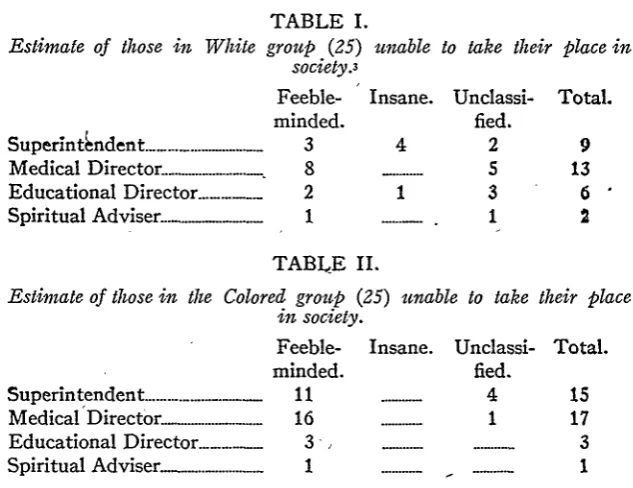
TABLE I.
Estimate of those in White group (25) unable to take their place in
society.3
Feeble- Insane. Unclassi- Total.
minded, fled.
Superint~ndent ... 3 4 2 9
M edical Director. ... 8 ... 5 13 Educational Director... 2 1 3 6 Spiritual Adviser... 1 ... 1 2
TABLE II.
Estimate of those in the Colored group (25) unable to take their place in society.
Feeble- Insane. Unclassi- Total.
minded, fled.
Superintendent...-... 11 4 15
Medical Director. ... 16 ... 1 17 Educational Director... 3 .. ... 3 Spiritual Adviser .. ... ... 1 .... ... 1
I have selected the nine cases in the White group mentioned by the Superintendent and tabulated their records in the tests showing their median, average and mean variation with the other 14 in the White group, whom he considers able, after proper treatment, to take their place in society. In like manner I have treated the 13 cases who are placed in this category by the Medical Director.
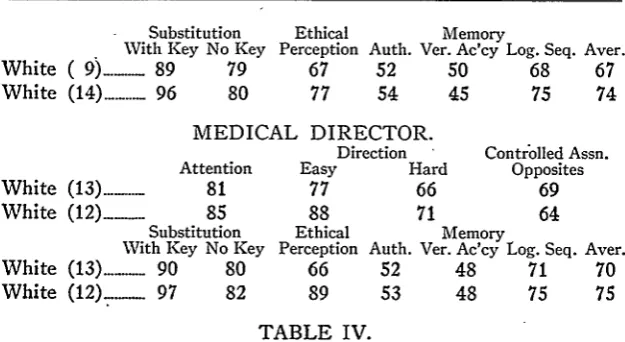
The general average in acckiracy of the cases indicated by the Superintendent and those indicated by the Medical Director are shown together-in Table III, and Table IV gives the general average of the same subjects for .time.
TABLE III.
Average Accuracy Score of the 9 subjects unable to take their place in society and the 14 able, as indicated by Superintendent, and that of the 13 subjects unable and 12 able as indicated by Medical Director.
O(All White cases.)
SUPERINTENDEN4T.
Direction Controlled Assn. Attention Easy Hard Opposites
White
(9)..._
80 77 60 57White (14)... 84 91 71 72
MENTAL TESTS AND PRACTICAL JUDGMENTS 253
Substitution With Key No Key White (
9)....
89 79 White (14)... 96 80Ethical Perception
67 77
Memory
Auth. Ver. Ac'cy Log. Seq. Aver.
52 50 68 67
54 45 75 74
MEDICAL DIRECTOR.
Direction Controlled Assn. Attention Easy Hard Opposites
White (13)... 81 77 66 69
White (12)---_ 85 88 71 64
Substitution Ethical Memory
With Key No Key Perception Auth. Ver. Ac'cy Log. Seq. Aver. White (13).___ 90 80 66 52 48 71 70 White (12)--. 97 82 89 53 48 75 75
TABLE IV.
Average Time Score of the 9 subjects unable to take their place in society and the 14 able, as indicated by the Superintendent and that of the 13 subjects unable and 12 able as indicated by the Medical Director.
(All White cases.)
White ( 9). White (14).
White (9)... White (4 ...
SUPERINTENDENT.
Direction Attention Easy Hard
224" 183" 320"
192 151 227
Substitution With Key No Key
337" 137"
279 109
Controlled Assn. Opposites Species-genus
200" 2."
131 1.7
Memory 125" 192 Average 191" 160
White (13) ... White (12)...
White (13)-.... White (12).__
Atten 1
MEDICAL DIRECTOR.
Direction Controlled Assn. ntion Easy Hard Opposites Species-genus
97 150" 259" 152" 1.9
05 154 255 149 1.8
Substitution With Key
305"' 285
No Key
133" 112 Memory 115" 125 Average 164" 160
[image:6.614.34.347.67.238.2]TABLE V.
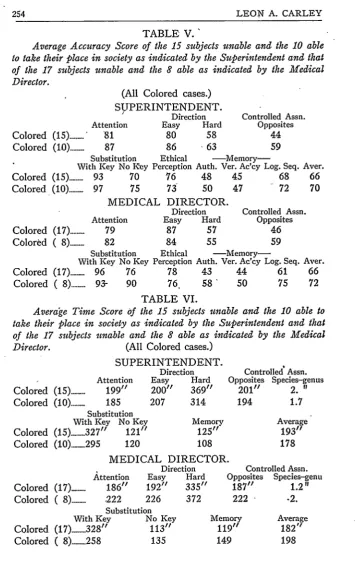
Average Accuracy Score of the 15 subjects unable and the 10 able to take their place in society as indicated by the Superintendent and that of the 17 subjects unable and the 8 able as indicated by the Medical Director.
(All Colored cases.) SVPERINTENDENT.
Direction Controlled Assn. Attention Easy Hard Opposites
Colored (15).... S1 80 58 44
Colored (10).... 87 86 63 59
Substitution Ethical
-Memory-With Key No IKey Perception Auth. Ver. Ac'cy Log. Seq. Aver. Colored (15)... 93 70 76 48 45 68 66 Colored (10).... 97 75 73 50 47 72 70
MEDICAL DIRECTOR.
Direction Controlled Assn. Attention Easy Hard Opposites
Colored (17)... 79 87 57 46
Colored ( 8)... 82 84 55 59
Substitution Ethical
-Memory-With Key No Key Perception Auth. Ver. Ac'cy Log. Seq. Aver. Colored (17)--- 96 76 78 43 44 61 66 Colored ( 8)-.... 93- 90 76 58' 50 75 72
TABLE VI.
Average Time Score of the 15 subjects unable and the 10 able to take their place in society as indicated by the Superintendent and that of the 17 subjects unable and the 8 able as indicated by the Medical
Director. (All Colored cases.)
SUPERINTENDENT.
Direction Controlled Assn. Attention Easy Hard Opposites Species-genus Colored (15)-.. 199", 200" 369" 201" 2. ,1
Colored (10).-- 185 207 314 194 1.7
Substitution
With Key No Key Colored (15)-.327" 121" Colored (10).-_295 120
MEDICAL D]
Dire Attention Easy
Colored (17)-_ 186" 192"'
Colored ( 8).... ,222 226
Substitution With Key No Key
Colored (17)-328" 113"
Colored ( 8)--.258 135
Memory
125"
108
Average 193" 178
[RECTOR.
ction Controlled Assn.
Hard Opposites Species-genu 335" 187"' 1.2"
372 222 -2.
Memory 119", 149
Average 182"
[image:7.614.32.388.40.616.2] [image:7.614.36.363.55.353.2]MENTAL TESTS AND PRACTICAL JUDGMENTS 255
From Table III we see that the average accuracy of the Super-intendent's 9 White cases is 7 per cent under the average accuracy of the other 14 White cases whom he considers able to take their places; while the Medical Director's 13 White cases are 5 per cent under the balance of 12 White cases whom he considers able to take their places. As to average time, Table V shows the Superintendent's cases slower by 31" and the Medical Director's slower by 41 than those who in their judgment are able to take their place in society.
In the Colored group the Superintendent's 15 cases are 4 per cent lower in accuracy than the remaining 10, and the Medical Director's 17 cases are 6 per cent lower than the remaining 8 cases; while in time the Superintendent's 15 cases are 15" slower than the remaining 10 and the Medical Director's 17 cases are 16" faster than the balance of 8 cases (Table VII).
Taking all the subjects whom the Superintendent estimates as unable, we find an average in accuracy of 66.5 per cent against 72 per cent average for the balance; while in time the average is 192" against 169" for the balance of the group.
For the Medical Director's total cases we have an average of 68 per cent against 73.5 per cent for the balance; and in time an average of 173" against an average of 179" for the balance of the
group.
The following are typical forms in which the officers of the Reformatory have expressed their judgment of the cases:
CASE NO. 1.
Superintendent.-" Moral" defective."
Medical Director.-" Neurotic; curable."
Educational Director.-" Good sense of right and wrong; will make good."
Spiritual Adviser.-"No sharp sense of right and wrong; will
not make good."
Military Director.-"Will be a thief all his life."
Detail Officer.-" Good environment will make him right."
CASE NO. 2.
Superintendent.-" Feebleminded."
Medical Director.-" Mentally defective; incurable."
Educational Director-" Childish; will not make good."
Spiritual Adviser.-" Mentally defective; will not make good." Military Director.-"A fool; a degenerate."
CASE NO. 3.
Superintendent.-" Confirmed criminal." Medical Director.-" Feebleminded."
Educational Director.-" Defective; no capacity."
Spiritual Adviser. - "Mentally normal. No sharp sense of right and wrong; probably will not make good."
Military Adviser.-" Sneak thief and always will be." Detail Officer.-" Derelict; industrious; a wild boy."
CASE NO. 4.
Superintendent.-" Insane."
Medical Director.-" Neurotic; incurable."
Educational Director.-" Will not make good."
Spiritual Adviser.-" Mentally normal; no apperception for right; will not make good."
Military Director.-" Crazy."
Detail Officer.-" Crazy."
CASE NO. 5.
Superintendent.-?
Medical Director.--"Feebleminded."
Educational Director.-" Will not make good."
Spiritual Adviser.-" Mentally normal; knows right and wrong;
will make good."
Military Director.-"Sneak thief, although professing reform,
will have to show me."
Detail Officer.-" Leader; above normal."
An analysis of this estimate of all the cases shows that for 17 the judgments of the six officers agree; in eight there is a practical agreement, while as to 22 cases they differ, and in 3 cases there is a wide variation. Probably the same percentage of variation would show if a similar analysis were made in all institutions dealing with mental and moral delinquents. When our tests are sufficiently per-fected and standardized, then our institutional officers can have regular conferences over the inmates, and have standards by which to be guided.
MENTAL TESTS AND PRACTICAL JUDGMENTS 257
of right and wrong. The estimate of the Military Director shows the point of view of the policeman in that a large number '"know the difference between right and wrong" but commit crime deliber-ately. If space permitted an analysis could be made of the judg-ment of the Educational Director and the others who are in close contact with the subjects each day, as to their characteristics.
We will now take the score in accuracy for each of the 7 White cases which the Superintendent and Medical Director agree upon as unable to take their place in society and compare the same with the score of the Erie Employes. It follows in Table VII, and a similar comparison for time will be found in TableVIII.
TABLE VII.
Accuracy Score of Erie R. R. employes and 7 White cases estimated as unable to take their place in society by both the Superintendent and
Medical Director.
Control-Direction. led Assn. Substitution. Memory.
.
4) 730C 7n d4
Case ... 1580 7 50..8 979>0.5 5 57
Cae4 ... 1 8 20 4 3 2 o2 ... 50 0 75 4)
as 8 0 0 a2) 60 0 >
M 0 z 4 >
-Erie (13)-... ..82 82 66 54 97 84 73 53 49 73 71 Case2-...15 8075 50 5S 97 94 80 55 50 75 71 Case 4-...15 5820 42 49 53 22 ...505075 41 Case 6 ... 13 96 90 70 50 98 84 100 65 50 75 77 Case --- A 78 85 60 80 98 92 20 60 50 75 69 Case 15 ... A 82 85 70 68 94 92 ... 45 50 75 72 Case 17 ... 10 80 85' 95 65 99 46 ... 45 50 75 71 Case 20 ... 15 64 85 25 28 so 90 70 25 50 25 54
TABLE VIII.
Time Score of Erie R. R. employes and 7 White cases estimated
as unable to take their place in society by both the Superintendent and
Medical Director.
Direction. Controlled Assn. Substitution.
Atten- Op- Species- With Mem- Aver-tion. Easy. Hard. posites. gen. Key. No Key. ory. age. Erie (13) .... 209" 220" 361" 231" 2.4 321" 154" 167" 208" Case 2 ... 245 311 550 372 2.2 492 259 106 292 Case 4 ... 146 213 239 166 1.8 332 65 160 165 Case 6 ... 242 150 242 60 1.7 260 135 135 153 Case 10 ... 130 145 177 278 2.0 314 137 100 160 Case 15 ---- 184 110 280 157 1.2 270 115 107 153 Case 17 ---- 206 310 320 232 2.3 485 270 166 248 Case 20 ... 221 150 310 120 3.1 320 135 106 170
[image:10.614.27.387.221.414.2]a little below the Erie average and two very much below; while in time all are quicker than the Erie, except two. The three lower in accuracy are Nos. 4, 10 and 20, and the two slower in time Nos. 2 and 17. Of these five cases the only ones estimated as feebleminded are No. 2 by the Superintendant and Nos. 2 and 20 by the Medical Director. The Binet Test classifies both at 15 years.
In the Colored group there are 10 whom the Superintendent and the Medical Director agree upon as unable to take their place. The following Table IX sets out the accuracy of each of these; and Table X shows the same comparison in time.
TABLE IX.
Accuracy Score of Erie R. R. employes and 10 Colored cases estimated as unable to take their place in society by both the Superintendent and Medical Director.
Binet. Atten-tion.
Cont.
Direction. Assn.
Oppo-sites. Easy. Hard.
Substitution.
Key. No Key.
Erie (13) ... 82% 82% 66% 54% 97% 87%
Case 26 ... A 88 80 70 45 96 84
Case 27 ... 11 92 80 90 15 98 88 Case 32 ... 15 96 100 55 75 93 90 Case 34 ... 11 88 70 65 70 100 98 Case 36 ... -.... 12-15 84 65 35 58 97 66 Case 41 ... 9 88 60 50 35 95 100 Case 42 ... 12 80 95 50 55 98 78 Case 43 ... 10 56 95 35 48 99 98 Case 47 ... 12 70 60 65 48 94 Case 50 ... 15 94 95 60 33 92 68
Memory.
Ethical Average.
Pereception. Auth. Verb.Accy.Log. Seq.
Erie (13) ... Case 26 ... Case 27 ... Case 32 ... Case 34. ... Case 36 ... Case 41 ... Case 42 ... Case 43 ... Case 47 ...
Case 50 . ---...
73% 90 90 100 50 90 80 50 90 70 53% 45 80 15 65 30 45 55 30 45 50
49% 73%
50 75
50 75
25 25
50 75
50 75
25 75
50 75
50 75
50 75
50 75
TABLE X.
[image:11.622.43.378.261.552.2]MENTAL TESTS AND PRACTICAL JUDGMENTS 259
Direction. Controlled Assn.
Attention.
Easy. Hard. Opposites. Species-genus.
Erie (13) ... 209" 220" 361" 231" 2.4" Case 26 ... 165 195 374 255 1.8 Case 27 ... 280 210 330 127 2.8 Case 32 ... 166 208 483 218 1.4 Case 34. ... 152 180 320 194 1.1 Case 36 ... 191 150 342 199 3.2 Case 41 ... 184 300 329 234 2.5 Case 42 ... 252 180 391 36S 2.6 Case 43 ... ._ 221 300 433 224 1.5 Case 47 ... 164 240 582 272 - 1.7 Case 50 --...--- 190 125 372 253 2.4
Substitution.
Memory. Average.
With Key No Key.
Erie (13) ... Case 26 ... Case 27 ... Case 32 ... Case 34 ... Case 36 ... C ase 41 ...----... Case 42 ... Case 43 ... Case 47 ... Case 50. ...
From Tables
321" 346 225 340 250 370 305 350 380 480 400 154" 122 95 192 1T4 160 95 155 210 135 167" 85 148 295 127 104 121 145 79 100 90 208" 192 164 237 168 189 196 230 231 229 195 IX and X we see that one of the Colored cases is equal in accuracy with the Erie average; three are better; six are below; while in time six are quicker than the Erie and four are slower. The six lower in accuracy are Nos. 32, 36, 41, 43, 47 and 50; and the four slower in time are Nos. 32, 42, 43, and 47. These cases are all estimated as feebleminded by both the Superintendent and Medical
Director.
The Binet tests classify No. 41, 9 years; No. 43, 10 years; Nos. 27 and 34, 11 years; Nos. 36, 42 and 47, 12 years; Nos. 32 and 50 as 15 years and No. 26 as adult.