Munich Personal RePEc Archive
Fair value on commons-based intellectual
property assets: Lessons of an estimation
over Linux kernel.
García-García, Jesús and Alonso de Magdaleno, María Isabel
Universidad de Oviedo
8 June 2010
F
AIR VALUE ON COMMONS-
BASED INTELLECTUAL PROPERTY ASSETS.
L
ESSONS OF AN ESTIMATION OVERL
INUXK
ERNELJesús GARCÍA-GARCÍA
Department of Accounting University of Oviedo (Spain)
María Isabel ALONSODE MAGDALENO
Department of Business Administration University of Oviedo (Spain)
--- Very Preliminary Draft:
08/06/10---Keywords: FLOSS, commons, accounting standards, financial reporting
Introduction
Wealth, growth and welfare are driven nowadays by intangible intellectual assets. Classical tangible or financial assets are rapidly becoming commodities. With the arrival of the new information technologies, the structure of firms have changed dramatically, shifting the focus of value creation from tangible based activities to intangible based value creation. As showed on a classical study by Lev (2001), the value of intangible assets has therefore constantly increased in the last decades from an average of 40% of total market value of business corporations at the begin of the 1980s to over 80% at the end of the 20th century. In knowledge intensive industries a firm’s book value is often lower than 10% of it’s market value, of which the largest part are constituted by intangible assets such as relations to customers and business partners, a company’s workforce, patents, trademarks or other intellectual property, organizational capital in form of superior business processes, organization structures and a unique corporate culture. Lev's classical study is now ten years old, so we can suppose this phenomenon has been growing since then.
One of the main reasons for the growing disconnect between market values and financial information is the legal framework for financial reporting. Accounting rules may not allow companies to capitalize investments in intangibles and to report on them like on other assets, so financial statements could be insufficient to assess properly the performance and the value generation potential where intangible assets are the major drivers of corporate value. Basic measures of performance and profitability such as Return-On-Investment (ROI) and Return-On-Equity (ROE), valuations for the purpose of mergers and acquisitions, resource allocations and other are seriously flawed or mislead without an estimate of the value of intangible assets.
The Linux operating system kernel has been developed using an open source development model. It is one of the most prominent examples of Free/Libre Open Source Software (FLOSS) and represented a $21 billion ecosystem in 2007, expected to more than double in revenue by the end of 2012 (IDC, 2009). As FLOSS, Linux is developed collaboratively, meaning no one company is only responsible for its development or ongoing support. Companies share research and development costs with their partners and competitors, since 2005 over 5000 individual developers from nearly 500 different companies have contributed to the kernel. This spreading of development burden amongst individuals and companies has resulted in a large and efficient ecosystem and unheralded software innovation, freely available to society. This principles and practices are commonly applied to the peer production development of software that is made available for public collaboration. However, open source methods are increasingly being applied in other fields of endeavour, such as biotechnology or cultural production.
general volunteer activity is not reflected on financial statements. As a result, there is not value of volunteer contributions and there is also no single source for cost estimates of how much it has taken to develop an open source technology. This volunteer activity encloses not only individuals but corporations contributing software into the open source movement. There is a sense of the growing importance of this type of crowdsourced innovation, at least in particular contexts. Important innovations by communities of users and firms have been documented, in some cases giving birth to highly innovative start-up firms. It is in information and communication technologies that some of the most interesting instances of user-generated innovations occur. Open source software is one prominent case because creations are often motivated by users' needs (Lerner and Tirole, 2005), and are carried out using productive methods that are at odds with the traditional tenets of software engineering (Koch and Gonzalez-Barahona, 2005; Picci, 2006). Great value of FLOSS is missing from financial statements and managements decisions because accounting framework ignore activities carried out by users and outside of formal productive contexts. Accordingly, a whole ecosystem of crowdsourced innovation could be left aside from companies' valuation.
A) THE ACCOUNTING FRAMEWORK FOR FINANCIAL REPORTING
The need for a valuation
Innovation is thinking, and thinking is work. It is hard to compare thinking to other kinds of work. The real effort is the cost of creation, not the physical or logical support. Once a person has paid the cost of creation, however, the economic cost of a second person using that knowledge moves down to essentially zero, even though is still effort involved in learning and understanding this knowledge. Therefore, our incentive is to use other people's knowledge frequently and to create new knowledge rarely. There is another great dilemma on information goods. Shared knowledge is especially valuable because knowledge is generally susceptible to network effects: the more people who posses a particular piece of knowledge, the more valuable that knowledge becomes because it gets pooled with other knowledge to lead to new applications. This is the second basic dilemma of information: information has higher individual value when it is kept secret, but higher societal value when it is shared (Lindberg, 2008).
balance sheet and this could lead to a business being significantly under-valued. Costs of development or acquisition of IP were often expensed or amortised. IP is undoubtedly an asset, however, and must be treated as such if accounts are to provide a true and fair view of the business. FLOSS and open source commons are under copyleft IP licenses which means that it requires derived works to be available under the same license terms. Thus, commons-based IP assets has no limit to distribution and reuse for anybody.
Valuing informational assets is complex and challenging but achievable. There is no single ideal method for valuing them. Various methods must be employed as appropriate, either alone or in combination. Challenges are presented by lack of available information for comparison, interdependency of IP rights with other assets of the business and the difficulty of putting a value on intangibles.
There are many and varied reasons why a business might choose to value its IP. Some of the most commonly are briefly explained below (Glaze and White, 2007):
• To raise finance, perhaps by selling the IP, using it as security for a loan or as a way of attracting investment. It is important to provide as reliable and accurate valuation as possible.
• To put a realistic value on a business to be purchased or sold.
• For taxation purposes, for example when transferring IP rights.
• When licensing IP to or from a third party an accurate valuation is crucial in ensuring an appropiate licensee fee.
• When managing assets and planning business strategy. Management should know what their business owns and its worth to enable effective decision-making, for example whether IP rights value justifies the costs of developing or protecting.
• To report accurately on the value of the business to investors and other interested third parties by returning accounts that provide a true and fair view of the business.
Cost approach
The basic foundation of the cost approach is that a company would pay no more for an IP asset than the costs to replace it; that is, the replacement costs. A more complex view bases the cost approach on economic logic, if a firm invest on an asset it is expected that returns would cover the cost of the asset. The costs to replace the intangibles assets include the costs today of developing similar assets that provides similar benefits at similar costs adjusted for any obsolescence in the existing technology. The cost approach attempts to quantify the amount required to replace the benefits of the asset at issue, net of obsolescence. This approach does not consider directly the future cash flow associated with the property, the period over which they may be available, or the risk associated with the cash flows. While this can be a relatively easy approach, it is highly doubtful whether there is any real relationship between the value of knowledge rights and the cost of developing and maintaining them. Large sums are frequently spent on development of IP that turn out to have little or no value in terms of generating income. Conversely, the economic benefits of some IP rights far outstrip the costs of acquiring or developing them. Another major weakness of this method is that the costs associated with developing something are not all related to its value. This is particularly evident in respect of research and development activities; the cost of developing an IP is the same whether is never marketed at all or goes on to become a blockbuster.
Market approach
The market approach measures value by referencing to comparable transactions in the market. Ideally, it would be possible to observe the value of the IP obtained from a prior market transaction. However, it is exceedingly rare for such transactions to be available: many deals remain highly confidential, and most IP is not developed to be sold or is sold only as a part of a larger transaction, even more if we speak about commons IP assets. The market price maybe a reliable pricing method for tangible goods that have sufficient numbers of comparable objects to evaluate, but this is not the case for IP, given its character as exclusive right. More commonly, applying the market approach entails collecting data on prices paid for reasonable comparable IP. This approach requires data from an active market in sufficient similar property. Adjustments to the values obtained from third-party transactions may be necessary for any material differences between the market transactions and the IP. The reliability of this approach depends directly on the availability of detailed data regarding comparable third-party transactions and any necessary adjustments. We must also identify any material differences between the transactions and make any necessary adjustments using an appropriate methodology.
Income approach
entities and capital assets, and liabilities such as bonds and mortgages, but also the amount saved in royalty payments to be allowed to use a similar IP. It is the most appropriate approach, because the value of future cash flows is likely to be what the business strategist, potential purchaser or financing institution is most interested in. In general, income approach considers the economic contribution of the IP in terms of the net cash flows realized, the profile of those cash flows, and the risks associated with realizing them. The income approach is consistent with economic principles. It captures the timing, market conditions and risks associated with the use of the IP. This approach requires data on the revenues, costs, risks, and economic life associated with the IP to be valued. In some cases, sufficiently reliable and accurate data are not available. Many times, this method remains a theoretical approach because calculations are based on a market not yet developed, even the final value of the asset is dependent on the negotiation skills of the parties involved.
The concept of intangible asset and its valuation on accounting framework
Every country has is own accounting legal framework, but all of them relies on standards fixed by private not-for profit organizations. International Accounting Standards Board (IASB) and Financial Accounting Standards Board (FASB) are main independent, privately-funded accounting standard-setters. In order to establish accounting principles, IASB and FASB issues pronouncements publicly, each addressing general or specific accounting issues.
The IASB was founded on 2001 as the successor to the International Accounting Standards Committee (IASC) founded on 1973. It is responsible for developing International Financial Reporting Standards (IFRS), called International Accounting Standards (IAS) before 2001, and promoting the use and application of these standards. IFRS are considered a "principles based" set of standards in that they establish broad rules as well as dictating specific treatments. IASB is an European organization based on London so IFRS are used in many parts of the world but mainly on European Union where IFRS reporting is required or inspires local accounting framework1. In addition, the increasing worldwide acceptance of financial reporting using IFRS is leading USA towards IFRS. IASB work is directed also at convergence with USA financial reporting framework.
The FASB is an American private organization, founded on 1973 and settled on Norwalk (Connecticut), whose primary purpose is to develop generally accepted accounting principles (GAAP) within the USA in the public's interest. GAAP are accounting rules used to prepare, present, and report financial statements for a wide variety of entities, including publicly-traded and privately-held companies, non-profit organizations and governments2.
1 Current overview of countries that have adopted IFRS total or partially: http://www.iasplus.com/country/useias.htm
2 USA government does not directly set accounting standards, in the belief that the private sector has better knowledge and
The most important difference between IFRS and GAAP is that the IFRS is based on principles, whereas GAAP is based on rules. GAAP suffers from the complexity of trying to set rules for all situations, a complexity that often masks economic reality. According to IASB, in the absence of a standard or an interpretation that specifically applies to a transaction, management must use its judgement in developing and applying an accounting policy based on accepted principles that results in information that is relevant and reliable. We must remark that there is no common language for measuring the performance of companies. Until recently, all major countries had their own accounting rules. Inconsistent approaches to accounting make it hard to compare companies based on different countries. But nowadays IFRS has become the approach of choice for financial reporting. A single set of accounting rules would mean more effective global disclosure and transparency.
Assets are the fundamental concept in accounting. Assets, also called economic resources, are the lifeblood of both business enterprises and not-for-profit organizations. Since resources or assets confer their benefits on an enterprise by being exchanged, used, or otherwise invested, changes in resources or assets are the purpose, the means, and the result of an enterprise’s operations, and a business enterprise exists primarily to acquire, use, produce, and distribute resources (FASB, 1985).
On IFRS an asset is defined as a resource controlled by the enterprise as a result of past events and from which future economic benefits are expected to flow to the enterprise . An item that meets the definition of an element should be recognised if (IASB, 2001):
1. it is probable that any future economic benefit associated with the item will flow to or from the entity; and
2. the item has a cost or value that can be measured with reliability3.
According to FASB (1985) an asset has three essential characteristics to come into existence:
1. it embodies a probable future benefit that involves a capacity, singly or in combination with other assets, to contribute directly or indirectly to future net cash inflows .
2. a particular entity can obtain the benefit and control others’ access to it .
3. the transaction or other event giving rise to the entity’s right to or control of the benefit has already occurred.
Both definitions include future economic benefit as the main feature of an asset. The most obvious evidence of future economic benefit is a market price. Anything that is commonly bought and sold has future
3 Measurement, as defined by IASB, is the process of determining the monetary amounts at which the elements of the financial
economic benefit. Similarly, anything that creditors or others commonly accept in settlement of liabilities has future economic benefit, and anything that is commonly used to produce goods or services, whether tangible or intangible and whether or not it has a market price or is otherwise exchangeable, also has future economic benefit. Incurrence of costs may be also significant evidence of acquisition or enhancement of future economic benefits.
IASB definition of an assets is wider than FASB's one. FASB requires not only probable future benefit but exclusive control of resources and the existence of a transaction in the past. The absence on IASB's definition of a transaction in the past can be justified on the ground that it was superfluous, anything that exists must have come into existence at some time in the past. But it also can be interpreted as a possibility to report real world economic phenomena that have no origin in past transactions, thus allowing the recognition, at fair value, of elements of internally generated goodwill that until this time have not been regarded as suitable for recognition in financial reports.
An entity must control an item’s future economic benefit to be able to consider the item as its asset. The classical view of control over assets is based on scarcity. To enjoy an asset’s benefits, an entity generally must be in a position to deny or regulate access to that benefit by others. Thus, an asset of an entity is the future economic benefit that the entity can control and thus can, within limits set by the nature of the benefit or the entity’s right to it, use as it pleases. The entity having an asset is the one that can exchange it, use it to produce goods or services, exact a price for others’ use of it, use it to settle liabilities, hold it, or perhaps distribute it to owners. An entity usually gains the ability to control an asset’s future economic benefits through a legal right. However, an entity still may have an asset without having an enforceable legal right to it if it can obtain and control the benefit some other way, for example, by maintaining exclusive access to the asset’s benefits by keeping secret a formula or process.
A question arises whether an item received should be recognized as an asset or as an expense or loss if the value of future benefit obtained is uncertain or even doubtful or if the future benefit may be short-lived or of highly uncertain duration. Expenditures for R&D are examples of items for which management’s intent clearly is to obtain or increment future economic benefits but for which there is uncertainty about the extent, if any, to which the expenditures succeeded in creating or increasing future economic benefits. It must be clear that we must firmly reject the popular argument that costs are assets. Although an entity normally incurs costs to acquire or use assets, costs incurred are not themselves assets. The essence of an asset is its future economic benefit rather than whether or not it was acquired at a cost. The ultimate evidence of the existence of assets is the future economic benefit, not the costs incurred (FASB, 1985).
from costs incurred on R&D required prerequisite conditions that are based on such factors as technological feasibility, marketability and usefulness. FASB argued that considerable judgement is required to identify the point in the R&D process at which a new or improved product is defined and determined to be technologically feasible, marketable or useful. So the FASB decided to reject this method because, in practice, no set of conditions that might be established for capitalization of costs could achieve comparability among firms. Selective capitalization is applied only to costs incurred after fulfilment of the specified conditions, and the capitalized amount would not indicate the total costs incurred to produce future benefits. In practice, most companies write off as an expense of the present period R&D and development costs made with the expectation of benefiting future periods. This policy mismatch revenue/expense relationship and cannot be justified on the grounds of accounting principles to show the true and fair view of the company. Furthermore, precluding capitalization removes from financial statements what may be a company's most valuable asset (Gornik-Tomaszewski and Millan, 2005).
Intangible assets can be defined as identifiable non-monetary assets that cannot be seen, touched or physically measured, which are created through time and/or effort and that are identifiable as a separate asset. There are two basic forms of intangibles:
• legal intangibles: such as trade secrets, copyrights, patents and trademarks.
• competitive intangibles: such as know-how, knowledge, collaboration activities and goodwill.
Legal intangibles are called intellectual property and generate legal property rights. Competitive intangibles, while legally non-ownable, have an impact on effectiveness, productivity, wastage, and opportunity costs within an organization. Therefore, they have also impact on costs, revenues, market value, and share price. Competitive intangibles are the biggest source of competitive advantage for organizations.
The three critical attributes of an intangible asset are, according to IAS 38 (IASB, 1998):
• identifiability
• control (power to obtain benefits from the asset)
• future economic benefits (such as revenues or reduced future costs)
This attributes are similar to the generic attributes of an asset except for the requirement of identifiability as the main feature of an intangible. Requirement is obvious due to lack of physical entity. IAS 38 states an intangible asset as identifiable when it:
• arises from contractual or other legal rights, regardless of whether those rights are transferable or separable from the entity or from other rights and obligations.
This requirements applies whether an intangible asset is acquired externally or generated internally. The probability of future economic benefits must be based on reasonable and supportable assumptions about conditions that will exist over the life of the asset and is always considered to be satisfied for intangible assets that are acquired separately or in a business combination but not for internally generated intangible assets. If an item does not meet both the definition of and the criteria for recognition as an intangible asset, it must be expensed when it is incurred without possibility to be reinstating as an intangible asset at a later date.
R&D and software development costs are capitalised only after technical and commercial feasibility of the asset for sale or use have been established. This means that the entity must intend and be able to complete the intangible asset and either use it or sell it and be able to demonstrate how the asset will generate future economic benefits. Resources to complete the project and ability to measure cost are also required.
Financial reports must disclose for each class of intangible asset, according to IAS 38:
• useful life or amortisation rate
• amortisation method
• gross carrying amount
• accumulated amortisation and impairment losses
• line items in the income statement in which amortisation is included
• reconciliation of the carrying amount at the beginning and the end of the period showing: - additions (business combinations separately)
- assets held for sale
- retirements and other disposals - revaluations
- impairments
- reversals of impairments - amortisation
- foreign exchange differences - other changes
• basis for determining that an intangible has an indefinite life
• description and carrying amount of individually material intangible assets
• information about intangible assets whose title is restricted
• contractual commitments to acquire intangible assets
Additional disclosures are required about:
• intangible assets carried at revalued amounts
• the amount of R&D expenditure recognised as an expense in the current period
Open source generated assets face the problem of the control over them. According to copyleft licenses there is one organization that keeps control over the license. But it doesn't hold any control about uses and economic explotation of the asset. However, any organization that freely receives the asset can use it to generate income.
Effect of intangible assets on firm value
There is a large body of literature in economics, finance and accounting concerned with the valuation relevance of intangible investments on financial reporting. Among the studies on the valuation of expenditures on intangibles are those that examine R&D costs [Chan, Martin and Kessinger (1990), Sougiannis (1994), Lev and Sougiannis (1996), Lev and Zarowin (1999), Shi (2003) and the literature review made by Anagnostopoulou (2008)]; investment in brand names and trademarks [Barth, Clement, Foster and Kasznik (1998)]; goodwill [Chauvin and Hirschey (1994)]; patents [Hall, Jaffe and Trajtenberg (2005)] and human resources [Hanson (1997)]. Most of these studies provide evidence consistent with the notion that investment in intangibles enhances the value of the firm.
of being undertaken by firms, investments in intangibles must have a positive expected net present value, at least in the eyes of the investing firms’ management and most likely in the eyes of investors as well. In this respect, the empirical finding that the market views R&D expenditures as an asset merely confirms the obvious - that investors do not question the wisdom of investing in intangibles.
Intellectual capital valuation
Intellectual capital is one of the intangible assets that makes a company worth more than the sum of its countable parts. As an asset, it has been inadequately covered for years by goodwill. But unlike accounting goodwill, intellectual capital appreciates and has its own criteria on decision-making. On the knowledge age, intellectual capital has become an issue of intense interest and concern because it has turn into an strategic asset. Because of information technology, companies rely more on expertise and technical ability, and less on manual labour.
Although it has been around forever, intellectual capital was not identified as a key asset until the 1990's decade. The first intellectual capital annual report accompanying financial statements was released in 1995 by Skandia (at this time the largest insurance and financial services company in Scandinavia). The Skandia model has since been adopted and refined by other companies, some of which have created their own approaches to intellectual capital. Intellectual capital holds far-reaching implications for measure and audit what makes companies valuable rather than the historical approach that has characterized classical financial reporting.
What difference would it make even if intellectual capital could be measured? The knowledge economy is characterized by huge investments in both human capital and information technology. Under the existing reporting system, a typical investor does not receive an accurate picture of a company’s true value. The more a company invests in its future, the less its book value because intellectual capital is only reported as wage expenses. As a result, too many deserving companies are underoptimized and undercapitalized.
Evaluating intellectual capital can help make a company more efficient, more profitable and more competitive. By identifying and measuring intellectual capital, firms are better prepared to (Edvinsson and Malone, 1997):
• Confirm the company’s ability to achieve its goals.
• Plan and fund research and development.
• Make decisions for reengineering programs.
• Focus organizational education and training programs.
• Expand the organization’s memory by identifying key resources and avoiding reinvention.
Undoubtedly, valuing intellectual capital has risks, though not valuing it may do financial statements lose relevance. Placing a monetary value on intangible assets creates a potential for abuse that must not be forgotten.
We can describe intellectual capital as assets currently valued at zero on the balance sheet, including items such as human brainpower, brand names, trademarks, and assets booked at historical costs that have appreciated over time into something of much greater value. It is obvious that intellectual capital could be confused with intellectual property (copyrights, patents ...) and goodwill and capital gains not reported on financial statements, which are a subset of intellectual capital.
A more formal definition is given by Brooking (1997). Brooking defines intellectual capital as the combined intangible assets which enable a firm to function. In other words, a company is the sum of its tangible assets and its intellectual capital. Edvinsson and Malone (1997) equate intellectual capital with the sum of human capital and structural capital (i.e. customer relationships, information technology networks and management). Stewart (1997) gives a more functional definition defining intellectual capital as packaged useful information, intellectual material that has been formalized, captured, and leveraged to produce a higher-valued asset.
There are three areas of an enterprise where intellectual capital can be found. Accordingly, intellectual capital is divided into:
• Human Capital: The capabilities of the company’s employees necessary to provide solutions, to innovate and to renew. In addition to individual capabilities, human capital includes the dynamics of an intelligent organization in a changing competitive environment, its creativity, and innovativeness.
• Structural Capital: The infrastructure of human capital, including the organizational capabilities to meet market requirements. Infrastructure includes the quality and reach of information technology systems, company images, databases, organizational concept and documentation.
• Customer Capital: The relationships with people with whom a company does business (customers and suppliers). It has also been referred to as relationship capital.
Both human and structural capital are assessed in how they affect profit and revenue, which rely in large part on how well customers and suppliers are reached and retained in relationship with the company. Therefore, another key component of intellectual capital is companies' relationship with customers and suppliers. it is the easiest component of intellectual capital to measure, because revenues come from customers and profitability come not only from customers but from relationship with suppliers.
Edvinsson and Malone (1997) make a suggestion on how companies can evaluate their customer capital. This suggestion can be fitted to open source communities in part by measuring the following:
• Community profile: Who are our the members of our community, and how do they different from others communities. What potential do firms have to improve loyalty, generate new collaborations, and convert from other communities and projects.
• Collaboration duration: How often our community base collaborate on the development, how and when members of the community become loyal and what is the frequency of firm's contact with community.
• Community role: How the company involve members of the community in product design, production, delivery or service.
• Community support: what programs are in place to communicate and ensure community satisfaction.
• Community success: How do customers purchase rate (if applicable), downloads rate and overall satisfaction measure up with those of similar products.
This kind of community reporting can be attached to financial statements as voluntary disclosure and be subject of detailed audit work similarly to intellectual capital reporting.
B) AN ESTIMATION OF THE VALUE OF THE LINUX KERNEL
Methodology
Existing software estimation models could be categorized into the following types:
1. Analogy costing: The resources estimates are developed based upon past experience with similar systems. A pair wise comparison with a similar project on a component-wise basis is used to obtain an overall estimate.
3. Parametric model costing: Resource estimates are developed using prediction models which mathematically relate effort and duration to the parameters that influence them. These models are built up using regression analysis on available data.
Parametric models are amongst the most popular. Simplistically, effort is estimated as:
Effort = a (Size)p
Where a represents the impact parameters, Size is the measure of output (lines of code or function points) and p is exponent relating size to effort. The parameters a and p are estimated from historical data. Well known models of this type are COCOMO, SLIM and PRICE-S.
The COCOMO model, one of the most popular and most elaborated, was developed by Boehm (1981). It consists of three submodels: Basic, Intermediate and Advanced. It can be written as:
E = K SαΠ C i
Where K and α are parameters on the mode the software system is developed and the fifteen Ci's are the cost
drivers (Boehm, 1981; Hu et al. 1998).
Previously, similar works had been done by several authors estimating Red Hat (Wheeler, 2001), Debian (González-Barahona et al., 2001; Amor-Iglesias et al., 2005) and Fedora (Linux Foundation, 2008). distributions. Parametric cost model “Intermediate COCOMO81”, developed by Boehm (1981), is used to get better accuracy on our estimation of effort, considering the Linux Kernel to be a “semidetached” application:
Effort = a (Size)pΠCi
Where a represents the impact parameters, Size is the measure of output, p is exponent relating size to effort and fifteen Ci are the cost drivers. The parameters a and p are estimated from historical data. According to the model and previous literature (Wheeler, 2004) parameters are estimated as a=3, b=1.12 and ∏Ci=1.55.
Size of the project is measured using Physical Software Lines of Code (SLOC) as output. Effort results in person-months.
annual salary for a developer in 2006 was 31,040€4. Most FLOSS development is global, so using a EU-average salary number has some bias built into the model. An overhead factor value is necessary to estimate the costs of office space, equipment, overhead staff, and so on. We use 2.4 as an estimate, which is used on literature applying COCOMO models to estimate FLOSS value.
The COCOMO model provides a rough estimate of the effort needed to develop software of a given size. Since this estimation technique is designed for classical software generation processes and for large projects, the results it gives when applied to Linux Kernel should be viewed with caution. While imperfect, there is reason to believe that these models are still valid for estimating effort in FLOSS projects as advocated by Wheeler (2001): although many FLOSS don't need management of human resources, they still require technical management, infrastructure maintenance, and so on; design documentation is captured less
formally in open source projects, but it's often captured by necessity because projects tend to have many
developers separated geographically; clearly, the systems must still be programmed; testing is still done,
although as with many of today's proprietary programs, a good deal of testing is done through alpha and
beta releases; in addition, quality is enhanced in many open source projects through peer review of
submitted code; the estimates may be lower than the actual values because they don't include estimates of
human language translations and fonts.
Despite Wheeler's advocacy, there are many drawbacks to using effort estimation models for FLOSS projects, but that the existing effort estimation models are validated on closed source projects and long term new development products rather than maintenance projects is of foremost importance. In FLOSS projects a code-base already exists and developers will be fixing existing bugs and adding new functionality, not developing a full new product. Models such as the COCOMO use SLOC as a measure of output, and in a maintenance context, effort estimates are a function of the code that was changed. Is SLOC a good measure of output in a maintenance context? While the size of the code-base is correlated to the complexity of the code, the modification of a small number of lines does not by any means indicate that less effort was spent thinking about and formulating a solution to a problem that a modification that required modification of a relatively larger number of lines of code (Asundi, 2005).
In most costing systems, historical data is used as a basis for cost/effort estimation for future projects. Unfortunately, in most cases, especially for software products, reliable data are difficult if not impossible to find. But in FLOSS projects, there are more issues that need to be kept in mind while building an effort estimation model. If not working for companies, few FLOSS developers keep track of the effort they spent in fixing bugs or developing new functionality. Time-stamps are the registered data for when the bug was identified to the time it was considered closed. Correlating this time interval with the effort may lead to
4 EUROSTAT: Mean annual earnings in high-tech manufacturing and knowledge-intensive high-technology services for upper
wildly fluctuating estimates and thus an unreliable model, unless the research takes data from selected developers. But effort is not evenly distributed across all participants, due to open nature in many projects a Pareto distribution is fitted on relationship between effort and developers, more than 90% of modifications are made by 10% of all contributors, something that does not happen in closed source projects and that can affect productivity.
The physical SLOC measure, disclosed by Linux Foundation, is used as the primary measure of output in the estimation. Physical SLOC is defined as a line ending in a newline or end-of-file marker, and which contains at least one non-whitespace non-comment character. Park (1992) recommends the use of physical SLOC measure because is much easier to implement than logical SLOC, which must be redefined for every programming language being measured, making inter-language comparisons more difficult (e.g. count of all terminating semicolons in a C file). Using physical SLOC also implied that for an effort estimation model COCOMO (Constructive Cost Model) developed by Boehm (1981) can be used. More advanced versions of the model, such as COCOMO II requires logical SLOC as an input instead of physical SLOC.
Limitations and advantages to the approach
• The COCOMO model was designed from research on proprietary software development. Because of that, it may undercount the complexity inherent in collaborative developed software.
• Models that take SLOC as output focus on net additions to software code. In a collaborative development model, code is developed and then changed and deleted and this effort is not reflected in the values associated with this estimate.
• Collaborative development means there often will be multiple individuals or groups working on different approaches to solving the same technical problem. Since only one approach is included in the delivered software, the effort invested in the alternatives isn't included in SLOC estimates.
• SLOC methods equate value to quantity. But the impact in innovation is not just measured in added lines.
• The numbers obtained from COCOMO represent how much it would cost to develop the software from scratch. This estimates the costs but not the value to the industry ecosystem.
• There has been little work on modelling the effort in collaborative and incremental development. An enhanced COCOMO-style effort model will be needed to compute the gain in productivity in working with smaller incremental components as done in collaborative development.
Results
software of a given size. Since this estimation technique is designed for classical software generation processes, the results it gives when applied to Linux Kernel should be viewed with caution.
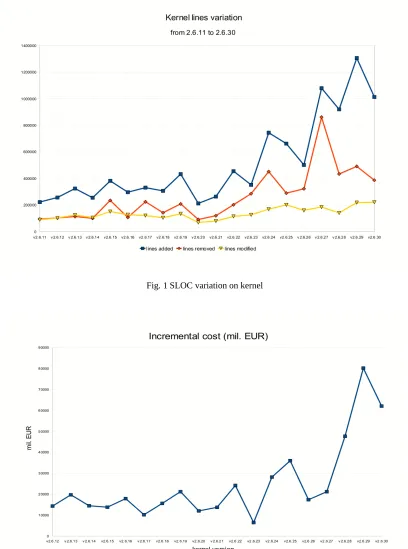
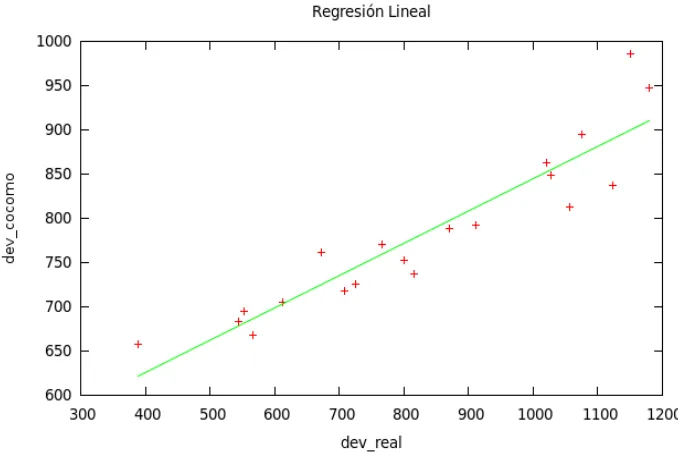
An estimated development value is calculated for each kernel version. Differential costs are considered as R&D or intangible asset value. Results are validated against linear regression of developers observed on developers according to model (R2=86,49%).
For latest version (2.6.30):
• Estimated total value = EUR 1,025,553,430
• Estimated needed developers = 985.74
• Estimated time of development = 167.59 months (14 years)
Estimated annual investment on R&D:
• 2005 (2.6.11 to 2.6.16): EUR 80,141,810
• 2006 (2.6.16 to 2.6.21): EUR 72,704,900
• 2007 (2.6.21 to 2.6.25): EUR 94,729,880
• 2008 (2.6.25 to 2.6.30): EUR 228,353,700
These results are also consistent with growth of R&D expenses on the ICT sector. Estimated 2008 results are comparable to 4% and 12% of Microsoft’s and Google’s R&D expenses on whole company products.
C) PRELIMINARY CONCLUSSIONS AND WORK IN PROGRESS
Actual accounting systems are based on transactions. But in the current, knowledge-based economy much of the value creation precedes, sometimes by years, the occurrence of transactions. Until then, the accounting system does not register any value created in contrast to the investments made into R&D, which are fully expensed. This difference, between how the accounting system is handling value created and is handling investments into value creation, is the major reason for the growing disconnect between market values and financial information.
with expenses is distorted by the immediate expensing of intangibles and recording revenues in subsequent periods uncorrelated by those costs.
There is a great value on commons-based innovation. Because Linux kernel has been developed collectively, there is no single source for cost estimates of how much it has taken to develop the technology. Despite absence of book value, we think commons-based innovation must receive a higher level of official recognition that would set it as an alternative to decision-makers. Legal and regulatory framework must allow companies participating on commons-based R&D to generate intangible assets for their contribution to successful projects. Otherwise, expenses must have an equitable tax treatment as a donation to social welfare as argued by Ghosh (2005). In both cases, financial measurements are needed. Tax treatment may be favoured by the fact that many communities of developers are organized on foundations. This phenomenon in open source development has been studied by Riehle (2010). Foundation, as legal entity, represents the community of developers (individuals and firms) and serves as the steward of the projects under its responsibility. It provides financial backing and legal certainty, making the survival of the software less dependent on the individuals who initially started it. Foundations can obtain legal coverage for tax-exempt activities and donations.
Accounting framework for financial reporting is not ready to estimate open source intangible assets value, neither in cost, income or market valuations. Development costs are not capitalized as assets. The great value of a community crowdsourcing the development is not reported neither on fundamental statements (i.e. balance sheet) neither on complementary documents to financial reports. We caution that is possible that value should not be reduced entirely to monetary terms. Several technical and social advantages cannot be communicated or decide upon effectively as financial issues. Reporting of intellectual capital may be followed as a model to disclosure a “community value report” with quantitative and qualitative indicators.
Fig. 1 SLOC variation on kernel
References
Aboody D. and B. Lev (1998). The Value Relevance of Intangibles: The Case of Software Capitalization.
Journal of Accounting Research, Vol. 36, Supplement, pp. 161-191.
Amor-Iglesias, J.J.; J.M. González-Barahona; G. Robles-Martínez and I. Herráiz-Tabernero (2005). “Measuring Libre Software Using Debian 3.1 (Sarge) as a Case Study: Preliminary Results”. UPGRADE The European Journal for the Informatics Professional, vol. VI, n. 3, pp. 13-16.
Anagnostopoulou, S.C. (2008). R&D expenses an firm valuation: a literature review. International Journal of Accounting and Information Management, 16 (1), pp. 5-24.
Asundi, J. (2005). “The need for Effort Estimation Models for Open Source Software Projects”. Fifth Workshop on Open Source Software Engineering (5-WOSSE), May, St Louis, MO, USA.
Barth, M.E., M.B. Clement, G. Foster and R. Kasznik (1998). Brand Values and Capital Market Valuation.
Review of Accounting Studies, Vol. 3, pp. 49-68.
Boehm, B.W. (1981). Software Engineering Economics, Prentice Hall.
Brooking, A. (1997). Intellectual Capital. International Thomson Business Press, London.
Chan, S.H, J.D. Martin and J.W. Kessinger (1990). Corporate Research and Development Expenditures and Share Value, Journal of Accounting and Economics, Vol. 26, pp. 255- 276.
Chauvin K.W. and M. Hirschey (1994). Goodwill, Profitability, and Market Value of the Firm. Journal of Accounting and Public Policy, Vol. 13, n. 2, pp. 159-180.
Edvinsson, L. and M.S. Malone (1997). Intellectual Capital. Harper-Collins, New York.
Financial Accounting Standards Board (1985). Stament of Financial Accounting Concepts No.6, FASB, Norwalk, CT. <http://www.fasb.org/pdf/con6.pdf>
Givoly, D. and C. Shi (2008), Accounting for software development costs and the cost of capital: Evidence from IPO underpricing in the software industry. Journal of Accounting, Auditing & Finance, 23, pp. 271– 303.
González-Barahona, J.M.; M.A. Ortuño, P. De Las Heras, J. Centeno y V. Matellán (2001). "Contando patatas: el tamaño de Debian 2.2", Novática, 154, pp. 30-37.
Gornik-Tomaszewski, S. and M.A. Millan (2005). Accounting for Research and Development Costs: A Comparison of U.S. and International Standards. Review of Business – Saint John's University of New York, 26 (2), 42-47.
Hall, B.H., A. Jaffe and M. Trajtenberg (2005). Market Value and Patent Citations. Rand Journal of Economics, Vol. 36, pp. 16-38.
Hand, J.R.M. (2008). Discussion of "Accounting for Software Development Costs and the Cost of Capital: Evidence from IPO Underpricing in the Software Industry’’. Journal of Accounting, Auditing & Finance, 23, pp. 305-310.
Hanson, B. (1997). Personnel Investments and Abnormal Returns: Knowledge-based Firms and Human Resource, Accounting. Journal of Human Resource, Costing and Accounting, 2 (2), pp. 9-29.
IDC (2009). The Opportunity for Linux in a New Economy.
<http://www.linuxfoundation.org/sites/main/files/publications/Linux_in_New_Economy.pdf>
International Accounting Standards Board (1998). IAS 38 Intangible Assets (revision July 1st, 2009), IASB,
London.
International Accounting Standards Board (2001). Framework for the preparation and presentation of financial statements, IASB, London.
Koch, S. and Gonzalez-Barahona, J.M. (2005). “Open Source software engineering: The state of research”.
First Monday, Special issue n. 2: Open Source, October.
<http://firstmonday.org/htbin/cgiwrap/bin/ojs/index.php/fm/issue/view/212>
Lev, B. (2001). Intangibles: Management, Measurement and Reporting. Brookings Institution Press, New York.
Lev, B and T. Sougiannis (1996). The Capitalization, Amortization and Value Relevance of R&D, Journal of Accounting and Economics, Vol. 21, pp. 107-138.
Lev, B. and P. Zarowin (1999). The Boundaries of Financial Reporting and How to Extend Them, Journal of Accounting Research, Vol. 37. n. 3, pp. 353-386.
Linux Foundation (2008). Estimating the Total Development Cost of a Linux Distribution.
<http://www.linuxfoundation.org/publications/estimatinglinux.php>
Linux Foundation (2009). Linux Kernel Development. How Fast It is Going, Who is Doing It, What They are Doing, and Who is Sponsoring It: An August 2009 Update.
<http:// www.linuxfoundation.org/publications/whowriteslinux.pdf>
Mohd, E. (2005). Accounting for Software Development Costs and Information Asymmetry. The Accounting Review, Vol. 80, pp. 1211-1231.
Picci, L. (2006), "Bad design by design: economics meets other types of interactions,”. In Foundations of Interaction Design, S. Bagnara and G.C. Smith (eds), Lawrence Erlbaum Associates, New York.
Riehle, D. (2010). The Economic Case for Open Source Foundations. IEEE Computer, vol. 43 (1), pp. 86-90.
Shi, C. (2003). On the Trade-off Between the Future Benefits and Riskiness of R&D: A Bondholders’ Perspective, Journal of Accounting and Economics, Vol. 35, n. 2, pp. 227-254.
Sougiannis, T. (1994). The Accounting Based Valuation of Corporate R&D, The Accounting Review, Vol. 69, n. 1, pp. 44-68.
Stewart, T.A. (1997). Intellectual Capital. Doubleday, New York.
Wheeler, D. A. (2001). More than a Gigabuck: Estimating GNU/Linux's size. <http://www.dwheeler.com/sloc/redhat71-v1/redhat71sloc.html>