http://dx.doi.org/10.4236/health.2016.86062
How to cite this paper: Kurazumi, Y., Kondo, E., Fukagawa, K., Hashimoto, R., Yamato, Y., Tobita, K., Sakoi, T., Tsuchikawa, T. and Horikoshi, T. (2016) Availability of Heat Conduction for Environmental Control Method to Improving Thermal Envi-ronment and Preventing Oversensitivity to Cold and Air-Conditioning Disease on Female Office Workers. Health, 8, 583- 604. http://dx.doi.org/10.4236/health.2016.86062
Availability of Heat Conduction for
Environmental Control Method to
Improving Thermal Environment and
Preventing Oversensitivity to Cold and
Air-Conditioning Disease on
Female Office Workers
Yoshihito Kurazumi1*, Emi Kondo2, Kenta Fukagawa3, Reiko Hashimoto1, Yoshiaki Yamato4, Kunihito Tobita5, Tomonori Sakoi6, Tadahiro Tsuchikawa7, Tetsumi Horikoshi8
1School of Life Studies, Sugiyama Jogakuen University, Nagoya, Japan
2Department of Architecture, Ariake National College of Technology, Omuta, Japan 3Department of Architecture, Kyushu Sangyo University, Fukuoka, Japan
4Department of Architecture and Structural Engineering, Kure National College of Technology, Kure, Japan 5School of Humanities and Social Sciences, Osaka Prefecture University, Sakai, Japan
6Kansei Engineering Course, Shinshu University, Ueda, Japan
7School of Human Science & Environment, University of Hyogo, Himeji, Japan 8Department of Architecture, Aichi Sangyo University, Okazaki, Japan
Received 10 March 2016; accepted 19 April 2016; published 22 April 2016 Copyright © 2016 by authors and Scientific Research Publishing Inc.
This work is licensed under the Creative Commons Attribution International License (CC BY).
http://creativecommons.org/licenses/by/4.0/
Abstract
The purpose of this study is to demonstrate the effect localized heating of the feet has on physio-logical and psychophysio-logical reactions of female in an air-conditioned environment in summer. In Ja-pan, female office workers wear less clothing than their male counterparts. In an air-conditioned office space in summer, female conducts thermoregulation by putting on cardigans, etc. but this action does not greatly contribute to improving conditions for the legs and feet, the lower extrem-ities of the body. The improvement of sensational and physiological temperature by localized warming of the body can contribute to a healthy working environment for female office workers, their safety, and a reduction in air conditioning’s energy expenditure. We used the indoor thermal
environment evaluation index ETF to investigate the effect localized heating of the feet has on human physiological and psychological response in an air-conditioned environment in summer. The result of heating by means of heat conduction via the sole of the foot was expressed more strongly as a psychological effect than as a whole-body physiological effect. Heating by means of heat conduction via the sole of the foot was a thermal environment factor that compensates for a low temperature in whole-body thermal sensation and whole-body thermal comfort. The effect of heating due to heat conduction via the sole of the foot was expressed in the change in sole-of- the-foot skin temperature. Applying slight heat conduction by means of heating via the sole of the foot demonstrated the result of improved whole-body thermal sensation and whole-body thermal comfort.
Keywords
Female, Office Worker, Sensitivity to Cold, Thermal Environment, Thermal Sense
1. Introduction
Air conditioners and other all-air temperature regulation systems are a typical method of indoor thermal envi-ronment regulation in Japan. These are demonstrated to be effective in highly hermetic spaces, but in office spaces and the like where people frequently enter and leave, the setting of higher outlet air speeds or outlet air-flow temperatures is necessary, potentially producing a large temperature distribution. Air-conditioning facilities of this variety have issues of deterioration of air quality, and discomfort owing to the direct effect of the outlet airflow, and vertical temperature distribution. In particular, it is difficult to resolve issues such as disparities in personal thermal sensation with respect to indoor air temperature in an office space when air conditioning is used during the summer. Furthermore, the direct effect of cold air emitted from the air conditioner on the body can chill the body and risk causing air-conditioning syndromes such as sensitivity to cold, headaches, and phys-ical listlessness. In comparison with their male counterparts, female office workers wear less clothing, making it more likely for them to experience physical chill. Introducing task and ambient air conditioning or personal air conditioning makes it possible to regulate the local environment around the body, but the reality is that the in-stallation and cost of these form a barrier to their inin-stallation in existing buildings and spaces, and they have not become popular.
Methods of improving the local thermal environment other than convection by fan etc. include wearing clothes on an individual basis and conveying heat by thermal radiation or heat conduction from the environmen-tal side. At home, it is possible to improve the thermal environment by improving one’s physical circumstances with clothing or by adjusting the temperature or airflow of the air-conditioning system, etc. In an air-conditioned office space in summer, women can adopt the behavioral thermoregulation of putting on cardigans etc., but this does not greatly contribute to improving the condition of the lower extremities of the body. Accordingly, it is necessary to improve the environment around the body by conveying heat from the environmental side, making it essential to improve the thermal environment using local thermal radiation and heat conduction.
in air conditioning’s energy expenditure.
To date, several studies quantitatively discussing heat conduction by contact have been reported with respect to the effect heat conduction from the foot region has on the human body. Muncey and Hutson [1], Missenard [2], Cammerer and Schüle [3], and Olesen [4] [5] deal with the heat conduction from the foot quantitatively. The research of Choi et al. [6] regarding floor heating spaces deals with the heat conduction between the contact area of a human body in a cross-legged sitting position and the floor quantitatively. Watanabe et al. [7] regarding a Kotatsu heating space deals with heat conduction between a human body in a leg-out sitting position and the floor quantitatively. The research of Kurazumi et al. [8] [9] deals with heat conduction between a human body in a leg-out sitting position and the floor quantitatively. Kurazumi et al. [10] deal with the heat conduction be-tween a human body in standing, chair-seated, seiza sitting, cross-legged sitting, sideways sitting, both-knees- erect sitting, leg-out sitting, and lateral supine positions and the floor quantitatively. The research of Choi et al.
[6] and Watanabe et al. [7] on a floor heating space and the research of Kurazumi et al. [8] [9] on a floor cooling space use as an evaluation axis a conduction-corrected operative temperature that is a quantitative environmental index incorporating heat conduction and thermal radiation. Also, the research of Kurazumi et al. [10] on a floor heating space uses as an evaluation axis an indoor thermal environment evaluation index ETF that can tempera-ture-convert the effects of air temperature, radiative temperature, contact section surface temperature, and hu-midity. Furthermore, in the research of Horikoshi et al. [11], heat conduction between the human body in a chair-seated position and the chair is also considered, and the heat conduction from the chair is presented as non-negligible. Kurazumi et al. [12] [13] focuses on differences in posture, quantitatively weighing the differ-ences of heat conduction between the human body and the floor surface in standing, chair-seated, seiza sitting, cross-legged sitting, sideways sitting, both-knees-erect sitting, leg-out sitting, and lateral supine positions, and demonstrates the evaluation criteria in the case of evaluating thermal environment taking into account heat con-duction. Kurazumi et al.[14] focus on differences in posture, quantitatively weighing the differences of heat conduction between the human body and the floor surface in standing, chair-seated, seiza sitting, cross-legged sitting, sideways sitting, both-knees-erect sitting, leg-out sitting, lateral and supine positions, and demonstrate a conduction-corrected operative temperature for each position in the case of a neutral thermal sensation. Howev-er, research dealing with the heat balance of the human body is rare. In addition, heating/cooling combining the heating and cooling of the human body has not been studied at all.
Accordingly, the present study focused on heat conduction from the foot region and aimed to demonstrate the effect that local heating of the foot region has on physiological/psychological reactions in a cooled environment in summer. If the effect of local heat conduction on the foot region can be quantitatively demonstrated, it will be possible to improve the sensational and physiological temperature by locally heating the body and develop pre-ventative measures against chills and air-conditioner syndrome. In addition, the energy required to improve sen-sational and physiological temperature can be substantially reduced, contributing to the development of new thermal environment regulation equipment that offers air-conditioning energy savings and reduces environmen-tal burdens.
2. Experimental Design
2.1. ETFThe thermal environment evaluation index for an indoor space, ETF, was developed by Kurazumi et al. [15]. ETF can temperature-convert the effect of air velocity and difference in attitude, thermal radiation, contact part’s surface temperature and humidity into individual meteorological elements.
hta hta hta ETF a
f f f f
TVF ERF ECF EHF
ETF T
h h h h
= + + + + (1)
(
)(
)
hta o conv c conv s a
TVF = h fcl Fclo f −h fcl Fcl f T T− (2)
(
)
hta r rad r a
ERF =h fcl Fcl f T T− (3)
(
)
hta d cond f a
ECF =h Fcld f T −T (4)
(
0.5)
ETF c a ETF
EHF =Lwh fcl Fpcl p − p∗ (5)
f o conv r rad d cond
h =h fcl Fclo f +h fcl Fcl f +h Fcld f (6) where
ETF: conduction-corrected modified effective temperature [K];
Ta: air temperature [K];
TVFhta: convective heat transfer area of the combined thermal velocity field [W/m2];
ERFhta: radiant heat transfer area combined with the effective radiation field for thermal radiation [W/m2];
ECFhta: heat transfer area combined effective conduction field [W/m2];
EHFETF: effective humid field at conduction-corrected modified effective temperature [W/m2];
hr: radiant heat transfer coefficient [W/m2K];
fcl: effective surface area factor of clothing [-];
fconv: convective heat transfer area factor [-];
fcond: conductive heat transfer area factor [-];
frad: radiant heat transfer area factor [-];
Fcl: thermal efficiency factor of clothing in the exposed airflow area [-];
Fcld: thermal efficiency factor of clothing in the heat conduction area [-];
Fclo: thermal efficiency factor of clothing under standard conditions [-];
Fpcl: permeation efficiency factor of clothing [-];
hc: convective heat transfer coefficient [W/m2K];
hd: resultant heat conductance [W/m2K];
hf: sensible heat transfer coefficient [W/m2K];
ho: convective heat transfer coefficient under standard conditions [W/m2K];
L: Lewis relation coefficient [K/kPa];
pa: water vapor pressure at outdoor air temperature [kPa]; ETF
p∗ : saturated water vapor pressure at conduction-corrected modified effective temperature [kPa];
Ts: convection-corrected mean skin temperature [K];
Tf: surface temperature of the contacted material [K];
Tr: mean radiant temperature for long-wave radiation [K];
w: skin wettedness [-].
2.2. Experimental Procedure
The experiments were carried out from August to September in 2013 and 2014.The experiment was performed using a cloth booth-type laboratory placed in an artificial climate chamber as shown in Figure 1.
Footprint-shaped sole-of-the-foot heating apparatus comprising a graft carbon heater element was installed in the booth. Aside from the sole-of-the-foot heating section of the heating apparatus, heat-insulating material and thermal radiation shielding sheets were used, with linoleum as the floor covering material. The surface tempera-ture was the same as the air temperatempera-ture, with the exception of the sole-of-the-foot heating section.
The seat and back of the chair used in the case of a chair-seated position had good breathability. The chair had a low heat capacity and only a small part was in contact with the human body, so with the exception of the part in contact with the floor the human body was considered to be exposed to the air.
Figure 1. Plan of experimental set up where subjects are exposed to thermal conditions.
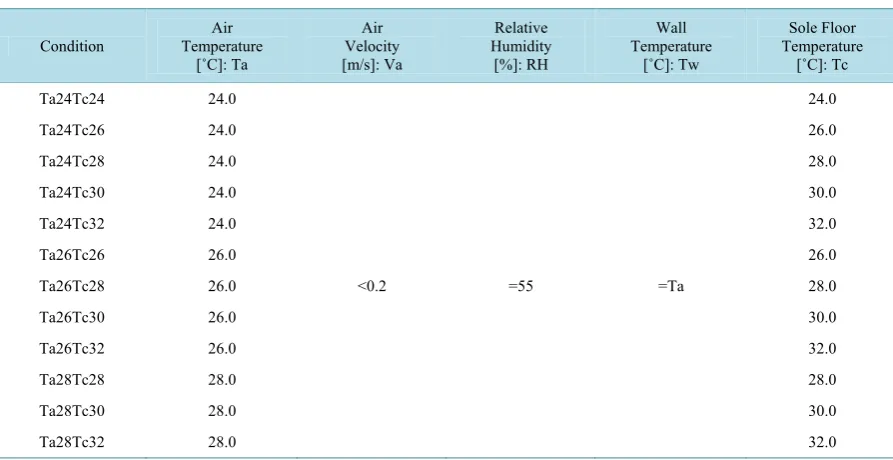
Table 1. Experimental conditions.
Condition Temperature Air
[˚C]: Ta
Air Velocity [m/s]: Va
Relative Humidity
[%]: RH
Wall Temperature
[˚C]: Tw
Sole Floor Temperature
[˚C]: Tc
Ta24Tc24 24.0 24.0
Ta24Tc26 24.0 26.0
Ta24Tc28 24.0 28.0
Ta24Tc30 24.0 30.0
Ta24Tc32 24.0 32.0
Ta26Tc26 26.0 26.0
Ta26Tc28 26.0 <0.2 =55 =Ta 28.0
Ta26Tc30 26.0 30.0
Ta26Tc32 26.0 32.0
Ta28Tc28 28.0 28.0
Ta28Tc30 28.0 30.0
Ta28Tc32 28.0 32.0
2.3. Subjects
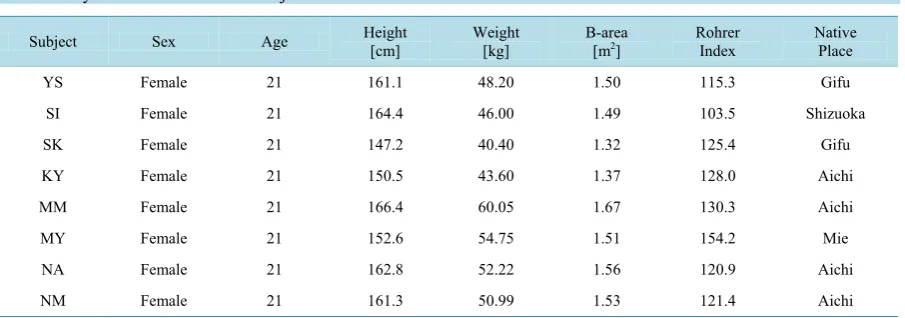
The subjects were volunteers. Based on the mean height and weight and the standard deviation of height and weight [16] [17], the subjects were selected. The subjects were eight healthy adult female university students. The physical data of the subjects are shown in Table 2. Their height was 158.8 ± 6.3 cm and their weight was 50.20 ± 5.73 kg. The subjects had standard physiques according to the Rohrer index and were not unique.
In accordance with the Helsinki Declaration [19], the details of the experiment were fully explained to the subjects in advance and their consent to participation in the experiment was obtained.
2.4. Measured Parameters
The thermal environment parameters measured were air temperature, humidity, air velocity, temperature of each surface of the room, and surface temperature of the sole-of-the-foot heating apparatus. Air temperature and hu-midity were measured by an Assmann ventilated psychrometer at a height of 0.6 m from the floor. Air velocity was measured by an omnidirectional heated sphere anemometer at the same height. The temperature of each wall surface and the surface temperature of the sole-of-the-foot heating apparatus were measured by a φ0.2 mm type T thermocouple. The sole-of-the-foot heating apparatus surface temperature was measured on an aluminum sheet on each graft carbon heater element and on the point directly under the human body contact area on the li-noleum floor covering material.
The measured human body parameters were sublingual temperature, skin temperature, weight loss, skin sur-face sensible heat flux of the sole-of-the-foot contact section, thermal sensation, and thermal comfort. Sublin-gual temperature was measured by a φ0.2 mm type T thermocouple placed in the oral cavity under the tongue. Skin temperature was measured at eight locations by a φ0.2 mm type T thermocouple: the head, trunk, arm, hand, thigh, calf, foot, and the part of the foot in contact with the sole-of-the-foot heating apparatus. The sensi-ble heat flux on the skin surface of the heel was measured with a φ20 mm heat flux sensor (Captec, HF series, thickness 0.4 mm, sensitivity 1.69 - 2.10 µV/(W/m2), response time approximately 200 ms). The latent heat loss consequent on respiration from within the quantity of heat conversion was included in the body weight loss. However, sensible heat loss consequent on respiration was omitted as negligible.
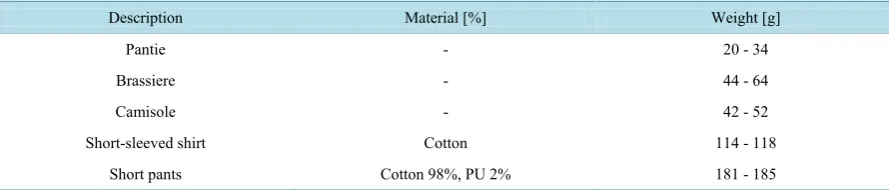
The female test subjects wore light clothing: panties, a brassiere, a camisole, a T-shirt, and shorts. Table 3
shows the clothing parameters. Since it was difficult to make the panties, bra, and camisole identical, the sub-jects wore items they had brought themselves. The clo value was calculated from the weight of clothing accord-ing to the formula of Hanada et al. [20].
[image:6.595.88.541.537.696.2]The whole-body thermal sensation, whole-body thermal comfort, foot region thermal sensation, and foot gion thermal comfort were measured on a linear assessment scale [21]. The scale for whole-body and foot re-gion thermal sensation ranged from “hot” to “cold” and the scale for whole-body and foot rere-gion comfort sensa-tion ranged from “comfortable” to “uncomfortable”. The reported values were read from the scales, which ran from zero for “cold” and “uncomfortable” to 100 for “hot” and “comfortable”, respectively.
Table 2. Physical characteristics of subjects.
Subject Sex Age Height [cm] Weight [kg] B-area [m2] Rohrer Index Native Place
YS Female 21 161.1 48.20 1.50 115.3 Gifu SI Female 21 164.4 46.00 1.49 103.5 Shizuoka SK Female 21 147.2 40.40 1.32 125.4 Gifu KY Female 21 150.5 43.60 1.37 128.0 Aichi MM Female 21 166.4 60.05 1.67 130.3 Aichi MY Female 21 152.6 54.75 1.51 154.2 Mie NA Female 21 162.8 52.22 1.56 120.9 Aichi NM Female 21 161.3 50.99 1.53 121.4 Aichi B-area is the calculated body surface area by Kurazumi’s formula [18]. S = 100.315 W0.383 H0.693 ×10−4 (Kurazumi et al., 1994). S: Body surface
Table 3. Clothing ensembles of subjects.
Description Material [%] Weight [g]
Pantie - 20 - 34
Brassiere - 44 - 64
Camisole - 42 - 52
Short-sleeved shirt Cotton 114 - 118
Short pants Cotton 98%, PU 2% 181 - 185 PU is polyurethane.
The calculation of the mean skin temperature used for the calculation of the heat balance of the human body was performed using a weighting factor that took into account the convective heat transfer area [22]. Further-more, the chair used in the experiment had good breathability, and so the weighting factor used did not take into account contact with the chair. Then, the calculation of the mean skin temperature used for the physiological re-sponse of the human body was performed using a weighting factor that took into account conductive heat trans-fer area [23].
3. Results
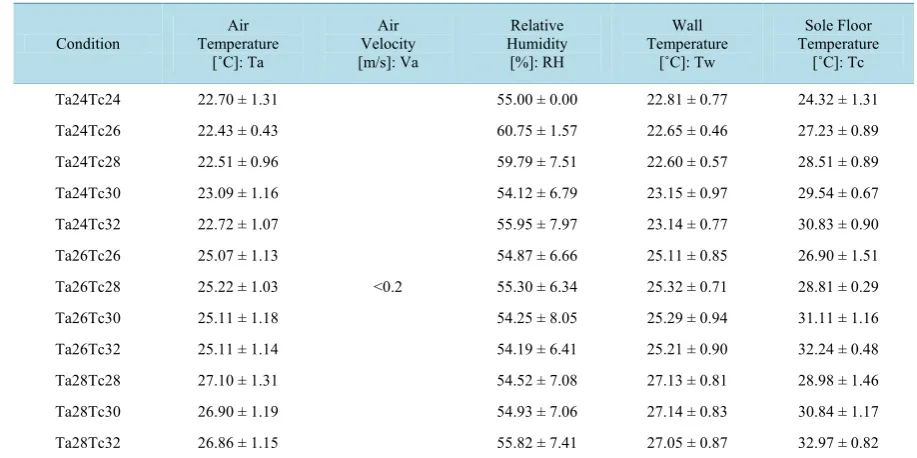
Table 4 shows the results of thermal environment parameters. The air temperatures in the experimental
condi-tions were at most 1.5˚C lower than the set value and the variation was within a range of ±1.3˚C. The relative humidities were at most around 5.8% lower than the set value and the variation was within a range of ±8%. The temperatures of the surfaces comprising the laboratory were at most around 1.4˚C lower, but the difference from the air temperature during each experiment was at most 0.4˚C higher, and the difference was within a range of ±1.0˚C. The space was homogeneous with temperatures almost the same as the air temperature. Air velocity was under 0.2 m/s throughout the experiment. The floor temperature for the sole of the foot was ±1.2˚C of the set value and the difference was within a range of ±1.5˚C. The air temperature was lower than set, but the set condi-tions for other thermal environment parameters were basically satisfactory and stable. There were no visual ob-servations of ineffective sweating in any of the experiments. The weight loss during the exposure time was probably caused by insensible perspiration.
Table 4. Experimental results.
Condition Temperature Air
[˚C]: Ta Air Velocity [m/s]: Va Relative Humidity [%]: RH Wall Temperature [˚C]: Tw Sole Floor Temperature [˚C]: Tc
Ta24Tc24 22.70 ± 1.31 55.00 ± 0.00 22.81 ± 0.77 24.32 ± 1.31 Ta24Tc26 22.43 ± 0.43 60.75 ± 1.57 22.65 ± 0.46 27.23 ± 0.89 Ta24Tc28 22.51 ± 0.96 59.79 ± 7.51 22.60 ± 0.57 28.51 ± 0.89 Ta24Tc30 23.09 ± 1.16 54.12 ± 6.79 23.15 ± 0.97 29.54 ± 0.67 Ta24Tc32 22.72 ± 1.07 55.95 ± 7.97 23.14 ± 0.77 30.83 ± 0.90 Ta26Tc26 25.07 ± 1.13 54.87 ± 6.66 25.11 ± 0.85 26.90 ± 1.51 Ta26Tc28 25.22 ± 1.03 <0.2 55.30 ± 6.34 25.32 ± 0.71 28.81 ± 0.29 Ta26Tc30 25.11 ± 1.18 54.25 ± 8.05 25.29 ± 0.94 31.11 ± 1.16 Ta26Tc32 25.11 ± 1.14 54.19 ± 6.41 25.21 ± 0.90 32.24 ± 0.48 Ta28Tc28 27.10 ± 1.31 54.52 ± 7.08 27.13 ± 0.81 28.98 ± 1.46 Ta28Tc30 26.90 ± 1.19 54.93 ± 7.06 27.14 ± 0.83 30.84 ± 1.17 Ta28Tc32 26.86 ± 1.15 55.82 ± 7.41 27.05 ± 0.87 32.97 ± 0.82
4. Discussion
4.1. ETF and Mean Skin Temperature
Figure 2 shows the relationship between ETF and mean skin temperature. The figure shows the tendency for
mean skin temperature to increase with ETF. The figure also shows the tendency for mean skin temperature to decrease the more the experimental conditions involve a greater heat acquisition owed to heat conduction via the sole of the foot at the same ETF. For roughly the same ETF, this is a thermal environment condition whereby the result of heat conduction owed to heating the sole of the foot is added to the air temperature. Accordingly, the effect of air temperature is probably more strongly expressed in mean skin temperature as a whole-body physiological reaction than the effect of heating by means of heat conduction via the sole of the foot.
Focusing on the regression line for the indicator of heating by means of heat conduction via the sole of the foot, we found that mean skin temperature for around the same ETF shows a tendency to be higher when there is no heating via the sole of the foot. Mean skin temperature also shows the tendency to increase slightly with greater heat acquisition owed to heating via the sole of the foot. However, this tendency is not shown in the case of an air temperature of 24˚C. Accordingly, when air temperature is low enough for heat loss from the human body to become excessive, the slight effect in increasing mean skin temperature by heating owed to heat con-duction via the sole of the foot may not be desirable.
An inspection of the parallelism of the regression line for the indicator of heating by means of heat conduc-tion via the sole of the foot gave the result p > 0.10 (F(3, 116) = 0.642, p = 0.425), indicating no significant dif-ference in the parallelism of regression. An inspection of the homogeneity of the regression line for the indicator of heating by means of heat conduction via the sole of the foot gave the result p < 0.01 (t(116) = −3.27, p = 0.001), indicating a significant difference in the homogeneity of the regression line. Consequently, it seems im-probable that the effect of heating by means of heat conduction via the sole of the foot is expressed in the mean skin temperature within the scope of results for ETF in this experiment.
Figure 3 shows the relationship between the heat conversion term for heat conduction ECFhta and change in
mean skin temperature. The figure shows the tendency for the amount by which mean skin temperature decreas-es to be strongly exprdecreas-essed as ECFhta increasdecreas-es. In the above relationship between ETF and mean skin tempera-ture, the effect of air temperature was conjectured to be expressed more strongly than the effect of heating via the sole of the foot in the mean skin temperature as a whole-body physiological reaction. This tendency can be argued to be clearly expressed in the relationship between ECFhta and change of mean skin temperature.
Figure 2. Relationship between ETF and mean skin temperature.
Figure 3. Relationship between ECFhta and change of mean skin
temperature.
skin temperature for about the same ECFhta. Accordingly, the result of heating by means of heat conduction via the sole of the foot may be apparent in mean skin temperature as a whole-body physiological reaction.
[image:9.595.192.436.361.612.2]0.349), indicating no significant difference in the homogeneity of the regression lines.
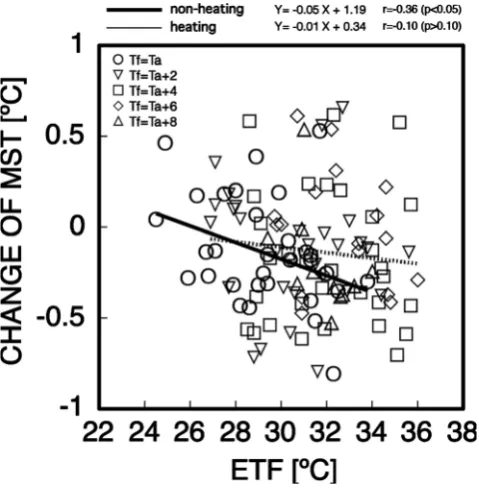
Figure 4 shows the relationship between ETF and change in mean skin temperature. Focusing on the
regres-sion line for the indicator of heating by means of heat conduction via the sole of the foot, we found a tendency for the amount by which mean skin temperature decreases to become larger even for a larger ETF. An inspection of the parallelism of the regression line for the indicator of heating by means of heat conduction via the sole of the foot gave the result p > 0.10 (F(3, 116) = 0.719, p = 0.398), indicating no significant difference in the paral-lelism of regression. An inspection of the homogeneity of the regression lines for the indicator of heating by means of heat conduction via the sole of the foot gave the result p > 0.10 (t(116) = 1.070, p = 0.289), indicating no significant difference in the homogeneity of the regression lines. The effect of air temperature being more strongly expressed in mean skin temperature as a whole-body physiological reaction than the effect of heating by means of heat conduction via the sole of the foot can be argued to be clearly demonstrated.
Kurazumi et al. [13] performed an experiment to demonstrate the effect a thermal environment comprising air temperature and floor surface temperature has on each means of heat transfer for the human body according to difference in position. They showed that an evaluation of the thermal environment including the result of heat conduction is essential for body positions in which the contact surface ratio exceeds 2.5% when there is a large difference between the floor surface temperature and the contact area skin temperature. In the present study also, a change in mean skin temperature is demonstrated as owed to floor heating, and an evaluation of the thermal environment incorporating the effect of heat conduction can be considered essential.
Consequently, heating owed to heat conduction via the sole of the foot has the result of increasing mean skin temperature. However, the effect of air temperature is probably more strongly expressed in mean skin tempera-ture than the effect of heating by means of heat conduction via the sole of the foot.
4.2. ETF and Whole-Body Thermal Sensation
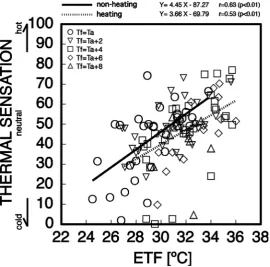
Figure 5 shows the relationship between ETF and whole-body thermal sensation. The figure shows the tendency
for whole-body thermal sensation to move towards the hot end as ETF increases. The figure also shows the ten-dency for whole-body thermal sensation to move towards the cold end the more the experimental conditions in-volve a greater heat acquisition owed to heat conduction via the sole of the foot at about the same ETF.
Focusing on the regression line for the indicator of heating by means of heat conduction via the sole of the foot, we saw a tendency for whole-body thermal sensation for around the same ETF to move toward the hot end
Figure 4. Relationship between ETF and change of mean skin
Figure 5. Relationship between ETF and whole body thermal sensation.
when there is no heating via the sole of the foot. Whole-body thermal sensation also shows the tendency to move toward the hot end for greater heat acquisition owed to heating via the sole of the foot. Accordingly, like the relationship between ETF and mean skin temperature, the effect of air temperature is probably more strongly expressed in whole-body thermal sensation as a whole-body physiological reaction than the effect of heating by means of heat conduction via the sole of the foot.
An inspection of the parallelism of the regression lines for the indicator of heating by means of heat conduc-tion via the sole of the foot gave the result p > 0.10 (F(3, 116) = 0.986, p = 0.323), indicating no significant dif-ference in the parallelism of regression. An inspection of the homogeneity of the regression lines for the indica-tor of heating by means of heat conduction via the sole of the foot gave the result p < 0.05 (t(116) = −1.990, p = 0.049), indicating a significant difference in the homogeneity of the regression lines.
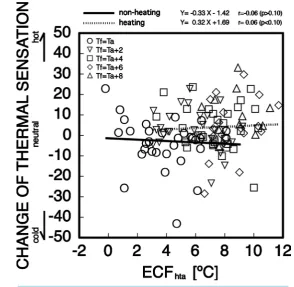
Figure 6 shows the relationship between the heat conversion term for heat conduction ECFhta and change in
whole-body thermal sensation. Although the tendency is shown for the change in whole-body thermal sensation to be greater slightly toward the hot end as ECFhta increases, a large change is not observed. Focusing on the re-gression lines for the indicator of heating by means of heat conduction via the sole of the foot, we saw a ten-dency for those with heating via the sole of the foot to have a change whereby the whole-body thermal sensation increases for about the same ECFhta. Accordingly, the result of heating by means of heat conduction via the sole of the foot may be apparent in whole-body thermal sensation as a whole-body psychological reaction. Heating by heat conduction via the sole of the foot may be a thermal environment factor for whole-body thermal sensa-tion that compensates for a low air temperature by way of a psychological reacsensa-tion, in contrast to the tendency for the amount by which mean skin temperature decreases to become larger and for the effect of air temperature to be strongly expressed in mean skin temperature as a physiological reaction even when ECFhta is high, as shown in Figure 3.
Figure 6. Relationship between ECFhta and change of whole body thermal sensation.
in whole-body thermal sensation toward the hot end. The effect of heating by means of heat conduction via the sole of the foot may be expressed in the change in whole-body thermal sensation within the scope of results for ECFhta in this experiment.
In the above relationship between ETF and mean skin temperature, the effect of air temperature is conjectured to be expressed more strongly than heating by means of heat conduction via the sole of the foot in mean skin temperature as a whole-body physiological reaction. However, given the relationship between ECFhta and the change in whole-body thermal sensation, the result of heating by means of heat conduction via the sole of the foot on whole-body thermal sensation is probably stronger as a psychological reaction than on the mean skin temperature as a physiological reaction.
Figure 7 shows the relationship between ETF and whole-body thermal sensation. An inspection of the
paral-lelism of the regression lines for the indicator of heating by means of heat conduction via the sole of the foot gave the result p > 0.10 (F(3, 116) = 0.574, p = 0.450), indicating no significant difference in the parallelism of regression. An inspection of the homogeneity of the regression lines for the indicator of heating by means of heat conduction via the sole of the foot gave the result p > 0.10 (t(116) = 1.360, p = 0.175), indicating no signif-icant difference in the homogeneity of the regression lines. However, in the case heating is applied by means of heat conduction via the sole of the foot, there is a large change in whole-body thermal sensation toward the hot end. The effect of heating by means of heat conduction via the sole of the foot may be expressed in the whole-body thermal sensation given the scope of results for ETF in this experiment.
The above suggests that heating by means of heat conduction via the sole of the foot may work to move whole-body thermal sensation toward the hot end.
4.3. ETF and Whole-Body Thermal Comfort
Figure 8 shows the relationship between ETF and whole-body thermal comfort. The figure shows the tendency
Figure 7. Relationship between ETF and change of whole body thermal
sensation.
Figure 8. Relationship between ETF and whole body thermal comfort.
[image:13.595.176.452.396.670.2]con-dition, heating by means of heat conduction via the sole of the foot works to move whole-body thermal comfort toward the comfortable end. However, when the body is in a warm condition, heating by means of heat conduc-tion via the sole of the foot may work to move whole-body thermal comfort toward the uncomfortable end. Ku-no et al. [30] proposed a two-dimensional thermal sensation model by which comfort differs depending on whether the body is cold or warm when the thermal balance of the body is in transition, even with the same thermal environment stimuli. In the present study also, which is a human subject experiment, the same pheno-menon was observed for an ETF of around 29˚C.
[image:14.595.170.453.415.696.2]An inspection of the parallelism of the regression line for the indicator of heating by means of heat conduc-tion via the sole of the foot gave the result p < 0.10 (F(3, 116) = 3.832, p = 0.053), indicating a significant dif-ference in the parallelism of regression. An inspection of the homogeneity of the regression lines for the indica-tor of heating by means of heat conduction via the sole of the foot gave the result p > 0.10 (t(116) = −1.280, p = 0.2052), indicating no significant difference in the homogeneity of the regression lines. Accordingly, the effect of heating by means of heat conduction via the sole of the foot may be expressed in the whole-body thermal comfort, given the scope of results for ETF in this experiment.
Figure 9 shows the relationship between the heat conversion term for heat conduction ECFhta and change in
whole-body thermal comfort. The figure shows the tendency for the change in whole-body thermal comfort to be greater slightly toward the comfortable end as ECFhta increases. Focusing on the regression line for the indi-cator of heating by means of heat conduction via the sole of the foot, we found a tendency for heating by means of heat conduction via the sole of the foot to have a greater change in whole-body thermal comfort toward the comfortable end when ECFhta is under around 3˚C. Meanwhile, when ECFhta is around 3˚C or more the tendency is shown for no heating by means of heat conduction via the sole of the foot to have a greater change in whole- body thermal comfort toward the comfortable side.
An inspection of the parallelism of the regression lines for the indicator of heating by means of heat conduc-tion via the sole of the foot gave the result p > 0.10 (F(3, 116) = 0.848, p = 0.359), indicating no significant dif-ference in the parallelism of regression. An inspection of the homogeneity of the regression lines for the indica-tor of heating by means of heat conduction via the sole of the foot gave the result p > 0.10 (t(116) = −1.110, p =
Figure 9. Relationship between ECFhta and change of whole body thermal
0.271), indicating no significant difference in the homogeneity of the regression lines. Accordingly, the effect of heating by means of heat conduction via the sole of the foot is probably not apparent in the change in whole-body thermal comfort, given the scope of results for ECFhta in this experiment.
Heating by means of heat conduction via the sole of the foot was conjectured to work to move whole-body thermal sensation toward the hot end in the above relationship between ETF and thermal sensation. Similarly,
Figure 10 shows the relationship between ETF and change in whole-body thermal sensation. An inspection of
the parallelism of the regression lines for the indicator of heating by means of heat conduction via the sole of the foot gave the result p > 0.10 (F(3, 116) = 1.064, p = 0.305), indicating no significant difference in the paral-lelism of regression. An inspection of the homogeneity of the regression lines for the indicator of heating by means of heat conduction via the sole of the foot gave the result p > 0.10 (t(116) = −0.200, p = 0.840), indicating no significant difference in the homogeneity of the regression lines. Accordingly, the effect of heating by means of heat conduction via the sole of the foot is probably not expressed in the change in whole-body thermal com-fort, given the scope of results for ETF in this experiment. However, when the body is in a cool condition, heat-ing by means of heat conduction via the sole of the foot works to move whole-body thermal comfort toward the comfortable end. Also, when the body is in a warm condition, heating by means of heat conduction via the sole of the foot may work to move whole-body thermal comfort toward the uncomfortable end.
Accordingly, heating by heat conduction via the sole of the foot may be a thermal environment factor for whole-body thermal sensation that compensates for a low air temperature by way of a psychological reaction, similarly to the relationship between ETF and thermal sensation.
[image:15.595.173.452.413.693.2]4.4. Mean Skin Temperature and Whole-Body Thermal Sensation
Figure 11 shows the relationship between mean skin temperature and whole-body thermal sensation. The figure
shows the tendency for whole-body thermal sensation to move toward the hot end as mean skin temperature in-creases. Although only slight, the tendency is shown for whole-body thermal sensation to move toward the hot end the more the experimental conditions involve a greater heat acquisition owed to heat conduction via the sole of the foot, even for about the same mean skin temperature.
Figure 10. Relationship between ETF and change of whole body thermal
Figure 11. Relationship between mean skin temperature and whole body
thermal sensation.
Focusing on the regression line for the indicator of heating by means of heat conduction via the sole of the foot, we found a tendency for whole-body thermal sensation to move toward the hot end in cases where there is heating by means of heat conduction via the sole of the foot when the body is seated in a chair at rest and mean skin temperature is lower than a comfortable 33˚C to 34˚C [31]. The mean skin temperature at which a neither hot nor cold, thermally neutral whole-body thermal sensation is reported is 33.4˚C when there is no heating by means of heat conduction via the sole of the foot and 33.3˚C when there is.
An inspection of the parallelism of the regression lines for the indicator of heating by means of heat conduc-tion via the sole of the foot gave the result p < 0.10 (F(3, 116) = 3.475, p = 0.065), indicating a significant dif-ference in the parallelism of regression. An inspection of the homogeneity of the regression lines for the indica-tor of heating by means of heat conduction via the sole of the foot gave the result p > 0.10 (t(116) = 1.520, p = 0.131), indicating no significant difference in the homogeneity of the regression lines. Accordingly, the effect of heating by means of heat conduction via the sole of the foot is probably expressed in whole-body thermal sensa-tion.
In a condition whereby air conditioning cools the body below a thermally neutral state, the result of heating by means of heat conduction via the sole of the foot may be demonstrated. The result of heating by means of heat conduction via the sole of the foot may be more strongly expressed as a psychological effect than a whole-body physiological effect.
4.5. Mean Skin Temperature and Whole-Body Thermal Comfort
Figure 12 shows the relationship between mean skin temperature and whole-body thermal comfort. The figure
shows the tendency for whole-body thermal comfort to move toward the comfortable end as mean skin temper-ature increases. Although only slight, the tendency is shown for whole-body thermal comfort to move towards the comfortable end the more the experimental conditions involve a greater heat acquisition owed to heat con-duction via the sole of the foot, even for roughly the same mean skin temperature.
Figure 12. Relationship between mean skin temperature and whole body
thermal comfort.
33.5˚C The tendency is shown for whole-body thermal comfort to move toward the comfortable end when there is no heating by means of heat conduction via the sole of the foot when mean skin temperature is around 33.5˚C
or higher. A difference in conditions is probably indicated according to whether the body is in a cool condition or a warm condition, as expressed by the above ETF and whole-body thermal comfort. The mean skin tempera-ture at which a neither comfortable nor uncomfortable, neutral whole-body thermal comfort is reported is 33.3˚C
when there is no heating by means of heat conduction via the sole of the foot and 33.3˚C when there is. It is the same value in either case.
An inspection of the parallelism of the regression lines for the indicator of heating by means of heat conduc-tion via the sole of the foot gave the result p > 0.10 (F(3, 116) = 2.010, p = 0.159), indicating no significant dif-ference in the parallelism of regression. An inspection of the homogeneity of the regression lines for the indica-tor of heating by means of heat conduction via the sole of the foot gave the result p > 0.10 (t(116) = 0.870, p = 0.387), indicating no significant difference in the homogeneity of the regression lines. However, when mean skin temperature is under around 33.5˚C, whole-body thermal comfort is greater when heating is applied by means of heat conduction via the sole of the foot. Accordingly, the effect of heating by means of heat conduc-tion via the sole of the foot is probably expressed in whole-body thermal comfort.
As stated above regarding the relationship between mean skin temperature and whole-body thermal sensation, when air conditioning cools the body below a thermally neutral state, the effect of heat conduction by means of heating via the sole of the foot may be demonstrated. The result of heating by means of heat conduction via the sole of the foot may be expressed more strongly as a psychological effect than as a whole-body physiological effect.
Kurazumi et al. [26] demonstrated that the contact area between a body in a chair-seated position and the floor is 0.8% of the entire surface area of the body. Accordingly, it can be argued that an energy-saving result that improves physical circumstances is demonstrated by giving the body a small heat conduction via a small heat transfer area. This may mean that smaller, lighter, and more energy-efficient temperature control is possible by using heat conduction instead of regulating the air temperature of the entire space.
4.6. ECFhta and Change of Sole of Foot Temperature
Figure 13. Relationship between ECFhta and change of sole of foot skin
temperature.
sole-of-the-foot skin temperature. The figure shows the tendency for the change in the sole-of-the-foot skin temperature to increase with ECFhta. The result whereby local heating by heat conduction increases the skin temperature of the extremities is clearly shown.
Focusing on the regression line for the indicator of heating by means of heat conduction via the sole of the foot, we found a tendency for heating via the sole of the foot to result in a greater amount by which sole-of- the-foot skin temperature increases for around the same ECFhta. Accordingly, the result of heating by means of heat conduction via the sole of the foot may be expressed in the sole-of-the-foot skin temperature as a local phy-siological reaction.
An inspection of the parallelism of the regression lines for the indicator of heating by means of heat conduc-tion via the sole of the foot gave the result p < 0.05 (F(3, 116) = 4.216, p = 0.042), indicating a significant dif-ference in the parallelism of regression. An inspection of the homogeneity of the regression lines for the indica-tor of heating by means of heat conduction via the sole of the foot gave the result p > 0.10 (t(116) = 0.940, p = 0.347), indicating no significant difference in the homogeneity of the regression lines. The tendency for the amount by which mean skin temperature decreases to become large as ECFhta increases was shown above in the relationship between the heat conversion term for heat conduction ECFhta and the change in sole-of-the-foot skin temperature. The tendency for the effect of air temperature to be more strongly expressed than the effect of heating via the sole of the foot in mean skin temperature as a whole-body physiological reaction was clearly demonstrated. However, the effect of heating owed to heat conduction via the sole of the foot may be expressed in the change in sole-of-the-foot skin temperature, given the scope of results for ECFhta in this experiment.
ex-tremities of the body are important for female office workers, who have the potential to be exposed to an air-conditioned environment in light clothes for long periods in summer. Accordingly, the result of heating by means of heat conduction via the sole of the foot increasing sole-of-the-foot skin temperature may alleviate sen-sitivity to cold by stimulating the extremities of the body.
4.7. Change of Sole-of-Foot Temperature and Change of Whole-Body Thermal Sensation
Figure 14 shows the relationship between change in sole-of-the-foot skin temperature and change in whole-
body thermal sensation. Even if the amount by which the sole-of-the-foot skin temperature increases becomes large, the tendency for the amount by which whole-body thermal sensation moves to the hot end to become large is clearly not shown.
Focusing on the regression line for the indicator of heating by means of heat conduction via the sole of the foot, we found that cases where there is heating by means of heat conduction via the sole of the foot tend to have a slightly greater amount by which whole-body thermal sensation moves to the hot end. However, even if the amount by which the sole-of-the-foot skin temperature increases becomes large, there is almost no change in whole-body thermal sensation.
An inspection of the parallelism of the regression lines for the indicator of heating by means of heat conduc-tion via the sole of the foot gave the result p > 0.10 (F(3, 116) = 0.852, p = 0.358), indicating no significant dif-ference in the parallelism of regression. An inspection of the homogeneity of the regression lines for the indica-tor of heating by means of heat conduction via the sole of the foot gave the result p < 0.10 (t(116) = 1.730, p = 0.087), indicating a significant difference in the homogeneity of the regression lines. Accordingly, increasing the skin temperature of the extremities of the body by heat conduction via the sole of the foot may have an effect on whole-body thermal sensation.
The above can be considered to have demonstrated that whole-body thermal sensation is improved by apply-ing slight heat conduction by means of heatapply-ing via the sole of the foot.
[image:19.595.177.448.452.696.2]4.8. Change of Sole-of-Foot Temperature and Change of Whole-Body Thermal Comfort
Figure 15 shows the relationship between change in sole-of-the-foot skin temperature and change in whole-
body thermal comfort. The figure shows the tendency for the amount by which whole-body thermal comfort
Figure 14. Relationship between change of sole-of-foot temperature and
Figure 15. Relationship between change of sole-of-foot temperature and
change of whole-body thermal comfort.
moves to the comfortable end to become slightly large as the amount by which the sole-of-the-foot skin temper-ature increases becomes large.
Focusing on the regression line for the indicator of heating by means of heat conduction via the sole of the foot, we found a tendency for there to be a greater change in whole-body thermal comfort toward the comfort end when there is heating by means of heat conduction by the sole of the foot when the change in sole-of- the-foot skin temperature is under around −3˚C. When the change in sole-of-the-foot skin temperature is around
−3˚C or more, the tendency is for there to be a greater change in whole-body thermal comfort toward the com-fort end when there is no heating by means of heat conduction via the sole of the foot.
An inspection of the parallelism of the regression lines for the indicator of heating by means of heat conduc-tion via the sole of the foot gave the result p > 0.10 (F(3, 116) = 0.157, p = 0.693), indicating no significant dif-ference in the parallelism of regression. An inspection of the homogeneity of the regression lines for the indica-tor of heating by means of heat conduction via the sole of the foot gave the result p > 0.10 (t(116) = 0.420, p = 0.677), indicating no significant difference in the homogeneity of the regression lines. Accordingly, the effect of heating by means of heat conduction via the sole of the foot is probably not apparent in the change in whole- body thermal comfort, given the results for change in sole-of-the-foot skin temperature in this experiment. However, there may be a difference in the resulting improvement in comfort for the whole body according to the state of chill of the skin temperature of the body’s extremities as detailed above.
The above can be considered to have demonstrated that heating by means of heat conduction via the sole of the foot is a thermal environment factor that compensates for low air temperature when the extremities of the body are chilled.
5. Conclusions
The findings are as follows.
1) The effect of air temperature was demonstrated to be more strongly expressed in mean skin temperature than the effect of heating by heat conduction via the sole of the foot.
2) The result of heating by means of heat conduction via the sole of the foot was demonstrated to be more strongly expressed as a psychological effect than as a whole-body physiological effect.
3) Heating by means of heat conduction via the sole of the foot was demonstrated to be a thermal environment factor that compensates for a low air temperature with respect to whole-body thermal sensation and whole-body thermal comfort.
4) Applying slight heating by means of heat conduction via the sole of the foot was demonstrated to result in improved whole-body thermal sensation and whole-body thermal comfort.
Heating by means of heat conduction via the sole of the foot can increase sole-of-the-foot skin temperature and therefore may alleviate sensitivity to cold by stimulating the extremities of the body. This may contribute to a healthy working environment for female office workers, their safety, and a reduction in air conditioning’s energy expenditure.
Acknowledgements
We would like to express our sincerest gratitude to the study subjects who participated in the present study.
References
[1] Muncey, R.W. and Hutson, J.M. (1953) The Effect of the Floor on Foot Temperature. Australian Journal of Applied Science, 4, 395-404.
[2] Missenard, A. (1955) Chauffage par Rayonnement Température Limite du Sol. Chaieuret Industrie, 355, 37-53. [3] Cammerer, J.S. and Schüle, W. (1957) Vergleichsmessungen zwischen physiologischen und
physikalischenprüfverffa-hren der wärmeableitung von fußböden. Gesundheits Ingenieur, 78, 251-252.
[4] Olesen, B.W. (1977) Thermal Comfort Requirements for Floors. Proceedings of the Meeting of Commissions B1, B2,
E1 of the IIR, Belgrade, Yugoslavia, 16-18 November 1977, 337-343.
[5] Olesen, B.W. (1977) Thermal Comfort Requirements for Floors Occupied by People with Bare Feet. ASHRAE Trans-actions, 83, 41-57.
[6] Choi, Y., Horikoshi, T., Miyamoto, S. and Mizutani, A. (1996) Combined Effect of Air and Heated Floor Temperature on Man in Japanese Sitting Posture. Journal of Architecture, Planning and Environmental Engineering (Transactions of AIJ), 480, 7-14.
[7] Watanabe, S., Horikoshi, T., Miyoshi, Y. and Miyamoto, S. (1997) Thermal Effect of Heating Lower Extremities of the Human Body Using Kotatsu on the Human Thermal Comfort. Journal of Architecture, Planning and Environmen-tal Engineering (Transactions of AIJ), 497, 47-52.
[8] Kurazumi, Y., Hamanaka, K. and Kobayashi, K. (2005) Optimum Thermal Comfort Zone in Floor Cooling Condition.
Transactions of the Society of Heating, Air-Conditioning and Sanitary Engineers of Japan, 99, 31-41.
[9] Kurazumi, Y. and Kobayashi, K. (2006) Thermal Comfort Zone in Floor Cooling. Transactions of the Society of Heat-ing, Air-Conditioning and Sanitary Engineers of Japan, 114, 39-49.
[10] Kurazumi, Y., Tsuchikawa, T., Kondo, E., Yamato, Y., Tobita, K., Fukagawa, K., Horikoshi, T. and Matsubara, N. (2009) Validity and Evaluation Method of Combined Thermal Environmental Factors upon the Human Body. Japa-nese Journal of Biometeorology, 46, 121-137.
[11] Horikoshi, T., Dohi, M. and Tsuji, C. (1987) Experimental Study on the Influence of Thermal Conditions upon the Human Physiological and Psychological Responses in Air-Conditioned Room. The Annals of Physiological Anthro-pology, 6, 255-266. http://dx.doi.org/10.2114/ahs1983.6.255
[12] Kurazumi, Y., Matsubara, N., Yamato, Y., Yamamoto, S., Nagai, H. and Narumi, D. (1998) The Influence of Posture upon Conductive Heat Exchange. Japanese Journal of Biometeorology, 35, 85-94.
[13] Kurazumi, Y., Matsubara, N., Nagai, H., Furukawa, N., Fujiwara, M., Ue, A., Ueki, Y. and Yamamoto, S. (1999) The Effect of Conductive Heat Exchange for Evaluation of the Thermal Environment on the Human Body. Transactions of the Society of Heating, Air-Conditioning and Sanitary Engineers of Japan, 72, 23-34.
[14] Kurazumi, Y., Matsubara, N., Ueki, Y., Ue, A., Nagai, H., Yamamoto, S., Furukawa, N. and Fujiwara, M. (1999) In-fluence of the Difference of Postures upon the Human Physiological and Phychological Responses in a Heated Floor Room. Japanese Journal of Biometeorology, 36, 3-19.
Effective Temperature as the Indices of Combined and Separate Effect of Environmental Factors on Sensational Tem-perature. Energy and Buildings, 42, 441-448. http://dx.doi.org/10.1016/j.enbuild.2009.10.012
[16] Ministry of Health, Labour and Welfare in Japan (2016) The National Health and Nutrition Survey in Japan, 2012.
http://www.mhlw.go.jp/bunya/kenkou/eiyou/dl/h24-houkoku.pdf
[17] Ministry of Health, Labour and Welfare in Japan (2016) The National Health and Nutrition Survey in Japan, 2013.
http://www.mhlw.go.jp/bunya/kenkou/eiyou/dl/h25-houkoku.pdf
[18] Kurazumi, Y., Horikoshi, T., Tsuchikawa, T. and Matsubara, N. (1994) The Body Surface Area of Japanese. Japanese Journal of Biometeorology, 31, 5-29.
[19] World Medical Association (2015) WMA Declaration of Helsinki—Ethical Principles for Medical Research Involving Human Subjects. http://www.wma.net/en/30publications/10policies/b3/index.html
[20] Hanada, K., Mihira, K. and Ohhata, K. (1981) Studies on the Thermal Resistance of Women’s Underwear. Journal of the Japan Research Association for Textile End-Use, 22, 430-437.
[21] Horikoshi, T., Kobayashi, Y. and Tsuchikawa, T. (1991) Indices of Combined and Independent Effect of Thermal En-vironmental Variable upon the Human Body. ASHRAE Transactions, 97, 228-238.
[22] Kurazumi, Y., Tsuchikawa, T., Kakutani, K., Yamato, Y., Torii, T., Matsubara, N. and Horikoshi, T. (2004) Mean Skin Temperature Taking into Account Convective Heat Transfer Areas, -Calculation Method of Seiza Sitting, Cross- Legged Sitting, Sideway Sitting, Both-Knees-Erect Sitting, Leg-Out Sitting, Lateral and Supine Positions-. Journal of Environmental Engineering (Transactions of AIJ), 585, 19-26.
[23] Kurazumi, Y., Matsubara, N., Furukawa, N., Fujiwara, M., Ue, A., Ueki, Y., Nagai, H. and Yamamoto, S. (1998) Jap-anese Weighting Coefficients for Calculating Mean Skin Temperature in Relation to Posture. Japanese Journal of Biometeorology, 35, 121-132.
[24] Watanabe, S., Horikoshi, T., Miyoshi, Y., Miyamoto, S. and Mizutani, A. (1997) Thermal Effect of Heating Facility Kotatsu on the Human Body in Japanese Style Room. Journal of Architecture, Planning and Environmental Engineer-ing (Transactions of AIJ), 497, 39-45.
[25] Kurazumi, Y., Yamato, Y., Tobita, K., Fukagawa, K., Hase, H., Han, S., Kondo, E., Tsuchikawa, T., Horikoshi, T. and Matsubara, N. (2010) Experimental Verification of Conduction-Corrected Modified Effective Temperature as Thermal Environmental Evaluation Index. CLIMA 2010 (10th REHVA World Congress), Antalya, Turkey, 9-12 May 2010, 1-8. [26] Kurazumi, Y., Tsuchikawa, T., Matsubara, N. and Horikoshi, T. (2008) Effect of Posture on the Heat Transfer Areas of
the Human Body. Building and Environment, 43, 1555-1565. http://dx.doi.org/10.1016/j.buildenv.2007.09.001
[27] Hendler, E., Crosbie, R. and Hardy, J.D. (1958) Measurement of Heating of the Skin during Exposure to Infrared Rad-iation. Journal of Applied Physiology, 12, 177-185.
[28] Tsuchikawa, T., Kobayashi, Y., Horikoshi, T., Miwa, E., Kurazumi, Y. and Hirayama, K. (1988) The Effective Radia-tion Area of the Human Body and ConfiguraRadia-tion Factors between the Human Body and Rectangular Planes and Meas-ured by the Photographic Method, -Measurement for Male Subjects; Four Combinations of Nude or Closed and Stand-ing or Sedentary Postures-. Journal of Architecture, Planning and Environmental Engineering (Transactions of AIJ),
388, 48-59.
[29] Kurazumi, Y., Tsuchikawa, T., Yamato, Y., Sakoi, T., Bolashikov, Z.D., Kondo, E., Fukagawa, K., Tobita, K., Matsu-bara, N. and Horikoshi, T. (2013) Measurement of Heat Transfer Coefficients of Leg-Out Sitting and Chair Sitting Human Body under Forced Convection from Front and Back. Journal of Human and Living Environment, 20, 51-61. [30] Kuno, S., Ohno, H. and Nakahara, N. (1987) A Two-Dimensional Model Expressing Thermal Sensation in Transitional
Condition. ASHRAE Transactions, 93, 396-406.