ORIGINAL RESEARCH ARTICLE
TEACHING OF CHEMICAL SOLUTIONS FRAMED WITH THE THEME SANEANTE
*1
Danilo Abrantes de Oliveira,
1Windson Timoteo de Sousa,
1Franciney Begne Bezerra,
2Egle Katarinne
Souza da Silva,
1Marcelo Bento da Silva,
1João Paulo Ferreira Lima,
1Felícia Maria Fernandes de Oliveira,
2
Luislândia Vieira de Figueiredo,
3José Gorete Pedroza de Lacerda and
2Neliane Dias de Souza
1
Licensees in Chemistry-Universidade Federal de Campina Grande - UFCG/CFP
2
Masters student in Agroindustrial Systems - Universidade Federal de Campina Grande - UFCG/CCTA
3
TeacherMaster -Universidade Federal de Campina Grande - UFCG/CFP
ARTICLE INFO ABSTRACT
The teaching of chemistry in actuality should provide students with a critical view on the various chemical phenomena that surround it, so you will be able to relate what is discussed in the classroom with your own experience. This association, by means of contextualization, facilitates the understanding and allows the students to be active agents in the construction of knowledge. Based on the understanding of the importance of the contextualization of teaching of chemistry, developed this research with the aim to contextualize the content of chemical solutions with the theme Sanitizing, through the use of two documentaries. Participated in this research 26 students in the third year of secondary school of the State School education, primary and secondary Bernardino José Batista is located in the city of Triunfo, in the interior of Paraíba. The data obtained in the questionnaire identified prior conceptual gaps of students involved, although they have already studied the content addressed. Soon, after watching the documentaries and group discussion, all of the students managed to relate the theme Saneante the chemical solutions, as well as managed to exemplify and identify the existing relationship between these themes.
Copyright © 2019,Danilo Abrantes de Oliveira. This is an open access article distributed under the Creative Commons Attribution License, which permits unrestricted use, distribution, and reproduction in any medium, provided the original work is properly cited.
INTRODUCTION
The process of teaching/learning of essential and basic chemical content has been the target of many discussions and academic works, justified by the fact that the methodology adopted, most of the times, by many teachers, is based solely on the methodical and traditional transposition of such content. This reflects directly on student performance, causing discomfort and translates into a motivation, based on the distance between the content taught and what is seen in their day-to-day. What defends itself, however, is that the traditional model of education open space for a model that allows the student an approximation of what is seen in the classroom and what he is experienced in your day-to-day basis, enabling students to understand the chemical transformations that occur in the physical world in a comprehensive and integrated, so that they may judge it with theoretical and practical foundations.
*Corresponding author: Danilo Abrantes de Oliveira
Licensees in Chemistry-Universidade Federal de Campina Grande - UFCG/CFP
In this context, it is important that the student can relate what is learned in the classroom with your everyday life, thus acquiring a critical, scientific knowledge, and especially,
social (FERNANDES et al., 2018). This will contribute
significantly to their attitudes and daily activities are based on sustainable practices and not fragmented or far away from the teaching/learning process. An example of chemical content is essential and basic, worked in the great majority of cases in a methodical and traditional, is solutions. The approach is generally given by teachers with emphasis on calculations and applications of formulas, not explores the great relationship existing between the content and the quotidian. In this model the teaching ends up turning more to quantitative aspects and with little attention paid to the qualitative. The content of chemical solutions, according to the structure of the national basis common curriculum is worked in the second year of secondary education in the discipline of Chemistry. It is characterized as essential in the curriculum, due to its immense application in the everyday life of the student, as well as applications in industrial processes. It is a content that requires
ISSN: 2230-9926
International Journal of Development Research
Vol. 09, Issue, 01, pp.25048-25053, January, 2019
Article History:
Received 02nd October, 2018
Received in revised form 16th November, 2018
Accepted 20th December, 2018
Published online 30th January, 2019
Key Words:
Teaching of chemistry; Contextualization; Saneante.
Citation: Danilo Abrantes de Oliveira, Windson Timoteo de Sousa, Franciney Begne Bezerra et al. 2019. “Teaching of chemical solutions framed with
the theme saneante”, International Journal of Development Research, 9, (01), 25048-25053.
previous knowledge of other chemical concepts, as well as the application of formulas and equations are linked to the notion of macro and microscopic chemical processes that end up valuing the quantitative aspects at the expense of qualitative aspects (ECHEVERRIA, 1996; VOGRINC; GLAZAR, 2007; PEREIRA; UEHARA; NÚÑEZ, 2012; FERREIRA, 2015). The chemical solutions are inserted in various everyday situations, a large quantity of products, or chemical substances, are solutions, such as drinks and metallic objects. Therefore, it is interesting that the students will be able to relate the theoretical concepts chemicals with situations everyday practices (SÁ; SILVA, 2008, p.01). In addition, it is important to know that the study of chemical content serves as a basis for others, i.e., their concepts are needed to ensure that the student can understand more broadly some topics such as the chemical transformations, chemical equilibrium and ionic (CARMO; MARCONDES; MATORANO, 2010). In this bias, it is widely known and understood that the chemical solutions are part of everyday life, being necessary for the explanation in the classroom of the chemical aspects (properties, constitution and behavior) is related to the experience of learners, to facilitate the understanding and the absorption of the content. Thus, the teaching of solutions can no longer be treated solely by means of models and theories are ready, and the student through his prior knowledge will have the chance to build their own scientific knowledge. Based on the understanding of the importance of the contextualization of teaching of
chemistry, developed this research with the aim to
contextualize the content of chemical solutions with the theme Sanitizing.
MATERIALS AND METHODS
Participated in this research 26 students in the third year of secondary school of the State School education, primary and secondary Bernardino José Batista is located in the city of Triunfo-ParaÍba, city is located 498 Km from the capital, João Pessoa. Initially it was applied a questionnaire prior to identify the participants' knowledge about the content of chemical solutions. To contextualize the content with the theme Saneante used two documentaries of short duration, labeled as sanitizing and sanitizing clandestine, available on
video-sharing site YouTube. Such documentaries explain the
relationship between this theme with the contents of chemical solutions and the importance with the care that must be taken on the handling and storage of these chemicals. After watching the documentary was opened a section of discussion/debate between the class and the teacher, and then, the participants underwent another questionnaire to assess whether they managed to link the topic with the chemical content worked.
RESULTS AND DISCUSSION
Analysis of the prior knowledge of students about the chemical solutions: The research began with the application of a questionnaire with five questions, aiming to identify the grounding of students on the topic Chemical Solutions. In the first moment, participants were asked about the definition of chemical solutions, and 67% reported that they did not remember or did not know the definition, on the other hand, it was possible to realize some approximate definitions, as described in Table 1. Russel defines chemical solutions as being homogeneous systems formed by mixing of two or more substances, consisting of two components: the solvent and the
solute (Russel, 1994). Therefore, it is noted that the students have only notions about the theme, thus justifying the learning deficit and confirming the need for the adoption of features that contribute to the dissemination of knowledge more effectively and functional. Table II presents the design of the students about the presence of chemical solutions in everyday life. The majority of students (81%) when asked to cite examples of chemical solutions, with which it has contact in the day-to-day show difficulties in linking the content with their experience, reaching does not present any examples. Only 19% of participants showed some respect, even though in many cases are not well defined, as can be observed in Table II, thus confirming, the distance between the content seen in the classroom and their application in daily life, certainly due to the lack of contextualization adoption along the explanation of the content. About this, Silva (2003) affirms that the interpretation is the tool able to improve relations between the contents seen in the classroom and situations present in the day-to-day students, leading him to improve his knowledge.
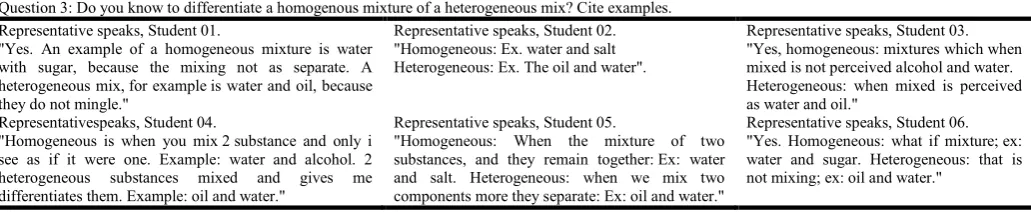
Table III emphasizes the design of students about the difference between homogeneous mixture and heterogeneous mix, in addition to examples that each one can cite these types of mixture. Ten students, corresponding to 47.62% said they would not know or do not remember the difference between the types of mixtures, nor cite examples. The other 11 students showed different responses, using basically two aspects to differentiate the types of mixture: separation or not of substances when mixed and the visible aspect. You can interpret the possibility of the existence of a conceptual gap and also an effective learning, fragmented and also distant from reality and practical situations, which is coupled to the traditional teaching adopted, the lack of use of didactic materials that enhance the quantitative aspects, hindering the operationalization of calculations, and the reduced amount of examples adopted by the faculty during the transposition of the content (CARMO; MARCONDES, 2008).
In table IV presents the conceptions of students about the definitions of solute and solvent in a solution. The majority of students (13 in total) again did not respond or said they would not remember. Between The answers collected, there was a recurrence of aspects: greater quantity and lower quantity to try to define solute and solvent. It is also realized the confusion between terms and the generalization of the water as the sole solvent, the shows a prior knowledge of students, but that need be molded or rebuilt through an educational practice more efficiently, from the adoption of resources that encourage the search for knowledge and the direct participation of students in this process. The difficulties encountered in the process of learning specifically related to the content of chemical solutions have already been discussed by some authors, being that the same point such occurrences as causes: the majority of students of education and ingressante average of higher education cannot establish in full relations between the compositions of substances and their properties; they cannot solve simple equations estequiométricas, besides not
differentiating the levels of macro analysis
and submicroscópico (VOGRINC; GLAZAR, 2007;
PEREIRA; UEHARA; NÚÑEZ, 2012). Such difficulties can be justified also by traditional pedagogical practices of
teachers of this discipline. As affirms Baldaquim et al. (2018,
It is also important to highlight the complexity of abstraction to understand the chemical concepts, so that, deny this difficulty may be considered naivety." Table V shows the answers of the learners when asked about how to classify the chemical solutions, in addition to examples of each type. The information collected emphasize the learning deficit of the participants of this research, where 71.43% demonstrated do not know or do not remember about the theme of classification of chemical solutions. In addition, it can be noted that the answers of the remaining 28.57%, are confusing and inconclusive, leading to the need to seek situations that contribute to the advancement of learning, and the use of virtual objects of learning a good alternative. Regarding the classification of chemical solutions, Ferreira (2015, p. 62) cites: "They are divided as to the physical state (solid, liquid and gaseous), as well as to the solubility (, saturated and unsaturated and saturated) regarding electrical conductivity
(electrolyte and non-electrolyte)". The conceptual
shortcomings identified with the target of this research, who despite having already seen the contents of chemical solutions in the second year of secondary education, addressed a contextualized: Chemical Solutions and sanitizing.
Contextualization in the teaching of chemistry through the theme of Sanitizing
After unmasking the prior knowledge of students realized the need to adopt differentiated methodologies in order to contribute to the process of teaching and learning. They were used to this two documentaries, short duration, in order to explain the relationship between the topic of sanitizing and the content of chemical solutions, in addition to the importance and the care that must be taken with the handling and storage of these chemicals. After the action highlighted above, was opened a section of discussion and realized that the students had knowledge about the theme, just didn't know the word. In addition, were also highlighted the implications regarding the use of sanitizing cakes or clandestine companies. The majority of participants stated that their parents usually buy the sanitizing sold on their doors, because they cost much cheaper than those sold in supermarkets, but almost never looking to
risk inherent to these products. After watching the
documentaries and after discursões, students were submitted to a new questionnaire with eight questions to determine if in fact, the same, understood what was covered and if the resources used were satisfactory for this.
Table 1. Definition of chemical solutions
Question 1: Do you know define what is a chemical solution?
Representativespeaks, Student 01. Representative speaks, Student 02. Representative speaks, Student 03. "It is a mixture of chemical compounds" "It is a mixture of chemical compound,
when it comes into contact with this compound, turns a chemical solution"
"It is the result of the mixture of solute with the solvent"
Representativespeaks, Student 04. Representative speaks, Student 05. Representative speaks, Student 06. "chemical solution i believe everything is
or what if you can mix in order to obtain another substance"
"It is all that we can mix and managed to form another chemical formula being homogeneous or heterogeneous it"
"A chemical solution is the result of the mixture of solute and solvent"
[image:3.595.42.558.306.412.2]Representativespeaks, Student 07. "chemical solution is the set of elements" Source: the authors themselves, 2018.
Table 2. Chemical Solutions and everyday life
Question 2: can you cite three examples of chemical solutions, with which it has contact in everyday life? Representativespeaks, Student 01. Representative speaks, Student 02. Representative speaks, Student 03.
"Water (H2O); alcohol (H2O2)" "Alcohol, hydrogen peroxide bleach." "cooking gas, the rice in boiling time, the nescau with milk (todinho)". Representativespeaks, Student 04.
"cooking gas, petrol and ethanol". Source: the authors themselves (2018).
Table 3. Mixtures Homogeneous and heterogeneous
Question 3: Do you know to differentiate a homogenous mixture of a heterogeneous mix? Cite examples.
Representative speaks, Student 01. Representative speaks, Student 02. Representative speaks, Student 03. "Yes. An example of a homogeneous mixture is water
with sugar, because the mixing not as separate. A heterogeneous mix, for example is water and oil, because they do not mingle."
"Homogeneous: Ex. water and salt Heterogeneous: Ex. The oil and water".
"Yes, homogeneous: mixtures which when mixed is not perceived alcohol and water. Heterogeneous: when mixed is perceived as water and oil."
Representativespeaks, Student 04. Representative speaks, Student 05. Representative speaks, Student 06. "Homogeneous is when you mix 2 substance and only i
see as if it were one. Example: water and alcohol. 2 heterogeneous substances mixed and gives me differentiates them. Example: oil and water."
"Homogeneous: When the mixture of two substances, and they remain together: Ex: water and salt. Heterogeneous: when we mix two components more they separate: Ex: oil and water."
"Yes. Homogeneous: what if mixture; ex: water and sugar. Heterogeneous: that is not mixing; ex: oil and water."
Source: the authors themselves (2018).
Table 4. Solute and solvent
Question 4: You can define what is solute and solvent that is in a chemical solution?.
Representativespeaks, Student 01. Representative speaks, Student 02. Representative speaks, Student 03. "Always solvent is water. Solute is what
will be diluted in water."
"SOLUTE is the substance that is in a smaller quantity and solvent is to be in greater quantity in the mixture"
"SOLUTE is the substance that when the mixture is located in greater quantity. Already the solvent is what is in lesser quantity."
Representative speaks, Student 04.
In the first moment, they were asked about the concept of sanitizing and if you would be able to cite examples. All of the students managed to respond and consistently cite examples, demonstrating that the methodology used (documentaries) was well accepted and contributed to the development of the teaching and learning process as can be seen in Table VI, which features views of participants. The students and the contemporary society are marked by the audiovisual sector, by the multiplicity of languages intimately linked with the power of the media of information/communication, therefore, the use of videos (classes, newsletters, documentaries) are tools that promote motivation to learning and knowledge acquisition
(SILVA et al., 2012). Table VII shows the vision of students
regarding the Saneante more used in their homes, and which components can or are present. The great majority of them responded that the saneante more used, between the answers the most present were to sanitary water and detergent. However do not know how to answer what is the chemical composition of these sanitizing and as a consequence a component. Stresses that most people usually make use of sanitizing without even reading their labels, so you can suffer
[image:4.595.39.545.82.132.2]health problems due to exposure to some chemical component that have allergy and who knew not be component of saneante who did use. On the positioning of the students as to the destination given by them or their family packs of sanitizing used in your home. So unanimously responded that discard in the trash. It is then a great lack of environmental education, on the part of both learners as the population in general. The lack of selective collection also favors this type of action. Although in the present day, are constantly being charged the correct environmental attitudes, whether by means of public policies or other forms, unfortunately there are few cities that have acceded to these charges. Students were asked if they had already been victims of poisoning by some saneante or even if they knew of any family member who had suffered some type of problem caused by incorrect use of some kind of sanitizing and the vast majority, 19 in total, corresponding to 73%, responded that no, something that without a shadow of doubt is good, considering that there are many cases of health problems caused by the use of improper way of sanitizing as researchindicates.
Table 5. Classification of chemical solutions
Question 5: Do you know how to classify the chemical solutions?.
Representativespeaks, Student 01. Representative speaks, Student 02. Representative speaks, Student 03. "The chemical solutions are classified in homogeneous and
heterogeneous. Examples of homogeneous is water and salt, and heterogeneous, water and oil."
"may be classified into: homogeneous and heterogeneous, mixtures, solutions, solute and solvent."
"homogeneous, heterogeneous solutions."
Source: the authors themselves (2018).
Table 6. Definition and examples of Sanitizing
Question 1: define what are Sanitizing? Cite examples.
Representative speaks, Student 01. Representative speaks, Student 02. Representative speaks, Student 03. "Sanitizing are all products used for
cleaning and sanitizing, sanitary water, soap, and etc".
"are chemical substances designated for domestic use for cleaning, polishing, sanitize and prevent certain parasites. Powdered soap, detergents, waxes, bleaches and disinfectants.".
"sanitizing products are intended for the sanitising both personal and collective. Examples: bleach, detergent, bleach and etc."
Source: the authors themselves (2018).
Table 7. Sanitizing and composition
Question 2: Which product saneante more used in your home? Know the composition of him? Cite at least one component of this product
Representative speaks, Student 01. Representative speaks, Student 02. Representative speaks, Student 03. "Soap. I do not know any component of this product." "bleach". "bleach, I do not know the composition." Representativespeaks, Student 04. Representative speaks, Student 05. Representative speaks, Student 06. "Detergent and bleach, i don't know any component of these products". "Detergent, bleach and soap." "sanitary water and detergent" Source: the authors themselves (2018).
Table 8. Sanitizing poisoning
Question 4: Do you or someone in your family has already suffered food poisoning by sanitizing products? Explain how it happened to intoxication. Representative speaks, Student 01. Representative speaks, Student 02. Representative speaks, Student 03. "Yes, my sister when small had contact with a
bleach type, as I was a little girl i can't remember if the intoxication was on the skin or was inside."
"Yes, I suffered when he was in the house of the mother of my sister, I was drinking water in a bottle of bleach thinking it was water and the truth was bleach."
"Yes, my mother had an allergic reaction to the detergent."
Source: the authors themselves (2018).
Table 9. Care with the Sanitizing
Question 5: What are the care that must be taken in the handling and storage of the products Sanitizing?
Representativespeaks, Student 01. Representative speaks, Student 02. Representative speaks, Student 03. "Let out of the reach of children, always in
its original packaging and always with labels".
"read before the product label, composition, where and in which you can use it. Store in dry and airy."
"To use the products we use boots and gloves. The products must be stored in places of difficult access to children and animals." Representativespeaks, Student 04. Representative speaks, Student 05. Representative speaks, Student 06. "It has to pay attention on product labels,
and place out of the reach of children".
"When handling the product, pay attention on the label and place it out of reach of children and pets. And, at the store, store in a safe place, away from food."
"Leave away from children and animals, read the label carefully to know what are the proper care with such a product."
However, 3 students (11.5%) presented cases, being two with family and one with himself, as shown in Table VIII. According to the National System of Tóxico-Farmacológicas Information (SINITOX) in Brazil, between the years of 1994 and 2004 were reported 776,366 cases of intoxication, of
which 123,230 correspond to the intoxication
with sanitizing (household cleaning,+ domestic pesticides,
+rodenticides) and of these, 66.2% were not
intentional (SINITOX, 2018). In Table IX students explain the care that must be taken in the handling and storage of Sanitizing. All students demonstrated know the basic care. Emphasize that we must always read labels before use, furthermore, always keep the label on the container, so that it can be avoided accidents, as for example, the ingestion of a saneante thinking that liquid can be any liquid such as juice. Another point very seconded by students was the maintenance of containers out of the reach of children and animals. Studies indicate that the majority of accidents with Sanitizing is with children of up to five, in their homes, so it is very interesting to see that students understood well this aspect (MEREDITH,
1993; GIBBS et al, 2005; PRESGRAVE, 2007). Other
placings refers to storage locations, according to them, the sanitizing should be stored in dry and airy. It is evident that the documentaries reached the intended goal, bringing basic information and very important.
In Table X, students explain how the sanitizing can be classified as chemical solutions. The answers were satisfactory, where only 9% of the students reported not knowing how to explain, other 91% gave various explanations, all related to the fact of sanitizing are homogeneous mixtures, using, therefore, the definition of chemical solution. Russel defines chemical solutions as being homogeneous systems formed by mixing of two or more substances, consisting of two components: the solvent and the solute (RUSSEL, 1994). It is important to highlight that the students not even using a chemical language need managed to expose their understandings, since inquiry made is directly linked to the objective of this research.
In Table XI, learners highlight what should be done with the packaging of sanitizing, i.e., explain what the proper final destination. All responses emphasized the importance of recycling and point to the need of separation and selective collection of garbage. In the face of the responses, it is clear that students are already beginning to awaken a knowledge about environmental education and the importance of proper disposal of solid waste. In this context, themes such as garbage, environmental pollution, among other things, enable the approach of chemical concepts so contextualized, "providing relevant knowledge about the subject, always making relationship with the daily life of the students, allowing them to create a critical idea with scientific
background about this serious social problem" (SANTOS et al.
2011, p. 03). It is important to highlight that it is the responsibility of the plan for solid waste management, the management of solid waste produced by sanitizing products,
however, the majority of Brazilian municipalities is
desregulares regarding this requirement. In summary, as there is no incentive for the correct disposal of these wastes, the packaging end up being evicted in open-air dumps or burned. In Table XII learners highlight the environmental risks that the inadequate disposal of packaging of sanitizing can cause. All participants pointed to problems with the ground and with fountains, impairing the fauna and flora of these environments. It is possible to perceive the formation of an environmental awareness demonstrated through the answers presented, one of the goals of this research also. "The risk perception of the population should be considered for the decision and definition of preventive measures to be adopted" (PRESGRAVE, 2007, p. 102). In this context, it is important to emphasize that, as the sanitizing are consumed on a large scale, healthcare should not be limited to the use, but also to store products and discard the packaging, since the disposal of the wrong way can lead to seríssimos environmental problems, such as, for example, desertification of land and destruction of rivers (BRAZIL, 2010).
Final Considerations
[image:5.595.37.559.77.148.2]Initially it was identified that the students involved in this research, despite their having already studied the content of
Table 10. Chemical Solution x Sanitizing
Question 6: In your understanding because the sanitizing can be understood as chemical solutions? Explain this relationship.
Representative speaks, Student 01. Representative speaks, Student 02. Representative speaks, Student 03. "Sanitizing can be understood as chemical solutions,
presenting homogeneous mixture and submit a single phase."
"Why do they contain chemical substance that contains a homogeneous mixture that is present for more than one component, but only see a phase."
"can be understood as a chemical solution, for them homogenous beings forming a single party."
Representative speaks, Student 04. Representative speaks, Student 05.
[image:5.595.35.562.189.230.2]"Because the sanitizing contains a homogeneous mixture" "because they are homogenous solutions that presents only a phase." Source: the authors themselves (2018).
Table 11. Destination Packages of products Sanitizing
Question 7: What should be done with the packaging of products sanitizing? What proper disposal?
Representative speaks, Student 01. Representative speaks, Student 02. Representative speaks, Student 03. "Being separated from the trash and never uses
them for other purposes."
"The packaging should be forwarded for recycling or for the collection due."
"Do not reuse them and uses them to donate for recycling"
Source: the authors themselves (2018).
Table 12. Environmental risks of improper disposal of packaging of Sanitizing
Question 8: What are the environmental risks that the inadequate disposal of packaging of sanitizing cause? Representativespeaks, Student 01. Representative speaks, Student 02. Representative speaks, Student 03. "contamination of soil and especially
the contamination of rivers."
"may cause pollution in the rivers, and the destruction of the water."
"In addition to the pollution, is responsible for the degradation of the environment, causing the destruction of biomes and the extension of various animals."
[image:5.595.40.554.270.321.2]chemical solutions, still presented conceptual gaps on the same. Given that reinforces the need for the development and application of methods that facilitate the learning and the association of what is studied in the classroom with their own
experience of educating. After watching the two
documentaries students understand better what is a chemical solution and managed to exemplify and relate the chemical content with their everyday life. Given the above, it can be inferred that the proposed objective in this study was achieved and how future work seeks to develop other activities contextualized for this and other contents of the discipline of chemistry.
REFERENCES
BALDAQUIM, M. J. investigative experimentation in
teaching of chemistry: building a tower of
liquids. ACTIO, Curitiba, v. 3, n.1, p. 19-36, Jan./Feb. 2018.
Brazil. National Solid Waste Policy - Law 12,305, 02 August 2010. Brasilia, 2010.
CARMO, M. P.; MARCONDES, M. E. R. Addressing solutions in the classroom - an experience of teaching from the ideas of the students. The new chemistry in School, No 28, 2008.
Here, I.; VOGRINC, J.; GLAZAR, S. A. Assessing 16-year-old studentes' understanding of aqueous solution at submicroscopic level. Research in Science Education, 2007.
ECHEVERRIA, A. R. How students perceive the formation of
solutions. The new chemistry in school. No. 3, May 1996.
FERNANDES, L. A. A. et al.; contextualization of teaching of
chemistry with the Thematic Saneante. Annals of the Brazilian Congress of Environmental Management and Sustainability - Vol. 6: Congestas, 2018.
FERREIRA, J. A. M. G. learning difficulties of the content of solutions: proposal for a contextualized education. Thesis (Doctorate in Chemistry) - Universidade Federal do Rio Grande do Norte. Center of Exact Sciences and Earth. The Graduate Program in Chemistry. Natal, RN, 2015.
GIBBS, L. et al. Parental Understanding motivators and
barriers to uptake of child poison safety strategies: a qualitative study. Injury Prevention, 2005.
MEREDITH TJ. Epidemiology of poisoning . Pharmacology and Therapeutics 1993.
NUNES, A. S.; ADORNI, D.S. The teaching of chemistry in the public schools of basic education and middle of the municipality of Itapetinga, BA: the look of the students. In: DIALOGICAL Meeting Transdisciplinary Enditrans, 2010, Vitória da Conquista, BA. -Education and scientific knowledge, 2010.
PEREIRA, J. E.; UEHARA, F.M.G.; NÚÑEZ, I. B. pedagogical discursive analysis of proofs in mathematics and chemistry of the vestibular UFRN. Revista Holos, Year 28, v. 3, 2012.
PRESGRAVE, R. F. Assessment of human accidental
intoxication caused by products sanitizing
domissanitários as subsidy for health surveillance
actions. thesis for a doctorate in Health Surveillance - Oswaldo Cruz Foundation, the National Institute for Quality Control in Health, Graduate Program in Health Surveillance, Rio de Janeiro, 2007.
Russell, J. B. General Chemistry. Vol. 1. 2Nd edition, São Paulo; Pennsylvania Books, 1994.
SANTOS, J. A. T. et al. Severity of poisoning by sanitizing
immigrants. Text Context Enferm, Florianópolis, 2011.
SILVA et al. The use of Educational Videos in classes of
Chemistry Teaching Medium for historic and
contextualized approach the topic window. The
Institutional Program of Initiation Scholarship for teaching - PIBID. The new chemistry in School, Vol. 34, No. 4, Nov. 2012.
SILVA, R.M.G.D. Contextualizing learning in chemistry in education. The new chemistry in School, São Paulo, No 18, 2003.
SINITOX- National Information System
Tóxico-Farmacológicas. Tabulation at national level. 2018.