ORIGINAL RESEARCH ARTICLE
APPLICATION OF THE METHOD OF ACTIVE THERMOGRAPHY IN WOODEN STRUCTURES
OF NINETEENTH CENTURY BUILDINGS
1,*
Silva, L.C.S.L.,
2Mantilla, J.N.R. and
3Carrasco
E.V.M.
1
Federal University of Minas Gerais, School of Architecture, Postgraduate Program in
Built Environment and Sustainable Heritage
2
Fumec University, Faculty of Engineering and Architecture, Post graduation in Construction Materials
3
Federal University of Minas Gerais, School of Architecture, Postgraduate Program in Built Environment and
Sustainable Heritage
ARTICLE INFO ABSTRACT
The architecture developed in Brazil during its colonial period was the result of an intense exchange of European cultures with the regions of exploration. The cover constructive systems are examples of the architecture developed in the colony, with the regionalist adaptations of the influences of the Portuguese metropolis. The armed rafter shear, a constructive system widely widespread between the 17th and 19th centuries in Brazilian historical cities, is a structural cover with little complexity in its conception, but due to the fragility of its stability, it undergoes great plastic deformations and displacements, destabilizing underlying building systems such as linings and masonry. This paper presents the case study of a non-destructive test methodology using the infrared thermography method on a wooden armed rafter shear from the Matriz do Santíssimo Sacramento church, located in the city of Jequitibá, central region of the state of Minas Gerais, Brazil. With the application of the method, the state of the internal integrity of the pieces was evaluated quantitatively, which validates the active reflective thermography as an alternative to the state-of-the-art investigations of old wooden shears.
Copyright © 2018,Deepti D. Dhere et al. This is an open access article distributed under the Creative Commons Attribution License, which permits unrestricted use, distribution, and reproduction in any medium, provided the original work is properly cited.
INTRODUCTION
Moreira (2010) states that traditionally in Portuguese architecture, the one with greatest influence in the Brazilian colonial architecture, were used in the shear truss coverings, which is why there is a great diversity of studies on this type of structure, which allows the construction of a variety of decorative types of ceilings, aided by leg and level frames. The level shear truss, as it is named in Portugal, was the typology of cover that most influenced the roofs of the colonial period in Brazil. There are two strands for Brazilian adaptation of the level shear truss, the first one, named high thread shears, presents the purl in on the connection of the common rafter with the high line and the second, known as armed rafter, there
*Corresponding author: Silva, L.C.S.L.,
1
Federal University of Minas Gerais, School of Architecture, Postgraduate Program in Built Environment and Sustainable Heritage.
is no use of the purlin and the rafters are connected by slats at up to 50 centimeters. In both cases, due to the absence of low line, there is structural instability (Fig. 1). Thus, the greater the span, greater the horizontal force transmitted to the supports, and greater the thickness of the cover support wall, to delay the onset of pathologies by displacements. Santos (1951) states that in seeking the solution to the horizontal force, the masters of work in the seventeenth century in Brazil preferred to use the tether, a tensile resistant part that absorbs the horizontal force. This solution sought to reduce the sections of the support masonry, since the tether would absorb all the horizontal loads produced by the shears, but later, it was verified that this solution would not prevent the displacements, besides de-characterizing the construction system (Fig. 2). Broto (2005) states that wood as organic material is subject to deterioration by biological agents on both the macro and micro scale. Biotic agents are living organisms that degrade wood, growing in favorable environments, especially where there are
ISSN: 2230-9926
International Journal of Development Research
Vol. 08, Issue, 07, pp. 21442-21447, July,2018
Article History: Received 16th April, 2018
Received in revised form 07th May, 2018
Accepted 21st June, 2018
Published online 30th July, 2018
Key Words: Wooden Structures, Colonial Architecture,
Assembled Armed Shear Rafters, Thermography.
Citation: Silva, L.C.S.L., Mantilla, J.N.R., and Carrasco E.V.M. 2018. “Application of the method of active thermography in wooden structures of
nineteenth century buildings”, International Journal of Development Research, 8, (07), 21442-21447.
Figure 1. Armed rafter shears
Figure 2. Deformation in the masonry resulted from the displacement of the armed rafter shear in the São José church in
the city of Ouro Preto – Brazil
relative humidity and high temperatures with thermo hygrometric values of the order of H = 15% and T = 15 - 30ºC, respectively. Carrasco and Azevedo (2003) describe that among the biological agents responsible for the biodegradation of wood, a broad spectrum of macro organisms such as birds, rodents, bats, insects and microorganisms such as bacteria, algae, yeasts, fungi, lichens and, sometimes lower plants. Wood is a hygroscopic material, capable of interacting with the environment by absorbing or losing moisture. Thus, Nyujsha (1990) states that excess relative humidity and constant hygrothermal variations favor the development of biocolonization, thus affecting the natural durability of the parts and altering the performance of the shears by undergoing constant retraction and swelling. With the hygrothermal variations, retractions and swells are responsible for internal stresses in the wood, resulting in openings and progressive cracks in the drying process. The damages caused by cracks in the strength of wooden structures vary with their extent, depth and section of the piece where they occur. Feio and Lourenço (2005) conclude that the cycles associated with hygrothermal variations generally lead to the loss of mechanical bond strength, which results in increased flexibility and deformations of the entire structural set. Cruz (2001) states that preliminary inspections to be carried out on old wooden coverings should be specific to each building, since historical,
socioeconomic and regional factors influenced their
constructions. In the preliminary inspections, signs of poor conservation of the covering elements of the wood must be investigated, such as excessive humidity and exposure of the parts to the elements, hidden and excessive vibrations caused by the increase of vehicle traffic in the historical urban centers.
To the validation of the preliminary inspection is satisfactory the use of good practices that involve the geometric survey of the dimensions of the elements, evaluation of the characteristics of the materials, as well as the characterization of the structural damages (MARTINS, 2009). Interventions in wooden structures often involve partial alterations in a building, so it is necessary to maintain dimensions and characteristics of historical importance. Thus, inspection methods that investigate the actual state of the structure and
reduce the impacts of substitutions are critical. Oliveira et al.
(2005) state that with an effective damage mapping it is possible to make the most precise decision about the maintenance or rehabilitation technique to be adopted in the intervention. In this context, nondestructive tests (NDT) applied to historical structures have advantages because they do not damage the structural capacity of the material, because
of the speed of execution and relatively low cost. Cortizo et al.
(2008) define the thermography method as a non-destructive test, without the need of contact with the body or system, for the visual identification of the surface thermal gradient, provided that it is in ambient conditions based on the capture
of the infrared radiation, which allows detecting
heterogeneities in constructive elements and systems. For
Figueiredo et al. (2017), the thermographic method consists in
the recording of images by color scales of perception of the surface temperature of a body, being possible, through this technique, to detect temperature changes that identify potential pathological problems. Thermographic tests allow qualitative and quantitative analysis of the results. The qualitative analyzes, characterized by being simpler approaches, should be used whenever a superficial characterization of the problem is sought, reaching thermograms that will be interpreted only visually. The quantitative analysis requires the use of measurement parameters, such as ambient temperature, relative humidity, distance and actual surface emissivity (GARCIA, 2014). Maldague (2000) states that there are two techniques for the non-destructive thermal photographic method: passive and active. The passive technique consists of the internal storage of energy by the materials when stimulated by a natural source of energy. The active technique consists in the incidence of an artificial source of heat on the surface, where there is heating or cooling of the bodies, which results in a heat flow, generating a thermal gradient. In this method, an external stimulus is required to produce a thermal contrast in zones that are in thermal equilibrium. For the active technique, Garcia (2014) defines that the thermal excitation must occur through simple artificial heat inducing sources (lamps, flashes, hot air jets) or sophisticated (ultrasonic pulses, infrared radiation, microwave, laser). The heat source is directed onto one of the faces of the material, at a set distance according to the heating requirement of the tested material to obtain the desired results, considering the possibility of combustion of the material. The results can be reflective, when the image is realized on the face where the thermal excitation occurred, or where the image is realized on the opposite side of the thermal excitation, thus establishing a thermal flow by transmission.
MATERIALS AND METHODS
The location of the religious buildings was based on a search of the collections of the Documentation and Information Center of the National Artistic Historical Heritage Institute (CDI/IPHAN) in Belo Horizonte/Minas Gerais. The data was collected on the constructive history of real estate, artistic influences, projects and interventions throughout the centuries. With this survey, the construction system of armed rafter was identified in the Matriz do Santíssimo Sacramento church in the city of Jequitibá, located 116 km from Belo Horizonte, with date of construction in the 19th century and provision dated June 8, 1818 (Fig. 3) (IEPHA/MG, 2018). The church is in the process of being restored by the SEPRES Company and supervised by the State Institute of Historic and Artistic Heritage of Minas Gerais (IEPHA/MG).
Figure 3. View of the left side facade of the Matriz do Santíssimo Sacramento church. City of Jequitibá, Minas Gerais, Brazil
State of Conservation of the armed rafter shears of the Matriz do Santíssimo Sacramento church: With visual inspection, it was found that the state of conservation of the shears of church’s coverage are critical. Through in situ inspection it was verified that there were fractures in the shingles, infestation of xylophagous insects, vegetation, pigeons and rodents. Among all the anomalies, the most prominent was the pathology of structural order, resulting from a displacement caused by horizontal thrust, characteristic of the armed rafter shears, which caused large deformations in the church's masonry. With such a situation of risk of collapse, safety measures were adopted, such as external shoring of masonry (Fig. 3). The wooden pieces of the shears analyzed were assigned by the company SEPRES, and the gather of these pieces was authorized by IEPHA/MG (Fig. 3) and transported to the Laboratory of Technological Research (LPT) of the School of Architecture of the Federal University of Minas Gerais.
Methodology of thermographic tests applied to old wooden coverings: For this work, the active reflexive method was chosen. Such choice is justified due to the need for artificial thermal excitation to carry out the analyzes on the parts inside the laboratory. Another determinant factor for the adoption of the reflective method was the exposure of the material to high temperatures, which could cause the wood to burn if the transmissive method was adopted, since the cross sections of the elements were robust and to heat another face would demand greater exposure of the material to high temperatures, allowing a very aggressive heating to the integrity of the material.
Although there are tables with emissivity values for various materials, these values should be used for reference only. The equipment used to perform the active thermography method
was the FLIR T4201 thermographic camera of the
Technological Research Laboratory of the School of Architecture of the Federal University of Minas Gerais.The procedures were initiated with the preliminary visual inspection, mapping the areas that presented biotic and abiotic damages. For the application of the quantitative active method of infrared thermography, it is crucial to know the environmental conditions where the test will be performed, since these directly affect the results obtained. For the collection of environmental data, the Thermo-Hygro PM 500
equipment of the company POLIMED2 was adopted. After the
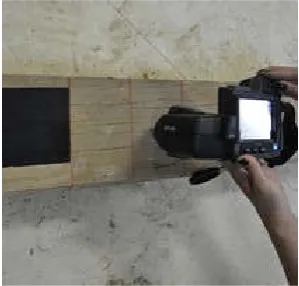
data collection, the procedures for non-destructive tests were started with the FLIR T420 thermal camera. Based on the methodology of the black body, presented by Figueiredo (2017), a region of the rafter 1 (Fig. 5) was chosen that, through visual inspection, did not present a moist surface and hollow sound. Then, on the area of the chosen wooden piece, black matte adhesive paper with dimensions of 6cmx6cm was placed, thus marking the area of the test. Once the temperature between the wood and adhesive paper was stabilized, the procedure for calibrating the chamber was started, configuring the equipment with the following parameters:
Approximate distance between the wood, adhesive
paper and the chamber;
Emissivity value of matte black adhesive paper;
Calibration of the emissivity of the wood;
After 30 minutes of waiting, a measurement was made with the camera directed in the region of the matte black adhesive paper (Fig. 4), calibrating the emissivity value and the temperature of the material in the chamber, obtaining the black body test. After calibration, the thermal excitation in the material was performed with the 500W halogen lamp reflector for 40 minutes on each 30cm longitudinal fraction of the part. Waiting time is justified by the concern of constant and uniform heating in the parts, since the robustness of the elements could hinder the reflection of the temperature. The heat incidence was performed at linear spacings of 30cm due to the amplitude of illumination of the reflector.
Figure 4. Black body test for determination of emissivity
1The FLIR T420 thermal imager belongs to the FLIR T series. This equipment
has a temperature range of 4 ̊ F to 1.202 ̊ F (-20 ̊ C to 650 ̊ C), with a maximum gain of 2,192 ̊ F (1200 ̊ C), 320 x 240-pixel infrared and 4x continuous zoom (FLIR, 2009).
2PM 500 digital thermohigrometer with high precision probe with temperature
[image:3.595.359.509.562.705.2]The distance between the reflector and the chamber was 20cm to avoid possible combustion of the parts.
RESULTS
To obtain the results, the geometric survey of the armed rafter shears was carried out initially, obtaining the following measurements:
• Rafter 1: 11.27m long, 0.15m wide and 0.10m high.
• Rafter 2: 11,40m of longitudinal length, 0,15m of
width and 0,09m of height.
[image:4.595.314.551.79.176.2]• High line: 6.64m long, 0.13m wide and 0.10m high.
Figure 5. Selected areas of the armed rafter shears for thermographic damage mapping.
With the mapping (Fig. 5), the quantitative active thermographic method was applied to six areas that, by preliminary inspection, presented damages of both biotic and abiotic origin. It is noted that the geometric survey is of paramount importance in case studies to be quantified and localized the extent of the degraded area. With the data of the black body test, the thermal camera was calibrated for the tests with the following data:
Emissivity: Ɛ = 0.93;
Material temperature: 27.1° C;
Relative air humidity: U = 55%;
Ambient temperature: 28° C;
After the equipment received these data, the test was performed, and the following results were obtained:
Area 1.
[image:4.595.49.280.161.282.2]
(a) (b)
Figure 6. Area 1. Lower linkage of frame 1. (a) thermography, (b) connection detailing
Area 2.
Figure 7. Area 2: (a) thermographic image, (b) part image
[image:4.595.313.559.225.333.2]Area 3.
Figure 8. Area 3. (a) thermographic image, (b) part image
[image:4.595.318.549.389.493.2]Area 4.
Figure 9. Area 4. (a) thermographic image, (b) part image.
Area 5.
Figure 10. Area 5. (a) thermographic image, (b) part image.
Area 6.
Figure 11. Area 6: (a) Thermographic image, (b) part image.
[image:4.595.45.275.530.644.2] [image:4.595.313.551.547.652.2] [image:4.595.37.259.676.779.2]In the visual inspection, it was detected that area 2 (Fig. 7) presented on the surface biotic attack of fungi of brown rot, which caused the alteration in the heat absorption by the material and variable thermal amplitude in the same face tested. Region 3 (Fig. 8) presented a higher temperature range than all the other regions tested, reaching 82.5°C in the hottest areas and 27.1° C in the calibration temperature areas. This is due to the internal heating of the connection between the rafter 1 and the high line, notch region of the parts, and the loss of internal mass and heating of the metal locking elements. It was verified through the visual inspections that in regions 4, 5 and 6 there is presence of fungi of brown rot, causing the wood to decay. Thus, the thermographic test evaluated the depth of the damage in the internal region of the piece and, as can be seen in Figs. 9, 10 and 11, there is loss of internal material mass and fiber discontinuity. In region 5 (Fig. 10) it is still possible to identify an already dead xylophagous insect. Note that the constancy in the distance between the camera and the material to be tested is of fundamental importance, since the variation of the same increases the amplitude of the color scale. In the regions where there were the highest temperature amplitudes (Fig. 8 and 9) variation in the display color scale was observed with respect to the initial calibration temperature of the chamber due to the distance of the camera from the material. This does not invalidate the method but increases the color spectrum for heating other materials in the environment.
DISCUSSION
The methodological application of infrared thermography is too simple, however when precautions are not taken during the test, such as the hygrothermal survey of the environment and calibration of the equipment, the results are led to wrong conclusions. According to Mario (2011), the main factors that influence this technique are:
• Hydrothermal conditions of the object and the
environment in which it is before, during and after the test;
• External sources of thermal excitation or reflection;
• Measurement conditions (emissivity, distance
between the material and the camera, viewing angle, etc.)
The non-destructive method of infrared thermography, which is active for reflection, for inspection of the building's internal construction elements, has been used with satisfactory results due to the practicality, since there is no need for transportation and direct contact with the material, and for reading speed of their results. For Rocha (2017) infrared thermography as a non-destructive method of quantitative inspection of structures allows the professional to evaluate the results in situ, which is useful to avoid hasty decisions for the complete replacement of wooden elements, without a correct evaluation of the state of conservation. However, it is important to note that the distance between the equipment and the element being inspected interferes with the color scale generated by the thermogram camera. The thermographic spectrum captures the lower temperature of the environment in relation to the more heated, which with a greater distance, other elements are also captured by the camera, which reduces the accuracy of the value of the heat absorption of the inspected object. This work delimited the case study to structural elements that were discarded from the restoration work of the Matriz do Santíssimo Sacramento church, to obtain the results more coherent with the good
practices of interventions in historical structures, evaluating the real need of the discarding of the pieces, since the preservation of constructive systems perpetuates the way of doing in the historicity of constructions. With the results obtained, degradation zones were detected as indicated in figure 5, but with the aid of appropriate therapies there was no need to discard the elements analyzed. This procedure demonstrates the effective response of the thermography method in the inspection of the integrity of old structures, in contrast to the lack of preparation of the competent authorities, which, due to technological deficiency, allows the amputation of the perpetuation of the historicity of the construction systems. There are techniques that, used in partnership with infrared thermography, extend the spectrum of evaluation of the material, such as: visual inspection, percussion tests, X-ray etc. Complementing the methods in inspections in historical buildings exhaust the probabilities of erroneous evaluations and validate the results found assertively and accurately in the decision of the rehabilitation methodologies to be adopted for the preservation of the patrimony. It was concluded in this study that the absence of non-destructive in situ inspections interfered directly in the preservation of armed rafter shears, since, despite the presence of pathologies in wood, there was no need to discard the elements, but only the rehabilitation therapies. Therefore, studies aimed at the evolution of NDT techniques and their cooperation are fundamental for the preservation, either in situ or applied to materials in laboratories with specialized labor.
Acknowledgement
We thank the Foundation for Research Support of the State of Minas Gerais (FAPEMIG) and the National Council for Scientific and Technological Development (CNPq).
REFEERENCS
Broto, C. 2005. Enciclopédia Broto de patologías de laconstrucción. Espanha.
Carrasco, E. V. M., Azevedo Júnior, A. P. 2003. Avaliação não-destrutiva de propriedades mecânicas de madeiras através de ultrassom – fundamentos físicos e resultados
experimentais. Engenharia Civil. Vol.1, n. 16, p. 27-37.
Portugal.
Cortizo, E. Cabaleiro; Barbosa, M. Pinotti; Souza, L. A. Cruz. 2008. Estado da Arte da Termografia. Fórum Patrimônio: Ambiente Construído e Patrimônio Sustentável. Vol.2, n.2. Brasil
Cruz, H. 2011. Inspeção, avaliação e conservação de estruturas
de madeira. 1as Jornadas de Materiais de Construção, p.
215 – 227. Portugal.
Feio, A. O., Lourenço, P. B. 2005. Possibilidades e aplicações de ensaios não destrutivos. In: Encontro sobre a madeira e suas aplicações nobres “Bem utilizar a madeira”, 1., Anais ISISE, Portugal.
Figueiredo, C. A. S., Bremer, C. F., Carrasco, E. V. M. 2017. Use of thermography as a non-destructive technique in the diagnosis of pathologies hidden in Wood of old buildings. In: II Congresso Latino-americano de Estruturas de Madeira e II Congresso Ibero-americano da Madeira na Construção. Argentina.
Flir Systems 2009 Manual do utilizador. Brasil.
Construções. Faculdade de Engenharia da Universidade do Porto. Portugal.
Instituto Estadual do Patrimônio Histórico e Artístico de Minas Gerais 2018. Livro de Tombo. Disponível online em http://www.iepha.mg.gov.br/index.php/programas-e-
acoes/patrimonio-cultural-protegido/bens- tombados/details/1/41/bens-tombados-igreja-matriz-do-sant%C3%ADssimo-sacramento
Leite, M. R. G. 2010. Lunário Potiguar Edificado: Inventário de Tipologias Construtivas de Igrejas do Rio Grande do Norte. Mestrado em Metodologias de Intervenção no Patrimônio Arquitectónico. Faculdade de Arquitetura da Universidade do Porto. Portugal.
Maldague, X. 2001. Infrared and Thermal testing:
Nondestructive testing handbook. 3th ed, Columbus, OH: Patrick O. Moore.
Mario, M. 2011. Uso da termografia como ferramenta não destrutiva para avaliação de manifestações patológicas ocultas. Trabalho de conclusão de curso apresentado ao Departamento de Engenharia Civil da Universidade Federal do Rio Grande do Sul. Brasil.
Martins. S. F. M. 2009. Estruturas de madeira – Inspecção e Diagnóstico. Aplicação em estudo de caso. Dissertação de Mestrado em Engenharia Civil. Área de Especialização: Materiais, Reabilitação e Sustentabilidade da Construção. Escola de Engenharia. Universidade do Minho. Portugal.
Matauco, E. N. 2000. La carpintería de armar española. Munilla-Lería. Espanha.
Moreira, M. I. 2010. Tectos Decorativos em Madeira em Edifícios Patrimoniais Portugueses. Dissertação de Mestrado em Engenharia Civil – Especialização em Construções. Faculdade de Engenharia. Universidade do Porto. Portugal.
Nyujsha, J. P. 1990. Biodeterioration and biost ability of library materials. Restaurator, n.4, p.71-77.
Oliveira, F. G. R. de; Sales, A. 2005. Efeito da densidade e do teor de umidade na velocidade ultrassônica da madeira. Revista Pesquisa e Tecnologia Minerva, 2 (1): p.25 – 31. Polimed ® Ltda. (2002) Manual do usuário. Brasil.
Rocha, J. H. A., Póvas, Y. V. 2017. A termografía infravermelha como um ensaio não destrutivo para a inspeção de Pontes de concreto armado: Revisão do estado da arte. Revista ALCONPAT, 7 (3), pp. 200 – 214. ISSN 2007-6835.
Santos, P. F. 1951. A arquitetura Religiosa de Ouro Preto. Rio de Janeiro, Kosmos. Brasil.