1703
IMAGE COMPRESSION TECHNIQUE USING SUCCESSIVE
BLOCKS INTERFRAME CODING
1ESCALIN TRESA L, 2DR. SUNDARARAJAN M
1
Research Scholar, Department of ETCE, Sathyabama University, Chennai, India
2
Dean, Electronics Sciences, Bharath University, Chennai, India E-mail:[email protected], [email protected]
ABSTRACT
A powerful technique for compressing images is very essential because the raw images needs huge amount of disk space which seems to be a disadvantage for transmission and storage. Though many compression techniques available in the field; a technique is needed which should be faster, more memory efficiency and simple that meets the requirements of the compression vs. quality. In this paper, we proposed a lossless method of image compression and decompression using a technique called Successive Blocks Interframe Coding (SBIC). This technique is simple in implementation and utilizes less memory. An algorithm has been refined and executed to compress and decompress the given images using SBIC technique in MATLAB R2014b simulation tool. The experimental results shows that the SBIC technique is most powerful and gives a good compression ratio without any data loss; while decompresses it reproduces the original image without any loss of data with the same 100% original file quality.
Keywords: Block Comparison, Neighborhood Similarity, Inter Pixel Redundancy, Hybrid Compression, Lossless Compression, Successive Blocks Interframe, Image Compression
1. INTRODUCTION
Theobjective of Successive Block Inter-frame Coding (SBIC)is to reduce the local redundancy of theimage and to store or transmit data in an efficient form and at the decrypting end the quality wants to be retained 100% lossless to represent the original image data without any distortion. Digital images are composed of huge array of pixels. The dot like pixels have different amounts of primary colors that are mixed together to form final color of pixels. The image format is a way of storing the image details in a computer file as far as the original image is reconstructed for displaying / printing. The differences in the formats have essentially to do with the details that is stored and the efficiency with which it is stored. Image compression is essential for a powerful transmission and image storage. Image has huge details that depend upon storage space, huge bandwidth and long time for transmission. So it is auspicious to compress the image by storing only the needed details to reconstruct the image. There are two types of image compression techniques: Lossless compression and Lossy compression. In Lossless compression, the original and the reconstructed image after compression are identical [1].This lossless image compression is especially suitable in facsimile
transmission and image archiving to store medical or legal records [2][3][4].Here, each single bit of information will remain the same in the file after compression and thus all the information is restored completely. Lossy compression is used mostly nowadays due to its high compression ratio when compared with lossless compression. The proposed technique SBIC is a lossless image compression technique as it uses successive redundant information for its compression process [5]. Information theory says, measuring redundancy is the fractional subtraction between the entropy H(X) of an ensemble X and its maximal possible valuelog| |. Typically, it is the amount of wasted space in the area of storage. Image compression is a solution to eliminate or reduce the unwanted redundancy. The propose method SBIC reduces the redundant data in successive blocks to achieve high compression ratio with reduced time for process and fast decompression [6][7].
2. LITERATURE REVIEW
ISSN: 1992-8645 www.jatit.org E-ISSN: 1817-3195
1704 redundancy, Psycho-visual redundancy and Coding redundancy [8].
2.1 Inter-pixel Redundancy
Natural images have large degree of correlation within its pixels. This correlation is known as inter-pixel redundancy or spatial redundancy and is removed by predictive coding or transform coding.
2.2 Psycho-visual Redundancy
Images are generally meant for consumption of human eyes, which does not respond with same sensitivity to all visual information. The relative relevancy of various image information components can be exploited to eliminate any amount of data that is psycho-visually redundant. The process that removes or reduces Psycho-visual redundancy is known as quantization.
2.3 Coding redundancy
A variable-length code that matches the statistical model of the image or its processed version exploits the coding redundancy in the image.
2.3.1 Transform based Image compression Image coding techniques based on transform uses mathematical transformation to map the pixel values of image onto a set of de-correlated coefficients, thus removes inter-pixel redundancy. These coefficients are then quantized (psycho-visual redundancy), and encoded (coding efficiency). There exist many types of image transforms like Discrete Fourier Transform (DFT), Discrete Sine Transform (DST), Discrete Cosine Transform (DCT), Karhunen-Loeve transform (KLT), Slant Transform, Hadamard Transform and Discrete Wavelet Transform (DWT). For compression, better transform is obtained if energy compaction capability is higher. Though KLT transform is good in terms of energy compaction (transform coding gain) [9], the drawback is data dependent and overhead of sending the transform may reduce the transform coding gain. Another popular transform is discrete cosine transform (DCT), which has transform coding gain very close to KLT and higher than DFT but the computational complexity of DCT is less than DFT. Due to these reasons, DCT has become the most popular used transform coding technique [10].
2.3.2 Image Compression Using Wavelet Transform
The Discrete Wavelet Transform (DWT) is the transform took over by the latest image
compression standard JPEG2000 and it is the popular transform. The DWT success is based on the ease of computation and its decomposition of an image into spatial sub bands that facilitates the design of efficient quantization algorithms and allows exploitation of the human visual system characteristics [11].
3. SUCCESSIVE REDUNDANCY
ANALYSIS
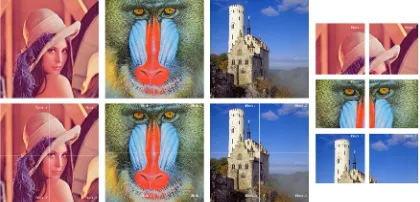
[image:2.612.327.537.475.576.2]There exist three types of redundancies in image compression and coding techniques. They are coding redundancy, spatial redundancy and psycho visual redundancy. Apart from these redundancies, we can trace a new kind of redundancy on image ie. successive blocks pixels redundancy which is based on our proposed methodology. Proposed method says, if an image is divided into fixed blocks in a constant ratio and by analyzing the successive blocks; we can trace 30-70% of successive blocks pixels get redundant or contains strongly correlated pixels as in equation 1;in other words, large regions whose pixel values are the same or around the same. Fig. 1 shows that each 512x512 image gets divided into 256x256 blocks and the blocks are subjected to analyze successive blocks pixel redundancy and we can clearly notice the closest pixels relationship between each successive block. This relation is the key for SBIC image compression process [12][13].
Fig 1. Successive Blocks Pixel Redundancy
_ , ~ 1
!, ~30% % 70% (1)
The similarity percentage between two successive blocks could be traced by visually comparing the above blocks and all the (ith)
1705 4. SUCCESSIVE BLOCKS
INTERFRAME CODING
Unlike other compression methods SBIC works on the closest relationship of a scene; any meaningful scene will have successive pixels/blocks relationship. The proposed method takes advantage of this relationship to compress more than any other formats. SBIC uses Motion Picture Experts Group (MPEG) coding for compression of image and the general block diagram of SBIC is shown in Fig. 2.
Fig 2. SBIC block diagram for image compression 4.1 Block Processing
Original input image is given to Block processing. Block processing consists of preprocessing, tray preparation, block sequencing and doubly linked tray. Output of this block processing is subjected to quantization.
4.1.1 Image Preprocessing
Preprocessing involves those operations that are normally required prior to the main data analysis and extraction of information. Some standard correction procedures may be carried out in this stage before the image is subjected to tray preparation. Padding is done in this stage. Padding is required if the height of the fixed block or width of the image is not divisible, then the image is adjusted with padding bits.
4.1.2 Tray Preparation
The images get divided into blocks and are grouped under the tray for the procedural flow. Each tray gets processed in the order of stack operation (First In First Out) and the total number of tray’s can be calculated using the equation 2. There exist two types of trays namely odd and even tray. In the odd trays, the blocks are arranged in ascending order whereas in the case of even trays the blocks are arranged in descending order. This process is to link the tray in a sequential manner of nearest neighborhood relationship, after each block is arranged. The purpose of preparing tray and blocks arrangement on the tray is to further eliminate the redundancies, by using the motion picture compression technique. On the tray, each
successive block gets placed in a manner similar to the books arranged on the rack.
∑ Tray ,-./01 21-02345678 9-:1 (2)
4.1.3 Doubly linked tray
It consists of a group of trays (odd and even) altogether represent a sequence. In simplest form, each tray is composed of blocks and a reference (link) to the next tray in the sequence. This structure allows for efficient insertion or removal of elements from any position in the sequence during iteration. Linked tray looks like the linear data structure doubly linked list which has a group of tray in a sequence which is divided into two parts as shown in Fig. 3. Each tray has its own preprocessed blocks and the address of the next tray to form a chain. The processed chain gets subjected to MPEG coding process.
Fig. 3. Linked tray
Also each tray has two links; first link points to the previous tray and the next link points to the next tray in the sequence. The blocks were fetched and processed in the tray in a zigzag scan order. The blocks are collected and processed in the tray based on odd tray (OTi) and even tray (ETi). Total number of tray's can be calculated using the equation 3, where 'x' is the linked block's sequence in the buffer for the next level process.
x < x Ti
>
-?!
3
The Odd tray (OTi) will be connected to the head of Even Tray (ETi). This will be continued until the end of all trays, in this way a sequential block chain will be formed as shown in Fig.3.
4.2 MPEG Encoding and Block Sequencing
ISSN: 1992-8645 www.jatit.org E-ISSN: 1817-3195
1706 which represents the estimated motion. Motion Compensation (MC) uses the ability of object motion to bring about compression. Motion estimation and motion compensation are the capable methods to exclude the temporal redundancy because of high correlation in between successive blocks. For compressing the images, redundancy between neighboring frames can be abused where a frame is selected as reference frame and successive frames are predicted from the reference frames using motion estimation technique. Motion estimation technique evaluates previous and future frames to determine blocks that have no changes and the motion vectors are saved in the place of blocks. This process is called as Interframe coding.
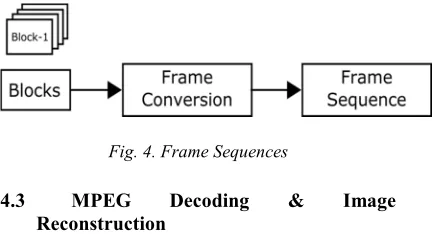
In real video pictures, estimating motions can be a complicated combination of translation and rotation. Hence requires huge amounts of processing. But translational motion is estimated easily and used profitably for motion compensated coding. The entire MPEG frames sequences of set {x} are administered to MPEG-4 H.264 encoder to perform compression. The redundant blocks are excluded from the frames one the fixed size blocks are transformed into frames.ME and MC techniques are executed in the reference and current frame. After excluding the redundant information, rest of the information of frames is compressed using frame difference [14][15]. This process repeats until all the frames are compressed and is shown in Fig. 4.
Fig. 4. Frame Sequences
4.3 MPEG Decoding & Image Reconstruction
[image:4.612.90.306.483.600.2]The decompression phase shown in Fig. 5 is simple than the compression phase. The reverse of compression process to reconstruct the image by the decoder is called as MC. By inversing the procedure of encoder process, the original frames is regenerated one by one and every frame gets converted into blocks and then tray will be formed. According to image property, trays are joined together and the image gets reconstructed again.
Fig. 5. Image Reconstruction
4.4 Lossless Compression
Generally lossy compression technique provides more compression ratio when compared to lossless compression. But in the proposed SBIC, the compressed image is lossless and it yields a good result than lossy compression technique; there is no information loss in the compressed image.
5. QUALITY MERTICS OF
RECONSTRUCTED IMAGES
The process of reducing the size in bytes of a graphics file without affecting the quality of the image is called as Image compression. The essential figure of merit for image compression is the compression ratio which is the size of a compressed file to the uncompressed file. PSNR is the ratio between the highest possible power of a signal and the power of corrupting noise that affects the loyalty of its representation. The quality of the image is obtained by calculating the PSNR of the reconstructed image using equation 4. If PSNR is high, image quality is also high.
@ AB 20 DBE FG HI 4A
where, N is the highest possible value of the signal in the image.
1707
E F 1K <|L % | M
?! 1
K | | 5
where, fi is the prediction, yiis the true value and
the mean absolute error is an average of the absolute errors |ei|=|fi- yi|.
RMSE means that the decompressed image is close to the original image on a pixel-by-pixel basis. The RMSE can be calculated using the equation 6.
BE F
O1A < P % PQ R
?!
6
where, xQ- is the predicted value and variable x- is computed for N different predictions.
Image quality is defined as poor if the MSE is large. MSE can be calculated using the equation 7.
E F
<TL , U % V , U WAX X 7
where,f(i, j) represents the original image and
F(i, j) represents the distorted image and i and j
are the pixel position of the M×N image. MSE is zero when f(i, j) = F(i, j).
SS is defined as the reduction in size relative to the uncompressed size and it can be calculated using equation 8.
Space Saving Compressed Size
Uncompressed Size 8
In absence of any perceptual measure, which is essentially subjective in nature, these measures can be used to judge the quality of reconstruction.
6. RESULT & DISCUSSION
Analyses and discusses the results obtained by performing the techniques explained above on a set of test images as shown in Fig. 6.
The performance is measured using the parameters Peak Signal to Noise Ratio (PSNR), Mean Square Error (MSE), Mean Absolute Error (MAE), Root Mean Square Error (RMSE)and Space Saving (SS).The proposed SBIC can be carrying out on any kind of image and are not limited to these test images. The experimental result shows a feasible quality improvement with high compression ratio when compared with Joint Picture Experts Group (JPEG), JPEG 2000 and JPEG-LS.
Fig.6. Test images (512x512 pixels) for SBIC
The images tested were taken from the standard image processing database images. In positive terms, SBIC compresses the image based on redundancy; basically a meaningful image will have local redundancy or closest relationship with its nearest block. So the compression occurs is based on the local redundancy only not in the form of global redundancy. Therefore (O(n)2) = 0, since SBIC considers the local redundancy. Hence the time taken for compression will be less. In negative terms of SBIC, if the images nearest block redundancy are random and have no redundancy then the compression will be less and time taken for compression will be high.
ISSN: 1992-8645 www.jatit.org E-ISSN: 1817-3195
1708 Table 1Compression byexisting techniques Vs. SBIC
with Elapsed Time
Input image
Original Size (bytes)
JPEG (bytes)
JPEG 2000 (bytes)
JPEG-LS (bytes)
SBIC (bytes)
Elap sed Time (Sec)
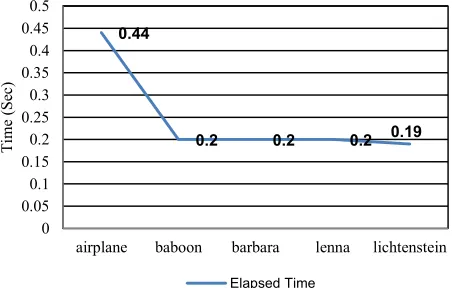
airplane 786,486 291,939 103,164 413,238 33,764 0.44
baboon 785,480 515,137 323,472 617,486 95,077 0.2
barbara 786,186 210,735 198,061 504,169 56,706 0.2
lenna 766,486 351,941 158,394 462,660 35,539 0.2
[image:6.612.80.302.108.461.2]lichtenstein 785,486 239,577 105,355 377,675 38,903 0.19
[image:6.612.327.553.207.351.2]Fig. 7 shows the comparison of the size of original and the compressed image using various images as input.
Fig. 7. Original vs. Compressed (Size)
Fig. 8 shows the comparison of different existing and proposed SBIC techniques by its size. From this graph it’s clear that the proposed SBIC shows a promising result more than any other methods.
Fig.8. Comparison of proposed and existing techniques
Fig. 9 shows the elapsed time for various input images. From this graph it’s clear that the proposed SBIC shows a random result. It shows that the time will vary based on the image content. If the image blocks were different and the redundancy is less, the elapsed time will increase.
Fig.9. Compression Size vs. Elapsed time
[image:6.612.86.306.326.465.2]Fig. 10 shows the comparison of various quality metrics for different input images. For example, considering PSNR: it is the most commonly used one to measure the quality of reconstruction of lossy compression codecs. When comparing compression codecs, PSNR is an approximation to human perception of reconstruction quality. Although a higher PSNR generally indicates that the reconstruction is of higher quality, in some cases it may not. Form the Fig 10 we can clearly see that all the images were reconstructed with high quality nearly 90%. By modifying MPEG-4 codec, the PSNR of SBIC can be raised to 100% reconstruction quality without any loss.
Fig.10. MAE, MSE, RMSE and PSNR chart
0 200 400 600 800 1,000
airplane baboon barbara lenna lichtenstein Original Size Compressed
0 100 200 300 400 500 600 700
airplane baboon barbara lenna lichtenstein
S
iz
e
(b
y
te
s)
Proposed JPEG JPEG 2000 JPEG 2000-LS
0.44
0.2 0.2 0.2 0.19
0 0.05 0.1 0.15 0.2 0.25 0.3 0.35 0.4 0.45 0.5
airplane baboon barbara lenna lichtenstein
T
im
e
(S
ec
)
Elapsed Time
0 10 20 30 40 50 60 70 80 90 100
airplane baboon barbara lenna lichtenstein
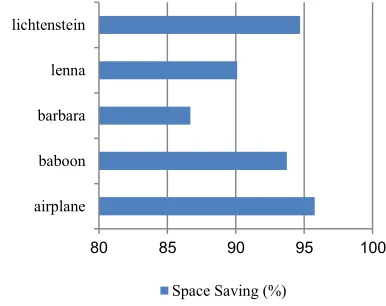
[image:6.612.95.307.550.709.2] [image:6.612.338.548.559.694.2]1709 Fig 11 is the representation of image space saving over the original size for different input images. For example the image airplane is compressed using SBIC and it gets stored in hard disk. SBIC compression saves the memory more than 95% while comparing the original image size.
Fig. 11. Space Saving chart
7. LIMITATIONS
Image compression is performed for various reasons. Few benefits of image compression are i) compressed images can be loaded faster ii) webpages use less space on Web host after compression. Image compression does not reduce the physical size of the image but it compresses the data and makes the image into smaller size. Few limitations of SBIC are as follows:
i) SBIC does not support layered images. Graphic designer needs to work on layered images to manipulate and edit graphic images which are not possible with SBIC.
ii) No transparency support
iii) SBIC image format is not capable of handling animated graphic images.
iv) Best results can be obtained based on image size vs block size (eg. If image size is too large and block size is too small, the compression factor gets affected).
8. CONCLUSION & FUTURE WORK
The proposed SBIC shows that large successive data redundancy on fixed blocks aid to achieve high compression and lossless reconstruction of the original image. The experimental result shows that the test images obtained approximately 93% of space saving, 92.19% of compression performance and 83.79%
of PSNR value. SBIC is suitable for applications such as satellite technologies, medical imaging, digital cameras and web applications for storing and transmitting images since no loss of information after decompression. Hence the proposed SBIC is an efficient technique for image compression and decompression than any other methods namely JPEG, JPEG 2000 and JPEG LS. However, the proposed methodology SBIC is better than the existing methods and for further developments; Multimedia Compression and Layered compression can be used.
REFERENCES:
[1] Shaou-Gang Miaou, Member, IEEE, Fu-Sheng Ke, and Shu-Ching Chen "A Lossless Compression Method for Medical Image Sequences Using JPEG-LS and Interframe Coding", IEEE transactions on
information technology in biomedicine,
volume. 13, no. 5, September 2009. [2] Gerald Schaefer, Roman Starosolski and
Shao Ying Zhu, "An evaluation of lossless compression algorithms for medical infrared images",IEEE Engineering
Medical Biological Conference, pp.
1673-1676, September 2005.
[3] XiwenOwenZhao, ZhihaiHenryHe, "Lossless Image Compression Using Super-Spatial Structure Prediction", IEEE
Signal Processing, Volume. 17, No. 4,
April 2010.
[4] Y. D. Wang, "The implementation of undistorted dynamic compression technique for biomedical image". Master's
thesis, Department of Electrical
Engineering at National Cheng Kung
University, Taiwan, 2005.
[5] Marcelo J Weinberger, Gadiel. Seroussi, and Guillermo Sapiro, "The LOCO-I lossless image compression algorithm: Principles and standardization into JPEGLS",IEEE Transaction Image
Processing, volume 9, no. 8, pp.
1309-1324, August 2000.
[6] Dania Brunello, Giancarlo Calvagno, Gian Antonio Mian, and Roberto Rinaldo, "Lossless compression of video using temporal information",IEEE Transaction
on Image processing, Volume 12, No. 2, pp
132-139, February 2003.
[7] N.D.Memon and Khalid Sayood, "Lossless compression of video sequences",IEEE
80 85 90 95 100
airplane baboon barbara lenna lichtenstein
ISSN: 1992-8645 www.jatit.org E-ISSN: 1817-3195
1710
Transaction Commun., volume. 44, no. 10,
pp. 1340-1345, October. 1996.
[8] G. K. Wallace, "The JPEG Still Picture Compression Standard", Communications
of the ACM, Vol. 34, Issue 4, pp.30-44,
1991.
[9] R. H. B. Kekre, A. Athawale and Dipali Sadavarti, "Algorithm to Generate Kekre's Wavelet Transform from Kekre's Transform" in International Journal of
Engineering Science and Technology, vol.
2(5), pp756-767 2010.
[10] H. B. Kekre, S. Thepade, A. Maloo, “Image Retrieval using Fractional Coefficients of Transformed Image using DCT and Walsh Transform‖”, International Journal of Engineering Science and
Technology, 2(4): 362-371, 2010.
[11] S. Sridhar, P. Rajeshkumar, K.V. Ramanaiah, "Wavelet Transform Techniques for Image Compression-An evaluation", International Journal of Image
Graphics and Signal Processing, 2014.
[12] S. Brofferio and F. Rocca, "Interframe redundancy reduction of video signals generated by translating objects", IEEE
Trans. Commun., vol. COM-25, pp.
448-455, Apr. 1977.
[13] J. A. Roese, "Interframe cosine transform image coding", IEEE Trans. Commun., vol. COM-25, pp. 1329-1338, Nov. 1977. [14] M. F. Zhang, J. Hu, and L. M. Zhang,
"Lossless video compression using combination of temporal and spatial prediction",IEEE International Conference
Neural Network, Signal Processing,
volume. 2, pp. 1193-1196, December 2003. [15] J.R. Jain and A.K. Jain, "Displacement
measurement and its application in interframeimage coding", IEEE Trans.
Commun., Vol. COM-29, No. 12, pp.