BIROn - Birkbeck Institutional Research Online
Kiss, M. and Goolsby, B.A. and Raymond, J.E. and Shapiro, K.L. and Silvert,
L. and Nobre, A.C. and Fragopanagos, N. and Taylor, J.G. and Eimer, Martin
(2007) Efficient attentional selection predicts distractor devaluation:
event-related potential evidence for a direct link between attention and emotion.
Journal of Cognitive Neuroscience 19 (8), pp. 1316-1322. ISSN 0898-929X.
Downloaded from:
Usage Guidelines:
Please refer to usage guidelines at
or alternatively
Efficient Attentional Selection Predicts Distractor
Devaluation: Event-related Potential Evidence for
a Direct Link between Attention and Emotion
Monika Kiss
1, Brian A. Goolsby
2, Jane E. Raymond
2, Kimron L. Shapiro
2,
Laetitia Silvert
3, Anna C. Nobre
3, Nickolaos Fragopanagos
4,
John G. Taylor
4, and Martin Eimer
1Abstract
& Links between attention and emotion were investigated by obtaining electrophysiological measures of attentional selec-tivity together with behavioral measures of affective evaluation. Participants were asked to rate faces that had just been pre-sented as targets or distractors in a visual search task. Dis-tractors were rated as less trustworthy than targets. To study the association between the efficiency of selective attention during visual search and subsequent emotional responses, the N2pc component was quantified as a function of evaluative judgments. Evaluation of distractor faces (but not target faces)
covaried with selective attention. On trials where distractors were later judged negatively, the N2pc emerged earlier, dem-onstrating that attention was strongly biased toward target events, and distractors were effectively inhibited. When pre-vious distractors were judged positively, the N2pc was delayed, indicating unfocused attention to the target and less distractor suppression. Variations in attentional selectivity across trials can predict subsequent emotional responses, strongly suggest-ing that attention is closely associated with subsequent affec-tive evaluation. &
INTRODUCTION
The adaptive control of behavior in a complex environ-ment relies on mechanisms that enable the efficient selection of task-relevant information and the simulta-neous inhibition of other information irrelevant for a current task set. Selective attention and emotion are both involved in this prioritization of perceptual and response-related processes. Given their shared function in mediating selective processing, it is not surprising that brain imaging studies have uncovered close links be-tween brain mechanisms involved in attention and emo-tion (e.g., Vuilleumier, Armony, Driver, & Dolan, 2001; Bush, Luu, & Posner, 2000). The emotional salience of stimuli is known to affect sensory processing (e.g., Lang et al., 1998; Lang, Bradley, & Cuthbert, 1990), the allo-cation of attention (e.g., Eastwood, Smilek, & Merikle, 2001; Fox, Russo, Bowles, & Dutton, 2001; Lang, Bradley, & Cuthbert, 1997), and memory and decision-making processes (see Cacioppo & Gardner, 1999, for a review). Given that there is now conclusive evidence that the emotional significance of visual events can modulate at-tentional processes, the question arises as to whether such links between emotion and attention might in fact
be bidirectional, with attentional processes also affecting emotional responses. In other words, does directing attention to one stimulus, while simultaneously ignor-ing another stimulus, have consequences for the sub-sequent emotional evaluation of these stimuli? Several recent studies have demonstrated that this is indeed the case. For example, Raymond, Fenske, and Tavassoli (2003) asked participants to first report the location of one target stimulus within a simple visual search display consisting of two colored abstract images, and then to provide an emotional evaluation of one of these images (using a cheerful/dreary dimension). Images previously presented as distractors were not only rated as less cheerful than images previously seen as targets, but also as less cheerful than novel images. In contrast, ratings for previous targets did not differ from ratings for novel items. To explain these findings, Raymond et al. pro-posed that, during visual search, attentional inhibition of irrelevant distractor items is encoded along with the representation of the distractor, and later during evalu-ation leads to more negative affective judgments.
Further support for the existence of systematic ef-fects of attentional selectivity on emotional evaluation in general, and for the devaluation-by-inhibition hypoth-esis in particular was provided in additional studies by Raymond and colleagues using multi-item search ar-rays. Using a temporally segregated ‘‘preview’’ visual
1
search paradigm, Fenske, Raymond, and Kunar (2004) presented a subset of distractors prior to the remaining target and distractor items. Putative top–down inhibition of the previewed distractors (Watson & Humphreys, 1997) was reflected in their devaluation in a subsequent rating task relative to distractors that were not pre-viewed, again suggesting that attentional selection pro-cesses have affective consequences. Raymond, Fenske, and Westoby (2005) demonstrated that distractors lo-cated near the target were devalued relative to far dis-tractors, consistent with the view that attended locations are surrounded by a local inhibitory region (e.g., Bahcall & Kowler, 1999). Extending these findings to meaningful social stimuli, Raymond et al. found that unfamiliar neu-tral faces that had been presented as distractors in visual search arrays were subsequently rated as less trustwor-thy than faces previously presented as search targets, with distractors located near a target again judged more negatively than more distant distractors. Finally, Fenske, Raymond, Kessler, Westoby, and Tipper (2005) dem-onstrated that faces associated with a no-go cue were judged as less trustworthy than uncued faces, suggesting that response inhibition can also affect the emotional evaluation of stimuli that are spatially and temporally contingent with a no-go signal.
Although such behavioral results provide compelling initial support for the hypothesis that selective attentional processing can influence emotional responses, they do not demonstrate unequivocally that the attentional se-lection of targets and the inhibition of distractors are
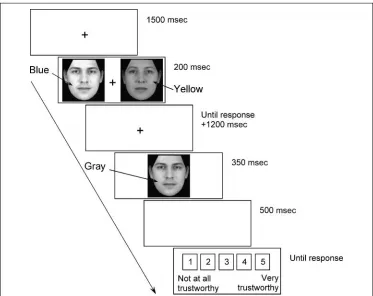
directly linked to the subsequent emotional devaluation of distractors. To establish the existence of such a direct link, it is necessary to use an independent direct measure of attentional selectivity in order to uncover systematic covariations between attention and evaluative judgments. Distractor devaluation needs to be shown to be associ-ated with variations in attentional processing, with effi-cient attentional selection linked to negative distractor ratings, and inefficient selection to more positive ratings. The aim of the present study was to provide such evi-dence. Event-related brain potentials (ERPs) were re-corded in a task similar to the tasks used by Raymond et al. (2003, 2005). On each trial, participants first had to select and respond to one target from a visual search display containing two grayscale faces (each seen with a transparent color overlay) in the left and right hemifield (visual search task). They then made a trustworthiness judgment for one of these two faces (evaluation task) seen without any color overlay. Target faces had to be selected on the basis of gender (with male or female faces desig-nated as target in different blocks), whereas the response was determined by the target’s easily discriminable over-lay color (blue vs. yellow; depicted in light and dark gray in Figure 1). Based on the previous findings by Raymond et al. (2003, 2005), it was predicted that faces that were distractors in the preceding visual search display would be judged as less trustworthy relative to target faces.
[image:3.612.185.558.439.735.2]To obtain an electrophysiological indicator of atten-tional selectivity during visual search, the N2pc compo-nent was measured in response to each bilateral visual
Figure 1. Example of the sequence of stimuli in each trial. The search display contained one target and one distractor face, which had either a blue or a yellow overlay (depicted here in light and dark gray). In mismatch trials, target and distractor faces were differently colored, whereas in match trials both faces had the same color. The to-be-rated face was always a grayscale image. All faces were equiluminant.
search display. The N2pc component is typically elicited at poststimulus latencies of 200 to 350 msec at poste-rior electrodes contralateral to the side of a task-relevant visual event, such as a target in a visual search task, and is assumed to reflect the attentional selection of task-relevant events and inhibition of irrelevant distrac-tors (cf., Woodman & Luck, 1999; Eimer, 1996; Luck & Hillyard, 1994). N2pc amplitudes reflect the difference in ERP activity between electrodes contralateral and ipsilateral to a target, and thus provide a direct mea-sure of the relative distribution of attention in the visual field. The current study focused on the N2pc because this component provides a unique online marker of the selective attentional processing of targets versus distrac-tors: Large N2pc amplitudes indicate fully focused at-tention and effective distractor inhibition, whereas small and delayed N2pc components are linked to a more dif-fuse attentional state.
Because target selection in the visual search task was contingent upon a perceptually demanding discrimi-nation between male and female faces, the speed and efficiency of attentional selectivity was expected to vary substantially across trials. On some trials, attentional target selection will be fast and efficient, and distractors will be fully inhibited (reflected by large N2pc ampli-tudes). On other trials, attention will remain more dif-fuse and distractor inhibition weak (reflected by small and delayed N2pc components). If selective attentional processing in the visual search task was directly linked to subsequent distractor devaluation, then more negative distractor ratings should be obtained on trials where attentional target selection was efficient (i.e., distractors were successfully suppressed) and large N2pc ampli-tudes were therefore elicited. In contrast, more positive distractor ratings should be found for trials with diffuse attention and incomplete distractor suppression, as re-flected by small and delayed N2pc components.
To apply this logic directly, N2pc components would have to be quantified on single trials in order to establish their relationship with subsequent evaluative judge-ments. However, due to the low signal-to-noise ratio of ERP components such as the N2pc, measuring this component requires averaging across many trials. In the present study, this problem was circumvented by using the evaluative judgements produced at the end of each trial as a criterion for sorting trials. Separate ERPs in response to visual search arrays were computed as a function of whether targets or distractors faces were subsequently rated as high or low in their trustworthi-ness. Two predictions were tested. First, if efficient target selection and distractor inhibition were directly linked to subsequent distractor devaluation, a larger and earlier N2pc component should be found in response to visual search arrays for those trials where distractors were later rated as not trustworthy as compared to trials with more positive distractor ratings. Second, if the sub-sequent emotional evaluation of target stimuli was
unaf-fected by attention, as suggested by previous behavioral findings of Raymond and colleagues, variations in atten-tional selectivity, as reflected by the N2pc component, should show no such systematic relationship to the rat-ings of target faces.
METHODS
Participants
Sixteen volunteers (mean age = 29.1 years, 5 men) were paid to participate in this experiment. Two of the partici-pants were left-handed, and all had normal or corrected-to-normal vision. The experiment was performed with the approval of the ethics committee of the School of Psychology, Birkbeck College.
Stimuli
A total of 1280 face images with neutral expressions and no visible hair were created using the GenHead software (www.genemation.com). Half of the faces were male and the other half female. Faces were converted from RGB color to eight-bit grayscale using Corel Photo-Paint, and equated for luminance in Matlab (The Mathworks, Natick, MA). Matlab was also used to create one blue-and one yellow-tinted version of each grayscale face. Each face subtended 3.884.28visual angle.
Experimental Procedure and Design
Stimuli were presented on a computer screen at a dis-tance of 56 cm. Stimulus presentation and behavioral response collection were controlled by E-Prime soft-ware (Psychology Softsoft-ware Tools, Pittsburgh, PA). On each trial, participants performed a visual search task followed by an evaluation task (see Figure 1).
For the subsequent evaluation task, a single face was presented in grayscale for 350 msec at the center of the screen. This to-be-rated face was equally often the target or the distractor of the preceding visual search display, and appeared 1200 msec after the response in the visual search task. Participants indicated their trustworthiness judgment on a 5-point scale ranging from 1 (not at all trustworthy) to 5 (very trustworthy), which appeared 500 msec after the offset of the to-be-rated face and re-mained on the screen until a response was recorded. The interval between the rating response and onset of the next visual search display was 1500 msec.
Participants performed 10 blocks of 64 trials each, resulting in a total of 640 trials. The designated target face in the visual search task was female in five succes-sive blocks, and male in the other five blocks, with order of target gender counterbalanced across participants. To prevent carryover effects from previous exposure, each face was used in only one trial of the experiment. Participants were instructed to maintain central fixation throughout the experiment and to respond to both tasks as quickly and accurately as possible.
Electrophysiological Recording and Data Processing
Electroencephalograms (EEGs) were DC-recorded (200 Hz digitization rate, 40 Hz upper amplifier cutoff frequency) from 23 scalp sites using electrodes mounted in an elastic cap in a modified montage of the International 10-20 system. Electrodes were located at sites Fpz, F7, F3, Fz, F4, F8, FC5, FC6, T7, C3, Cz, C4, T8, CP5, CP6, P7, P3, Pz, P4, P8, PO7, PO8, and Oz. All scalp electrodes were recorded with reference to linked earlobes. A bipolar electrode pair at the outer canthi of both eyes was used to monitor horizontal eye movements. Elec-trode impedances were kept below 5 k. EEGs were epoched into 600-msec segments from 100 msec prior to 500 msec after the onset of the visual search display. Epochs containing blinks, eye movements, or movement artifacts were removed. ERPs were averaged for each combination of target position (left vs. right) and trial type (mismatch vs. match). These averages were then further sorted as a function the subsequent trustworthi-ness rating on each trial (high, rating 4 and 5; low, rating 1 and 2), separately for trials in which ratings were re-quired for target or distractor faces. Trials where targets or distractors were rated as ‘‘3’’ were not included in these averages.
RESULTS
Behavioral Performance
Trials where response times (RTs) exceeded 4000 msec in the visual search task and 5000 msec in the evaluation task were excluded (less than 0.5% of all trials), and only
trials where target color was correctly reported were analyzed. Visual search performance was better in match trials than in mismatch trials, with faster RTs, 766 vs. 1052 msec,t(15) = 9.37,p< .001, and lower error rates, 1.9% vs. 7.4%, t(15) = 5.04,p< .001.
Figure 2 shows mean trustworthiness ratings obtained for faces that had previously figured as targets or dis-tractors in the same trial, separately for mismatch and match trials. In a repeated measures analysis of variance (ANOVA) for the factors trial type (match vs. mismatch) and attention (target vs. distractor), a main effect of at-tention was present, F(1,15) = 7.5, p < .015, as dis-tractors were rated as less trustworthy than targets, thus confirming that attentional target selection affected subsequent emotional responses. There was no Trial TypeAttention interaction (F< 1).
N2pc Component in the Visual Search Task
To verify the existence of an N2pc in the visual search task, ERPs in response to all visual search arrays were first analyzed irrespective of subsequent trustworthiness ratings. Figure 3 displays ERPs obtained at occipital elec-trodes PO7/PO8 contralateral and ipsilateral to the loca-tion of the target face on mismatch (left) and match trials (right).
[image:5.612.319.558.536.703.2]Mean ERP amplitudes at PO7/PO8 were computed within two successive time windows (early and late N2pc: 240–290 and 290–340 msec poststimulus), and were analyzed in repeated measures ANOVAs with the factors trial type (match vs. mismatch) and contralater-ality (contralateral vs. ipsilateral hemisphere relative to the side of the target). Main effects of contralaterality were present for both time windows,F(1,15) = 6.8 and 12.7,p< .02 and .003, respectively, thus confirming that an N2pc was reliably triggered during the attentional selection of target faces. Although the N2pc appeared more pronounced in mismatch trials, no Trial Type
Figure 2. Mean trustworthiness ratings for target and distractor faces in mismatch and match trials. Error bars represent standard errors of the mean.
Contralaterality interactions were present in either time window (bothF< 1.5).
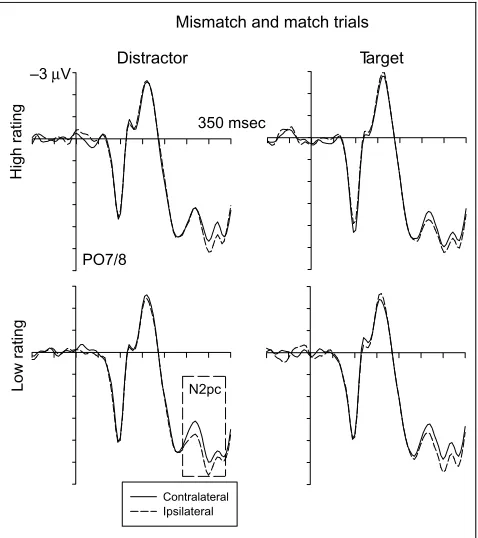
Figure 4 shows ERPs to visual search displays on trials where subsequent ratings were later required for the dis-tractor (left) or the target (right), pooled across match and mismatch trials, as a function of trustworthiness judgment (low, 1 or 2 on rating scale, bottom; high, 4 or 5 on rating scale, top).
Differences in the judged trustworthiness of the dis-tractor were mirrored by systematic N2pc differences, with an earlier N2pc for trials where distractors were later judged as not trustworthy. In stark contrast, sub-sequent target ratings showed no apparent relationship to the N2pc in response to visual search displays.
This was confirmed in an analysis of N2pc peak laten-cies, which were computed by subtracting ERPs at PO7/ PO8 ipsilateral to the target from contralateral ERPs, and then determining the latency of the maximal negative peak between 240 and 340 msec poststimulus for each participant, and separately for trials with high or low target or distractor ratings. Although no difference in N2pc peak latencies was observed between trials with negative versus positive target ratings (299 and 301 msec poststimulus, respectively; F < 1), a significant latency difference was present as a function of distractor ratings, as the N2pc peaked earlier for trials with subsequent negative distractor evaluations relative to trials with posi-tive distractor ratings, 285 vs. 307 msec;F(1,15) = 6.37,
p< .023.
This pattern was further confirmed in repeated mea-sures ANOVAs conducted for ERP mean amplitudes, sep-arately for trials with distractor or target ratings, for the factors rating (high vs. low) and contralaterality. When distractors were rated, a significant Rating Contralat-erality interaction was present for the early N2pc win-dow: 240–290 msec poststimulus;F(1,15) = 5.4,p< .035. Follow-up analyses revealed a highly significant effect of contralaterality on trials with subsequently low-rated
distractors,F(1,15) = 9.3,p< .008, reflecting the pres-ence of a robust early N2pc, which was entirely absent for trials where distractors received high ratings (F< 1). In the 290- to 340-msec time window, a main effect of contralaterality,F(1,15) = 6.5,p< .022, was found with-out any RatingContralaterality interaction (F< 1), as the later part of the N2pc was present regardless of how distractor faces were subsequently rated (Figure 4). For trials including target ratings, main effects of contralat-erality were found for both time windows, F(1,15) = 5.3 and 6.8,p< .036 and .019, respectively, without any indication of RatingContralaterality interactions (both
F< 1), suggesting that the efficiency of attentional tar-get selection, as reflected by the N2pc, had no impact on the subsequent rating of target faces.
DISCUSSION
[image:6.612.54.295.63.218.2]The aim of the present study was to investigate the hypothesis that links between emotion and attention are bidirectional. Although it is well known that the emo-tional salience of stimuli affects attenemo-tional processes (e.g., Fox et al., 2001; Lang et al., 1997), the question of whether attentional selectivity also affects emotional re-sponses has only recently begun to be addressed (e.g., Raymond et al., 2003). If attention modulates emotion,
[image:6.612.312.551.402.671.2]Figure 3. Grand-averaged ERPs elicited by the search display in mismatch (left) and match (right) trials at posterior electrode sites PO7/8 contralateral (solid lines) and ipsilateral (dashed lines) to the target.
the attentional selection of targets among distractors in a visual search task should directly affect the subsequent emotional evaluation of these stimuli. Using the N2pc as an electrophysiological index of the relative distribu-tion of attendistribu-tion across target and distractor faces in a bilateral visual search array, we demonstrated that var-iations in the efficiency of attentional target selection predict subsequent trustworthiness ratings for distractor faces, but were entirely unrelated to the subsequent rating of target faces.
Similarly to Raymond et al. (2005), participants had to judge the trustworthiness of faces they had previously attended or ignored. Distractor faces were rated as less trustworthy relative to target faces, thereby confirming results from previous experiments. The gender-based attentional selection of target versus distractor faces in the visual search task was reflected by an N2pc com-ponent that was present not only on mismatch trials (where the two faces in the visual search array differed in color, and targets thus needed to be identified to select the correct response), but also on match trials (where both faces had the same color, and response selection could have taken place without any attentional selection and identification of target faces), suggesting that attention was directed to the face targets in both types of trials.
Most importantly, when ERPs in response to visual search arrays were sorted as a function of subsequent evaluative judgments, a clear dissociation in the affective consequences of target selection and distractor inhibi-tion was obtained. Differences in the judged trustwor-thiness of previous target faces were not linked to any differences in attentional selectivity across trials, as re-flected by the N2pc triggered during the visual search task. In other words, trial-by-trial variations in the effi-ciency of attentional target processing did not have any effect on subsequent evaluative judgments of tar-get faces. This corresponds perfectly to the finding of Raymond et al. (2003) that affective judgments in re-sponse to previously attended items did not differ from judgments to novel items. In marked contrast, when ERPs were sorted as a function of trustworthiness ratings for distractor faces, a systematic relationship between attentional selectivity and subsequent evaluative judg-ments was revealed. The N2pc emerged earlier on trials where distractor faces were subsequently judged to be untrustworthy relative to trials where trustworthiness ratings were high. In other words, distractor faces were evaluated negatively on trials where attention showed a strong early bias toward target events (implying more effective distractor inhibition), but more positively on trials where the distribution of attention was initially more diffuse, and distractor suppression therefore less pronounced. This pattern of results confirms previous observations by Raymond et al. that the attentional se-lection of targets in visual search tasks is linked to dis-tractor devaluation. Most importantly, it demonstrates
the existence of a systematic covariation between an electrophysiological index of attentional selectivity and subsequent evaluative judgments.
It might be argued that variations in trustworthiness judgments produced at the end of each trial may have been due to systematic differences in the physical char-acteristics of individual faces. Because faces that are low in trustworthiness are known to trigger increased amyg-dala activations (Winston, Strange, O’Doherty, & Dolan, 2002), faces rated as untrustworthy may thus have been generally more emotionally and attentionally salient during the attentional search task. However, the fact that the assignment of individual faces as targets or dis-tractors was performed in a random fashion for each participant ensured that faces seen as distractors by some participants were seen as targets by others, there-by effectively ruling out the possibility of any such sys-tematic item effects. In addition, the fact that the N2pc emerged earlier on trials where distractors were later judged as untrustworthy cannot easily be explained by assuming that these distractors were more salient, as this should have attenuated rather than enhanced any early attentional bias towards the target. Finally, if re-sidual item effects were responsible for the pattern of ERP results found in the present study, this should have equally applied to trials where target faces had to be rated. However, no effect of trustworthiness ratings on the N2pc was found for these trials.
In summary, the present study has provided new elec-trophysiological evidence for the existence of systematic covariations between electrophysiological measures of attentional selectivity and behavioral measures of sub-sequent affective evaluation processes. The efficiency of attentional selectivity in visual search covaries with, and therefore can predict, subsequent emotional responses to distractor stimuli. This pattern of results provides new evidence for the hypothesis that links between attention and emotion are bidirectional, as it suggests that selec-tive attentional processing has immediate consequences for the affective evaluation of visual stimuli.
Acknowledgments
This research was supported by a grant from the Biotechnol-ogy and Biological Sciences Research Council (BBSRC ), UK. M. E. holds a Royal Society-Wolfson Research Merit Award.
Reprint requests should be sent to Monika Kiss, School of Psychology, Birkbeck College, University of London, Malet Street, London WC1E 7HX, United Kingdom, or via e-mail: [email protected].
REFERENCES
Bahcall, D. O., & Kowler, E. (1999). Attentional interference at small spatial separations.Vision Research, 39,71–86. Bush, G., Luu, P., & Posner, M. I. (2000). Cognitive and
emotional inf luences in anterior cingulate cortex.Trends in Cognitive Sciences, 4,215–222.
Cacioppo, J. T., & Gardner, W. L. (1999). Emotion.Annual Review of Psychology, 50,191–214.
Eastwood, J. D., Smilek, D., & Merikle, P. M. (2001). Differential attentional guidance by unattended faces expressing positive and negative emotion.Perception and Psychophysics, 63,1004–1013.
Eimer, M. (1996). The N2pc component as an indicator of attentional selectivity.Electroencephalography and Clinical Neurophysiology, 99,225–234.
Fenske, M. J., Raymond, J. E., Kessler, K., Westoby, N., & Tipper, S. P. (2005). Attentional inhibition has social–emotional consequences for unfamiliar faces. Psychological Science, 16,753–758.
Fenske, M. J., Raymond, J. E., & Kunar, M. A. (2004). The affective consequences of visual attention in preview search.Psychonomic Bulletin and Review, 11,1055–1061. Fox, E., Russo, R., Bowles, R., & Dutton, K. (2001). Do
threatening stimuli draw or hold visual attention in subclinical anxiety?Journal of Experimental Psychology: General, 130,681–700.
Lang, P. J., Bradley, M. M., & Cuthbert, B. N. (1990). Emotion, attention, and the startle ref lex.Psychological Review, 97,377–395.
Lang, P. J., Bradley, M. M., & Cuthbert, B. N. (1997). Motivated attention: Affect, activation, and action. In P. J. Lang, A. F. Simmons, & M. T. Balaban (Eds.),Attention and orienting: Sensory and motivational processes (pp. 97–135). Mahwah, NJ: Erlbaum.
Lang, P. J., Bradley, M. M., Fitzsimmons, J. R., Cuthbert, B. N, Scott, J. D., Moulder, B., et al. (1998). Emotional arousal
and activation of visual cortex: An fMRI analysis. Psychophysiology, 35,199–210.
Luck, S. J., & Hillyard, S. A. (1994). Spatial filtering during visual search: Evidence from human electrophysiology. Journal of Experimental Psychology: Human Perception and Performance, 20,1000–1014.
Raymond, J. E., Fenske, M. J., & Tavassoli, N. T. (2003). Selective attention determines emotional responses to novel visual stimuli.Psychological Science, 14, 537–542.
Raymond, J. E., Fenske, M. J., & Westoby, N. (2005). Emotional devaluation of distracting patterns and faces: A consequence of attentional inhibition during visual search?Journal of Experimental Psychology: Human Perception and Performance, 31,1404–1415. Watson, D. G., & Humphreys, G. W. (1997). Visual marking:
Prioritizing selection for new objects by top-down attentional inhibition of old objects.Psychological Review, 104,90–122.
Winston, J. S., Strange, B. A., O’Doherty, J., & Dolan, R. J. (2002). Automatic and intentional brain responses during evaluation of trustworthiness of faces.Nature Neuroscience, 5,277–283.
Woodman, G. F., & Luck, S. J. (1999). Electrophysiological measurement of rapid shifts of attention during visual search.Nature, 400,867–869.