ORIGINAL RESEARCH ARTICLE
A SCIENTOMETRIC STUDY OF THE JOURNAL OF PHILOSOPHY OF EDUCATION
*1
David Gutiérrez-Rubio,
1Alexander Maz-Machado,
1Carmen León-Mantero
and
2María José Madrid-Martín
1
University of Córdoba, Spain
2Pontifical University of Salamanca, Spain
ARTICLE INFO ABSTRACT
This study introduces a bibliometric analysis of the Journal of Philosophy of Education, a journal of the field Education and Educational Research which has had presence in the Journal Citations Index (JCR) during the last 20 years. Collaborations between authors, countries and its gender distribution have been analyzed. Low values of Collaborative Index and Degree of Collaboration have been found, compared to other Social Science journals. Geographical collaboration is analyzed, where the network of countries pivots around United Kingdom. An increase of female authorship in the journal is noticed over the years, as well as higher levels of collaboration when at least one of the authors is a woman.
Copyright © 2019,David Gutiérrez-Rubio et al. This is an open access article distributed under the Creative Commons Attribution License, which permits
unrestricted use, distribution, and reproduction in any medium, provided the original work is properly cited.
INTRODUCTION
As stated by Price (1978), scientific research does not constitute a closed system of expert manpower, but a process which is strongly associated with the preparation of more people to perform such investigations, even though they may not necessarily stay in the research institution afterwards. This activity, which include multiple agents within the building of science, is therefore reflected in the papers that disseminate the results of research. Documents published in scientific journals offer researchers a series of data and information that transcend the proper knowledge that is being transferred about a certain field. Using bibliometric indicators obtained from scientific publications it is possible to identify aspects related to the sociology of science. Furthermore, collaboration patterns or gender patterns can be established through scientometric analysis. Bibliometrics is defined as “the study of the quantitative aspects of the production, dissemination, and use of recorded information. It develops mathematical models and measures for these processes and then uses the models and measures for prediction and decision making” (Tague-Sutcliffe, 1992). Bibliometric indicators are studied and analyzed, for each journal, from different points of views.
*Corresponding author: David Gutiérrez-Rubio
University of Córdoba, Spain
Some of these are already reported by the Journal Citations Index (JCR) or Scimago Journal Rank (SJR). Other bibliometric indicators are obtained when they are analyzed according to other variables. Those have been reported in different studies for groups of journals (Smith and Hazelton, 2008) or for individual journals (Maz-Machado, Madrid, and
León-Mantero, 2015). Numerous studies argue how
collaborations are generated within science. Some of the factors that are often quoted are the visibility of an author or research group (Whitley, 2000), enhancing the quality of the research (Adams, Black, Clemmons, and Stephan, 2005), or learning new methodological techniques (Maz-Machado and Jiménez-Fanjul, 2018), as well as having access to systems, materials and resources that would otherwise be inaccessible, working with colleagues who share similar interests, ideas, theoretical approaches or problems, etc. Recently, studies that seek to establish collaborative relationships between men and women in the dissemination of scientific knowledge are gaining momentum. All these collaborations generate a series of social structures that we denominate networks. These networks have been studied from the 60’s onwards, when Price (1965) analyzed the citation patterns between authors and addressed the network’s issue in an article published in Science. Some studies establish a positive correlation between the number of authors of a publication and its impact – see, e.
ISSN: 2230-9926
International Journal of Development Research
Vol. 09, Issue, 03, pp.26754-26758, March, 2019
Article History:
Received 29th December, 2018
Received in revised form 08th January, 2019
Accepted 20th February, 2019
Published online 31st March, 2019
Available online at http://www.journalijdr.com
Key Words:
Bibliometrics, Scientometrics, Collaboration, Gender, Journals.
Citation: David Gutiérrez-Rubio, Alexander Maz-Machado, Carmen León-Mantero and María José Madrid-Martín. 2019. “A scientometric study of
the journal of philosophy of education”, International Journal of Development Research, 09, (03), 26754-26758.
g., Lawani (1986). Journals within the field of Education are often analyzed in order to determine publication patterns of a certain country (Madrid, Jiménez-Fanjul, León-Mantero, and Maz-Machado, 2017), or of a certain research field (Earp, 2010; Jamai, Md Zain, Samsudin and Ale Ebrahim, 2015). In Maz-Machado et al. (2015) diverse international investigations within the field of Education, are reviewed with scientometric approach. The largest international study analyzing journals within the Education field was carried out by Fairbairn et al. (2009), who studied 1042 journals from 15 international databases and 26 disciplines in the field of Education. Due to the interest and relevance of the studies addressing Education journals, we consider that it is important to identify publication patterns across significant journals of this field. Thus, we present a scientometric study of the Journal of Philosophy of Education, a journal which has had presence in the JCR during the last 20 years in the categories Education and Educational Research and History of Social Sciences.
Objectives
The aim of this study is to analyse production patterns from the Journal of Philosopy of Education. Therefore, we will focus on the following objectives:
To study authorship patterns of the published literature.
To identify the degree of collaboration among the
authors and countries.
To identify the authors and the countries which have
the largest production of the Journal.
To identify gender patterns within the authorship of the
papers.
MATERIALS AND METHODS
On the 16thof January, 2019 the database Web of Science
(Analytics, 2018) was consulted. All the records were searched using the parameters: “Publication Name” [Journal of Philosopy of Education] and “Year Published” [1999–2018]. Thus, the 20 last years of this journal were analysed. This search yielded 926 documents. All citable documents (articles, reviews) were filtered, so a total of 736 documents (683 articles and 53 reviews) were obtained. Henceforth, we will refer to them as documents, broadly speaking. All the information was uploaded to an ad hoc Microsoft® Access® 2016 relational database for the treatment and normalisation of data. Afterwards, author gender, affiliation and country of origin was identified and standardized. In cases where there was an incomplete register (for example, involving gender information), other sources were consulted so as to obtain such data. For that purpose, a search was conducted on the web pages of the institutions involved. Different indexes have been defined in order to determine the degree of collaboration in a series of articles – one of them, the Collaborative Index (CI) (Lawani, 1980), is defined as
=∑
Where is the number of articles with exactly authors, and
is the total number of articles.
This index matches the average number of authors per article and it takes values between 1 and infinite. Values next to 1
indicate a low degree of collaboration within the series of publications. Another measure which is commonly used is the Degree of Collaboration (DC) (Subramanyam, 1983), defined as
= 1 −
I. e., the relative frequency of the total number of articles with 2 or more authors. This index takes values between 1 and 0. Low values indicate a low degree of collaboration. As a general criterion, we opted for the complete counting system, as suggested by Cronin and Overfelt (1994), attributing full authorship to each co-author, considering them equally. The same procedure was applied in the case of countries.
RESULTS AND DISCUSSION
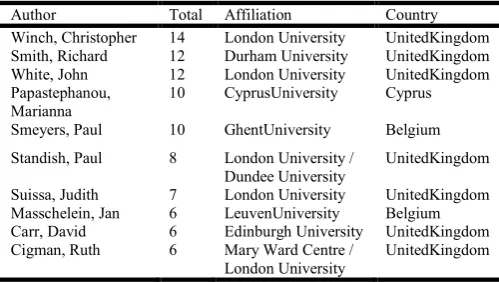
[image:2.595.308.558.632.773.2]Between the years 1999 and 2019, this journal published 736 citable documents –an average of 36,8 documents per year. This production has varied from 19 documents published in 2010 to 56 documents published in 2009. The largest number of documents, 155, were published during the 2007-2009 triennium (Figure 1). The abovementioned documents were published by 568 different authors – that mean an average of 1, 29 articles per author. The most productive authors are shown in Table I, as well as their affiliation and country of origin. It can be seen that most of the authors belong to the London University. There are also five large producers (as stated by Bradford, 1948), with 10 or more productions. The documents accounted for were signed by authors from more than 36 different countries. As shown in Table II, United Kingdom, home country of this journal, accumulates 43,3% of the total number of authors. This, added to the 17,4% of authors from the USA, results in a 60% of the total number of papers published. The fact that it is only possible to find 4 Spanish-speaking countries (Spain, Mexico, Colombia and Venezuela) stands out – especially because, altogether, we find 10 articles published by authors coming from those countries, that is, only 1,1% of the total production. If we analyze the distribution of the number of articles published by each country by using the Gini index, which measures inequality within the statistical dispersion of a certain magnitude between diverse receptors (see, e. g., Ceriani and Verne, 2012), a value of 0.776 is obtained, which indicates a substantial inequality in the distribution of scientific production of the involved countries. Even if we omit United Kingdom from the calculation this index, it becomes 0.672, which is considered to behigh, still.
Table 1. 10 most prolific authors
Author Total Affiliation Country Winch, Christopher 14 London University UnitedKingdom Smith, Richard 12 Durham University UnitedKingdom White, John 12 London University UnitedKingdom Papastephanou,
Marianna
10 CyprusUniversity Cyprus
Smeyers, Paul 10 GhentUniversity Belgium
Standish, Paul 8 London University / Dundee University
UnitedKingdom
Suissa, Judith 7 London University UnitedKingdom Masschelein, Jan 6 LeuvenUniversity Belgium Carr, David 6 Edinburgh University UnitedKingdom Cigman, Ruth 6 Mary Ward Centre /
London University
UnitedKingdom
Figure 1. Production per year and JCR rank (quartiles in Education and Educational Research)
Figure 2. United Kingdom, USA and Belgium year
Figure 3. Articles per year – national and international collaboration
Table 2. Countries with 10 or more publications
Country Numberofarticles Percentageover total United Kingdom 371
USA 149
Belgium 51
Canada 48
Australia 27
Netherlands 27
Israel 23
Germany 19
Norway 15
South Africa 14
26756 International Journal of Development Research,
Production per year and JCR rank (quartiles in Educational Research)
United Kingdom, USA and Belgium production per
and international
Countries with 10 or more publications
Percentageover total 43,3% 17,4% 5,9% 5,6% 3,1% 3,1% 2,6% 2,2% 1,7% 1,6%
When examining the production of the three countries with a larger number of articles published over the last 20 years, a high proportion of those is noticed in the case of United Kingdom, particularly during the first
With reference to the collaboration between authors, it must be highlighted that overall values of the Collaborative Index (CI) and the Degree of Collaboration (DC) per years, point out values of CI=1.15 and DC=0.127. These values indicate that the collaboration between authors in the
of Education is minimal. If a year
index is made, as shown in Table III, it is noticed that collaboration tendencies remain stable with minimum values, except for occasional peaks, as seen in 2008 or 2012. Also, peaks seen in the years 2001, 2008, 2012 or 2017 do correspond to the increase of production from United Kingdom, as the previous figure shows. When focusing on the type of collaboration for the period between 1999 and 2 and based on a “national” (within institutions of the same country) or “international” classification, it can be seen that there is a slight increase in international collaboration as of the year 2010 (Figure 3). National collaboration is more frequen than international collaboration except in the case of the years 2011 and 2017. During the 20 years which have been analyzed, 36 different countries published articles and 18 of them carried out international collaborations. Values in parentheses have been calculated with regard to the total production of each country. The country which has achieved a bigger collaboration rate is South Africa (60%), followed by Belgium (38,78%) and the Netherlands (36%). If we distinguish the type of collaboration, countr
[image:3.595.43.282.437.630.2]international collaboration are South Africa (40%), Australia (25%) and Sweden (16,67%). National collaborations are led by the Netherlands (24%), Belgium (22,45%) and South Africa (20%) (Table IV).
Figure 4. Collaboration nodes betwe
Also, in case of countries like Cyprus, it may be observed that none of the 13 articles published has an international collaboration (in fact, none of them are co
same applies to Israel or Japan, with only one article of this kind, compared to a total of articles of 18 or 12, respectively, or Canada, with only 3 international articles compared to a total of articles of 42. Each author’s affiliation to a certain country generate two collaboration networks in the production
of the Journal of Philosophy of Education
composed by 16 countries – in this network, it can be seen that the United Kingdom is linked to 8 countries, consequently becoming a connecting link between countries. USA collaborates with 6 countries (Figure 4).
International Journal of Development Research, Vol. 09, Issue, 03, pp.26754-26758, March
When examining the production of the three countries with a larger number of articles published over the last 20 years, a high proportion of those is noticed in the case of United Kingdom, particularly during the first years studied (Figure 2). With reference to the collaboration between authors, it must be highlighted that overall values of the Collaborative Index (CI) and the Degree of Collaboration (DC) per years, point out values of CI=1.15 and DC=0.127. These values indicate that ration between authors in the Journal of Philosophy is minimal. If a year-by-year comparison of these index is made, as shown in Table III, it is noticed that collaboration tendencies remain stable with minimum values, aks, as seen in 2008 or 2012. Also, peaks seen in the years 2001, 2008, 2012 or 2017 do correspond to the increase of production from United Kingdom, as the previous figure shows. When focusing on the for the period between 1999 and 2019, and based on a “national” (within institutions of the same country) or “international” classification, it can be seen that there is a slight increase in international collaboration as of the year 2010 (Figure 3). National collaboration is more frequent than international collaboration except in the case of the years During the 20 years which have been analyzed, 36 different countries published articles and 18 of them carried out international collaborations. Values in en calculated with regard to the total The country which has achieved a bigger collaboration rate is South Africa (60%), followed by the Netherlands (36%). If we distinguish the type of collaboration, countries with a higher international collaboration are South Africa (40%), Australia (25%) and Sweden (16,67%). National collaborations are led by the Netherlands (24%), Belgium (22,45%) and South Africa
Collaboration nodes between countries
[image:3.595.309.558.457.619.2]Also, in case of countries like Cyprus, it may be observed that none of the 13 articles published has an international collaboration (in fact, none of them are co-authored). The same applies to Israel or Japan, with only one article of this kind, compared to a total of articles of 18 or 12, respectively, or Canada, with only 3 international articles compared to a Each author’s affiliation to a certain country generate two collaboration networks in the production Journal of Philosophy of Education. The first one is in this network, it can be seen that the United Kingdom is linked to 8 countries, consequently becoming a connecting link between countries. USA
(Figure 4).
[image:3.595.51.272.690.796.2]The second network is formed by Finland and Norway. Only the countries with international collaborations are shown in this graphic. The size of each node is proportional to the number of articles published by each country in collaboration to other countries. If we compare the production figures by country shown in Table IV, it is noticed that the countries with a higher production have published co-authored papers with the country of origin of the journal, United Kingdom. Regarding gender production, it is further observed that 846 signatures were generated – out of those, 591 correspond to male authors (69,8%) and 255 correspond to female authors (30,2%). If we just consider articles where at least one of the authors is female, values for DC and IC are DC=0.234 and IC=1.3, while if we just consider articles where none of the authors are female, values for DC and IC are DC
[image:4.595.158.441.53.219.2]IC=1.086. That is, there seems to be a greater tendency to collaborate when there are female authors involved in the paper.
Figure
[image:4.595.66.532.266.328.2]1999 2000 2001 2002 CI 1,05 1,14 1,20 1,06 DC 0,05 0,09 0,18 0,06 2010 2011 2012 2013 CI 1,16 1,16 1,33 1,06 DC 0,16 0,16 0,25 0,06
Table 4. Production of each country, considering the type
Countries Without collaboration United Kingdom 279
USA 123
Belgium 30
Canada 37
Netherlands 16
Australia 17
Germany 15
Israel 16
South Africa 6
Cyprus 13
Norway 11
Japan 11
Sweden 10
Finland 8
Table 5. Geographical collaboration considering the type of gender collaboration
GenderCollaboration
26757 David Gutiérrez-Rubio
The second network is formed by Finland and Norway. Only the countries with international collaborations are shown in this graphic. The size of each node is proportional to the number of articles published by each country in collaboration If we compare the production figures by country shown in Table IV, it is noticed that the countries with authored papers with the country of origin of the journal, United Kingdom. Regarding gender production, it is further observed that 846 out of those, 591 correspond to rrespond to female authors If we just consider articles where at least one of the authors is female, values for DC and IC are DC=0.234 and IC=1.3, while if we just consider articles where none of the authors are female, values for DC and IC are DC=0.079 and IC=1.086. That is, there seems to be a greater tendency to collaborate when there are female authors involved in the
These differences are statistically relevant, as both the Median and the Mann-Whitney tests give significant p (p=0.000) when comparing the number of authors between articles with and without female authors.
evolution, over the years, of the proportion of female authors. It is noticeable that there is a growing tendency, even though some years show a decrease.
obtained in the analysis of the relationship between the type of gender collaboration (male only, female only, and mixed) and the geographical collaboration (national or
chi-squared test does not give a statistically significant p for testing the independence of both variables, so we cannot claim that there is statistically significant evidence of the relationship among the type of collaboration b
and that of the geographical area. However, from a descriptive point of view, there is greater proportion of international collaboration in papers with female authors, mixed or not.
[image:4.595.77.524.358.502.2]Figure 5. Proportion of female signatures by year
Table 3. Collaboration indexes per year
2002 2003 2004 2005 2006 2007
1,03 1,16 1,19 1,11 1,06
0,03 0,13 0,12 0,11 0,06
2013 2014 2015 2016 2017 2018
1,06 1,15 1,22 1,17 1,23 1,15
0,06 0,12 0,17 0,13 0,18 0,15
Production of each country, considering the type of collaboration
Without collaboration With national collaboration With international collaboration
26 16
11 6
11 8
2 3
6 3
1 6
1 2
1 1
3 6
0 0
1 1
0 1
0 2
0 1
Geographical collaboration considering the type of gender collaboration
Geographical Collaboration National International
GenderCollaboration Maleonly 30 10
Femaleonly 9 7
Mixed 25 13
Rubio et al. A scientometric study of the journal of philosophy of education
These differences are statistically relevant, as both the Median Whitney tests give significant p-values (p=0.000) when comparing the number of authors between articles with and without female authors. Figure 2 shows the evolution, over the years, of the proportion of female authors. a growing tendency, even though some years show a decrease. Table V shows the results obtained in the analysis of the relationship between the type of (male only, female only, and mixed) and the geographical collaboration (national or international). The squared test does not give a statistically significant p-value for testing the independence of both variables, so we cannot claim that there is statistically significant evidence of the relationship among the type of collaboration between genders and that of the geographical area. However, from a descriptive point of view, there is greater proportion of international
female authors, mixed or not.
2008 2009
1,29 1,09 0,25 0,07 General
1,153 0,127
of collaboration
international collaboration Total 321 140 49 42 25 24 18 18 15 13 13 12 12 9
Geographical collaboration considering the type of gender collaboration
Collaboration
[image:4.595.150.447.537.589.2]Conclusion
The present study provides information on the current state of
the scientific production generated by the Journal of
Philosophy of Education. It was noted that most of the papers submitted to this journal have, mainly, national character, as they are submitted by authors from United Kingdom, place of publication of this journal. Collaboration between authors, either national or international collaborations, is very low – only 16%. This contrasts to the international tendency that shows an increase in collaboration of Social Science journals (Aguado-López et al., 2017). Female production has increased gradually over the years until the number of female signatures reached the same number of male ones. Certain gender differences were observed in collaborations. For example, the presence of female signatures is associated to a greater number of authors per article, but no statistically significant evidences were found to suggest a correlation with geographical collaboration. Future research lines will address the analysis of other journals of this field, and should allow comparisons in order to detect patterns across a range of scientific journals.
REFERENCES
Adams, J. D., Black, G. C., Clemmons, J. R., and Stephan, P. E. 2005. Scientific teams and institutional collaborations:
Evidence from US universities, 1981–1999. Research
policy, 34(3), 259-285.
Aguado-López, Eduardo, Becerril-García, Arianna, and Godínez-Larios, Sheila. 2017. Colaboración internacional en las ciencias sociales y humanidades: inclusión, participación e integración. Convergencia, 24(75), 13-44. Ajiferuke, I., Burell, Q., and Tague, J. 1988. Collaborative
coefficient: A single measure of the degree of collaboration
in research. Scientometrics, 14(5-6), 421-433.
https://doi.org/10.1007/BF02017100
Analytics, C. 2018. Journal Citation Reports® Social Sciences Edition.
Bavelas, A. 1950. Communication Patterns in Task‐Oriented
Groups. The Journal of the Acoustical Society of America, 22(6), 725-730. https://doi.org/10.1121/1.1906679
Bradford, S. C. 1948. Documentation. London: Crosby
Lockwood.
Ceriani, L., and Verme, P. 2012. The origins of the Gini index: extracts from Variabilità e Mutabilità (1912) by Corrado Gini. The Journal of Economic Inequality, 10(3), 421-443.
Cronin, B., and Overfelt, K. 1994. Citation‐based auditing of
academic performance. Journal of the American Society for Information Science, 45(2), 61-72.
Earp, V. J. 2010. A bibliometric snapshot of the journal of
higher education and its impact on the field. Behavioral
and Social Sciences Librarian, 29(4), 283-295.
Fairbairn, H., Holbrook, A., Bourke, S., Preston, G., Cantwell,
R., and Scevak, J. 2009. A profile of education journals.
Paper presented at the AARE 2008 International Educational Research Conference.
Jamai, S., Md Zain, A., Samsudin, M., and Ale Ebrahim, E. 2015. Publication Trends in Physics Education: A Bibliometric study. Joournal of Educational Research, 35, 19-36. doi: https://doi.org/10.5281/zenodo.801889
Lawani, S. M. 1980. Quality, Collaboration and Citations in
Cancer Research, Florida State University (PhD Thesis). Ph. D. Theses.
Lawani, S. M. 1986. Some bibliometric correlates of quality in
scientific research. Scientometrics, 9(1), 13-25.
https://doi.org/10.1007/BF02016604
Madrid, M. J., Jiménez-Fanjul, N., León-Mantero, C., and Maz-Machado, A. 2017. Revistas brasileñas de Educación
en SCOPUS: un análisis bibliométrico. Biblios(67), 30-41
%@ 1562-4730.
Maz-Machado, A., and Jiménez-Fanjul, N. 2018.
Collaboration and Citation Analysis Within Social Sciences: A Comparative Analysis Between Two Fields Scientometrics (pp. 65-82): IntechOpen.
Maz-Machado, A., Jiménez-Fanjul, N., and Madrid, M. J. 2015. Collaboration in the Iberoamerican Journals in the category Information Science and Library Science in WOS. Library Philosophy and Practice (e-Journal), 1270. Maz-Machado, A., Madrid, M. J., and León-Mantero, C. 2015.
Research on the productivity of the journal Review of
Educational Research: A scientometric study. Journal of
Advances in Library and Information Science, IV(4), 288-293.
Price, D. d. S. 1965. Networks of scientific papers. Science,
510-515.
Price, D. d. S. 1978. Toward a model for science indicators. Toward a metric of science: The advent of science indicators, 69-95.
Smith, D. R., and Hazelton, M. 2008. Bibliometrics, citation
indexing, and the journals of nursing. Nursing and health
sciences, 10(4), 260-265.
Subramanyam, K. 1983. Bibliometric studies of research
collaboration: A review. Journal of Information Science,
6(1), 33-38. https://doi.org/10.1177/016555158300600105 Tague-Sutcliffe, J. 1992. An introduction to informetrics.
Information processing and management, 28(1), 1-3.
Whitley, R. 2000. The intellectual and social organization of
the sciences: Oxford University Press on Demand