Full Length Research Article
SMART METERING IN POWER DISTRIBUTION SYSTEM
*Souvik Kumar Dolui and Dr. Soumitra Kumar Mandal
Department of Electrical Engineering, NITTTR, Kolkata Salt Lake City, India
ARTICLE INFO ABSTRACT
This paper related to an energy management system with integration of smart meters for electricity consumers in a smart grid. The proposed system not only helps to reduce the power demand and cost savings but also can significantly improve power system reliability and efficiency. By implementing smart metering techniques into the distribution network, consumers can monitor their energy costs and usage which could help to reduce global energy demands. This system describes the implementation of consumer remote load control which allows consumers to control their own household appliances when not at home. The utility companies can also use the smart meters to reduce the energy demand on the network by remotely switching consumer loads.
Copyright©2016, Souvik Kumar Dolui and Dr. Soumitra Kumar Mandal. This is an open access article distributed under the Creative Commons Attribution License, which permits unrestricted use, distribution, and reproduction in any medium, provided the original work is properly cited.
INTRODUCTION
Nowadays, wireless sensor nodes have played significant roles in the monitoring and control system for various industrial applications to achieve automation, self-awareness and real-time control with great flexibility. The smart grid presents flexible and reliable energy distribution between the supplier control centre and the smart meters on the user-side. In addition to the main power supplier, additional energy generation sources (that may also comprise green energy) are included in smart grid, such as batteries, backup devices, plug-in hybrid electric vehicles (PHEVs), solar cells, and so forth. This aspect of the smart grid is expected to contribute to a quite complicated real-time consumer power demand management. A smart grid would help the utilities get information about the electricity use by the consumers and can potentially adapt its distribution process with respect to the time and quantum of power demand. The smart grid, which uses smart meters could potentially be used for detecting power theft. In addition, the information that the consumers would have access through the smart meters would possibly help them manage their energy use in a better and more efficient way.
*Corresponding author: Souvik Kumar Dolui
Department of Electrical Engineering, NITTTR, Kolkata Salt Lake City, India
Such hyper growth will need unprecedented amount of energy that can only be met through efficient energy utilization through smart metering and smart grid technology. The substations, transformers, and energy meters which are important part of the energy infrastructure and real-time monitoring. Smart metering technology includes automated meter reading (AMR) systems, automated meter management (AMM) and advanced metering infrastructure (AMI). AMR systems were established in the 1960s due to advancements in metering technologies and communication systems. They consist of a one-way communication, from meter to supplier (Ward and Owen, 2006). This communication link allows for information and readings on the customers daily usage, “total usage and real time usage data” and this is then relayed back to the utility (Oterino, 2007). The implementation and installation of the AMR technology provided great advantages to both customer and supplier, these advantages include; improvement of meter reading accuracy, reduction of data collection costs, the ability for frequent measuring and reporting of readings (Derbel, 2009). AMM involves two way communication between customer and the network. “Two way communication allows for commands to be uploaded to the meters and data downloaded from the meters” (Jamasb, 2009). the systems allow for remote disconnection or connection of components and the ability to remotely alter the pricing schemes when required. AMI systems refer to the “entire
ISSN: 2230-9926
International Journal of Development Research
Vol. 06, Issue, 08, pp.8851-8855, August, 2016
International Journal of
DEVELOPMENT RESEARCH
Article History:
Received 27th May, 2016
Received in revised form 19th June, 2016
Accepted 12th July, 2016
Published online 24th August, 2016
Available online at http://www.journalijdr.com
Key Words:
infrastructure of meters, communication networks and data management systems required for advanced information to be measured, collected and subsequently used” (Jamasb, 2009) The system which also uses two-way communication, contains four major components; a network of smart meters, the in home display, collection point (collector) and the central office (Highfill, 2008). The AMI system measures, collects and analyses energy usage, and communicates either on request or on a schedule where the communication is either wired or wireless (Ahmad, 2011).
Some of the advantages of smart metering devices include
Ability to monitor day to day energy usage
Outage detection, that allows for early fault awareness
by the utility company
Functions that allow automatic shutdown of loads, or
restrictions on the usage of certain loads during peak hours when tariffs are high
Reduced monthly energy bills due to awareness of
consumption
More accurate and timely billing, due to real time
energy monitoring
Reduced cost due to real time energy monitoring
Reduced employee safety incidents due to automatic
reading, which removes the need for utility employees to go to consumer premises to read meters.
Improved customer safety and risk on premises as there
is no need for meter reading personnel to gain access to consumer premises in order to read their electricity meter
Improved environmental benefits, due to the reduced
need for new power plants as consumer energy demands are reduced
Reduced travel for meter reading staff and improved
energy control results in a smaller carbon footprint
Features of a smart meter
The following features are common attributes of a smart meter
Communications
Smart meter communications take place in the home area network (HAN), whereby data is communicated between smart meter and the smart appliances and in WAN, between the smart meter and the utility company, the communication is bi-directional, meaning that the control centre can send information to the loads and receive information from the loads. The communications can be either wired or wireless. The HAN is a residential local area network that connects one or more devices in homes or factories to the smart meter, For example an in-home-display (IHD), which is a smart meter combined with a monitor displaying the energy usage and various other useful information for the consumer, this system uses either wired or wireless communications that allows for sending and receiving of information between device and meter (Ahmad, 2011). The WAN connects networks over a large area such as a country or province. The WAN system often connects multiple smaller LAN networks together, for AMI systems WAN connects the meter data management systems (MDMS) to the central office through the use of
wireless communication technologies, WAN systems require quick and efficient data transfer (Ahmad, 2011).
Real Time Energy Consumption Readings
The smart meter has the ability to measure and communicate energy consumption readings to the utility. The readings usually occur every 10, 15 or 30 minutes, that allows for a real time and more accurate reading (Lai, 2009).
Cumulative Monthly Energy Cost
As the smart meter provides a more accurate energy consumption reading compared to meters in the past and due to the communication advancements, the smart meter has the added ability to display a cumulative monthly cost for consumers to monitor. This cost takes into account off peak and peak periods with the different tariffs associated with each period. The ability to monitor consumption costs provides awareness to consumers, allowing for possible decrease in energy usage.
Remote Control
Due to the two-way communications between supplier and consumer, the smart meter adds the benefit of controlling separate loads. The loads that have the highest energy consumption and are usually controlled include: the geyser, heaters, washing machine, pool pump, the stove and the oven. Through the use of remote control the supplier or control centre has the ability to switch on/off these loads when the demand is high or when the control centre or utility company requires a reduction in the energy demands.
Outage Detection
In order to improve the reliability in a network, energy suppliers and distributors need a quicker way of detecting faults. Outage Detection is used to reduce the amount of time taken to notify the utility company about the loss of power in a certain area (Lai, 2009).
Advanced Metering infrastructure (AMI)
This infrastructure includes home network systems, including communicating thermostats and other in-home controls, smart meters, communication networks from the meters to local data
concentrators, back-haul communications networks to
data in ways that enable more intelligent energy consumption decisions, even providing interactive services like prepayment. The service provider (utility) employs existing, enhanced or new back office systems that collect and analyze AMI data to help optimize operations, economics and consumer service.
For example, AMI provides immediate feedback on consumer outages and power quality, enabling the service provider to rapidly address grid deficiencies. AMI’s bidirectional communications infrastructure also supports grid automation at the station and circuit level. The vast amount of new data flowing from AMI allows improved management of utility assets as well as better planning of asset maintenance, additions and replacements. The resulting more efficient and reliable grid is one of AMI’s many benefits. An AMI system is comprised of a number of technologies and applications that have been integrated to perform as one:
Smart meters
Wide-area communications infrastructure
Home (local) area networks (HANs/LANs)
Meter Data Management Systems (MDMS)
Operational Gateways
Smart Meters
Conventional electromechanical meters served as the utility cash register for most of its history. At the residential level, these meters simply recorded the total energy consumed over a period of time – typically a month. Smart meters are solid state programmable devices that perform many more functions, including most or all of the following:
Remote turn on / turn off operations
Power quality monitoring
Communications with other intelligent devices in the
home
Consumption data for consumer and utility
Wide-area communications infrastructure
The AMI communications infrastructure supports continuous interaction between the utility, the consumer and the controllable electrical load. It must employ open bi-directional
communication standards, yet be highly secure. It has the potential to also serve as the foundation for a multitude of modern grid functions beyond AMI. Various architectures can be employed, with one of the most common being local concentrators that collect data from groups of meters and transmit that data to a central server via a backhaul channel. Various media can be considered to provide part or all of this architecture:
Power line carrier (PLC)
Broadband over power lines (BPL)
Wireless (radio frequency) either centralized or a
distributed mesh
Copper or optical fiber
Home/Local Area Networks (HAN/LAN)
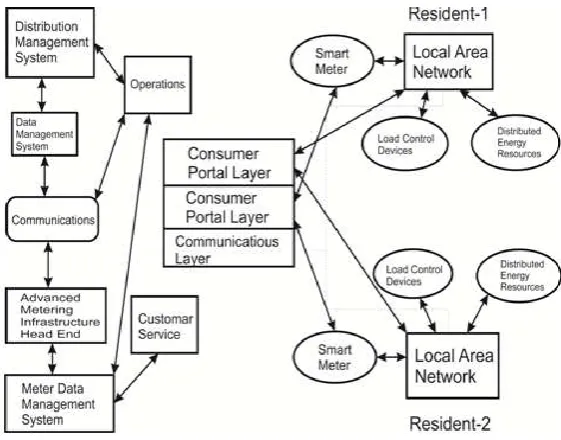
A HAN interfaces with a consumer portal to link smart meters to controllable electrical devices. Its energy management functions may include:
Consumer always knows about what energy is used and
what it is the cost
Responsiveness to price signals based on
consumer-entered preferences
Set points that limit utility or local control actions to a
consumer specified band
Control of loads without continuing consumer
involvement
Consumer over-ride capability
[image:3.595.156.437.122.342.2]The HAN consumer portal provides a smart interface to the market by acting as the consumer’s “agent.” It can also support new value added services such as security monitoring.
Figure 1. Advanced Metering Infrastructure Interface
A HAN may be implemented in a number of ways, with the consumer portal located in any of several possible devices including the meter itself, the neighbourhood collector, a stand-alone utility-supplied gateway or even within customer-supplied equipment.
Meter Data Management Systems (MDMS)
A MDMS is a database with analytical tools that enable interaction with other information systems such as the following:
Consumer information system (CIS), billing systems,
and the utility web site
Outage management system (OMS)
Enterprise resource planning (ERP) power quality
management and load forecasting systems
Mobile workforce management (MWM)
Geographic information system (GIS)
Transformer load management (TLM)
One of the primary functions of an MDMS is to perform validation, editing and estimation (VEE) on the AMI data to ensure that despite disruptions in the communications network or at customer premises, the data flowing to the systems described above is complete and accurate.
Operational Gateways
AMI interfaces with many system-side applications to support:
Advanced Distribution Operations (ADO)
Distribution management system with advanced sensors
(including PQ data from AMI meters)
Advanced outage management (real-time outage
information from AMI meters)
DER operations (using Watt and VAR data from AMI
meters)
Distribution automation (including Volt/VAR optimization
and fault location, isolation, sectionalisation and
restoration (FLISR))
Distribution geographic information system
Application of AMI communications infrastructure for:
Micro-grid operations (AC and DC)
Hi-speed information processing
Advanced protection and control
Advanced grid components for distribution
Advanced Transmission Operations (ATO)
Substation automation
Hi-speed information processing
Advanced protection and control (including distribution
control to improve transmission conditions)
Modelling, simulation and visualization tools
Advanced regional operational applications
Electricity markets
The Benefits of Ami
AMI provides benefits to consumers, utilities and society as a whole.
Consumer Benefits
For the consumer, this means more choices about price and service, less intrusion and more information with which to manage consumption, cost and other decisions. It also means higher reliability, better power quality, and more prompt, more accurate billing . In addition, AMI will help keep down utility costs, and therefore electricity prices. As members of society, consumers also reap all the benefits that accrue to society in general, as described below.
Utility Benefits
AMI helps the utility avoid estimated readings, provide accurate and timely bills, operate more efficiently and reliably, and offer significantly better consumer service. AMI eliminates the vehicle, training, health insurance, and other overhead expenses of manual meter reading, while the shorter read-to-pay time advances the utility’s cash flow, creating a one-time benefit. And consumer concerns about meter readers on their premises are eliminated. Operationally, with AMI the utility knows immediately when and where an outage occurs so it can dispatch repair crews in a more timely and efficient way. Meter-level outage and restoration information accelerates the outage restoration process, which includes notifying consumers about when power is likely to return.
This huge increase in valuable information helps the utility:
Assess equipment health
Maximize asset utilization and life
Optimize maintenance, capital and O&M spending
Pinpoint grid problems
Improve grid planning
Locate/ identify power quality issues
Detect/reduce energy theft
Societal Benefits
Society, in general, benefits from AMI in many ways. One way is through improved efficiency in energy delivery and use, producing a favourable environmental impact. It can accelerate the use of distributed generation, which can in turn encourage the use of green energy sources. It is likely that emissions trading will be enabled by AMI’s detailed measurement and recording capabilities. The modern AMI meters maintain their accuracy over time, resulting in a more equitable situation for all consumers. In addition, modern meters are self-monitoring, making it easier to identify
inaccurate measurements, incorrect installations and,
especially, electric energy theft. The price and demand reductions during high-demand periods.
Reduced the transmission and distribution cost,
electrical loss and generation cost.
Improved the Electric System Efficiency (lower
operating cost) and Electric System Reliability(Lower Maintenance Costs)
Conclusion
grid context. With the social and economic development and increasingly highlighted problems of energy shortages, the demands for network reliability is increased significantly. The need of quality service as well as the requirements of power efficiency has to be improved. Smart Grid has an important direction of development of a global power industry. Considering the actual development of our country, one of our focuses on the development of smart grid should be its "self-healing" feature to protect the power grid as a strong grid. This paper presents the review of smart grid and functional characteristics of smart grid technology, summed up the research situation at India and abroad.
REFERENCES
Ahmad, S. 2011. "Smart metering and home automation solutions for the next decade," in Emerging Trends in Networks and Computer Communications, pp. 200-204. Chen, L., Li, N., Low, S. and Doyle, J. 2010. “Two market
models for demand response in power networks,” in Smart
Grid Communications, First IEEE International
Conference on, oct. 2010, page 397-402.
Das, S. et al., 2002. “The role of prediction algorithms in the MavHome smart home architecture,” IEEE Trans. Wireless Commun., vol. 9, no. 6, page 77–84.
Derbel, F. 2009. "Trends in smart metering," Systems, Signals and Devices, pp. 1-4, March.
Fadlullah, Z. M., Fouda, M. M., Shen, X., Nozaki, Y. and Kato, N. 2011. “An Early Warning System against Malicious Activities for Smart Grid Communications,” IEEE Network Magazine, vol. 25, no. 5, page 50-55. Fouda, M. M., Fadlullah, Z. M., Kato, N., Lu, R. and Shen, X.
2011. “A Lightweight Message Authentication Scheme for Smart Grid Communications,” IEEE Transactions on Smart Grid, vol. 2, no. 4, page 675-685.
He, M., Zhang, J. 2011. “A dependency graph approach for fault detection and localization towards secure smart grid,” IEEE Trans. Smart Grid, vol. 2, no. 2, page 342–351.
Highfill, D., Bennett, C. 2008. "Networking AMI Smart Meters," in Energy 2030 Conference, New York, pp. 1-8. Jamasb, T., Pollitt, M. G. and Brophy Haney, A. 2009. "Smart
Metering and Electricty Demand: Technology, Economics and International Experience," University of Cambridge, Cambridge.
Katiraei, F., Iravani, M.R. 2006. “Power Management Strategies for a Microgrid With Multiple Distributed Generation Units,” Power Systems, IEEE Transactions on , vol. 21, no. 4, page 1821-1831.
Katiraei, Iravani, Hatziargyriou, Dimeas, “Microgrids
management, Power and Energy Magazine,” IEEE, vol.6, no.3, page 5465.
Koutsopoulos, I. and Tassiulas, L. 2011. “Challenges in Demand Load Control for the Smart Grid,” IEEE Network Magazine, vol. 25, no. 5, page 16-21.
Lai, L., Lee, P. 2009. "A practical approach of smart metering in remote monitoring of renewable energy applications,". IEEE Power & Energy Society General Meeting, pp. 1-4, July 2009.
Moaddabi, N. and Gharehpetian, G. B. 2013. “Wide Area Method for Self-Healing of Smart Grids in Unstable Oscillations,” Electric Power Components and Systems, vol. 41, page 365-382.
Mohsenian-Rad, A., Wong, V. W. S., Jatskevich, J., Schober, R. and Leon-Garcia, A. 2010. “Autonomous Demand-Side
Management Based on GameTheoretic Energy
Consumption Scheduling for the Future Smart Grid,” IEEE Transactions on Smart Grid, vol. 1, no. 3, page 320-331. Oterino, D., Carmona, A. J.J.G de la Rosa A. Moreno-Munoz,
2007. "Automated Meter Reading Systems in Outage Management, Compatibility in Power Electronics, pp. 1-4, May.
Ward, J. and Owen, G. 2006. "Smart Meters: Commercial, Policy and Regulatory Drivers," Sustainability first, 2006.