IJPSR (2013), Vol. 4, Issue 11 (Research Article)
Received on 26 June, 2013; received in revised form, 23 July, 2013; accepted, 25 October, 2013; published 01 November, 2013
VARIATION IN β - SITOSTEROL CONTENT FROM CASSIA FISTULA L. FRUIT PULP COLLECTED FROM DIFFERENT GEOGRAPHICAL REGIONS
S. Shailajan*, M. Yeragi, A. Matani and D. Gurjar
Herbal Research Laboratory, Ramnarain Ruia College, Matunga (E), Mumbai 400019, Maharashtra, India ABSTRACT: Cassia fistula L. (Fabaceae) fruits are reported to possess a wide range of therapeutic properties. In the present work, an HPTLC method has been developed and validated for estimation of β-sitosterol content in C. fistula fruit collected from different geographical regions in and outside India and its polyherbal formulation. Chromatographic separation was achieved on HPTLC plates pre-coated with silica gel 60 F254 using toluene: ethyl acetate: methanol (7:1:0.5, v/v/v) as a mobile phase. A compact spot of β-sitosterol at Rf value of 0.46 ± 0.02 was observed in all the samples of C. fistula by derivatizing the HPTLC plate with 10 % methanolic sulphuric acid reagent followed by its densitometric scanning using CAMAG TLC scanner 4 at 366 nm. The method was validated as per ICH guidelines. Finding of the present work can be used as a routine quality control tool for the assessment of C.
fistula fruits in terms of its β-sitosterol content.
INTRODUCTION: Cassia fistula L., (Fabaceae) commonly known as Amaltas is a deciduous tree and grows throughout the greater parts of India 1. Various parts of C. fistula such as stem bark, leaves, flowers, fruit pulp and seeds are extensively used as medicine for a wide range of ailments. Both the leaves and pods of C. fistula are widely used in traditional medicine as strong purgatives 2. Black viscid pulp of C. fistula fruit is used to treat diabetes, rheumatism, gout, colic pains, skin diseases, fever, abdominal pain, leprosy and reported to possess anti-bacterial, anti-leishmanial, anti-oxidant, luekotriene inhibition, anxiolytic, anthelmintic, anti-parasitic and estrogenic properties 3-5.
QUICK RESPONSE CODE
DOI:
10.13040/IJPSR.0975-8232.4(11).4392-96
Article can be accessed online on: www.ijpsr.com
DOI link: http://dx.doi.org/10.13040/IJPSR.0975-8232.4(11).4392-96
Several herbal industries have been using C. fistula
fruit pulp in various Ayurvedic, Unani and Herbal formulations.
C. fistula fruits are reported to contain various phytoconstituents like rhein, epicatechin, catechin, kaempferol, 1, 8-dihydroxy-3-methylanthra-quinone, dihydrokaempferol, β-sitosterol etc 5.
β-sitosterol has been reported to possess a wide range of therapeutic activities such as anticancer 6, estrogenic and anti-diabetic 7 etc.
HPTLC technique is reported to be useful for identification of morphological and geographical variations in terms of chemical markers from various medicinally important plants 8. Literature survey revealed that the β-sitosterol content in C. fistula fruit pulp has not been evaluated so far using HPTLC technique. Thus, the present investigation describes the development and validation of HPTLC method for the estimation of β-sitosterol from fruit pulp samples of C. fistula collected from different regions and its herbal formulation.
Keywords:
β-sitosterol, Cassia fistula, formulation, fruits, HPTLC,
Validation Correspondence to Author:
Dr. Sunita Shailajan
Associate Professor in Botany, F-13, Herbal Research Lab, Ramnarain Ruia College, Matunga (East), Mumbai – 400019, Maharashtra, India
MATERIALS AND METHODS:
Collection, drying and storage: Plant material collected from Mumbai, India was authenticated by Agharkar Research Institute, Pune (Auth 12-12) and a voucher specimen was deposited for further reference. Fruit pulp samples were collected from Malaysia (Southeast Asia) and regions of India like Udaipur (Rajasthan), Ahmedabad and Rajkot (Gujarat), Mumbai (Maharashtra) and Dehradun (Uttarakhand) in order to study the impact of regional variation on β-sitosterol content. Samples were powdered, sieved through BSS sieve (85 mesh) and stored in air-tight containers. Laxived formulation containing fruit pulp of C. fistula was purchased from the local market.
Chemicals: Solvents of analytical grade were procured from Merck Specialities Pvt. Ltd., India. β-sitosterol standard (98 % purity, Figure 1) was procured from Sigma Aldrich Chemical Company, (Steinheim, Germany).
FIGURE 1: STRUCTURE OF β-SITOSTEROL
Extraction procedure: Each plant sample was accurately weighed (0.5 g) and extracted in methanol (10.0 mL). This mixture was vortexed for 1 minute, kept standing overnight and then filtered through Whatman filter paper No. 41 (E. Merck, India). The filtrates were subjected to chromatographic analysis.
HPTLC conditions: Chromatographic separation was achieved on TLC plates pre-coated with silica gel 60 F254 (E. Merck) of 0.2 mm thickness with
aluminium sheet support. Samples were spotted using CAMAG Linomat 5 sample spotter (Camag Muttenz, Switzerland) equipped with syringe (Hamilton, 100 µL). Plates were developed in a glass twin trough chamber (CAMAG) pre-saturated with mobile phase toluene: ethyl acetate: methanol (7:1:0.5, v/v/v).
The plate was derivatized with 10 % methanolic sulphuric acid reagent and scanned at 366 nm using CAMAG HPTLC Scanner 4 equipped with winCATS software. The experimental condition was maintained at 25 ± 20 C. CAMAG reprostar 3 was used for photodocumentation.
Preparation of standard stock solution: A stock solution of β-sitosterol (1000.0 μg/mL) was prepared in methanol. Seven calibrant samples ranging from 5.0 μg/mL – 60.0 μg/mL and three quality control samples of β-sitosterol namely low, mid, and high (10.0, 30.0, 50.0 μg/mL respectively) were prepared in methanol using the stock solution.
Method validation: The developed HPTLC method was validated as per ICH guidelines 9 in terms of its specificity, system suitability, sensitivity [limit of detection (LOD) and limit of quantification (LOQ)], linearity, precision, stability, recovery and ruggedness.
Estimation of β-sitosterol from C. fistula fruit pulp: Relative response for the characteristic band of β-sitosterol in C. fistula fruit pulp samples and formulation was obtained. The content of β-sitosterol in each sample was determined using the regression equation obtained from regression analysis of the calibration curve.
Statistical analysis: Microsoft Excel-2007 was used for the statistical evaluation of results.
RESULTS AND DISCUSSION: HPTLC methods are commonly applied for the identification, assay or content uniformity of herbal raw materials and their formulations 10. C. fistula is one of the most commonly used herbs in traditional systems of medicine. Its therapeutic benefits are largely based on folkloric rather than scientific evidences.
Briefly, the separation of β-sitosterol was achieved from the methanolic extract of C. fistula fruit pulp on HPTLC plates using toluene: ethyl acetate: methanol (7:1:0.5, v/v/v) as a mobile phase and 10 % methanolic sulphuric acid as a derivatizing reagent.
β-sitosterol was detected at Rf = 0.46 and its
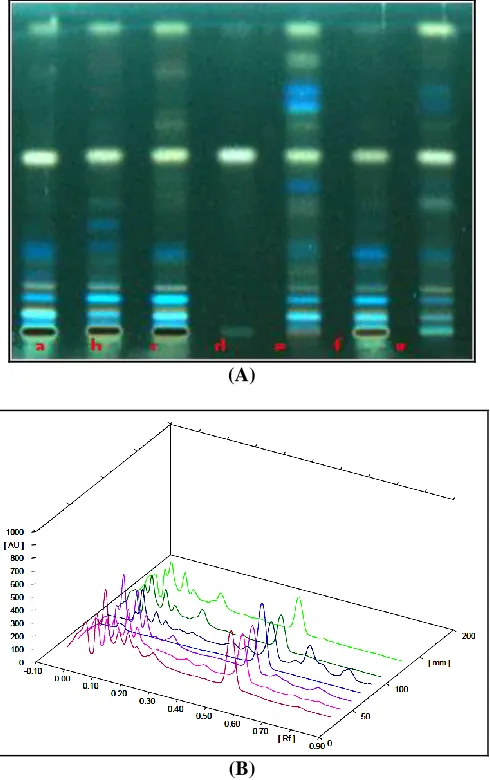
identity in the matrix of C. fistula fruits was confirmed by overlay and colour with that of the standard β-sitosterol [Figure 2 (A and B) and Figure 3 (A and B)].
(A)
(B)
FIGURE 2: HPTLC PLATE PHOTO (A) AND OVERLAY (B) OF CASSIA FISTULA FRUIT PULP COLLECTED FROM DIFFERENT GEOGRAPHICAL REGIONS WITH β -SITOSTEROL AT 366 NM.
Track details: a: Malaysia, b: Udaipur, c: Ahmedabad, d: β-sitosterol (50 µg/mL), e: Rajkot, f: Mumbai, g: Dehradun. (Samples were extracted in methanol)
(A)
B)
FIGURE 3: HPTLC PLATE PHOTO (A) AND OVERLAY (B) OF CASSIA FISTULA FRUIT PULP AND ITS FORMULATION WITH β -SITOSTEROL AT 366 NM.
Track details, a: Cassia fistula fruit pulp, b: β-sitosterol (50 µg/mL), c: Laxived formulation (Samples were extracted in methanol)
The method was validated as per ICH guidelines and it was found linear (5.0-60.0 μg/mL of β-sitosterol), precise (% RSD for intra-day and inter-day variation were 0.023% and 0.013% respectively) and sensitive (LOD and LOQ values were 1.0 µg/mL and 5.0 µg/mL respectively). The average recovery for quality control samples of β-sitosterol was 99.86 %. The method was also found rugged for the parameters like change in analysts, change in mobile phase composition and change in spotting volume. The results of method validation experiment are depicted in Table 1.
[image:3.612.317.561.40.364.2] [image:3.612.52.297.217.607.2]This clearly suggests the impact of regional variation on the marker content of medicinal plants and the results were in compliance with the other published reports 11-15. Sample collected from Mumbai showed the maximum β-sitosterol content while sample from Malaysia had minimum (Table 2). Method was also found applicable to evaluate the β-sitosterol content from an herbal formulation Laxived containing Cassia fistula fruit pulp. The β-sitosterol content in Laxived formulation was found to be 0.18 ± 0.02 mg/g.
TABLE 1: THE RESULTS OF METHOD VALIDATION PARAMETERS FOR β -SITOSTEROL USING HPTLC TECHNIQUE
Parameters Results
LOD (µg/mL) and LOQ (µg/mL) 1.0 and 5.0
Linear range (µg/mL) 5.0 – 60.0
Regression equation y = 25.93 x + 90.66 Mean coefficient of determination
(r2) 0.997
System suitability (% CV, n = 5)
Rf 0.02
Area 0.02
Precision (% CV, n = 3)
Within-Batch 0.01 – 0.04
Between-Batch 0.01 – 0.02 Recovery using QC samples (% mean ± SD,
n = 7)
Low (10.0 µg/mL) 101.61 ± 1.97
Mid (30.0 µg/mL) 101.95 ± 1.66
High (50.0 µg/mL) 96.02 ± 1.10
Stability Standard Stock Solution stability
(For 30 days) Stable at (4 ± 1 0C)
Bench top stability (For 6.00 hours) Stable at (25 ± 20C)
Ruggedness Rugged
TABLE 2: β-SITOSTEROL CONTENT IN THE FRUIT PULP OF CASSIA FISTULA COLLECTED FROM DIFFERENT GEOGRAPHICAL REGIONS
Place of collection Content in mg/g (Mean ± SD, n=7)
Mumbai 0.27 ± 0.03
Udaipur 0.25 ± 0.04
Baroda 0.23 ± 0.03
Rajkot 0.16 ± 0.02
Malaysia 0.15 ± 0.02
Dehradun 0.20 ± 0.01
Thus, the HPTLC method developed was found to be suitable for the quantification of β-sitosterol in the herbal raw materials of varied matrices. The developed method can be used as a powerful quality control tool for botanical identification in terms of their β-sitosterol content and to detect presence of adulterants.
CONCLUSION: Results of the present study could be used by industries for the characterization of C. fistula fruit and its formulations in order to check their uniformity. C. fistula with precise quality can be encouraged in Herbal industries using such validated methods.
ACKNOWLEDGEMENT: We acknowledge Bhavesh Tiwari for his technical assistance.
REFERENCES:
1. Danish M, Singh P, Mishra G, Srivastava S, Jha KK and Khosa RL: Cassia fistula Linn. (Amulthus)- An Important Medicinal Plant: A Review of Its Traditional Uses, Phytochemistry and Pharmacological Properties. J Nat
Prod Plant Resour 2011; 1: 101-18.
2. Elujoba AA, Abere AT and Adelusi SA: Laxative
activities of Cassia pod sources from Nigeria. Niger J Nat
Prod Med 1999; 3: 51-3.
3. Bahorun T, Neergheen VS and Aruoma OI: Phytochemical
constituents of Cassia fistula. Afr J Biotechnol 2005; 4: 1530-40.
4. Das S, Sarma G and Barman S: Hepatoprotective Activity of Aqueous Extract of fruit pulp of Cassia fistula (AFCF) against carbon tetrachloride (CCL4) induced liver damage in albino rats. J Clin Diagn Res 2008; 2: 1133-8.
5. Thirumal M, Srimanthula S and Kishore G: Cassia fistula
Linn- Pharmacognostical, Phytochemical and
Pharmacological Review. Critical review in
pharmaceutical sciences 2012; 1: 43-65.
6. Von Holtz RL, Fink CS and Awad AB: β-sitosterol activates the sphingomyelin cycle and induces apoptosis in LN CaP human prostate cancer cells. Nutr Cancer 1998; 32: 8-12.
7. Malini T and Vanithakumari G: Comparative study of the effects of beta-Sitosterol, estradiol and progesterone on selected biochemical parameters of the uterus of ovariectomised rats. J Ethnopharmacol 1992; 36: 51-5. 8. Shailajan S and Yeragi M: Evaluation of content of
β-sitosterol from stem bark and flowers of Salmalia
malabarica collected from different regions. Anal Chem:
Ind J 2011; 10: 26-30.
9. Shailajan S, Menon S, Sayed N and Tiwari B:
Simultaneous quantitation of three bioactive triterpenoids Lupeol, Stigmasterol and β-sitosterol from Carissa
carandas using RP-HPLC method and its validation as per
ICH guidelines. Int J Green Pharm 2012;6: 241-7.
10. Hussain M, Fareed S, Ali M and Rahman M:
Phytochemical investigation and hyphenated
chromatographic analysis of bioactive lupeol and stigmasterol in Sespadula by validated high-performance
thin layer chromatography method. Journal of
11. Srinivas KS and Aparna AS: High Performance Thin Layer Chromatographic determination of chrysin in
Oroxylum indicum vent. from different geographical
regions of India. E-Journal of Chemistry 2012; 9: 313-7. 12. Kaushik S, Khan N, Ahmad S, Singh M, Gupta S and
Semwal A: Comparative pharmacognostical evaluation and HPTLC fingerprinting of Nicotiana tabacum (Linn.) root collected from different geographical regions of India.
Central European Journal of Experimental Biology 2012;
1: 18-25.
13. Shailajan S, Yeragi M and Tiwari B: Estimation of Rhein from Cassia fistula Linn. using validated HPTLC method.
Int J Green Pharm 2013; 7: 62-5.
14. Shailajan S, Sayed N and Tiwari B: Impact of regional variation on lupeol content in Carissa carandas Linn. Fruits: Evaluation using validated high performance thin layer chromatography. Journal of Advanced Scientific
Research 2013; 4: 21-4.
15. Mamatha A: Quantitative HPTLC analysis of
andrographolide in Andrographis paniculata obtained from different geographical sources (India). Int J Pharm
Pharm Sci 2011; 3: 42-4.
All © 2013 are reserved by International Journal of Pharmaceutical Sciences and Research. This Journal licensed under a Creative Commons Attribution-NonCommercial-ShareAlike 3.0 Unported License.
This article can be downloaded to ANDROID OS based mobile. Scan QR Code using Code/Bar Scanner from your mobile. (Scanners are available on Google Playstore)
How to cite this article: